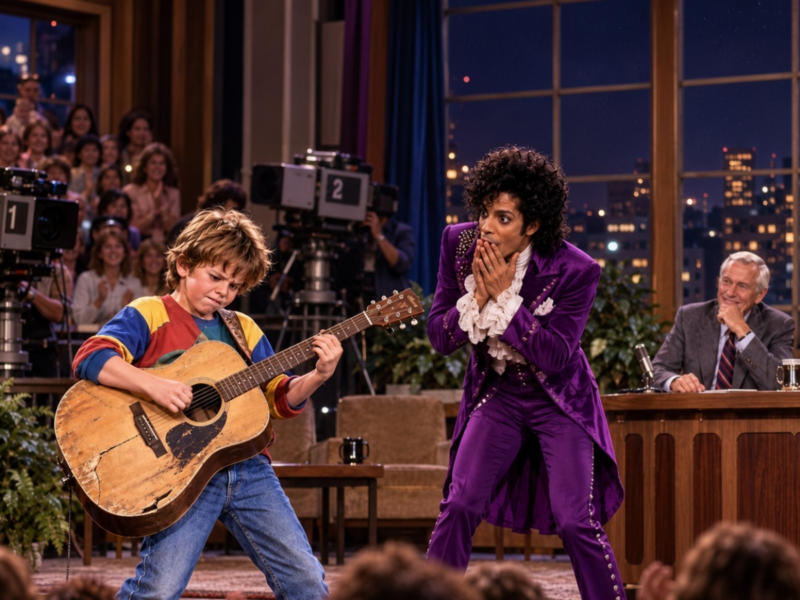
Prince Laughed When a Little Boy Walked Onstage With a Broken Guitar—Then One Note Silenced The Entire Studio.
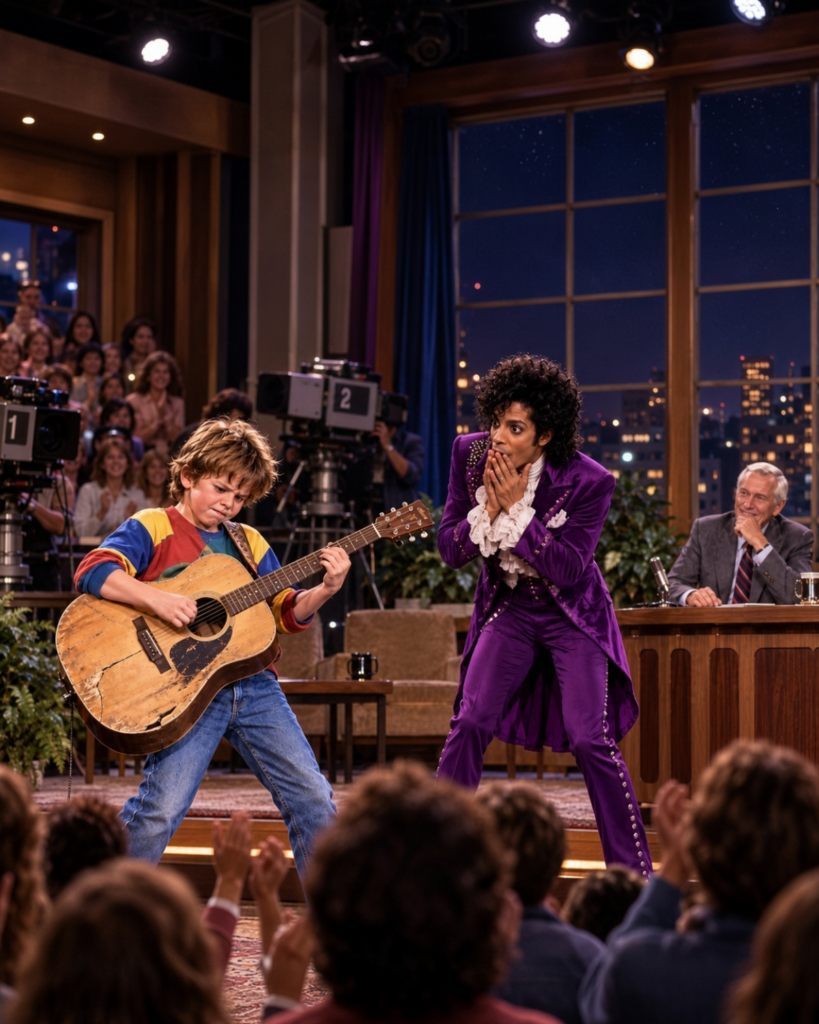
The studio had seen almost everything.
Famous singers had walked through those doors.
Actors had delivered unforgettable monologues.
Comedians had brought entire audiences to tears from laughter.
And Prince had performed there before.
Whenever Prince stepped onto that stage, people expected something extraordinary.
But that night, nobody expected the extraordinary to come from a little boy carrying a broken guitar.
The audience was still laughing when the host stepped into the center of the stage.
The cameras were rolling.
The orchestra was ready.
The lights were glowing beneath the ceiling.
And then the host looked toward the entrance.
“Ladies and gentlemen,” he paused. “There is someone here tonight who says he has something he wants to show Prince.”
The audience applauded politely.
Then the doors opened.
A little boy walked onto the stage.
He couldn’t have been more than ten or eleven.
His clothes were simple.
His shoes looked worn.
His hair was slightly messy.
And hanging from his shoulder was an old acoustic guitar that immediately caught everyone’s attention.
It was damaged badly.
A long crack ran across the wooden body.
The finish was faded.
Several scratches covered the sides.
One of the tuning pegs looked as though it had been repaired by hand.
It wasn’t the kind of instrument anyone expected to see beneath the bright lights of a major television studio.
Some people in the audience smiled.
Others whispered.
The boy looked around nervously.
For a moment, he seemed to regret walking onto the stage.
Then he saw Prince.
Prince stood several feet away in his unmistakable purple outfit, watching the boy with a curious expression.
He didn’t laugh.
He didn’t mock him, but there was a playful smile on his face.
The host walked toward the child. “What’s your name?”
The boy quietly answered.
The audience could barely hear him.
The host leaned closer. “Sorry, what was that?”
The boy repeated his name.
This time, the microphone caught it.
The audience applauded.
The boy looked down.
The host smiled. “And I hear you’ve been playing guitar for a while.”
The boy nodded.
“How long?”
The boy thought for a moment. “Since I was little.”
The audience laughed softly.
The host smiled. “You’re still little.”
The boy smiled for the first time.
Then the host turned toward Prince.
“He says you’re the reason he started playing.”
The audience immediately reacted.
Prince looked at the boy.
The boy’s smile disappeared.
He suddenly became serious.
Prince walked closer.
As he approached, his eyes went directly to the damaged guitar.
He studied the crack, then the worn strings, then the boy.
“You play this?”
The boy nodded.
Prince touched the edge of the guitar carefully. “This thing has been through a war.”
The audience laughed.
Even the boy laughed.
But Prince wasn’t making fun of him.
He looked genuinely interested.
“You really think you can play?”
The boy hesitated, then nodded.
Prince raised an eyebrow. “Really?”
Another nod.
Prince smiled. “Then show me.”
The audience applauded.
The boy walked toward the center of the stage.
His footsteps were small against the enormous studio floor.
He sat down.
The guitar rested against his chest.
For several seconds, he simply stared at it.
His fingers hovered above the strings.
The cameras moved closer.
The audience became quieter.
The host stepped forward. “What are you going to play?”
The boy looked at him, then slowly turned toward Prince. “Your song.”
The audience erupted.
Prince’s eyebrows lifted.
He looked genuinely surprised.
The host laughed. “Oh, you’ve chosen a dangerous way to impress him.”
The audience laughed again.
But Prince didn’t.
He was staring at the boy.
Something had changed in his expression.
The playful smile was gone.
Now he was curious.
Very curious.
The boy lowered his head.
His fingers moved into position.
He took one breath, then another, and finally he played.
The first note was small, almost fragile.
The second followed in a chord.
It wasn’t perfect.
His fingers trembled.
One string buzzed slightly.
A few people in the audience smiled sympathetically.
The boy heard it.
His hands stopped.
Silence.
He looked down at the guitar.
For one terrible second, it seemed as though he might put it down.
The host glanced toward Prince.
Prince didn’t move.
He simply watched.
The boy swallowed, then closed his eyes.
He took a deep breath and started again.
This time, the first notes were steadier.
The melody began to emerge.
The audience slowly stopped moving.
Prince’s expression changed.
His head tilted slightly.
He listened.
The boy wasn’t playing like someone who had expensive lessons.
He wasn’t playing with the polished precision of a professional musician.
But there was something else in the sound.
Something difficult to explain.
Emotion.
The boy’s fingers began moving faster.
The damaged guitar seemed to disappear.
The crack disappeared.
The scratches disappeared.
The worn strings disappeared.
There was only the music.
Prince took one step closer.
The boy continued.
His shoulders relaxed.
His breathing became steadier.
And then the audience recognized the melody.
A murmur passed through the studio.
Someone whispered the name of the song.
Prince heard it, too.
His eyes widened.
The boy was playing one of Prince’s songs.
But he wasn’t simply copying it.
He was changing it.
The melody was softer, more vulnerable, almost like the boy had taken the song apart and rebuilt it from memory.
Prince stared at him.
The little boy opened his eyes for a moment.
Their eyes met.
Prince gave the smallest nod. “Keep going.”
The boy continued.
The music became stronger.
The audience became completely silent.
No laughter, no whispering, no movement.
Even the cameras seemed to become invisible.
The boy reached a difficult section.
His fingers moved toward the next chord, then stopped.
He couldn’t remember.
His face tightened.
The room waited.
He looked toward Prince.
Prince stepped forward.
For a moment, everyone expected the superstar to take the guitar.
Instead, Prince quietly said, “Don’t stop.”
The boy looked at him.
Prince nodded. “You’ve got it.”
The boy took a breath.
His fingers returned to the strings, and this time he played without looking down.
The notes came faster, cleaner, stronger.
His entire body moved with the rhythm.
The audience slowly realized what was happening.
This wasn’t a cute television moment anymore.
This wasn’t a child trying to impress a celebrity.
Something real was happening on that stage.
Prince stopped smiling.
His eyes became fixed on the boy’s hands.
The boy reached the final passage.
One last sequence, one last breath.
Then he struck the final chord.
It rang through the studio, and suddenly nothing happened.
No applause, no cheering, no laughter—just silence.
The boy lowered his hands.
His heart was pounding.
He looked toward Prince, waiting, terrified.
Prince remained completely still.
Then he slowly walked toward him.
The audience watched.
Prince stopped directly in front of the boy.
He looked at the guitar, then at the boy’s hands, then into the child’s eyes, and finally asked the question that would change the entire atmosphere of the studio.
“Who taught you to play like that?”
The boy lowered his eyes, his fingers tightened around the damaged guitar.
For a moment, he said nothing.
Then, barely above a whisper, he answered, “Nobody.”
Prince’s expression softened.
The audience remained silent.
The boy looked at the guitar.
Then he whispered, “I just listened to you.”
Prince stared at him, and for the first time that night, the superstar looked completely speechless.
But the boy wasn’t finished.
He took a shaky breath. “My dad used to play your records.”
Prince’s eyes moved toward the damaged guitar.
The boy’s voice became quieter. “He taught me this.”
He touched the cracked wooden body. “This was his guitar.”
Prince looked at the instrument again, and suddenly that long crack across the wood didn’t look like damage anymore.
It looked like a memory.
A piece of someone who wasn’t there.
The audience slowly realized the same thing.
The boy wasn’t carrying a broken guitar.
He was carrying the last piece of his father he had left.
Prince gently placed his hand against the instrument.
His voice became almost a whisper. “Where is your dad?”
The boy looked down, and the answer came quietly. “He’s gone.”
The studio fell completely silent.
Prince’s face changed.
The laughter was gone.
The playful expression was gone.
There was only emotion now.
He looked at the little boy, then at the old guitar, then back at the boy.
And when Prince finally spoke, his voice was softer than anyone in that studio expected. “Then your dad gave you something nobody can ever take away.”
The boy looked up.
Prince smiled through the emotion in his eyes. “He gave you music.”
The audience began to applaud, but Prince wasn’t finished.
He turned toward the stage, then toward his own guitar, and slowly reached for it.
The boy watched in confusion.
Prince lifted the instrument from its stand, then walked back toward the child.
The audience began gasping.
Prince held out his guitar. “This—” he looked directly into the boy’s eyes, “—is yours.”
The boy froze.
He shook his head immediately. “I can’t.”
Prince smiled. “Yes, you can.”
The boy stared at the guitar.
His eyes began filling with tears.
But before he could reach for it, Prince leaned closer and whispered, “I’m not giving you a better guitar because yours isn’t good enough.”
He touched the cracked guitar gently. “I’m giving you this because you’ve already proven you don’t need a perfect instrument.”
The audience erupted.
The boy finally reached toward the guitar, but Prince stopped him for one second.
“There is one thing I want you to promise me.”
The boy nodded.
Prince looked at the damaged guitar. “Never be ashamed of this.”
The boy looked down at his father’s instrument.
Prince smiled. “It brought you here.”
The boy’s eyes filled with tears, and then Prince turned toward the band.
“Actually,” the entire audience leaned forward.
Prince looked at the boy. “I think we should play one more.”
The boy’s eyes widened.
Prince sat beside him.
The cameras moved closer.
The band prepared.
And just before the first note began, Prince leaned toward the frightened child and whispered, “Don’t try to play like me.”
He smiled. “Play like yourself.”
Then the lights rose.
The band began.
And the boy placed his fingers on the strings.
This time he wasn’t playing for Prince.
He wasn’t playing for the audience.
He was playing for the father whose guitar had carried him all the way to that stage.
And nobody in the studio knew that the next few minutes would become the most unforgettable performance of the night.
The first note of the second performance was different.
The boy’s fingers were still trembling, but this time the fear did not control them.
Prince sat beside him, close enough for the child to hear every breath.
Yet he deliberately refused to take the lead.
He let the boy begin.
One soft chord, then another.
The band waited.
Prince waited.
And the entire studio waited.
The boy looked down at his father’s cracked guitar and remembered the promise he had made without ever saying it aloud.
Keep playing.
So he played.
The melody grew slowly, almost cautiously.
His shoulders relaxed.
His fingers began finding the strings with greater confidence.
The same hands that had frozen only minutes earlier now moved as if the guitar had become part of him.
Prince watched with a quiet smile.
He could have taken over.
He could have played the difficult passages himself and brought the audience to its feet in seconds.
But he didn’t.
Instead, every time the boy hesitated, Prince gave him the smallest nod again.
Keep going.
Trust yourself.
The audience noticed.
They began to understand that Prince wasn’t performing for the boy.
He was teaching him how to perform for himself.
Then the boy reached the first major transition.
His fingers slipped.
The chord buzzed.
He stopped for half a second.
A few people gasped.
Prince leaned closer. “Don’t look at the mistake.”
The boy looked at him.
“Look at where you’re going.”
The child took a breath.
Then he continued.
This time, the mistake became part of the music.
Prince smiled. “That’s it.”
The band quietly joined.
The sound changed immediately.
The little acoustic guitar was surrounded by professional musicians.
Yet somehow it remained at the center of everything.
Its worn strings cut through the polished arrangement with a fragile honesty that no expensive instrument could reproduce.
The boy looked up.
For the first time, he saw the audience differently.
They weren’t waiting for him to fail.
They were listening.
A woman in the front row was crying.
A man beside her had both hands over his mouth.
Even the host, who had spent the night controlling the rhythm of the program, stood completely still.
The boy kept playing.
Then Prince began singing.
His voice entered gently, leaving space for the child.
The boy followed—not perfectly, not loudly, but fearlessly.
For several seconds, the two voices and two guitars seemed to have nothing in common.
One belonged to a superstar.
The other belonged to a child who had learned in a room somewhere with an old record player and a damaged guitar.
Yet the difference was exactly what made the moment beautiful.
Prince wasn’t trying to make the boy sound like him.
He was making room for the boy to sound like himself.
The final section approached.
The boy’s fingers began moving faster.
Prince watched him carefully.
Then something unexpected happened.
The boy changed the rhythm.
Prince stopped.
The band stopped.
For one heartbeat, the entire studio seemed confused.
The boy looked terrified. “I’m sorry,” he whispered.
Prince stared at him, then smiled. “Why?”
“I changed it.”
Prince nodded. “You did.”
The boy lowered his eyes. “I thought I ruined it.”
Prince leaned toward him. “No.”
He tapped the guitar gently. “You found something.”
The boy looked up.
Prince continued. “Do it again.”
The audience murmured.
The boy played the new rhythm.
Prince listened.
Then he joined.
This time, Prince followed him.
The audience erupted.
The little boy’s face changed.
He realized what was happening.
The superstar wasn’t correcting him.
He was listening to him.
And suddenly, the child played with even greater confidence.
The music became a conversation.
Prince answered one phrase, the boy answered another.
The band began following both of them.
It was no longer a performance Prince had planned.
It was something being created in real time.
And somewhere between one chord and the next, the broken guitar stopped being the symbol of what the boy lacked.
It became the symbol of everything he had survived.
The applause grew louder.
The boy smiled.
Prince smiled back.
Then, unexpectedly, the host stepped forward. “Prince.”
Prince looked toward him.
The host’s voice was emotional. “I’ve been doing television for a long time,” he looked at the boy, “but I don’t think I’ve ever seen anything like this.”
The audience applauded.
The host turned toward the child. “Can I ask you something?”
The boy nodded.
“What made you keep playing when your guitar was falling apart?”
The boy looked down.
His thumb moved slowly across the cracked wood. “My dad.”
The studio quieted.
The boy continued. “He told me that guitars don’t have to be beautiful.”
He swallowed. “He said they just have to tell the truth.”
Prince’s expression changed.
The host asked softly, “What did he mean?”
The boy looked toward Prince. “I think he meant—” he paused, “—that music should say what you can’t.”
Prince lowered his head for a moment.
He said nothing.
The audience watched him.
Then Prince looked at the boy and quietly asked, “What was your dad’s favorite song?”
The boy smiled. “One of yours.”
Prince laughed softly. “Of course.”
The audience laughed with him.
Then the boy’s smile disappeared. “He used to play it whenever he was tired.”
Prince nodded. “And you learned it from him?”
“No.” The boy touched his guitar. “I learned it after he died.”
Silence.
The sentence seemed to land harder than anything else he had said.
Prince looked at him. “Why?”
“Because I didn’t want the house to be quiet.”
The audience froze.
The boy continued. “After he was gone, everything was quiet.”
His voice shook. “So I played his guitar.”
A tear rolled down his cheek. “At first, I didn’t know what I was doing.”
He smiled through the tears. “But I kept trying.”
Prince reached over and gently squeezed his shoulder.
The audience began applauding softly.
The host looked toward Prince. “Why did you give him your guitar?”
Prince glanced at the instrument he had placed beside the boy.
Then he looked at the child. “Because someone gave me a chance once.”
The audience became quiet.
The host asked, “Who?”
Prince smiled. “Music.”
He paused. “Music gave me a place to put everything I couldn’t explain.”
Then he looked at the boy. “And now he needs a place to put his story.”
The boy stared at him. “But I don’t deserve it.”
Prince immediately shook his head. “Don’t ever say that.”
The boy looked surprised.
Prince continued, “You don’t earn music. You don’t have to be famous. You don’t have to be rich. You don’t need a perfect guitar. You just have to love it enough to keep going.”
The boy nodded.
Prince picked up the new guitar again.
Now he held it toward him. “Play something that isn’t my song.”
The boy froze.
The audience laughed nervously.
Prince smiled. “Your song.”
The boy looked down. “I don’t have one.”
Prince leaned back. “Everyone has one.”
The boy stared at the strings.
Then he slowly placed his fingers on them.
He played one note, then another.
The notes were unfamiliar, simple, beautiful.
Prince’s expression changed instantly.
The boy continued.
It wasn’t a song he had learned.
It wasn’t something from a record.
It was something he had created.
And Prince realized that the little boy had been carrying that melody inside him all along.
The studio became silent again.
The boy closed his eyes.
The melody grew.
Prince didn’t touch his guitar.
He simply listened.
And when the boy reached the final note, Prince stood.
The audience waited.
Prince looked at the child with an expression that was impossible to fake. “You said you couldn’t write a song.”
The boy looked nervous.
Prince smiled. “You just did.”
The audience exploded.
But Prince wasn’t looking at the audience.
He was looking at the boy.
And then he asked a question that made the child’s face go completely pale.
“Would you play that again?”
Prince pointed toward the stage. “With me?”
The boy stared at him, then slowly nodded, but before they could begin, the studio doors opened.
A staff member rushed toward the host.
He whispered something into his ear.
The host’s face changed.
He looked toward the boy, then toward Prince, and finally toward the audience.
“Prince,” he swallowed. “We just received a message.”
Prince turned. “What kind of message?”
The host looked at the boy. “It’s about his father.”
The boy stopped breathing, and suddenly the smile disappeared from Prince’s face, because whatever was written in that message had the power to change everything.
The entire studio seemed to freeze.
The host was still holding the piece of paper.
Prince stood beside the little boy, and the child stared at the host as though he already knew the message was going to hurt.
“What does it say?” Prince asked quietly.
The host looked down at the paper, then back at the boy. “We received a message from someone who says they knew your father.”
The boy’s face went pale. “My father?”
The host nodded.
The boy immediately stepped forward. “Who?”
The host hesitated.
Then he read the message. “He says your father used to work at a small music shop.”
The boy’s eyes widened. “Yes.”
“He says your father would often talk about you.”
The boy swallowed. “What else?”
The host continued. “He says that before your father passed away, he left something behind.”
The boy stopped breathing. “What?”
The host looked toward Prince. “A recording.”
The studio fell silent.
The boy stared at him. “A recording of what?”
The host slowly answered. “Of you.”
The boy’s eyes filled with tears.
But he shook his head. “How?”
The host explained that the person who had sent the message had discovered an old cassette recording among his father’s belongings.
The father had apparently recorded the boy practicing guitar years earlier.
The boy covered his mouth.
He had no memory of it.
Prince stepped closer. “Do you have the recording?”
The host nodded.
A production assistant hurried onto the stage carrying a small cassette player.
The audience watched in complete silence.
The host placed it on the table.
The boy stared at the old machine.
His hands began shaking.
Prince noticed. “You don’t have to listen if you don’t want to.”
The boy looked at him. “I want to.”
The host pressed play.
Static filled the studio.
Then came the sound of a child’s voice—small, uncertain, trying to play guitar.
The boy immediately recognized himself.
He covered his face. “That was me.”
A faint sound of laughter could be heard on the recording.
Then a man’s voice.
His father’s voice.
The boy froze.
Nobody in the studio moved.
The voice was older, warm, gentle.
“Again.”
The child on the recording played a wrong chord.
The father laughed softly. “That’s okay.”
Another chord.
Again.
The boy began crying.
Prince lowered his eyes.
The recording continued. “You’re rushing.”
The child laughed. “I can’t do it.”
His father answered, “Yes, you can.”
The boy on stage pressed both hands against his face.
Then the recording became quieter.
The father spoke again. “One day, you’re going to play this for a lot of people.”
The audience began tearing up.
The little boy shook his head.
His father continued. “And when you’re scared—” a pause, “—don’t stop.”
The boy broke down.
Prince immediately placed an arm around him.
The recording continued. “Don’t worry about being perfect.”
Another pause. “Just make them feel something.”
Then came one final sentence.
The words were simple, but they seemed to shake the entire room.
“I’ll always be listening.”
The recording ended.
Silence.
No applause, no music, nothing.
The boy was crying against Prince’s shoulder.
Prince held him tightly.
For several seconds, the superstar said nothing.
Then he whispered, “He heard you tonight.”
The boy looked up. “You think so?”
Prince nodded. “I know so.”
The audience finally erupted into applause.
The boy wiped his tears, but then he looked toward the broken guitar. “My dad wanted me to play for people.”
Prince nodded.
“You did.”
“But I almost stopped.”
Prince looked directly at him. “And that’s why I told you not to.”
The boy stared at Prince.
Prince touched the cracked guitar. “You thought the broken part meant the guitar was finished.”
He paused. “But it wasn’t.”
Then he pointed gently toward the boy. “Neither are you.”
The audience applauded again, but Prince suddenly stepped away.
He walked toward the center of the stage, then turned toward the band. “Turn everything off.”
The musicians looked confused.
Prince repeated, “Everything.”
One by one, the instruments stopped.
The stage lights dimmed.
The cameras remained.
The audience became quiet.
Prince walked back to the boy. “Your father said something important.”
The boy looked at him. “What?”
“Don’t worry about being perfect.”
Prince sat down. “So tonight, we’re not going to make it perfect.”
The boy smiled through his tears. “What are we going to do?”
Prince picked up his guitar. “We’re going to make it honest.”
The boy nodded.
He sat beside Prince.
No band, no complicated arrangement, no giant production—just two guitars.
Prince looked toward the audience. “Ready?”
The audience answered with applause.
Prince looked at the boy. “Your song.”
The boy shook his head. “Our song.”
Prince smiled. “Our song.”
The boy took a breath, then played the first note.
Prince waited.
The boy played another, then another.
A simple melody began to form.
Prince joined.
He didn’t overpower the child.
He followed him.
The boy looked surprised.
Prince nodded. “Keep going.”
The melody grew.
It wasn’t a famous song.
Nobody in the audience knew it.
It had never been recorded.
It had never been released.
It existed only because a frightened little boy had finally decided to let his feelings become music.
And as the two played together, something extraordinary happened.
The audience stopped watching Prince.
They stopped watching the child.
They simply listened.
A melody created from grief, from memory, from love.
The boy closed his eyes.
For the first time since walking onto the stage, he wasn’t thinking about whether he was good enough.
He wasn’t thinking about the cameras.
He wasn’t thinking about Prince.
He was thinking about his father.
The man who had once sat beside him and said, “Again.”
The boy played the final phrase.
His fingers moved confidently.
Then Prince added a final chord.
The sound faded.
Silence returned.
And this time the silence felt different.
It wasn’t uncertainty.
It was respect.
Then one person stood.
Another followed.
Within seconds, the entire studio rose.
The applause became enormous.
The boy stared at the audience in disbelief.
Prince stood beside him.
Then the host walked toward them. “I don’t think anyone here will ever forget that.”
The boy looked at Prince. “Neither will I.”
Prince smiled.
Then he looked down at the damaged guitar. “You know something?”
“What?”
“I think you should keep this.”
The boy looked confused. “The broken one?”
Prince nodded. “Especially the broken one.”
“Why?”
Prince pointed toward the crack. “Because someday, when you’re standing on a stage much bigger than this—” he paused, “—someone is going to ask you how you started.”
The boy listened.
“And you’ll point to that guitar.”
The boy looked down.
“And you’ll tell them that your father gave you your first song.”
The boy smiled.
“And that a broken guitar brought you to Prince.”
The audience laughed softly.
Prince shook his head. “No.”
The boy looked at him.
Prince smiled. “You didn’t come here because of me.”
He placed a hand over the boy’s shoulder. “You came here because you kept playing.”
The boy’s eyes filled with tears again.
Prince continued, “I may have opened a door tonight.”
He looked at the damaged guitar. “But you walked through it yourself.”
The audience erupted.
The boy hugged Prince.
Prince hugged him back.
Then something unexpected happened.
The little boy pulled away and looked at Prince. “Can I ask you something?”
“Anything.”
“Why did you really give me your guitar?”
Prince smiled.
For a moment, he looked toward the audience.
Then he answered quietly, “Because when I was young, someone gave me a chance.”
The boy waited.
“And I never forgot what that felt like.”
Prince looked directly into his eyes. “So when I saw you standing there—” he paused, “—I remembered myself.”
The boy smiled.
Prince picked up the new guitar and handed it to him again. “This one is for your future.”
Then he pointed toward the old guitar. “And that one is for your past.”
The boy held both.
One represented everything he had inherited.
The other represented everything he could become.
The host wiped his eyes.
The audience applauded.
But then Prince looked toward the cameras. “There’s one more thing.”
The studio became quiet.
Prince turned toward the boy. “You’re going to play again.”
The boy smiled. “Tonight?”
Prince shook his head. “No.”
He pointed toward the audience. “Someday.”
Then he smiled. “On a stage where nobody remembers my name.”
The boy looked confused.
Prince continued, “Because that’s when I’ll know you made it.”
The boy stared at him, and somewhere inside the audience, someone began crying, because everyone understood what Prince had just done.
He wasn’t trying to create another fan.
He wasn’t trying to create another imitation.
He was trying to make sure a young musician understood that his voice belonged to him.
The cameras slowly pulled back.
The studio lights glowed above them.
The little boy stood holding his father’s damaged guitar in one hand and Prince’s guitar in the other.
Two instruments, two generations, two stories, and one promise.
Keep playing.
But the night wasn’t over yet.
Because before the camera stopped rolling, Prince noticed something written on the back of the old guitar.
He turned it over.
His expression suddenly changed.
There, underneath years of scratches and faded wood, were three handwritten words.
Prince stared at them, then looked at the boy. “Did your father write this?”
The boy shook his head. “I’ve never seen it before.”
Prince read the words again.
His face became completely serious.
Then he whispered, “This changes everything.”
And the cameras kept rolling.
Prince turned the old guitar over in his hands.
The studio was still.
Every camera was pointed toward him.
Every person in the audience was waiting.
The little boy stood beside Prince, holding his breath.
Three words had been written on the back of the guitar.
Three words hidden beneath years of scratches, faded paint, and worn wood.
Prince stared at them again.
Then he looked at the boy. “Did your father write this?”
The boy shook his head. “I’ve never seen it before.”
Prince ran his fingers gently across the writing.
His expression had completely changed.
“What does it say?” the host asked.
Prince didn’t answer immediately.
He turned the guitar toward the boy.
The child read the words, and his face went pale.
Keep his song alive.
For several seconds, the boy couldn’t speak.
He touched the writing with one trembling finger. “My dad.”
His voice broke. “He never told me that was there.”
Prince nodded slowly. “Maybe he knew you would find it when you were ready.”
The boy looked at the guitar.
Then at the empty space beside the stage where his father would have stood if he were still alive.
His eyes filled with tears. “But what does ‘his song’ mean?”
Prince looked at him. “Maybe it doesn’t mean one song.”
The boy waited.
“Maybe it means everything he gave you.”
The child lowered his head.
The audience was silent.
Prince continued, “Your father gave you this guitar.”
He touched the cracked body.
“He gave you records.”
Then he touched the boy’s shoulder.
“He gave you courage.”
The boy wiped his tears.
“And tonight,” Prince smiled, “you gave that courage a voice.”
The audience slowly began applauding, but Prince raised one hand.
He wasn’t finished.
He turned toward the host. “Can we do something?”
The host nodded. “Anything.”
Prince looked toward the audience. “Bring the lights up.”
The stage brightened.
The cameras pulled farther back.
Prince stood beside the boy.
Then he pointed toward the center of the stage. “Put one chair there.”
A staff member brought a chair.
Prince looked at the boy. “That’s for your father.”
The boy stared at the empty chair.
His lips trembled.
Prince continued, “Tonight, you don’t have to imagine him watching from somewhere far away.”
He gestured toward the chair. “Put him right here.”
The boy slowly walked toward it.
He placed his father’s broken guitar against the chair, then stepped back.
The studio was completely silent.
The boy looked at the guitar. “I wish he could hear me.”
Prince walked beside him. “Maybe he can.”
The boy looked up.
Prince smiled gently. “But even if you can’t prove that—” he paused, “—you can still make sure his music doesn’t disappear.”
The boy nodded.
Then he asked, “How?”
Prince pointed toward the guitar. “Keep playing.”
The answer was simple.
But the boy understood.
He didn’t need to become famous tomorrow.
He didn’t need a record deal.
He didn’t need millions of people to know his name.
He needed only to continue.
Prince returned to the center of the stage.
Then he turned toward the audience. “You know what I learned tonight?”
Nobody moved.
Prince looked at the boy. “Sometimes we think talent is something you can see immediately.”
He pointed toward the boy’s worn shoes. “But talent doesn’t always arrive wearing expensive clothes.”
He pointed toward the guitar. “It doesn’t always arrive carrying a perfect instrument.”
Then he looked toward the audience. “And sometimes,” he paused, “it arrives frightened.”
The audience listened.
“Sometimes it arrives believing it’s not good enough.”
Prince looked at the boy. “And sometimes all it needs is one person to say—”
He turned toward the child. “Don’t stop.”
The audience erupted.
The boy smiled.
Prince put his hand on his shoulder.
Then the host stepped forward. “Prince, can I ask you something?”
Prince nodded.
“Why did you laugh when he first walked on stage?”
The audience laughed softly.
Prince smiled. “I wasn’t laughing at him.”
He looked toward the boy. “I was smiling because I thought I knew what was going to happen.”
The host asked, “And you were wrong?”
Prince nodded completely.
The audience laughed.
Prince continued, “I thought I was going to watch a little boy try to imitate me.”
He looked at the cracked guitar. “But I didn’t.”
He looked directly at the child. “I watched a musician.”
The boy’s eyes filled with tears.
Prince smiled. “And that reminded me of something important.”
“What?”
“That music doesn’t care how old you are.”
The audience applauded.
“It doesn’t care what your clothes look like.”
More applause.
“It doesn’t care how much your guitar costs.”
The applause grew louder.
“It only cares whether you mean what you’re playing.”
The boy looked at his father’s guitar.
Then he smiled.
The host turned toward him. “If you could say one thing to your father right now, what would you say?”
The boy froze.
He looked at the empty chair.
His eyes became wet.
Then he walked toward it.
He picked up the broken guitar.
He held it against his chest and quietly said, “I kept playing.”
The entire studio went silent.
The boy continued, “I was scared.”
A tear rolled down his cheek. “But I didn’t stop.”
He looked toward Prince. “And he told me not to.”
Prince smiled.
The boy turned toward the empty chair again.
So he took a breath. “I hope you’re listening.”
The audience erupted in applause.
Some people stood.
Others cried openly.
Prince looked down.
His eyes were wet.
Then he walked toward the boy.
He put one arm around him. “You did it.”
The boy whispered, “Thank you.”
Prince shook his head. “Don’t thank me.”
The boy looked confused. “Why?”
“Because you did the hard part.”
The boy smiled.
“You walked onto the stage.”
He touched the old guitar. “You played when your hands were shaking.”
Then he pointed toward the audience. “And you kept going when you thought everyone was waiting for you to fail.”
Prince smiled. “That wasn’t me. That was you.”
The boy looked down.
For the first time, he seemed to believe it.
Then Prince did something nobody expected.
He took his own guitar and placed it beside the father’s guitar.
Two guitars.
One old, one new.
One damaged, one almost perfect.
Prince looked at the boy. “Keep both.”
The boy stared. “Both?”
“Yes.”
“Why?”
Prince pointed toward the old guitar. “This one reminds you where you came from.”
Then he pointed toward the new one. “And this one reminds you where you can go.”
The boy nodded.
Prince continued, “But remember—” he looked directly into the child’s eyes, “—never let the new guitar make you forget the old one.”
The boy smiled. “I won’t.”
The audience applauded.
The band began playing softly in the background.
The host stepped away.
The cameras slowly moved closer.
Prince sat beside the boy one final time. “Ready?”
The boy nodded. “For what?”
Prince smiled. “To play one last song.”
The boy looked surprised. “Which one?”
Prince pointed toward the broken guitar. “Your father’s favorite.”
The boy’s eyes widened. “My father’s favorite?”
Prince nodded. “You know it.”
The boy thought for a moment, then his face changed. “Yes.”
He picked up the guitar.
Prince picked up his.
The band waited.
The boy looked toward the empty chair.
Then he began.
One note, then another.
A simple melody.
The same melody his father had once played in their home.
Prince listened, then joined.
The music filled the studio.
This time there was no challenge, no competition, no celebrity, no little boy trying to prove himself.
There was only a father, remembered through a song.
The boy played with confidence.
Prince followed him.
The audience listened.
And as the final melody approached, the boy looked toward the empty chair.
He smiled, then played the final chord.
Prince added one final note.
The sound faded.
Silence.
Then the audience stood.
The applause was enormous.
The boy looked around in disbelief.
Prince stood beside him.
He raised the child’s hand.
The boy looked embarrassed.
Prince laughed. “Get used to it.”
The boy laughed through his tears.
The audience cheered.
And somewhere beneath the bright studio lights, the broken guitar that had once looked like something worthless had become the most important object in the room.
Not because it was expensive.
Not because it was beautiful.
But because it carried a story—a father’s love, a child’s grief, a musician’s courage, and a promise that would continue long after the cameras stopped rolling.
Prince leaned toward the boy one last time. “Do you remember what I told you?”
The boy nodded. “Play like yourself.”
Prince smiled. “Exactly.”
The boy looked at the audience, then at his father’s guitar, then at Prince.
And finally, he smiled. “I will.”
The cameras began pulling away.
The audience continued applauding.
Prince stood beside the child—the superstar and the unknown musician, the legend and the beginner, the man who had already filled arenas and the boy who had just discovered his own voice.
But for one night, they were equals.
Because music had never asked which one was more famous.
It had only asked which one was brave enough to tell the truth.
And that night, the little boy answered.
He didn’t need a perfect guitar.
He didn’t need expensive lessons.
He didn’t need a famous name.
He needed only the instrument his father left behind, the courage to keep playing, and one person willing to believe in him.
Prince had laughed when the boy first walked onto the stage.
But he hadn’t laughed because the boy was foolish.
He laughed because he didn’t yet know what was about to happen.
By the end of the night, the entire studio knew the broken guitar had not been the boy’s weakness.
It had been his beginning.
And the crack across its wooden body had become a reminder of something far more powerful than perfection.
Beautiful music doesn’t come from perfect instruments.
It comes from imperfect people who refuse to stop playing.
Years later, people might forget the cameras.
They might forget the applause.
They might even forget the exact song.
But the boy would remember that night forever.
He would remember Prince looking at him and saying, “Don’t stop.”
And whenever fear returned, whenever a difficult song seemed impossible, whenever someone told him he wasn’t good enough, he would look at that old guitar.
He would run his fingers across the crack.
And he would remember his father’s voice again.
So he would play again.
And again.
And again.
Because sometimes a broken guitar isn’t the end of a story.
Sometimes it’s the first chapter of a legend.









