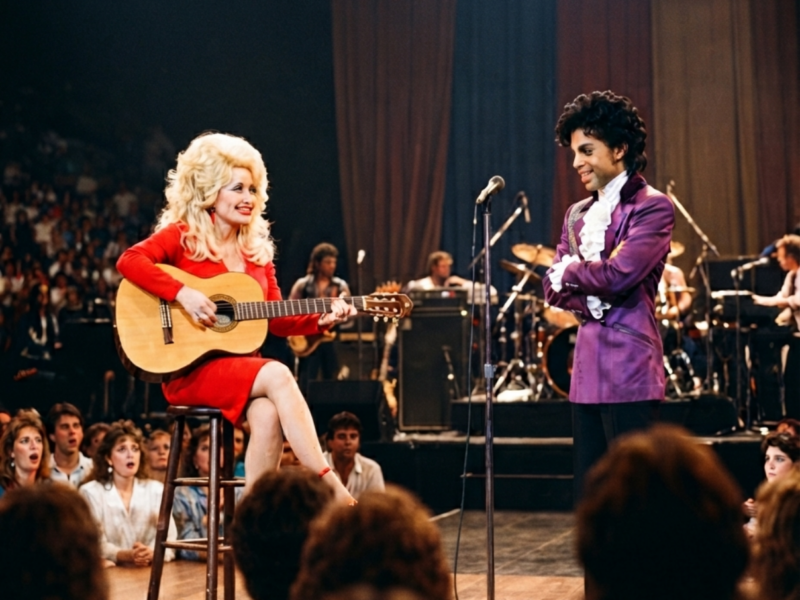
Prince DARED Dolly Parton To Play a Guitar LIVE — What Dolly Did Next Shocked 20,000 People.
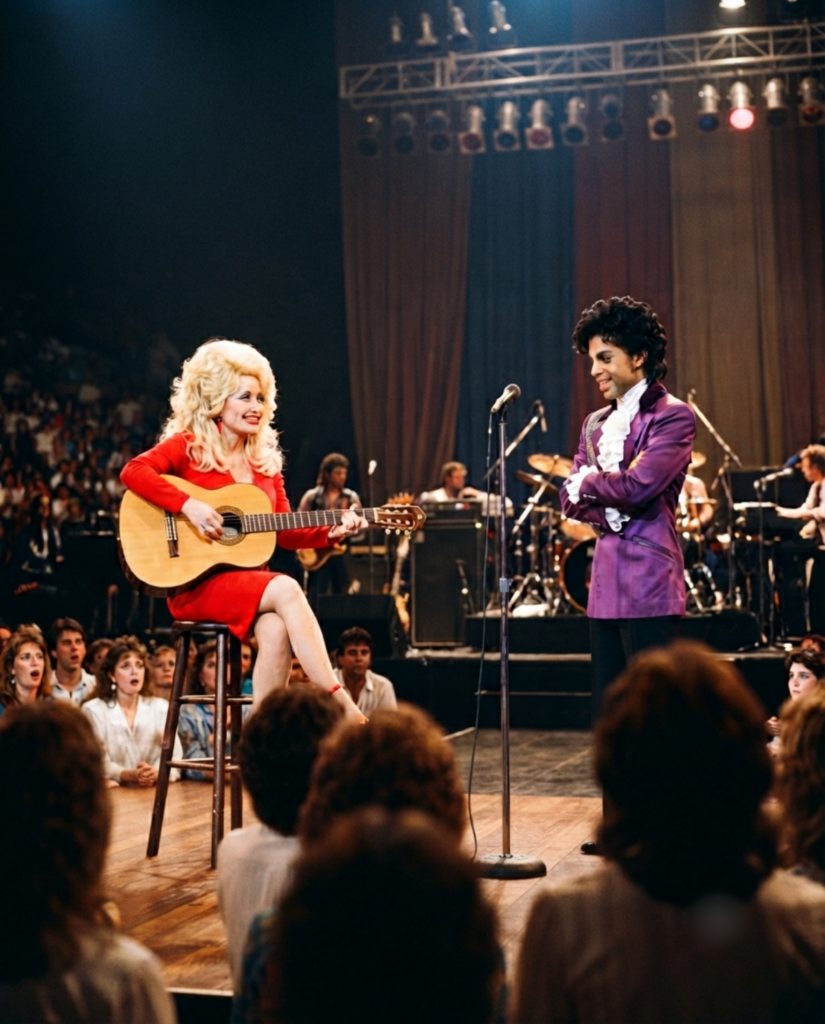
When Prince said, “Dolly’s got a great voice, but she’s never really had to prove she can actually play anything,” he thought he was just stating the obvious.
When Dolly Parton answered by walking onto a stage in front of 20,000 people with nothing but an old beat-up guitar and no band behind her, and played four minutes that left the whole crowd and one very stunned Prince standing there speechless, she showed everybody that being underestimated your whole life teaches you things no amount of natural talent ever could.
But the real shock didn’t happen after she finished playing.
It happened around the ninety-second mark, right when Prince, watching from the side of the stage with his arms crossed, realized the woman he’d just challenged had been quietly working on something for decades that almost nobody outside her own family had ever gotten to hear.
August 1986.
A private dressing room backstage at an industry gala in Los Angeles.
Prince sat sideways on a folding chair, his guitar strap draped loose over one shoulder, talking to a music journalist who’d somehow talked his way into fifteen minutes before the show started.
The conversation had drifted the way it always did with Prince—from music theory into ego, into who in this business actually deserved the credit they got and who was just writing a good haircut and a marketing budget.
The interviewer brought up Dolly.
What did Prince think of her?
Not as a personality.
Not as this larger-than-life character everybody loved.
But as an actual musician.
Prince’s answer started off careful.
Almost gentle.
“Dolly’s got one of the best voices this country’s ever produced,” he said.
“Nobody’s arguing that. And that songwriting—forget about it. Some of the sharpest lyrics in the whole business. I respect that woman more than most people in this industry.”
“But?” the interviewer said, sensing there was more coming.
Prince thought about his words.
“But singing and songwriting, that’s one thing. Actual musicianship—sitting down and really playing an instrument in front of people, showing your hands can do something—that’s different. I play everything on my own records. Guitar, bass, drums, keys. All of it myself. Dolly’s got the sweetest voice in Nashville, but has anybody actually watched her play guitar? I mean, really play it? Not just strum a few chords behind a song. I don’t think that’s the gift she’s got.”
The interview ran with a headline that traveled fast through the industry.
“Prince: Dolly’s a Singer, Not a Player.”
The kind of quote that sells magazines and starts arguments in bars all across the country.
Word of the quote reached Nashville within days.
The way things always seem to travel faster once somebody famous said something spicy about somebody else famous.
Radio DJs picked it apart on morning shows, debating whether Prince had a point or whether he was just being difficult the way he sometimes could be.
A few country music writers took offense on Dolly’s behalf, penning columns defending her legitimacy as an artist, pointing to her songwriting catalog as proof enough that she belonged in any conversation about serious musicianship.
But Dolly herself said nothing publicly for weeks.
Her publicist fielded a handful of requests for comment, and each time, Dolly waved it off with the same easy answer.
“Let him say what he wants to say,” she told her publicist over the phone one afternoon.
“Ain’t my job to convince every man in this business what I’m capable of. Never has been.”
But privately, something different was happening.
September 1986.
Dolly’s home studio outside Nashville.
Her longtime guitarist and close friend, a quiet man named Earl who’d been with her band since the early ’70s, showed her the article.
Hesitant.
Already bracing for whatever reaction might come.
Dolly read it slow, twice through.
Then she set the page down on the table beside her coffee cup, careful the way she handled most things when she was actually upset but didn’t want to show it.
“Prince is about the most talented man I’ve ever heard on a record,” Dolly said quietly.
“And he’s not wrong that folks don’t see me play much. He’s just wrong about why.”
Earl waited, not sure what was coming next.
“I’ve been playing guitar since I was little bitty,” Dolly said.
“Before anybody ever let me sing on a stage. My daddy couldn’t afford a real one, so my uncle Bill fixed one up out of parts he found, and I taught myself on that thing sitting on the porch. But once Nashville got hold of me—once the label had a plan for what Dolly Parton was supposed to be—that plan was singer, songwriter, personality. Wasn’t guitarist. So I learned to just do what needed doing in the background and let other folks handle the flashy stuff on stage.”
She picked the article back up.
Read the quote one more time.
“He thinks nobody’s seen it because it don’t exist,” Dolly said.
“That ain’t the same thing as it not being there.”
“You upset?” Earl asked.
Something small and quiet crossed Dolly’s face.
Something that looked almost like the beginning of a plan starting to form behind her eyes.
“No,” she said slowly.
“I think it’s about time somebody found out.”
Over the following weeks, Earl noticed something different in Dolly’s habits.
She’d always kept her guitar practice private, tucked away in odd hours when nobody else was around.
But now, she started asking him to stay late after regular rehearsals.
Just the two of them.
Working through pieces she’d never shown the rest of the band.
“You writing something new?” Earl asked one evening, watching her work through a difficult passage for the third time in a row.
“Something old, actually,” Dolly said, not looking up from the fretboard.
“Something I started a long time ago and never finished. Figured now’s as good a time as any to finish it properly.”
She didn’t tell him why.
Didn’t need to.
Earl understood well enough what had put that particular fire under her.
What her team didn’t know yet was that Dolly wasn’t planning some polite response through her publicist.
Wasn’t planning a quiet retraction in a follow-up interview where she’d laugh the whole thing off.
She was planning something else entirely.
Something that would take weeks of quiet, private practice in a back room at her house that nobody but her closest guitarist was allowed to walk into.
The Nashville Music Cares benefit concert had been scheduled for late October 1986.
One single night.
A lineup that read like a fever dream nobody expected to actually happen.
Country legends.
Pop crossover acts.
Even Prince himself agreeing to headline a portion of the evening despite his usual reluctance to share a bill with country performers.
The venue, on loan for this special charity event, held roughly 20,000 people, and the tickets had sold out within hours the moment they went on sale.
Organizers had spent months assembling the bill, calling in favors, negotiating with managers and labels who normally kept their artists on tight, controlled schedules.
Getting Prince to agree at all had taken considerable convincing.
He rarely performed at these kinds of mixed-genre charity events, preferring the total creative control of his own headlining tours.
But the cause—raising money for musicians struggling with medical bills and addiction treatment—had struck something personal in him, and he’d eventually agreed on the condition that his set remain entirely his own, uninterrupted by the usual charity-show format of constant guest appearances and surprise collaborations.
Dolly had agreed almost immediately when asked, the way she usually did for causes connected to the music community that had raised her up from nothing.
Prince arrived at soundcheck that afternoon in a mood everyone around him recognized immediately.
Sharp.
Focused.
A little combative.
The way he always got before a big performance.
He ran through several songs with his band, adjusting tones, correcting a monitor engineer who couldn’t quite get his in-ears balanced the way he wanted—the usual perfectionism that made him both brilliant and occasionally difficult to work alongside.
His band members exchanged knowing glances during these moments.
They’d learned over the years that Prince’s irritability before a show usually meant he was thinking about something bigger than the immediate technical details.
Something churning underneath the surface that would eventually reveal itself in the performance itself.
Dolly arrived a few hours later, warm and chatty with every stagehand she passed.
Learning names.
Laughing loud enough that people two rooms over could hear her coming before they saw her.
But underneath that familiar warmth, something quieter was sitting in her that afternoon.
Something she hadn’t mentioned to anybody beyond her closest band members.
She walked the stage once alone before the crowd arrived, running her hand along the edge of it, feeling out the space the way she always did.
Then she disappeared into her dressing room and didn’t come back out again until it was time.
Nobody backstage knew what Dolly had brought with her in a battered old guitar case that her personal assistant carried in and sat carefully against the wall, untouched for the rest of the afternoon.
Earl, sitting quietly in the corner of that dressing room while Dolly went through her vocal warm-ups, occasionally glanced toward that case, understanding better than anybody else present exactly what was waiting inside it.
“You nervous?” he asked her at one point.
Dolly considered the question seriously.
“A little,” she admitted.
“Been holding this back a long time. Feels strange thinking about letting it out in front of that many people.”
“You don’t have to do anything tonight,” Earl said.
“Nobody’s making you prove anything to Prince or anybody else.”
Dolly smiled at him.
Something steady settling behind her eyes.
“I know that, honey. But I think I’ve been waiting for a reason for a long time now. Maybe tonight’s just the reason showing up.”
The show started at eight that evening.
The arena was packed to the rafters.
Twenty thousand people who’d waited months for exactly this night.
The energy in the building thick enough you could practically feel it in your chest.
Dolly opened her portion of the show the way she always did.
Big and warm and generous.
Three songs that had the entire crowd singing along by the second chorus of each one.
She told her usual stories between numbers.
About growing up poor in the mountains.
About her mama singing hymns over the sink while washing dishes.
The kind of stories the crowd ate up every single time, no matter how many times she’d told them before.
By the time she finished her third song, the whole arena was on its feet and staying there, completely given over to her particular magic.
Prince watched from the wings, arms crossed, nodding along.
Genuinely impressed the way anybody with an ear for real talent would be.
But there was something underneath that nod.
Something that had been sitting in him since that interview two months earlier.
Something he hadn’t quite let go of.
His band members noticed him watching more intently than usual.
His usual restless energy replaced by something more focused.
Almost calculating.
“You planning something?” his bass player asked quietly as Dolly took her final bow to thunderous applause.
Prince didn’t answer immediately, his eyes still fixed on the stage where Dolly stood, accepting the crowd’s adoration.
“Maybe,” he said finally.
When Dolly finished her set and the applause was still rolling through the building, Prince walked out onto the stage before the crew had even finished resetting for his own performance.
Unplanned.
Not on the schedule.
The producers backstage exchanged panicked glances.
Nobody quite sure what was about to happen.
Dolly, still catching her breath, turned to see Prince walking toward her with a microphone in his hand.
The crowd’s noise shifted.
Confused at first.
Then electric.
Sensing something unplanned was unfolding in real time.
“Ladies and gentlemen,” Prince said into the mic, that easy, confident half-smile spreading across his face.
“I think we’ve got a little unfinished business up here tonight.”
Dolly’s expression stayed warm, though something behind her eyes sharpened just slightly.
“A couple months back,” Prince continued, “I said some things in an interview about my friend Dolly here. Said she’s got one of the best voices in this whole business, and I meant that. Still mean it. But I also said something about how nobody’s ever really seen her play guitar. Not really play it. Said maybe that’s just not her gift.”
The arena went quiet the way a room goes quiet when it senses it’s about to witness something that wasn’t in the program.
“Is that true?” Prince said, turning to Dolly now.
“You never really shown anybody what you can do on that guitar?”
Dolly’s voice when it came was soft but steady, carrying easy through the microphone she’d kept in hand.
“That’s about right,” she said.
“So here’s what I’m thinking,” Prince said.
That competitive glint entering his eyes now—the one everybody who’d worked with him would have recognized instantly.
“Right here. Right now. In front of all these good people. I dare you to prove me wrong.”
The crowd erupted into a wave of noise.
Murmurs and gasps rolling through the seats.
Dolly stood there a second, the weight of twenty thousand eyes on her, Prince standing a few feet away with that easy, challenging smile.
She looked out at the crowd.
Then back at Prince.
And something in her expression settled, the way water settles after you drop a stone in it.
“Bring me the guitar in my dressing room,” Dolly said quietly to a stagehand standing nearby.
“Old brown case. Leaning against the back wall.”
The stagehand took off running.
Prince’s smile flickered just slightly.
A small crack of surprise passing across his face.
He hadn’t expected an immediate yes.
He’d expected hesitation.
Maybe a graceful deflection.
Maybe Dolly laughing it off and turning it into a joke—the kind of thing that plays fine on camera without any real risk attached to it.
Instead, Dolly was standing there calm.
Waiting.
“You got something back there,” Prince said, half to himself, half into the mic.
The crowd picking up on the shift in his energy immediately.
“I’ve had it a long time,” Dolly said.
The stagehand returned less than a minute later, carrying the old brown case carefully across the stage.
He set it down and opened it in front of Dolly.
Inside, resting in a worn velvet lining, was a guitar nobody in that arena had ever seen her play in public.
A simple, well-loved instrument.
Its finish scratched and dulled from years of private use.
Strings darkened from hands that had clearly been playing it far longer than anybody realized.
Dolly lifted it out, slung the strap over her shoulder with a practiced motion, and settled it against her body.
The way you settle something that’s an extension of yourself.
Not something you’re borrowing for a stunt.
Prince’s eyebrows went up slightly, watching how she held it.
That wasn’t the posture of somebody who’d picked up a guitar three or four times in their whole life.
“What are you going to play?” Prince asked, still holding the mic, though his voice had lost some of its earlier bravado.
Dolly thought about it for a second.
“You said I don’t have anything to show. So I ain’t going to play something safe.”
She turned to the sound engineer standing at the side of the stage.
“Cut everything. No backing track. Nothing. Just me.”
The engineer looked to the producer, who nodded—though visibly nervous about handing this much dead air to an unplanned, unrehearsed moment on live broadcast television, because cameras from the charity’s national simulcast were rolling.
And there was no going back.
The lights dimmed.
Not the full production lighting she’d just performed under.
Not the sparkle and shine of her earlier set.
Just a single spotlight, tight and warm, settling over her.
Standing there alone with an old guitar and twenty thousand people holding their breath.
Prince stepped back toward the wings.
Close enough to watch.
Far enough to give Dolly the whole stage.
The competitive smile was gone now.
Replaced with something more like genuine curiosity.
Maybe even the first flicker of concern that he might have just walked into something bigger than he’d planned.
Dolly closed her eyes for a moment, adjusted her grip on the neck, and then—without a word, without any introduction—she began to play.
The first notes were simple.
A slow, aching progression rooted deep in old Appalachian tradition.
Nothing flashy.
Nothing built for show.
Just a handful of notes laid down with a patience nobody in that arena expected from a woman they’d just watched perform three sparkling, upbeat crowd-pleasers less than twenty minutes earlier.
Her fingers moved slow across the fretboard.
Deliberate.
Careful.
Not fast.
Not showing off.
Just present.
Like she was having a conversation with the instrument rather than performing a trick for an audience.
Chet Atkins, watching from a private box that evening as a guest of the charity’s board, later said he’d noticed something in the very first phrase that told him this wasn’t a stunt.
“She wasn’t playing to impress anybody,” Atkins would say in an interview years later.
“She was playing because she had something to say, and this was how she’d learned to say it way back before Nashville ever heard her name.”
Prince stood in the wings, arms no longer crossed, watching with an intensity his own band members said they’d rarely seen from him during another artist’s performance.
He leaned forward slightly, studying Dolly’s hands the way you study something you didn’t expect to be studying.
Thirty seconds in, Dolly bent a note.
Held it.
Let it waver—that slight vibrato shaking the pitch just enough to make it sound almost like a voice cracking.
The note hung in the air over the arena, and the whole building went dead silent.
Twenty thousand people who’d come expecting a spectacle instead got something that felt entirely unguarded.
She released the bend slowly, let it settle back to its original pitch, and moved into the next phrase.
Somewhere in the crowd, a young musician who’d come mainly to see Prince found himself genuinely transfixed, leaning so far forward in his seat his friend had to tap his shoulder to remind him he still had a drink in his hand.
“This isn’t what I expected from tonight,” he whispered.
A minute in, Dolly’s playing shifted into something more rhythmic.
Still slow.
Still deliberate.
But with a groove underneath it now—the kind of feel that made a few people in the crowd start swaying without deciding to.
She wasn’t playing anything anybody recognized.
No cover.
No familiar riff borrowed from a record everybody already knew.
This was something original.
Something that sounded like it had been written in private, in a small room with nobody watching, over years of quiet practice nobody had ever been allowed to witness.
Prince’s expression had changed completely by now.
The smirk from earlier—the easy confidence of a man who thought he already knew the answer to the question he was asking—had given way to something closer to genuine astonishment.
He turned to one of his own band members standing near him in the wings.
“Did you know she could do this?”
The band member shook his head slowly, eyes still fixed on the stage.
“Nobody knew.”
Ninety seconds in, Dolly did something that made the whole arena lean forward at once.
She hit a run of notes—fast, a cascading pattern that climbed up the neck of the guitar with a precision that would have taken most players years to build the muscle memory for.
Then dropped back down into a low, growling bend that made the amplifier hum with feedback.
Controlled.
Intentional.
Adding weight to the note rather than distorting it into noise.
Chet Atkins, in his private box, sat forward, gripping the armrest.
“That’s not beginner’s luck,” he said quietly to the person beside him.
“That’s years.”
Two minutes into the piece, Dolly opened her eyes for the first time since she’d started playing.
She looked out at the crowd.
Then found Prince standing in the wings.
Their eyes met.
Prince didn’t say anything.
Didn’t need to.
His expression said everything that needed saying.
Dolly closed her eyes again and kept going.
The intensity building now.
The tempo picking up slightly.
Each phrase answering the one before it.
A musical conversation happening entirely within herself.
Question and response.
Tension and release.
The same architecture that built every great mountain ballad anybody had ever heard.
Except this one was coming from a woman the entire music industry had spent decades insisting only knew how to sing pretty songs and tell folksy jokes.
Somewhere backstage, a group of session musicians who’d wandered close to the wings to watch Prince’s setup found themselves instead absolutely riveted by what was unfolding on stage.
One of them, a veteran bassist who’d worked sessions in Nashville for over twenty years, felt his jaw actually drop.
“I’ve heard every guitarist worth hearing come through this town,” he murmured to nobody in particular.
“Nobody ever mentioned this.”
Three minutes in, she built toward something bigger.
Her right hand moved faster now, picking with a speed that made several musicians backstage—people who’d played with legends their whole careers—exchange stunned glances with each other.
This wasn’t showmanship.
There was no theatrical flourish attached to it.
No big smile.
No wink to the crowd.
None of the visual charm Dolly had built an empire on.
Just her hands moving across the strings.
Her whole body still except for the small, controlled motion required to make the instrument speak.
Prince stepped forward slightly.
Close enough now that some of the front rows could see both performers in the same frame.
Dolly center stage under her single spotlight.
Prince just at the edge of it, watching like a student who’d suddenly found himself in the wrong classroom.
At three and a half minutes, Dolly hit the climax of the piece.
A sustained bend pushed a full step up the neck.
Held with a vibrato so wide and so controlled it sounded almost vocal.
Like the guitar itself was crying.
She held it five seconds.
Ten seconds.
The crowd, already dead silent, seemed to hold its breath along with the note.
Fifteen seconds.
Somewhere in the arena, somebody let out an audible gasp.
Twenty seconds.
And the note was still ringing.
Still bending.
Still alive under her fingers.
A physical feat that anybody who understood the guitar knew required not just finger strength but years of calluses built up through repetition nobody had ever seen her do.
Then slowly—so slowly it felt almost unbearable—Dolly let the bend release.
Let the note descend back to its original pitch.
Let it ring out on the open string and fade naturally into silence.
She lowered the guitar.
Bowed her head slightly.
Stood there motionless, a light sheen of sweat visible on her face despite having played for less than four minutes.
The arena remained frozen.
Three seconds.
Four.
Five.
Then it broke.
The applause that came wasn’t the screaming, warm roar of a typical Dolly Parton show.
It was something else entirely.
Something deeper.
The sound of twenty thousand people who just watched somebody they thought they fully understood reveal an entire dimension of themselves nobody had ever known existed.
Prince walked across the stage toward her.
Slow.
His usual swagger completely absent.
He reached Dolly and stopped a few feet away, just looking at her for a long moment.
Something working behind his eyes.
“How long?” Prince asked, his voice carrying through the microphone still clipped to his jacket.
“How long have you been able to do that?”
Dolly looked up, a small, tired smile crossing her face.
“Since I was about seven years old. Used to sneak out to the barn after chores were done. Taught myself on an old busted-up guitar my uncle fixed up out of scrap parts. Just trying to figure out what my hands could do when nobody was telling me what I was supposed to sound like.”
“Nobody ever heard this,” Prince said, still processing.
“Nobody was ever allowed to,” Dolly said.
“The label had a plan for me. The plan didn’t include this. So I kept it for myself.”
Prince stood there another moment.
And then he did something the crowd hadn’t expected either.
He reached up, unstrapped his own guitar—the very instrument he’d played through his entire set that night—and held it out toward Dolly.
“Play something with me,” Prince said.
“Right now. Whatever you want.”
Dolly looked at the guitar.
Then at Prince.
Something passing between them that the whole arena could feel even without understanding exactly what it meant.
“I don’t need your guitar, honey,” Dolly said, the smile widening slightly.
“I’ve got mine.”
Prince laughed.
A real laugh.
The tension of the whole evening finally breaking.
He slung his own guitar back over his shoulder instead.
“All right, then,” Prince said.
“Let’s see what happens when two people who’ve spent their whole lives being underestimated get on the same stage.”
The band, still standing ready from the earlier set, looked to their conductor for direction.
Prince waved them in.
Quiet.
Just bass and a soft hi-hat.
Nothing more, giving both guitars room to breathe.
Dolly counted it in with a nod, and the two of them began to play together.
Trading phrases the way musicians do when they’re genuinely listening to each other rather than performing at each other.
Dolly would lay down a slow, bending phrase, and Prince would answer with something sharper, more angular—his own signature style—weaving in and around what she’d just offered.
Where Dolly’s playing was patient, almost meditative, Prince was electric, full of sudden turns and unexpected runs.
The two styles shouldn’t have worked together.
Born from completely different traditions.
Completely different relationships to the instrument.
But somehow, up on that stage, they did.
Three minutes into their duet, something remarkable happened.
Dolly, who’d spent her whole solo playing with her eyes closed, opened them and looked directly at Prince.
Prince looked back.
And without either of them saying a word, they landed on the same note at exactly the same moment, bending it together in perfect unison.
Two guitars crying the same cry.
One from a childhood in the Smoky Mountains built around poverty and discipline and dreams that seemed impossible.
The other from a childhood in Minneapolis built around difference and isolation.
Same pain.
Different histories.
Same language underneath it all.
The crowd was on its feet now.
Not screaming.
Standing.
The particular kind of standing ovation that happens when a room understands it’s witnessing something rare.
Something that wasn’t planned.
Something that could never be perfectly recreated even if they tried.
Behind the stage, several of Dolly’s own band members had gathered near the monitors, watching in stunned silence themselves.
Earl, standing among them, felt something like pride swell in his chest.
Having been the only person who’d known this moment was coming.
Having helped her prepare for it in secret over the preceding weeks without ever fully understanding when or how she’d actually decide to reveal it.
“She’s been holding on to that her whole life,” Earl said quietly to the guitarist standing beside him.
“Well,” the other musician replied, still watching the stage with wide eyes.
“She sure picked a hell of a night to let it go.”
They brought the piece to a close together.
Both performers landing on the final chord at the same instant, letting it ring out and fade into the enormous silence of the arena holding its breath one more time.
Then the applause came.
And this time, it didn’t stop for a long time.
Prince took the microphone first, still catching his breath, sweat on his forehead, something genuinely humbled in his expression.
“Ladies and gentlemen,” he said.
“I came out here tonight thinking I knew exactly who Dolly Parton was. Thought I had her figured out. Best voice alive. Best songwriter alive. No argument there. But I just found out there’s a whole side of this woman the world’s never gotten to see. And I think that’s on all of us for assuming we already knew everything there was to know about somebody just because we’d heard her sing a thousand times.”
He turned to Dolly.
“I owe you an apology. What I said in that interview about you not really being a musician—that was wrong. Dead wrong.”
The crowd roared its approval.
Dolly took the microphone gently from his hand.
Her voice when it came was soft, carrying the particular weight of somebody who’d been holding something in for a very long time.
“You didn’t know because I never let anybody know,” Dolly said.
“That’s not your fault, honey. I built a whole career around giving people exactly what they expected from me. Big hair. Big laugh. The show they paid for. And somewhere along the way, I think I convinced myself that showing this part of who I am—the part that just sits alone with a guitar and works through something nobody else can see—that it wasn’t what people wanted from me. That it might confuse the image.”
She paused, looking out at the crowd.
“Tonight, I found out I was wrong about that, too.”
Prince put a hand on Dolly’s shoulder.
Genuine warmth in the gesture now.
All trace of the earlier competitive edge completely gone.
“Where’d that piece come from?” Prince asked.
“What you played before I came out? That wasn’t just technical skill. That was something real underneath it.”
Dolly considered the question.
“I wrote that a long time ago,” she said.
“Thinking about my daddy trading a hog for the doctor’s fee when I was born. About my mama singing hymns while she scrubbed dishes with no running water half the year. I used to go out to that barn after chores and just play something that was mine. Something nobody was grading. Nobody was judging. Nobody was going to tell me I did it wrong. That piece tonight—that’s basically forty years of those quiet evenings all folded into four minutes.”
The arena had gone completely still again, listening to every word.
“Pain don’t need permission to be real,” Dolly continued.
“Don’t matter if you got it from a cabin with no running water or a childhood somewhere else entirely. It’s still pain. I think tonight I finally let myself show that instead of hiding it behind everything else I built.”
Chet Atkins, watching from his private box, stood up slowly and began to applaud.
The rest of the arena followed his lead, the ovation rolling through the venue in waves.
Backstage an hour later, after the rest of Prince’s set had wrapped and the crowd had finally started filing out into the Nashville night, still buzzing about what they’d witnessed, Dolly sat in her dressing room with the guitar resting across her lap, running her thumb absently along the strings.
Earl knocked softly and stuck his head in.
“You holding up all right?”
Dolly looked up, something a little dazed still lingering in her expression.
“I think so. Feel strange, honey. Like I just took off a coat I’ve been wearing so long I forgot it was even on me.”
“How’s it feel now that it’s off?”
Dolly considered the question.
“Lighter. Scary too. But mostly lighter.”
Prince knocked next, then let himself in without waiting for an answer.
The way you do with somebody you feel like you actually know now.
“Got a minute?” Prince asked.
“For you? Always,” Dolly said.
Earl excused himself quietly, understanding this was a conversation that needed just the two of them.
Prince sat down across from Dolly, still visibly working through what had happened.
“I need to ask you something, and I need you to be honest with me.”
“Go ahead.”
“Why tonight? You could have just laughed it off. Made a joke out of the whole thing. Instead, you sent somebody running for a guitar you’d apparently been hiding for years. Why risk that in front of twenty thousand people with no rehearsal?”
Dolly thought about the question seriously before answering.
“Because you weren’t wrong that nobody’s ever seen it. You were just wrong about why. And I think some part of me had been waiting a long time for somebody to finally ask the question in a way I couldn’t avoid answering. You gave me an excuse I’ve been needing for years.”
Prince sat with that for a moment.
“You know, I’ve spent my whole career trying to prove I could do everything myself. Play every instrument. Write every part. Produce every track. Some of that’s genuine love for the craft. But if I’m being honest, some of it’s fear, too. Fear that if I don’t do it all myself, somebody’s going to say I’m not really the one behind the music.”
“That’s a heavy thing to carry.”
“So is what you just heard about my daddy and that hog and our old barn,” Dolly said.
“That’s not nothing, Prince.”
Prince was quiet for a moment.
“No, it’s not.”
“You should play more,” Dolly said.
“In front of people. Not because you owe anybody proof of anything. Because it looked like it meant something to you up there. Looked like maybe you were feeling something too, instead of just showing off.”
Prince smiled.
Small but genuine.
“Maybe I will.”
They talked a while longer, the adrenaline of the night slowly draining out of both of them, replaced by something quieter and more reflective.
Prince asked about her childhood, genuinely curious now rather than simply making conversation.
Dolly told him about her grandfather’s church, about how she used to stand on a wooden chair just so she could reach the pulpit microphone, her voice already bigger than her body when she was barely old enough for school.
“Sounds like my own childhood in some ways,” Prince said.
“Different circumstances, but that same sense of music being the one place where you actually got to be yourself completely.”
“That’s exactly it,” Dolly said.
“Music never judged me for being poor or plain or however folks decided to see me. It just was what it was, and I could pour whatever I needed into it.”
“I think that’s why I got so defensive about musicianship,” Prince admitted.
“Felt like if people didn’t see me actually doing the work, they’d decide it was all just image. All just performance without substance underneath it.”
“Well,” Dolly said, “I reckon we both learned something about each other tonight that we didn’t expect walking in.”
That night at the arena never got officially released as an album or single, though a handful of grainy audience recordings and a partial broadcast clip circulated for years among collectors who understood exactly what they had.
But everybody who was in that building carried the memory of it the rest of their lives, telling the story to anybody who’d listen about the night Prince dared Dolly Parton to prove she was a real musician, and Dolly answered with four minutes that nobody in that arena, least of all Prince himself, ever forgot.
Years later, when reporters asked Prince about that evening, he never dressed the story up bigger than it already was, never tried to reclaim the narrative or spin it in his own favor.
“That’s one of the only times in my life I’ve been completely wrong about somebody, and glad to be wrong,” Prince said in a 1994 interview.
“I thought I knew exactly what Dolly was capable of because I’d heard her sing a thousand times on the radio, same as everybody else. Turns out there was a whole side of her none of us ever got to see because she never let us. And when she finally did, it wasn’t because she wanted applause. It was because I pushed her into a corner. And instead of running from it, she turned around and showed me something real.”









