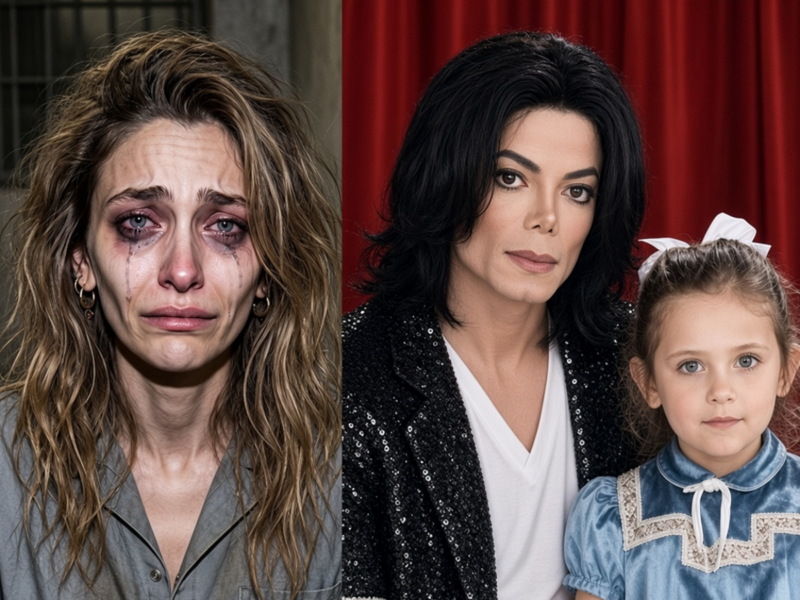
Paris Jackson hid a perforated septum, 6 years sober, and a suicide attempt at 15—her darkest truth will break you.
It wasn’t her first time.
While the public still saw Michael Jackson’s daughter stepping in front of cameras, smiling at events, and living a life millions believed they could only dream of, behind closed doors, Paris was fighting a war against herself.
There were wounds she hid beneath her clothing, later covering them with tattoos years down the line.
There were things she had never told a soul.
And even the very place expected to help Paris heal ultimately became a memory that she said left her with additional PTSD.
But what pushed a girl seemingly having it all to the point where she no longer wanted to wake up the next morning?
And more importantly, what happened after Paris survived?
In late 2025, Paris Jackson casually brought her phone close to her face, switched on the flashlight, and shined it directly inside her nasal cavity.
This wasn’t a leaked hospital photo snapped by tabloid reporters, nor was it an unflattering angle captured by paparazzi while she let her guard down.
Paris herself was the one proactively exposing that truth for the entire world to see.
Under the cold white glare of the phone screen, a jagged perforation right on her nasal septum was clearly visible.
She took a breath.
A faint, dry whistling sound escaped.
Paris calmly explained that the sound was sometimes so distinct it could bleed straight through the microphone whenever she stepped into a recording studio.
With almost zero beating around the bush, she stated that what viewers were thinking was the exact culprit.
“Don’t do drugs,” Paris warned.
After a brief hesitation mixed with a hint of self-deprecating laughter, she added that she had no intention of dictating how others should live, but she strongly discouraged it because drugs had ruined her life down to its very roots.
It was an exceptionally brief statement for a dark chapter so prolonged that her body still stubbornly retained the physical proof to this day.
Paris shared that she had been silently coexisting with that perforated septum since she turned twenty.
As of right now, she has zero intention of undergoing surgery to fix it.
The reason is heartbreaking.
She has maintained nearly six years of sobriety, and she refuses to risk putting that fragile balance in jeopardy from the heavy painkillers required after a major operation.
Consequently, the injury remains entirely intact.
For a singer, that physical aftermath carries a breathtakingly suffocating irony.
A recording studio is a sanctuary of silence where even the tiniest vibrations are captured by the microphone.
Paris can master her vocal phrasing, calibrate her distance from the mic, and control every breath.
Yet she can never entirely stop that whistling sound generated from her old wound.
The human body is indeed stubbornly relentless in recording the past.
Paris even joked once that the hole was wide enough to thread a strand of spaghetti through it.
The way she delivered it made the scene sound almost humorous for a fleeting second.
But that very bitter self-mockery made the consequences all the more haunting.
A disfigurement that once held the power to throw someone into a panic had lingered on her body long enough for its owner to learn how to turn it into a self-deprecating joke.
Yet if someone were to fixate solely on that nasal perforation and hastily conclude that Paris’s story was merely a cliché script of a Hollywood rich kid partying too hard and paying the price, they would completely miss the chaotic depth of reality.
What Paris revealed later was far more complex.
She shared that from a very young age, she possessed an innate craving to hunt for an external catalyst to warp her internal emotional state.
Sometimes that substitute was food.
Sometimes it was latching onto another person.
Other times it took the form of self-harm behaviors.
By around the eighth or ninth grade, chemical substances officially entered that destructive equation.
Paris defined her state of mind when lacking anything to numb her feelings using sharp, striking words.
Restless to the point of frenzy.
Irritable for no reason.
Discontent with reality.
And profoundly disgusted and alienated in her own skin.
Then she discovered that certain chemicals could instantly force all those dreadful sensations to shut up in the blink of an eye.
The escape door had swung wide open.
The catch was that the deeper she plunged through it, the more lost Paris became, unable to find her way back.
Years later, she finally found the courage to look back on one of the darkest periods of her life.
At one point, Paris considered trying to detox at home.
She knew someone who had Suboxone and believed it might help her through the process.
But there was a complication she did not fully understand at the time.
The opioids she had been taking were contaminated with fentanyl.
She took Suboxone too early and experienced precipitated withdrawal, an extremely intense and distressing reaction that she later described as one of the most difficult experiences of her life.
Eventually, Paris decided to continue the process without relying on Suboxone.
But even then she was still struggling with alcohol and other substances.
Meaning that leaving one substance behind did not immediately free her from the larger cycle she had become trapped in.
Then there was the issue of sleep.
Paris recalled a period that lasted for an entire month when she was barely sleeping.
On some nights she managed only one or two hours, while three hours felt like a particularly good night.
Her body was exhausted.
Her mind was overwhelmed.
And her nervous system was constantly under pressure.
There was nothing glamorous about being Michael Jackson’s daughter during that period.
There were no red carpets, flashing cameras, or designer gowns.
Instead, there was a young woman trying to navigate an overwhelming period of her life while struggling with a combination of emotional pain, exhaustion, and substance dependence.
That was the real difference between Paris during those years and the simple rebellious celebrity child image that the public often attached to her.
Substance use was no longer something connected only to parties or youthful experimentation.
It had gradually become intertwined with the way she handled stress, loneliness, exhaustion, and difficult emotions.
The most troubling part was not simply how many substances were involved.
It was how deeply they had become connected to everyday life.
Sleeping.
Staying awake.
Managing difficult feelings.
And temporarily escaping emotional pain.
Eventually, the consequences began affecting different parts of her life and well-being.
But Paris did not simply recognize the problem one morning and immediately change everything.
That is one of the most complicated realities of addiction.
Understanding that something is hurting you does not automatically give you the ability to walk away from it.
When substances become intertwined with the emotions that originally led a person toward them, breaking that pattern can take considerable time.
The consequences can create more emotional pressure, which can then make the original problem even harder to overcome.
It took Paris years to begin breaking that cycle.
And although the physical consequences were visible in different ways, they represented only one part of a much larger struggle.
During those years, Paris was also dealing with emotional pain that went far beyond substance use.
There were moments when she no longer wanted simply to escape from difficult feelings.
She wanted the pain itself to disappear.
In 2017, Paris Jackson publicly opened up about one of the darkest chapters of her adolescence, a period that the public had previously understood only through scattered reports.
She spoke openly about struggling with intense self-hatred and emotional distress during those years.
But those struggles did not appear without a history behind them.
According to Paris, when she was fourteen, she experienced a deeply traumatic encounter involving an older stranger.
She kept the experience to herself for years, carrying the emotional weight in silence.
At the same time, the world around her offered very little relief.
Online strangers criticized her appearance, questioned her identity, attacked her family, discussed her late father, and challenged her connection to the Jackson name.
For a teenager already struggling to understand herself, that constant attention created another layer of pressure.
Instead of having the privacy most young people need while growing up, Paris was navigating adolescence under an extraordinary level of public scrutiny.
The result was a complicated emotional storm, one shaped by grief, trauma, loneliness, public criticism, and the enormous expectations that came with being Michael Jackson’s daughter.
And for Paris, that period would become one of the defining chapters in her eventual journey toward understanding herself and rebuilding her life.
She began hanging out with older crowds, desperately forcing herself into a warped, accelerated version of adulthood.
Yet the harder she sprinted forward, the more everything spun out of control.
In June 2013, freshly turning fifteen, she was rushed to the hospital following a suicide attempt.
News instantly erupted into a global tempest.
The name Paris Jackson blanketed newspaper headlines, transforming a crisis that rightfully belonged within the private sanctuary of an unfortunate teenager into fodder for public dissection.
It wasn’t until many years later that Paris dropped a vital detail that completely reshaped how people looked back at that day.
It was unequivocally not her first time seeking an end.
She confessed that she had endured quite a few bouts of deep despair where she tried to finish her life.
One of the suicide attempts she later recounted took place during a pitch-black period when she was battling withdrawal and chronic insomnia.
She recalled downing an entire bottle of benzodiazepines and washing it down with a full bottle of vodka.
At that moment, Paris wasn’t performing a symbolic gesture or seeking attention.
By her own account, her sole objective was never to wake up again.
Paris herself later ruefully admitted that because her body possessed zero significant tolerance to benzodiazepines at the time, that cocktail of pills and booze should have been potent enough to snuff out her life.
Yet it didn’t happen.
Paris woke up.
There was a chilling sterility to that moment.
It bore no resemblance to Hollywood cinematic tropes where a survivor immediately embraces life and realizes they’ve just been gifted a miraculous second chance.
Paris remained trapped dead in the center of addiction, insomnia, and unhealed mental trauma.
The morning after a botched suicide attempt never automatically morphs into day one of a brand-new life.
Sometimes it’s simply another miserable morning with an aching body, a chaotic mind, and one more brutal truth she was forced to carry.
Even her plan to vanish forever had failed miserably.
Following the seismic shock of her fifteenth year, Paris was successively funneled by her family through various psychiatric treatment programs, including a specialized youth facility in Utah.
For a long time, she framed that experience through a somewhat positive lens.
Yet by 2026, looking back with the chronological distance of a mature woman, Paris sketched an entirely different portrait.
She bluntly declared that she walked out of that place with more PTSD than when she walked in.
It is worth noting that Paris drew extremely sharp boundaries around her accusations.
She didn’t accuse the facility of physical or sexual abuse, readily acknowledging that other patients might have found healing there.
But for herself, she insisted she had suffered profound psychological, emotional, and spiritual abuse.
She described a suffocating atmosphere that crushed all trust, where she felt incapable of opening up to anyone, from her roommates down to the monitoring staff.
If she accidentally uttered a single out-of-line remark, she lived in constant dread that it would negatively impact her standing or her minor privileges within the facility.
Even phone calls home failed to deliver the safety net a distressed child expected, as Paris recounted that those calls were heavily monitored and listened in on, while her family had reportedly been warned to not believe what Paris says.
A teenager shipped there to heal ended up having to master a completely inverse survival skill.
Play the game.
Paris used that exact phrase when reflecting on her past.
From her perspective, to escape that system, those trapped inside were forced to decode how the game operated and bend their behavior accordingly.
Place that reality right next to fifteen-year-old Paris, a teenager who had already lost all faith in humanity, fresh off a mental breakdown, shipped to a place supposedly designed to make her feel safe enough to speak the truth, only to conclude that if she wanted a shot at walking out free, she had to learn how to zip her mouth and mask reality.
And when Paris finally walked out of Utah, although the iron gates slammed shut behind her, the ghost of that place never truly left.
She shared that she continued to be plagued by repetitive nightmares for two or three years straight, dreaming she was being dragged back there.
A physical institution existing in the real world had morphed into a haunting ground inside her sleep.
That is why years later, Paris stopped telling the recovery story through the safe standard script of crisis, rehab, saved.
To her, a core part of the apparatus built to rescue her had instead mutated into yet another wound requiring treatment.
That doesn’t imply every treatment center Paris walked through was completely useless, nor that every other patient’s experience mirrored hers.
Paris herself left room for those differences.
Yet her candid confessions shattered a terribly convenient illusion the public loves holding on to, that you simply need to dump a rebellious teen into an intensive treatment facility and all tragedy will automatically tie up with a neat bow the moment the door opens for them to return home.
Paris walked out.
Yet the psychological fractures walked right out alongside her.
The ensuing years continued as an unrelenting cycle of drugs, alcohol, failed detox attempts, and brushes where her mind drifted terrifyingly close to the edge of the abyss.
Right up until the threshold of genuinely stepping onto the path of sobriety, Paris endured yet another near-fatal suicide attempt.
Yet that very desperate nadir served as the fateful turning point, steering her life toward an alternate trajectory.
It wasn’t because a loved one whispered the correct spell, nor was it a spectacular intervention that shocked her awake.
Paris later stated flatly that no external intervention could ever force her to get sober until she herself was truly ready.
In the opening days of 2020, that readiness finally materialized.
Even so, sobriety was about to hand Paris another grueling lesson.
Cutting ties with drugs did not mean the urge to extinguish her own life would magically vanish forever.
Paris Jackson once likened the journey of sobriety to a horrific car crash.
For years, she could ruthlessly chuck all her garbage into the backseat of her life’s car.
Grief.
Blazing anger.
Horrific memories.
Shame.
And tens of thousands of unanswered questions.
Chemical substances served as an anchor, pinning that chaos quietly in place for a time.
Yet when the vehicle slammed on the brakes without warning, everything cluttered in the back seat violently flew forward.
That precisely mirrors the sensation Paris experienced stepping into sobriety.
Drugs had cleared out of her body, but the deep-seated catalysts driving her to drugs remained completely intact.
The first week of January 2020 officially marked a milestone.
Paris threw herself into the sober path.
A day survived multiplied into a week.
A week stacked into a month.
Then the years began accumulating.
By January 2025, she proudly publicized hitting the milestone of five completely clean years free of heroin and alcohol.
In an emotional anniversary video, Paris spliced together archival frames with recovery chips alongside seemingly minor everyday fragments.
Music.
Close friends.
Adoring pets.
Bursts of laughter.
And spontaneous dance steps.
She wrote that thanks to sobriety, she was handed back her birthrights.
Making music.
Loving.
Laughing.
Trembling fully before both joy and pain.
And truly being present in this life.
If the narrative stopped right there, it would boast the pristine, cookie-cutter structure of a Hollywood feature.
A glamorous young girl crashing into the abyss, bravely getting clean, rediscovering herself, and watching the screen fade to black on a satisfied smile.
Yet Paris’s life never possessed such a neatly polished ending.
Roughly five years after maintaining her sober state, suicidal ideation abruptly flared up and returned to tear at her.
This time, it wasn’t fifteen-year-old Paris.
It wasn’t a girl drowning in the haze of heroin and alcohol.
She had banked years of sobriety behind her, run through an array of cutting-edge therapeutic treatments, and mapped her internal landscape far deeper than anyone else.
Yet by Paris’s own admission, there came a moment when she drifted very, very close to self-termination.
When asked if slipping back into that psychological black hole after years of clean living felt terrifying, Paris delivered a spine-chilling reply.
To her, it was an agonizingly familiar space.
The truly terrifying element resided in the people around her, those who had to watch her slip right along the precipice and were forced to carry the secondary trauma of it themselves.
That gritty detail completely upends and redefines the true meaning of sobriety within the chronicles of Paris Jackson’s life.
Sobriety is not a magic wand capable of cauterizing every wound.
Paris confessed that prior to that she had sampled nearly every therapeutic modality known to humanity.
Cognitive behavioral therapy, CBT.
Dialectical behavior therapy, DBT.
Eye movement desensitization and reprocessing, EMDR.
Somatic therapy.
Experiential therapy.
Transcranial magnetic stimulation, TMS, offered minor relief for her OCD, but according to her, it utterly failed against depression.
She even tested a stellate ganglion block, a procedure targeting a cluster of nerves in the neck intended to soothe PTSD symptoms.
Paris noted it provided fleeting, short-lived relief.
She described that quest for salvation like a lost soul wandering through successive doors, clinging to the fragile hope that the next one would finally house something capable of ordering the noise inside her brain to shut up.
And then Paris turned to ECT, electroconvulsive therapy.
The name alone carries decades of terrifying cinematic and pop culture baggage.
Yet modern ECT is actually a rigorous medical procedure administered under anesthesia, typically prescribed for treatment-resistant severe depression, especially when conventional methods hit a wall.
For Paris, that decision arrived following a critical juncture where she acknowledged standing on the literal coattails of death.
This was no longer the story of an underage minor being dragged into a rehab center by adults.
Paris, at this point, was an independent adult proactively seeking radical medical intervention upon realizing that sobriety, despite saving vast swaths of her life, couldn’t single-handedly solve her entire survival equation.
And herein lies the poignant paradox.
Years prior, whenever her inner world grew too deafening and chaotic, Paris would instinctively chase heroin, alcohol, or heavy chemicals to alter her senses.
Now, as the darkness reemerged, she still yearned for it to stop.
Yet her reaction had fundamentally transformed.
Rather than self-destructing via toxins that mutilated her flesh, Paris proactively reached out to doctors, mental health professionals, and those equipped to guide her through her most perilous twist.
No grand cinematic miracle materialized overnight.
There was only the identical primal agony of the old days, but a completely transformed human being stood bravely facing it.
That brutal reality infused Paris’s five-year sobriety milestone with an entirely separate tier of meaning.
It stood as no guarantee that from 2020 onward, her existence would forever bask in pastel pinks.
On the contrary, Paris herself was the first to frankly concede that happiness is merely a fleeting moment, and agony carries that exact same transient nature.
The most priceless asset she harvested wasn’t a formula for permanent bliss, but a blood-bought lesson.
Never issue a permanent decision while trapped inside an emotion guaranteed to fade with time.
By 2026, Paris had crossed the mark of six full years of sobriety.
Yet if one were to isolate the single greatest transformation, the answer certainly wouldn’t rest in the dry digit six.
It resided in the cavernous gap stretching between two versions of Paris.
One Paris who spiked her vodka with sedatives, intending never to open her eyes again.
And a Paris years later when those dark thoughts launched a surprise ambush, choosing an entirely alternative escape route to remain with this world.
That distinction may sound fleetingly fragile.
Yet within the architecture of Paris Jackson’s life, it served as the absolute border, separating life from death.
And life never grants her prolonged rest.
It prepared to test that intrinsic will to stay via an entirely unforeseen script.
This time devoid of drugs, devoid of hospitals, blaring ambulance sirens, or rehab facilities.
Instead, it assumed the shape of an engagement ring, a wedding date locked onto a calendar, and a wedding dress being stitched stitch by stitch for a church aisle Paris would ultimately never walk down.
In late 2024, Paris Jackson openly shared news of her engagement to music producer Justin Long.
A sparkling ring appeared on her finger.
Joyous photos flooded social media, and her story seemed to veer toward a vastly different, calmer, and more radiant chapter than the stormy years preceding it.
By mid-2025, the wedding had outgrown the conceptual drawing board.
Paris excitedly revealed that her dream wedding dress was being meticulously handcrafted stitch by stitch.
The sacred venue had been chosen, and the date of the ceremony had been firmly locked in.
She even joked that the timing had been selected with the assistance of astrology.
After countless years of recklessly drifting amidst life’s uncertainties, Paris could finally point to a specific spot on a calendar and know precisely where she planned to stand tomorrow and beside whom.
Then paparazzi photos capturing Paris in tears suddenly went viral.
The internet instantly boiled over with tens of thousands of toxic assumptions, forcing Paris to step forward and clarify herself.
Those were breakup tears.
The engagement had officially come to an end.
There would be no church bells.
Plans that had been meticulously mapped out down to the smallest detail, from the wedding dress nearing completion to the venue loaded with layers of meaning, suddenly morphed into the orphaned memories of a future that never materialized.
There is a deeply poignant loneliness residing in artifacts birthed solely to await a celebration day that will never take place.
Yet right at this brutal crossroad, the fortitude of a woman who achieved successful self-recovery truly shone.
Paris cried.
She openly confessed her pain and disappointment, but current pain no longer served as the lighter, igniting her instinct to flee via chemical escapes.
She calmly came to realize that a person can be entirely kind and good-hearted, yet still fail to be the destined puzzle piece meant for you.
A broken relationship requires no vile betrayal or shadowy puppet master villain to justify its end.
Sometimes two parallel paths simply reach a point where they can no longer run side by side.
For a soul once accustomed to borrowing external crutches to stuff the emptiness within, bravely embracing loss and walking through it softly carried a transformative weight far greater than any prestigious career milestone.
By 2026, Paris peeled back yet another truth.
Justin Long was not the first man she had planned to marry.
Prior to that, during her darkest period, when both she and her partner were drowning in liquor and drugs, another proposal and engagement ring had existed.
According to Paris, that previous ring had even been purchased using her own money without her knowledge.
The story carried a coloring both absurd and excruciatingly tragic.
The sacred symbol of an eternal future built right on top of a shattered present, manipulated entirely by toxic substances.
Paris never denied her feelings back then.
She knew she had loved sincerely.
It was simply that the mature woman standing in the present understood that genuine emotion does not automatically generate a healthy relationship if the foundation underneath is thoroughly rotten.
Two engagements representing two completely opposing extremes of Paris’s life.
One occurred amidst the chaotic storm of addiction.
The other unfolded in the light of sobriety.
Both halted right before the threshold of the altar.
Yet a parallel outcome did not mean her character remained unchanged.
This time, as the future she cherished collapsed right before her eyes, she retained the most precious asset she had spent agonizing years rebuilding.
The sovereign power to be present and steer her own existence.
And from this anchor point, the biggest, most pressing question left unanswered by previous chapters surged forward, demanding an answer.
Why was learning to live alongside her own emotions once an impossible trial for Paris Jackson?
No single cause could shoulder the entire answer, and to pin all the storms of her life onto one single incident would be a cruel oversimplification.
Even so, in the chronicles of Paris Jackson’s life, a razor-sharp historical milestone permanently cleaved her trajectory into two distinct worlds.
The day the world lost Michael Jackson.
And the day after, when an eleven-year-old girl woke up in sheer panic, realizing she had forever lost the man she knew simply by a sacred name.
Daddy.









