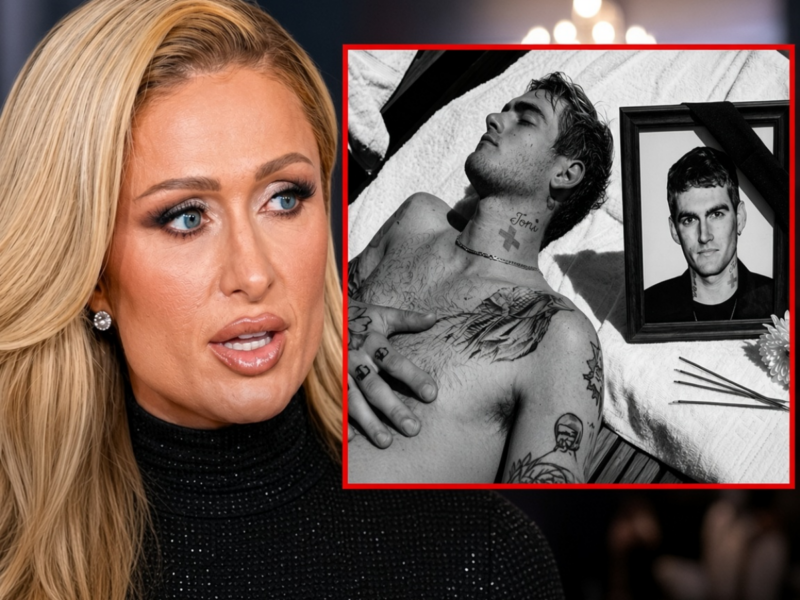
Paris Hilton FINALLY Opens Up About the Death of Cindy Crawford’s Son.
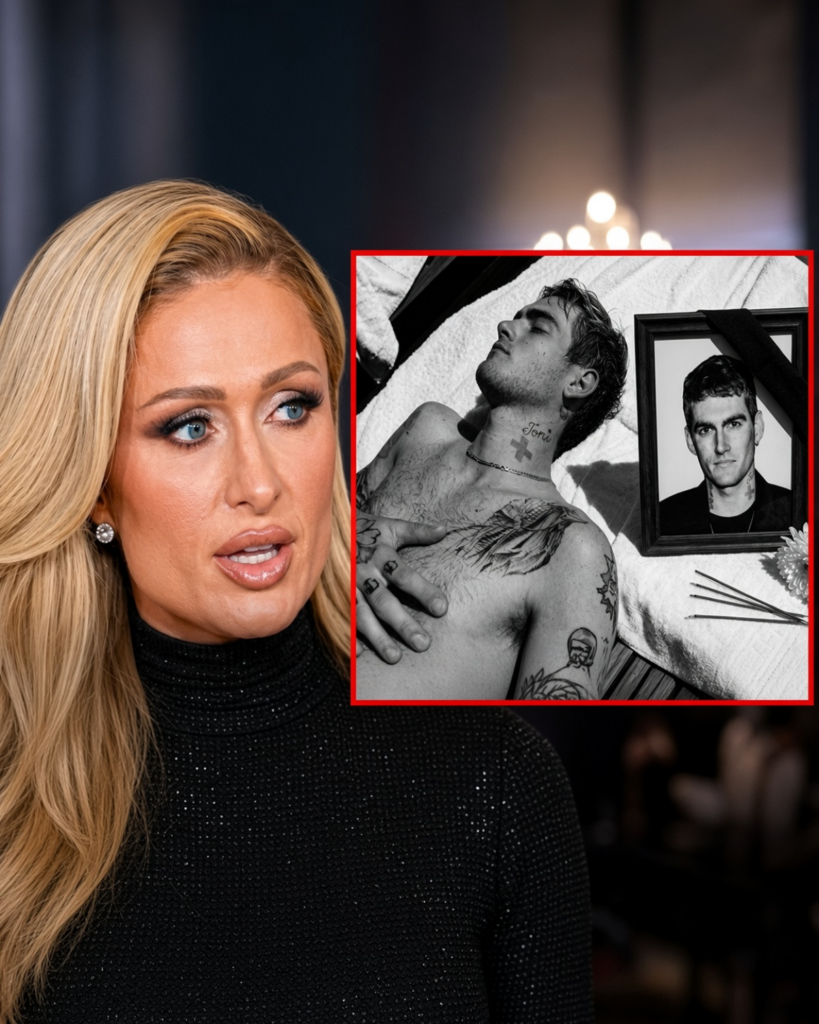
Cindy Crawford’s son, Presley Gerber, died Sunday in a rehab facility at around 10:00 p.m. on September 19th, 2026.
The solitary figure of Presley Gerber, the 27-year-old son of legend Cindy Crawford, disappeared behind the doors of a luxury rehabilitation facility in Santa Monica.
He entered with a final glimmer of hope, determined to break the grip of addiction that had plagued his youth.
Yet little did he know that those doors marked a fatal threshold.
Less than 12 hours later, sirens pierced the early morning mist.
Presley was found lifeless in a cold room, taking the secrets of his final moments to the grave.
The media erupted while his family, struck dumb with grief, chose absolute silence.
Amidst this suffocating storm, Paris Hilton tearfully broke the silence.
Her heartbreaking revelations not only unveiled the nightmare of that fateful final night, but also crushed the hearts of anyone who has ever loved a struggling soul fighting to find their way back.
Presley Walker Gerber was born on July 2nd, 1999, as the firstborn child of legendary supermodel Cindy Crawford and successful businessman Rande Gerber.
From the very moment of his birth, those two names ensured that his life would be unlike that of most ordinary children.
At the time, Cindy was not merely a famous model.
She had become an icon defining an entire fashion era, a pop culture monument who stepped off the pages of magazines to etch herself into history.
Her signature mole above her lip, thick brown hair, prestigious Vogue covers, and especially the 1992 Pepsi commercial established Cindy as one of the most recognizable faces in America.
Meanwhile, Rande Gerber built his own business empire, eventually becoming a co-founder of Casamigos alongside George Clooney and Mike Meldman.
Three years after Presley’s birth, the family welcomed Kaia, who would later step onto the runways and quickly rise to become one of the most sought-after supermodels of her generation.
Viewed from the outside, Presley seemed to have been dropped straight into a Hollywood blueprint designed to be too flawless.
A successful father, a supermodel mother, a beautiful younger sister, a breezy beachfront mansion in Malibu, and a world of endless opportunities waiting right at his doorstep.
Yet growing up in such a family also meant that Presley practically never had the chance to be a completely anonymous young man.
When your mother is Cindy Crawford, every single feature of your face is subjected to comparison and dissection from early childhood.
When your sister also becomes a famous model, any career choice you make is inevitably placed side by side with your relatives’ achievements.
Presley grew up amidst the sun-drenched, windswept lands of Malibu.
Tethered to the ocean, surfing, skateboarding, and photography, he embodied the quintessential carefree California youth.
Blonde hair, sun-kissed skin, afternoons spent by the shore, and an appearance born to stand in front of a camera.
Yet those cameras also bore a harsh flip side.
An ordinary child has the freedom to change styles, make foolish mistakes, or simply have a bad day in peace without anyone caring.
Presley did not.
The moment he walked beside Cindy at any event, a barrage of lenses immediately swiveled toward him.
From a very early age, the world had already written a ready-made script for him.
Cindy Crawford’s son.
And it would take Presley many years to exhaustively prove that beneath that glamorous label lay a far more complex human being.
At age 16, Presley walked the Moschino Resort 2017 runway in Los Angeles.
The doors of high fashion swung wide open almost instantly.
Following that were Balmain, Vetements, Tommy Hilfiger, Burberry, Ralph Lauren, Dolce & Gabbana, Calvin Klein, and a slew of top-tier brands that thousands of young models spend years trying to access.
In 2018, Presley and Kaia became the faces of a global Calvin Klein Jeans campaign.
That same year, he appeared alongside his mother in a Super Bowl Pepsi commercial, creating a visually striking media moment more than two decades after Cindy became a Pepsi icon.
Her biological son stepped into the exact same frame.
Presley had it all.
Looks, lineage, multi-million dollar contracts, wealth, connections, and a wide-open path paved right before him.
Had the story ended there, he might have simply become another textbook example of Hollywood offspring following in their parents’ footsteps.
Yet that trajectory began to deviate from the pristine picture quite early.
In late 2018, Presley’s car was pulled over by police in Beverly Hills, leading to an arrest for driving under the influence.
He was only 19 years old at the time.
The incident triggered three years of probation, a mandatory DUI program, and community service.
The press promptly pounced on the opportunity to spin a familiar narrative.
The rebellious wealthy brat.
To many, Presley was just another celebrity kid born into excessive privilege who began hitting snags before turning 20.
But years later, when he bravely spoke publicly about addiction and his rehabilitation stints, that DUI arrest suddenly took on a completely different hue.
It no longer stood in isolation as a reckless night of youth.
It became the very first piece of a much larger, darker puzzle.
Then in February 2020, Presley did something that forced the entire internet to double take.
He chose to tattoo the word misunderstood directly across his face.
For anyone else, a facial tattoo was already an irreversible and daring choice.
For a model whose livelihood depended on his appearance, it was practically a direct challenge to the very industry paying for his features.
Social media erupted in controversy.
People made memes, laughed, and wondered what Cindy Crawford thought about it all.
Some argued he was desperately acting out in rebellion, while others viewed it as an attention stunt by a wealthy kid.
But the most recurring question remained.
What could someone born with nearly everything possibly have to feel misunderstood about?
Perhaps that very superficial question exposed just how little the world truly understood Presley.
Misunderstood.
It was not the name of a former lover.
Not a trendy fashion slogan, nor an exclusive brand name.
Presley chose a plain, raw word to describe the shaky chasm between himself and how the external world perceived him, placing it right beneath his eyes where anyone looking at his face would be forced to confront it.
Sometime later, the tattoo was removed.
But that word never vanished from Presley’s story.
On the contrary, as he began opening up in subsequent years about depression, medication, substance use, and rehab, misunderstood morphed into a haunting prologue for all the shadowed corners the public had never grasped.
Because outsiders saw a life where Presley had everything, and Presley was actually surviving an existence where money and a handsome face could not solve everything.
If his sole objective was image preservation, Presley was entirely equipped to do so.
The Gerber-Crawford family understood media relations better than almost anyone else in Hollywood.
Cindy had lived under the microscope of camera lenses for decades.
Public family photos were always polished, warm, and maintained just the right amount of private distance.
Even Kaia later acknowledged that her parents were inherently intensely private people.
Yet Presley chose almost the exact opposite route.
Instead of merely parading runways, picturesque Malibu beaches, or flawless, unblemished shots, he began flinging open the doors to the most chaotic parts of his life.
He launched Mental Health Mondays on Instagram, turning it into a platform to discuss mental wellness and the agonies most people preferred to sweep under the rug.
This was a remarkable and courageous shift.
The young man once defined by Calvin Klein now sat quietly before a camera lens to talk about crushing bouts of depression.
The son of one of the world’s most famous supermodels was attempting to shatter the toxic illusion that looks, wealth, and fame could shield a person from inner collapse.
During a 2023 appearance on the Studio 22 podcast, Presley tearfully recounted hitting rock bottom in the darkest depths of despair, expressing his belief that if his own agonizing experiences could rescue even one person or a hundred people from that abyss, then everything he endured would be worth it.
He did not speak as an elevated expert, nor did he posture as someone fully cured.
Presley bared his soul like a soldier still bleeding on the front line.
He defined mental health as a 24/7 job.
A deceptively simple phrase, yet one that encapsulated the grueling reality of his subsequent years.
Presley never harbored illusions that recovery was a one-time treatment that magically restored a normal life.
To him, it was a battle fought every single day.
Some days brought sunlight and balance.
Other days, storms raged and everything slipped out of control.
He bravely looked back at past mistakes in hopes that others might learn from them and bypass similar downfalls.
A young man once mocked by the internet for the word misunderstood on his face was now stripping himself bare to explain the very things prominent families desperately tried to bury.
Kaia perceived this deeply.
In an interview conducted prior to her brother’s passing, she shared that while her family naturally kept things intensely guarded, Presley chose to be intensely human and raw in front of everyone.
In Kaia’s view, trying to tightly clamp a lid over an issue only made struggling individuals feel as though their family was ashamed of them.
Presley ripped that lid off.
He spoke of his flaws, his stumbles, and over time that unvarnished openness made everyone following him realize that his war was never light.
In November 2025, after a prolonged period of digital silence, Presley returned to Instagram.
He explained that he had needed to step back from social media to prioritize his mental health.
Yet he also promised to return stronger, clearer, and more intentional.
Presley reiterated the core mission of Mental Health Mondays, fostering authentic conversations about the struggles people hide.
He even expressed pride that his initiative had encouraged others to be more open about healing.
That was Presley on one side of the narrative.
Hopeful.
Purposeful.
Believing that ugly years could be repurposed into something useful.
Yet just a few weeks later, a different Presley emerged.
In a video recorded from inside a sauna, he calmly reeled off a list of heavy pharmaceuticals too long to ignore.
Opioids, benzodiazepines, anti-depressants, blood pressure medications, anti-convulsants, ketamine spilled forth in conversation.
Presley specifically named buprenorphine, Xanax, and Valium, admitting his benzodiazepine use fluctuated depending on life’s pressures, and life at that moment was undeniably turbulent.
He spoke of wave after wave of losses striking in various forms.
Presley did not use them as excuses, nor did he conceal that those heavy blows had pushed him far away from the fresh-faced model from the Calvin Klein ads.
Cindy Crawford saw the video.
She left a brief message for her son, assuring him that the family loved him and he was not alone.
A simple comment, yet viewed retrospectively through the harsh light of September 20th, it carried heartbreaking weight.
Those closest to Presley already knew how critical the battle had become.
Cindy was not a mother who only woke up to her son’s crisis through police reports.
Kaia wasn’t an oblivious sister.
The family had lived inside the crisis.
They had watched Presley undergo treatment, rise, stumble, and scramble to find another way out.
In early 2026, that alternative route brought Presley to Mexico.
This time it was ibogaine, a psychoactive compound derived from the root of the central African iboga plant, renowned in alternative recovery circles outside traditional medicine.
Presley underwent what he described as an ibogaine flood dose.
Instead of painting it as a miraculous, peaceful retreat, he candidly admitted his raw terror.
Presley spoke of having to face down the darkness he had long run from, stepping back onto the path toward his true self.
His loved ones immediately rallied around him with hopeful cheers.
Cindy called her son a warrior, declaring he had walked through fire to reclaim himself and expressing immense pride.
Kaia echoed that pride in her brother.
Rande praised the extraordinary courage required to confront such demons.
Behind those comments lay a family exhausted by endless loops of hope.
Maybe this treatment is the final one.
Maybe this method is different.
Maybe this time Presley will find the right key.
And Presley desperately wanted to believe it, too.
In reflections surrounding his treatment, he voiced his wish that this would be his final time seeking help and that if he ever returned, it would be by choice rather than out of desperate rescue from a dark phase.
However, a subtle detail in how Presley recounted his ibogaine experience prevented the story from neatly wrapping up in triumph.
He did not declare himself cured.
He simply left it open-ended.
We’ll see.
And the subsequent months proved to be precisely that uncertain we’ll-see period.
In June 2026, Presley appeared alongside Cindy and Rande at a mental health event in Malibu, marking one of his final notable public appearances.
Presley spoke about radical honesty with oneself, the liberating feeling of no longer needing to hide.
He offered straightforward advice to those struggling.
Move your body.
Step outside.
Feel the sunlight.
Knowing the tragic end point, it is easy to reframe those words as a farewell address.
But Presley at that moment was not standing on stage as a man bidding goodbye.
He was still fighting to live.
And that very resilience made the ensuing three months infinitely more agonizing.
During the early months of 2026, Presley continued to populate ordinary social snapshots of the Los Angeles elite.
In January, he showed up to support Paris Hilton at an Infinite Icon event.
March brought the ibogaine treatment in Mexico.
June featured the Malibu Mental Health Symposium.
As late as early August, Presley was still posting fashion-related content, glancing purely at his Instagram feed.
There was no ticking clock warning that he had mere weeks left to live.
This is precisely why post-mortem narratives easily distort the past once the ending is known.
Every old photograph can be retroactively branded a warning sign.
Yet when those frames were captured, Presley was merely a man navigating the unpredictable peaks and valleys of a grueling recovery process.
During that exact window, Kaia began speaking more candidly about the toll her brother’s battle exacted on the entire household.
She described substance addiction as an entity with the power to level everyone.
An addict never exists in a vacuum.
Parents transform.
Siblings shift.
Late-night panic calls, rehab stints, and alternating cycles of hope and crushing disappointment force an entire family to operate around an endless crisis.
Kaia confessed to subconsciously morphing into the easy child.
Sensing that Presley required an overwhelming share of attention, she disciplined herself not to demand too much, lest she add to the burden.
That poignant detail unmasked a reality vastly different from the pristine Gerber-Crawford red carpet imagery.
Before the flashbulbs, they personified Hollywood perfection.
Cindy, Rande, Presley, and Kaia flawlessly lined up.
But behind closed doors, with a family member locked in mortal combat against addiction, another child learned to shrink their own needs just to leave breathing room for the monumental crisis dominating the house.
Remarkably, Kaia never spoke of Presley with bitterness.
Instead, she honored his courage to speak out.
She recognized in him a bravery unfamiliar to her naturally guarded family.
Presley refused to pretend everything was fine.
He dragged his chaotic reality into the light.
And if her family learned anything from that war, Kaia believed it was the lesson never to make a struggling soul feel forced to hide their wounds merely to protect the family’s public facade.
Then came the night of Saturday, September 19th.
At approximately 10:00 p.m., Presley arrived at Resolutions Living in Santa Monica.
From the outside, the property bore little resemblance to the stark clinical rehab centers depicted in movies.
It was a sprawling residential estate nestled in an affluent neighborhood, boasting seven bedrooms, nine bathrooms, a library, a home theater, and an estimated value of $7.7 million.
Purchased in 2021 for around $5.8 million, an adjoining property was later acquired to expand the footprint.
Resolutions Living was marketed as a mental health recovery residence, a specialized environment intended to support individuals navigating addiction, depression, trauma, and co-occurring conditions.
That night, Presley walked inside.
Footage surfaced after his death, purportedly capturing Presley inside his living quarters.
Naturally, those clips were later sensationalized as his final moments.
Yet the truly haunting element lay not in cryptic facial expressions, but in the glaring reality that Presley was still breathing, still moving, still housed within a room, still just a 27-year-old guy attempting yet another recovery cycle.
And in less than 12 hours, everything unraveled.
Around 9:35 a.m. on Sunday, emergency responders received a distress call regarding cardiac arrest.
Minutes later, leaked details tilted the inquiry toward a suspected overdose.
Police and paramedics rushed to the estate.
By 9:45 a.m., Presley was officially pronounced dead.
From roughly 10:00 p.m. the night before to 9:45 a.m. the next morning, less than 12 fleeting hours, a man walked into a supposed sanctuary of healing by nightfall and perished within its walls before midday.
Instantly, monumental questions erupted.
What transpired during those critical 11 hours?
Attention zeroed in on the suspected substance involved.
Investigators began tracing an intensely sensitive inquiry.
Where did Presley acquire the substance?
And how could someone who had just checked into a recovery facility plunge into a fatal medical crisis within hours?
Autopsies commenced while specialized toxicology panels became the keys to reconstructing his final moments.
While his family reeled from the initial shock of loss, the administrative machinery surrounding Resolutions Living came under intense microscopic scrutiny that brought a critical structural detail to light.
Resolutions Living did not operate as a traditional medical hospital or licensed detox clinic.
The facility functioned under a recovery residence model, whereas its licensed clinical treatment services operated out of a completely separate location.
That structural loophole meant the villa where Presley drew his final breath lacked the rigorous medical oversight mandated for licensed clinical facilities.
In the wake of his death, California health regulators began examining whether operations at the residence had overstepped the boundaries of a standard sober living home.
Simultaneously, the tragedy ignited a sweeping public debate regarding California’s loosely regulated sober living industry, a sector long shadowed by questions of oversight standards.
The fallout generated a chaotic media storm.
A $7.7 million mansion.
A high-profile star checking in by night, lifeless by morning.
Police tracking illicit drug pipelines.
State agencies auditing operational frameworks.
And wedged between those investigations lay an unrecorded 11-hour void known precisely only to those inside those walls.
Yet what made the story infinitely more heartbreaking than the legal questions was the fact that Presley had not refused help.
He had gone there.
After years of therapy, Mental Health Mondays, video disclosures about medications, ibogaine therapy, and heartfelt family encouragement, Presley was still stubbornly searching for recovery.
On the night of September 19th, he walked in.
On the morning of September 20th, he passed away.
And in the quiet stillness before his name flooded the internet, close friends began receiving the devastating news in private.
Among them was Paris Hilton.
Paris Hilton and Presley Gerber were far from mere acquaintances who happened to cross paths on a red carpet for a fleeting photo op before the press branded them friends posthumously.
They shared overlapping social circles across Los Angeles for years.
Presley attended Paris’s 39th birthday celebration in February 2020.
In November 2023, he shared snapshots of the two together at a holiday gathering.
By early 2026, Presley turned up to support Paris at her Infinite Icon launch.
He had shared her brightest moments.
Eight months later, Paris was forced to confront one of his darkest.
What drew intense scrutiny to her comment, “Love you, bro,” was not merely its text.
It was the timing.
The message materialized while much of the public remained entirely oblivious to Presley’s passing.
Consequently, an immediate wave of speculation swept through the web.
Paris must have been privately notified ahead of the public leak.
There was no lengthy explanation of how she received the news or who dialed her phone.
There was only an eerie suspension of time where Presley’s physical body was gone.
Yet his Instagram profile remained active, prompting Paris to step into that digital ghost town to bid farewell to someone who could no longer reply.
Once the news officially broke, her words multiplied and deepened.
Paris confessed that her heart was utterly shattered and she still refused to believe the reality of it.
She remembered Presley as a soul who was sweet, gentle, sensitive, kind, and deeply genuine.
She recalled infectious laughter, long conversations, and quiet moments just hanging out.
In Paris’s memory, Presley was not a Calvin Klein model, not Cindy Crawford’s son, not the guy with misunderstood inked on his face, and not a celebrity kid with a DUI record.
She remembered his wounded, compassionate heart.
Presley never inhabited a world entirely stripped of affection.
And that precise truth made the tragedy harder to digest than a simple narrative of abandonment.
Some battles are so fierce that a family’s love alone cannot win them.
And the Gerber family understood that bitter truth better than anyone.
In an interview conducted prior to her brother’s passing, Kaia agonizingly defined Presley’s addiction as a force with the capacity to level everyone.
That phrase carried haunting weight because when she uttered it, Presley was still alive.
Kaia wasn’t manufacturing poignant post-funeral philosophy.
She was describing the suffocating reality of her household while the war raged on.
She confided how she unconsciously morphed into the easy child.
Sensing that Presley monopolized her parents’ emotional bandwidth and anxiety, Kaia trained herself not to demand extra friction.
It was a classic defense mechanism within crisis-burdened families.
The healthy sibling absorbed shock by shrinking their footprint.
Not because they were loved less, but because a raging fire consumed the house, demanding all hands on deck.
That heartbreaking nuance forever transformed how one viewed those flawless family portraits.
Cindy, Rande, Presley, and Kaia standing shoulder to shoulder, four stunning figures resembling a luxury ad campaign.
Yet hidden behind that glossy surface lay frantic midnight calls, grueling medical interventions, cycling hopes, and shattered crashes, alongside a younger sister quietly playing the good child so the home wouldn’t fracture.
Even so, Kaia never expressed bitterness toward her brother.
Instead, she honored his courage to speak out.
She recognized in him a bravery unfamiliar to her naturally guarded family.
Presley refused to hide behind their fiercely private family traditions.
He rejected fake perfection.
Kaia even posed a piercing rhetorical question.
If a family guards secrets too fiercely, doesn’t it make the struggling person feel as though their loved ones are ashamed of them?
Presley refused to live as a hidden shadow.
He dragged his fight into the daylight, and Cindy repeatedly stepped out of her comfort zone into that public arena to encourage her son.
Following the ibogaine treatment in Mexico, she hailed Presley as a warrior who walked through fire to reclaim himself, expressing boundless pride.
Rande praised his courage.
Kaia cheered him on publicly.
Those heartfelt validations occurred while Presley still drew breath, proof of a family that never surrendered, desperately hoping each trial would serve as a permanent turning point.
Yet every flicker of hope yielded a harsh new bend in the road.
And after September 20th, those hopes devolved into dark interrogations most intensely targeting Resolutions Living.
The $7.7 million Santa Monica estate featured luxury amenities, nine baths, and a home theater.
Owned by psychologist Raza Nabavei and his clinical psychologist wife Miam Akbar, it operated on paper as a recovery residence segregated entirely from the organization’s licensed clinical treatment wing.
That blurred structural line turned the property into a lightning rod of public fury.
When a family entrusts a loved one to a recovery-branded facility, what standards apply?
What level of monitoring is enforced?
Who answers when a resident spirals into a midnight crisis?
What pharmacological controls govern the premises?
And how could someone fighting addiction easily access lethal substances capable of ending his life within hours of arrival?
Postmortem, those inquiries ceased to be theoretical, because a 27-year-old man had grown cold on that estate’s bed less than 24 hours after checking in.
Public outrage boiled over, radiating from Presley’s room out into California’s broader sober living industry.
Long-ignored regulatory gaps were dragged into the spotlight.
Resolutions Living faced aggressive audits.
State agencies reviewed operational statutes.
Police chased down drug supply lines.
Addiction specialists stepped forward to articulate a brutal truth familiar only to those who lived it.
Relapse risks peak precisely within heavily shielded recovery environments.
Following prolonged abstinence, a body’s biological tolerance shifts radically.
Doses previously tolerated become lethal upon relapse.
Amid an increasingly toxic illicit drug market, a single lapse proved fatal.
And while outsiders debated rehab standards, pharmaceutical liabilities, and administrative blame, Cindy Crawford was forced to confront a truth infinitely starker than any legal brief.
She had lost her flesh and blood son.
After over 30 years navigating camera lenses, Cindy likely wished for nothing less than the media mob staking out her doorstep to report her son’s death.
The family pleaded for absolute privacy.
Leaks indicated plans for an intimate, low-key memorial.
Despite Presley’s sprawling social network, Malibu was whispered as the final resting place, the coastline framing his childhood surf sessions and free-spirited days before rehab prescriptions and screaming tabloid headlines devoured his identity.
If his farewell unfolded that way, it stood in stark contrast to his dazzling yet suffocating life in the spotlight.
No runways.
No Calvin Klein campaigns.
No paparazzi flanking.
No intrusive inquiries about his resemblance to Cindy.
Only family, loved ones, and those who genuinely knew his spirit.
Because if Cindy, Rande, and Kaia harbored one desperate wish post-September 20th, it was reclaiming Presley from media exploitation.
He was not Cindy Crawford’s son who died in rehab.
He was Presley, their flesh and blood.
Kaia’s beloved brother.
A man they fought tooth and nail to keep on this earth for years.
Presley once had a word tattooed on his face.
Misunderstood.
Six years later, his story ended in a room in Santa Monica, but perhaps there is still much that remains misunderstood.









