One buried sentence in a decades-old settlement just erased 22 days of footage about Michael Jackson’s darkest chapter.
June 2024.
Somewhere inside the Jackson estate’s legal files, an attorney finds a single sentence buried in a settlement signed decades earlier.
A sentence nobody remembered writing.
A sentence with the power to erase the final act of a $155 million movie.
Within weeks, 22 days of footage, an entire storyline, and the darkest chapter of the most famous entertainer who ever lived would be deleted from the screen.
But that discovery is only half of this story.
The other half is a 26-year-old man from Los Angeles who had never acted in a film, whose casting broke every rule in Hollywood, and who made a director with three decades of experience stand in a room and admit he could not tell the difference between a nephew and the ghost of his uncle.
This is the story of Jaafar Jackson and of the movie about Michael Jackson that Michael Jackson’s own family fought over, rewrote, and buried in pieces.
On January 30th, 2023, the announcement landed like a lightning strike across the internet.
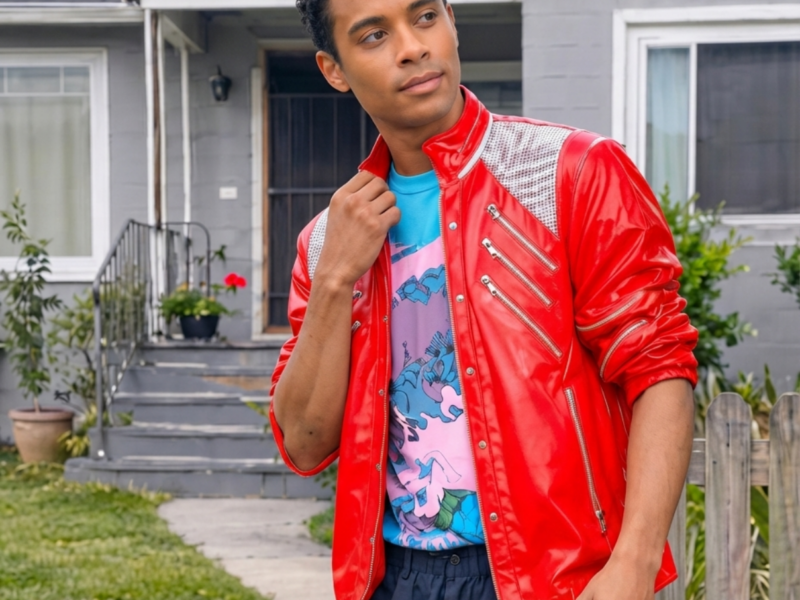
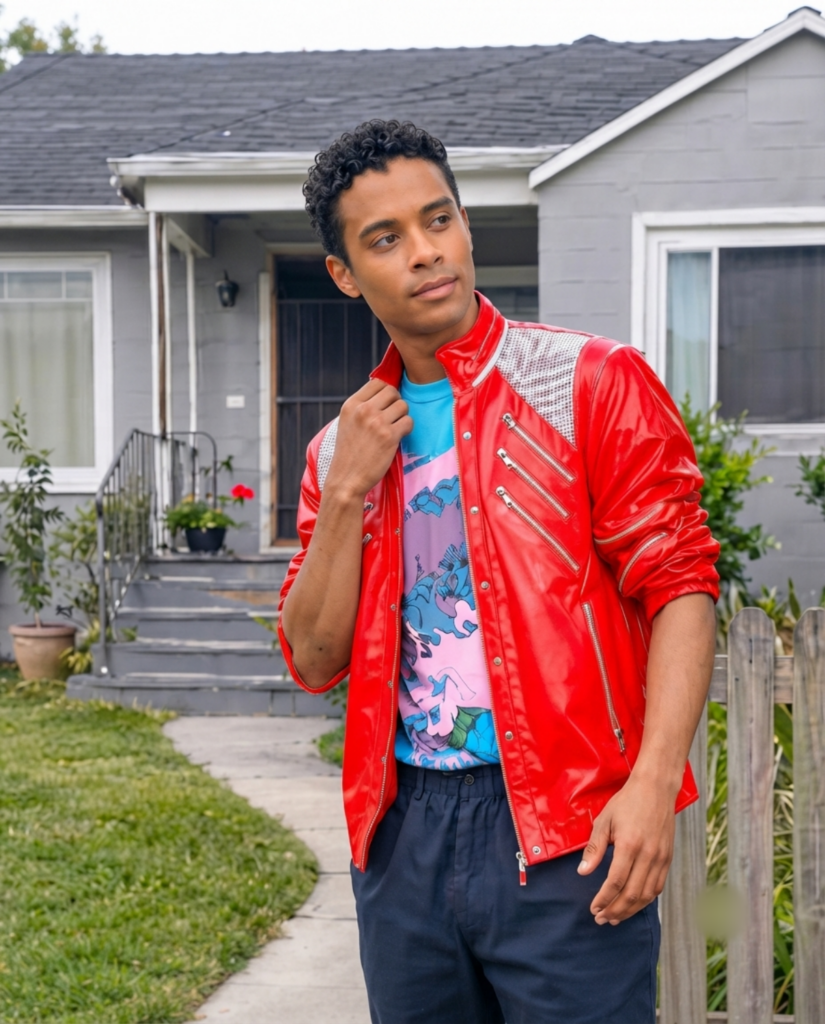
Lionsgate confirmed that Michael Jackson would be played in a major studio biopic by his real-life nephew Jaafar Jackson, the son of Jermaine Jackson and Alejandra Oaziaza.
He was 26 years old.
He had never starred in a movie.
He had released exactly one single, a 2019 song called “Got Me Singing” that had quietly gathered 10 million views on YouTube.
And he shared a face with the most photographed man of the 20th century.
A face so familiar that his own family stopped in their tracks.
Katherine Jackson, Michael’s mother, put it in writing: “Jaafar embodies my son. It’s so wonderful to see him carry on the Jackson legacy of entertainers and performers.”
Jaafar marked the moment on Instagram with a promise to the fan base.
“I’m humbled and honored to bring my uncle Michael’s story to life. To all the fans all over the world, I’ll see you soon.”
But before the announcement, before the cameras, there was a video.
And it was not supposed to reach the director at all.
Antoine Fuqua, the man behind *Training Day* and *The Equalizer*, told the story on the Rich Eisen Show.
He was on a film set in Italy shooting *The Equalizer 3* when his cinematographer, the legendary Robert Richardson, walked over with a phone.
On the screen was a figure performing like Michael Jackson.
The stance.
The glide.
The precision.
Fuqua assumed it was archival footage of Michael himself.
It was Jaafar, shot in the present day.
“Could not tell the difference,” Fuqua said.
What he did not know was that Jaafar had been rehearsing to become his uncle for roughly two years before Fuqua ever joined the project.
A preparation Graham King, the producer who had spent years interviewing hundreds of people who knew Michael, had quietly arranged.
Fuqua believed the resemblance was the easy part.
The real question was whether a man with zero acting experience could carry a $155 million film.
So he tested him.
And what happened next is the moment everyone who has told this story comes back to.
First came a test screening.
“When I tell you, man, he walked out the room and it was Michael Jackson,” Fuqua recalled.
Then he threw an unscripted question at Jaafar.
No rehearsal.
No warning.
Asking him to respond as Michael Jackson.
And Jaafar answered in character.
And the room changed.
“He answered the question as if he was Michael and he had the whole room with tears in their eyes,” Fuqua said.
“And I was like, he’s the real deal.”
Think about what that means.
Grown adults.
Film professionals who had seen every impression, every tribute act, every imitation on every talent show on earth.
And they were crying.
Not because a boy looked like his uncle.
Because something in the way he stood, the gentleness Fuqua described, his way he spoke, and his behavior and his gentleness reached into the room and pulled out a man who had been dead for 14 years.
Then came a first day of principal photography.
No warm-up.
No small scenes to ease in.
Jaafar’s debut in front of camera was a recreation of the Bad Tour staged in front of 500 extras.
And he blew everybody away.
Fuqua said, “For an actor’s very first scene in his very first film, that is not a beginning. That is a gauntlet.”
And it raises the question this whole story turns on.
How does a nephew with no training walk onto a set and do that?
The answer, it turns out, is that the role cost him more than anyone outside the family can imagine.
Because for Jaafar Jackson, Michael was never a legend on a poster.
He was the man who hid candy at Neverland.
Jaafar was born in Los Angeles on July 25th, 1996.
By then, his uncle was the biggest star alive.
But inside the family, the dynamics were stranger and softer than the tabloids ever showed.
In his first television interview on the *Today Show* in April 2026, Jaafar described it himself.
“I remember just growing up and we would have family time. Michael would come over to where I was growing up and we’d have some days where we’d all get together, play family game day.”
Then he said the sentence that has stopped fans cold ever since.
“We’d have wonderful times at Neverland and just playing hide-and-go-seek, getting as much candy, going on rides, watching movies. It was all fun.”
Hide-and-go-seek at Neverland.
The most searched-for man on the planet.
The owner of a private amusement park.
Crouching behind a tree while his nephew counted to 10.
That is the image nobody put in a documentary.
That is the detail that makes this story human instead of mythological.
Because myths don’t play hide-and-seek.
And Jaafar was 12 years old when that uncle died.
June 25th, 2009.
Michael Jackson was 50 years old, dead from acute propofol intoxication in a rented mansion in Los Angeles, weeks before a 50-show comeback residency in London.
The county coroner ruled it a homicide.
His personal physician, Conrad Murray, was later convicted of involuntary manslaughter.
The world mourned an icon.
A 12-year-old boy in Encino mourned a man who used to come over for family game day.
Jaafar’s father, Jermaine, was four years younger than Michael, growing up in the same shadow.
Childhood inside the Jackson family was never ordinary.
In early 2010, when Jaafar was 13, police and child protection officers investigated the family home in Encino after he bought a stun gun online.
A strange, sad footnote that shows how tightly the world watched every corner of his family, even its children.
Jaafar started singing and dancing at 12, dreamed improbably of becoming a professional golfer, and grew up covering Sam Cooke and Marvin Gaye while the ghost of the family’s greatest name filled every room.
In 2021, he appeared in a music video for his uncle Tito’s single, “Love One Another.”
Three years later, Tito was gone, the first of the brothers to die while the film about the family was still being rebuilt.
When the casting call for history came, he didn’t audition.
There was nothing to audition against.
There was only blood and work.
“I never dreamed of being an actor or even thought of playing him, but I knew it was a calling,” Jaafar said in the film’s behind-the-scenes featurette.
“I really had to earn the role and prove to the filmmakers that I was capable of becoming Michael. Essentially, it was starting at the roots and finding that authenticity.”
Antoine Fuqua saw it from the other side of the monitor.
“To see how much he cares, that’s what makes him so special. Whatever that spirit of Michael he’s bringing is present and everyone on the team can feel it.”
And Jaafar, on *Today*, put the weight another way.
“There’s definitely a responsibility that you feel going into something this big. There’s so many moments that I wanted to nail and make sure I had the true essence.”
Production was supposed to begin in 2023, but the SAG-AFTRA strike froze Hollywood through the summer and pushed the start to January 2024, primarily in Santa Barbara, with John Logan, the screenwriter of *Gladiator* and *Skyfall*, behind the script.
The cast was stacked.
Colman Domingo as Joe Jackson.
Nia Long as Katherine.
Miles Teller as attorney John Branca.
The younger Michael was played by Juliano Krue Valdi, and the brothers were split between child and adult performers.
Jamal Henderson as Jermaine.
Ryan Hill as Tito.
Joseph David Jones as Jackie.
Trey Horton as Marlon.
Jessica Sula as La Toya.
Around them assembled a gallery of the era’s real names.
Kendrick Sampson as Quincy Jones.
Lawrence Tate as Berry Gordy.
Liv Simone as Gladys Knight.
Derek Luke as attorney Johnnie Cochran.
And Kat Graham as Diana Ross.
And Domingo, like his co-star, produced one of those moments directors talk about for years.
Fuqua described turning a corner on a soundstage and seeing a man with his back to him in full hair and makeup.
He assumed it was a wig test.
The man turned around.
It was Domingo.
And then began talking to Fuqua in character as Joe Jackson, mid-conversation about the day’s schedule.
Fuqua was so shaken he went straight to Graham King and rewrote the shooting plan.
“I said, ‘Graham, we should film Colman today.'”
It was not planned.
Footage from that unplanned afternoon made the final cut, intercut with the brothers performing on their final tour.
Michael’s own son, Prince, served as an executive producer and was a daily presence on set.
Production wrapped on May 30th, 2024.
The film was scheduled for April 18th, 2025.
And then in June 2024, an attorney for the estate opened a settlement file and found the sentence.
Here is what the world was not supposed to know.
The original version of *Michael* did not end on a stage.
It began, in the words of *Variety*’s reporting in *Media’s Rez*, with one of the darkest chapters of the singer’s life.
In one scene from the original script, the King of Pop stares at his reflection in a mirror, capturing his sorrowful gaze as police car lights flash behind him.
It is 1993, and Jackson has just been accused of child molestation.
The scene was meant to open the film.
The story deliberately starting inside its darkest hour.
Investigators arrive at Neverland Ranch to search for evidence.
Much of the film’s third act was devoted to the scandal, the accusations that shadowed the final 16 years of his life, the trial in 2005 where he was acquitted on all counts, the allegations he denied until the day he died.
And all of it was deleted.
Not softened.
Deleted.
Because when estate attorneys examined the fine print, they discovered a clause in a settlement with one of the accusers, Jordan Chandler, that barred the depiction or mention of him in any movie.
The clause had sat unnoticed through every stage of development.
Michael Jackson always insisted on his innocence and was never criminally convicted of anything related to the allegations.
But the legal machinery of a settlement signed in the 1990s had just quietly reached into 2024 and rewritten a Hollywood ending.
What happened next reads like a disaster movie shot from behind the camera.
During production, rumors had swirled that the cut ran close to four hours and the studio was weighing a two-part release.
The original cut, in fact, had run more than three and a half hours, and Graham King had always hoped to shape the story into two films.
Instead, the release date slid from April 2025 to October 3rd, 2025, and then again to spring 2026.
The rewrite dragged on longer because John Logan’s own home was damaged in the Palisades fire.
The man rewriting Michael Jackson’s ending while his own house burned.
In June 2025, the entire cast reassembled for 22 days of additional photography to shoot a brand-new third act.
Because the production had primarily shot in Santa Barbara and restarted in Los Angeles, it failed to qualify for California state tax rebates, adding between $10 and $15 million to the budget.
Some outlets reported the total bill could reach $50 million.
The film had been greenlit at $155 million.
The final cost swelled to somewhere between $170 and $200 million.
And here is the detail that tells you everything about who controls this story.
The Jackson Estate shouldered those extra costs, because its own oversight had necessitated the changes, and in exchange, it took an equity stake in the film.
The family was no longer just consultants on Michael Jackson’s story.
They were shareholders in it.
The new ending was chosen with surgical care.
Instead of closing on the darkest moment of Jackson’s career, the film now ends at his zenith, on the Bad Tour, following him as he prepares to walk on stage for another electrifying performance.
The dramatic engine of the final act is no longer a courtroom.
It is his relationship with his father, the domineering Joe Jackson, who resisted his son’s solo career for fear it would destroy the Jackson 5.
The film does keep one tender thread, a scene where Jackson buys toys for children in a hospital.
It also walks carefully into one wound the estate considered safe enough to show.
The 1984 Pepsi commercial shoot, when a pyrotechnics accident burned Jackson’s scalp, and the painkillers prescribed for that recovery began the dependence that would shadow the rest of his life.
Pain is allowed on screen in this film as long as it happened before 1989.
And one famous name is simply absent.
Janet Jackson is not a character in the movie at all.
At the Los Angeles premiere, La Toya Jackson explained why.
“She was asked and she kindly declined, so you have to respect her wishes.”
Janet has never publicly said more.
The most famous living Jackson, a superstar in her own right, looked at this film and chose silence.
She was not the only one.
In September 2025, Colman Domingo told *People* that Prince and Paris Jackson had been helpful and very much in support of the film.
Paris Jackson did not let that stand.
She posted that she had no involvement in the project at all.
That while fans might enjoy it, the movie portrays an inaccurate picture of her father’s life.
And she used the words “full-blown lies.”
Then she wrote the sentence that cut deepest.
“I spoke up. I wasn’t heard. I’m fed up. Y’all going to like the f***ing movie. So just go watch it, go enjoy it, do whatever. Leave me out of it.”
Michael’s daughter, publicly distancing herself from the movie about her father, produced by the estate that manages his legacy.
Prince stayed involved.
Bigi, the youngest, attended the Berlin premiere in support.
One family.
One film.
Two opposite verdicts.
And no way to know which one Michael himself would have chosen.
La Toya, Jackie, Jermaine, and Marlon showed up in support.
Randy, locked in a family conflict with Jermaine for years, has never commented at all.
The teaser trailer finally dropped on November 6th, 2025, and the internet did what it always does.
Split in half.
Millions watched Jaafar recreate the *Thriller* video, the moonwalk, the iconic performances.
“The tracks are made, the songs are ready,” an engineer announces in the teaser.
A line that carried strange weight for anyone who knew how much of this movie had been rebuilt.
Some called it the most convincing resemblance ever put on screen.
Others asked what the film was leaving out.
Dan Reed, director of the documentary *Leaving Neverland*, had written in *The Guardian* back in February 2023, weeks after the casting was announced.
“No one is talking about cancelling this movie, which will glorify a man who raped children.”
And then he added the line that will follow this film forever.
“What the total absence of outrage accompanying the announcement of this movie tells us is that Jackson’s seduction is still a living force operating from beyond the grave.”
That is the other side of this story, stated plainly.
There are people for whom this film is a betrayal.
And their evidence is not invented.
The film’s producers were betting the estate’s confidence came from elsewhere.
From the Broadway musical *MJ*, which pointedly ends just before the 1993 allegations break and has grossed over $300 million.
The estate also pointed to the Cirque du Soleil show *One* and the 2009 concert film *This Is It*, proof the appetite had never faded.
*MJ* was one of only four new musicals to survive on Broadway since the pandemic.
That success convinced the estate the public was ready to embrace a sympathetic Michael.
The math said yes.
The history said maybe.
Then the world premiere arrived.
April 20th, 2026, at the Dolby Theater, the same building that hosts the Oscars.
And the red carpet told a story of its own.
Kat Graham announced that her role as Diana Ross had been cut from the film entirely.
An Oscar-nominated actress erased from the movie the week it premiered.
The reviews that followed were, in the words of *Vanity Fair*’s tally, mostly negative.
Some critics calling the film “sanitized.”
And most brutally, “not a movie.”
The man who had made a casting room cry, who had walked out of a test screening and left professionals whispering that Michael Jackson had entered the room, was now the star of a film a critic said had removed its own soul.
And yet, the tracking numbers said it would open above $55 million domestically, higher than *Bohemian Rhapsody* managed, with the studio internally hoping for $700 million worldwide.
Initial ticket sales were still climbing as the release approached.
And comparisons to the $910 million global run of *Bohemian Rhapsody* hung over every projection.
Lionsgate’s Adam Fogelson had already confirmed the creative team was preparing more.
“I can tell you that the creative team is hard at work making sure that we’re in a position to deliver more *Michael*s soon after we release the first film.”
Graham King has told the studios roughly 30% of the material cut from this film could be reconstituted for a second one.
Neverland Ranch.
The later albums.
*Dangerous*.
*Invincible*.
His love of animals.
Which means the buried third act.
The deleted mirror scene.
The flashing police lights over Neverland.
That footage exists.
It sits in a vault, and everyone involved knows a second film would have to walk straight into the darkness the first one paid up to $50 million to avoid.
Through all of it, Jaafar has kept one steady answer on *Today*.
In his first television interview, he described a craftsman’s checklist.
“I wanted to set goals for myself to nail the mannerisms. I didn’t want the dancing to outdo the acting and the acting outdo the dancing.”
And revealed that the vocals in the film are a mixture of his voice and his uncle’s.
Because, as he put it, it was simply his uncle’s essence.
Sit with that for a moment.
In the movie, when Michael Jackson sings, it is a duet between a dead man and the nephew he once played hide-and-seek with at Neverland.
Every time the King of Pop opens his mouth on screen, one voice is living and one is gone.
And neither of them is acting alone.
“I honestly wouldn’t be able to pull this off if I didn’t have the support,” Jaafar said.
The family standing behind him, heart to heart, while his most famous daughter walked away.
His first film role.
His uncle’s face.
His uncle’s voice woven through his own.
There has never been a performance like it in the history of cinema.
And there may never be one again.
So, is the movie worth what it cost?
The money.
The years.
The family fractures.
The deleted darkness.
That answer belongs to the audience.
Now, hold one image before you go.
In June 2024, an attorney at the Jackson estate found a sentence in a settlement file, and 22 days of filming a dead legend’s darkest chapter were erased before the world ever saw them.
Somewhere in a vault in California, that footage still exists.
The mirror.
The sorrowful eyes.
The police lights washing over Neverland.
It may be shown someday.
It may never be.
And somewhere in memory, there is another scene no camera ever captured.
The King of Pop hiding behind a tree, waiting for his nephew to find him.
One of those images is footage.
The other is a 12-year-old boy’s last memory of his uncle.
Hollywood bought the first one for $200 million.
The second one, Jaafar Jackson carried into every frame for free.









