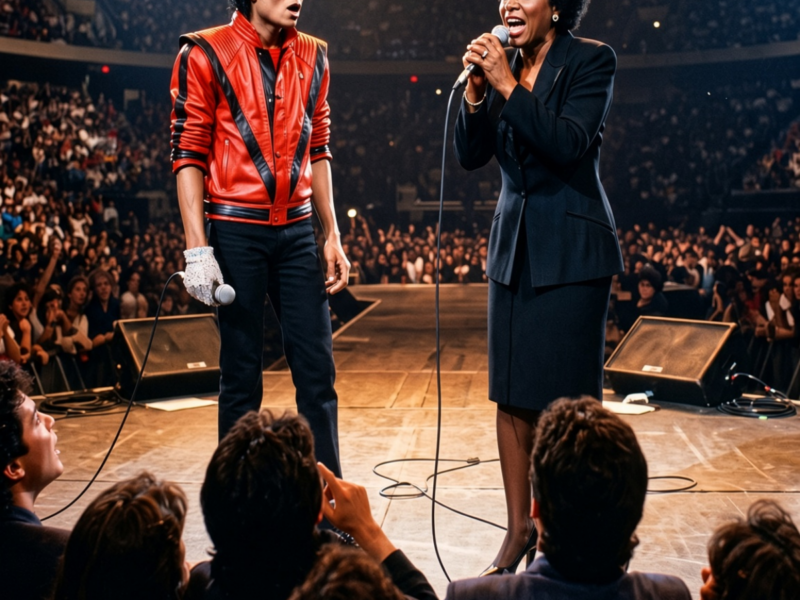
MYSTERIOUS Woman Joined Michael Jackson on Stage — Her Voice Made Him STOP Mid-Song.

Michael Jackson stopped singing in the middle of a word.
Twenty thousand people were packed into Madison Square Garden that night, and most of them had been screaming since the lights went down.
Now nobody was screaming.
The keyboard player kept going for two more bars, then three.
Then his hands slowed down and lifted off the keys like he’d touched a hot stove.
The drummer was the last to quit.
After that, there was nothing.
Just the hum of the big speakers.
And way up in the top rows, one person who didn’t understand what was happening laughed, and then stopped laughing.
Michael was standing at the front of the stage in a red and black leather jacket, one white glove on his right hand, the microphone hanging down at his side like he’d forgotten he was holding it.
He wasn’t looking at the crowd.
He was looking at the woman standing next to him.
She was fifty-seven years old.
She was wearing a dark church suit with a small pin on the lapel and sensible shoes she’d bought on sale at a store in Jamaica, Queens.
Ten minutes earlier, she had been sitting in the front row next to her granddaughter, holding a pocketbook on her knees.
She wasn’t a performer.
She hadn’t sung in front of anybody in fifteen years.
She’d only come because somebody had to take the girl, and she had just opened her mouth and sung one line of Michael Jackson’s own song back to him in a voice that made the hair stand up on the arms of every person in that building.
Michael’s lips moved.
People in the first few rows swore later that they saw him whisper something, a question, but nobody could hear it.
Then he did something nobody on that tour had ever seen him do.
He turned his back on twenty thousand people, put his hand over his mouth, and stood there with his shoulders shaking.
What happened over the next twenty minutes is one of those stories people tell for the rest of their lives.
Some of them tell it wrong.
Some of them add things that never happened, but they all agree on one point.
Michael Jackson knew that voice.
He had heard it before, a long time ago, in a little room at the back of a theater in Chicago when he was nine years old and so scared he couldn’t stop shaking.
And the woman in the church suit had no idea he remembered.
To understand how they ended up on that stage together, you have to go back a few weeks, then a few years, and then a great deal further, to a sewing machine, a torn pair of pants, and an old hymn about a little bird.
If you’re watching this right now, tell me in the comments where in the world you’re listening from.
I read them, all of them, and it never stops surprising me how far these stories go.
And if there’s a voice from your childhood you still carry around with you, stay right here, because this story is for you.
It was the summer of 1984, and there was no bigger name on earth than Michael Jackson.
Thriller had come out at the end of 1982, and it simply would not stop selling.
By the summer of ’84, it was the biggest album anybody had ever made.
Kids in Tokyo were doing the moonwalk in school hallways.
Kids in London had single white gloves.
Grown men in offices argued about whether that jacket in the Beat It video was cool or ridiculous, and then went home and watched the video again.
That summer, Michael went back on the road with his brothers.
They called it the Victory Tour.
Jackie, Tito, Jermaine, Marlon, Randy, and Michael.
All six of them on one stage for the first time in years.
It opened in Kansas City in July, and it was enormous.
Stadiums, mostly fifty thousand people a night.
Lights and fog and a stage so big it took a convoy of trucks to move it from city to city.
There had been a lot of trouble about the tickets.
At first, you couldn’t just walk up and buy one.
You had to mail in a money order for a block of four seats, one hundred twenty dollars, and then wait and hope you’d been picked in a lottery.
A lot of families couldn’t come up with that kind of money all at once, and a lot of them were angry, and the newspapers wrote about it.
Michael hated that.
In the middle of July, he stood up at a press conference and said the ticket system would change and that he’d be giving every dollar he made from the tour to charity.
In early August, the tour came to New York.
Three nights at Madison Square Garden.
It was smaller than the stadiums, about twenty thousand seats, which meant it was the closest a lot of people were ever going to get to him.
And in a small apartment in Jamaica, Queens, a sixteen-year-old girl named Denise Haynes had been praying about those three nights since the day they were announced.
Denise had every record.
She had a Thriller poster on her bedroom door and a smaller one inside her closet where her mother couldn’t see it and tell her she was too old for posters.
She had taught herself the moonwalk on the kitchen linoleum in her socks until the day she slid right into the refrigerator and dented it.
She’d saved her babysitting money for eight months for the Victory Tour lottery, and she’d lost the lottery.
She cried for one whole evening and then went back to school.
Then two weeks before the shows, a radio station on the FM dial ran a contest.
Be the ninth caller when they played Human Nature, and you’d win two seats in the front row for the Saturday show.
Denise sat by the telephone in the hallway for three straight days.
On the third day, when the first few notes came on, she dialed so fast she broke a fingernail.
She was the ninth caller.
Her mother, Gloria, was a night nurse at a hospital in Queens, and Saturday was the one night she couldn’t get off.
She’d already traded two shifts that month.
She came home the next morning in her white shoes, sat down at the kitchen table, and said, “Baby, I’m sorry. I can’t. I tried.”
Denise looked at the tickets on the table like somebody had just told her they’d expired.
And then her grandmother, who had been standing at the stove frying eggs the whole time, said without turning around, “I’ll take her.”
Denise and her mother both stared at her.
Loretta Haynes was fifty-seven years old.
She went to church on Sundays and Wednesdays.
She worked six days a week at a dry cleaner on Jamaica Avenue doing alterations, taking up hems and letting out waistbands for people who’d had too many good dinners.
She went to bed at 9:30.
She did not go to rock concerts.
As far as anybody in that family knew, she had never been to a concert of any kind.
“Mama, it’s going to be loud,” Gloria said.
“I’ve heard loud,” Loretta said.
She flipped an egg.
“Somebody’s got to take the child. I’m not going to have her riding that train into Manhattan by herself at eleven at night. I’ll bring my earplugs. I’ll sit there. She can scream for both of us.”
So that was settled.
Or it seemed to be.
But Gloria noticed something that morning that she didn’t say out loud until years later.
When Loretta turned around to set the plate down, her eyes were wet.
Gloria thought it was from the onions.
There weren’t any onions.
This story is about to take a turn nobody expected, because Loretta Haynes had not always been a woman who did alterations at a dry cleaner.
And this was not the first time her life had crossed paths with Michael Jackson.
She had just never told anybody about the first time.
Not her daughter-in-law, not her granddaughter, not the pastor at her church.
Nobody.
She was born in 1927 in Clarksdale, Mississippi, the youngest of five children.
Her father worked on a cotton farm outside town, and her mother took in washing.
They didn’t have much, and what they did have mostly went to keeping shoes on five pairs of feet.
But they had church, and church had music.
Loretta started singing before she could read.
Her mother used to stand her on a wooden chair in front of the little church on Sundays because she was too short to be seen otherwise and let her sing the opening hymn.
She was six years old.
She had a voice that didn’t match her body at all.
It was low and big and warm, and it had a crack in it, a little catch right in the middle that made grown men look down at their shoes.
An old deacon used to say, “That little girl didn’t sing to you. She sang about you, and you’d better hope it was something nice.”
When she was sixteen, in 1943, her family packed up and went north, like so many families from the Delta did in those years.
They rode the train to Chicago with everything they owned in four suitcases and two cardboard boxes tied with string.
They ended up on the South Side in a cold-water flat near 47th Street.
Her father got work in a meatpacking plant.
Her mother cleaned houses on the North Side, and Loretta found the churches.
In the 1940s, the South Side of Chicago was the center of the gospel music world.
There were church choirs that could make the windows rattle.
There were traveling groups that sang in a different town every night of the week.
There were songwriters and piano players and radio programs on Sunday mornings.
If you could sing, really sing, somebody would hear you.
Somebody heard Loretta.
By the time she was twenty, she was singing with a gospel group called the Calvary Sisters.
Four women, one piano player, and an old Buick with a busted heater.
They sang in churches all over the Midwest.
Gary, Indiana.
Detroit.
St. Louis.
Memphis.
Little towns in Ohio where they’d sleep at the pastor’s house because the hotels wouldn’t take them.
They’d sing three services on a Sunday and then drive all night to get to the next one.
Loretta sang lead.
She was the one who did the long notes at the end.
The ones that went up and up and then came down soft like somebody setting a baby in a crib.
People fainted at those notes.
Not every night, but often enough that the group started bringing a church usher with smelling salts.
In 1953, the Calvary Sisters recorded two songs for a small Chicago label.
It was a tiny little record.
They pressed a few thousand copies and sold them out of the trunk of the Buick after church.
It never got anywhere near the charts.
But if you ask around among the older gospel collectors, there are still a few people who know that record, and they’ll tell you the second side has one of the best lead vocals ever cut in Chicago in that decade.
That was Loretta.
In 1947, she married a man named Raymond Haynes.
Raymond was a Pullman porter on the trains that ran out of Chicago, which meant he was gone four or five days at a time and came home smelling like coal smoke and starch.
He was quiet and gentle and couldn’t sing a note, and he thought his wife was the most wonderful thing God had ever put on the South Side.
They had one son, Calvin, born in the spring of 1948.
For a while there, Loretta had everything.
A husband who adored her.
A little boy who sat in the front pew and clapped on the wrong beat.
A voice people drove a hundred miles to hear.
Then, in the winter of 1960, Raymond had a heart attack on a train somewhere between Chicago and New Orleans.
He was forty years old.
It brought him home in a box.
Loretta was thirty-three with a twelve-year-old son and a rent payment due.
The Calvary Sisters were still getting dates, but a gospel group doesn’t pay steady, and a woman can’t leave a twelve-year-old boy alone for a week at a time while she sings in Memphis.
So she did what she had to do.
She quit the group.
Her mother had taught her to sew when she was little, and she was good at it.
Very good.
So she went looking for steady work with a needle, and she found it in a place she never expected.
The Regal Theater.
If you grew up on the South Side of Chicago in those years, the Regal was the center of the universe.
It sat at 47th Street and South Parkway, a huge old movie palace with gold paint on the ceiling and velvet seats.
And it had been the most important Black theater in the Midwest since the 1920s.
Everybody played the Regal.
Duke Ellington.
Ella Fitzgerald.
Nat King Cole.
Later on, the Motown acts.
The Supremes.
The Temptations.
Stevie Wonder when he was still Little Stevie.
James Brown sweating through three shirts a night.
And all those acts needed costumes, and costumes tear.
Loretta got a job in the wardrobe room.
It was a narrow room in the basement under the stage with pipes running across the ceiling.
Two sewing machines, an ironing board, a long rack of hangers, and a mirror with a crack in the corner.
It smelled like steam and hot dust and hair pomade.
When the band was playing upstairs, the whole room hummed, and the hangers on the rack shook against each other like little bells.
She worked there for eight years.
She let out suits for singers who’d gained weight on the road.
She sewed sequins back on gowns.
She fixed zippers that broke three minutes before a curtain.
She sewed buttons on James Brown’s shirts so many times she said she could do it in her sleep.
And sometimes she did.
And while she sewed, she sang.
She didn’t sing loud.
She didn’t sing for anybody.
She sang the old hymns her mother used to sing over the washtub, under her breath, while she worked.
It was the only singing she did anymore.
A few of the performers who came down to that basement got used to it.
They’d come in with a torn hem and stand there a little longer than they needed to, just listening.
One of the Temptations used to say Loretta’s room was the only quiet place in the whole Regal, even with the band going right over your head.
If you’re enjoying this story so far, do me a small favor and tap that like button.
It honestly helps these stories reach more people than you’d ever guess.
And stay with me, because we’re about to go down into that basement on one particular night and meet a very small boy who was very, very scared.
The Regal had an amateur night.
It had had one for years.
Every so often, local acts would get a shot at the big stage in front of a real crowd.
And the crowd would decide who won by how loud they cheered.
It was not a polite crowd.
If they liked you, they lifted the roof.
If they didn’t, they let you know that, too.
And they didn’t wait for you to finish.
In 1967, a family act from Gary, Indiana came to amateur night.
Five brothers.
Their father was a steelworker named Joseph who’d once played guitar in a little band of his own.
The boys had been rehearsing in their living room for years with their father standing over them and making them do the same step again and again until it was perfect.
They had already won talent shows in Gary.
They’d played some clubs.
They played a lot of places most kids their age should never have been inside of.
The smallest of them, the one who sang lead, was eight or nine years old.
His name was Michael.
That night, about forty minutes before they were supposed to go on, Loretta was sitting at her machine hemming a pair of trousers for a saxophone player when the door banged open and a tall, stern-looking man walked in holding a little boy by the wrist.
“His pants are torn,” Joseph Jackson said.
“Can you fix it?”
Loretta looked at the boy.
He was wearing a little vest and a matching pair of trousers, and the seam on the back of the trousers had split open right down the middle, from the waistband almost to the knee.
He’d done a spin in the hallway during warm-ups, and the cheap thread had just given out.
“I can fix it,” Loretta said.
“Take them off and give me ten minutes.”
Joseph nodded and went back out.
Somebody upstairs was yelling for him.
There was always somebody yelling for somebody at the Regal.
So the boy stood there in the middle of that basement room in his little shirt and his underwear and his socks, holding his trousers out to a woman he’d never seen before.
And Loretta noticed he was shaking.
Not a little.
His whole body was shaking like a dog that’s been left out in the rain.
His teeth were clicking together.
His eyes were huge.
When she took the pants from his hand, his fingers were ice cold.
“Baby, you cold?” she asked.
He shook his head.
“You scared?”
He didn’t answer.
He looked at the floor.
She took a towel off the ironing board and wrapped it around his shoulders, and she sat him down on a wooden stool next to her machine.
Then she turned the trousers inside out and started pinning the seam.
“You know what’s up there tonight,” she said, not looking at him, just talking.
“Two thousand people. And I’ll tell you a secret about every one of them. Every single one of them is scared of something. The man selling popcorn is scared his wife’s going to leave him. The lady in the third row is scared her boy’s not going to come home from the army. Everybody’s scared. You’re not special for being scared. You’re just a little bit more honest about it.”
The boy said nothing, but he stopped looking at the floor and started looking at her hands.
She ran the seam through the machine once, then turned it around and ran it again, double-stitched so it would hold through any kind of spin.
And while she did that, without really thinking about it, she started to sing.
It was an old hymn called His Eye Is on the Sparrow.
It had been her mother’s favorite.
It’s a song about a little bird and the idea that if God keeps an eye on something as small as a sparrow, then He’s surely keeping an eye on you.
Loretta’s mother used to sing it over the washtub in Clarksdale.
And Loretta sang it the same way.
Low and slow.
And at the end of each line, she did a little turn with her voice.
A little curl.
It went up and around and then dropped down, almost like a sigh.
Her mother used to do it.
Nobody else Loretta ever heard did it quite that way.
She sang it under her breath the way she always did.
Then she noticed that the boy had stopped shaking, so she sang it a little louder.
By the time she got to the end of the second verse, Michael was sitting very still on that stool with the towel around his shoulders, his eyes fixed on her face, his mouth a little open.
He wasn’t shaking at all.
She finished the last line, did the little curl at the end, and bit off the thread with her teeth.
“There,” she said.
“That seam’s not going anywhere. You could do a cartwheel in these.”
The boy took the trousers and stepped into them.
And while he was buttoning them, he asked his first and only question of the night.
His voice was very small and very high.
“How do you sing like that and not get scared?”
Loretta laughed.
Then she leaned down so they were eye to eye.
“I’ll tell you the trick,” she said.
“My mama told it to me when I was littler than you. When you get up there, don’t you look at all those people. It’s too many. Nobody can sing to two thousand people. You pick one face. Just one. Somebody way in the back who looks like they need it. And you sing the whole song to that one person like nobody else is in the room. You do that, baby, and you won’t have time to be scared. You’ll be too busy.”
Michael looked at her for a long moment.
Then he nodded very seriously, the way children do when somebody has told them something important.
Somebody banged on the door.
“Jacksons, five minutes.”
And the boy ran out, and Loretta went back to the saxophone player’s hem.
She heard them through the ceiling.
She heard the crowd go quiet when they started, then start to buzz, and then she heard something she didn’t hear very often at amateur night.
She heard the Regal Theater crowd go completely out of its mind.
The ceiling over her head shook so hard that dust came down on her sewing machine.
The Jackson brothers won amateur night that evening.
Within two years, they were signed to Motown.
Loretta never saw the boy again.
Not in person.
She never knew if he’d even heard what she said.
She went back to her hems and her zippers and her hymns.
And the next week, there was another act and another torn seam.
Then, in December of 1969, she was sitting in her living room watching the Ed Sullivan Show, and five brothers from Gary, Indiana came out in matching outfits and sang their first big hit.
And the little one, the one up front, was spinning and sliding and grinning like he owned the whole world.
Loretta put her hand over her mouth.
“Lord,” she said out loud to nobody.
“That’s my boy with the pants.”
She watched the whole thing standing up, and she noticed something.
All through the song, the boy kept singing toward one spot.
Not the camera, not the crowd in front.
One spot, way out in the back of the theater, like there was somebody sitting back there he was singing to.
She smiled.
She told herself she was being a foolish old woman.
Plenty of singers do that.
It probably meant nothing.
But she was smiling at the time, and she should remember that, because she didn’t smile much more that year.
Six months before that broadcast, in the summer of 1969, two men in Army uniforms had come up the stairs of her apartment building in Chicago and knocked on her door.
Calvin had been twenty-one years old.
He’d been drafted in 1968, right after he married a nurse’s aide named Gloria, and he’d shipped out to Vietnam two months before his daughter was born.
He saw his baby girl once, in a photograph, which he kept in the pocket over his heart.
He was killed in a place called the A Shau Valley in May of 1969.
The baby’s name was Denise.
At Calvin’s funeral, the pastor asked Loretta if she’d sing.
Everybody expected it.
The whole church was full of people who’d heard her sing at a hundred other funerals.
People who’d driven in from Gary and Milwaukee because they knew she’d sing for her own boy, and they wanted to be there to hear it.
She stood up.
She walked to the front of the church.
She opened her mouth, and nothing came out.
Not a note.
Not a sound.
She stood there with her mouth open for maybe ten seconds while the whole church held its breath, and then she closed it again and walked back to her seat and sat down.
The organist played something instead.
She never sang again.
Not at church, not at weddings, not under her breath at the sewing machine.
It was as if something in her had been unplugged, and she didn’t have the strength or the wish to plug it back in.
The Regal Theater had closed its doors in 1968.
A few years later, they tore it down.
By then, Loretta had already left Chicago.
Gloria had family in Queens, and after Calvin died, she went back to New York with the baby.
Loretta held out in Chicago alone for a few years, but there was nothing there for her anymore except a grave and an empty apartment.
In 1974, she packed her sewing machine into a crate and moved to Jamaica, Queens, into the spare room of Gloria’s apartment to help raise her granddaughter.
She found the job at the dry cleaner.
Within a week, she joined a church on a quiet side street, and she sat in the back pew.
And when the congregation stood up to sing, she stood up, too, and held the hymnal open and moved her lips, but no sound came out.
People in that church assumed she just couldn’t sing.
Some of them felt a little sorry for her.
Denise grew up with her grandmother in the next room, and she never once heard her sing.
Not a lullaby.
Not Happy Birthday.
When Denise was little and asked why, Loretta would say, “Grandma’s voice went on vacation, baby,” and change the subject.
And all those years, every time Michael Jackson came on the radio, Loretta Haynes reached over and turned it down a little.
Not off.
Just down.
She never explained that either.
So now you understand why her eyes were wet that morning in the kitchen, holding a frying pan, when her granddaughter’s face fell over a pair of front-row tickets.
She hadn’t planned to say it.
It just came out of her mouth.
“I’ll take her.”
And then she spent the next two weeks wondering what on earth she’d done.
Before I take you into Madison Square Garden on that Saturday night, I’d love it if you’d hit subscribe if you haven’t already.
It’s free, it takes a second, and it means the next story like this one shows up right where you can find it.
And if you’ve ever lost your voice in some way, I mean really lost it the way Loretta did, tell me about it in the comments.
I think a lot of people out there know exactly what that feels like.
The Saturday came.
Denise was ready by two in the afternoon, even though the show didn’t start until eight.
She changed her outfit three times.
In the end, she wore a pair of jeans, a white T-shirt she’d ironed herself, and one white glove she’d bought at a drugstore and covered with sequins from a craft store, one sequin at a time, with a hot glue gun, over four evenings.
Loretta wore her church suit.
It was dark, with a straight skirt and a jacket with shoulder pads, and she pinned a small gold brooch on the lapel that Raymond had given her for their tenth anniversary.
She wore low heels and stockings, and she brought a pocketbook with tissues, peppermints, a little bottle of aspirin, two pairs of foam earplugs, and forty dollars folded inside a change purse in case of emergencies.
“Grandma,” Denise said, looking at her from the doorway.
“You look like you’re going to a funeral.”
“I’m going to New York City at night,” Loretta said.
“Same thing.”
They took the train in from Jamaica.
It was a hot, sticky August evening, and the subway car was full of kids heading for the same place.
Kids in sequined gloves and red jackets and sunglasses at seven at night.
A boy across from them was practicing the moonwalk in the aisle while the train rocked back and forth.
Every few seconds, he’d lose his balance and grab the pole.
Denise was trying very hard to look like she was too grown up to be excited.
She wasn’t fooling anybody.
Her knee was bouncing so hard the whole bench shook.
Loretta sat with her pocketbook on her lap and watched the dark tunnel walls go by.
And she didn’t say much.
They came up out of the station at 34th Street, and the noise hit them before they’d reached the top of the stairs.
There were thousands of people on the sidewalks outside the Garden.
Police on horseback.
Men selling T-shirts out of garbage bags.
Somebody had a boombox on his shoulder playing Thriller at full volume, and a whole group of teenagers on the corner was doing the dance from the video right there on Seventh Avenue, shuffling sideways with their arms out like zombies while the taxis honked.
Loretta held Denise’s hand tight the whole way to the doors.
She hadn’t held Denise’s hand on the street in years.
Denise let her.
Their seats were in the very first row, a little to the left of center, right up against the barrier, close enough that Denise could have reached out and touched the front of the stage if the security men hadn’t been standing there.
She just stood there with her mouth open, looking up at it.
Huge black speaker stacks.
Rows of lights hanging from steel frames.
A drum riser.
Keyboards.
It all looked like the inside of a spaceship.
“Grandma,” she whispered.
“Grandma, he’s going to be right there. Right there.”
“I see it, baby.”
Loretta sat down, put her pocketbook under her seat, and looked around.
Twenty thousand people filling the arena from the floor all the way up to the dark rafters.
The noise was like the ocean.
Every couple of minutes, a wave of screaming would start somewhere up in the cheap seats and roll all the way around the building for no reason at all.
She thought, for no reason she could explain, about that basement room at the Regal.
About the hangers shaking on the rack.
About how small two thousand people seemed compared to this.
Then the lights went out.
The sound that came out of that crowd was not something Loretta Haynes had ever heard in her life.
It was so loud it didn’t feel like sound anymore.
It felt like weather.
It pushed against her chest.
Next to her, Denise was screaming with both hands over her mouth, and Loretta could see her doing it, but she couldn’t hear a single thing coming out of her.
Loretta reached into her pocketbook for the earplugs.
Then she stopped and left them there.
The show was everything people said it was.
The six brothers came out of the smoke and the lights, and it was the Jacksons, the real thing.
All of them together.
Jermaine sang a couple of his own songs.
Marlon and Randy and Jackie and Tito were up there moving in step like they’d been doing it their whole lives, which they had.
But when Michael stepped up to the front, it was a different thing altogether.
Loretta had seen a lot of performers.
She’d sewn the costumes on half the legends of rhythm and blues.
She’d seen James Brown fall to his knees four times in one song and get up every time looking fresher than before.
She’d watched Jackie Wilson do the splits in a pair of trousers she’d personally let out an inch.
So she was not an easy woman to impress.
But she sat in that front row and watched that skinny young man move, and she forgot she was supposed to be bored.
He moved like water does when it’s going downhill, like there was nothing in the way.
He’d stop dead, completely still, one hand up, and the whole Garden would scream.
Then he’d spin and come out of the spin sliding backwards, and you couldn’t see how his feet were doing it.
Denise was crying and screaming and jumping, and her sequin glove was waving over her head, and a few sequins were already coming off and falling on the floor like little stars.
Loretta didn’t scream.
She sat with her hands folded in her lap.
But during one song, somewhere in the middle of the show, she noticed something, and it stuck with her.
Michael would sing to the crowd, and he’d move all over that stage.
But every so often, for a few lines, he’d lift his chin and look way up into the back of the building.
Not at the front rows where the screaming was loudest.
Way up into the dark, up near the rafters, like he’d found somebody up there.
Loretta’s breath caught in her throat.
Then she shook her head at herself.
“You old fool,” she thought.
“That boy’s sung to ten million people since that night. He doesn’t remember some lady in a basement.”
About an hour into the show, the stage lights changed.
The big flashing colors faded, and one soft white spotlight came down on the front of the stage, and the band started something slow.
A few soft chords on the keyboard, then the strings from somewhere behind.
Denise grabbed her grandmother’s arm so hard it left marks.
“Grandma,” she said.
“Grandma, it’s She’s Out of My Life.”
Loretta knew it.
Everybody knew that one.
It was from Off the Wall, back in 1979, and it was the saddest song on the whole record.
A slow ballad about a man who knows he’s let love walk out the door and knows it’s his own fault.
When Michael recorded it in the studio, the story goes, he cried at the end of the take, and they left it on the record.
You can still hear his voice break on the last line.
On the Victory Tour, he sang it alone at the front of the stage with just that single light on him.
And during it, he did something he was becoming famous for.
He’d go to the edge of the stage, look out at the front rows, and pick somebody.
Usually a girl.
Usually a young one.
Usually somebody who was screaming her head off and crying.
Security would lift her up over the barrier and onto the stage, and he’d hold her hand and sing the song to her while she fell apart, and twenty thousand people screamed with jealousy.
Every girl in the front row knew it was coming.
Every girl in the front row had been hoping for it since the moment she sat down.
Denise grabbed Loretta’s arm with both hands.
“Grandma, he’s going to pick somebody. He’s going to pick somebody from right here.”
The first rows went crazy.
Girls were screaming his name and holding their arms out.
Somebody a few seats down held up a hand-painted sign.
A girl behind them was sobbing so hard she couldn’t breathe, and her friend was fanning her with a program.
Michael started the first verse, standing at the front edge of the stage in his red and black jacket with the light on him and the microphone in his gloved hand.
And Loretta Haynes, sitting very still in the middle of all that screaming, did something she had not done in fifteen years.
She sang along.
Not out loud.
Not really.
It was barely a sound at all.
Just a breath with a shape to it.
The words of the song moving her lips.
Her eyes were closed.
Her hands were folded in her lap.
She didn’t even know she was doing it.
It was the first song in fifteen years that had gotten past whatever lock she’d put on herself after Calvin’s funeral, and it got past it because it was a song about losing somebody and knowing it was too late to fix it.
She wasn’t thinking about a girlfriend.
She was thinking about a boy in a front pew who clapped on the wrong beat.
And on the stage, about eight feet above her, Michael Jackson was looking for somebody to sing to.
His eyes went along the front row, past the screaming girls and the signs and the arms reaching up.
And they stopped on the one person in that whole section who wasn’t screaming.
A gray-haired woman in a dark church suit, sitting perfectly still with her eyes closed and her lips moving and tears running down her face.
He stood there looking at her for two full lines of the song.
Then he walked to the edge of the stage, bent down, and held out his hand.
Not toward the screaming girls.
Toward her.
Denise saw it first.
She grabbed her grandmother’s shoulder and shook it so hard Loretta’s eyes flew open.
“Grandma, Grandma, he’s pointing at you.”
Loretta looked up.
There he was, right above her, one white glove held out, and those big dark eyes looking straight at her face.
She shook her head.
She put up both hands, palms out.
“No, no, no.”
She pointed at Denise.
“Take her. Take the girl.”
Michael shook his head, smiling a little, and pointed at Loretta again.
The girls around them had figured out what was happening, and they were screaming at Loretta now.
“Go! Go, lady, go!”
Denise was crying and pushing her grandmother up out of her seat with both hands.
“Go, Grandma, go! Oh my God, go!”
A big security man in a black T-shirt was already leaning over the barrier.
“Ma’am,” he said.
“Ma’am, he wants you. Come on.”
And before Loretta had decided anything at all, two pairs of hands were helping her over the barrier, and she was being walked up a little set of metal stairs at the side of the stage in her low heels and her church suit, with her pocketbook still under the seat and her heart going so hard she could feel it in her ears.
Then she was on the stage.
She remembered later that the lights were the first thing.
You don’t understand how bright it is up there until you’re standing in it.
It was like stepping into the sun.
She couldn’t see the crowd at all.
Just a dark, roaring nothing with little sparks of light in it where people were holding up lighters.
And then there was a hand in hers.
A gloved hand.
Very light.
Very gentle.
Michael Jackson led her to the front of the stage and turned her around to face that dark roaring nothing, and kept singing.
He sang the whole second verse to her face, holding her hand, his eyes on hers.
The crowd was making a sound like a jet engine.
And Loretta, who had never in her life been frightened of a stage, found that she was shaking.
Her whole body.
Her teeth were clicking together.
Her hand in his was ice cold.
He felt it.
She saw him feel it.
Something in his face changed for a second.
Something small and puzzled.
And then it was gone.
He came to the part of the song where he usually let the girl he’d picked sing a line.
That was the bit.
That was the joke, really.
He’d tip the microphone toward her, and she’d giggle or scream or squeak out a couple of words, and the crowd would laugh and cheer, and he’d take the microphone back and finish the song.
He tipped the microphone toward Loretta.
He gave her a little nod.
Go on.
She looked at the microphone, and for one second she was back at the front of that church in Chicago fifteen years ago with her mouth open and nothing coming out.
Every person she’d ever loved who was gone was standing behind her in the dark.
Her mother.
Raymond.
Calvin.
She thought, “I can’t. I can’t do it here either.”
And then she thought of something else.
She thought of a little boy on a wooden stool with a towel around his shoulders, asking her, “How do you sing like that and not get scared?”
She knew the answer.
She’d given it to him herself.
So Loretta Haynes stopped trying to look at twenty thousand people, which nobody can sing to.
She looked out past the lights into the dark, up toward the very top of the building, and she picked one spot way up there in the back where nobody could see anything at all.
And she pretended her son was sitting in it.
And she sang one line.
That’s all it was supposed to be.
One line of Michael’s own song.
The sound that came out of her was not a sound anybody in that building was expecting.
It was low and enormous, and it filled the Garden all the way to the roof without even trying.
It had church in it.
And the Delta.
And a basement full of steam and hot dust.
It had a crack in it, right in the middle.
A little catch that you felt in your own chest before your ears understood what was happening.
It was the voice that made people faint in little churches in Ohio in 1950.
The screaming stopped.
Not slowly.
All at once.
Like somebody had pulled a plug.
Twenty thousand people just closed their mouths.
And at the end of the line, without meaning to, without even knowing she was doing it, Loretta did the little thing her mother used to do.
The little curl.
Her voice went up and around and dropped down soft at the end, almost like a sigh.
And that’s when Michael Jackson stopped singing in the middle of a word.
Before I tell you what Michael whispered to her on that stage and why he turned his back on the whole Garden, I want to ask you something.
If this story has gotten to you even a little bit, let me know by liking the video and type the word “sparrow” in the comments so I know you’re still here with me.
Because what comes next is the part I’ve been waiting to tell you.
The band fell apart behind him, one instrument at a time.
The keyboard player.
The strings.
The drums.
Then the Garden was quiet.
Not quiet the way a church is quiet.
Quiet the way a room gets when everybody in it has just realized they’re watching something they don’t understand.
Michael was standing very close to her, still holding her hand.
He was staring at her face.
The microphone hung down at his side.
His lips moved, and Loretta heard him say it, though nobody else did.
His voice was very small and very high.
And suddenly, impossibly, it was the voice of a nine-year-old boy.
“The pants,” he said.
Loretta stared at him.
“Chicago,” he whispered.
“The Regal. You fixed my pants.”
Then his face crumpled, and he let go of her hand, and he turned around so the audience couldn’t see him, and he put his hand over his mouth.
His shoulders were shaking.
Up on the drum riser, Randy had both drumsticks frozen in the air.
Marlon took two steps forward and then stopped, not sure if he should come any closer.
Jackie looked at Tito, and Tito just shrugged, his eyes wide.
None of them had seen their little brother do anything like this on stage in their whole lives.
Not once.
Not when the stage broke, not when the sound went out, not ever.
Out in the dark, twenty thousand people held perfectly still.
Loretta stood there in her church suit and her low heels, not sure what to do with her hands.
Then she did the only thing she knew how to do.
She did what she’d done in that basement.
She stepped up behind him, put one hand on his shoulder, and leaned in close.
“Baby,” she said quietly.
“You’re all right. Turn around. They’re waiting on you.”
Michael wiped his face with the back of his gloved hand.
Then he turned around.
His eyes were red and wet, and there were stripes in his makeup, and he was smiling the biggest smile she’d ever seen on anybody’s face.
He lifted the microphone.
“I’m sorry,” he said to the crowd, his voice cracked.
“I’m sorry. Give me one second.”
The Garden laughed softly, the way you’d laugh at a friend.
And some people clapped.
Somebody up in the back yelled, “We love you, Michael.”
And the whole building cheered and then went quiet again to listen.
“I want to tell you something,” Michael said.
“I need to tell you something, and I’m going to do it right now, because I’ve been waiting seventeen years to say it.”
He put his arm around Loretta’s shoulders.
“When I was nine years old,” he said, “my brothers and I played amateur night at the Regal Theater in Chicago. It was one of our first really big shows, and I was so scared. I was so scared I couldn’t stop shaking. And before we went on, I split my pants. Right down the back. And my father took me downstairs to the wardrobe room, and there was a lady down there with a sewing machine, and she fixed my pants. And while she fixed them, she sang to me.”
He looked at Loretta.
She had both hands pressed flat against her chest.
“She sang an old hymn,” Michael said, “and I stopped shaking. And then she told me a secret. She told me how to sing to a big crowd and not be scared. And I’ve done it. Every single show ever since. Every show since I was nine.”
He swallowed.
“And I never knew her name. I asked about her. I asked people at the Regal for years. Nobody could tell me. And then they tore the Regal down. And I thought, ‘Well, that’s it. I’m never going to get to thank her.'”
He stopped.
He had to.
“That voice I just heard,” he said finally.
“That’s her voice. That’s the lady. She’s standing right here.”
Twenty thousand people came up out of their seats at the same time.
It wasn’t a cheer, exactly.
It was something bigger and stranger than that.
A sound that had gasping in it, and crying, and people calling out things nobody could make out.
In the front row, Denise Haynes had both hands over her face, and she was sobbing so hard the girl next to her, a total stranger, was holding her up.
Michael held up one hand, and the noise came down again.
He turned to Loretta and held the microphone between them so everybody could hear.
“What’s your name?” he said.
She leaned toward the microphone.
Her voice was steady now.
“Loretta Haynes.”
“Loretta,” Michael said, like he was trying it out, like he wanted to remember it this time.
“Miss Loretta, would you do something for me? If I can, baby, would you sing it again? The song you sang me. The one about the bird?”
Loretta looked out at the dark.
Then she looked down at the front row at her granddaughter, who was nodding at her through her tears, nodding and nodding, mouthing the word “please.”
Her granddaughter had never once heard her sing.
Sixteen years.
Not a lullaby.
Not Happy Birthday.
“All right,” Loretta said.
Michael signaled to the band to stay quiet.
He took one step back, out of the light, so she was standing in it alone.
And Loretta Haynes closed her eyes and sang “His Eye Is on the Sparrow,” unaccompanied, to twenty thousand people at Madison Square Garden.
She sang it the way her mother had sung it over the washtub in Clarksdale.
Low and slow at first.
Then, as the hymn went on, she let it open up the way she used to in the little churches when the spirit got going.
Her voice climbed and climbed and filled up the building and came back down soft.
And at the end of every line, there was that little curl.
That little sigh that nobody else in the world did quite the same way.
People who were there that night still talk about it.
A man who’d been sitting up in the 300 level wrote a letter to a newspaper in Brooklyn the next week, and he said the sound came up to where he was sitting like it was looking for him personally.
A woman who’d brought her two daughters said she watched a security guard, a big man, maybe 250 pounds, stand at the barrier with his arms folded and tears running straight down his face into his collar, and not even bother to wipe them.
Up on the drum riser, Randy put his sticks down on the snare very quietly, so they wouldn’t make a sound.
And Michael Jackson stood just outside the circle of light with his eyes closed and his lips moving, singing along under his breath.
Not a sound came out of him.
He wasn’t singing to the crowd.
He was just a little boy on a stool in a basement, listening.
When she reached the last line, Loretta looked up past the lights into the very top of that dark building, to one empty spot up there, way in the back, and she sang the last note to it.
Then she stopped.
The silence after that note was the longest silence of the whole Victory Tour.
Some people say it was ten seconds.
Some people say it was more.
Nobody moved.
Nobody coughed.
Then somebody up in the back started clapping, slow.
And then the whole building came down.
If you’ve stayed with me this long, thank you.
Really, I know these stories take some time, and I don’t take it lightly that you’re spending yours here.
If you want to hear more of them, make sure you’re subscribed and turn on the little bell so you know when the next one is ready.
Now, let me tell you how they finished that song.
When the noise finally started to settle, Michael stepped back into the light.
He took Loretta’s hand again.
Then he turned around to the band.
“From the top,” he said into the microphone.
“‘She’s Out of My Life.’ From the top. And this time, Miss Loretta is singing it with me.”
The keyboard player played the opening chords again, soft.
The strings came in, and they sang it together.
People who know Michael’s music know how he sang that song.
Light.
Fragile.
A voice that sounded like it might break at any second because it was about to.
Loretta’s voice was something else entirely.
It was deep and wide and strong, a voice that had held up whole congregations on its shoulders.
Two voices that should not have worked together at all.
They worked.
Michael took the first verse, and she came in under him very quietly, filling in the bottom of the sound the way she used to fill in behind the Calvary Sisters.
On the second verse, he nodded at her, and she took the melody, and he slid around her, high and light, like a bird going around a tree.
It didn’t sound like a pop song anymore, and it didn’t sound like church.
It sounded like two people who’d both lost somebody and both knew exactly what that song was really about and weren’t pretending anymore that it was about a girlfriend.
When they got to the end, where Michael’s voice always broke on the record, he didn’t sing it.
He let her sing it.
And Loretta’s voice didn’t break.
It held.
It held that last line all the way out to the end, and then let it go soft, like setting a baby in a crib.
Michael put his arms around her and hugged her right there in front of twenty thousand people for a long time.
The ovation went on for almost four minutes.
People who were there say it was louder than anything else that night.
Louder than “Billie Jean.”
Louder than “Beat It.”
Michael kept trying to step back and let her have it.
And she kept trying to step back and give it to him.
And finally, Jackie came down from his spot and took both of them by the elbows and walked them to the front of the stage together, and they bowed.
Then Michael walked her to the stairs himself.
He wouldn’t let security do it.
He held her hand all the way down the metal steps and back to the barrier, and he leaned down and spoke to her in her ear before he let her go.
She nodded.
Then he looked over at Denise, who was standing there with her face wet and her sequin glove half bald from all the sequins that had fallen off, and he pointed at her and smiled and touched his own glove.
Denise nearly passed out.
The show went on.
It had to.
There were still five songs left.
But every person in that building said afterward that something had changed in it.
Michael danced harder in the last half hour than he had all night.
And during “Billie Jean,” during the part where he stood stock still at the front of the stage with one hand up and twenty thousand people screaming, he looked down at the front row, a little to the left of center, and he winked.
If this story has moved you, please share it with somebody who needs to hear it.
Maybe somebody who stopped singing a long time ago, in whatever way they sing.
And tell me in the comments, who was the person who told you something when you were small that you still carry with you today?
I’ll be reading.
After the last song, the lights came up, and twenty thousand people started filing toward the exits.
Loretta reached under her seat for her pocketbook.
It was right where she’d left it.
Earplugs and peppermints and forty dollars and all.
She was halfway done buttoning her jacket when a young man with a laminated pass around his neck came up to the barrier.
“Mrs. Haynes,” he said.
“Michael asked me to bring you back. You and your granddaughter, if you’d like to come.”
Denise made a sound like a teakettle.
They followed the young man through a door at the side of the floor, down a concrete hallway, past men rolling equipment cases and women carrying armfuls of costumes, past a room where somebody was yelling into a telephone about a truck in New Jersey.
Loretta noticed the costumes.
Out of habit, she looked at the seams.
She noticed one jacket with a sleeve coming loose at the shoulder and made a little mental note about it, which made her laugh at herself.
The young man knocked on a door and opened it.
It was a small room.
That’s what surprised Denise most later on.
She’d expected something like a palace.
It was a little cinder-block room with a couch, a mirror with lights around it, a rack of jackets, a table with fruit and bottles of water, and a television set in the corner that nobody was watching.
Michael was sitting on the couch.
He’d taken his jacket off and was wearing a plain shirt, and he’d wiped most of the makeup off.
And without it, he looked very young.
Younger than twenty-five.
When the door opened, he stood up so fast he knocked over a bottle of water.
“Miss Loretta,” he said, and then before she could say anything, he crossed the room and hugged her again.
They talked for almost an hour.
A couple of his people kept putting their heads in the door, looking at their watches, and he kept waving them away.
He wanted to know everything.
Where she’d been.
What happened after the Regal.
How she ended up in Queens.
And Loretta found herself telling him things she hadn’t told anybody in years.
About Clarksdale and the wooden chair at the front of the church.
About the Calvary Sisters and the Buick with the busted heater.
About Raymond.
And then, slowly, with Denise sitting right there listening to it, about Calvin.
She told him about the funeral.
About standing in front of that church with her mouth open and nothing coming out.
About fifteen years of moving her lips in the back pew.
Denise had never heard any of it.
Not like that.
She sat on the arm of the couch and cried quietly the whole time, and Michael reached over at one point and handed her a box of tissues without looking away from Loretta.
When she was finished, Michael was quiet for a while.
“Can I tell you something?” he said finally.
“Go ahead, baby.”
“After that night at the Regal,” he said, “I did what you told me. Every show. I picked one face way in the back, and I sang to it. At first I did it because I was scared. Then I did it because it worked. And then after a while, I don’t know, it started to be something else. I started thinking that maybe somebody really was back there. Somebody who needed it. And I’d better sing the song right, in case they did.”
He shrugged a little, embarrassed.
“Tonight I picked you because you weren’t screaming,” he said.
“Everybody else was screaming, and you were just sitting there crying with your eyes closed, and I thought, ‘That lady needs this song more than anybody in this building. So I’m going to sing it to her.'”
He smiled.
“I didn’t know it was you. I didn’t know until you opened your mouth. And then you did that thing at the end. That little turn.”
“My mama’s,” Loretta said.
“I’ve been trying to do that turn for seventeen years.”
Michael said, “I’ve never gotten it right. Not once. I’d know it anywhere.”
Loretta laughed and wiped her eyes.
Then he got serious.
He leaned forward with his elbows on his knees.
“Why did you stop?” he asked.
“Really?”
Loretta thought about it.
“Because singing was always for somebody,” she said.
“I sang for my mama. I sang for Raymond. I sang for my boy every Sunday, sitting in that front pew. And when they were all gone, I just thought, ‘Well, who’s it for now? There’s nobody to sing it to anymore, so what’s the use?'”
Michael nodded slowly.
Then he said something that Denise wrote down that same night on the train home, on the back of a ticket stub, so she wouldn’t forget it.
“You taught me that it’s okay to sing to somebody you can’t see,” he said.
“That’s what you told me. Pick one face way in the back, even if you can’t really see them. Miss Loretta, you’ve been singing to people you couldn’t see your whole life. You just forgot you knew how.”
Loretta didn’t say anything for a long time.
“Tonight,” she said finally, “when I sang that song, I picked a spot way up at the very top of the building, right up under the roof, and I pretended my Calvin was sitting there.”
“I know,” Michael said.
“I saw you look up there. I thought you might be doing that.”
She nodded.
“Felt like he was,” she said quietly.
Then Michael asked her the question he’d been working up to.
“Would you sing again? Not just tonight. I mean really sing. Make a record. I know people. I know a man who makes gospel records. He’s the best there is. And he would lose his mind if he heard you. I’ll call him myself tomorrow. Whatever it costs, I’ll take care of it.”
Loretta laughed out loud.
“Baby, I’m fifty-seven years old. I hem pants for a living. Nobody’s making a record with a fifty-seven-year-old seamstress from Queens.”
“Why not?”
“Because nobody buys records from old ladies.”
“Miss Loretta,” Michael said, “you just made twenty thousand people in New York City shut up. You know how hard that is? I’ve been trying to do it all summer.”
He smiled.
“That voice doesn’t know how old you are. It doesn’t care. And it’s not done yet.”
Before they left, he went to the rack of jackets in the corner and came back holding one of his own stage gloves.
A white one, covered in rhinestones.
The real thing.
He handed it to Denise.
Denise looked at it in her hands like it might break.
“Your grandmother’s going to need a manager,” Michael told her, completely serious.
“You’ve got to make sure she shows up. You promise?”
Denise nodded so hard her earrings jingled.
Then, as they were walking out the door, Loretta turned around.
“Michael,” she said.
He looked up.
She pointed at the rack.
“That jacket on the end. The right sleeve is coming loose at the shoulder. Have somebody put a double stitch on it before tomorrow, or it’s going to come off in the middle of ‘Beat It.'”
Michael looked at the jacket.
Then he looked at her, and he laughed so hard he had to sit down.
Denise and her grandmother took the subway home to Jamaica at one in the morning.
The car was almost empty.
Denise held the white glove in her lap the whole way, in both hands.
She kept looking over at her grandmother, and finally she said, very quietly, “Grandma, you never told me.”
“I know.”
“Why?”
Loretta watched the dark tunnel go by for a while.
“I guess I thought it was mine,” she said.
“One little thing that was just mine. And I didn’t think he’d remember. Why would he? I was just a lady with a sewing machine.”
Denise laid her head on her grandmother’s shoulder.
They rode like that for a few stops.
Then, somewhere under Queens Boulevard, Loretta started humming.
Very softly.
Just under the noise of the train.
Denise didn’t move.
She didn’t say a word.
She was afraid if she did, it would stop.
It didn’t stop.
Loretta hummed all the way home.
Michael Jackson called the next morning.
Gloria answered the phone in the hallway in her bathrobe, having gotten home from her shift about forty minutes before and having heard absolutely none of this story yet.
A soft voice on the line said it was Michael and could he please speak to Miss Loretta.
Gloria said, “Michael who?” and was about to hang up when Denise came flying down the hallway and snatched the phone out of her hand.
He’d done what he said.
He’d called the gospel producer himself, from his hotel, at eight in the morning.
The producer was a man named Harold Pruit who ran a small studio and a gospel label in Newark and had been making church records for thirty years.
When Michael described the voice to him, Harold Pruit was polite but not very excited.
People told him about wonderful voices every week.
Then Michael told him the name of the Calvary Sisters.
There was a long silence on the line.
Then Harold Pruit said, “The Calvary Sisters? The Chicago Calvary Sisters? 1953?”
“I think so,” said Michael.
“I have that record,” Harold Pruit said.
“I’ve had that record since I was a teenager. That woman on the second side. I’ve been asking people for thirty years what ever happened to her.”
Loretta went to Newark three weeks later.
She took the train wearing the same church suit.
She told her boss at the dry cleaner she’d be back by two.
She was not back by two.
She stood in front of a microphone in a little studio with egg-carton foam on the walls, with Harold Pruit behind the glass and a piano player who’d driven in from Philadelphia, and they ran through “His Eye Is on the Sparrow” once, just to get the level set.
When she was done, Harold Pruit didn’t say anything for a long while.
Then he pushed the talkback button and said, “Mrs. Haynes, I’m going to need you to quit your job.”
She didn’t quit her job.
Not then.
But she did start going to Newark every Saturday.
The album came out in the spring of 1985.
It was called Sparrow.
Eleven songs, most of them the old hymns her mother had sung over the washtub, plus two new ones Harold Pruit’s piano player wrote for her.
On the back of the record sleeve, there was a short note, just a few lines, written by Michael Jackson.
It said that the woman on this record had taught him how to sing to a crowd when he was nine years old and that he’d been waiting his whole life to hear her voice again.
It was never a big hit.
Gospel records like that almost never are.
But it sold steadily, in the churches and the little record stores and out of the trunks of cars after Sunday services, the same way the Calvary Sisters record had thirty years before.
Gospel radio stations played it.
Choir directors started buying it to play for their choirs.
Somebody wrote a long review of it in a gospel magazine that said, “Loretta Haynes sang like a woman who had been through the fire and come out carrying a song in each hand.”
Loretta cut that review out and taped it to the side of her sewing machine.
She did quit the dry cleaner, eventually, in 1986.
For the next ten years, she sang churches, mostly, revival and gospel festivals in the summertime.
She sang at the funerals of half the old people in Jamaica, Queens, and she never once had trouble getting a note out again.
She went back to Chicago twice to sing at churches on the South Side.
And both times, people came up to her afterward, old people who said they remembered her from the Calvary Sisters, and cried.
One old man brought her a copy of the 1953 record in its original paper sleeve and asked her to sign it.
She signed it with a ballpoint pen, and her hands were shaking.
She made two more records with Harold Pruit, and she started singing in the front pew of her church on Sunday mornings, out loud.
The first Sunday she did it, the whole congregation turned around to look, and the pastor stopped in the middle of the hymn and then started laughing and said, “Well, Sister Haynes, where have you been hiding that?”
Denise kept her promise.
She was the manager.
At sixteen, then seventeen, then eighteen.
She kept the calendar, made the phone calls, carried the bags, and made sure her grandmother showed up.
She went to college a few years later to study music education, and she became a choir teacher at a public high school in Queens, and she taught there for thirty years.
She still has the white glove.
It’s in a frame on the wall of her living room, next to a framed photograph of Loretta standing on a stage in a dark church suit in a circle of white light, with a young man in a red and black jacket standing just outside the light with his eyes closed.
Michael didn’t forget her either.
He sent her a Christmas card every year.
Every year, without missing one, and always with a short note in his own handwriting.
And in March of 1988, when his Bad tour came to Madison Square Garden, he sent two front-row tickets to an apartment in Jamaica, Queens, with a note that said, “Same seats.”
That night, during “Man in the Mirror,” he walked to the front of the stage and pointed down into the front row, a little to the left of center, and brought her up again.
And this time, he didn’t make her sing just one line.
They sang the whole last part of it together, with the gospel choir behind them.
And Loretta took the very last note herself, the way she’d taken it in 1984, holding it out up toward the roof.
People who were at both shows say the second time was louder, but the first time was the one they talk about.
Loretta Haynes died in the fall of 1997, at seventy years old, in Queens, with Gloria and Denise in the room.
Denise was holding her hand.
The last thing she did, the nurse said later, was hum something very softly.
Nobody could tell what it was, but Denise knew.
The funeral was at the little church on the quiet side street.
It was packed.
There were people from Chicago and Newark and choir members from twelve different churches and old women who’d heard the Calvary Sisters in Ohio forty-five years before.
A huge spray of white flowers arrived that morning with no name on the card, only a drawing in pen of a little bird.
Denise sang at the funeral.
She sang “His Eye Is on the Sparrow.”
And at the end of every line, she did the little turn her grandmother had done.
The little curl.
The sigh.
She’d practiced it for weeks.
She says she still doesn’t get it quite right.
She says, “Nobody ever will.”
Some years later, Michael was asked in an interview about the people who had shaped him as a performer.
He named the ones you’d expect.
James Brown.
Jackie Wilson.
Fred Astaire.
Then he stopped, and he said there was a woman most people had never heard of.
She’d fixed his pants in a theater basement in Chicago when he was nine years old.
And she taught him the most important thing anybody ever taught him about singing.
“She told me to sing to one person,” he said.
“Not the whole crowd. One person, way in the back, who needs it. I still do it every show. And sometimes, when I look up there, I swear I see her.”
There’s a recording of that night in August of 1984.
It’s not official.
A boy in the second row had snuck a little cassette recorder into the Garden inside his jacket.
The sound is terrible.
It’s mostly screaming, and a lot of it sounds like it was recorded from the bottom of a swimming pool.
But in the middle of “She’s Out of My Life,” the screaming suddenly stops.
And in that silence, scratchy and far away, you can hear a woman’s voice come out of the dark.
Low and enormous, with a crack right in the middle of it.
One line.
And a little turn at the end, like a sigh.
And then you hear Michael Jackson stop singing in the middle of a word.
A mysterious woman joined Michael Jackson on stage and her voice made him stop mid-song.
But the reason he stopped wasn’t because she was loud or because she was good, though she was both.
He stopped because he recognized her.
Because seventeen years earlier, in a basement under a theater that doesn’t exist anymore, a stranger with a needle and thread had noticed a little boy shaking and taken the time to sing to him and given him a piece of advice he carried for the rest of his life.
She thought it was nothing.
She thought he’d never remember.
That’s the thing about kindness.
You almost never get to find out where it goes.
You fix a seam, you sing a song, you tell a scared child one true thing, and then the door bangs open and he runs off and you go back to your work and you never see him again.
But sometimes, once in a great while, he comes back, and he finds you in the front row, and he holds out his hand.









