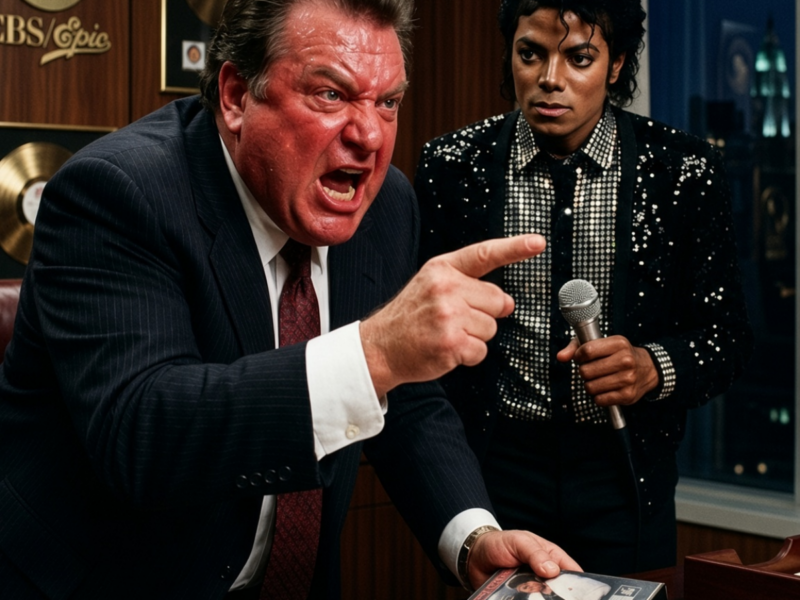
MTV Didn’t Want Michael Jackson — Until His Videos Became Too Big to Ignore.
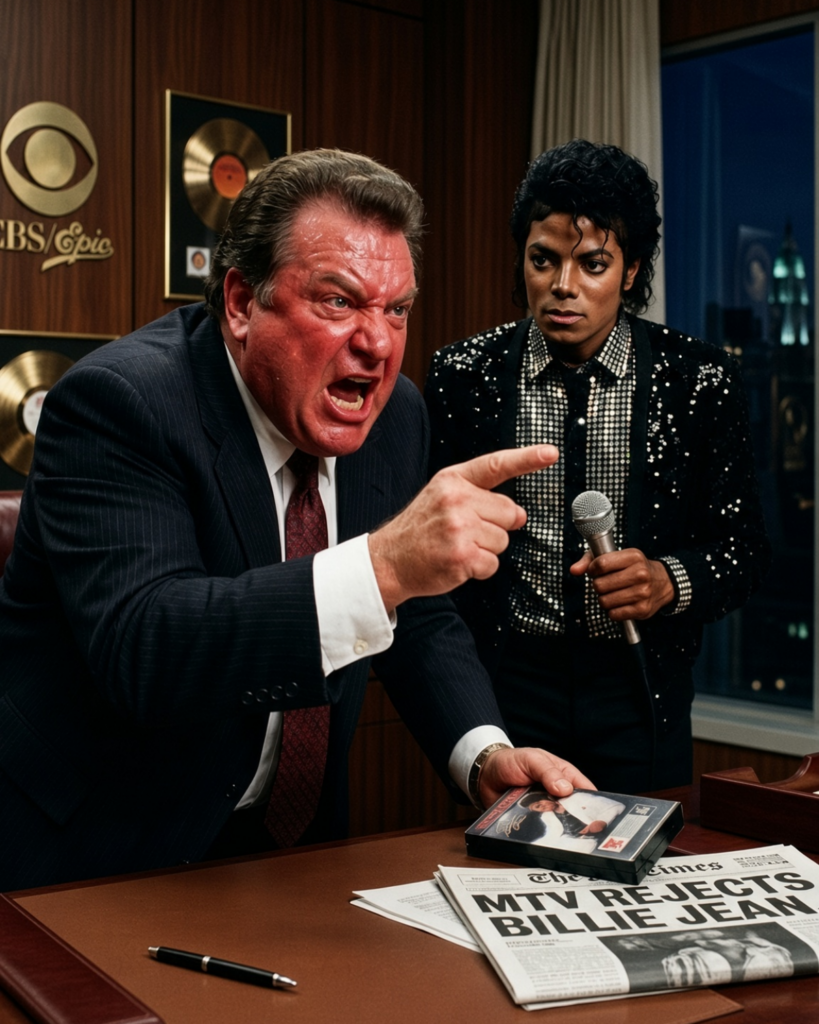
The NBC studio director was screaming into his headset, demanding Michael Jackson cut his dance routine because Black artists didn’t belong on TV—until eight seconds of movement broke MTV forever.
In the summer of 1981, three letters launched on American cable television that promised to change the music industry forever.
MTV.
When Music Television first hit the airwaves on August 1, 1981, its opening image was literal footage of the Apollo 11 moon landing.
The voiceover declared, “Ladies and gentlemen, rock and roll.”
The network presented itself as a counterculture revolution—a twenty-four-hour visual radio station run by cool young visionaries who were going to tear down the dusty rules of corporate broadcasting.
But behind the scenes, MTV was governed by an ironclad policy that was never printed in any public manual, yet understood by every record executive in New York and Los Angeles.
Rock music only.
To MTV’s programming director, Bob Pittman, and his team, rock music wasn’t just a genre.
It was a visual and racial demographic.
They argued that their target audience was suburban white teenagers.
And to keep those teenagers from changing the channel, the programming needed to reflect what they assumed those kids wanted.
In practice, that meant white artists playing guitars.
Of the first 120 music videos played on MTV, virtually none featured Black musicians.
Artists who were selling out arenas across the country—Earth, Wind & Fire, Donna Summer, Prince, and Stevie Wonder—were systematically shut out.
MTV executives claimed it wasn’t about race.
It was simply about format.
They insisted they were a rock station, not an urban station.
Then came late 1982.
Michael Jackson wasn’t a newcomer begging for a break.
He was already a superstar.
His 1979 solo album, Off the Wall, had yielded four top-ten hits and sold millions of copies.
By November 1982, he released Thriller—an album meticulously engineered alongside producer Quincy Jones to dismantle the traditional boundaries between pop, rock, funk, and R&B.
When Epic Records brought the newly minted music video for “Billie Jean”—a cinematic masterpiece directed by Steve Barron, featuring Michael stepping on paving stones that glowed under his feet—to MTV’s Manhattan offices, they expected excitement.
Instead, they walked into a wall of cold corporate indifference.
The story goes that MTV’s programming leadership dismissed the video almost immediately.
“We don’t play that kind of music,” was the message relayed back to the label.
The irony was staggering.
While MTV executives were guarding their perimeter, Thriller was becoming a global phenomenon.
Michael’s tracks were dominating Top 40 radio, blasting out of boom boxes in urban centers, playing in suburban shopping malls, and packing dance floors in clubs across the country.
Yet on the premier visual medium in youth culture, the world’s biggest pop star was effectively invisible.
The rejection wasn’t just a business hurdle.
It was an explicit declaration: No matter how big your music is, your face does not fit our brand.
Inside CBS Records and its subsidiary, Epic, news of MTV’s refusal didn’t trigger quiet disappointment.
It ignited an explosive corporate war.
At the center of CBS Records was Walter Yetnikoff—a legendary, bombastic, knife-fighting record executive known for his fiery temper and ruthless devotion to his top talent.
Yetnikoff didn’t look at MTV as an innovative cultural force.
He saw them as a fledgling cable startup surviving on the music videos that record labels funded out of their own pockets.
When Yetnikoff learned that MTV had rejected “Billie Jean,” he took it as a personal insult to CBS, to Epic, and above all to Michael Jackson.
Yetnikoff picked up the phone, bypassed low-level programmers, and went straight for MTV’s executive suite.
He didn’t ask for a meeting, and he certainly didn’t negotiate.
He delivered a brutal ultimatum that became legendary within the halls of the music industry.
“I’m pulling every single video we own off your station. No more Rod Stewart. No more Pink Floyd. No more Billy Joel. No more of the white rock mainstays keeping your ratings afloat. You want a music channel? Try running one without our library.”
He went even further, threatening to go public with MTV’s exclusionary policies, calling out their unwritten racial ban on national television and exposing the network to massive public backlash.
It was a standoff that threatened to paralyze the young cable channel.
MTV was caught between its rigid internal programming rules and the stark reality that losing CBS Records’ entire roster would leave them with hours of blank airtime every day.
Faced with financial and operational ruin, MTV relented.
They agreed to add “Billie Jean” to their broadcast schedule.
But getting the video on air was only a partial victory.
MTV treated “Billie Jean” as a token compromise rather than a main event.
They placed it in low-frequency rotation, playing it primarily in off-peak hours.
They were trying to appease Walter Yetnikoff while keeping Michael Jackson at arm’s length, hoping the storm would pass and they could return to business as usual.
What MTV’s executives failed to realize was that corporate threats could only force a video onto a playlist.
Michael Jackson wasn’t interested in being tolerated or tucked away in late-night slots.
He was quietly planning a maneuver that would render MTV’s programming policies completely obsolete.
While record executives bickered over airplay metrics in New York boardrooms, Michael Jackson was isolated in his family home in Encino, California, focused entirely on execution.
Michael understood something that the corporate executives overlooked.
Boardrooms can negotiate airplay, but only a monumental cultural moment can force a network to change its identity.
He needed an event so undeniable, so universally watched, that no television executive could ever hide behind a format preference again.
That opportunity arrived in the form of a major network television special: Motown 25: Yesterday, Today, Forever.
Scheduled to tape on March 25, 1983, at the Pasadena Civic Auditorium, to be broadcast nationwide on NBC.
The producers envisioned a classic nostalgia show.
They wanted a warm, sentimental reunion where Michael would stand alongside his brothers, perform the old Jackson 5 classics like “I Want You Back” and “ABC,” wave at the crowd, and give 47 million viewers a nostalgic trip down memory lane.
Berry Gordy, the founder of Motown, personally appealed to Michael to take part.
Michael agreed to reunite with the Jackson 5, but behind closed doors, he set one firm, non-negotiable condition.
He wanted four minutes on stage alone to perform a solo song.
The production team was deeply hesitant.
“Billie Jean” was not a Motown song.
It was released on Epic Records.
It didn’t fit the theme, the historical narrative, or the tightly structured broadcast script of an anniversary special.
Broadcast television in the 1980s was timed down to the exact second, with zero tolerance for unapproved deviations.
Behind the scenes, NBC’s director Don Mischer and executive producer Suzanne de Passe pushed back hard.
Four minutes of unscripted solo pop performance was a massive gamble on prime-time network TV.
Camera angles were blocked out.
Lighting cues were locked in.
And network executives were terrified of running over their allotted runtime.
Michael simply listened, nodded politely, and kept his true intentions to himself.
For weeks leading up to the taping, while going through the motions during daytime Jackson 5 rehearsals, Michael spent his nights practicing alone in his home garage.
He wasn’t running through standard pop dance steps.
He was obsessively studying street dancers he had watched on Venice Beach, mixing their fluid movements with elements drawn from mime artists like Marcel Marceau, as well as tap legends like Fred Astaire and Cab Calloway.
He was refining eight seconds of movement.
On the night of the performance, inside his dressing room at the Pasadena Civic Auditorium, his brother Marlon noticed Michael doing something strange.
He wasn’t doing vocal warm-ups or stretching his hamstrings.
He was sitting quietly in a chair with a pair of flat black leather loafers, painstakingly polishing the bottom soles until they were smooth as glass.
Marlon watched him for a moment and asked, “Michael, what are you doing?”
Michael didn’t look up.
He just kept working on the leather.
“Making sure they’re ready,” he whispered.
March 25, 1983.
The Pasadena Civic Auditorium was packed with Hollywood royalty, music industry elites, and thousands of screaming fans.
The Jackson 5 reunion segment went off without a hitch.
It was energetic, vibrant, and safe.
Michael sang the old hits, danced with his brothers, and fed the audience the exact dose of nostalgia the producers had requested.
As the medley wrapped up, the audience cheered, assuming the Jackson family set was complete.
His brothers walked off stage right.
Michael was supposed to follow them.
Instead, Michael walked toward center stage, took the microphone out of the stand, and looked out over the crowd.
“Those were the good old days,” he said, his voice soft, gentle, and deliberate.
“I love those songs. But especially, I like the new songs.”
In the NBC control room, chaos broke loose.
Director Don Mischer began shouting into his headset.
This line wasn’t in the teleprompter.
This wasn’t in the script.
Michael turned his back to the audience, walked to the side of the stage, and put on a black fedora.
When he turned back around, he was slipping a single white sequined glove onto his left hand.
The iconic, driving bassline of “Billie Jean” began echoing through the auditorium sound system.
Backstage, broadcast executives and music industry insiders watched in stunned silence.
This wasn’t the safe, sanitized reunion act they had rehearsed.
This was an unscripted takeover of prime-time network television.
Michael began to move.
His performance was sharp, electric, and dangerous.
His spins were faster, his stops were crisper, and his physical control was unlike anything previously seen on network TV.
The camera operators, who had strict orders to maintain wide, steady broadcast angles, began ignoring their director’s shot sheets.
They zoomed in close, unable to pull their lenses away from him.
Then, at precisely two minutes and forty-two seconds into the performance, Michael spun on his heel, dropped his shoulders, snapped his body into position, and glided backward across the stage floor.
One: the initial glide.
Seconds one to two.
Michael shifts his weight entirely onto his front foot while sliding his flat-soled right loafer backward, creating the physical illusion of walking forward while moving in reverse.
Two: the seamless weight transfer.
Seconds three to five.
He snaps his heels in a fluid, rhythmic switch, alternating feet with zero visible exertion, preserving the floating momentum across the stage.
Three: the freeze-frame termination.
Seconds six through eight.
He abruptly halts the motion, pops onto the tips of his toes, snaps his fedora down, and freezes, letting the visual impact hit the audience instantly.
It lasted eight seconds.
For eight seconds, standard human mechanics appeared to suspend themselves.
His body moved backward while his legs appeared to step forward, sliding effortlessly across the slicked stage floor like a figure skater on ice.
It wasn’t just a dance move.
It was a visual illusion that broke the rhythm of traditional television.
The audience in the auditorium didn’t just cheer.
They erupted into a collective roar.
Diana Ross sat in the front row with her hands over her mouth.
The Temptations stood frozen in the wings, watching in absolute disbelief.
In the NBC control room, the screaming into the headsets stopped.
Don Mischer’s hand hovered over the button to cut to commercial, but he couldn’t press it.
The camera operators held their frames tight as Michael finished the glide, popped onto his toes, and struck a freeze-frame pose, holding it while the audience noise drowned out the venue’s monitors.
He hadn’t just showcased a single.
He had hijacked 47 million television screens simultaneously, delivering a performance that instantly made every other musical act on television feel outdated.
When Motown 25 aired on television a few weeks later in May 1983, the response was immediate.
NBC’s switchboards were jammed with thousands of calls from viewers asking the same questions.
Who was that?
What was that move?
How do we see it again?
The dance move, which Michael formerly christened the moonwalk, became a cultural phenomenon overnight.
Playground sidewalks, dance halls, and living room carpets across America were suddenly filled with kids trying to recreate the illusion.
The day after the broadcast, 84-year-old Fred Astaire—the undisputed titan of Hollywood dance—called Michael personally.
His message was short and direct.
“You’re a hell of a dancer. You put them on their asses last night.”
For MTV, the debate was effectively over.
Their self-imposed rock-only format was no longer defensible to subscribers, advertisers, or the broader music industry.
The demand for Michael Jackson was so overwhelming that continuing to restrict his airplay risked turning MTV into a cultural relic before it even established its brand.
Within days, “Billie Jean” was placed into heavy, high-frequency rotation, airing multiple times an hour.
The video didn’t just fit into MTV’s schedule.
It drove the network’s ratings to unprecedented heights.
When Michael followed up later that year with the fourteen-minute mini-movie for “Thriller,” MTV paid premium rates to broadcast it, running the short film up to five times a day.
Thriller transformed MTV from a struggling cable experiment into the epicenter of global youth culture.
The barrier had been shattered—not through corporate diplomacy, but through absolute artistic dominance.
Following Michael’s breakthrough, the floodgates opened.
Prince’s “Little Red Corvette.”
Lionel Richie’s “All Night Long.”
Tina Turner’s “What’s Love Got to Do with It.”
And Whitney Houston’s early hits flooded into heavy rotation.
MTV transformed into the diverse, hit-driven cultural powerhouse that defined the 1980s and 1990s.
MTV didn’t change its programming philosophy out of sudden generosity or social enlightenment.
They changed because Michael Jackson constructed a cultural moment so massive that staying the old course meant accepting total irrelevance.
He didn’t ask for permission to break through the wall.
He moonwalked right through it.









