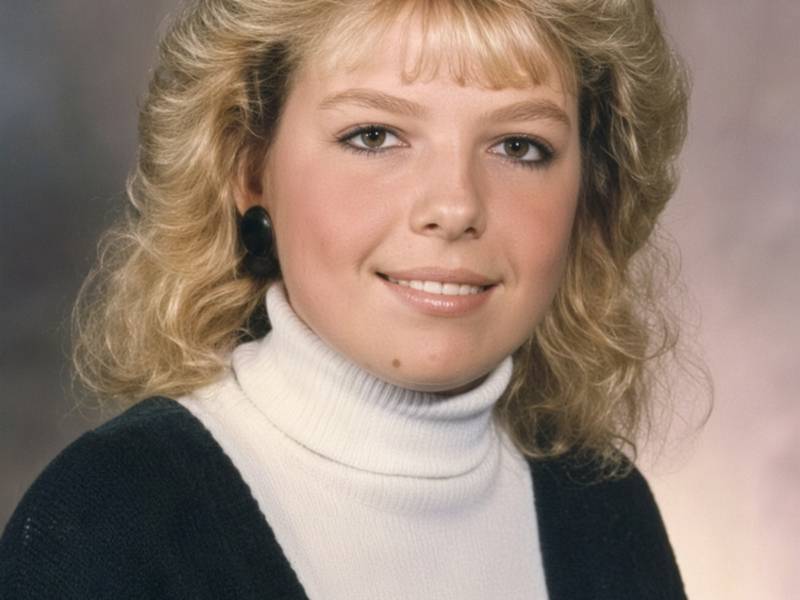
Missouri 1989 Cold Case SOLVED — Arrest Shocks Community.

A 31-year-old Kansas City murder case has been solved with advanced DNA testing.
We’re talking here about the Fawn Cox case.
She was just 16 years old when she was raped and murdered inside her own bedroom.
On the morning of July 26th, 1989, an alarm clock rang inside a second-floor bedroom of a house near East 9th Street and Van Brunt Boulevard in Kansas City, Missouri.
It rang at the time it was set.
It did the only thing it knew how to do.
The girl who set it never turned it off.
Beverly Cox heard it from downstairs.
Her daughter Fawn had worked a closing shift at Worlds of Fun the night before and come home exhausted.
The alarm meant she had another shift that morning.
Beverly waited.
The sound kept going.
Fawn was never a heavy sleeper.
Beverly sent her younger daughter Felisa upstairs to check.
Felisa pushed open the bedroom door.
Fawn was on the bed, motionless.
Her skin had changed color.
Dark bruises circled her neck.
She had been dead for hours.
Someone had climbed to the second-floor window, entered the bedroom, sexually assaulted Fawn, and strangled her.
The rest of the family had been asleep one floor below the entire time.
An air conditioning unit in the downstairs bedroom had been running all night, loud enough to swallow every sound above it.
The family’s dog had barked sometime after midnight.
Felisa got up, calmed the dog, and went back to sleep.
Nobody heard anything else.
Investigators collected biological evidence from the scene.
In 1989, it was almost useless.
All they could do was compare blood types.
They had a crime with physical evidence that pointed to one person on Earth and no technology to read it.
The evidence was boxed and stored.
It sat in a police locker for 31 years.
Her name was Fawn Marie Cox.
She was 16 years old, saving every dollar from her summer job to buy her first car.
It took 31 years and a DNA test the family spent decades begging for to solve this case.
The answer had been right next to them the entire time.
Fawn lived with her parents, John and Beverly, and her two younger sisters, Amber and Felisa.
She was the oldest.
She helped raise her sisters, worked long shifts without complaint, roller skated with Amber and Felisa on weekends, and never missed church on Sundays.
Her best friend Donna McGee lived across the street.
They spent summer evenings on the porch talking about boys and high school and everything that mattered when you were 16.
By the summer of 1989, Fawn was working at Worlds of Fun, saving every dollar for her first car.
Independence. A future she was building shift by shift.
On the evening of July 25th, Beverly and Felisa picked her up from the park around 11:00 p.m.
Fawn slid into the car exhausted.
She had another shift in the morning.
When they got home, the house was sweltering.
The family had one air conditioning unit crammed into the downstairs bedroom window.
It was loud enough to drown out almost everything above it.
John was already asleep.
Felisa settled onto the couch near the cool air.
Amber was across the street babysitting.
Fawn climbed the stairs alone.
She changed into her nightshirt.
Her bedroom door lock had been broken for months, so she wedged a steak knife into the frame—a 16-year-old’s version of a deadbolt.
She set her alarm and closed her eyes.
She was 16 years old, asleep in her own bed with her family one floor below her.
By morning, she would be gone, and no one in that house would have heard a thing.
Sometime between midnight and 2:00 a.m., the family’s dog began to bark.
The dog was pregnant, normally calm, but something had set her off.
Felisa stirred on the couch, went to her, spoke softly until she settled.
Pregnancy nerves, she figured.
She went back to sleep.
The air conditioner hummed on.
The house stayed quiet.
When detectives arrived that morning, the crime scene told two stories at once, and neither one made immediate sense.
Fawn had been strangled.
The medical examiner confirmed strangulation as cause of death.
She had also been sexually assaulted.
This was not a random attack.
It was deliberate, controlled, and personal.
Whoever did this had been inside her room long enough to do what he came to do and leave without waking a family sleeping one floor below.
The entry point was the second-floor window.
Outside, John Cox’s orange dumpster truck sat parked directly beneath the girl’s bedroom, where it had been parked for so long nobody thought about it anymore.
Someone had climbed the truck, reached the window, and come through it.
The window was unlocked.
It had been unlocked all summer.
Inside, investigators found short hairs that did not belong to Fawn, small bloodstains, biological evidence recovered from the bedsheet.
They found an old army cap in Fawn’s room that no one in the family recognized.
She had never worn anything like it.
And they found the steak knife she had wedged into the door frame that night—her only security—at the scene.
But then there was the rest of it.
In the yard below a different second-floor window—the one to Amber and Felisa’s room—a stereo and a Nintendo console were sitting in the grass, dropped from the window above, as if someone had planned to grab them on the way out and then abandoned them.
Inside Fawn’s closet, blankets had been pulled down and left in a pile on the floor.
The scene looked like a burglary and a murder had happened in the same house on the same night.
One detail troubled investigators more than anything else.
Fawn’s bed sat on wheels.
In any kind of struggle, that bed would have rolled across the room.
It didn’t.
Either Fawn never had the chance to fight back, or someone had held it steady while someone else was on top of her.
If there were two people in that room, the physical evidence only pointed to one.
The biological material left behind came from a single source.
In 1989, that evidence was nearly useless.
DNA technology was in its earliest stages.
There were no genetic databases, no markers to compare, no profiles to run.
All investigators could do was compare blood types.
They logged roughly 90 pieces of physical evidence, collected more than 200 witness statements, and boxed everything for storage.
The biological material from Fawn’s bedsheet was preserved and locked away in a police evidence locker.
It pointed to exactly one person.
Nobody could read it yet.
Within weeks, detectives had a lead.
Fawn had been dating a boy connected to the Ninth Street Dogs, the gang that operated in the neighborhood.
The connection drew investigators straight to the group’s orbit.
In August 1989, one month after the murder, police arrested three teenagers.
One of them was in Fawn’s class at Northeast High School.
A witness had come forward with detailed information—specifics the police had deliberately kept from the public.
Things only someone involved would know.
A grand jury charged one of the teenagers with first-degree murder.
He was held in jail while prosecutors built their case.
For the first time since that morning, the Cox family felt something close to relief.
He sat in a cell for eight months.
Then everything collapsed.
The DNA did not match.
The fingerprints on the steak knife did not match.
And the witness—the entire foundation of the prosecution’s case—recanted, said they had lied, stopped cooperating.
Without testimony, without forensic evidence tying any of the three to the sexual assault and murder, the prosecution had nothing.
All charges were dropped.
But before they were released, one of the teenagers told investigators something that made the case harder, not easier.
He described climbing John Cox’s orange dumpster truck, crossing to the window, and slipping inside the house.
He described throwing a stereo and a Nintendo console out the window to collect on the way out.
He described throwing a tape recorder and the handle snapping off.
He told detectives exactly where he had hidden it—under a bush near the house.
Police searched.
They found it right where he said it would be.
This was not a guess.
This was someone who had been inside that house.
But he insisted that he and his friends had only come to steal.
They never entered Fawn’s room.
They never saw her.
They never knew what had happened ten feet from where they were standing.
Then he withdrew the confession and stopped talking.
The story evaporated.
The evidence said three boys had been inside the Cox house that night.
The evidence also said none of them had killed Fawn.
Someone else had been in her bedroom.
Someone whose DNA was on that bedsheet and whose name was not in any file, any database, any lead the investigation had produced.
Knowing and proving are two different things.
The family knew those boys had been in the house.
One of them had spent eight months in jail for it.
But the person who had actually killed Fawn was still out there, and the investigation had no direction left to follow.
The case went cold.
Amber Cox carried it the hardest.
She was the middle sister, a year younger than Fawn.
She was the one who should have been upstairs that night.
Her bedroom was across the hall.
On any normal night, she would have been in it.
But that evening, she had been babysitting across the street.
The burglars had entered through her window.
If Amber had been home, she would have been the first person they encountered.
That knowledge lived inside her for decades.
She later told Fox 4 that she had looked up to Fawn her entire life.
Wanted to be just like her.
She called Fawn her protector.
After the murder, that protector was gone, and Amber could not stop herself from trying to take over the role Fawn had left behind.
She became the family’s investigator.
She scoured cold case forums, searched every true crime website, followed every mention of Fawn’s name online.
When she found strangers discussing the case, she reached out, thanked them, asked if they had real information.
She posted details on verified forums that the police had never made public.
In one post, she explained that she normally would have been sleeping in the room the burglars entered, that the killers had either gotten lucky or been watching long enough to know the family schedule.
The obsession consumed her.
She ended up in the hospital.
The weight of it had overwhelmed everything else in her life.
Beverly Cox did not stop either.
She gave interview after interview, year after year.
Her voice steady but visibly broken.
John stood beside her.
They held fundraisers.
They erected billboards across Kansas City with Fawn’s face and a plea for information.
They offered rewards.
$3,000 in 2000.
$10,000 in 2019.
Beverly sat in front of cameras and said what she had said a hundred times before.
“Money does a lot on the streets. That’s what we’re hoping and praying for.”
A decade passed, then another.
The neighborhood around East 9th Street and Van Brunt Boulevard changed.
Kids who had grown up on those blocks graduated and moved on.
The Ninth Street Dogs faded.
New families moved in who had never heard Fawn’s name.
Detectives who had worked the original case retired or transferred.
New officers inherited the file, read through the stacks of reports, and reached the same conclusion every time.
Every actionable lead had been exhausted years earlier.
In the early 2000s, the Kansas City Crime Lab developed a full DNA profile from the biological evidence collected in 1989.
Technology had finally caught up to the material that had been sitting in that police locker since the morning they found Fawn.
The profile was uploaded to CODIS, the FBI’s national database of DNA from convicted offenders.
The result came back empty.
No match.
The man behind that sample had never been arrested, never been convicted, never given any law enforcement agency in the country a reason to have his DNA on file.
The family watched other cold cases from the same era get solved.
The Golden State Killer.
Cases from the 1970s and 1980s cracked open by genetic genealogy.
The same technology that compared crime scene DNA to public ancestry databases and built family trees branch by branch until a name emerged.
They watched it work for other families and asked the same question every time.
Why not Fawn?
The answer was money.
Genetic genealogy testing was expensive.
Only a handful of labs in the world could do it.
Waiting lists stretched for years.
Police departments had to choose which cases got priority, and the Kansas City Police Department did not have the funding.
For years, detectives told the Cox family the same thing.
“We’re working on it. We just need the money.”
In 2019, the family decided they would not wait any longer.
They launched a fundraiser to pay for the testing themselves.
Within weeks, they had raised more than $10,000.
They walked into the police department with the money in hand, ready to buy their own answers.
The police said no.
Captain Ben Caldwell, who had recently been promoted from supervisor of the missing persons and cold case section, explained the position.
If the department accepted money from one family, it would create a two-tiered system.
Families with resources could pay to solve their cases faster.
Families without resources would wait indefinitely.
It was not fair.
Felisa Cox understood the logic.
She also understood what it meant.
“If this had been a rich family or someone important, this case would have been solved immediately.”
Then, in the summer of 2020, a federal initiative called Operation Legend was launched in Kansas City.
The program brought FBI resources, advanced lab access, and funding for forensic technology that local departments could not afford on their own.
Captain Caldwell submitted Fawn’s case for genealogical DNA testing.
It was approved.
The FBI paid the bill.
The biological evidence collected from Fawn’s bedsheet in 1989 was sent for analysis.
The process compared the unknown suspect’s DNA profile to millions of entries in public genealogy databases, identified distant relatives who shared fragments of the genetic signature, and built family trees backward through generations, narrowing branch by branch until the pool of possible matches shrank to a name.
The results came back in a matter of weeks.
31 years of silence.
31 years of billboards, fundraisers, interviews, and the same answer from every detective who ever touched the file.
And the test that finally broke it open took weeks.
The genealogy results narrowed to a single branch.
A man from the same family tree as Fawn.
Not a distant relative.
Not a second cousin traced through five generations of records.
A first cousin.
Someone who had grown up around the Cox family.
Someone who had been inside that house dozens of times, who knew which windows stayed unlocked in summer, who knew the layout of the second floor, who knew that Fawn slept alone up there when the heat pushed everyone else downstairs.
His name was Donald Lee Cox Jr.
He was 21 years old the night Fawn was killed.
Five years older than her.
Donald had been a guest in the Cox home.
He had sat at their table.
He had been close enough to the family to know their routines, to know when Amber would be home and when she would not, to know that the air conditioner in the downstairs bedroom was loud enough to cover anything that happened above it.
He knew that house the way only someone who had spent time in it would.
And the night he used that knowledge, he climbed the same path anyone familiar with the property would have recognized.
The orange dumpster truck beneath the window.
The unlocked frame.
The second floor where a 16-year-old girl was asleep with a steak knife wedged into a broken door lock because it was the only protection she had.
Investigators would never confront Donald Cox Jr. in an interrogation room.
They would never place him in handcuffs or sit across from him at a defense table.
Donald had died in 2006, fourteen years before the DNA test that identified him.
He overdosed on drugs.
His death had been investigated at the time because the circumstances were considered suspicious.
The medical examiner determined it was not foul play, but as part of that investigation, a blood sample had been drawn and preserved.
That blood sample sat in a medical examiner’s file for fourteen years.
When the genealogical DNA results pointed to Donald, detectives requested it.
Crime lab staff extracted the DNA and compared it to the biological evidence recovered from Fawn’s bedsheet in July of 1989.
It was a match.
31 years.
The evidence had been in a police locker.
The answer had been in a medical examiner’s file.
And the man it pointed to had been dead since 2006, buried without ever being questioned, without ever being suspected, without ever being asked to explain why his DNA was on a murdered girl’s bed.
On November 10th, 2020, detectives sat down with the Cox family and told them the name.
Both of Fawn’s parents were still living.
Captain Ben Caldwell said they were sad but relieved.
They told investigators something that had never appeared in any report or any interview in 31 years.
They said they had sometimes wondered whether the cousin had been responsible.
31 years of billboards.
31 years of fundraisers and interviews and rewards and begging for a DNA test.
And somewhere underneath all of it, a quiet suspicion they had never spoken out loud.
Felisa sat with the news the way people sit with things that are too heavy to hold and too important to set down.
She told reporters there was relief in finally knowing.
Then she said the sentence that carried everything the family had been living inside since that morning in 1989.
“The answers aren’t always what we were asking for, but there’s closure.”
The Kansas City Police Department did not release Donald’s name publicly.
He had never been charged.
He had never stood trial.
He had never been convicted.
The department confirmed only that the suspect was a cousin, approximately five years older than Fawn, who had died in 2006.
The family confirmed the rest.
Questions remained that would never be answered.
The three teenagers who had been inside the house that night.
The one who described climbing the truck, entering through the window, throwing the electronics into the yard.
Did Donald enter with them?
Was he part of the burglary, hiding in the upstairs closet while the boys looted the other room, waiting for his moment?
Or did he come separately, through a different path, at a different time, for a different reason entirely?
The biological evidence pointed to one person.
Only Donald’s DNA was found on Fawn.
Whatever those boys saw or did not see that night, the evidence said they did not kill her.
The case was closed without additional charges.
Even if those teenagers had been in the house, there was no evidence they participated in the murder.
Only Donald’s presence was on Fawn’s body.
Only Donald’s secret had lasted 31 years.
Amber later revealed something the family had carried quietly for years.
Donald had sexually abused younger girls in the family.
It had been buried in shame and silence, the way those things often are in families, where the word itself feels like a weapon pointed inward.
Nobody imagined he was capable of murder, but the pattern had been there, visible only in hindsight, only after a DNA test gave it a shape nobody could look away from.
Donald Cox Jr. lived seventeen years after killing Fawn.
He was arrested repeatedly for theft and drugs.
He moved through the system and moved back out.
He attended family gatherings.
He looked John and Beverly Cox in the eye.
He never said a word about what he had done in that second-floor bedroom.
Then his addiction killed him in 2006, and whatever he carried went into the ground with him.
Captain Ben Caldwell put it simply: “This one touched a lot of people because she was an innocent child who was murdered in her own bed.”
On the night of July 25th, 1989, Fawn Marie Cox came home from a shift at Worlds of Fun, climbed the stairs of a house where her family was already asleep, and set her alarm for the next morning.
She was 16 years old.
She was saving for her first car.
She never missed church.
She roller skated with her sisters on weekends and spent summer evenings on the porch with her best friend, talking about everything that mattered.
She wedged a steak knife into a broken door frame because it was the only lock she had.
She closed her eyes in a room where the only sound was the heat and the quiet of a house she trusted.
The alarm she set that night rang the next morning the way it was supposed to.
It did the only thing it knew how to do.
Fawn was not there to turn it off.









