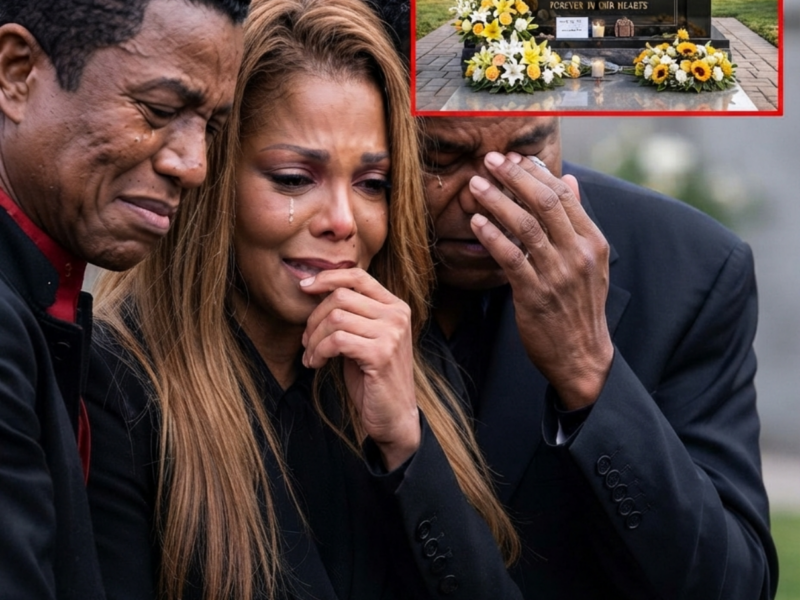
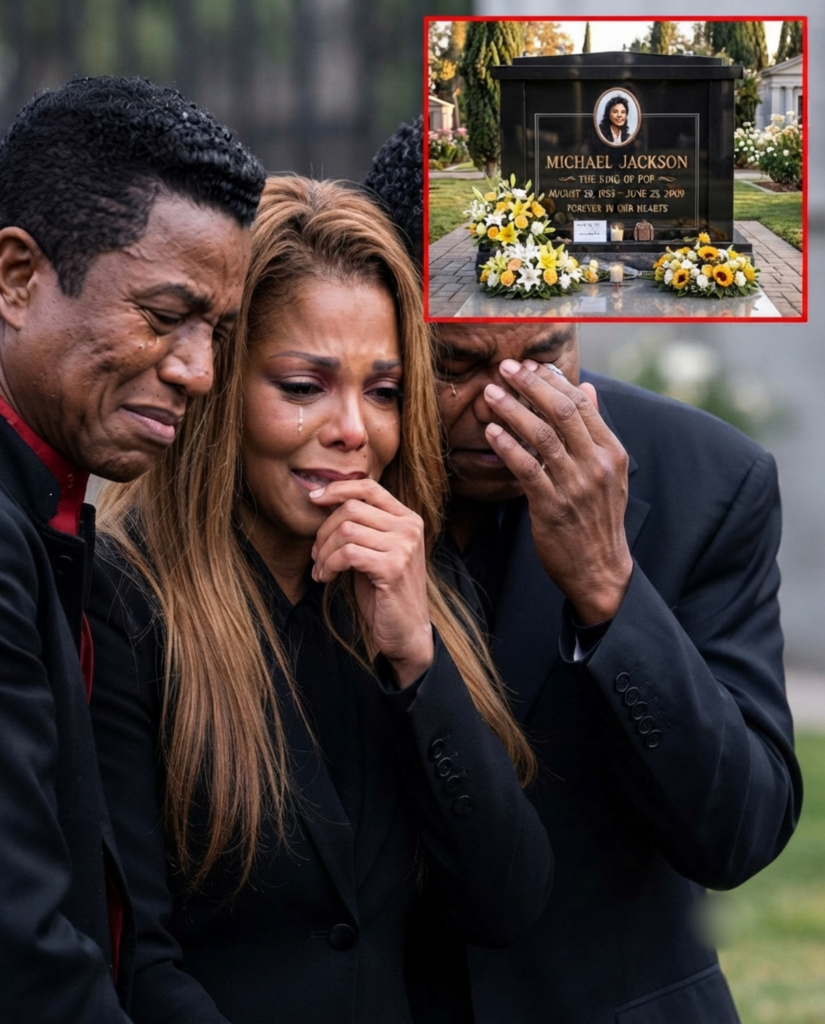
Michael Jackson’s Siblings FINNALLY Reveal What Really Happened The Day He Passed.
What do you think Michael would think about the music of today?
“Oh, he loves it. He loves it. Music changed, you know—a different generation. So, I love the music today. It’s a different style.”
“It’s a different style.”
“Yes, it is.”
She said she asked me, “Was I driving?” And I said, “I’m getting ready to get on the freeway.”
She said, “No, pull over. Don’t get on the freeway.”
And right then, I knew something was terribly wrong.
I said, “Janet, is he dead?”
And she said, “He’s gone.”
And I just melted right there. And I didn’t know what to do. I pulled over in this parking lot and just cried for like fifteen minutes.
“I spoke to Mother. I spoke to Tito. I spoke to my sister La Toya. They were headed to the hospital.”
“And you headed to the airport?”
“Not at that very moment. I didn’t know the severity of it. No one knew.”
Then came the memorial service, where a family member unexpectedly spoke a farewell that left the rest in tears. And in the wake of the funeral, the questions began to rise.
For what the Jackson family witnessed on June 25th, 2009, was far more complex than the initial news bulletin the entire world heard.
Today, let us step back to June 25th, 2009, tracing every phone call, every firsthand account, and everything Michael Jackson’s siblings witnessed with their own eyes to understand what truly happened on the day the King of Pop passed away.
About a month before the world was shaken by the passing of Michael Jackson, the Jackson family home was steeped in a rare and fleeting atmosphere of peace.
It was a secret gathering orchestrated as a surprise gift for their parents—a rare moment of quiet, detached from the suffocating enclosure of stardom.
On that day, there were no glittering sequined outfits, no roaring crowds in gigantic stadiums, and the name King of Pop was entirely absent.
There was only Michael—a son, a brother, and a father—bringing his children to gather around his parents.
“So we sat down and ate. He was sitting next to Jackie. He was making jokes as usual. I was across the room looking at him, and we always have these inside jokes where we laugh and clown, because this is what we always did.”
“You tell him you loved him, too?”
“He was—then we said to one another—”
“I was.”
“Yeah. And said, ‘I love you.’ He says, ‘I love you, too.'”
“It was very hard for me, because I was in Las Vegas at the time. And I was with Jermaine’s kids. We were shopping around in Las Vegas at the Venetian. And I was just looking at a screen of Michael—a photo of Michael. All of a sudden, someone said—”
At that time, Michael was pouring every ounce of his remaining energy into *This Is It*—the massive run of fifty concerts scheduled at the O2 Arena in London.
To the public, it was hyped as the grand comeback, signaling the return of the King of Pop to his throne after years of virtual seclusion from touring.
But for the Jackson family, London also held the promise of a sweeter dream: a family reunion on British soil, where the original members of the Jackson 5 were slated to join Michael on stage for a segment of the show.
Whenever he spoke of it, Michael’s eyes would light up with a childlike excitement.
“I was complimenting him on a song he did. And we were singing the harmony—’Baby don’t make me, baby don’t make me, baby don’t make me fly away.’ And I said, ‘Michael, I love this song.’ I told him I really love your performance on that song. And he said, ‘Jermaine, that means a lot to me coming from you.’ All the grandkids were there—my mother and father and everyone. And he was there with Prince and Paris, and we had a great time. And after that, he said, ‘I’ll see you at the O2 theaters, right?’ And we said, ‘Yeah, we’ll be there to see the other half of those shows. We were going to do with him as the original Jackson 5.’ And that was all planned. And then after that evening was finished, he was so excited. He said, ‘I’ll see you guys in London at the O2.’ And that was the last time I saw him.”
For years, history recorded the fateful morning of June 25th through dry, cold news cuts.
Michael Jackson unconscious at the luxurious yet isolated rented estate in Holmby Hills. His private physician, Conrad Murray, panicking in attempts to resuscitate him. The 911 emergency call placed. And an ambulance screaming through the streets to rush him to the Ronald Reagan UCLA Medical Center.
Yet that gloomy, emotionless picture only truly shattered into bone-deep agony and choked sobs through the haunting accounts that surfaced years later—told by those who witnessed that terrifying seismic shock with their own eyes.
On the day his father collapsed, Prince Jackson was only twelve years old.
“I looked towards my right, and there was a plastic bag sitting on top of a chair. And so I proceeded to get the bag, and I opened it, and he placed the vials in the bag.”
“Okay. So you held the bag open, and he—what? Just dropped the vials in there?”
“Yes, sir. He reached into the bag and dropped the vials.”
His face drained of all color, shouting for help and frantically telling Prince that the doctor needed him upstairs immediately, because his father was in deep trouble.
Without stopping to think, instinct propelled Prince to turn and sprint toward the foot of the stairs—and then from the gloomy upper floor—
“What I recall is that I was closer—well, coming into that specific area—and they were right behind me. And Paris screamed out, ‘Daddy.'”
Years later, when forced to stand before a cold courtroom to face the harsh inquiries of public opinion—
“Ever since I was born, Daddy has been the best father you could ever imagine. And I just wanted to say I love him so much.”
The children whom Michael had desperately tried to shield—to protect with every fiber of his being from the chaotic, ruthless, and toxic public scrutiny of the showbiz world outside—were now ruthlessly shoved into the epicenter of an earthly hell no child should ever have to witness.
“The last time I saw Mike was maybe the month before. I was giving my parents a surprise, and so we were all there. My wife and I were on the other side of town. We got a call from Larry King saying, ‘Jermaine, do you know anything about Michael being rushed to the hospital?’ And we said, ‘No.’ So forty-five minutes had gone by. So I had spoken to Janet. Janet called me, and she said, ‘What’s going on?’ And I said, ‘I really don’t know, but I’m going to find out.’ Then I spoke to an attorney named Joel Katz, who said that he heard it’s pretty bad. So then I called my mother back, and she says she’s on her way to the hospital right then and there. So we’re waiting and waiting, and my brother, the legendary King of Pop, Michael Jackson, passed away on Thursday, June 25th, 2009, at 2:26 p.m.”
“Him being Michael Jackson—superstar—and he’s your brother, and he’s, you know—”
“See, people don’t understand. Michael was a person who saw good in everyone. Everyone. That’s why the songs ‘We Are the World,’ ‘Heal the World,’ ‘Man in the Mirror,’ ‘Earth Song.’ He was trying to show people it’s not about the materialistic things. It’s not about money. It’s about people caring about people. Children who go to bed starving—millions of children every day. He was the voice for children. He was concerned about the rainforests in ’84, before Al Gore started with the global warming—everything. This is who Michael Jackson really was.”
“Abuse—I would call it discipline. And if I got a spanking, or Tito, or Jackie, or Marlon, or Michael—some of us would hold it as a grudge, or we wouldn’t recover from it as soon as others did. There was no abuse. There was nothing. I mean, we were disciplined like any other Black family out there. We did something wrong, we got a spanking. If there was fruit in the kitchen, we had to ask for it.”
“They spent a lot of time together. And you know, at one point, Michael was going through a stage where he had a serious acne problem, and it had gotten so bad that Michael was afraid to really look at people in the face and talk to them. I mean, when he talked to you, he’d look down. And my mother was sensitive toward that. I think because of her interest in wanting to help him, to give him the needed support that was necessary—then I think that caused a lot of the closeness.”
For Tito Jackson—the eldest brother who had weathered countless bitter storms alongside Michael since the early days of the Jackson 5—the fateful moment that altered his entire life did not begin with wailing sirens or a flashy news ticker.
But with a question that sounded deceptively ordinary, yet carried the weight of a thousand mountains.
“My middle son, Tarryl, had called me on the phone and said, ‘Dad, is it true, like they’re saying on TV, about my Uncle Michael?’ So I immediately tried to tune in to CNN *Headline News*. And I had learned that—on my way, I called my mom, and she said, ‘You guys better get down here.'”
“Walked in the room and to see him lying there lifeless. He was still soft. I kissed his forehead and told him I was going to miss him so much. And that’s how we got it.”
“Michael Jackson just died. Michael Jackson’s dead. What is—what is he talking about? And I hear someone else telling me as I’m walking, ‘Michael Jackson’s dead.’ And I called my sister, and she said, ‘Yes, he is.’ And so we got on the plane and went to LA, and it was hard packing the bags. I couldn’t stand.”
“Yeah, it’s—”
“My legs were weak. I couldn’t stand at all. It’s just—”
“It’s tough.”
“Yeah, it’s tough. So on the way there, Janet had called me and said, ‘Tito, are you driving?’ I said, ‘Yes, I am.’ She said, ‘Pull over.’ And when she said that, I knew something was drastically wrong. And I pulled over, and she broke the bad news to me.”
“And then I called my mother back, and I heard in her voice saying that he’s dead. And just a feeling of emptiness came before my body, because to hear my mother say her child is dead, and my brother’s dead, is—I’ve never ever thought that I would ever hear this from her lips.”
“What was it for you in that service that helped you, perhaps the most, in dealing with your brother’s death? There being some sort of a closure, I suppose, at that time—”
“And I just wanted to say I love him so much.”
“You were trying your best to comfort her. You were Auntie Janet at that moment.”
“Mhm.”
“When she turned to you, what did—did you just want to scoop her up and just protect her?”
“Mhm. All of them. Not just her. Blanket, Prince, my other nieces and nephews. It’s just—it’s been very hard. I think we’ve been doing very well. I have a very strong faith.”
“When Michael first passed, every time I walked into a store, and you know, the media and the public—or I should say the merchants even—they just had a heyday. And everywhere I went, he was there. You know, every—when I get on an elevator, I even went into a lamp store to purchase a lamp, and they were constantly just playing all his music. And you couldn’t get away from it. And at that time, I didn’t want to hear anything, because it was so very difficult. And it was that way for a long time. Then one while I could deal with it, listening. And then another time I couldn’t.”
Outside the Ronald Reagan UCLA Medical Center, the seismic shock known as Michael Jackson turned the Westwood area into a blazing epicenter for the entire world.
The streets were strictly cordoned off under police barricades. Hundreds of camera lenses pointed directly toward the main gates. Television news helicopters whirred and roared across the gray sky, creating a suffocating, breathless atmosphere.
Fans began to pour in, swelling like a mournful flood—carrying flowers, candles, and tear-streaked photographs as they stood and wept silently in the rain.
Yet when he stepped through the hospital doors, Jermaine Jackson no longer saw a great superstar or a symbol of humanity.
In a space thick with the scent of antiseptic and a chilling silence, the first person he searched for was his mother.
Katherine sat there, isolated down the long hallway. A relative later described with a choked voice that she seemed physically present, but her soul and spirit had drifted away somewhere else.
Jermaine walked up, pulling his aging mother into a trembling, helpless embrace.
“UCLA. I went straight for my mother, to see how she was, and she was sitting there, and I guess she was there, but she wasn’t there. I consoled her and hugged her, and I went to see my baby, Michael. I went to live for him.”
“La Toya was there before us, and he was lifeless. I touched his forehead, his face, and it was still soft. And I kissed him. I pulled his eyeballs back to look in his eyes—his eyes. And I just told him how much I love him. And I’m going to miss you so much.”
“What do you do at a moment like that? What do you do? Do you say something? What do you do?”
“I said, ‘Michael, why did you go? Why did you leave? Why did you leave me?’ What was going through my mind, Larry? I wish it was me there instead of him.”
“Really?”
“Yes. Because I love Michael so much. It’s a different love. All my family, siblings—the world loves him. But I just felt a special connection with him, because just going back to the memories of how my father used to keep us.”
“It was the worst feeling I’ve ever experienced in my life. You know, I’ve had other relatives who had passed away, but they weren’t my close siblings. But when my brother passed away, it just seemed like my whole self, inner self, just melted.”
“I guess my whole family feels that way. And to knowing that his presence has been so strong around the world—but even with us as a family, we realize that we’re all brothers and sisters. But then Michael just didn’t belong to us. He belonged to the world.”
“He wrote, ‘I can’t describe our pain in losing our brother, or the pain of his children in losing their father, or the pain of my parents in losing their son. I still have not seen the film *This Is It*. I still can’t watch any of his videos, listen to his music. I’m certain that one day I’ll again be able to enjoy the miraculous sound of his voice and the marvelous sight of his dancing. But that day has not yet arrived. The mourning continues.'”
“Where are you in that process, Janet, at this point, actually, since you finally were able to—”
“I feel that he should be remembered for all the great things he did for the world. The messages in his music. The contributions he made to charity—things of this nature. That’s more important to humans than just music. He actually tried to heal the world through his lyrics and the things that he did to help others. Michael was special. I mean, he just loved around the world. People love him around the world. And so did the group, and loved the group together.”
“Well, Michael’s just such a great spirit. When he’s on stage with you, you just feel his presence. He makes you want to do more or do better in this whole thing. And he just knew how to adapt to any situation, any crowd or whatever. He just—he was a magical person.”
“He’s an old pro. And not only that—you know, today, when we’re performing today, you know, we feel his spirit on stage.”
“Absolutely.”
“Everywhere we go. And we feel that if Mike was there, he’d be giving 110%. And that’s what we do on the stage. We try to give it all out.”
“Got to stand up to that ability to legendary—”
“What people expect.”
“The spirit is still with us while we’re on stage, even today.”
The moment Michael Jackson drew his final breath was also when the bond linking him and his older brother Jermaine transformed into a heart-shattering agony.
Jermaine once publicly confessed a thought that left anyone listening utterly frozen.
“I wish that person lying there were me instead of Michael.”
They were not merely blood brothers. They were life-or-death companions through dreary hotel rooms, swaying tour buses cutting through the night, thousands of grueling rehearsal hours, and a childhood stolen to be thrown into the ruthless machinery of the entertainment industry.
Therefore, Michael’s departure did not merely mean losing a brother. It simultaneously stripped away a foundational piece of memory and youth that Jermaine had most deeply anchored to.
Yet amid that storm of mourning, the Jackson family lacked even the most basic privilege: the right to grieve in quiet privacy.
Less than two weeks after the fateful June 25th—on July 7th, 2009—they were forced to step out into the light to face one of the largest and most-watched memorial services in human history.
Before heading to Staples Center, the family gathered at Forest Lawn Hollywood Hills for a private farewell ritual.
Jermaine later revealed that the family wanted a private window of time honoring the Jehovah’s Witness background they were raised with.
There, after a speech by relative Wendell Hawkins, young Paris made a particularly heart-wrenching request.
She wanted to hear the ballad “Gone Too Soon”—a song Michael once recorded to mourn lives that vanished from the world too soon—now played to bid farewell to her own beloved father.
Leaving that private ceremony, Michael’s coffin was brought to Staples Center.
The Jackson brothers appeared in sleek yet mourning black suits, wearing white gloves, taking turns slowly carrying the weight of their brother’s casket on their shoulders.
Inside the arena, amid a myriad of emotional tribute performances, there were moments when the family’s endurance nearly collapsed entirely.
Jermaine stepped up to the microphone singing “Smile,” one of Michael’s favorite tracks.
Yet the heaviest blow to the loved ones’ emotional resilience came at the very end of the program.
Marlon stepped out—but instead of praising Michael as a global superstar, he spoke of the younger brother the family had witnessed enduring harsh public scrutiny, judgment, and cruel mockery.
Marlon choked out a harrowing question: How much pain can a human being of flesh and bone possibly endure?
He messaged to Michael that perhaps now, finally, the world would let his brother rest in peace.
Then Marlon delivered a message that broke everyone.
Brandon—Marlon’s twin brother—had passed away just a day after birth in 1957. Thus, he told Michael that upon crossing to the other side, he should embrace Brandon in his place.
“I love you, Michael. I will miss you.”
Finishing those words, Marlon bowed his head and broke into uncontrollable sobs.
Immediately following that, the family members were still gathered on stage.
Initially, Janet was slated to speak—but then Paris stepped up to the microphone. None of the uncles knew her intentions beforehand.
Months after the ordeal passed, when recalling that moment, Jermaine admitted it felt like a knife plunging straight into his chest. Marlon felt his heart shatter, while Tito confirmed the brothers were completely caught off guard by their niece’s action.
Paris, at the time, was merely an eleven-year-old child drifting amidst a storm.
Janet stood right beside her, gently soothing and encouraging, “Speak up, honey!”—struggling to keep her voice from being choked by tears.
Paris sobbed. “Ever since I was born, Daddy has been the best father you could ever imagine.”
She only managed to add that she loved him very much before her tears completely broke through, unable to utter another word.
Following the memorial, Janet hosted a private family gathering at the Beverly Wilshire Hotel.
There, Prince, Paris, and Blanket gathered among their cousins. A reporter present captured a rare, heartbreakingly ordinary moment: Prince stood with his cousins and managed to smile when greeted—a brief ray of peace amid a global media storm.
Even so, the journey to lay Michael to rest was not yet over.
The casket displayed at Staples Center on July 7th was not actually his final resting place. The family had to wait nearly two more grueling months.
Ten weeks after the world lost Michael—on September 3rd, 2009—the family reconvened at Forest Lawn Memorial Park in Glendale.
Unlike the packed Staples Center watched by millions, this funeral was held privately and solemnly, with about two hundred close friends and relatives.
Figures tied to Michael’s life—like Elizabeth Taylor, Macaulay Culkin, ex-wife Lisa Marie Presley, and musical giants Quincy Jones and Berry Gordy—sat among the mourners.
Michael’s golden casket was blanketed with pristine white flowers.
And once more, the five brothers—Jackie, Tito, Jermaine, Marlon, and Randy—solemnly stepped up to serve as pallbearers for their brother.
The three children were also entrusted with a deeply symbolic ritual. Prince, Paris, and Blanket stepped forward together to place a crown atop their father’s casket before the ceremony officially began.
Michael was subsequently placed inside Holly Terrace within the Great Mausoleum at Forest Lawn Glendale.
The mausoleum doors slowly closed.
Over two months since June 25th, the Jackson family had finally completed the full burial of Michael into the embrace of Mother Earth.
Yet for those left behind, the closure of a funeral never meant the pain had ended.
Janet Jackson honestly confessed that for a long period following her brother’s passing, she was virtually paralyzed regarding anything related to Michael.
She could not listen to his music, watch his performance videos, and especially lacked the courage to turn on the documentary *This Is It*.
The trouble was, this world was overflowing with the presence of Michael Jackson.
Janet recounted that even stepping into a grocery store, entering an elevator, or trying to buy a small item, her brother’s singing voice would unexpectedly ring in her ears.
There was no space on earth that could help her evade Michael’s presence.
Ultimately, Janet understood she couldn’t keep running forever. She locked herself in her room for a long night to face her fear head-on.
She turned on old videotapes, listening to familiar melodies. Moments of choked tears arrived, but at times a cheerful old image unexpectedly brought a smile.
Janet realized she had to endure that lonely night to heal herself.
Yet a boundary remained that she could never cross: the film *This Is It*. Footage capturing Michael’s final rehearsals before death carried too heavy a weight—too close to a cruel reality to face with equanimity.
In contrast to Janet’s avoidance, Jermaine chose to face it by talking about his brother without pause.
He continuously appeared in media interviews, meticulously recounting every detail of that fateful day—his last meeting with Michael, the frantic rush driving back to UCLA, and the moment stepping into the sterile hospital room to see his brother lying motionless.
When asked if he saw Michael after death, Jermaine affirmed he did—admitting that sight permanently shredded his heart.
Meanwhile, Tito, Marlon, and Jackie chose to return to the stage, continuing to bring music to audiences.
Yet standing on those high platforms had fundamentally changed.
They shared that whenever performing after Michael’s death, at times they still hallucinated as if their brother stood right beside them.
Because Michael, in their memory, was always an artist demanding 110% perfection on stage. The remaining brothers told themselves to give everything as a continuation of that legacy.
As for the three children—Prince, Paris, and Blanket—they faced far more precarious, massive, practical changes.
They had permanently lost their protective father.
In his 2002 will, Michael had carefully designated his beloved mother, Katherine Jackson, as the legal guardian of his children should he pass away, naming Diana Ross as the alternate choice.
Following the tragedy, Katherine officially took over the responsibility of raising Prince, Paris, and Blanket.
The funeral concluded. The mausoleum doors at Forest Lawn Glendale shut forever.
But the storm of public opinion and suspicion surrounding Michael Jackson’s death never ceased haunting his family.
When the death certificate was officially amended to reflect the coroner’s cold conclusion that it was a homicide—directly attributing the cause to doses of propofol and potent sedatives—the sparks of suspicion within the family ignited fiercely.
Ultimately, the legal net narrowed and focused entirely on Conrad Murray.
In 2011, the private physician was officially convicted of involuntary manslaughter by a jury.
Yet even when justice was partially served through a prison sentence, it could not heal or synchronize how members of the Jackson family processed and reacted to the loss.
Behind the dazzling sheen of the title King of Pop, Michael Jackson’s life stands as a grand tragedy of isolation—where the boundaries between a global superstar and an ordinary human being were suffocated to the extreme.
Can the immense music and legacy left behind by Michael truly soothe the profound wounds and losses borne by his family and children?
Or does the brightest stage always demand an exorbitant price—known as the sacrifice of a lifetime?









