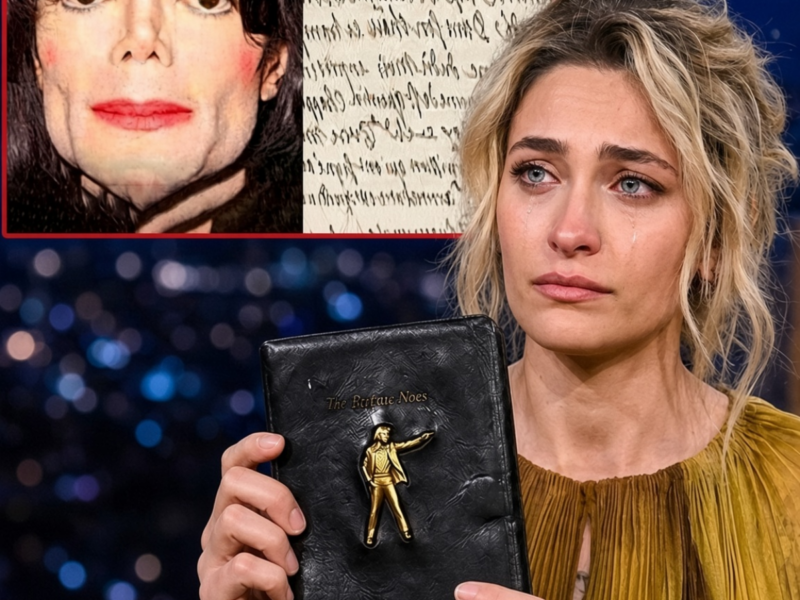
Michael Jackson’s Notebook Was Found – What He Wrote Is Disturbing.
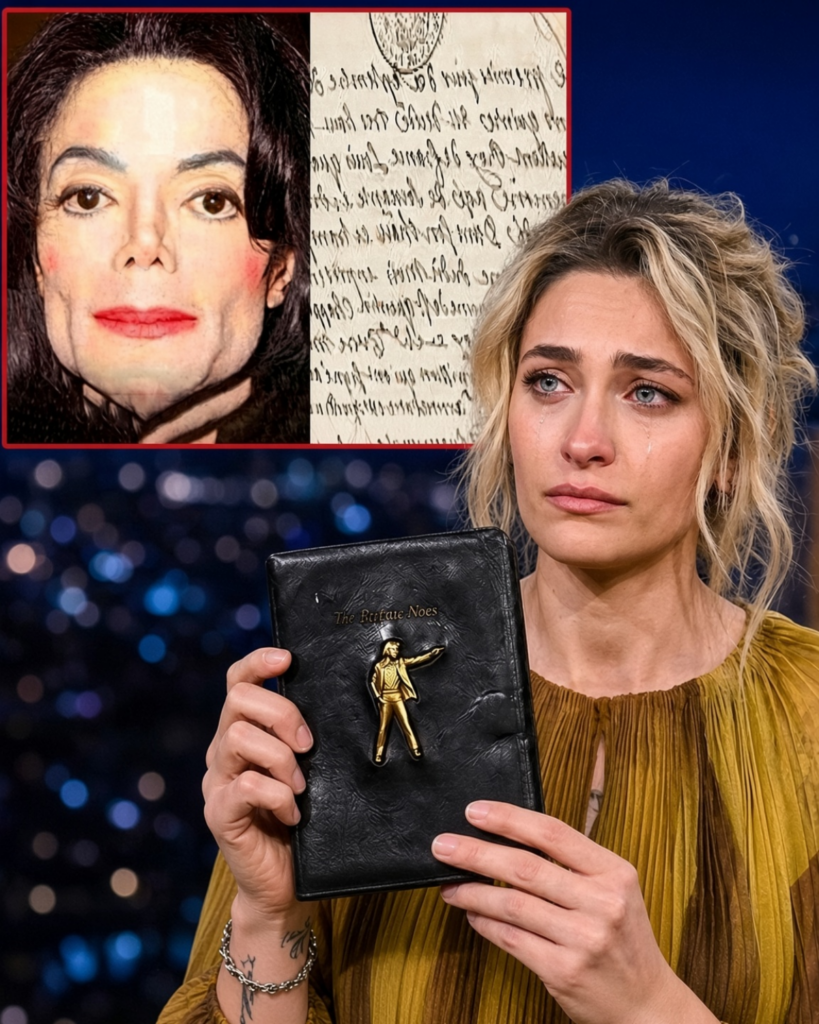
“I’m afraid someone is trying to kill me.”
Those eight words were reportedly written in a notebook by the most famous entertainer on Earth.
They were written months before a June morning in 2009 when his heart stopped inside a rented mansion in Los Angeles.
Nobody knows the exact day he wrote them.
Nobody can say with certainty who he meant.
But when the line surfaced, millions of people asked the same question.
Was Michael Jackson sensing something the rest of the world could not see?
Or was he a frightened, exhausted man putting his worst fears on paper in the dark?
The answer is more complicated than either.
The notebook held more than fear.
Between the dark lines were dollar signs, movie plans, and a hunger to be remembered forever.
There were instructions about money, a name that would later echo through courtrooms, and a short note about the doctor who would be convicted in his death.
Those pages will be read carefully, line by line, but not yet.
A page without context is only ink.
Understanding what Jackson feared requires knowing what he had built, what he stood to lose, and how the last weeks of his life actually unfolded.
First, a few honest words.
These extracts did not come from a court file or an official record.
They appeared in a 2020 book by journalist Dylan Howard, a book built around a cover-up theory.
They were repeated by outlets including The Mirror and The Sun.
A book with a thesis tends to show only the pages that support it.
No public confirmation of the original pages from independent experts has appeared, so their authenticity and dating remain unverified.
And although the pages are often described as newly found, they have been public for years.
Nothing in this video is meant to diagnose Jackson or judge him.
Where the record is clear, the video will say so.
Where it is a claim, a book, or a tabloid, that will be stated, too.
Michael Joseph Jackson was born on August 29th, 1958, in Gary, Indiana, the eighth of ten children.
His father, Joe, worked in a steel mill and ran a strict household, and he pushed his sons toward music early.
Michael was the youngest of the five brothers in the family act, and soon the brightest.
By the late 1960s, the Jackson 5 had signed with Motown Records, and their first four singles all reached number one.
A child barely old enough to ride a bike was suddenly singing on television to audiences who treated him like a miracle.
An ordinary childhood never came back.
As he grew, so did the pressure.
Jackson later spoke about loneliness as a boy, and about the harsh discipline in the family.
His father has admitted to using a switch and a belt on the children, though he denied wider abuse claims.
By his early twenties, Michael was ready to step out on his own.
A solo career meant freedom, but it also meant that every success and every failure would have only one name on it.
That habit of carrying everything alone, planted early, may explain a great deal about the choices he made in the last year of his life.
In 1979, he released Off the Wall, produced with Quincy Jones.
It sold millions and proved he could succeed without his brothers.
What came next changed popular music itself.
Thriller arrived in November 1982, and it kept climbing.
It is widely cited as the best-selling album ever made, with tens of millions of copies sold worldwide, and seven of its singles reached the American top ten.
Radio, television, and fashion rearranged themselves around it.
Jackson, still in his mid-twenties, had stopped being merely a pop star.
He had become a global event, and the world was watching his every move.
The moment people still replay came on May 16th, 1983, during a Motown television special.
Wearing a black jacket and a single sparkling glove, he performed “Billie Jean” and glided backward across the stage in a move that would become his signature.
The audience gasped.
Fred Astaire reportedly sent him a note of praise afterward.
The next year, Jackson won eight Grammy Awards in a single night.
Few performers have ever dominated one evening so completely.
Even people who had never bought a record knew the name, the glove, and the walk, and they could not look away.
Behind the glow was relentless work.
People who rehearsed with Jackson later described someone who wanted every beat exact and who treated a stage show like a machine with a hundred moving parts.
He studied older performers, from Fred Astaire to James Brown, and absorbed their timing.
The result looked effortless because it was not.
That detail matters here, because it explains the weight he carried in 2009.
Audiences expected the spectacle of 1983.
He expected it of himself, too, and now he was fifty years old with a body that had given decades of hard use.
He kept raising the bar.
Bad followed in 1987 and launched a world tour that ran through 1989.
Dangerous arrived in 1991.
In January 1993, he stood alone on the Super Bowl halftime stage, frozen for a long moment before the crowd erupted in a show watched by an enormous television audience.
History came in 1995 with a world tour the following year and Invincible in 2001.
Each era had its own look, its own sound, its own spectacle.
Fans did not just listen to a new record, they waited for it, argued over it, and planned their lives around its release.
He also changed what a music video could be.
The Thriller short film, released in December 1983, ran nearly fourteen minutes with a horror movie story, a spoken word turn by actor Vincent Price, and choreography that fans still copy at parties.
Before then, MTV had shown very few Black artists in heavy rotation, and the success of “Billie Jean” and “Beat It” is widely credited with helping change that.
Whatever one thinks of the details, the effect was clear.
Jackson did not simply sell records, he sold events, and events cost money, which leads to the business behind the magic.
In 1985, Jackson bought the publishing company ATV Music, which owned rights to many Beatles songs, for about $47.5 million.
Later, he merged it with Sony’s publishing arm into what became Sony/ATV.
Publishing is quiet, steady money, earned every time a song is played or licensed.
For decades, it was one of the most valuable things he owned.
In 2016, years after his death, his estate sold its stake in Sony/ATV to Sony for a reported $750 million.
That number matters later.
When the notebook is finally opened, one line mentions a company, a catalog, and a refusal to sell.
But the glamour could not hide the strain.
Reports described lavish spending on Neverland, on travel, and on projects that did not always pay off.
And by the 2000s, the press was writing about heavy debt and a fight to hold on to his assets.
A 2005 trial in California ended with his acquittal on every count.
Yet the years of scrutiny left their mark.
By the end of that decade, his catalog and name were still enormously valuable.
His cash flow, by many accounts, was not.
A man with huge assets and urgent bills is a man who needs a plan, and who tends to be surrounded by people promising one.
In those same years, Jackson became a father.
Prince was born in 1997, Paris in 1998, and a younger son, known publicly as Blanket, in 2002.
Friends and relatives often described him as devoted, and he guarded the children’s privacy fiercely, sometimes covering their faces in public.
They matter to this story.
It is hard to read any of his money plans without remembering that three children depended on him.
Whatever else was happening in his mind during 2009, he was a father trying to secure a future, and that goal sits quietly underneath nearly everything he wrote.
The plan arrived in March 2009.
At a London press event, Jackson announced a run of concerts called This Is It at the O2 Arena, promoted by AEG Live.
Ten shows, then fifty, due to begin in July.
Tickets sold out within hours.
For a man who had not toured in more than a decade, it was a daring return, and the money on the table was enormous.
It was also a heavy demand on a body and mind worn down by years of pain and sleepless nights.
Everyone could see the finish line.
Few could see what it might cost to reach it.
Those who knew him described a man who struggled to sleep.
At the later trial, physicians testified that his insomnia had worsened over the years, and that several doctors had prescribed sleep medication along the way.
In April 2009, nurse Cherilyn Lee later said Jackson told her the only thing that would help was propofol, a hospital anesthetic.
She refused and warned him he might not wake up.
He replied that he had been told it was safe.
That exchange is one of the most chilling details in the record, because it shows the drug was already on his mind weeks before the end.
Into this world stepped Dr. Conrad Murray, a cardiologist who became Jackson’s personal physician in the spring of 2009.
Evidence at his trial described a monthly fee tied to the London shows.
Prosecutors argued Murray gave Jackson propofol night after night in a bedroom without proper monitoring.
The defense argued Jackson had caused his own death by taking extra doses while the doctor was out of the room.
The jury was not persuaded.
The verdict comes shortly.
For now, the key point is how close this doctor stood to Jackson’s days and how little outside oversight surrounded the arrangement.
In June, the rehearsals grew intense.
On the evening before he died, Jackson reportedly rehearsed at Staples Center in Los Angeles, and many who were present described him as focused and in good spirits.
Footage from those weeks was edited into the film This Is It, released that fall.
Watching it, viewers see a perfectionist still capable of astonishing command.
That is another piece of the puzzle that does not fit neatly.
A man who feels afraid, a man in danger, and a man at the height of his craft can all be the same person on the same day.
June 25th, 2009, began in the early hours.
According to the coroner’s report, Murray was summoned to Jackson’s home because Jackson could not sleep.
Hours passed.
At about noon, the report says, the doctor found Jackson not breathing and began CPR.
A call to 911 was placed at about 12:21 p.m.
Paramedics arrived within minutes and took him to UCLA Medical Center.
Many details of those hours were fiercely disputed at trial, including when the doctor called for help and what he did before making that call.
What is not disputed is the outcome and how quickly the world came to know it.
At 2:26 p.m., Jackson was pronounced dead.
He was fifty years old.
The news moved faster than any media event of its era.
Websites slowed down, phone lines jammed, and crowds gathered outside the hospital.
Fans in Gary, in Los Angeles, and in cities he had never visited wept in the streets.
Less than three weeks before opening night at the O2, the world’s biggest star was gone.
And almost at once, beneath the grief, another question began to form.
How does a man inside such a carefully managed world end up in a bedroom with a hospital anesthetic?
On July 7th, a public memorial was held at Staples Center, the same arena where he had rehearsed.
Millions watched around the world.
His brother spoke, music filled the building, and his eleven-year-old daughter Paris stood at the microphone and spoke through tears about her father.
His mother Katherine was later granted guardianship of the children.
For a few hours, the question of how he died stepped aside, and the world simply said goodbye.
The questions did not disappear, though.
They waited, and they returned with the first official findings.
On August 28th, 2009, the Los Angeles County Coroner ruled the death a homicide caused by acute propofol intoxication with a sedative effect from benzodiazepines as a contributing factor.
In this legal sense, homicide means a death caused by another person’s actions, not necessarily a murder.
The coroner said the drug had been given outside a hospital without a proper medical reason, and that the recommended monitoring equipment was missing.
That statement is the closest thing to a settled official account.
It points to the circumstances of the treatment.
It does not describe a hidden plot.
Murray was charged with involuntary manslaughter and tried in Los Angeles in 2011.
Prosecutors told jurors he had been grossly negligent.
His defense argued that Jackson had taken the final dose himself.
On November 7th, 2011, the jury convicted him, and a judge sentenced him to four years in prison.
Murray was released in 2013 after serving about two years, and he has long maintained he did not cause Jackson’s death.
Many people felt the sentence was light.
Others believed the case showed how one man’s fame can bend the rules around him.
Both reactions are part of how this death is remembered.
Not everyone accepted that the story ended with one doctor.
In 2011, Jackson’s sister La Toya said in interviews promoting her memoir that her brother told her he feared being killed over his publishing and catalog, and she called Murray a fall guy.
Those are her claims and her beliefs.
No investigator has produced evidence of a plot, and Murray remains the only person criminally convicted.
When the family later sued AEG Live over its role in hiring Murray, the jury in 2013 found the company was not liable.
Questions remain in many fans’ minds.
But the legal record stops there.
The years that followed brought books, documentaries, and leaks.
Some were careful, many were not.
The notebook extracts arrived in July 2020 in the middle of that flood, and they are real enough to be worth discussing.
So what is actually in the notebook?
Start with the page that grabbed headlines.
By the accounts of outlets quoting the book, Jackson wrote that he feared someone was trying to kill him, that evil people were everywhere, and that they wanted to destroy him and take his publishing company.
He added that the system wanted him dead for his catalog, and that he refused to sell.
That is the Sony/ATV stake from earlier, the thing he valued most.
The same pages are full of ambition.
He reportedly listed plans to earn $20 million a week, naming possibilities such as Cirque du Soleil shows, an athletic wear deal with Nike, Las Vegas concerts, and Hollywood films.
He wrote of wanting to be immortalized, to stand beside Walt Disney and Charlie Chaplin.
In one short line, he reminded himself that without film, there would be no immortalization.
He also jotted plans to hire a merchandising manager and to remake classic adventure films, including 20,000 Leagues Under the Sea and The Seventh Voyage of Sinbad.
It reads like a man dreaming very big.
Other lines read like a man trying to take the wheel back.
He wrote that he wanted to sign every check above $5,000 himself, hire an accountant he trusted, and meet a lawyer in person.
He also noted that he did not want his manager at the time, Tommie Thome, on a plane with him or in his home.
Thome appears in press and court accounts of Jackson’s final year, and his exact role has been disputed.
These entries do not accuse anyone of a crime.
They suggest distrust, which can come from real events, from stress, or from both.
Then there is a short line that has drawn the most attention.
Referring to his doctor, Jackson reportedly wrote: “Conrad must practice now. I can’t be tired.”
On its face, it is a note about exhaustion and about a physician’s role in preparing for the O2 shows.
Nothing in the excerpts explains what practice meant.
It could refer to routines, to sleep, or to something else entirely.
Without the full page and its date, no one can responsibly turn it into evidence.
But it does match a pattern the trial described.
A performer under pressure, desperate for rest, and a doctor tied tightly to his schedule.
Caution is also needed with the coverage itself.
The Guardian Life article repeats a figure from The Sun saying Jackson weighed just over eight stone, about 122 pounds, at his death.
The medical examiner, Dr. Christopher Rogers, testified that Jackson weighed 136 pounds and was within a normal range.
The article also says Murray was paid $100,000 a month, while trial evidence described a proposed $150,000 monthly arrangement that was never finalized.
And it uses loaded labels like ramblings.
When a source gets checkable details wrong, its uncheckable ones deserve extra doubt.
So what do the pages really tell?
The official finding stands.
Propofol, given outside a hospital, caused his death, and a jury held his doctor criminally responsible.
Nothing in the excerpts contradicts that, and nothing in them names a plot.
Nor can they reveal his state of mind on any given day.
A fear written at midnight after weeks of poor sleep may look different by morning.
Writers of every kind put anxieties on paper precisely to get them out of their heads.
Michael Jackson gave the world music that still plays on every continent, at every wedding, and on every dance floor.
He also left questions that may never be fully answered, and pages that remain, for now, one book’s version of his private thoughts.
Behind the moonwalk, the glove, and the headlines was a human being who wanted to be safe and respected.









