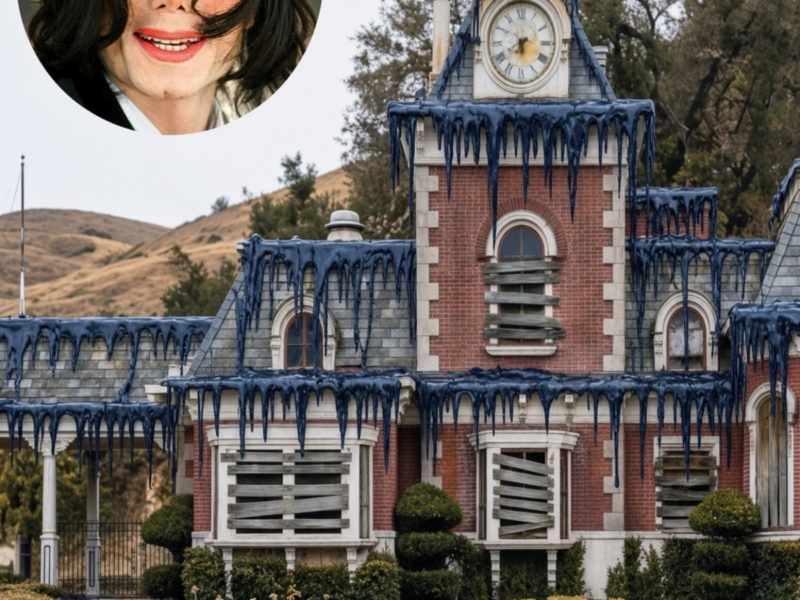
Michael Jackson’s Los Angeles Mansion Revisited 17 Years Later – What They Found Is Heartbreaking.
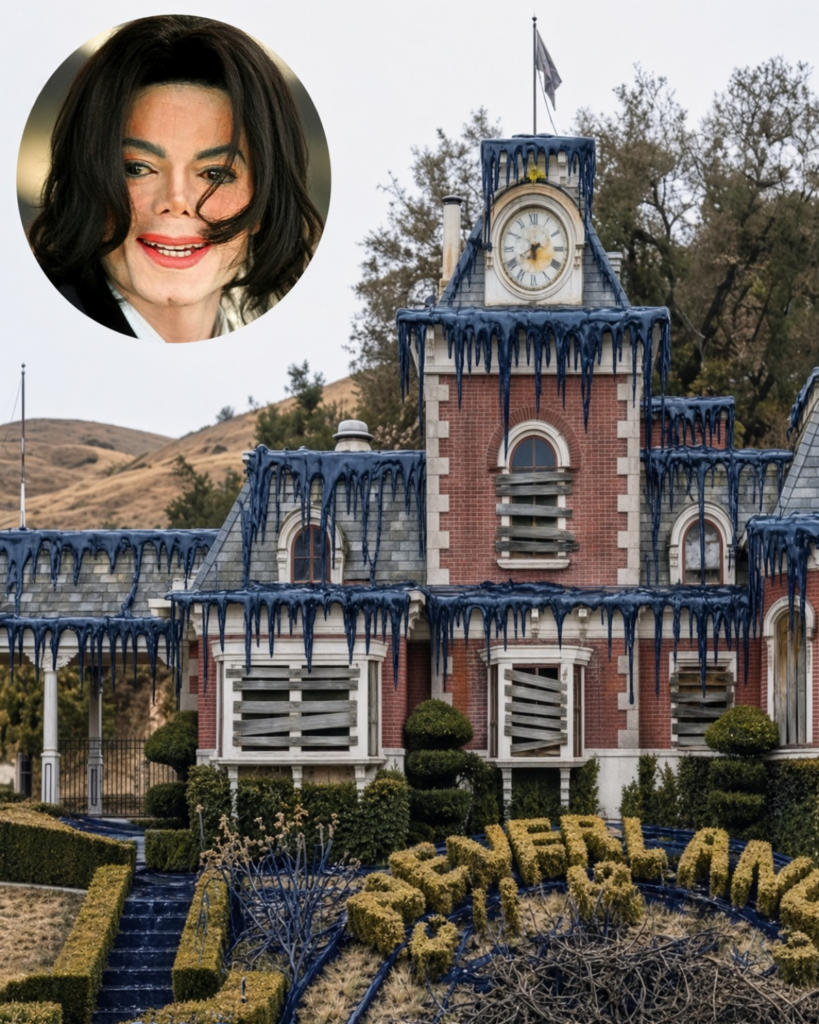
Seventeen years is a long time.
Long enough for a newborn to become an adult, for a city to rebuild its skyline, and for a world that once could not stop talking about a man to learn how to speak about him in quieter tones.
Drive west along Sunset Boulevard in Los Angeles, past the palm trees and the hedges grown tall enough to swallow estates, and you will reach a stretch of road called Holmby Hills.
This is old Hollywood money.
These are the kinds of streets where gates are bigger than most people’s front doors, where you see no one, only the walls built to keep people out.
Turn north onto Carolwood Drive, and at number 100, behind a gate and a wall of greenery, sits a French chateau-style mansion of more than 17,000 square feet.
It has seven bedrooms, a theater, a wine cellar, a gym, and a guest house with stained glass doors that open to a pool.
In December 2008, Michael Jackson rented it for $100,000 a month.
On June 25, 2009, he died inside it.
He was 50 years old.
The story of this house is not really about marble or square footage.
It is about a man who sold hundreds of millions of records, yet spent his final months behind a gate, rehearsing for the greatest comeback of his life, surrounded by his three children and by people whose motives are still debated today.
It is a story about a man, a house, and a heavy silence that followed one of the loudest careers in history.
What stands behind those hedges now?
And what does the world remember when it looks at them?
Stay with me, because the answer is more human and more heartbreaking than any tabloid headline ever allowed.
To understand why Michael Jackson ended up on Carolwood Drive, you have to understand how tired he was of being chased.
By 2008, the King of Pop had spent years drifting.
After his 2005 child molestation trial, in which he was acquitted on all counts, he left Neverland Ranch, the fantasy estate he had built in the hills of Santa Barbara County, and he never lived there again.
He wandered, staying in Bahrain, Ireland, and Las Vegas.
He was surrounded by debts, lawsuits, and rumors, and always he had his children with him.
Prince, born in 1997, Paris, born in 1998, and the youngest, Prince Michael II, whom the world nicknamed Blanket and whom the family called Bigi.
Los Angeles offered something different.
It was where the entertainment business lived, and it was where his future waited.
In March 2009, Jackson stood before cameras at London’s O2 Arena and announced a series of concerts he called This Is It.
The phrase was meant as a farewell to the stage.
Ten shows were planned first, then tickets sold so fast that the run was expanded to 50 dates beginning in July 2009.
Hundreds of thousands of fans were waiting.
He needed a base.
The Holmby Hills mansion, owned by clothing executive Hubert Guez, offered privacy, space, and a high wall.
For Jackson, who had been photographed everywhere he went for 40 years, privacy was not a luxury, it was oxygen.
And inside those walls, he tried to build a normal life for his kids.
Those who knew the family have described a house with a chalkboard in the kitchen where the children left little messages, and a home where Jackson wanted them to feel as safe as he never did.
He had grown up in Gary, Indiana, performing on stages as a small boy under the demands of a controlling father.
He often said he had missed his own childhood.
Now he wanted his children to have what he had lost.
The children were homeschooled by tutors.
They drew, played, and splashed in the pool.
Jackson set up spaces for creativity and, according to later reporting, used a room by the pool as a place to work on music.
He gave interviews rarely and trusted few.
Many of the people around him were new faces who had come into his orbit as the comeback project took shape.
In public, Prince, Paris, and Bigi had famously worn veils and masks to hide their faces from cameras, a decision that fueled endless speculation.
Inside the gates, the masks came off.
For the first time in a long while, the children could simply be children, running through the halls and gardens like kids anywhere.
Think about that picture: a global icon, tired, famous beyond measure, arranging his life so his children could have a quiet afternoon.
Fatherhood was his sanctuary, but the sanctuary had a clock ticking inside it, and the clock was counting down to July 13, the opening night in London.
Behind the gates, the final months were not peaceful.
They were a race.
Rehearsals for This Is It were directed by Kenny Ortega, the veteran choreographer behind major film and stage productions.
Jackson rehearsed at the Staples Center and at the Forum in Inglewood, working with dancers, musicians, and a huge production team who were building a spectacle unlike anything the world had seen.
Cameras were rolling, and the footage was later turned into a documentary that earned hundreds of millions of dollars worldwide.
In it, you can see Jackson at work, graceful, precise, and still capable of the moves that made him a legend.
Colleagues later described Jackson as a perfectionist.
He wanted the show to be bigger than anything he had ever done.
Giant video screens, illusions, dozens of dancers, and a set list stretching from the Jackson 5 to Thriller.
He pushed himself to match the memory of how the world had seen him at his peak, and he was no longer a young man.
The gap between that memory and a 50-year-old body weighed heavily.
The pressure came from everywhere.
Tickets for the first dates had sold out within hours.
Every day that passed was a day nearer to a deadline that could not move.
But the footage does not show the nights.
Jackson, who was 50 years old, suffered from severe insomnia.
For years, he had struggled to sleep, and by the spring of 2009, he was desperate for rest.
He felt that he could not perform without it.
His team and his promoters, AEG Live, were pouring millions of dollars into the show, and everyone knew the stakes.
An exhausted star could not carry a 50-night run.
Into this pressure walked Dr. Conrad Murray, a cardiologist from Houston whom Jackson had known for several years.
In the spring of 2009, Murray became Jackson’s personal physician with an agreed fee of $150,000 a month.
Murray later told police that he had been giving Jackson the powerful anesthetic propofol, a drug meant for hospitals and surgery, as a sleep aid.
Jackson reportedly called it his milk.
Meanwhile, the mansion, with its 12 fireplaces and manicured gardens, grew quieter.
Staff came and went.
Curtains stayed drawn.
The glamorous exterior hid a household built around one fragile need: sleep.
Let that settle.
A drug designed for operating rooms was being given in a bedroom in Holmby Hills without the equipment and monitoring that a hospital provides.
In May 2009, Murray recorded Jackson on his phone.
That audio was later played in court.
Jackson sounds groggy and slurring as he talks about the dream of building a children’s hospital and about the show he believed would be a huge success.
It is hard to listen to.
It reveals a man who is exhausted, hopeful, and fragile all at once.
On the night of June 24, Jackson rehearsed at the Staples Center.
Those who saw him said he was in good spirits, performing with energy.
Then he went home to the mansion, a place where he hoped to rest, and where the people around him believed the next morning would simply bring another day of preparation.
Instead, the house was about to become the center of one of the most devastating news stories of the century.
Here is what is known about the morning of June 25, 2009.
According to testimony at Conrad Murray’s trial, Jackson struggled to sleep through the night.
Murray said that he gave him several drugs, including sedatives, and then, after hours of trying, a dose of propofol.
He then, by his own account, stepped away from the bed.
When he returned, Jackson was no longer breathing.
What followed has been examined line by line in court.
The defense told a different story.
Murray’s lawyers argued that Jackson had given himself a final fatal dose while the doctor was out of the room.
The jury, after deliberating for less than two days, did not accept it.
Prosecutors argued that Murray did not have the proper equipment, did not monitor Jackson as a hospital would have, and did not immediately call for help.
Instead, he began chest compressions on a bed, a soft surface that makes CPR far less effective, and he made phone calls before an emergency call was placed.
At 12:21 in the afternoon, a security staffer, Alberto Alvarez, called 911.
The recording is public.
Anyone who hears it can still feel the panic in the voice of a man pleading for help to come quickly.
The dispatcher talks him through resuscitation.
In the background, you can hear the sound of someone trying to save a life.
Paramedics arrived within minutes and found Jackson lying on the bed, lifeless.
He was rushed to UCLA Medical Center with fans and reporters already gathering.
Doctors worked for a very long time.
At 2:26 in the afternoon, Pacific time, Michael Jackson was pronounced dead.
Helicopters circled above the hills, and television networks broke into their programming.
At the gate of the mansion, cameras lined the entire street.
The news spread across the planet faster than anything the internet had seen.
Websites crashed, phone lines jammed, crowds gathered outside the hospital, outside the gates of the Carolwood house, and at Neverland.
People wept in the streets, in Harlem, in London, in Tokyo.
Police treated the mansion as an investigation scene, and later the world would learn what they found.
Investigators documented medical equipment and vials in the bedroom.
Evidence that painted a picture of a man whose home had quietly become a place of treatment.
In August 2009, the Los Angeles County Coroner ruled the death a homicide, citing acute propofol intoxication with other sedatives contributing.
Within weeks, investigators from the Los Angeles Police Department and the Drug Enforcement Administration searched Murray’s clinic in Houston and a home in Las Vegas.
And the case that began in a bedroom grew into a national story.
Millions followed every development as if the whole world had been invited to sit in the courtroom and grieve in public.
Dr. Murray was charged with involuntary manslaughter.
His trial began in September 2011 and ended on November 7 with a jury finding him guilty.
He was sentenced to four years, the maximum, and served about two years before his release in 2013.
But the sentence is not the heartbreaking part.
The heartbreak is in the picture the evidence leaves behind.
A man who had built the most famous career in music lying in a bedroom in the early hours of a day he was supposed to wake up and keep rehearsing, depending on someone he trusted.
Prince, Paris, and Bigi were in the house.
Paris, then 11, would say at the memorial service weeks later that her father had been the best father you could ever imagine.
She was sobbing as she said it, and the world cried with her.
After a tragedy, a house does not simply become quiet.
It becomes a question.
What do you do with a home in which a world-famous man died?
For a while, the answer was nothing.
Fans arrived by the thousands and left flowers, letters, and candles at the gate.
Tour buses added the address to their routes.
According to news reports, thousands of tourists passed by in the months after his death, turning a private street into an unofficial memorial.
The owner, Hubert Guez, put the mansion on the market in August 2010.
News reports later said the asking price had been $29 million, a number that reflected both the size of the house and the weight of its story.
And inside, the contents remained: furniture, art, and the little traces of a family’s daily life.
In December 2011, those contents went to auction.
Julien’s Auctions, the same company Jackson had once hired to sell items from Neverland before he called that sale off in early 2009, recreated the mansion inside its Beverly Hills showroom.
Fans came for a private preview.
In a moment that seemed to say everything about grief and commerce colliding, the auction house set up a tribute space where the bed would have been and invited people to leave messages and gifts.
The auctioneer promised to deliver them to Jackson’s children and to his mother, Katherine.
The bed’s headboard was pulled from the sale at the family’s request, but other items sold.
A kitchen chalkboard on which his children had written the words “I love Daddy” went for $5,000.
An armoire on which Jackson had scribbled a note to himself on the mirror, a reminder about training and working at full strength, sold for more than $25,000.
A rug that had lain beneath his bed sold for $15,000, far above its estimate of a few hundred.
In total, the sale brought in nearly $1 million.
The family’s matriarch, Katherine Jackson, and the estate’s executors were left to manage a legacy that included both a staggering catalog of music and debts that had followed Jackson for years.
The auction was part of that long, uncomfortable accounting.
Many fans felt uneasy.
Was it respectful to sell a child’s chalkboard message?
Was it ghoulish to collect a rug?
Others argued that the items would be treasured by those who loved him.
Both feelings were real.
Both still are.
Supporters of the auction said fans deserved a chance to own a piece of his story.
Critics said a child’s handwriting should never have a price tag.
Between those positions sits a question nobody can fully answer.
When does remembering turn into selling?
That is the heartbreak of an icon’s possessions.
They begin as a family’s ordinary things.
A chalkboard, a note, a mirror.
Then the world turns them into relics.
Today those pieces sit quietly in private collections around the world.
Each one carrying a story that no price tag can ever hold.
So what stands at 100 North Carolwood Drive now?
The mansion was sold in 2012 for a reported $18.1 million to Steven Mayer, an executive at the investment firm Cerberus Capital Management, according to news coverage at the time.
It was a dramatic drop from the asking prices of earlier years, but it was still a stunning sum for a rented home that had become for many a place of sorrow.
Since then the house has returned to what it was built to be, a private residence in one of the most exclusive neighborhoods in America.
That means there are no tours, no plaques, and no welcome mats.
If you were to stand on the street today, you would see what any visitor sees.
Tall hedges, a gate, and the quiet that money buys.
You would not see the rooms.
You would not see the bedroom.
You would see only the world’s most famous privacy.
Fans have not forgotten.
Visitors have come over the years to stand outside, to take photographs, to leave a thought.
Even those who never met him, who only heard his voice on the radio, seem to feel the pull of the place.
In 2026, seventeen years after his death, he is still one of the most streamed and discussed artists in the world.
And a new film about his life has brought a new generation to his music.
Yet the house itself says nothing.
That is its strangest quality.
A place that witnessed so much sorrow now looks like any grand estate, peaceful and polished.
The grass is mowed, the gate is closed.
It is easy to forget that this quiet address once dominated headlines worldwide for months on end.
The sun falls on the same stone and the same trees as if nothing ever happened.
And maybe that is the answer to what you will find there.
Not a ghost, not a shrine, just time doing what time does.
The world has moved on, but the memory has not.
It lingers in the minds of the fans who still gather every June, and it lingers in the family who must live with the loss in a way that no auction or headline can measure.
Across town at Forest Lawn Memorial Park in Glendale, where Jackson was laid to rest in September 2009, fans gather each year on the anniversary of his death and on his birthday in August.
His star on the Hollywood Walk of Fame is covered in flowers on those days.
The real memorial, many say, is not a house at all.
It is the songs.
Heartbreak is not always something you find.
Sometimes it is simply what remains.
When we look back on Michael Jackson’s last home, we have a choice.
We can see it as a crime scene, a piece of real estate, or a tourist stop.
Or we can see it as the place where a father was trying to hold on to a normal life.
The record shows a man of astonishing contradictions.
He was the biggest star on Earth, and he was lonely.
He commanded stadiums, and he longed for a quiet afternoon with his children.
He could dance in a way that bent physics, yet he lay awake at night, unable to find rest.
He had the loudest fans in the world, and he trusted almost no one.
Remember what he said when he announced his final concerts: “This is it.”
He meant that these would be his last shows.
He had no idea how true those words would be.
It is easy to turn his death into a headline, a trial, or a debate.
And yes, the court found that a physician failed him, but the story is bigger than one man’s guilt.
It is about how fame can isolate a person, how pressure can pile up like weather, and how even the most powerful artist alive can be vulnerable in the dark of an ordinary night.
Fame is, after all, a spotlight, not a shelter.
His children carried that loss into adulthood.
Prince, Paris, and Bigi grew up in public with the world watching their grief.
And they have spoken in different ways about their father.
What they remember is not the legend.
It is the man who played with them, who made them laugh, who wrote the words they could hold on to.
That is why the little things matter.
A message from a child, a note on a mirror from a man pushing himself to be ready.
These are not artifacts of a star.
They are fingerprints of a human being.
And so the legacy of Michael Jackson cannot be measured only in record sales or in the awards on a shelf.
It lives in the moonwalk, in the way a generation learned to dance, in songs that still fill dance floors on every continent.
It lives in the fans who still gather.
The ones who play his music at weddings and funerals alike.
If there is a lesson at the gate of that house, it is a gentle one.
Be kind to people who seem to have everything.
Look past the spotlight, and remember that behind the greatest performances in the world, there is often someone who is simply tired, hopeful, and hoping for peace.
Years from now, historians will still write about the sales and the records, but those who loved him will remember the smaller things.
A smile, a spin, a child’s handwriting on a kitchen board.
Michael Jackson spent his life giving the world a show.
In the end, what he wanted most was a quiet home and the people he loved.









