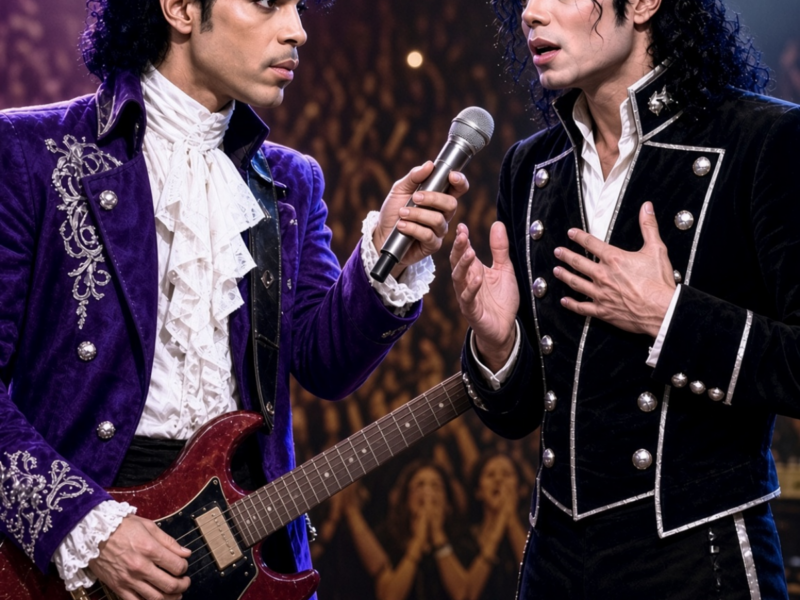
Michael Jackson’s Hidden Talent Exposed by Prince — You Won’t Believe What Happened.
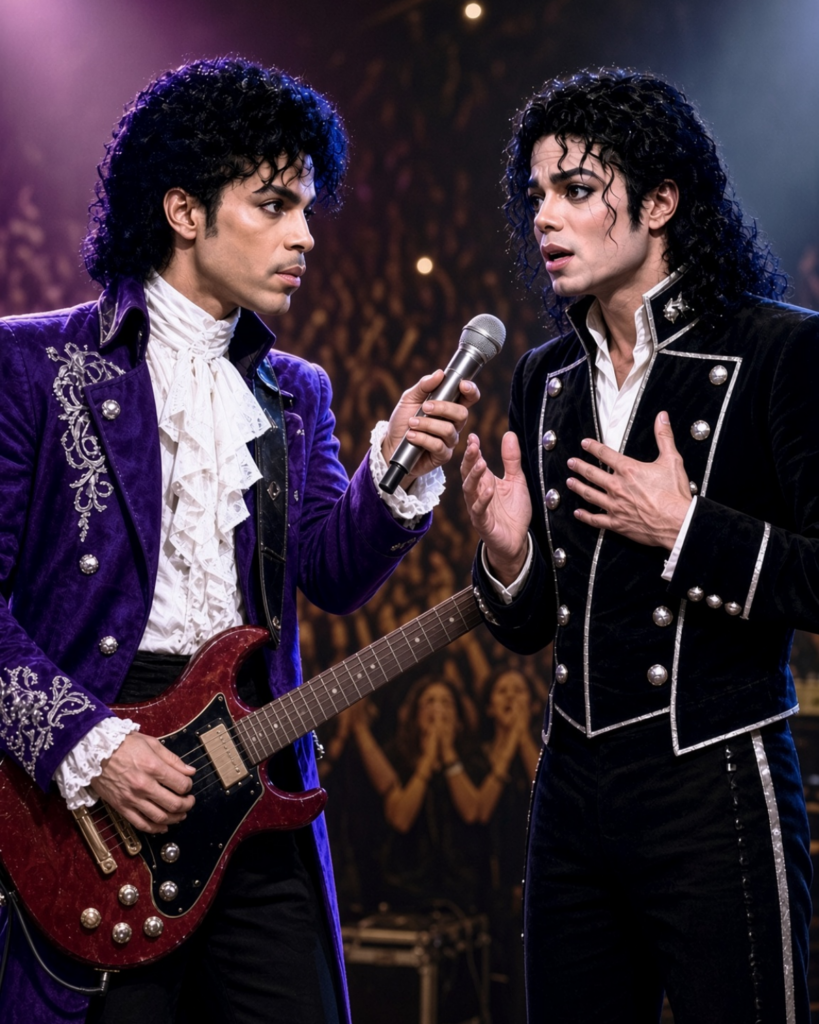
On the night of October 8, 1988, at the Great Western Forum in Inglewood, California, 18,000 people came to watch Prince perform alone, the way he always had.
Nobody in that building knew that a phone call from six years earlier was about to walk in through a side door in sunglasses and take a seat in a private box near the stage.
The wound went back to the spring of 1982, to a call from producer Quincy Jones.
He was finishing Michael Jackson’s Thriller, and one track needed a guitar solo raw enough to cut against the record’s polish.
He wanted Prince on “Beat It.”
Prince considered it for two days, then never called back, never showed up.
Eddie Van Halen played the solo instead, and it became one of the most famous sixteen bars in pop music.
Prince spent years turning the decision over in his head, more than he ever let on.
Michael rarely brought Prince’s name up in interviews, and when he did, people close to him noticed a peculiar stillness enter his voice.
The quiet of a man who understood he’d once been turned down by someone he privately admired more than anyone gave him credit for.
The music press spent the rest of the decade treating them as blood rivals because a rivalry sold more magazines than the truth: side-by-side chart comparisons, competing box office numbers, every award show framed as another round in a fight neither man had agreed to.
Privately, according to people close to both camps, each had told friends he respected the other’s work enormously and found something almost uncomfortable in how closely their instincts lined up.
Neither said so publicly.
Pride and six years of unspoken history kept it locked in separate rooms on separate coasts.
They’d crossed paths a handful of times—award shows, industry parties—always polite, always distant, always photographed.
But by 1988, at the height of both their careers, they had never once shared a stage in any meaningful way.
Michael had come to the Forum through a Warner Bros. executive both camps trusted, who’d spent months quietly trying to build a bridge between the two artists he considered the most important talents of his career.
Prince had extended the invitation personally, a handwritten note delivered with two tickets.
No explanation beyond one line: “Come see what I’ve built.”
Michael turned that note over in his hands for three days before deciding to go.
Sitting alone at the piano in the music room at Neverland, with it propped against a stack of sheet music he never used.
“I think it’s time,” he told his assistant, Renata Cole, that evening, adjusting his jacket in the mirror.
“I turned him down once, told myself it was Quincy’s decision, not mine. That’s not entirely true. I could have pushed harder to get him in that room. I didn’t. I think I owe it to both of us to at least sit in a room and listen to what he’s built since then.”
Renata didn’t fully understand, but she nodded anyway.
The drive to Inglewood took the better part of an hour, Michael sitting quietly in the back.
Thinking about a rehearsal room in Gary where he and his brothers used to practice under their father’s exacting eye.
About the particular loneliness of always being expected to be flawless.
He wondered whether Prince did the same thing—sat in darkened theaters running the same restless arithmetic, unable to just enjoy a performance.
He arrived a little after 7:00, ushered quietly to a private box near the stage, sunglasses on.
Word moved fast backstage, and by the time the house lights dropped, most of the crew already knew who was sitting in that box.
Though none said a word to Prince directly.
He already knew.
He’d spent the afternoon quietly reworking one small section of the set list with only his musical director, Dez Dickerson.
“You sure about this?” Dez asked, flipping through the charts.
“We’ve never rebuilt a section on the fly.”
“I’ve been sure about this for six years,” Prince said.
“Just needed him in the room first.”
The show began at 8:00.
The full Lovesexy spectacle unfolding as it had at every stop.
An elaborate in-the-round set with a working basketball hoop, a barber chair, a full band on risers that rotated through the performance, built less like a concert than a single continuous piece of music.
Prince moved through it with the relentless command that had defined his live shows for a decade.
Horns punching through arrangements with surgical precision.
The rhythm section locked so tight, the floor seemed to move as one body.
Prince darting between guitar, keys, and microphone.
The crowd was entirely his within twenty minutes.
About an hour in, following one of the night’s most physically demanding numbers, Prince walked to center stage, still catching his breath, guitar slung low, and raised a hand.
The band held.
The lighting dimmed to a single warm spot, and 18,000 people, sensing something outside the show’s usual rhythm, began to quiet.
“We got somebody special in the house tonight,” Prince said, his low Minneapolis cadence carrying through the arena’s sound system.
“Somebody I’ve been meaning to have a real conversation with for about six years now.”
A ripple of curious murmurs, nobody quite sure where this was going.
“Michael Jackson,” Prince said.
And the spotlight swung toward the private box.
“Come on out here.”
The arena exploded.
Michael, caught genuinely off guard despite everything he’d turned over on the drive to the Forum, sat frozen for a beat before standing slowly, giving the roaring crowd a small careful wave.
Security guided him down toward the stage, the noise building with every step.
And he climbed the short staircase into the light to meet Prince at center stage under a spotlight built for a show that until a few minutes earlier had never once included this moment in its structure.
“Prince,” Michael said, extending a hand.
Prince took it, held it a beat longer than a handshake required, something unreadable passing behind his eyes.
“Been a long time.”
“It has. Six years, give or take.”
Something shifted in Prince’s tone, and the crowd’s energy shifted with it.
18,000 people leaning forward, sensing the turn from celebration into something more pointed.
Michael’s smile held, though something behind his eyes went careful.
“I know what you’re about to bring up.”
“Do you?”
“Beat It,” Michael said.
“Quincy called you. You never came.”
Prince nodded slowly.
“Thought about it for two days. Sat with the idea of walking into somebody else’s studio, playing a part I didn’t build from the ground up on a record that was going to belong to somebody else no matter how good my solo turned out to be. Wasn’t ready for that back then. Told myself it was scheduling. Wasn’t. I was scared, if I’m honest with you and everybody in this building.”
The arena had gone almost completely silent.
18,000 people watching two of the most guarded men in the business trade something neither had ever said in public.
“I never pushed Quincy to fight for it, either,” Michael admitted.
“Told myself it wasn’t my place to ask twice. Truth is, some part of me was relieved when you said no.”
Prince studied him.
“So we’ve both been carrying the same fear around for six years.”
“Looks that way.”
“I’ve got an idea,” Prince said, turning slightly to address the crowd as much as Michael.
“Something I think might finally settle this properly. In front of everybody instead of behind closed doors where it’s easy to keep pretending it doesn’t matter.”
“Go on.”
“I want you to sing ‘Purple Rain.’ Tonight. Right now.”
“My song? My band? No rehearsal?”
The gasp that went through the Forum was full-throated and genuine.
18,000 people at once.
Somebody near the front called out, loud enough to carry, “He can’t be serious.”
But Prince had never been more serious about anything in his life, and every person in that building could see it plainly.
Michael’s composure faltered for the first time all night.
“That’s not just a song. That’s your whole story. Your father, your faith. I can’t just borrow that for ten minutes in front of 18,000 people.”
“That’s exactly why I’m asking. Anybody can sing a song that doesn’t cost them anything.”
“And if I get it wrong?”
Prince leaned in, his voice dropping low enough that the microphone almost missed it, though it didn’t, and 18,000 people strained forward to hear it anyway.
“You won’t get it wrong. Because the boy who used to stand in a room in Gary, scared of his own father, doesn’t know how to get honest music wrong. He only knows how to get it real. And real is the only thing this song has ever needed.”
Michael stood there a long moment, the weight of 18,000 strangers watching him, the biggest risk of his career standing in front of him in a purple trench coat.
He could have declined.
Nobody would have blamed him.
“Purple Rain” was the emotional center of an album built around Prince’s own most private wounds.
Attempting it in front of its creator was either extraordinary trust or complete recklessness.
The silence held six full seconds.
Michael looked at Prince, then at the crowd, and something in his face settled the way water settles after a stone breaks its surface.
“All right,” he said into the microphone, his voice changed, something lower and more exposed running underneath the polished tone 18,000 people knew from the radio.
“All right, Prince. You want honest? I’ll give you honest.”
He turned to the band.
“Strip it all the way down. Just the piano, if that’s all right. I don’t know exactly where I’m going with this, but I’ll find it. And I’d be grateful if you came with me.”
Dez looked at Prince, who gave a single deliberate nod.
Trust him.
Don’t ask questions.
And the keyboard player settled his hands over the keys and waited.
Michael closed his eyes for a moment before the first chord.
And for that brief span of silence, the biggest arena in Los Angeles felt impossibly like a small bedroom in Gary, Indiana, where a frightened boy used to sing quietly to himself just to feel like the walls weren’t closing in.
He began the way nobody expected—not the soaring guitar-driven power of the record, but stripped almost to a whisper.
His voice thin and unguarded in a way 18,000 people had genuinely never heard from him.
He sang the opening line like a confession rather than a performance, as if it were about every unresolved thing sitting between a son and a father who’d pushed him too hard for too long.
By the second line, something moved through the crowd like current through still water.
His voice grew stronger through the first verse, but not louder.
He let the song come to him instead of chasing it.
The room braced for the famous guitar swell to lift the arena.
It didn’t come.
Not yet.
Instead, Michael stripped the chorus to its barest bones, turning Prince’s soaring anthem into a hymn built around the grief of a boy who’d spent his childhood trying to be good enough for a father who never once said so out loud.
In the wings, members of Prince’s own band gathered to watch, exchanging the disbelief of professional musicians witnessing something they hadn’t expected to witness that night, or ever.
Prince stood off to the side, and something crossed his face his band had rarely seen in a decade together.
Not his usual calculated cool, but something raw, close to recognition.
A man hearing his own private wound sung back to him by somebody carrying a nearly identical one.
Prince walked out toward him slowly.
None of the sharp precision that had defined every move he’d made on that stage all night, guitar hanging unplugged and loose against his body.
He reached Michael’s side, plugged back in without a word, and began to play.
Not the screaming solo the record was famous for, just a soft, aching line underneath Michael’s voice.
An offering rather than a performance.
Michael’s voice caught for half a second, a tiny hitch most of the crowd missed.
The band noticed.
Prince noticed.
Michael didn’t stop singing.
Something in him, trained by a thousand nights of performing through exhaustion, understood that stopping now would shatter something more important than the song.
He kept going, his voice trembling now.
Not from weakness, but from the sheer weight of what was building between a boy from Gary and a boy from Minneapolis.
Both finding each other inside a song that had started as one man’s private wound and was quickly becoming something both of them owned.
By the second chorus Prince’s guitar had grown fuller.
The two of them moving with an instinctive conversation that looked like two men who’d rehearsed this a hundred times rather than two who had never once performed together.
Building toward the song’s famous instrumental climax as something shared.
Not as Prince alone the way it had been at every other stop on the tour.
The crowd was weeping.
Not one or two people near the front.
Hundreds.
Men and women alike gripping the armrests of their seats, caught between watching two legends share a stage for the first time and the deeper experience of watching two guarded men process something neither had ever fully said out loud.
In front of 18,000 strangers.
When the solo finally arrived it wasn’t the calculated, note-perfect version from the record.
It was raw, more urgent.
Prince bending notes with an intensity his own bandmates later said they’d rarely witnessed even from him.
Michael stood beside him.
Eyes closed, swaying, no longer singing, simply present.
Letting Prince carry the moment the way Prince had let him carry it minutes earlier.
The house lights programmed for a wash of purple at exactly this point in the show caught the sweat on both men’s faces, and for a moment the whole arena looked bathed in the color of the song itself.
An accident of timing that felt considerably less accidental than it was.
The final notes rang out and hung in the air.
Michael brought the last verse back in.
Quieter, exhausted, honest.
His voice barely above a whisper as the song wound toward its close, the two of them landing on the final sustained chord together.
Guitar and voice fading out at the exact same instant as if they’d silently agreed this was where it had to end.
For a long moment nobody made a sound.
Then the applause came.
And it wasn’t the screaming chaotic roar of an ordinary concert.
It was the sound of 18,000 people who had walked in as an audience and were walking out as witnesses to something none of them would ever fully be able to explain to anyone who hadn’t been there.
Prince turned to Michael, his chest still rising and falling from the solo.
Sweat visible under the stage lights.
For a long moment neither man said anything, just looked at each other.
Two people who had spent six years carefully avoiding exactly this kind of unguarded closeness.
“I wrote that song about my father,” Prince said finally, his voice thick, carrying through the microphone still clipped to his jacket.
“About wanting to fix something between us that felt unfixable most of my childhood. Never once in four years of playing it has it sounded the way it just sounded standing next to you.”
“I know exactly what you mean,” Michael said quietly.
“About the father part. I think that’s why I couldn’t sing it any other way tonight.”
Prince nodded slowly, something settling behind his eyes.
“I think I always knew that about you. Maybe that’s part of why I never showed up to that session six years ago. Some part of me was so scared of what it would feel like standing next to somebody carrying the exact same weight and not knowing what to do with that kind of recognition.”
“How’d you know? About my father, I mean. I never talked about that publicly, not back then.”
“I didn’t know for certain. Just recognized something in the way you move sometimes. A carefulness. Like every step still had to be approved by somebody who wasn’t even in the building.”
“Took me years to recognize it in myself,” Michael said.
“A man doesn’t move like that unless he learned it young. And the hard way.”
“Sometimes it takes somebody carrying the same thing to see it clearly,” Prince said.
“Everybody else just sees the performance.”
Michael managed a small tired smile.
“Why’d you actually come tonight?” Prince asked.
“You could have said no just as easily as I said no to that session six years ago.”
Michael considered the question seriously.
“Because I’ve spent six years wondering what it would have sounded like. The song, the guitar, the whole thing. Some part of me needed to finally find out, even if it scared me half to death standing up here not knowing how it would go.”
Prince extended his hand and this time Michael pulled him into an embrace instead, the crowd erupting louder.
18,000 people rising fully to their feet.
“Ladies and gentlemen,” Prince said, turning back to them, his voice steadier now.
“I think we just found out what happens when two people stop being scared of sounding the same as each other.”
Backstage after the show, Michael found Prince in a quiet corner near the dressing rooms, a towel draped over his shoulders.
“Got a minute?”
“For you, all the minutes you need.”
They sat quietly, the noise of the crew breaking down the set fading into the background.
“I need to say the rest of it properly,” Michael said eventually.
“Not for the cameras. I’ve thought about calling you more times than I could count. Tonight made it a lot harder to keep making excuses.”
“I think I owe you the bigger apology, honestly,” Prince said.
“I made a decision out of fear and let the industry believe it was scheduling or ego. Wasn’t fair to either of us, letting that stand for six years instead of telling you the truth.”
“Why tell me now?”
“Because watching you sing my song tonight the way you actually sang it made it pretty clear neither one of us has anything left to protect by staying guarded around each other. We’re carrying too much of the same weight for that to make sense anymore.”
“Do you think we could have made something good together back then, on ‘Beat It’?”
Prince considered it longer than anything else all evening.
“Something dangerous, probably. Might have been good. Might have been a mess. Never got the chance to find out. That’s the real thing I’ve been sitting with. Not knowing is worse than getting it wrong would have been.”
“We could still find out,” Michael said.
“Nothing stopping us now.”
Something warm and a little surprised crossed Prince’s face.
“You’d want to do that? After everything?”
“Especially after everything. Think we’ve spent enough years being careful around each other. Might be time to actually make something instead.”
“What would we even make?” Prince said.
“We work so differently.”
“Maybe that’s exactly why it would work,” Michael said.
“Two different ways of building the same kind of honesty.”
They talked a while about fathers who’d pushed them harder than either had fully processed.
“Mine used to play piano in the next room while I was supposed to be asleep,” Prince said at one point.
“I’d sneak out of bed and sit on the stairs just to listen. Only time I ever felt close to him was overhearing something he never meant for me to hear.”
Michael nodded slowly.
“My father locked the door during rehearsals. Wouldn’t let anybody leave until every part was perfect. I was seven years old learning what perfect meant before I understood what a mistake was supposed to feel like.”
“Strange kind of inheritance,” Prince said.
“Learning to love music by sneaking around to catch it instead of being given it outright.”
“Maybe that’s why we both build things the way we do,” Michael said.
“You layer carefully because nobody ever handed you the finished thing plainly. I keep things loose because the only real music I got from my father was the kind I wasn’t supposed to be hearing.”
Before Michael left that night, the two exchanged numbers.
An ordinary gesture carrying far more weight than either said aloud.
“Come by Paisley Park sometime,” Prince said.
“I’ll show you the whole setup. We can see what happens when we actually try.”
“I’d like that,” Michael said, and this time he meant it completely.
He flew out to Minneapolis a few months later and spent an afternoon at Paisley Park that neither man ever spoke about in much public detail afterward.
According to a studio engineer present that day, Frank Torres, the two of them spent hours building the bones of a song neither had planned in advance.
A baseline Prince had been sitting on for months meeting a vocal melody Michael worked out on the spot.
“Two completely different processes fitting together without either one slowing down to explain what they were doing,” Frank said years later.
“Every few minutes, it would just click.”
The song never received an official release, filed away the way half-finished ideas often are.
But the handful of people who heard the surviving tape described something unlike anything either artist made separately.
The Forum performance never aired in full.
The broadcast crew handling parts of the tour’s footage trimmed the segment considerably, unsure how to present a moment so far outside the show’s planned structure.
But everyone inside that arena carried it with them, telling the story to anyone who’d listen about the night Prince dared Michael Jackson to sing “Purple Rain.”
And what happened when two rivals finally stopped being careful with each other in front of 18,000 witnesses.
Years later, Prince never dressed the story up bigger than it already was.
“I spent six years letting people believe we didn’t respect each other,” he said in one reflection.
“Truth was, we respected each other too much to risk finding out what might happen if we actually stood next to each other and meant it. That night at the Forum, we found out. Turned out we didn’t have anything to be afraid of.”
Michael, asked about the evening before his passing in 2009, said something similar.
“People wanted to believe Prince and I were enemies. Made for a better story than the truth. We were both scared of being truly seen by somebody who understood exactly what that fear cost. That night, we stopped being scared of it. I don’t think I ever sang anything more honestly in my career.”
When Prince died in 2016, tributes poured in across the industry.
And reporters revisited old interviews where both men had described that Forum night in strikingly similar terms.
A longtime member of Prince’s road crew, reflecting on his career years later, said the strangest, most beautiful thing he ever saw on that tour wasn’t any of the choreography.
It was watching Prince hand somebody else the most personal song he ever wrote and trust him completely with it.
“Never saw him let another singer or guitarist near that song again. Not once. Not the rest of that tour.”
That’s the legacy of that October night at the Great Western Forum.
Not simply a jaw-dropping moment nobody expected from two of the biggest names in music history, but a reminder that the stories the world tells about rivalry are rarely the whole truth.
And that sometimes the bravest thing two guarded men can do is stand next to each other and finally stop pretending they aren’t carrying the exact same weight.









