Michael Jackson’s Final Rehearsal Footage Will Make You Cry.
The most heartbreaking thing about Michael Jackson’s final rehearsal is not that he looks ill or that he seems to know something terrible is coming.
It is that he does not appear to know the ending at all.
In the footage, he is smiling, moving to the music, joking with the people around him, and building a show he believes he is about to take to the world.
There is no audience in front of him, no roar of thousands of fans, and no spectacle outside the rehearsal lights.
Yet he performs as if the concert has already begun.
He is still chasing the moment he has imagined for months.
Still refining details.
Still giving the people around him the familiar warmth of a performer who knows that a show is made by an entire team.
The recording was made at Los Angeles Staples Center on June 24th, 2009 during preparations for the concerts that were supposed to bring Jackson back to the stage in London.
It captures his final night rehearsing before his death the following day.
The world would see the footage only afterward, which changed the way every smile, every wave, and every goodbye was understood.
A routine farewell suddenly carried the weight of a last one.
A line about the dream coming together sounded like a final message, even though there is no evidence that Jackson knew he was saying goodbye.
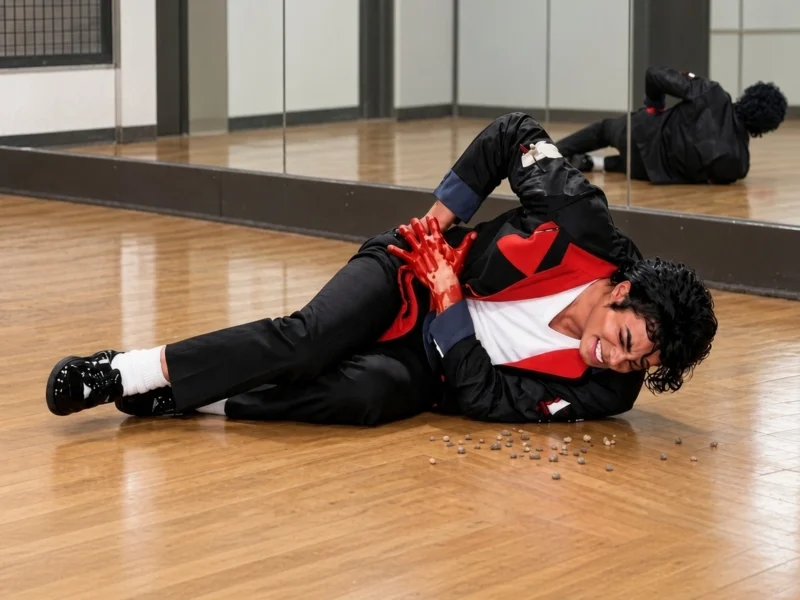
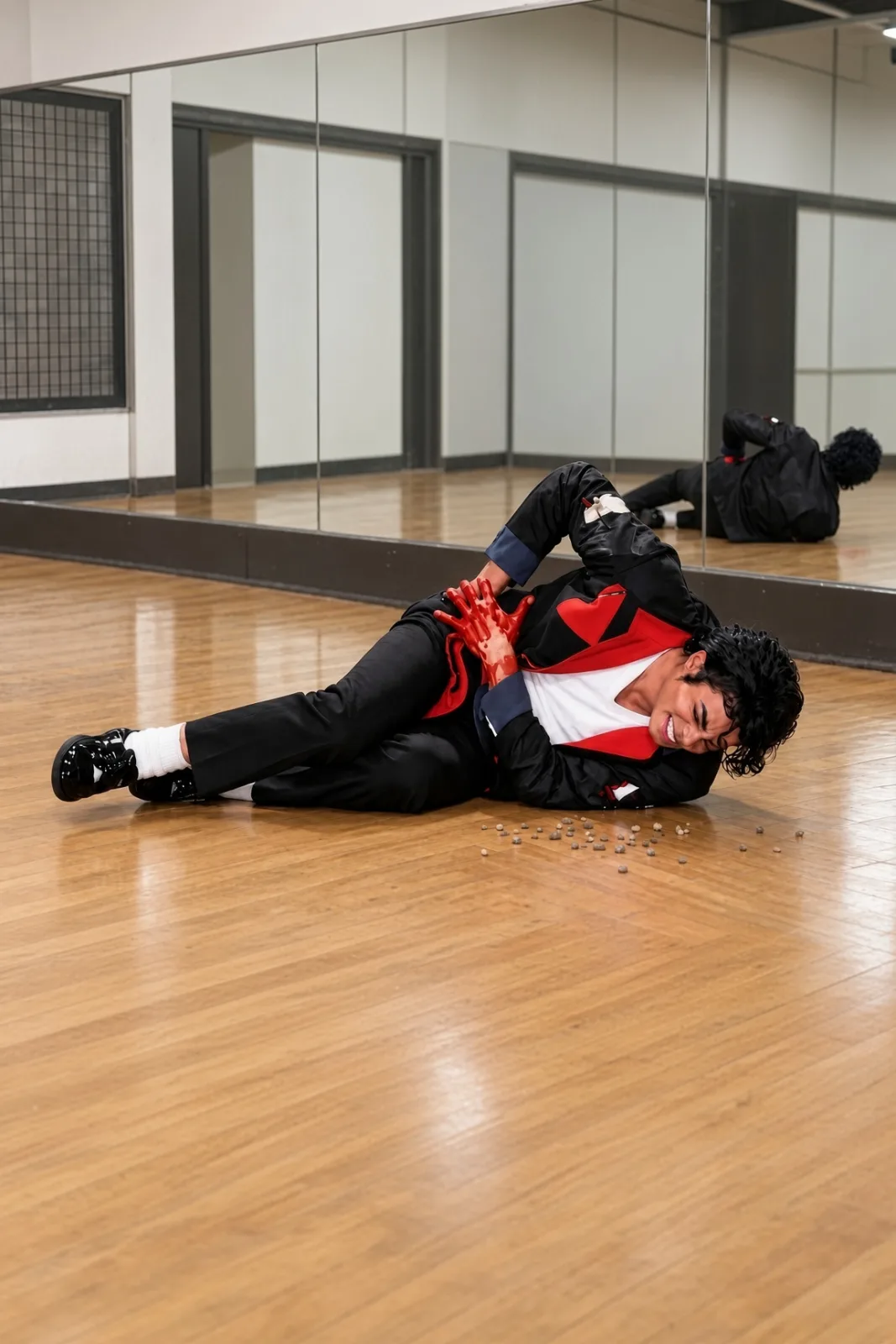
Meanwhile, the image of Michael Jackson’s intense movements and strained expression shows just how physically demanding his performances could be.
Curled forward and gripping his arm, he appears to embody the dramatic transformation seen in his iconic thriller choreography.
Although the pose alone doesn’t confirm an injury, it adds context to the emotional weight of his final rehearsal footage.
Now, let’s continue with today’s video.
By the end of the night, Jackson had performed some of the most demanding material in the planned show.
He hugged members of the team, wished them well, and told them he loved them.
He looked out across the empty arena and talked about the future as if London were already within reach.
Hours later, he would be at home and on June 25th, 2009, he would die at the age of 50.
Knowing that outcome makes the rehearsal painful to watch, but it also makes the footage worth understanding.
It is not just a recording of a famous man’s last work session.
It is a rare look at the craft, the ambition, the human connections, and the unfinished future behind one of the most consequential deaths in modern pop music.
To understand why the footage affects people so deeply, start with what Jackson was trying to build.
The planned This Is It concerts were meant to be a major comeback.
50 performances had been announced for London’s O2 Arena, and the production was being designed as more than a standard concert tour.
It combined familiar hits, elaborate staging, choreography, visual effects, and ideas Jackson wanted to present in a new way.
The shows had become a huge undertaking for the singer and the people working around him.
The opening night was approaching, and the team was still rehearsing, adjusting transitions, checking lighting, and trying to make a complicated production work as one complete experience.
For Jackson, the project carried more than commercial importance.
He had been famous since childhood and his career had moved through extraordinary highs, public battles, long periods away from touring and constant attention to his private life.
The London concerts offered a chance to put the focus back on the stage.
He could return to the songs and movements that audiences knew while showing how he wanted to present them.
Now, that does not mean the comeback would have solved every difficulty in his life or that success was guaranteed.
It means the rehearsals had a clear purpose, to prepare a show he believed could be special.
On June 24th, Jackson traveled to the Staples Center in Los Angeles for what became his last rehearsal.
Accounts of the evening describe him arriving in the early evening and working late into the night.
The venue was not packed with fans.
Instead, the arena held the band, dancers, choreographers, production staff, and others whose jobs were to help turn his plans into a finished performance.
In that setting, the familiar signs of a concert were present without the public spectacle.
There was a stage, music, costumes, lights, and a performer at the center, but the applause and the crowd were still waiting for London.
Jackson rehearsed a demanding set of songs including Wannabe Start in Something, Billy Jean, Smooth Criminal, She’s Out of My Life, and They Don’t Care About Us.
The material asked for different things from him.
Some numbers depended on quick, precise movement and strong rhythm.
Others called for stillness, vocal emotion, or a theatrical sense of timing.
They don’t care about us involved a disciplined march with dancers and a guitarist.
While Billy Jean gave him room for the movements that had become part of his visual identity.
The point of rehearsal was not simply to remember the songs.
It was to coordinate every element until the performance looked and sounded intentional.
Then came thriller.
For the production team, the number was both a signature moment and a complicated stage sequence.
The dancers used costumes inspired by the famous music video, bringing a piece of pop culture history into a new live setting.
In the rehearsal footage, Jackson dances with the group and moves through the choreography with the timing audiences expected from him.
The setting is unfinished compared with a real concert, but the performance still has its own energy.
He is not performing for a stadium of screaming fans.
He is working with colleagues who know the material and understand how much precision it requires.
Dorian Holly, the vocal coach who worked with Jackson and the band, later described Jackson as being like a child in a candy store because he was seeing his vision come alive.
Holly also recalled a lively atmosphere with jokes and a sense of excitement.
Randy Phillips, the chief executive of AEG Live, the concert promoter, likewise described Jackson as energetic and excited about the comeback.
These were impressions from people involved in the production, not medical assessments that can settle every question about Jackson’s condition, but they do help explain why many people who watched the footage after his death were struck by the contrast between the performer they saw on stage and the tragedy that followed less than a day later.
The evening continued with Earth Song, one of Jackson’s most dramatic and openly emotional songs.
The number had become a large-scale plea about the environment, human suffering, and the future of the planet.
It was designed to grow in intensity, asking the singer to move from a reflective opening into a powerful final section.
In the rehearsal, Jackson stands at the center of the stage, extending his arms and lifting his voice as the song builds.
The performance has the scale of a concert finale, even though the arena is empty.
This was the last song he performed on stage during that final rehearsal.
When Earth Song ended, the night was not quite finished.
Jackson stepped away from the stage and watched as the team continued working through Heal the World.
The production staff needed to examine the lighting, scenic elements, and staging so the rehearsal could continue without Jackson performing every part himself.
That detail is important because it makes the night less like a perfectly arranged farewell and more like what it was, a working rehearsal with technical decisions still to be checked.
The future show remained under construction.
Jackson and the team were still solving practical problems, not standing there with the knowledge that this would be the last time they shared that space.
Kenny Ortega, the show’s director and choreographer, later described the conversation he had with Jackson around this time.
Ortega testified that the two had experienced two successful rehearsal days and that Jackson was feeling good.
Jackson asked whether Ortega was happy and Ortega said that he was.
When Ortega asked Jackson the same question, Jackson replied that he was very happy.
Ortega also recalled Jackson speaking about feeling that they were accomplishing the dream he had envisioned.
The details of that exchange matter because the sense of achievement was not invented after the death.
It was part of the way the people involved described the night itself.
Another phrase associated with the rehearsal has stayed with fans.
This is the dream.
We did it good, Kenny.
We did it.
In the context of a show that had taken months to prepare, it was an expression of satisfaction.
The production was beginning to come together, and the London performances were getting closer.
Later, viewers heard those words with a knowledge Jackson did not possess.
That is the painful difference between a moment as it happens and a moment remembered afterward.
To Jackson, it could have been a normal declaration of relief and pride after a difficult stretch of work.
To the audience watching years later, it sounds unbearably final.
Ortega also recalled a feeling that the team could already imagine London.
The phrase, “You can feel London, you can smell it,” has been repeated because it conveys how near the concert seemed.
In the rehearsal room, the O2 arena was not physically present, but it was the destination shaping the work.
Every cue, movement, costume, and transition was being tested for the show that was supposed to happen there.
Jackson was not merely revisiting old hits.
He was preparing for a future he expected to reach.
It is tempting to turn his words into a prophecy, but that would mistake hindsight for knowledge.
The tragedy is that the future seemed real to him and to the people around him and then it was suddenly gone.
The human moments after the music are just as striking as the performances.
According to accounts from people who worked with Jackson, he made time to greet the dancers at the end of the night.
Daniel CBra, one of the dancers, later recalled that Jackson greeted the dancers every evening and that this night was no exception.
Celebra remembered telling Jackson, “Hey, Michael, I love you.”
And Jackson responding, “I love you, too, brother.”
The exchange was affectionate, but it was also part of a routine.
A good night was something Jackson did with the people who had spent hours working beside him.
Travis Payne, the associate producer and choreographer, also remembered calling out to Jackson as he left.
Payne said he told Jackson, “I love you.”
And Jackson replied, “I love you more.”
It was a brief exchange, warm and familiar.
Payne later described it as the last time he saw Jackson.
The words were not a public statement, and they were not delivered to an audience.
They were a personal goodbye between people who had worked together.
That is part of what makes the line so powerful now.
Its meaning changed because of what happened after it, not because Jackson necessarily intended it to carry a deeper message.
Jackson left the Staples Center late that night after the rehearsal and the remaining production work.
He had reason to believe the concert was moving closer to completion.
The dancers had done their work, the songs had been run, and the team had been able to feel the shape of the show.
There were still things to finish and the actual London opening had not yet happened, but the future seemed close.
He went back to his rented home in Holi Hills.
The rehearsal ended.
The next day was supposed to be another day of preparation.
There was no public sign off and no curtain call before an audience.
This is where the footage becomes difficult to watch.
Viewers know that Jackson died on June 25th, 2009 after being given propall and other sedative medication by his personal physician, Conrad Murray.
The rehearsal itself does not explain those events, and the footage should not be treated as if it does.
It captures a different part of the story.
Jackson at work among colleagues moving toward the next stage of his plan.
The contrast between the energy of the rehearsal and the details that later emerged about his death is shocking.
It can leave viewers searching the recording for clues, trying to decide whether he looked exhausted, unwell, or happy enough to be safe.
That context matters because accounts from the days before his death were not all identical.
Ortega later described an earlier rehearsal at which Jackson appeared weak and fatigued and he said Jackson was shivering.
Ortega recalled that the team had concerns and tried to help him warm up and eat.
Those recollections are disturbing and they sit beside memories of Jackson appearing engaged and enthusiastic on June 24th.
The accounts are not necessarily contradictory.
A person can seem unwell at one moment and animated at another.
A successful rehearsal does not prove that everything is fine.
Just as a difficult rehearsal does not tell us everything about someone’s health.
The final footage is one piece of a much larger record.
The June 23rd rehearsal was also recorded and portions of that work later became part of the public story.
In footage from that day, Jackson performs They Don’t Care About Us with the dancers moving in formation and rehearses Billy Jean, including his celebrated footwork.
The footage shows the team repeatedly working through transitions and cues.
At the end of one clip, a voice offstage says, “Hold for applause. Hold for applause. Fade out.”
The instruction is a simple production cue, but after Jackson’s death, it acquired a cruel irony.
There was no audience in the rehearsal room to applaud him because the applause was expected later in London.
The cameras captured rehearsal work, not a farewell scene.
The people in the room were focused on the next queue.
the next adjustment and the next day of preparation.
No one could have known that these ordinary working images would later become some of the last moving pictures audiences associated with Jackson.
Their meaning changed after his death when the plans visible in the footage could no longer be completed as intended.
Parts of the rehearsal footage were released to the public within days of Jackson’s death.
The concert promoter, AEG Live, shared material with news outlets, including CNN, at a time when questions about Jackson’s physical condition and the planned shows were already dominating public discussion.
The clips showed him dancing, singing, and working through the production.
For some, they were proof that he remained a compelling performer.
For others, they raised questions about how the demanding schedule had been managed and what the people around him understood about his health.
The footage could show his performance, but it could not settle all the arguments about responsibility, pressure, and medical care.
The full rehearsal recordings later became central to Michael Jackson’s This Is It, the documentary concert film released after his death.
The film offered a longer look at the process behind the planned shows with Jackson giving direction, shaping arrangements, and working with the musicians and dancers.
It showed the technical discipline behind performances that on stage might have looked effortless.
It also made clear how much the show depended on collaboration.
Jackson had a strong vision, but the production required a wide team to realize it.
The footage preserved that shared work, even though the concerts themselves never took place as planned.
On June 25th, Jackson did not wake into another ordinary day of rehearsals.
He died at his rented home in Los Angeles aged 50.
The official medical investigation concluded that the cause of death was acute propall intoxication with benzoazipene effects as a contributing factor.
The death was classified as a homicide, a medical and legal classification indicating that another person’s actions caused the death, not a conclusion that it was a murder in the everyday sense.
The investigation focused on the care provided by Murray, who had administered the medication while treating Jackson’s insomnia.
Propal is a powerful anesthetic normally used in settings where a patients breathing and circulation can be closely monitored.
It is not an ordinary sleep aid.
The evidence presented in the investigation described Jackson receiving Propoall along with other sedatives during the hours before he died.
The combination contributed to a fatal loss of normal breathing and ultimately cardiac arrest.
In the aftermath, investigators examined the medical decisions, the monitoring that was or was not in place, and the delay before emergency services were called.
These issues were matters for the investigation and court, not something viewers could diagnose from a rehearsal video.
Murray was charged with involuntary manslaughter.
His criminal trial began in 2011 and lasted several weeks, drawing intense public attention.
Prosecutors argued that Murray had acted with gross negligence by administering propall outside an appropriate medical setting, failing to provide the necessary monitoring and not responding properly when Jackson stopped breathing.
The defense presented its own arguments about the events, but the jury ultimately found Murray guilty.
On November 7th, 2011, he was convicted of involuntary manslaughter and was later sentenced to four years in county jail, the maximum available sentence at the time.
He served about 2 years before his release in 2013 and lost his medical license.
There is another reason the footage resonates.
It shows how much of Jackson’s identity was tied to performance.
He had been working professionally since childhood.
First with the Jackson 5 and then as a solo artist whose music and dance reshaped global pop culture.
He was known not only for songs but for staging, movement, costume, and the ability to turn a musical moment into an image people remembered.
For decades, audiences had watched him perform as though every gesture had been planned down to the smallest detail.
In the rehearsal footage, that precision is still there, but it appears inside an unfinished process rather than a polished spectacle.
When fans say the footage makes them cry, they are often responding to that combination.
Jackson is not presented only as a tragic figure.
He is active, focused, playful at times, and intensely committed to the performance.
The viewer sees how close the production seemed to its intended form and knows it would never reach its planned opening with him.
The sadness comes from the distance between what was being prepared and what actually happened.
London existed as a real future in the minds of the people making the show.
After June 25th, it became a future that could only be imagined.
The footage can also make people think about the pressure that surrounded a comeback on such a large scale.
50 shows in London was an enormous commitment and the preparations required sustained work from Jackson and the whole production team.
The public and industry attention was immense.
Yet, it would be too simple to say that the rehearsals alone explain his death or that the ambition of the project provides a complete answer.
The official investigation identified the fatal medication exposure and the medical care surrounding it.
The rehearsal videos tell a parallel story about the performance that was being prepared, not a substitute for the evidence about the cause of death.
Perhaps the most painful detail is that Jackson’s final good nights sound so familiar.
Those were words exchanged among people who expected to see each other again.
They were not delivered as a farewell to the world.
They were the small kindnesses of a night that appeared to be ending normally.
The next day transformed them into something else.
But that transformation belongs to the people who remember and watch the footage now.
Jackson himself, as far as the evidence shows, left the rehearsal looking toward the work still to come.
There is no applause at the end of the rehearsal, no final bow before a packed arena, and no closing montage planned to mark the moment.
There is a stage, a team, the end of a long evening, and people saying goodbye before heading home.
The world saw the footage only after Jackson was gone.
So every gesture arrived carrying knowledge that the people in the room did not have.
We know that the London concerts would not happen with him.
We know the next day would become one of the defining tragedies in music history.
They knew only that rehearsal was over and another day was supposed to follow.









