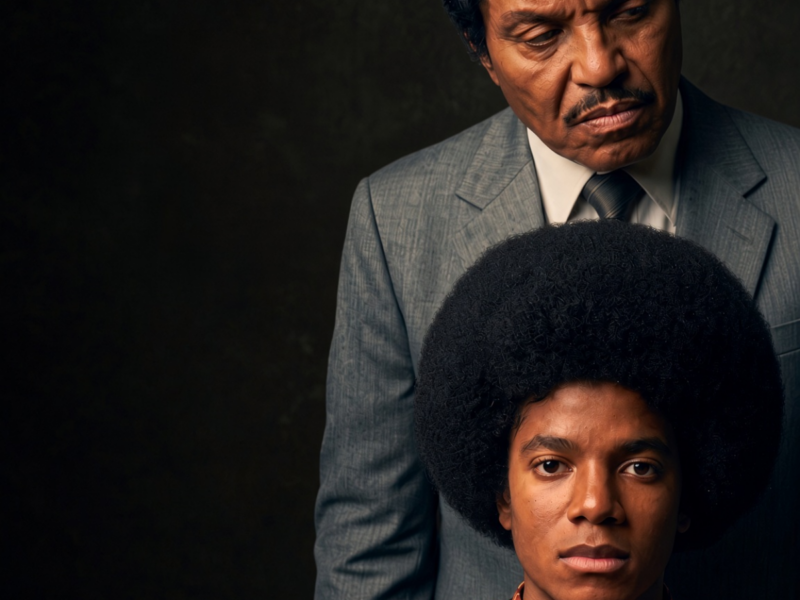
Michael Jackson’s Childhood Was Much CRUELER Than You Thought.
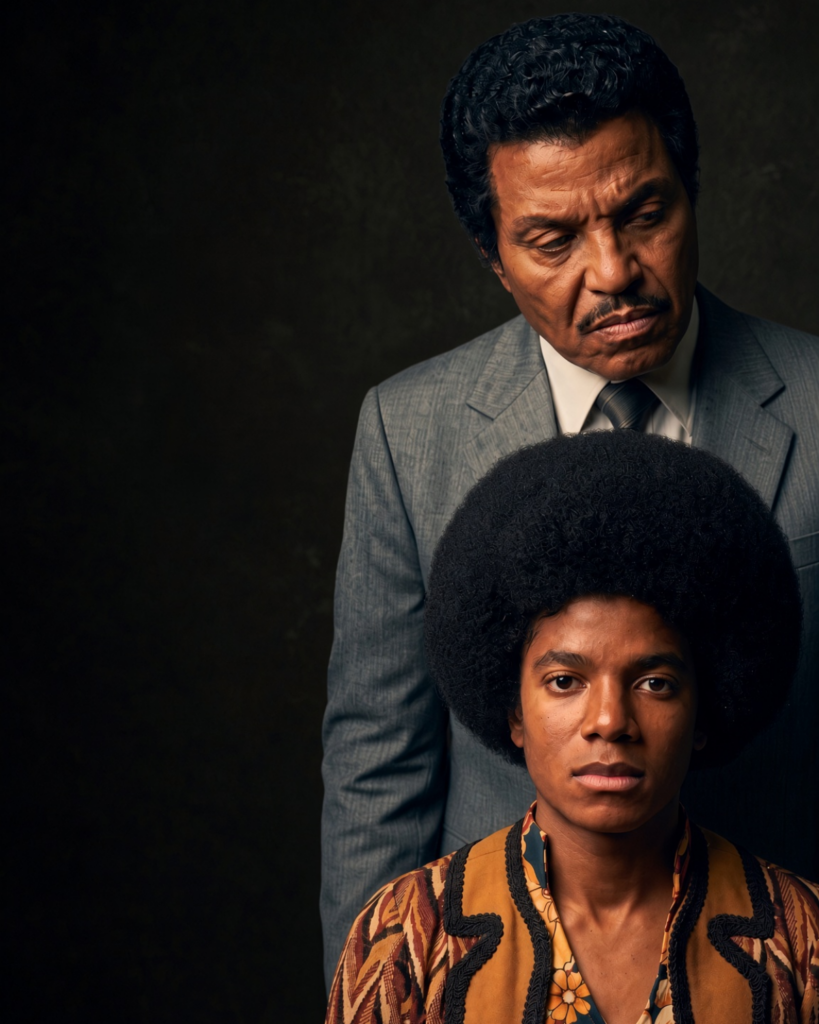
You know the voice. The moonwalk. The glove.
The sound of a nine-year-old boy from Gary, Indiana, singing like he’d already lived three lifetimes.
Michael Jackson became the most famous entertainer who has ever lived.
And the world has spent fifty years asking how a child that young got that good.
There’s an answer, and it isn’t a happy one.
His father made him that way. Rehearsal after rehearsal in a small house in a steel town—with a belt in his hand.
Michael said it himself, in his own autobiography, in his own words.
They would perform for their father and he would critique them. And if you messed up, you got hit. Sometimes with a belt. Sometimes with a switch.
The man’s name was Joseph Jackson.
His children were not permitted to call him “Dad.”
When his daughter Janet once tried, he corrected her: “You call me Joseph. I’m Joseph to you.”
This is the story of the father who built the greatest entertainment dynasty in American history—and what it cost the son at the center of it.
It is not a story about a monster. Exactly. It’s stranger and sadder than that.
Because by the end, Joe Jackson had everything he ever wanted—the fame, the fortune, the family name on every marquee in the world.
And he had lost the one thing he could never get back.
Keep that in mind. We come back to it.
It starts in a steel town in Indiana, with a man whose own dream had already died.
Joseph Walter Jackson was born in 1928 in Fountain Hill, Arkansas—the eldest of four children. His own father was a high school teacher.
His parents split when he was twelve.
Hold on to that. Because the man who would later run his own household like a foreman had lost the shape of his own family before he was a teenager.
He grew up wanting to be a musician. He played guitar. He had real ambition.
And for a while, he chased it—playing in a band called the Falcons in the Gary area.
But it didn’t happen for him. The record deal never came. The stage never got bigger.
And so Joe Jackson did what millions of men did in that place in that era.
He put the guitar in the closet, took a job in the steel mills of Gary, Indiana, and went to work to feed a family that would eventually number nine children.
Sit with that for a second, because it explains almost everything that follows.
Here was a man with a dream that died, working a brutal job in a steel town, watching his own future close.
And then one day, he came home and heard his sons singing.
What happened next has been told as an American fairy tale for fifty years.
A father discovers his children’s talent and turns them into the Jackson 5.
It is true. It is also only half the story.
Because the ambition that drove Joe Jackson from that moment forward was not only for his children. It was at least in part the ambition he’d never been allowed to satisfy himself—redirected into them.
The stage he never got, they would get. And they would get it his way.
And you have to understand the physical space this happened in, because it changes everything about what follows.
The house was at 2300 Jackson Street in Gary. Six hundred and seventy-two square feet. Two bedrooms. One bathroom. Eleven people.
Joe, Katherine, and nine children, living inside a building roughly the size of a two-car garage.
Hold that image, because it matters.
When the rehearsals started in that house, there was no upstairs to escape to. No spare room. No door to close.
Whatever happened in the front room happened to everybody—and every child in that family heard all of it, all the time.
The most disciplined act in the history of American pop music was forged in a space where nobody could get away from anybody.
The rehearsals started, and they were not the rehearsals of a normal family band.
They ran for hours after school, every day, year after year.
Other children in Gary played outside in the evenings. The Jackson boys ran routines in the front room until their father decided they were done.
And the pace outside the house was just as relentless.
Joe entered them in talent show after talent show, driving them across the Midwest in a Volkswagen bus, playing clubs where children legally should not have been, working their way up to the Apollo Theater in Harlem, where they won the famous Amateur Night.
It was a grind that would exhaust adult professionals—and the lead singer was in elementary school.
Michael described them plainly in his 1985 autobiography, Moonwalk.
And this is the sentence that has followed the family ever since:
They would perform for their father and he would critique them. If you messed up, you got hit. Sometimes with a belt. Sometimes with a switch.
His father, Michael wrote, was “real strict” with them. Real strict.
In a 2003 documentary, Michael put it another way.
Joseph practiced them with a belt in his hand. If you didn’t do it the right way, he said, he would “tear you up.”
Read that again and picture the room.
Small children—the youngest barely school age—running the same routine over and over in a cramped house in Gary.
While the man who would decide whether they’d eaten enough, worked hard enough, been good enough, stood there holding a belt.
Not as a threat in the abstract. As a working tool of the rehearsal.
And here is the thing that makes it so hard to judge cleanly.
It worked. It worked spectacularly.
By 1969, Joe had done the impossible. He got them signed to Motown.
In August of that year, Joe and the boys moved to Los Angeles, and the rest of the family followed that December.
They left the 600-square-foot house behind for good.
Within a year, the Jackson 5 had four number-one singles in a row—the first American group ever to send its first four releases straight to the top of the Billboard chart.
Michael was eleven years old.
And with the money, the family moved again—into a mansion in Encino, California. An estate called Hayvenhurst that would become the family compound for decades.
Picture the distance covered in about two years.
Eleven people in a two-bedroom bungalow next to the steel mills. Then a walled estate in the San Fernando Valley.
There is no version of this story where that isn’t an astonishing achievement.
And Joe Jackson was the one who made it happen.
So the discipline produced the miracle.
That is the uncomfortable arithmetic at the center of this story.
And the fear went deeper than the moments themselves.
In a 2003 interview with the journalist Martin Bashir, Michael—by then a grown man and the most famous person on the planet—broke down in tears talking about it.
He said that as a child he was so frightened of his father that he would sometimes vomit at the sight of him. Sometimes faint.
“We were terrified of him,” he said. Terrified.
That is not a tabloid claim. That is a son, on camera, crying—describing what his body did when his father walked into a room.
And there was another parent in that house, which makes the contrast sharper still.
Katherine Jackson, their mother, was the warmth.
She was the one Michael revered his entire life—the one he stayed close to until the day he died. The one he would eventually name as guardian of his own children.
Same family. Same years. One parent was safety. The other was fear.
The children learned very early which door to knock on.
The belt was one thing. The words were another.
Michael told Oprah Winfrey in 1993—in front of an audience of ninety million people—that his father had whipped him with a belt.
And he said something else that landed even harder, because it wasn’t about pain. It was about worth.
He said his father used to taunt him about his appearance. About his nose.
A boy who was becoming, at that very moment, the most looked-at person in the world was being told at home that his face was wrong.
And in that same conversation, he said something stranger than an accusation.
He said there had been times when his father would come to see him and he would get sick. He would start to regurgitate.
And then: “I love my father, but I don’t know him.”
Not “I hate him.” Not “he ruined me.”
A grown man at the peak of his fame, telling ninety million people that his body still reacted to his father’s presence—that he loved him anyway—and that after thirty-five years he had no idea who the man was.
It would be easy to draw a line from that to the rest of Michael Jackson’s life. But I’m not going to draw it for you, because it would be cheap, and because it belongs to him.
What matters here is simply that it happened—and that he said so publicly, twice, decades apart, with tears in his eyes both times.
And there is one more cost. The one Michael returned to more than any other for as long as he lived.
He never had a childhood.
While other boys his age were playing outside, he was rehearsing, recording, touring, working—a professional entertainer helping support a family of eleven before he was old enough to ride a bike to school.
He spoke about it constantly as an adult. Watching children play from a studio window. Never having had the thing every ordinary kid gets for free.
That was the trade. A boy’s childhood, spent.
And what it bought was one of the greatest careers in history.
He spent decades trying to buy it back.
And there was the name.
That small, precise thing that says more than any beating.
His own children were not allowed to call him father, or dad, or daddy.
He was Joseph.
Janet Jackson, decades later, remembered the moment she got it wrong. She called him “Dad,” and he corrected her.
“You call me Joseph. I’m Joseph to you. Not Dad. Joseph.”
The word for what he was to them had been taken away and replaced with his first name.
Here is where the story gets more complicated and more honest—because Joe Jackson never hid.
He was asked about all of it for decades, and he did something most accused men don’t. He half admitted it, on the record, and defended it.
In an interview with the BBC, he drew a distinction that has become infamous.
“I never beat him,” he said. “I whipped him with a stick and a belt. I never beat him.”
Read that sentence twice. It’s the whole man in one line.
He isn’t denying that he hit his children. He’s arguing about the vocabulary.
In his own autobiography, he acknowledged being a stern parent—and said he believed it was the only way to prepare his children for the tough world of show business.
That was his defense, and he never really moved off it.
The world was hard, so I made you harder. It worked, didn’t it?
And it’s worth being precise about what “manager” meant in that family, because it wasn’t a job title. It was total authority.
Joe controlled the rehearsals, the bookings, the contracts, the record deals, the touring schedule, and the money.
He decided when his sons worked and when they slept and what they were worth.
The line between father and employer did not exist, because he occupied both roles at once and never separated them.
When a child in that house was disciplined, it was never clear whether he was being corrected by his dad or penalized by his boss.
Every one of those children, the moment they were legally able, went looking for a lawyer.
And here is the uncomfortable part. In a narrow sense, it did work.
And to see why that mattered so much to him, you need to know what Gary, Indiana, actually was.
Gary was a steel town, built around the mills. And in the 1950s and ’60s, it was a hard place to be a Black family with nine children.
The work was punishing. The pay was capped. And the ceiling above a Black man in that economy was very low and very visible.
Joe Jackson worked in those mills. He knew exactly what the rest of his life looked like. And he knew what his sons’ lives looked like, too, if nothing changed.
The odds against a family in that bungalow producing even one professional musician were astronomical.
He produced a dynasty.
The executives of Michael’s estate said it out loud when Joe died, and it’s worth quoting because it’s the fairest thing anyone said about him.
They called him a strong man who acknowledged his own imperfections and who, in their words, “heroically delivered his sons and daughters from the steel mills of Gary, Indiana, to worldwide pop superstardom.”
That is not nothing. That is, by any measure, extraordinary.
His grandson, Prince—Michael’s own son—defended him publicly after his death, saying that his grandfather raised those kids right, and that without him, they might have ended up somewhere much worse.
Both things are true at once. And this is the part your instinct wants to flatten. So don’t let it.
Joe Jackson terrified his children—and Joe Jackson delivered them from the steel mills to the top of the world.
He was a bully, by his own family’s account. And he was also the engine of everything they became.
A man can be both. Most damaged men are.
But look at the price. Because the price is the whole point of this story.
As they became adults, one by one, the Jackson children fired him.
It started with Michael. And the timing tells you everything.
In 1979, Michael turned twenty-one and gained legal control over his own career.
Almost immediately, he dropped his father as his manager.
That same year, he released Off the Wall—the album that turned the child star into an adult superstar and sold millions.
Read those two facts side by side, because they happened in the same twelve months.
The moment Michael Jackson was legally free of his father, he used that freedom to fire him—and then made the best work of his life so far.
He was, by every account, terrified of doing it. This was a young man who had vomited at the sight of this person.
So he did it the way frightened people do difficult things: through other people.
He brought in professional managers and later the attorney John Branca, and let the machinery deliver the message.
But he did it.
The brothers followed. By 1983, the tensions had reached a breaking point, and the Jacksons collectively ended their father’s role as their manager.
The man who had driven them out of Gary in a Volkswagen bus was one contract at a time removed from the enterprise he had created.
He is said to have cried when it happened.
And then Janet, in 1986, released an album that made the whole thing explicit.
She called it Control.
The title was not subtle, and was not meant to be. It was, by her own framing, a declaration of independence—personal and professional—from the family and the father who had run both.
Think about the shape of that decade for Joe Jackson.
In 1979, his most valuable son fires him.
In 1983, the rest of the boys fire him.
In 1986, his youngest daughter names her breakout album after the thing she was taking back from him.
His children became the biggest stars on the planet, and every single one of them, at the first legal opportunity, removed him from their professional lives.
Michael revered his mother, Katherine, and kept his distance from Joseph for the rest of his life.
Janet said in a 2011 interview that she rarely spoke to her father at all, and that by adulthood they had severed ties.
And yet, in the family’s worst moments, it was still Joe they turned to—and Joe who showed up.
That contradiction never resolved.
They could not work with him, could not be close to him, and could not entirely let him go either.
There is one more detail from those years.
In 1999, Joe and Katherine Jackson filed for bankruptcy protection.
The man who had generated one of the largest fortunes in the history of entertainment—whose children were among the wealthiest performers alive—was personally broke.
He had built the machine and been shut out of it.
And years after Oprah, he was still saying the same thing in almost the same words.
“That’s sad,” he said of his father. “For a son who hungers to understand his own father. He’s still a mystery to me and may always be one.”
Hungers. That is the word he chose.
Michael Jackson could buy anything on earth and summon anyone. The thing he wanted—to simply understand the man who raised him—was the one thing he could not purchase, arrange, or perform his way into.
The stadiums didn’t fix it. The records didn’t fix it. Nothing ever did.
Then Michael died in June 2009, at fifty years old.
And when the will was read, it contained a silence louder than anything either man ever said out loud.
Joe Jackson was not in it.
Michael provided for his three children and for his mother, Katherine, who was named as the children’s guardian.
His father—the man who had built the machine that made him—was left nothing at all.
Not a bequest. Not a line. Not a mention.
A will is the last document a person ever writes. The final chance to say who mattered.
Michael Jackson wrote his knowing his father would read it, and Joe’s name simply was not there.
And notice who was in it.
Katherine—the parent who had been the warmth in that house at 2300 Jackson Street—was given the most sacred thing Michael had to give: the care of his own children.
The parent who had been the fear was given nothing.
Fifty years after the rehearsals in the front room, in the coldest and most formal language available to a man, Michael Jackson answered the question of which of his parents he trusted.
Joe spent part of his remaining years in legal fights seeking compensation from various parties connected to his son’s estate and death. He got nowhere.
He gave interviews. He kept defending the belt. Kept arguing about the vocabulary. Kept insisting that the world had been hard and he had done what had to be done.
And in those last years, something quieter happened, too—and it deserves saying, because this story has no clean villain.
The executives of Michael’s estate said after Joe’s death that they had developed a warm relationship with him in recent years and would miss him.
His children visited him at the end. When he was dying of cancer in 2018, his wife Katherine—who had stayed married to him for nearly seventy years—and several of his children came to see him.
Whatever he had been, they came.
He died in June 2018 at eighty-nine, in Las Vegas—two days after the ninth anniversary of Michael’s death.
Even the calendar seemed to insist on the connection between them.
So go back to Gary, Indiana.
A young man with a guitar and a dream that didn’t happen.
Working the steel mills, listening to his sons sing in the next room of a 600-square-foot house.
Joe Jackson wanted to be a star. He was never going to be one.
So he built the star instead—out of his own children, with rehearsals and discipline and a belt in his hand.
And it worked beyond anything he could have imagined that night.
He got the fame. He got the money. He got the name Jackson on every marquee on earth. And a son who sold more records than almost anyone who has ever lived.
By any measure Joe set for himself as a young man in that steel town, he won completely.
And the boy at the center of it grew up to become the most famous human being alive—and could not stand to be in the room with him.
Vomited at the sight of him as a child, by his own account.
Called him Joseph, because that was the rule of the house.
Fired him at twenty-one, the first legal minute he could.
Kept his distance for thirty years.
Went on the record in tears, in front of the world, to say he was terrified of him—and that he loved him—and that he did not know him.
Died calling him a mystery he never solved.
And left him out of the will.
There is a version of this story where the father at the end is asked whether it was worth it. And in a sense, he answered it over and over, every time he was asked about the belt.
He never took it back. He argued about the word.
Maybe that was the only answer he had.
Maybe a man who was handed nothing—who lost his own family at twelve, who watched his dream die in a steel mill—genuinely could not imagine another way to get his children out.
Maybe he believed, to the last day, that the fear was the price of the ticket. And that the ticket was worth it.
His children got out. That much is true.
He was right about the world being hard.
He was just wrong about what it would cost him.
Joe Jackson got the dynasty.
He did not get the son.
He built the most watched life in the world—and never once got to stand inside it as a father.
Ask yourself which of those two things a man would actually want on the last day of his life.









