Michael Jackson’s 8 rare stage fails finally exposed!
That is the story most people have never heard because the clips are buried, the footage is blurry, and the man himself never wanted anyone to know how close the show came close to ending.
What follows is not the myth, it is the record.
Let us begin where the danger was most visible and most famous because it set the pattern for everything that came after. January 27th, 1984, the Shrine Auditorium in Los Angeles.
Michael Jackson is 25 years old, filming a Pepsi commercial with his brothers in front of 3,000 fans assembled to simulate a concert. It is the sixth take.
He descends a staircase singing Billie Jean. A pyrotechnic fires early.
Sparks shower down. His hair, treated with the era’s flammable styling products, catches fire instantly.
He keeps dancing. For several seconds he continues his routine spinning and turning completely unaware that the back of his head is ablaze.
The flames only went out when he twisted around as part of his routine. Crew members rush the stage and tackle the ground, covering his burning hair with his own jacket.
His brother Jermaine turned to see Michael Jackson in trouble. His makeup artist Karen Faye later testified about what she witnessed.
“I never saw anything like that in my life,” she said. “This was someone I knew and he was on fire.
All his hair was gone and there was smoke coming out of his head.” He was taken to Cedars-Sinai Medical Center then transferred to the burn center at Brotman Memorial Hospital. Second- and third-degree burns on his scalp and body, severe hair loss.
As he was being carried away on a stretcher wearing his signature sequined glove, he tried to reassure the fans who had just watched him catch fire. “He was wonderful,” one spectator told the BBC.
“He reassured people even as he was being taken away on a stretcher.” He settled with Pepsi for $$1.5 million. He donated the entire sum to Brotman Medical Center to fund a burn center named in his honor.
He later said he had some major reconstructive surgery on my scalp and that he became increasingly more dependent on painkillers to get me through the days of my tour. According to Us Weekly, to relieve the second- and third-degree burns on his scalp and body, and later to help him tolerate multiple surgeries on the scorched spot on his head, Jackson was prescribed several medications, which kicked off his addiction to painkillers and obsession with plastic surgery.
But, not everyone agrees with that narrative. One of Jackson’s former agents, Jay Coleman, told AFP that it was “reckless and totally unjustified to blame the accident during the Pepsi commercial for his drug addiction.
Pepsi is being made a scapegoat here,” Coleman said. “It is grossly unfair for the media to blame this incident as the start of all his troubles.” He argued that the issue was not this incident, but the fact that Jackson had constant surgery for over 25 years, and those procedures continually led him to take painkillers.
Either way, the fire did not stop him. A month later, he won a record eight Grammy Awards in a single night.
That July, he embarked on the Victory Tour with his brothers, but it marked him, and it set the standard for what he would tolerate in the years to come. Four years later, the danger came not from the stage, but from the crowd.
September 11th, 1988, Aintree Racecourse, Liverpool, the final European date of the Bad World Tour. More than 1,500 people were injured in a crush near the stage, according to organizers, as 125,000 fans pressed forward.
Around 40 people required hospital treatment. First aid teams were overwhelmed, treating an estimated 3,400 fans during the concert.
No one on stage caused this. There is no suggestion Jackson or his team could have stopped it once it began, but it is a sober reminder of how much invisible infrastructure sits beneath every stadium show, and how quickly it can fail.
Then came the Dangerous World Tour, and with it a new level of mechanical risk. The show opened with Jackson launching through a trapdoor at the front of the stage, catapulting upward as pyrotechnics fired around him.
It was a stunt with no margin for error. The trapdoor had to fire, the charges had to detonate, and Jackson had to be in exactly the right position every single night in front of tens of thousands of people who had no idea how many things had to go right.
Jackson had already been burned once by pyrotechnics that fired a fraction of a second wrong. Crew treated this entrance with a level of caution that bordered on paranoia, but not every stunt received the same scrutiny.
During rehearsals for the Dangerous Tour, guitarist Jennifer Batten witnessed a near disaster with a mechanical arm nicknamed the cherry picker, designed to carry Jackson out over the audience with his cape billowing behind him. I remember we were at the Dangerous Tour rehearsals, and they were working on something new, Batten recalled on the Appetite for Distortion podcast.
They call it the cherry picker, where there was this big mechanical arm that would go out over the audience, and he’d be on top of them with this cape blowing in the wind. Michael is out there with the arm, and all of a sudden it throws him off, so he’s hanging on to the bars, and all the roadies are on their radios like, “Oh, holy su- the boss is in trouble.
Bring the arm back in.” He was brought down safely, unharmed, but the usually quiet and deferential Jackson got on the microphone and said something that revealed both his priorities and his patience. Eventually he comes back on the stage, and he gets on the mic, and he goes, “You know, I don’t mean to pull rank, but this needs to be fixed.” Batten noted that someone who had not been in show business since they were five might have screamed or fired someone.
Jackson did neither. He simply wanted the show to be safe.
He wanted it to be good. The cherry picker became a signature image of the tour.
Almost no one in the audience ever knew how close it came to going wrong before the tour had even opened. Three years later, in December 1995, the question of what Jackson would endure became harder to dismiss.
He was rehearsing at the Beacon Theatre in New York for an HBO special when he collapsed just before 5:00 p.m. on Wednesday, December 6th. He was rushed to Beth Israel Medical Center North where he spent 5 days in intensive care.
His doctor, William Alaine, said Jackson had been suffering from a viral infection and had been ill for a week or more before the collapse. Diarrhea from the infection led to severe dehydration which in turn dangerously quickened Jackson’s heartbeat while lowering his blood pressure causing his collapse.
Alaine said Jackson’s life had been in danger when he arrived at the hospital. His personal physician, Dr.
Alan Metzger, said the singer’s condition was serious, but he wouldn’t characterize it as life-threatening. Ambulance attendants found Jackson semi-conscious lying on the side of the rehearsal stage.
He was lethargic and mumbling when emergency workers arrived. The paramedics found that Jackson was so heavily made up they had to lift up his shirt to check his pallor.
Jackson was disappointed about not being able to perform. He tried to convince the medical team that he could give it a go, Alaine said.
We put our foot down. He was 37 years old.
He had been performing since he was five. The History World Tour which ran from 1996 to 1997 brought its own set of failures.
During a 1996 stop, his opening lines of Scream reportedly went out with his microphone not yet live. At a Moscow show, a curtain mechanism jammed mid-set and had to be physically held up by crew members through an entire performance of Smooth Criminal.
On another night, a backing track started playing before it was cued. And then there was the fan.
October 11th, 1996, Seoul, South Korea. Midway through Earth Song, Jackson is performing on a hydraulic lift 50 feet above the stage.
A fan breaks past the barriers and security line, climbs directly onto the same lift and wraps his arms around Jackson just as the platform begins to ascend. In an instant, a stunt built entirely around controlled machinery has an uncontrolled variable riding along with it with nowhere for either of them to go until the platform comes back down.
Jackson’s reaction was to keep the fan steady rather than push him away. He wrapped an arm around the fan to keep him safe and continued performing.
As the crane slowly began to lower, the fan continued to strike different poses in the air before he was removed by security when they reached stage level. Throughout the whole ordeal, Michael Jackson did not miss a note.
It has since been framed as a heartwarming moment about Jackson’s composure under pressure, and it is that. But underneath the warmth, it is also a serious security failure.
A person got past every layer of protection built around one of the most heavily guarded performers in the world and ended up suspended in the air with him. Not every stage fail is dramatic.
During a History Tour stop in Gelsenkirchen, Jackson’s pants reportedly tore while he was suspended on the mechanical crane used for his Beat It performance. Visible enough that some fans in the crowd noticed and reacted in real time.
It is a minor moment in the grand scheme of a 2-hour arena show, but it is a reminder that even the most tightly choreographed production in the world was still, underneath it all, a live show subject to the same small human unglamorous failures as any other performance anywhere. And then there was Munich, June 27th, 1999, Olympic Stadium, Munich.
Michael Jackson is headlining a benefit concert for UNESCO, Nelson Mandela’s Children’s Fund, and the International Red Cross. The stadium is packed with 70,000 screaming fans.
He is midway through Earth Song, standing on a hydraulic platform built for a stunt called the Bridge of No Return. It is the same rig, the same stunt that had gone off without a hitch two nights earlier in Seoul.
This time, it doesn’t hold. The middle section of the platform separates too early.
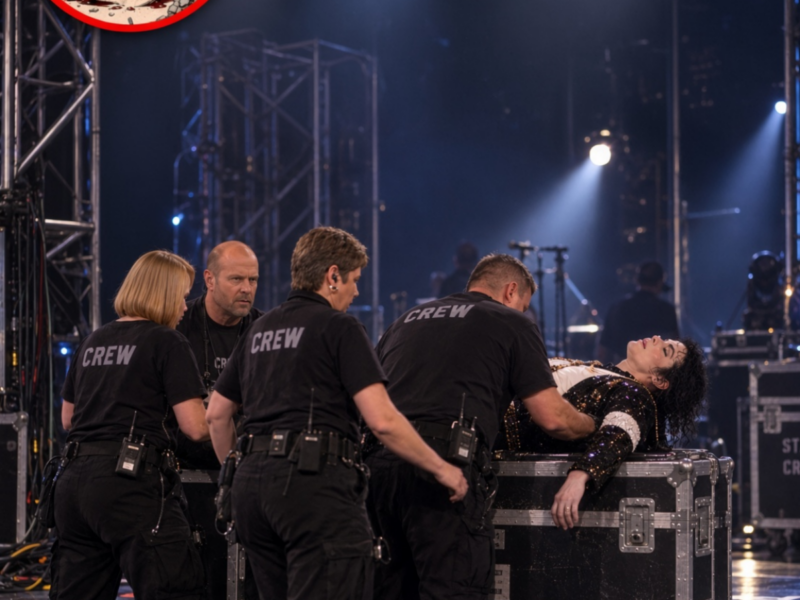
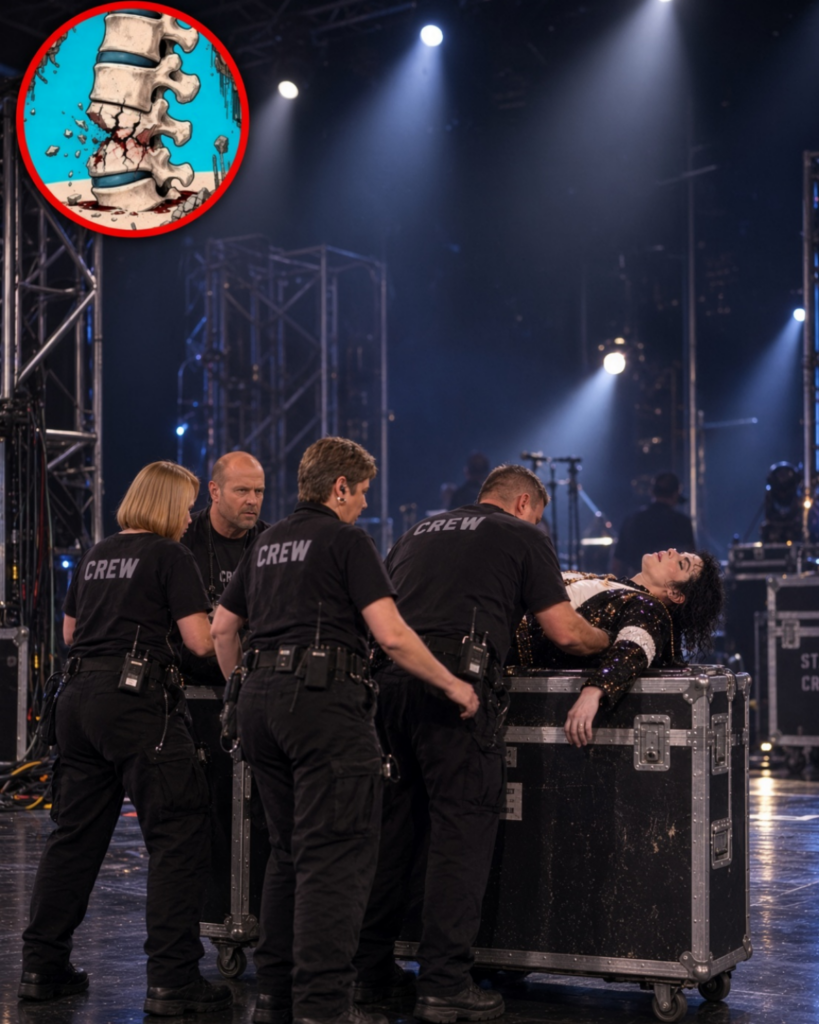
The bridge collapses into the orchestra pit with Jackson on it. Kenny Ortega, show’s producer, later described what happened.
The local crew evidently put the wrong cable wire on the metal and the bridge came crashing down into the orchestra pit with Michael on it, Ortega said. Michael felt the fall.
He knew it was happening and timed his jump as the bridge hit the ground and he continued to do the show. He climbed out of the hole in the stage, picked the song back up and finished the concert.
He was taken to Rechts der Isar Hospital afterward. He had a damaged spine, a sprained ankle, shock nerves and slight burns on his arms.
None of the fans, crew or backup performers were injured. When Ortega asked him afterward if he had been trembling in fear, Jackson responded like a line from an old musical, “Well, Kenny, I always was taught that the show must go on.” The scrambling stagehands and tour executives were horrified.
The audience didn’t fully understand what had just happened. Michael just kept going.
That concert was a charity event raising funds for children in Kosovo and Africa. He wasn’t going to let them down over a collapsed bridge.
And that phrase is the key to understanding all of these moments. It was not bravado, it was conditioning.
It was the voice of a man who had been performing since he was a child, who had been taught that the audience came first, that stopping was not an option, that weakness was not permitted. His long-time makeup artist later testified that Jackson had a low pain tolerance in everyday life except while performing.
She recalled that he complained more about back pain after the Munich fall and that he appeared to become more dependent on prescription drugs in the years following. His stylist, Michael Bush, revealed that Jackson lost so much weight during a single concert that the costumes he wore at the end of the show had to be smaller than the ones he wore at the beginning.
He typically had a 28-inch waist. Insomnia for Jackson was also possibly caused by the anxiety of going on stage.
But there is another layer to these failures that most people never hear about. It is the story of what was happening behind the scenes, in the sound booth, in the lighting rig, in the systems that were supposed to make the show run smoothly, and it reveals something that changes how you watch every one of these clips.
During the History World Tour, the microphone failures were not occasional. They were constant.
At the Amsterdam Arena in 1996, the wire of Jackson’s headset microphone snagged on the armor of his right arm during the opening seconds of Scream. He was supposed to be singing.
Instead, he was tangled. He did not stop.
He did not break character. He untangled himself with the same fluidity he brought to every dance step and continued as if nothing had happened.
When the microphone stand jammed during Billie Jean at that same Amsterdam show, preventing him from pulling the mic out for his vocals, he did not panic. He spun the stand, tugged at it with rhythmic precision, and turned a potential failure into a highlight that many fans initially thought was a rehearsed part of the show.
Even when the mic finally gave way, he transitioned instantly back into his vocal delivery and sharp dance steps without missing a single beat. At the Moscow show in September 1996, the white curtain used as a prop during Smooth Criminal malfunctioned.
Jackson’s headset microphone also broke. His costume designer and personal assistant, Michael Bush, had to rush onto the stage during You Are Not Alone to hand him a handheld microphone.
For The Way You Make Me Feel, Jackson used the handheld mic the entire time because of the broken headset and the adjustments to the live rhythm, he did not perform his classic beatbox at the end of Billie Jean. At the Bucharest show earlier that same month, the failures kept coming.
During Thriller, Jackson’s red jacket tore. During Heal the World, his microphone suddenly failed, and he had to use a handheld mic to finish the song.
The audio of his voice was weak and at times imperceptible throughout much of the performance, a technical glitch that was compensated for by his virtuosity, including robot dance steps that delighted the audience. And then there is the Scream opening.
Across multiple shows during the History Tour, the pre-recorded vocal for Scream failed to play. The result was Jackson performing the opening lines with no voice at all, either because the backing track did not start or because his microphone was not live.
Fan accounts from the Copenhagen, Helsinki, and other early History shows describe roughly a minute of Jackson doing mime on stage, no voice while the track that was supposed to carry the vocals simply did not engage. One fan described it as an eventful way to start a concert.
There is a version of this tour that fans still debate. The History World Tour is often criticized for its heavy use of playback, pre-recorded vocals that played while Jackson performed, but a soundboard recording that surfaced from the Munich 1997 show revealed something most people did not know.
Jackson was actually singing live over the backing track. His live vocals were simply made inaudible to the audience, and the performance that looked like lip-syncing was, in many cases, a man singing his heart out into a microphone that was not being broadcast.
That is the quiet tragedy underneath the failures. He was performing, the audience just could not hear him, and when the playback failed entirely, as it did during those Scream openings, the audience heard nothing at all, not the track, not his voice, just a man on stage moving, mouthing words into a dead microphone, waiting for the sound to come back.
The History tour was also plagued by the fact that Jackson was battling acute laryngitis, a condition that affected his vocal cords and made performing without backing tracks difficult. His voice was damaged, his body was damaged, the machinery around him kept failing, and still he went on.
The Amsterdam headset incident is not in most highlight reels, it is not in the documentaries. It is the kind of failure that only exists in fan forums and bootleg footage, described by people who were there or who watched the clips frame by frame.
A wire snagged on an arm, a momentary tangle, a performer who fixed it without anyone noticing, but that is the point. That is the through line of every failure on this list, the Pepsi fire, the Liverpool crush, the cherry picker, the Beacon Theatre collapse, the Seoul fan, the Gelsenkirchen pants, the Munich bridge, the Amsterdam microphone, the Moscow curtain, the Bucharest jacket, the scream silent, every single one of them was a moment where something went wrong and the man on stage absorbed it, fixed it, danced through it, and kept going.
So, what do these failures actually tell us? They tell us that a 25-year-old man at the height of his powers was burned on live television in front of 3,000 fans.
And his first instinct was to keep dancing. They tell us that a 37-year-old man collapsed from dehydration and a viral infection, and his first instinct was to try to convince the doctors to let him perform.
They tell us that a 40-year-old man fell 50 feet into an orchestra pit, and his first instinct was to climb out and finish the song. They also tell us that the pain never fully went away, that the surgeries continued, that the prescriptions continued, that the sleepless nights continued.
There is a version of this story that is simple. A man performed dangerous stunts.
Sometimes the stunts failed. He got hurt.
He kept going. He died young.
But that is not how lives work. Each of these moments was one event in a life that contained multitudes.
They were traumas. They were also moments that revealed his character.
What we know is this. He was 25 when his hair caught fire.
He was 50 when he died. In between, he won more Grammys, sold more records, and reached more people than almost any artist in history.
He also suffered. He struggled.
He was human. The heartbreak is not that something terrible happened to him.
It is that something terrible happened. And then more terrible things happened, and he kept going because that was what he had been taught to do.
The show must go on until it couldn’t. Maybe the kindest thing we can do now is remember the whole man, not just the fire, not just the fall, not just the end.
The man who sang in the hospital bathroom, the man who reassured fans while being carried away on a stretcher, the man who held onto a fan on a hydraulic platform so he would not fall, the man who donated $1.5 million to a burn center, the man who climbed out of a hole in a stage in Munich, picked the song back up and finished the show like nothing had happened. That is the man these failures revealed.
That is the man worth remembering.









