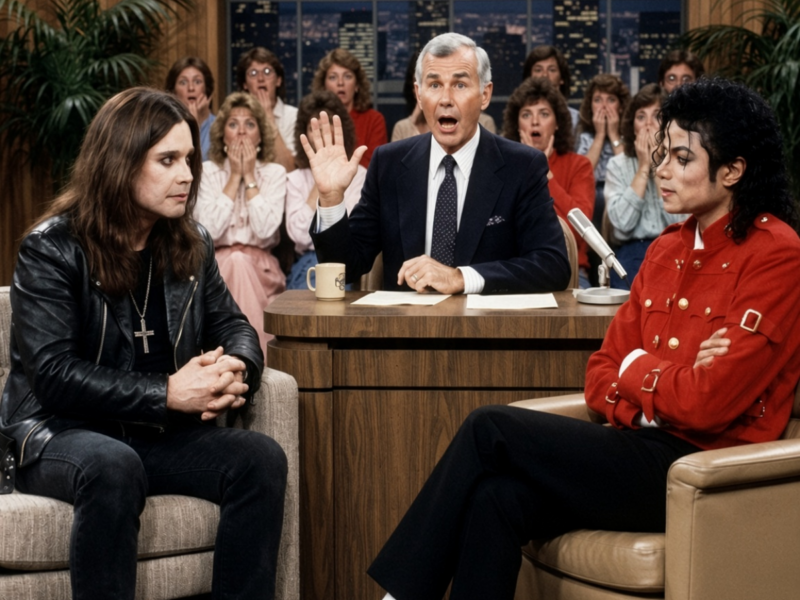
Michael Jackson weigerte sich, neben Ozzy Osbourne zu sitzen – Ozzy schockierte Johnny Carson.
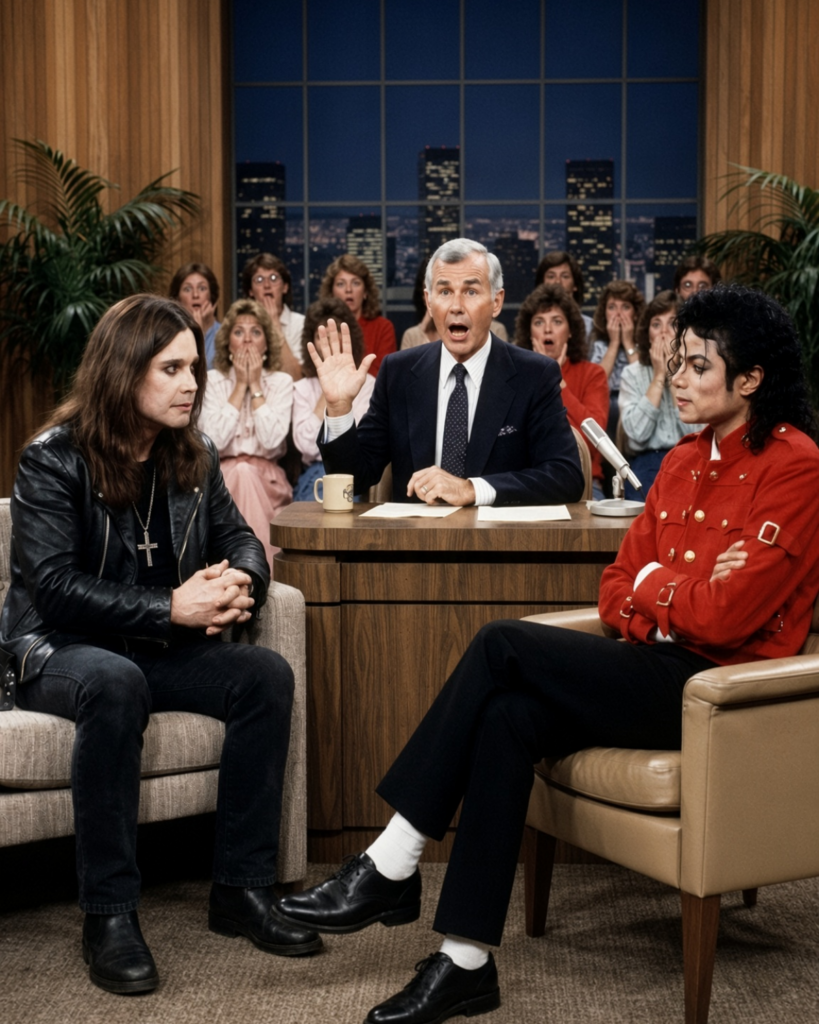
November 9, 1990.
Studio 1 at NBC’s Tonight Show in Burbank, California.
Johnny Carson, the undisputed king of late-night television, was preparing for what should have been a routine Friday broadcast.
The guest list that night read like a collision of two entirely different planets: Michael Jackson, the most famous entertainer on Earth, and Ozzy Osbourne, the Prince of Darkness himself.
No one in that studio audience could have predicted what was about to happen.
Because before Michael Jackson ever walked onto that stage, before the moonwalk, before the interviews, before the songs, there was a request.
A quiet, firm, absolutely non-negotiable request from Michael’s manager Frank DiLeo, delivered to the show’s producers backstage.
Michael Jackson would not sit next to Ozzy Osbourne.
Not for the interview segment.
Not for the musical performance.
Not even for the closing credits.
Under any circumstances.
The room went silent.
The producers looked at each other.
Johnny Carson, who had seen everything in thirty years of broadcasting, raised an eyebrow.
And Ozzy Osbourne, already seated in his dressing room in full leather and sunglasses, was about to deliver a reaction that would shock Johnny Carson more than anything Michael Jackson ever did.
To understand why this moment mattered so much, you have to understand who these two men were in 1990.
Michael Jackson was 32 years old.
He had just released Bad in 1987, was preparing for Dangerous in 1991, and had spent the previous decade rewriting the rules of pop music, music video, and global celebrity.
He was rehearsing constantly, working with choreographers, vocal coaches, and producers.
He was also, by 1990, deeply protective of his image, his personal space, and the carefully controlled environment he had built around himself.
He traveled with managers, bodyguards, publicists, and a small army of people whose job was to make sure nothing unpredictable ever happened to him.
Ozzy Osbourne, on the other hand, was 41 years old.
He had been the frontman of Black Sabbath, the band that essentially invented heavy metal.
He had bitten the head off a bat on stage in 1982, had been banned from entire cities, had struggled publicly with addiction, and had recently reinvented himself as a solo artist with albums like The Ultimate Sin and No Rest for the Wicked.
He was chaos personified.
He was the opposite of everything Michael Jackson’s team tried to control.
And that, more than anything, is why the request came.
Frank DiLeo, Michael’s manager, was a seasoned industry veteran who had managed Michael through the Thriller era.
He knew his client.
He knew that Michael’s world was built on ritual, on predictability, on carefully curated environments.
He knew that Michael had spent his entire childhood performing, had never had a normal adolescence, and had developed a fierce need to control the spaces he occupied.
He also knew that Ozzy Osbourne was the kind of person who could, with a single unscripted comment, completely derail a carefully planned television appearance.
So DiLeo made the request.
Politely.
Firmly.
Without room for negotiation.
“Michael will not sit next to Ozzy Osbourne. He will not be interviewed alongside him. He will not share a couch with him. He will perform, he will do his segment, and then he will leave. That is the only way this happens.”
The producers at The Tonight Show had dealt with difficult guests before.
They had dealt with Marlon Brando, with Frank Sinatra, with Elizabeth Taylor.
But this was different.
This was a request that, if it leaked, would become a story.
And in Hollywood, in 1990, everything leaked.
So the producers did what producers do.
They rearranged the show.
They separated the segments.
Michael Jackson would appear first, perform “Man in the Mirror” with a full gospel choir, sit for a brief interview with Johnny Carson, and then leave before Ozzy Osbourne ever walked onto the stage.
Ozzy would come out later, perform “Suicide Solution” with his band, and do his own interview.
The two men would never share a stage.
They would never sit on the same couch.
They would never even be in the same room at the same time.
It was a clean, professional solution to an awkward problem.
But Ozzy Osbourne, sitting in his dressing room, heard about the request.
And he was not happy about it.
Not because he wanted to sit next to Michael Jackson.
Ozzy had no particular interest in Michael Jackson’s music, and Michael Jackson had no particular interest in Ozzy’s.
But Ozzy understood, in that moment, that he was being treated as a problem.
As something to be managed.
As a risk.
And that, more than anything, offended him.
So when Ozzy Osbourne walked out onto the Tonight Show stage later that evening, he did something no one expected.
He sat down on the couch next to Johnny Carson, looked directly into the camera, and said, “So I hear Michael Jackson didn’t want to sit next to me.”
The audience laughed.
They thought he was joking.
Johnny Carson, who had been briefed on the situation, tried to steer the conversation back to safer ground.
He asked about Black Sabbath.
He asked about the new album.
He asked about touring.
But Ozzy was not done.
“I mean, I understand,” Ozzy continued, his voice dripping with mock sincerity. “I’m a bit scary. I bite heads off bats. I’ve been banned from cities. I’m sure Michael Jackson’s people thought I was going to corrupt him or something.”
The audience laughed again, but this time there was a nervous edge to it.
They knew they were watching something real.
Something unscripted.
Something that would be talked about for years.
Johnny Carson, to his credit, handled it the way he handled everything.
He leaned back in his chair, smiled his trademark smile, and said, “Well, Ozzy, I think Michael Jackson just wanted to make sure the show stayed family-friendly.”
It was a perfect Carson deflection.
Graceful, funny, and just sharp enough to acknowledge the absurdity of the situation without making anyone look bad.
But Ozzy wasn’t finished.
“Family-friendly?” he said. “I’ve got kids. I’ve been married. I’ve been sober for years. What’s more family-friendly than that?”
The audience applauded.
They were on Ozzy’s side now.
They were watching a man who had been treated as a liability turn the moment into a victory.
And Johnny Carson, who had seen everything, who had interviewed presidents and movie stars and rock legends, looked at Ozzy Osbourne and laughed.
A real laugh.
The kind of laugh that only happens when something genuinely surprises you.
And that, more than anything, is what made the moment unforgettable.
But the story didn’t end there.
Because Michael Jackson, backstage, heard about what Ozzy had said.
And according to accounts from people who were in the building that night, Michael didn’t get angry.
He didn’t yell.
He didn’t fire anyone.
He simply sat in his dressing room, stared at the wall for a long moment, and then said, quietly, “I just didn’t want to be uncomfortable.”
That sentence, more than anything, explains the whole thing.
Michael Jackson had spent his entire life being uncomfortable.
He had been uncomfortable on stage as a child, performing under his father’s watchful eye.
He had been uncomfortable in interviews, where reporters asked him questions no one should have to answer.
He had been uncomfortable in his own home, surrounded by people whose motives he couldn’t always trust.
And on that night, in that studio, he had tried to carve out one small corner of the world where he could feel safe.
And Ozzy Osbourne, whether he meant to or not, had turned that into a joke.
Now here’s the part that most people don’t know.
Ozzy Osbourne, after the show, after the laughter, after the applause, went back to his dressing room and sat in silence for a long time.
His manager, Sharon Arden, who would later become Sharon Osbourne, came in and asked him what was wrong.
And Ozzy, according to people who were there, said something that surprised everyone.
“I didn’t mean to hurt him. I was just pissed off that he treated me like a freak.”
That’s the thing about Ozzy Osbourne.
He was chaotic.
He was unpredictable.
He was, by his own admission, a mess.
But he was not cruel.
He understood what it felt like to be treated as a problem.
He had been treated that way his entire career.
And in that moment, sitting in his dressing room after the show, he realized that he had just done to Michael Jackson exactly what the industry had always done to him.
He had turned a person into a punchline.
Michael Jackson, meanwhile, was already gone.
He had left the building before Ozzy ever walked on stage.
He had performed “Man in the Mirror” with a gospel choir, had given Johnny Carson a polite, careful interview, and had slipped out through a back entrance.
He never mentioned Ozzy Osbourne in public.
He never complained about the joke.
He never retaliated.
He simply moved on, the way he had moved on from every uncomfortable moment in his life.
But people who were close to him said that he remembered.
Michael Jackson remembered everything.
He remembered the people who had treated him with respect, and he remembered the people who hadn’t.
And while he never spoke ill of Ozzy Osbourne, he also never appeared on the same program with him again.
Not on The Tonight Show.
Not on any show.
Their paths never crossed.
The moment was over, but the echo of it lingered for years.
So what is the real story here?
Was Michael Jackson being difficult?
Was Ozzy Osbourne being cruel?
Or was this simply a collision of two people who had been shaped by an industry that had never learned how to treat artists as human beings?
Michael Jackson spent his life trying to control his environment because his environment had never been safe.
Ozzy Osbourne spent his life being chaotic because chaos was the only thing he could control.
They were two sides of the same coin.
They were both survivors of an industry that chewed people up and spat them out.
And on that night in November 1990, their two worlds collided in a way that neither of them ever fully explained.
The Tonight Show with Johnny Carson aired for thirty years.
It hosted presidents, movie stars, comedians, and rock legends.
But the night Michael Jackson refused to sit next to Ozzy Osbourne became one of the most talked-about episodes in the show’s history.
Not because of the music.
Not because of the interviews.
But because of a single request, a single joke, and a single moment of silence.
Michael Jackson never gave a reason for his refusal.
Ozzy Osbourne never apologized.
Johnny Carson never asked either of them to come back together.
The moment passed.
The show moved on.
But the story remained.
And in the story, there is a lesson.
Sometimes the people we think are difficult are simply trying to protect themselves.
And sometimes the people we think are cruel are simply trying to protect their own dignity.
Michael Jackson and Ozzy Osbourne never sat next to each other.
But in their own separate ways, they were both trying to survive.









