Michael Jackson Took on Bohemian Rhapsody in Front of Freddie Mercury—Nobody Expected What Happened.
Wednesday, September 5th, 1984, Wembley Arena, North London.
By four in the afternoon, the queue outside the arena already curled around the car park and halfway back toward the stadium next door.
Kids in homemade t-shirts sat on the curb eating chips out of paper.
Older fans in denim jackets passed around flasks and argued about which album was best.
A man selling bootleg programs kept one eye on the crowd and the other on the two policemen by the gate.
Queen were in the middle of four nights at Wembley on The Works Tour, and every one of those nights had sold out within hours.
But this particular night had something extra.
It was Freddie Mercury’s birthday.
He was turning thirty-eight, and everyone in that queue knew it.
Somebody had brought a cake in a cardboard box and was guarding it like it held the crown jewels.
A group of girls from Leeds had spent their train fare on a banner that said nothing more than a giant heart with a crown drawn on top.
Inside, the crew had been working since dawn.
Lighting rigs hung from the ceiling like the ribs of some enormous metal animal.
Roadies taped cables to the stage floor and swore quietly at each other in three different accents.
Somebody was testing the drum kit one thump at a time, and each thump rolled around the empty arena and came back a second later.
On paper, it was just another stop on a long European tour.
Twelve thousand people, two hours of music, fireworks, a few costume changes, and then the trucks would roll on to the next city.
What almost nobody in that building knew was that Freddie Mercury had spent most of the day in a bad mood.
Not a loud one.
Freddie’s bad moods were quiet.
He’d arrived early, said hello to the crew, signed a couple of things for the catering staff, and then disappeared into his dressing room and shut the door.
His assistant, Peter, had worked with him long enough to know when to leave him alone.
So he did.
He left a pot of tea on the table outside the door and went to deal with the flowers that kept arriving.
There were dozens of them.
Bouquets from the record company, from friends, from people Freddie had met once at a party in Munich and never seen again.
Peter lined them up along the corridor until it looked like a florist had exploded.
The truth was that something had been nagging at Freddie for over a year, and his birthday had brought it right back to the surface.
To understand why, you have to go back to the summer of 1983.
That year, Freddie had flown to Los Angeles to spend a few days at the home of Michael Jackson.
The two of them had been circling each other for a while.
Back in 1980, Michael had come backstage after a Queen show at the Forum in Los Angeles.
He’d been polite, soft-spoken, almost shy.
And then, out of nowhere, he told the band they were making a mistake.
There was a song on their new album with a bass line he couldn’t get out of his head.
He said it should be a single.
The band weren’t sure.
It didn’t sound like Queen.
Michael kept insisting.
They listened to him.
The song was Another One Bites the Dust, and it went to number one in America.
So when Michael invited Freddie to come and record some ideas in his home studio in Encino, Freddie said yes.
They worked on a handful of songs.
One of them was a slow, aching piece called There Must Be More to Life Than This.
Another was a rougher, harder track called State of Shock.
For a few days, it felt like something special might come out of it.
Then it all fell apart.
The stories people tell about why are a little different depending on who’s telling them.
Schedules clashed.
Managers got involved.
Michael was deep in the Thriller whirlwind, and Freddie had his own album to make.
But the version that got passed around every studio from London to Los Angeles was the one about the llama.
Michael kept animals at his house.
Lots of them.
And one afternoon, while the two of them were trying to lay down vocals, Michael brought his pet llama, Louie, into the studio.
Freddie reportedly picked up the phone, called his manager, and said something along the lines of, “You have to come and get me out of here. I’m recording with a llama.”
It was a funny story.
People loved telling it.
But it had an ugly little tail on the end of it.
In the papers and around the industry, the tale turned into something else.
Freddie Mercury walked out on Michael Jackson.
Freddie Mercury was too much of a diva to share a microphone.
The songs were never finished.
State of Shock ended up being recorded by Michael with Mick Jagger instead, and it came out that summer on the Jacksons’ album.
Every time Freddie heard it on the radio in a taxi, he felt a small sting, because the truth was Freddie hadn’t left over a llama.
He’d left because he’d started to feel like a guest in someone else’s world, and he didn’t know how to say so.
And afterwards, he’d never picked up the phone to explain.
Neither had Michael.
A year had gone by, then more than a year, and on the morning of his thirty-eighth birthday, sitting in a dressing room full of flowers from people he barely knew, Freddie realized the one card he actually wanted wasn’t there.
At about half past two that afternoon, the phone rang in the production office.
The production manager, a big Glaswegian named Tommy who’d been touring with bands since the sixties, picked it up, expecting another question about parking passes.
Instead, the voice on the other end belonged to a very nervous-sounding American who said he was calling on behalf of Michael Jackson.
Tommy nearly laughed.
He’d had prank calls before.
Once somebody had rung claiming to be the Queen’s private secretary—meaning the actual Queen—asking for twenty tickets.
But this caller knew things.
He knew the name of Queen’s manager.
He knew the hotel the band was staying in.
And he explained very carefully that Michael was in London for a few days during a short break in his brothers’ tour.
He’d heard it was Freddie’s birthday.
He wanted to come to the show.
No announcement, no photographers, no fuss.
Just a quiet place to watch from the side of the stage.
Tommy put his hand over the receiver and looked across the room at Peter, who had just walked in with another armful of flowers.
“You’d better get Freddie,” he said.
Peter knocked on the dressing room door.
There was a long pause, and then Freddie’s voice came through a little flat.
“Come in, dear, if you must.”
Peter opened the door.
Freddie was sitting on a low sofa in a white vest and tracksuit bottoms, his feet up on a chair, a cup of tea going cold on the floor beside him.
He hadn’t touched his makeup.
He hadn’t even looked at the costumes hanging on the rail.
“Well?” Freddie said.
“There’s a phone call,” Peter said.
“It’s about Michael Jackson.”
Freddie didn’t move for a second.
Then he slowly put his feet down on the floor.
“What about him?”
“He’s in London. He wants to come tonight. He says he wants to wish you a happy birthday.”
Freddie looked at the floor.
Then he looked at the wall.
Then he started laughing.
Not his big stage laugh, but a small, surprised one.
The kind that comes out when something catches you off guard.
“Does he know,” Freddie said, “that the entire music business thinks I abandoned him for a farm animal?”
“I don’t think he said.”
Freddie stood up and walked over to the mirror.
For a long moment, he just looked at himself.
Then he said, “Tell them yes.”
Peter turned to go.
“Wait,” Freddie said.
“Tell them yes, but tell them one more thing. Tell Michael he’s not to leave the side of the stage until I say so.”
“And tell him—”
He paused, and a tiny smile crept onto his face.
“Tell him to wear sensible shoes.”
Peter stared at him.
“Sensible shoes?”
“You heard me, darling.”
“What does that mean?”
“You’ll find out,” Freddie said, and for the first time all day, he picked up his makeup brush.
Michael Jackson arrived just after six.
He didn’t come through the front of the arena.
A dark car with tinted windows rolled around the back, past the catering trucks and the generators, and stopped by a loading door that the crew used to haul equipment in.
The man who got out first was built like a wardrobe, with a mustache and a radio clipped to his belt.
He looked left, looked right, and then opened the back door.
The person who stepped out didn’t look much like the most famous entertainer on the planet.
He was slim, almost fragile, dressed in a dark jacket with the collar turned up, black trousers, and a wide-brimmed black hat pulled low over a pair of aviator sunglasses.
He carried nothing.
His hands were tucked into his pockets.
A couple of the younger crew members stopped what they were doing and just stared.
One of them, a lad of about nineteen named Danny who’d been hired to coil cables, actually dropped the cable he was holding.
It hit the concrete with a clang.
Michael turned toward the noise.
Then he took off his sunglasses, smiled at Danny, and said very quietly, “Hi. Sorry. I didn’t mean to scare you.”
Danny said later that he couldn’t remember what he said back.
He thought it might have been, “That’s all right, sir.”
But it could just as easily have been nothing at all.
That was the strange thing about Michael in person.
On television, he was electric.
He spun and froze and slid across stages like the laws of physics were optional.
But up close, he was soft-spoken to the point of being hard to hear.
He said please and thank you.
He shook hands with the catering women.
He asked Tommy, the production manager, whether there was somewhere he could sit that wouldn’t get in anybody’s way.
Tommy, who had spent twenty years dealing with rock stars who threw televisions out of hotel windows, was so thrown by the politeness that he offered Michael his own chair.
What people didn’t see that evening, and what Michael would never have mentioned, was how tired he was.
1984 had been the strangest year of his life.
Thriller had become the biggest-selling album anyone had ever made.
His face was on magazine covers in countries he’d never visited.
Back in January, while filming a commercial in Los Angeles, a pyrotechnic effect had gone wrong and set his hair on fire.
He’d been rushed to the hospital with burns on his scalp, and the footage had been played on the news around the world over and over while he lay in a hospital bed wondering if he’d ever get on stage again.
And then there was the tour.
His brothers wanted one last big run as the Jacksons, and Michael had agreed—partly out of loyalty, and partly because saying no to his family had never come easily.
So every few nights he walked out in front of fifty thousand people in a football stadium, and he gave them what they came for.
The glove, the spins, the moonwalk, the screaming never stopped.
Somewhere along the way, he’d started to feel like a wind-up toy.
People didn’t want to hear him sing.
They wanted to see him move.
When he walked into a room, eyes went straight to his feet, waiting for him to do something impossible.
And there was one more thing.
He’d never quite forgotten Freddie Mercury.
He told a few friends that the Encino sessions were some of the most fun he’d had in a studio.
Freddie made him laugh.
Freddie didn’t treat him like a child star or a product.
Freddie argued with him about harmonies, like an equal.
When it all fell apart, Michael had assumed he’d done something wrong.
Maybe it was the llama.
Maybe it was him.
He’d never asked.
Now, sitting on a borrowed chair in a drafty corridor behind Wembley Arena, he pulled his hat a little lower and watched the crew rush past.
Peter came to find him around half past six.
“Mr. Jackson,” he said.
Michael stood up immediately.
“Michael’s fine.”
“Michael. Freddie’s asked me to pass on a message.”
Michael’s face changed.
There was a flicker of something that looked a lot like nerves.
“Okay.”
“He says thank you for coming. He says you’re not to leave the side of the stage until he tells you to.”
Michael nodded slowly.
“Okay. Is he—is he going to talk to me before the show?”
“No,” Peter said.
“He says he’ll see you out there.”
Michael frowned.
“Out there?”
“And there’s one more thing.”
Peter cleared his throat, clearly aware of how silly it was about to sound.
“He says to wear sensible shoes.”
Michael looked down at his feet.
He was wearing a pair of black loafers, soft leather, the kind he always wore because they were perfect for sliding across the stage.
“What’s wrong with my shoes?” he asked.
Peter held up his hands.
“I honestly have no idea. I just deliver the messages.”
Michael laughed.
It was a high, surprised laugh, and it echoed down the corridor.
Then he looked back down at his loafers and went very quiet, as if he were trying to solve a riddle.
At eight, the lights in Wembley Arena went down.
Twelve thousand people screamed at once.
It was the kind of noise you felt in your ribs before you heard it.
Lighters flicked on all across the floor and up into the seats until the whole arena looked like a field full of fireflies.
Michael stood in the shadows of the wings, just behind a stack of speaker cabinets, where he could see the whole stage but nobody in the crowd could see him.
His bodyguard stood right behind him.
A stagehand had brought him a bottle of water and a pair of foam earplugs, and he’d put the earplugs in his pocket without using them.
He wanted to hear everything.
The band walked out first.
Roger Taylor climbed up behind his drums.
John Deacon took his place on the left, bass slung low.
Brian May stepped into the light with his homemade guitar, the one he’d built with his father out of an old fireplace mantel when he was a teenager.
And then Freddie came out.
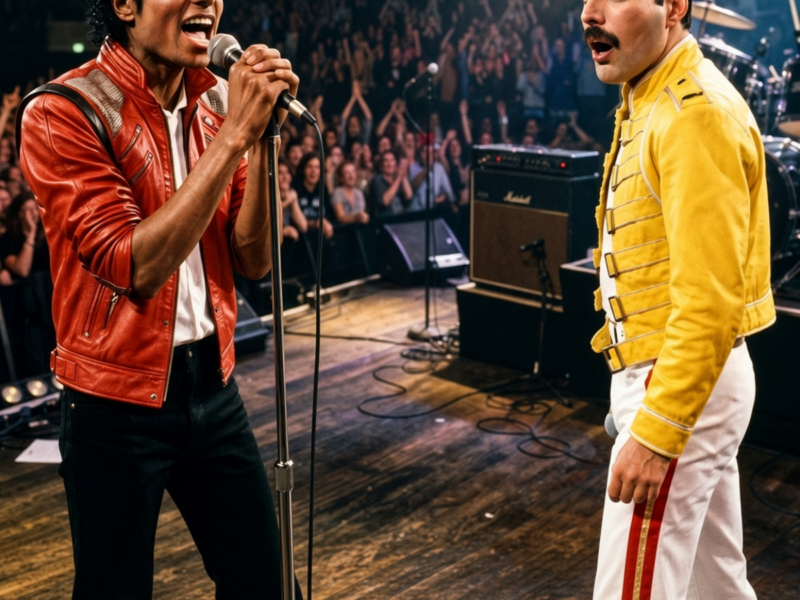
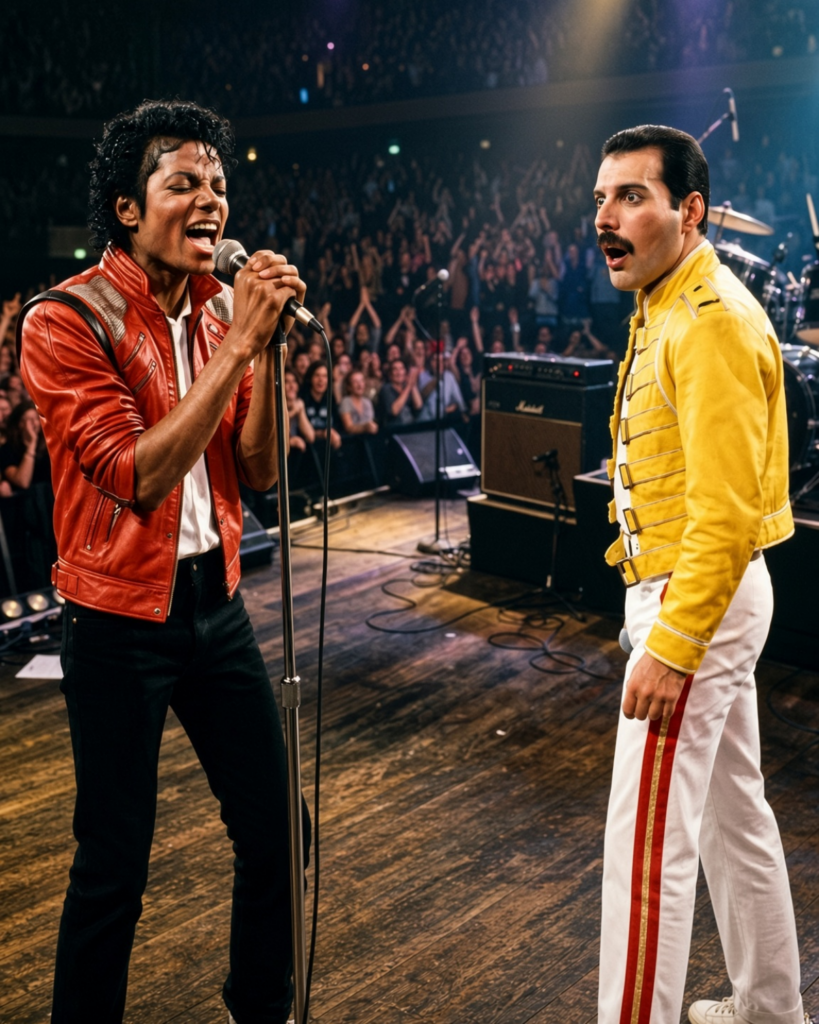
He was wearing a white vest and white trousers with a thin stripe down each leg, and over the top a fitted military-style jacket with rows of buckles across the chest.
He strutted to the front of the stage like he owned the building, raised one fist in the air, and held it there.
The roar that came back at him was so loud that Michael took a half step backward.
Whatever had been weighing on Freddie all day, it had vanished.
Or at least it had been locked away somewhere the audience couldn’t see it.
This was the other Freddie now.
The one who could hold twelve thousand people in the palm of his hand and make them do whatever he wanted.
The first few songs went off like fireworks.
Freddie ran from one side of the stage to the other.
He stood on the edge of the drum riser and pointed his microphone stand at the crowd like a sword.
He did the thing only he could do, where he sang a single note and the entire arena sang it back to him, and then he’d sing a trickier one, and a trickier one, and they’d follow him every time.
Twelve thousand voices chasing one man up and down a scale.
From the wings, Michael watched with his mouth slightly open.
He’d seen Queen before.
He’d seen them at the Forum four years earlier.
But he’d forgotten what it was like to watch Freddie work a room.
It wasn’t choreography.
It wasn’t rehearsed moves.
It was something looser and wilder than that.
Like Freddie was having an argument with the audience and winning it.
Brian noticed Michael first.
Between songs, while he was changing guitars, he glanced toward the wings and did a double take.
Then he leaned over to Roger and said something.
Roger looked, grinned, and hit his cymbal twice for no reason at all.
Freddie didn’t look toward the wings once.
Not once in the first forty minutes.
Michael began to wonder whether Freddie even knew he was there.
Then, halfway through the set, after a thundering version of Hammer to Fall, Freddie did something the band weren’t expecting.
He raised his hand.
The band stopped.
Roger’s cymbal hung in the air for a moment, then faded.
The crowd kept cheering, then slowly, section by section, they realized something unusual was happening.
The noise dropped.
Twelve thousand people went quiet, waiting.
Freddie walked to the front of the stage and stood there, catching his breath.
Sweat was running down his face.
He wiped it with the back of his hand and smiled.
“Thank you,” he said.
“Thank you, darlings. You’re making an old man very happy on his birthday.”
A roar went up.
Somebody near the front started singing Happy Birthday, and within seconds the entire arena had joined in.
Freddie stood there and let them sing it all the way through, conducting them with one finger, pulling a face of mock embarrassment.
When they finished, he bowed so low his hair nearly touched the floor.
“Now,” he said, straightening up.
“I want to tell you a little story.”
The arena went quiet again.
“A little while ago, I went to America to make some music with a friend of mine. A very talented young man. We wrote some songs together, and they were good songs. Some of them were very good songs.”
He paused.
“And then we never finished them.”
A few people in the crowd laughed, not quite sure where this was going.
“Now, you may have read in the newspapers that I walked out because of a llama.”
This time the whole arena laughed.
Freddie held up a hand.
“It’s true. There was a llama. I won’t deny the llama.”
More laughter.
“But the llama was not the problem, darlings. The problem was me. I was stubborn, and I was proud, and I never picked up the telephone, and I’ve regretted that for a very long time.”
The laughter died away.
People could tell he meant it.
In the wings, Michael had gone completely still.
His bodyguard glanced at him and saw that his eyes had gone glassy.
“Tonight,” Freddie said, “that friend came all the way to London to wish me happy birthday. He didn’t want any fuss. He asked for a quiet little spot at the side of the stage.”
He turned his head for the first time all night and looked directly into the wings.
“Sorry, darling, there are no quiet little spots at my birthday party.”
He swept his arm toward the side of the stage.
“Ladies and gentlemen—Mr. Michael Jackson.”
For about one second, nothing happened.
The crowd didn’t quite believe it.
Then a spotlight swung across the stage and landed on the speaker stack, and there he was—a slim figure in a black hat, blinking into the light like a deer on a country road.
The noise that came out of Wembley Arena in that moment was something the crew talked about for years.
Tommy, the production manager, said he’d been working in venues since 1964 and he’d never heard anything like it.
It was louder than the Beatles, he claimed, though he may have been exaggerating.
People were standing on their seats.
People were hugging strangers.
A girl in the third row fainted and had to be passed back over the barrier by the security guards.
Michael stood frozen for a moment.
Then his bodyguard leaned down and said something in his ear, and Michael took a deep breath and walked out onto the stage.
He walked the way he always walked—light on his feet, almost gliding.
The crowd noticed.
A few people screamed at the sight of it alone.
When he reached the middle of the stage, Freddie was waiting for him.
They looked at each other for a moment.
Neither of them seemed to know what to say.
Then Freddie opened his arms, and Michael stepped into them, and the two of them hugged in the center of the stage while twelve thousand people lost their minds.
When they pulled apart, Freddie kept one hand on Michael’s shoulder and brought his microphone up.
“Happy birthday,” Michael said off mic, so quietly that only Freddie heard it.
“Thank you for coming,” Freddie said.
Then, into the microphone: “Say hello to everyone, Michael.”
Someone passed Michael a microphone from the side of the stage.
He took it and looked at it for a moment like he’d forgotten what it was for.
Then he held it up and said, in his soft, high voice, “Hi, London.”
The crowd screamed again.
Freddie waited for it to die down.
Then he turned to Michael, and his face became serious.
“I have to ask you something,” Freddie said.
“Okay.”
“Did you wear sensible shoes?”
Michael burst out laughing.
So did the crowd, even though most of them had no idea what the joke was.
Michael lifted one foot and showed off his black loafer.
“These are the only shoes I have,” he said.
“Oh dear,” Freddie said.
“That’s a problem.”
“Why is that a problem?”
“Because I’m about to ask you to do something very difficult.”
The crowd went quiet.
They could smell it now.
Something was coming.
Freddie turned so that he was facing Michael directly, and he spoke into the microphone slowly, making sure every word landed.
“Everyone in the world,” he said, “has seen you dance. Every single person in this building has watched you do things with your feet that shouldn’t be possible. You’re the greatest dancer alive, darling, and everyone knows it.”
Michael looked down, a little embarrassed.
“But I was in a room with you last year,” Freddie continued.
“A small room with no cameras and no crowds and one very rude llama. And I heard you sing. Really sing. And I don’t think the world has ever heard what I heard in that room.”
Michael looked up.
“So here’s my birthday present,” Freddie said.
“I want you to sing one of my songs. And I want you to sing it without dancing. Not one step. Not one spin. You stand in one place and you sing, and that’s it.”
The crowd made a sound somewhere between a gasp and a laugh.
Michael stared at him.
“Which song?”
Freddie smiled.
He let the moment hang for as long as he could get away with.
“Bohemian Rhapsody.”
The arena erupted.
It wasn’t just cheering.
It was disbelief.
People were turning to each other with their hands over their mouths.
Somebody near the mixing desk shouted, “He can’t!”
And somebody else shouted back, “Shut up. He can.”
Michael took a step back and put his hand over his face.
When he took it away, he was laughing, but there was something nervous underneath the laugh.
“Freddie,” he said, “that song has like a hundred parts.”
“Six,” Freddie said.
“Roughly.”
“There’s opera in it.”
“There is.”
“There’s a guitar solo. There’s a ballad. There’s that heavy part at the end. How am I supposed to—”
He trailed off, gesturing at the whole stage.
“You’re supposed to stand still,” Freddie said.
“And sing.”
Michael looked out at the crowd.
Twelve thousand faces stared back at him.
Then he looked down at his feet.
And for the first time, the crowd understood the joke about the shoes.
“You really don’t want me to move,” Michael said.
“Not a muscle below the waist.”
“Darling, what if I mess it up?”
Freddie leaned closer.
He lowered the microphone so that the next part was mostly between the two of them, though the front rows caught it.
“Then you mess it up,” he said.
“And it’ll still be the most honest thing anyone’s done on this stage all year. Everybody’s seen what you can do with your feet, Michael. I want them to hear what you can do with your heart.”
Michael didn’t say anything for a long moment.
He’d been told what to do on stage since he was five years old.
Where to stand, when to spin, when to smile.
His father had drilled routines into him and his brothers in a tiny house in Gary, Indiana, until they could do them in their sleep.
And for most of his life, his feet had been his armor.
When he was nervous, he moved.
When he didn’t know what to say, he danced.
As long as he was moving, nobody could really get a good look at him.
Freddie was asking him to take the armor off.
Michael looked at Freddie.
Then, very slowly, he reached up and took off his hat.
He handed it to Freddie.
Then he knelt down, slipped off his loafers one by one, and set them side by side at the edge of the stage, neat as a pair of shoes outside a bedroom door.
He stood up in his socks.
The crowd went absolutely wild.
They understood.
Without those shoes, there’d be no sliding, no moonwalking, no spins.
He’d stripped away the one thing everybody expected from him.
Freddie was grinning so hard it looked like his face might split.
He put the hat on his own head at a ridiculous angle and walked over to the piano.
“Right,” he said into his microphone.
“I’ll play, you sing, and nobody—”
He pointed at the crowd.
“Nobody dances either. We’re all going to stand very still and behave ourselves.”
Laughter rippled through the arena.
Then Freddie sat down at the piano, took off the hat, and set it on top of the instrument.
The lights changed.
The big white washes faded, and a single soft spotlight came down on Michael, standing alone at the front of the stage in his socks, microphone held in both hands.
The arena went quiet.
Not the polite quiet of people waiting for the next song.
A deep, strange quiet, like everyone was holding their breath at the same moment.
Freddie played the opening chords.
Anyone who knows Bohemian Rhapsody knows how it begins, with those first few lines sung almost like a question, soft and unsure.
When Queen played it, those opening harmonies were usually stacked voices, layered and polished.
Tonight, there was only one voice.
Michael opened his mouth and sang the first line.
It wasn’t what people expected.
They’d expected the Michael from the radio, the one with the hiccups and the yelps and the sharp little gasps.
That Michael wasn’t there.
The voice that came out was quieter than that, higher and more fragile, almost like a boy’s voice again.
It floated out over the arena and seemed to hang there.
A woman in the fifth row said later that she felt the hair stand up on her arms.
Michael didn’t close his eyes.
He looked straight out into the darkness, into the crowd he couldn’t really see, and he sang those opening lines like he was asking the audience a real question and genuinely waiting to hear the answer.
His hands started to move just a little.
His fingers tapped against the side of the microphone.
His shoulders swayed.
Then his right foot lifted slightly off the floor.
Freddie, without missing a note on the piano, leaned into his own microphone and said very softly, “Uh-uh.”
The crowd laughed.
Michael laughed too, mid-line, and put his foot back down flat.
And somehow that laugh made the whole thing more real.
He wasn’t performing anymore.
He was a man standing in his socks, trying very hard to keep still while his whole body begged him to move.
The song moved into the ballad.
This was the part where the narrator confesses to his mother that he’s done something terrible, something he can’t take back, and that he’s frightened and wishes he’d never been born.
Freddie had written it years before, and he’d never really explained what it was about.
People had been guessing for a decade.
Michael sang it like he knew exactly what it was about.
His voice cracked on one of the high notes.
It wasn’t a mistake.
Or if it was, it was the kind of mistake that made it better.
It sounded like somebody who’d been carrying something heavy for a very long time and had just, for a second, let it slip.
There was a boy in there who’d grown up on stages and in hotel rooms.
There was a young man who’d lain in a hospital bed that January with burns on his head, watching the news play the footage over and over.
There was a performer who hadn’t been allowed to stand still since he was a child.
All of it came out in the ballad.
In the audience, people had stopped holding up their lighters.
They’d forgotten about them.
Some had let the flames go out.
Others just stood there with their arms at their sides.
Freddie was playing with his head turned toward Michael the entire time.
He barely looked at the keys.
Brian May, who had stepped back into the shadows near his amplifier, had his guitar held against his chest but wasn’t playing.
He was just listening.
Then the ballad reached its end, and Brian stepped forward.
The guitar solo in Bohemian Rhapsody is one of the most famous in rock music, and Brian played it the way he always did, with that singing, crying tone that sounded more like a human voice than a guitar.
But tonight, something was different.
He played it slower.
He played it gentler.
He turned it toward Michael the way you’d turn toward someone who’d just told you something painful, as if the guitar were answering him.
Michael stood still and listened.
His eyes had filled up.
He wiped them with the back of his wrist and nodded at Brian, and Brian nodded back.
And then came the part everyone had been waiting for.
The opera section.
Anybody who’d been to a Queen show in those days knew that the band never tried to play the operatic middle of Bohemian Rhapsody live.
It was impossible.
On the record, it was built out of hundreds of overdubbed voices, stacked in a studio over weeks.
On stage, the band usually walked off and let the recording play over the speakers while the lights flashed.
Tonight, Freddie had other ideas.
He stopped playing.
He stood up from the piano bench, walked to the front of the stage, and put one hand on Michael’s shoulder.
Then he turned to the crowd and spread his arms wide.
“This part,” Freddie said, “is yours.”
For a moment, the crowd didn’t understand.
Then they did, and twelve thousand people began to sing.
It was ragged at first.
Some people started too early, and some too late.
Some knew all the words, and some knew about three of them.
But within a few bars, the whole arena had found each other, and the sound that rolled around Wembley was unlike anything Michael had ever heard.
It was a choir the size of a small town.
Men and women and kids, all the high parts and low parts, the call and the answer, bouncing from the floor to the upper seats and back again.
Michael had spent his whole life being the one people watched.
Now he was the one watching.
He stood in the middle of the stage in his socks, holding the microphone at his side, and the look on his face was one that a few people in the front rows said they’d never forget.
It wasn’t the look of a superstar.
It was the look of a kid at a fairground seeing fireworks for the first time.
He didn’t conduct them with his feet.
He didn’t spin.
He did something much smaller.
He lifted one hand, palm up, and moved it gently through the air as the voices rose and fell.
That was all.
Just his hand, and the crowd followed it.
Freddie was standing a step behind him, and at one point, Freddie reached out and squeezed his shoulder hard, the way you’d hold on to a friend on a roller coaster.
As the operatic section climbed toward its peak, with the crowd splitting itself into the famous back-and-forth argument between voices, Roger Taylor stood up behind his drums and added his own high falsetto on top, screaming the highest notes the way only he could.
The crowd roared its approval without missing a beat.
And then the opera crashed into the heavy section.
Roger slammed into the drums.
Brian hit the riff.
John’s bass came in like a truck.
The lights went from soft to blinding, and the whole stage lit up.
This was the part where Michael had to fight himself hardest.
The heavy section of Bohemian Rhapsody is pure rock and roll.
Loud, angry, defiant.
Everything about it tells your body to move.
Michael’s whole frame was trembling with the effort of staying still.
His knees bent slightly, his shoulders jerked on the beat, his free hand clenched into a fist, but his feet stayed flat on the floor.
And his voice changed completely.
The soft, fragile singer from the ballad disappeared.
What came out now was raw and gritty, full of that famous edge, the hiccups and gasps and sharp bite he usually saved for his own records.
He sang the angry lines at the crowd like he was daring them to argue.
He threw his head back.
He hit a scream at the top of one phrase that made Freddie actually take a step backward and put a hand over his heart in mock shock.
The crowd was going berserk.
They were jumping, stamping, pumping their fists in the air.
The irony was not lost on anyone.
The one person in the building who was supposed to be the dancer was the only one standing still.
At one point, right in the middle of the hardest section, Michael’s left heel started to slide, just an inch, maybe less.
Freddie saw it instantly.
Without breaking stride, he pointed at the foot with one long finger and shook his head slowly, like a disappointed schoolteacher.
Michael saw him and cracked up.
He put his foot back, shook out his hands, and kept singing through the laughter.
That little moment—the finger, the shake of the head, the laugh—was the thing people in the arena talked about most afterward, because it told them what was really going on.
This wasn’t two superstars showing off.
It was two friends playing a game, and both of them were loving every second of it.
Then the heavy section burned itself out, and the song drifted into its final part.
Freddie went back to the piano.
The lights dropped again.
The noise of the arena faded until it was barely more than a murmur.
The ending of Bohemian Rhapsody is quiet.
It’s resigned.
It’s the sound of someone who has fought and screamed and thrown everything he has at the world, and now he’s just tired.
He’s accepting whatever comes next.
Michael sang those last lines almost in a whisper.
His voice wasn’t gritty anymore.
It wasn’t young and fragile either.
It was something in between, something older than his twenty-six years.
He sang slowly, taking his time, letting each word land.
He wasn’t looking at the crowd now.
He was looking at Freddie.
And Freddie, playing the final chords, was looking back at him.
The last line came and went.
Freddie played the final soft notes on the piano.
And then Roger Taylor, standing behind his kit, reached up and struck the big gong that hung behind the drums.
The sound rolled out over the arena, deep and low, and slowly faded into nothing.
For about three seconds, there was absolute silence in Wembley Arena.
Twelve thousand people.
Not one of them made a sound.
Michael stood there in his socks with the microphone hanging at his side.
He looked like he wasn’t sure whether he was allowed to breathe.
Then Freddie stood up from the piano.
He didn’t say anything.
He just started clapping.
Slowly at first, then harder, and the arena exploded.
It was the loudest noise of the night.
Louder than when Freddie had first walked out.
Louder even than when Michael’s name had been announced.
People were screaming and crying and hugging.
The girls from Leeds with the heart-and-crown banner were holding it up and jumping up and down so hard that one of them lost a shoe.
Security guards at the front barrier had given up trying to look stern and were just clapping along with everyone else.
Michael didn’t know what to do with himself.
He put a hand over his mouth.
He bowed, then bowed again.
He turned to Brian and Roger and John and pointed at each of them.
And then he turned to Freddie, and his shoulders dropped, and suddenly he looked very young.
Freddie walked over to him.
For a moment he just looked at Michael.
Freddie Mercury, who always had something to say, who had a comeback for every situation, who could silence a room of journalists with one raised eyebrow, didn’t say anything at all.
Then he took Michael’s face in both of his hands, the way a big brother might, and kissed him on the forehead.
“You didn’t move,” Freddie said into the microphone.
“You told me not to,” Michael said.
“I told you not to dance, darling.”
Freddie shook his head, and his own eyes were wet.
“I didn’t tell you to break my heart.”
The crowd roared again.
Michael laughed and wiped his face.
“I almost moved in the heavy part.”
“Your left foot is a criminal,” Freddie said.
“I saw it. It’s got a mind of its own.”
“I know. I’ve seen it on television.”
More laughter.
Then Freddie did something he almost never did on stage.
He turned the microphone away from his own mouth, faced Michael, and spoke quietly, and only the first few rows heard what he said.
One of those people was a nurse from Cudden named Sheila, who wrote it down on the back of her ticket that night so she wouldn’t forget.
According to Sheila, Freddie said, “I’m sorry about Encino. It wasn’t the llama. It was me. I was frightened I wasn’t good enough for your world, and I ran. I should have called.”
And Michael, according to Sheila, said, “I thought it was me. I thought I did something.”
“You didn’t do anything, darling. You were wonderful. You were wonderful then, and you were wonderful just now.”
They stood there for a moment.
Then Freddie raised the microphone again and said, “Would you like to hear something nobody’s ever heard?”
The crowd screamed that yes, they would.
Freddie sat back down at the piano.
He waved Michael over, and Michael, still in his socks, padded across the stage and sat down on the edge of the piano bench next to him.
The crowd could see them side by side under a single spotlight.
One in a buckled military jacket and a sweat-soaked vest.
One in a plain black jacket and no shoes.
“Last year,” Freddie said, “we wrote a song together in Michael’s house. It’s called There Must Be More to Life Than This. We never finished it.”
He looked at Michael.
“Do you remember it?”
Michael nodded.
“I remember all of it.”
“Then let’s finish it.”
Freddie started to play.
The melody was slow and gentle, full of long, reaching lines.
It had none of the bombast of Bohemian Rhapsody.
It was just a question, really—a song about looking at the world with all its noise and all its trouble, and wondering whether there was a better way to live.
Freddie sang the first verse himself.
His voice, after nearly an hour of full-throated rock, was a little rough at the edges, but he sang it gently, and the roughness made it sound more human.
Then Michael came in on the second verse, and then they sang together.
It was an odd pairing on paper—Freddie’s big, rich, operatic voice and Michael’s high, light one.
But on that night, sitting side by side at a piano in front of twelve thousand people who had fallen almost completely silent again, the two voices wrapped around each other like they’d been built for it.
Freddie took the low line, and Michael floated above him.
When Freddie pushed, Michael pulled back.
When Michael reached for a high note, Freddie dropped away to give him room.
Nobody was showing off.
Nobody was trying to win.
Brian May slipped his guitar off and set it down on its stand.
Roger put his sticks across his snare drum.
John Deacon sat down on his amplifier.
The three of them just listened, like everyone else in the room.
By the end of the song, there were people in the upper seats of Wembley Arena crying openly.
Not screaming, not jumping—just standing there with tears running down their faces while two men at a piano sang about wanting the world to be kinder than it was.
The last chord faded out.
Freddie took his hands off the keys and put them in his lap.
Michael looked at him, and Freddie looked back, and neither of them said anything.
Then Freddie nodded once.
Michael nodded back, and the crowd rose to its feet, and this time it didn’t scream.
It applauded.
A long, rolling, heavy applause that went on and on.
The kind of applause people give when they know they’ve seen something they’ll be describing to their grandchildren.
Freddie didn’t try to milk it.
He didn’t strike a pose or raise his fist.
He just sat there on the piano bench next to his friend and let it wash over them both.
Finally, Michael stood up.
He picked up his loafers from the edge of the stage where they’d been sitting all this time and held them up to the crowd like trophies.
The arena laughed and cheered.
He waved, bowed one last time, and walked off into the wings in his socks, shoes in hand.
Freddie watched him go.
Then he turned back to the crowd, clapped his hands together, and shouted, “Right—where were we?”
And the band launched straight back into the show as if nothing had happened.
But something had.
The show ended a little before eleven.
Freddie came off after the final encore soaked in sweat, a towel around his neck, grinning like a schoolboy.
The crew applauded him down the steps.
Somebody finally brought out the birthday cake that the fan had been guarding in the queue all afternoon—a little squashed, but still in one piece—and Freddie cut the first slice himself with a plastic knife.
Then he asked Peter where Michael was.
Peter pointed down the long corridor that ran underneath the seating.
“He’s been waiting.”
Michael was sitting on an equipment case at the far end, where the corridor opened onto the loading area.
The big doors were half open to the night air.
You could hear the crowd outside, the cars starting up, people still singing snatches of songs as they walked back to the tube station.
His bodyguard was standing a respectful distance away, pretending to study a fire extinguisher.
Michael had put his shoes back on.
His hat was on the case beside him.
He was holding a paper cup of tea that somebody from catering had made him, and he hadn’t drunk any of it.
Freddie walked over and sat down on the case next to him.
For a while, neither of them spoke.
Somewhere behind them, a roadie was dragging a flight case across the concrete, and the scrape of it echoed down the corridor.
“You were magnificent,” Freddie finally said.
Michael shook his head.
“I was so scared.”
“I know. That’s why you were magnificent.”
Michael turned the paper cup around in his hands.
“Can I tell you something?”
“Anything, darling.”
“No jokes?”
Freddie put his hand on his heart.
“No jokes, I promise. Not even about the llama.”
Michael almost smiled.
Then he looked down at his shoes.
“I don’t remember the last time I stood still in front of people,” he said.
“Really stood still. Since I was little, I always had something to do. A step, a spin, a mark on the floor. My father used to watch us rehearse, and if one of us missed a step, he stopped everything.”
He paused.
“Anyway. You learn to keep moving. If you keep moving, nobody can see you properly. They see the dancing. They don’t see you.”
Freddie didn’t say anything.
He just listened.
“This year’s been hard,” Michael said quietly.
“The fire. Everyone’s seen it on the news over and over, like it’s a movie. And the tour. Every night, fifty thousand people want me to do the moonwalk. And I love them. I do. But sometimes I walk off the stage and I think, did anybody hear me sing tonight, or did they just watch my feet?”
He put the tea down on the case.
“Tonight,” he said, “for the first time in a long time, I think they heard me.”
Freddie was quiet for a long moment.
Then he leaned back against the wall.
“Do you want to know why I asked you to do it?” he said.
“Why?”
“Because I have the same problem, darling. Just the other way round.”
He gestured at his own chest, at the jacket with all its buckles.
“People see this. The jacket, the mustache, the fist in the air. The show. And the show is wonderful. I adore the show. But sometimes I sit in that dressing room before I go on, and I think, is anybody still listening to the songs, or have I just become a very expensive fireworks display?”
Michael looked at him.
“I watched you tonight,” Freddie said.
“Standing there in your socks. And I heard every word. Every single word. And I thought, that’s what it’s supposed to feel like. That’s what it felt like when I was a skinny boy in a school band in India, banging away on a piano in a hall that smelled of floor polish, and nobody knew my name, and I was singing because I simply couldn’t stop.”
“You grew up in India?” Michael said.
“Zanzibar first. Then a boarding school in India. The boys called me Bucky because of my teeth.”
He tapped his front teeth and grinned.
“I had a little band called the Hectics. We played at school dances. Terrible sound system. Half the time the microphone didn’t work. And it was wonderful. I’d sing into a dead microphone, and it didn’t matter one bit.”
Michael laughed.
“We used to rehearse in our living room in Gary,” he said.
“It was so small you could touch both walls if you stretched out your arms. My brothers and me, and the amplifiers, and my mother trying to cook dinner in the next room.”
“What did your mother think of all that noise?”
Michael smiled.
A real one this time.
The kind that went all the way up into his eyes.
“My mother used to say something to me,” he said.
“When I was little, and I was nervous before a show, and I’d be fidgeting and tapping my feet and couldn’t stand still, she’d hold my face and say, ‘Baby, God gave you the voice. The feet were your idea.'”
Freddie threw his head back and laughed so hard that the bodyguard by the fire extinguisher looked over in alarm.
“Oh, I love her,” Freddie said.
“I absolutely love her. God gave you the voice. The feet were your idea.”
He wiped his eyes.
“She’s right, you know.”
“I know,” Michael said.
“I think I forgot.”
Freddie nodded slowly.
The roadie with the flight case had gone.
The corridor was quieter now.
“I’ll tell you something I’ve learned,” Freddie said.
“Anybody can fill a room with noise, darling. Any band with enough amplifiers can do that. The trick—the real trick—is filling it with quiet. Getting twelve thousand people to stop breathing at the same time. You did that tonight with nothing. No steps, no shoes, nothing. Just you.”
Michael didn’t answer.
He looked out through the half-open loading doors at the night.
“And one more thing,” Freddie said, more quietly.
“About you—already said sorry. I said it into a microphone in front of twelve thousand people. That doesn’t count.”
He turned to face Michael properly.
“I’m sorry. I should have picked up the phone. I was proud, and I was silly, and I let a very good friendship go for no reason at all. I’ve thought about it more than you’d believe.”
Michael was quiet for a moment.
Then he said, “I thought about calling you a hundred times.”
“Why didn’t you?”
“I thought you didn’t like me anymore.”
Freddie looked genuinely shocked.
“Not like you, darling? I adored you. I just couldn’t stand the llama.”
This time they both laughed, and the laugh went on longer than the joke deserved—the way laughter does when two people have finally put something heavy down.
“We should finish those songs one day,” Michael said.
“Properly. In a studio.”
“We should,” Freddie said.
“We will. When we’re both a little less busy.”
They both knew, even as they said it, that neither of them was ever going to be less busy.
But it was a nice thing to say.
And in that moment, both of them meant it.
After a while, Michael’s bodyguard cleared his throat and pointed at his watch.
The car was waiting.
Michael stood up and put on his hat.
“Happy birthday, Freddie,” he said.
“Thank you for my present,” Freddie said.
“I didn’t bring you a present.”
Freddie stood up, too, and pointed back down the long corridor toward the stage, where the crew were already pulling down the lights.
“Oh yes, you did,” he said.
They hugged.
Then Michael walked out through the loading doors into the cool London night.
He stopped once, just before he got to the car, and looked back.
Freddie was still standing in the doorway, silhouetted against the lights of the corridor.
Michael lifted one hand and waved.
Then he got in, and the car pulled away past the catering trucks and the generators and a handful of fans who’d figured out which gate to wait at and were now screaming and chasing the car down the road.
Freddie stood in the doorway for a long time after it had gone.
Peter came and found him eventually, carrying his coat.
“Are you all right?” Peter asked.
Freddie took the coat and put it over his arm.
He was smiling a little.
“Do you know,” he said, “for the first time in months, I can’t wait to get back on that stage tomorrow night.”
The next ten months would turn out to be some of the most important in Queen’s history.
In July of 1985, the band walked onto the stage at Live Aid in Wembley Stadium—the huge open-air ground right next door to the arena where this story happened.
They played for about twenty minutes.
By the time they walked off, a lot of people were saying it was the greatest live performance by any rock band ever.
Freddie had the whole stadium singing back to him.
Seventy-two thousand people following one man up and down a scale, and the world never quite looked at Queen the same way again.
The following summer, in 1986, Queen toured Europe one more time on what they called the Magic Tour.
It ended in August at Knebworth Park, in front of well over a hundred thousand people.
Nobody knew it at the time, but it would be the last show Freddie Mercury ever played with Queen.
Michael, meanwhile, went back to the studio and spent the next few years making the album that would become Bad.
When he finally set off on his first-ever solo world tour, he came back to London in 1988 and played seven nights at Wembley Stadium—more than anyone had played there before.
And people who were at those shows sometimes noticed something.
In the middle of all the dancing and the fireworks and the costume changes, there’d be moments when Michael would just stop, stand dead still at the microphone, and sing a ballad without moving a muscle.
And the whole stadium would go silent, waiting.
Freddie Mercury died in November of 1991 at his home in London, at the age of forty-five.
He had kept his illness private for years, working right up until the end, recording vocals when he could barely stand, because, as he told the band, he wanted to keep singing for as long as he possibly could.
The songs he and Michael started in Encino stayed in a drawer for decades.
Then, in 2014, Queen finally released There Must Be More to Life Than This, with both of their voices on it.
Freddie and Michael, singing together on the same track, more than thirty years after they’d first sat down in that little studio.
Neither of them lived to hear it come out.
Years after that night at Wembley, in the version of this story that people like to tell, Michael was asked by a young singer what the best advice he’d ever been given was.
He apparently thought about it for a long time.
Then he said, “A friend of mine once made me take my shoes off in front of twelve thousand people. He taught me that you don’t need to move for people to feel you. Sometimes you just have to stand still and tell the truth.”
Whether he ever really said that, nobody can quite prove.
But it sounds like him, and it sounds like the lesson of that night.
Because fame has a way of turning people into things.
A jacket, a glove, a mustache, a pair of shoes that can slide across a stage like it’s made of ice.
The world falls in love with the thing, and slowly, without anybody meaning it to happen, the person underneath gets harder to see—even for the person themselves.
What Freddie did on his thirty-eighth birthday was take away the thing.
He took away the dancing and asked a friend to stand there with nothing to hide behind.
And what Michael did was trust him enough to do it.
It wasn’t the moonwalk that people remembered from that night.
It wasn’t the lights or the fireworks or the famous names.
It was a young man in his socks, holding a microphone in both hands, trying so hard not to move that his whole body shook.
It was a left foot sliding one inch, and a finger wagging at it from the piano.
It was twelve thousand strangers singing opera together because someone trusted them to.
And it was two friends on a piano bench, finally finishing a song they’d started a year too early and nearly never finished at all.
Sometimes the greatest thing a performer can do is stop performing.
Sometimes the bravest move is not moving.
And sometimes all it takes to fix a friendship is one person willing to pick up the microphone and say, “It was me. I’m sorry.”









