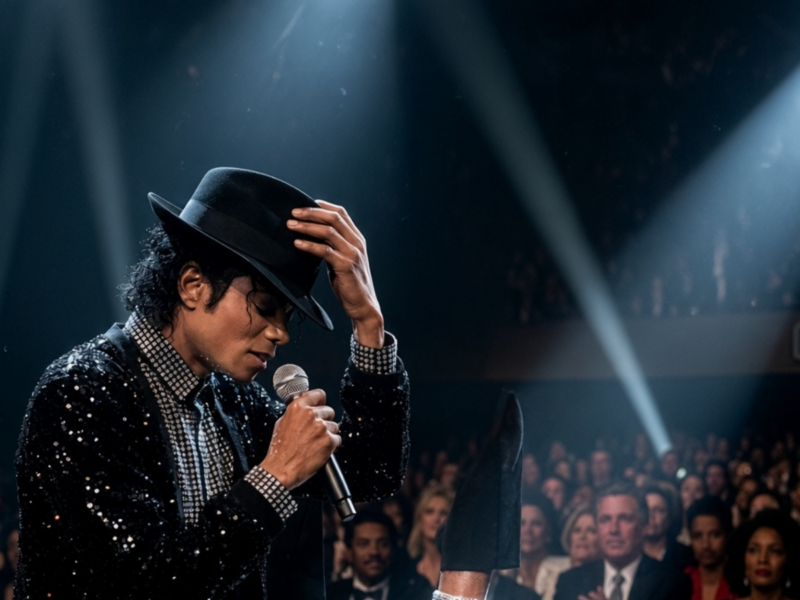
Michael Jackson Took 8 Seconds to Make History — Nobody in the Room Expected It.
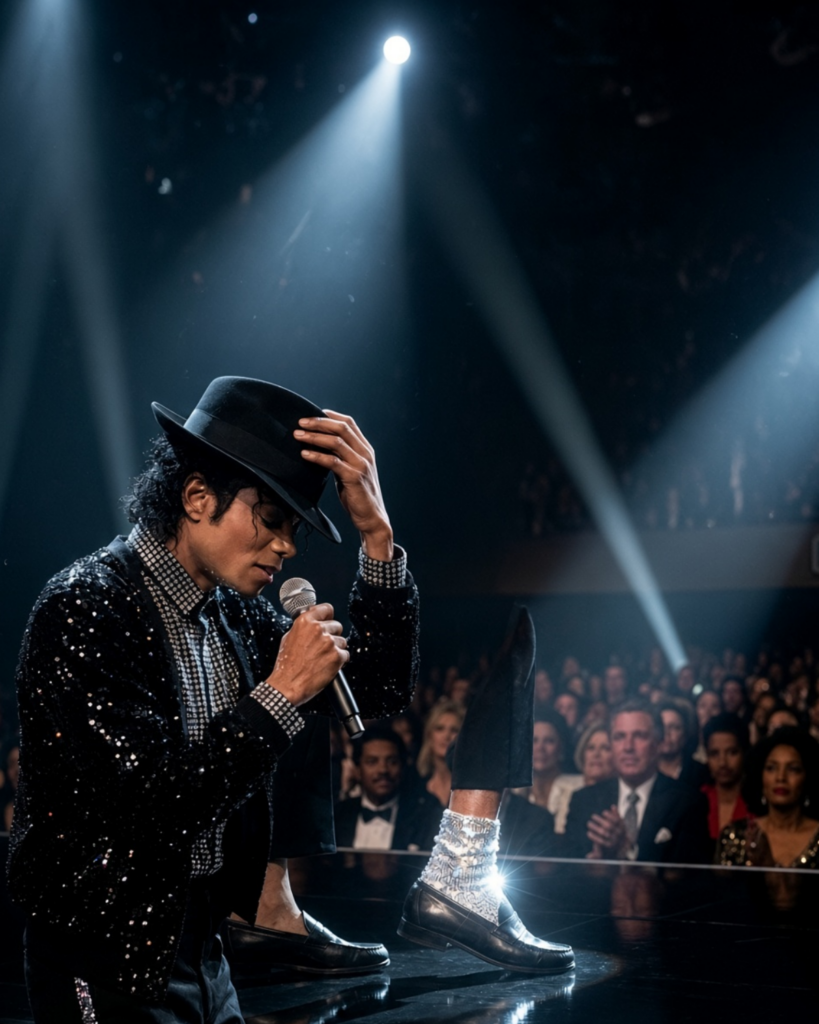
In 1983, Michael Jackson stepped onto a stage and broke the laws of physics for exactly eight seconds.
Nobody in the room saw it coming, and music history was changed forever.
At 10:37 p.m. on March 25th, 1983, an eighty-three-year-old Hollywood legend picked up his telephone in Los Angeles.
The man making the call was Fred Astaire, widely considered the greatest dancer to ever walk the earth.
On the other end of the line was a nervous twenty-four-year-old who had spent the last two hours hiding backstage, crying his eyes out because he thought he’d just ruined his entire career.
Fred Astaire didn’t call to offer sympathy.
He called to say four words that would completely validate everything this young artist had ever fought for.
“You’re a hell of a mover, kid.”
The moment that prompted the icon of classic cinema to reach out and effectively pass the torch lasted precisely eight seconds.
We know it today as the moonwalk.
But what the world didn’t realize that night—and what most history books completely leave out—is that those eight seconds almost never happened.
Just three weeks prior, Michael Jackson was standing in a high-stakes production meeting, threatening to walk away from the biggest television event of the decade over a song the producers refused to let him perform.
He was risking his reputation, his relationships with Motown legends, and his entire future on a secret he had been quietly guarding for over two years.
To understand how high the stakes were, you have to rewind to early March 1983.
Television producer Don Mischer and executive producer Suzanne de Passe were organizing an ambitious project: Motown 25: Yesterday, Today, Forever.
It was a massive television event designed to celebrate the silver anniversary of Motown Records—the legendary Black-owned record label that had launched Stevie Wonder, Marvin Gaye, Diana Ross, and the Jackson 5.
Naturally, the producers wanted the Jackson 5 to reunite on stage.
They wanted the classic hits, the nostalgic choreography, and the young boy genius, Michael Jackson, front and center.
There was just one massive problem.
Michael didn’t want to just look back.
Sitting across from Mischer and de Passe in a high-powered production meeting, Michael made a quiet, firm demand.
He would agree to perform the Motown medley with his brothers, but only if he were given a solo spot to perform his brand-new single.
That song was “Billie Jean.”
Don Mischer was flabbergasted.
“Michael, this is a Motown anniversary special,” Mischer explained, trying to keep his voice calm.
“We’re celebrating the history of the label. ‘Billie Jean’ isn’t a Motown song. It’s on Epic Records.”
Suzanne de Passe jumped in, attempting to appeal to Michael’s sense of fairness.
“If we let you perform non-Motown material, what happens on Monday morning when Marvin Gaye or Stevie Wonder calls and asks why they couldn’t sing their new songs? We can’t set that precedent.”
Michael didn’t raise his voice.
He didn’t throw a tantrum.
He simply stood up from the conference table and stated a quiet fact.
“Then I won’t do the show at all.”
It wasn’t a diva posture.
It was absolute conviction.
Michael knew something the producers didn’t.
He was preparing to reveal a secret maneuver to the world, and “Billie Jean” was the only track with the exact rhythm, tempo, and dramatic weight capable of carrying it.
Realizing that losing Michael Jackson meant risking the entire ratings draw of the special, the producers reluctantly caved.
Michael got his solo spot.
But Don Mischer remained skeptical.
Why was a twenty-four-year-old artist willing to burn bridges over a single performance?
What Don Mischer, Suzanne de Passe, and even Michael’s own family didn’t know was that Michael had been obsessively working on a secret project since the summer of 1981—two years prior.
While watching the music show Soul Train, Michael had spotted young street dancers executing an illusion called “the backslide.”
Dancers like Derek Cooley Jackson and Jeffrey Daniel were taking popping and locking street moves and using precise weight transfers to create the visual impossibility of walking forward while gliding backward.
Michael was instantly obsessed.
He arranged for private lessons with a talented street dancer named Geron “Casper” Candidate.
For weeks, Casper visited Michael to break down the mechanics of the move.
It wasn’t just footwork.
It was a complete illusion of the upper body.
“The trick,” Casper explained to him, “is keeping your torso completely isolated. The moment your upper body shifts, the magic breaks.”
Michael took those lessons and turned them into a ritual.
He practiced in his private studio in Encino.
He practiced in hotel rooms while on tour.
He practiced on break days during the grueling recording sessions for the Thriller album.
He practiced until his heels burned, his ankles throbbed, and his muscle memory executed the slide automatically.
Yet he told virtually no one.
Not his brothers.
Not his manager.
Not the TV crew.
In pop culture, if people catch wind of a breakthrough move before it’s perfected, two things happen.
Either someone else copies it on camera first, or television directors over-engineer the moment with terrible camera cuts.
Michael wanted total surprise and complete control over his vision.
March 24th, 1983.
The day before the live taping at the Pasadena Civic Auditorium, the venue was mostly vacant.
A few sound technicians were tweaking audio boards.
Riggers were adjusting light trusses.
And a handful of Motown icons were lounging in the seats, waiting for their turn to run through blocking.
Smokey Robinson was there.
Linda Ronstadt and Diana Ross were hanging around backstage.
Don Mischer leaned over his microphone in the control booth.
“Okay, Michael, let’s run ‘Billie Jean’ whenever you’re ready.”
Michael walked out onto the empty stage wearing plain rehearsal gear—dark jeans, a casual button-down, and a fedora.
No elaborate costuming, no backing dancers, no pyrotechnics.
Just a microphone stand and a track.
The iconic bassline started thumping through the house speakers.
Michael began to move.
About halfway through the song, he took a step, locked his ankle, and slid backward across the stage floor as if he were standing on a sheet of polished ice while walking forward.
Eight seconds.
The auditorium went dead silent.
In the control booth, Don Mischer froze.
“What on earth was that?” he whispered to his assistant director.
“I don’t know,” she replied.
“But we need to make sure every single lens catches it tomorrow night.”
Mischer immediately hit his intercom button, his voice echoing over the crew radios.
“Attention all camera operators. Tomorrow night during Michael’s solo, scrap the standard shot list. When he does that backward slide, I want three separate cameras locked on him—wide, medium, and tight. Do not miss his feet.”
Backstage, Diana Ross turned to Suzanne de Passe, her mouth slightly open.
“Did you know he could do that?”
Suzanne just shook her head.
Nobody did.
By the morning of March 25th, Michael was finalizing every visual element of his performance.
He understood visual psychology better than almost any entertainer in history.
He knew that an illusion isn’t just about movement.
It’s about directing the eye.
His costume designer laid out the iconic outfit.
The black sequin jacket that would catch the stage lights.
Black tailored pants hemmed deliberately two inches short to expose his ankles.
A single white sequined glove on his right hand.
A pair of custom socks.
When the designer looked closely at the socks, he stopped.
One sock was covered in shimmering silver sequins.
The other was a standard black cotton sock.
“Michael, I think we have a problem,” the designer said, holding them up.
“They don’t match.”
Michael smiled softly.
“It’s not a mistake. That’s exactly how I want them.”
“They don’t match,” the designer repeated, confused.
“They aren’t supposed to,” Michael explained.
“When I do the slide, the contrast of that single silver sock catching the spot beams will naturally draw every eye in the building straight to my footwork. It locks their attention right where the magic happens.”
Every single detail—from the high-water pants to the mismatched silver sock—was engineered to enhance those eight seconds of movement.
By 7:00 p.m., the Pasadena Civic Auditorium was packed with 3,000 people.
Executives, Hollywood stars, press, and fans packed the venue, expecting a nostalgic walkthrough of Motown’s greatest hits.
The show moved through incredible performances.
Diana Ross.
The Temptations.
Marvin Gaye.
Then came the Jackson 5 reunion.
The crowd cheered, sang along, and rode the wave of nostalgic joy as the brothers tore through “I Want You Back” and “ABC.”
Then the rest of the family cleared the stage.
Michael stood alone under a single spotlight, holding a fedora.
He looked out at the audience, tapped his mic, and said four words.
“Those were good songs. But I like the new songs.”
He whipped the fedora onto his head, hit his stance, and that infectious drumbeat of “Billie Jean” began.
What followed was a masterclass in solo performance.
Michael spun, snapped, and moved with a razor-sharp precision that felt almost inhuman.
The energy inside the auditorium was already boiling over.
Then, at exactly one minute and twenty-eight seconds into the track, Michael completed a turn, pushed up onto the toes of his right foot, dropped his left heel, and began to slide.
It lasted eight seconds.
The room didn’t just applaud.
It erupted in a physical, visceral reaction.
People screamed, pushed out of their seats, and grabbed the shoulders of total strangers next to them.
In the control booth, Don Mischer was barking orders into his headset.
“Camera three, stay on his feet. Camera one, get his face.”
Backstage, members of the Temptations stood frozen, watching the monitor with their jaws hanging open.
When the performance concluded with Michael holding his freeze-frame pose on his toes, the standing ovation was so deafening and prolonged that it actually threw the entire television production four minutes off schedule.
As Michael stepped off the stage and walked into the quiet darkness of the wings, away from the roaring crowd, he didn’t celebrate.
He didn’t smile.
He didn’t high-five his brothers.
Instead, he walked into a secluded hallway, leaned against the wall, and started crying—tears of deep frustration.
His manager rushed over, completely baffled.
“Michael, what are you doing? That was unbelievable. The entire house is losing their minds.”
Michael shook his head, wiping his eyes.
“It wasn’t good enough,” he choked out.
“I messed up the spin on the second verse. It was sloppy. I was supposed to hold that toe-stand longer.”
This was the complex duality of Michael Jackson.
The very performance that had just fundamentally rewired pop culture felt flawed to him because his internal standard was absolute perfection.
He couldn’t enjoy the genius that three thousand people had just witnessed because he was fixated on the split-second imperfections only he could see.
Michael returned home to his family’s estate in Encino later that evening, still emotionally drained and dissatisfied with his performance.
At 10:37 p.m., the phone rang in the hallway.
His mother, Katherine Jackson, picked it up.
“Hello, is this the Jackson residence?” an elderly, distinguished voice asked.
“Yes, it is. Who’s calling?”
“This is Fred Astaire. I’m looking to speak with Michael if he’s available.”
Katherine almost dropped the receiver.
She called upstairs to her son.
“Michael, phone for you.”
“Who is it, Mother?” Michael called down, exhausted.
Katherine paused, trying to wrap her mind around her own sentence.
“It’s Fred Astaire.”
Michael sprinted down the stairs, assuming it had to be a practical joke.
Fred Astaire didn’t just call people’s houses.
He was a living Hollywood monument.
Michael took the phone, his hand trembling slightly.
“Hello, Mr. Astaire.”
“Is this Michael?” the voice replied.
“I watched the taping tonight, kid. I taped it, and I just finished watching it for the second time.”
There was a brief pause on the line.
“You’re a hell of a mover, kid. You really put them on their asses tonight.”
Michael stood frozen.
The man who had set the global benchmark for dance in the twentieth century was complimenting him.
“You’re an angry dancer,” Astaire continued.
“I’m the same way. I used to do the same thing with my cane. But that slide—that moonwalk, or whatever you call it—that was something truly special. You’ve got it, kid. You’ve really got it.”
When Michael hung up ten minutes later, he broke down crying again.
But this time, they weren’t tears of frustration.
They were tears of pure validation.
The one person whose artistic judgment mattered more to him than anyone else on earth had just given him his blessing.
The Motown 25 special didn’t actually air on broadcast television until May 16th, 1983—nearly two months after the taping.
Yet the morning after the performance, something unprecedented happened.
Don Mischer flew to Washington, D.C., for a pre-scheduled production meeting at the White House.
When he walked into his hotel lobby, the bellhops were talking about Michael Jackson’s dance move.
When he got into a taxi, the driver brought it up.
In the East Wing, White House staff were trying to describe the slide to one another.
Word of mouth had spread through the industry like wildfire, purely from the 3,000 people who had been in that auditorium.
When the special finally aired on NBC on May 16th, an estimated 47 million viewers tuned in.
In 1983, that meant roughly one out of every five people in the United States watched Michael’s performance simultaneously.
The very next morning, American culture felt different.
Kids were attempting to slide across polished linoleum floors in school hallways.
Dance studios across the country had to create emergency urban and street dance courses to satisfy demand.
Sales of the album Thriller, which had already been performing well, exploded into an unprecedented hyper-buildup, putting it on track to become the bestselling album in human history.
More importantly, those eight seconds helped chip away at rigid racial and cultural boundaries on television.
In an era where mainstream networks were still hesitant to play music videos by Black artists, Michael Jackson’s eight-second performance forced the entire global media industry to pivot toward him.
Michael Jackson would perform the moonwalk thousands of times over the next two decades.
He refined it, lengthened it, added variations, and executed it on massive stadium tours in front of hundreds of thousands of people.
Many critics argue that his 1995 MTV Video Music Awards performance featured a technically smoother, more polished moonwalk than the original.
Yet nothing ever matched the pure, unadulterated shock of that March night in Pasadena.
Fred Astaire, who passed away in 1987, would famously greet Michael at industry events by performing a tiny moonwalk across the table using his middle and index fingers—a private joke between two master craftsmen who understood what it took to innovate in their field.
The story of Michael Jackson’s first moonwalk is more than just a piece of music trivia.
It’s a case study in artistic conviction.
One: calculated risk.
Michael was willing to walk away from a major career opportunity to protect his vision for how his art should be presented.
Two: relentless preparation.
He spent two years mastering a move in secret so that when the moment arrived, he could execute it effortlessly under immense pressure.
Three: the pursuit of mastery.
Genius often comes with an obsession that others don’t understand.
The very performance that amazed the world was one Michael initially thought wasn’t good enough.
Eight seconds is all it took.
Eight seconds of courage, preparation, and surprise that shifted pop culture on its axis and created a moment that people are still analyzing and recreating over forty years later.









