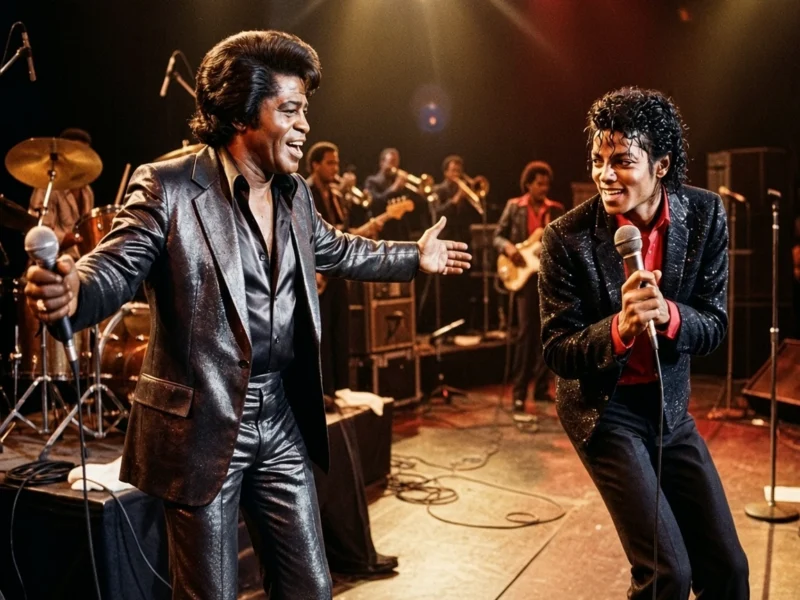
Michael Jackson SURPRISED James Brown LIVE — What Happened Next Brought Down the House.
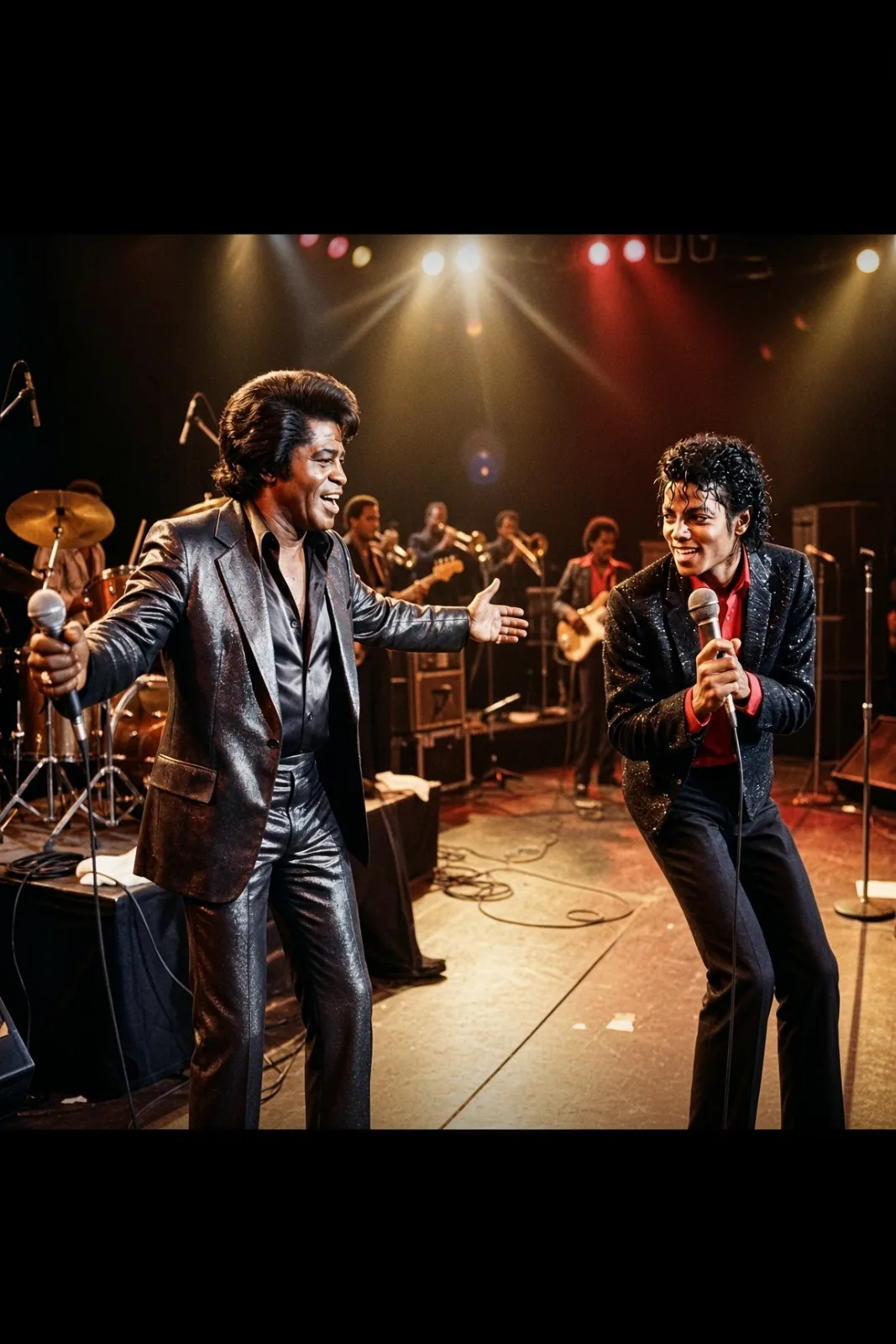
Michael Jackson stepped onto the BET Awards stage in 2003 during a tribute to James Brown, turning an already important lifetime achievement presentation into a remarkable meeting between two generations of performers.
Brown was the honoree, not Jackson.
The award recognized the Godfather of Soul, yet the surprise guest was one of the few artists whose appearance could redirect the attention of the entire room.
The moment was recorded on television.
That matters because the cape, the brief dancing, and the words that followed can be examined directly rather than reconstructed from backstage rumors.
Jackson placed Brown’s signature cape around his shoulders.
It was a specific reference to Brown’s celebrated stage routine, not simply a ceremonial gesture invented for an award show.
Then Jackson explained his presence in unmistakable terms.
Brown had influenced him more than any other entertainer.
The surprise was not a rivalry.
It was a public tribute from student to pioneer.
Contemporary Associated Press reporting described Jackson’s entrance as a surprise, and the applause as enormous.
The report also noted that the two performers danced together briefly.
The same coverage identified Brown as 70 years old that night.
The contrast was striking.
The veteran still performing his own demanding music while a younger global superstar honored him.
Brown performed material associated with his legendary live reputation, including It’s a Man’s Man’s Man’s World and Sex Machine.
His award presentation came in the context of performance, not a static speech.
BET later described Jackson’s appearance as an unexpected interruption of the familiar cape routine.
The show’s own retrospective preserves the idea that Brown did not anticipate that particular guest.
No invented backstage conversation is needed to explain the impact.
The broadcast shows the public action and contemporary reporting confirms the unusual audience response.
James Brown’s cape routine was already a recognizable piece of live show theater.
A performer would drape a cape over Brown as he appeared to leave the stage only for the performance to continue.
That ritual worked because the audience knew Brown’s stage energy.
The cape suggested an ending while his return could turn the ending into another burst of movement and sound.
At the BET ceremony, Jackson did not need to imitate the entire routine.
Handling the cape immediately connected the tribute to a performance language Brown had made famous.
The gesture also avoided a long explanation.
One image could tell viewers that Jackson understood Brown’s stagecraft and wanted to honor it on Brown’s own terms.
BET’s later photo histories repeatedly highlighted the cape moment.
The object became a concise visual reminder of the connection between the two entertainers.
Jackson’s speech made the meaning explicit.
He told the audience that no entertainer had influenced him more than Brown.
A statement reported the following morning by the Associated Press.
He also recalled looking up to Brown from childhood.
This was Jackson describing his own inspiration, not a narrator claiming access to his private thoughts.
The tribute came from an artist who had long been known for highly controlled stage performances.
Here, he used a public awards ceremony to direct attention towards someone else.
Brown received a lifetime achievement award.
Jackson’s role was to present it.
So, the lasting headline was not about a new Jackson single or a competition between performers.
For viewers asking what happened after the surprise entrance, the answer is simple and documented.
They danced briefly.
Jackson honored Brown with the cape, and he presented the award.
The BET stage was not the first place where Brown and Jackson shared a public musical moment.
Footage from a James Brown show in 1983 documents an earlier encounter.
That older recording is especially revealing because Brown invited Jackson to join him on stage.
The direction of the invitation was different from the 2003 awards presentation.
Jackson performed a brief dance during the 1983 appearance.
It was a guest moment within Brown’s show, rather than a scheduled Jackson concert or a recorded duet.
The earlier event also involved Prince.
Jackson suggested bringing Prince up, and Brown followed through, producing an unusual encounter among three major performers.
The Los Angeles Times later revisited the footage as a memorable collision of musical personalities.
Its account underscores that the event is documented, even if retellings sometimes exaggerated.
In the surviving recording, Brown remains the central figure.
He controls the stage, introduces the guests, and keeps the evening moving through an unexpected change in the lineup.
Jackson’s short appearance demonstrates that he was willing to perform in the presence of an artist he publicly admired.
The footage does not establish any private arrangement between them.
Prince’s entrance adds a separate episode to the tape.
The performance has inspired many retellings, but the clearest evidence remains what the recording itself visibly captures.
The 1983 meeting matters to the 2003 tribute because it gives their relationship a public history.
Two decades separated these appearances, yet both centered on Brown’s stage.
Rather than treating the older clip as proof of secret friendship, it is more accurate to describe two documented public encounters between artists with an unmistakable musical connection.
Long before the BET Awards existed, James Brown had built a career around an unusually demanding live performance style.
With rhythm, vocals, movement, and band leadership tightly connected, his work with the Famous Flames helped establish his early career.
As his reputation grew, the name James Brown became inseparable from a forceful approach to stage presentation.
Brown’s songs often emphasized rhythmic precision.
The accents and breaks gave dancers and musicians a structure that could feel both tightly controlled and explosively spontaneous.
The title Godfather of Soul reflected a broad cultural reputation, but the music was concrete.
Records, performances, touring bands, and innovations that later artists could study.
Understanding Brown’s work helps explain why a pop star famous for dance would cite him.
The influence involved performance technique as much as celebrity admiration.
Brown’s recordings placed exceptional emphasis on the rhythm section.
The pulse could become the main attraction rather than merely supporting a melody sung above it.
This approach mattered to dance because a sharp rhythmic accent gives a performer a clear place to stop, turn, gesture, or launch into the next movement.
Brown’s band arrangements often depended on precision.
Musicians had to respond quickly to cues, helping create the tight relationship between movement and sound heard in his performances.
That relationship is a useful lens for viewing Jackson’s work.
Both artists used rhythm to organize stage movement, even though their songs and presentation styles were not identical.
The comparison does not mean every Jackson step came from Brown.
It means Brown helped establish a model of musical physicality that Jackson publicly acknowledged.
Brown became famous in an era when televised music performances could reach audiences far beyond a single concert hall.
Film and broadcast preserved details of his movement.
Jackson’s childhood years overlapped with Brown’s rise as a major live attraction.
The younger performer could encounter a style that combined demanding singing with equally demanding dancing.
In his BET speech, Jackson himself connected the admiration to childhood.
That first-person statement is stronger evidence than any invented scene of him secretly studying a television screen.
Their careers developed through different phases of American popular music.
Brown was associated with soul and funk.
Jackson later became central to global pop and music video culture.
The difference in eras makes the BET meeting more meaningful.
It brought a widely acknowledged influence and an artist influenced by him into the same televised frame.
Jackson first became nationally famous as a member of the Jackson 5.
His early public identity was built on a group act with polished singing, coordinated movement, and energetic performances.
That background made performance discipline central to his career from an early age.
Audiences encountered him not simply as a recording voice, but as someone who could command a stage.
Brown had already demonstrated how a singer could make movement inseparable from the song.
Jackson’s later acknowledgement places Brown among the performers he regarded as models.
The Jackson 5 and Brown did not sound identical.
Their repertoire, arrangements, and audiences differed, which makes influence more interesting than straightforward imitation.
Influence can appear in timing, confidence, and the relationship between music and motion.
Those are useful connections to examine without inventing a particular lesson or private meeting.
As Jackson’s solo career expanded, his dancing became a defining part of his public image.
The visual presentation of songs increasingly mattered alongside the recordings themselves.
Jackson’s performances mixed distinct influences with his own developing vocabulary.
Brown’s influence was one part of that story, not an explanation for every later innovation.
The 1983 Motown television special helped introduce Jackson’s moonwalk to a mass audience.
That moment is separate from the James Brown show recorded in the same year.
The distinction matters because stories about Jackson often combine unrelated appearances.
The moonwalk broadcast and the Brown stage encounter were different events with different purposes.
By the time of the 2003 BET ceremony, Jackson had his own decades-long legacy.
His tribute to Brown was a recognition of influence across two established careers.
Brown’s style used quick footwork, controlled drops, and strong rhythmic punctuation.
Those elements gave a performer ways to answer the band physically, almost like another instrument.
Jackson also made brief movements central to memorable performances.
A turn, a stop, or a short sequence could draw attention because of its placement in the music.
Comparing their footage reveals shared priorities without requiring identical choreography.
Precision, timing, and theatrical confidence mattered to both men in different ways.
Their brief dance at BET becomes more interesting when viewed through that history.
It was not a full concert duet, but an exchange between artists associated with movement.
The event also avoided the need for an elaborate production number.
A short shared moment was enough for viewers to recognize the connection.
The BET Awards celebrated achievements in black music and entertainment.
In 2003, the ceremony included major contemporary performers alongside tributes to influential figures.
Brown’s Lifetime Achievement Award placed him within a wider conversation about the artists who had helped shape popular music before the newest chart successes.
The same evening included performers from hip-hop, rhythm and blues, and pop.
That variety helps explain why a Brown tribute belonged in the program.
Jackson’s presence connected an established pop icon with the show’s recognition of musical predecessors.
The ceremony became a place to see different generations together, unlike an ordinary concert.
An awards ceremony can preserve both a performance and a statement of appreciation.
Brown received both during the 2003 presentation.
Contemporary coverage of the BET Awards discussed 50 Cent’s wins alongside Jackson’s surprise appearance.
The juxtaposition shows how the ceremony joined new success with established influence.
The Associated Press reported that 50 Cent won Best New Artist and Best Male Hip Hop Artist.
Brown’s lifetime honor represented a different measure of achievement.
BET also featured artists such as Beyoncé and Jay-Z that year.
Their presence gives a sense of the musical environment surrounding Brown’s recognition.
Jackson’s appearance did not replace those performances.
It became a standout moment within an evening already designed around music, celebrity, and televised celebration.
The strongest documentary detail is the contrast in roles.
Emerging stars received current awards, while Brown was honored for a career that had helped create their musical landscape.
Brown did not receive the BET honor as a figure who had vanished from the stage.
Contemporary reporting described him as actively touring during the period.
His BET performance included two songs closely identified with his catalog.
The selections reminded viewers why his live presence had become legendary.
It’s a Man’s Man’s Man’s World offered one side of his repertoire, while Sex Machine represented the rhythmic intensity for which he was famous.
Both songs had histories beyond this awards night.
Their presence at the ceremony made the tribute a live demonstration of the artist being celebrated.
When Jackson entered, he was stepping into an active performance tradition.
Brown’s music, not an unrelated celebrity stunt, was the context for the surprise.
BET’s own retrospective says Brown did not know Jackson would appear for the cape gesture.
That detail explains why the entrance could register as a genuine surprise.
The televised footage places the two men close together, sharing the stage rather than speaking about one another from a distance.
It is the strongest visual evidence in the story.
Jackson’s use of the cape linked him to the routine Brown had made famous.
Viewers familiar with Brown’s shows could understand the gesture immediately.
Brown then encouraged a little dancing, according to BET’s later account.
The movement was brief, which is why describing it as a full collaborative performance would be misleading.
The surprise was followed by the formal award presentation.
The sequence combined the familiar stage ritual, a short dance, and a direct expression of respect.
The Associated Press described the huge ovation when Jackson appeared.
That is a reported public reaction, not a claim about what every individual in the room felt.
An ovation can show the scale of the moment, but it cannot reveal private motives.
The more reliable story remains what the artists actually did on stage.
The footage and the contemporary report complement each other.
One shows the encounter, while the other documents how unusually prominent the surprise became in coverage.
The surprise also changed the visual focus of the ceremony.
For a brief interval, viewers saw two widely recognized entertainers occupying the same stage.
That is enough to explain the title’s excitement without claiming that the audience witnessed an entirely unplanned concert or a hidden performance never recorded.
Jackson did not frame the presentation as a competition.
He said Brown had influenced him more than any other entertainer, directing the honor toward the man receiving the award.
His words offered a rare public connection between the technical history of pop performance and a specific predecessor.
He named the influence instead of leaving critics to infer it because the statement came during a recorded ceremony.
The attribution is straightforward.
It is Jackson’s own account of his artistic admiration.
The Lifetime Achievement Award formally belonged to Brown.
Jackson’s statement helped explain why that recognition resonated beyond Brown’s own generation of fans.
The speech also gave the short dance a lasting interpretation.
What viewers had just seen was a tribute, not merely an entertaining surprise appearance.
The BET appearance does not establish that Jackson and Brown rehearsed together in secret.
The public footage alone cannot tell us how every production detail was arranged.
It would also be inaccurate to describe a lengthy duet that evening.
The available reporting emphasizes a brief dance and the award presentation.
Accounts sometimes enlarge the surprise into a dramatic confrontation or a personal reconciliation.
Neither is necessary and neither follows from the evidence used here.
The documented facts are already compelling.
A famous performer appeared unexpectedly, participated in the signature routine, and publicly honored a major influence.
Keeping the story precise makes the genuine details stand out.
It also protects the meaning of Jackson’s words from speculation about private relationships.
The 1983 Brown performance provides a striking comparison.
In that earlier footage, Brown invited Jackson up from the audience and offered him a place on stage.
20 years later, Jackson returned the attention at a televised awards ceremony.
The symmetry is visible in the public record even without claiming that either man planned it.
The 1983 show also featured Prince after Jackson urged Brown to invite him.
That separate encounter gives the older footage an unusual place in pop music history.
The Los Angeles Times later discussed the 1983 video while reflecting on Prince.
Its account helps distinguish the recorded event from exaggerated internet retellings.
The two appearances show different kinds of recognition.
Brown sharing his stage with younger performers, then Jackson publicly celebrating Brown’s influence.
Brown’s influence reached far beyond Jackson.
His rhythmic approach became a reference point for generations of performers, producers, dancers, and musicians.
Jackson’s own impact likewise extended across pop performance, music videos, and stage presentation.
The 2003 encounter brought two distinct legacies into direct view.
Their careers cannot be reduced to one dance step or one awards appearance.
Each developed a substantial body of work that shaped how audiences experienced live entertainment.
Yet, the short BET moment is useful because it shows artistic influence being acknowledged publicly.
Viewers did not need a critic to explain the connection afterward.
Jackson’s tribute also illustrates that an artist’s originality can coexist with admiration for predecessors.
Publicly naming an influence does not diminish later achievement.
Brown continued performing into the 2000s.
The 2003 honor therefore recognized a living, working artist rather than only an influence from the distant past.
He died in December 2006.
That date gives the BET footage additional historical weight.
It preserves one of the later televised honors of his lifetime.
The significance of the video changed after his death.
A moment that had celebrated an active performer also became part of the archive through which audiences remembered him.
Jackson remained a major public figure after the ceremony.
The BET clip continued to circulate as a reminder of his openly expressed admiration for Brown.
It is important not to turn later events into supposed predictions.
Neither performer’s future can be read backward into what was said on stage in 2003.
Jackson died in June 2009.
BET subsequently announced special programming to remember his career including a countdown of notable moments from its awards history.
In that programming, BET identified the 2003 surprise with James Brown as its number two moment.
That ranking came from the network’s own retrospective.
The selection shows how strongly the appearance remained associated with the awards brand years later.
It was no longer only a headline from one ceremony.
BET’s decision also connected two memorial contexts.
Jackson’s passing and the earlier tribute he had offered Brown while Brown was alive.
The clip survived because the interaction was short, clear, and meaningful.
Its central gesture could be recognized even by someone unfamiliar with the rest of the 2003 broadcast.
BET has revisited the 2003 encounter in photo galleries and anniversary coverage.
Those retrospectives consistently emphasize the cape, the dance, and Jackson’s respect for Brown.
In a later history of the awards, BET described the meeting as recognition passed between generations.
That is the network’s interpretation, not an additional backstage fact.
Its 2024 coverage of lifetime achievement recipients again identified Brown’s award as presented by Jackson.
The event remains part of BET’s official record.
In 2025, BET’s own video channel shared the award presentation as part of an anniversary celebration.
That makes the footage accessible in an official context.
Official retrospectives matter because they show what the organizers themselves chose to preserve.
They also help separate the recorded moment from unsupported stories surrounding it.
Only a small portion of the 2003 ceremony involved Jackson and Brown together.
The brief duration is not a weakness of the history.
It is one of its defining features.
A short encounter can carry meaning when the people involved have long public histories.
Here, the significance depended on careers already familiar to music audiences.
The cape supplied the visual connection.
The dance supplied the live exchange.
Jackson’s speech supplied the explanation.
Those three elements make the sequence unusually complete.
There was no need for a new recording, a full tour, or a later joint project.
The televised award presentation already documented a direct acknowledgement of influence.
That is why the event works best when placed beside the verified history of both performers.
Rather than stretched into imaginary details about a single evening in 1983, James Brown invited Michael Jackson onto his stage.
In 2003, Jackson appeared to honor Brown on another stage.
This time, before a televised awards audience.
The earlier encounter included a young Prince.
The later one centered on Brown’s lifetime achievement.
The details differ, but both episodes show music history unfolding in public.
Jackson’s own statement gives the clearest answer to why he was there.
He wanted the audience to recognize the performer who had influenced him since childhood.
The cape, the brief dance, and the award presentation were all visible parts of that tribute.
The strongest version of this story is the one the surviving evidence actually supports.
James Brown received the honor, and Michael Jackson helped deliver it.
For more real stories behind music’s most unforgettable moments, subscribe to Beyond Fame.









