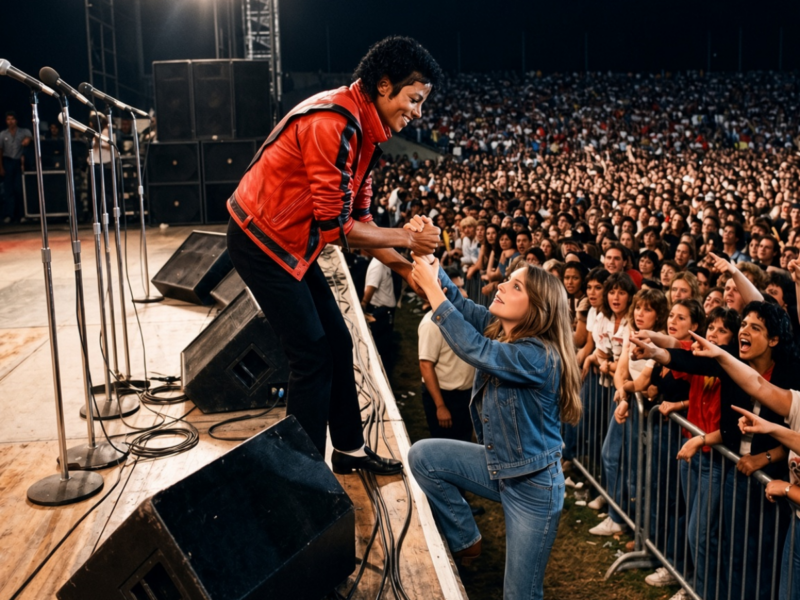
Michael Jackson STOPPED His Concert and Pulled Someone From Crowd — What Happened Next Shocked 70K.
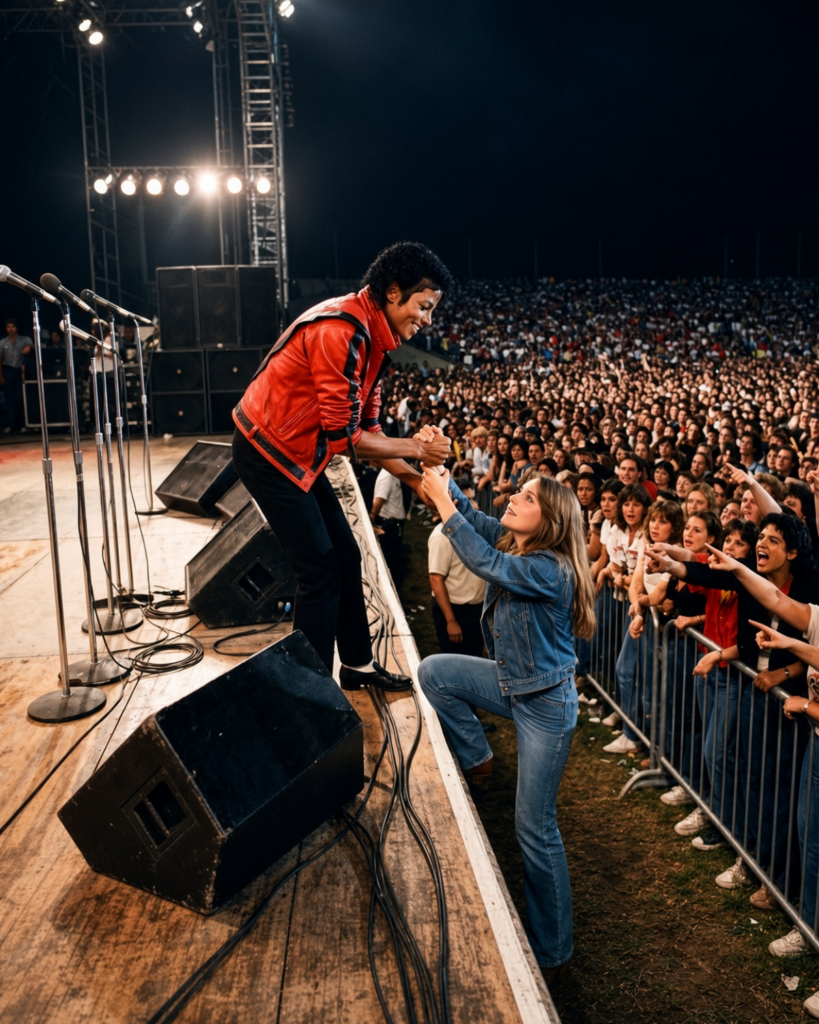
Michael Jackson stopped in the middle of the song.
Not at the end of a verse.
Not on a planned pause.
But right in the middle, with his right hand still raised in the air, and seventy thousand people screaming his name.
The band kept going for two more bars.
Then three.
And then the drummer saw Michael’s hand come down flat, palm to the floor, and he stopped, and the guitar stopped, and the keyboard stopped.
And for the first time all night, the Pontiac Silverdome went quiet.
Seventy thousand people packed into a football stadium outside Detroit, standing on their seats, holding their breath.
Michael walked slowly to the very front edge of the stage in his black buckled jacket and his white socks and his black loafers.
And he stood there under the white spotlight, staring down into the front row.
He wasn’t looking at the crowd.
He was looking at one person.
A little boy, maybe eleven years old, standing in the front row with his hands pressed flat against the metal barrier, eyes closed, not screaming, not singing, not doing anything at all except feeling the silence.
Michael knelt down.
He held out his hand.
And then he did something that seventy thousand people would talk about for the rest of their lives.
He turned to the crowd and he asked them in that soft, high voice to help him.
And what the crowd did next, and what that little boy did after that, is the part of this story that almost nobody knows.
Before we go any further, if you love the untold stories of Michael Jackson and the legends of music, take a second to subscribe and turn on notifications.
It really helps us bring you these stories.
Now, let’s go back to the beginning.
Because the little boy in the front row had not heard a single note of that concert.
Not one.
And he’d been waiting for it his whole life.
His name was Tyler Brooks.
He was eleven years old in the fall of 1988.
And he lived with his mother, his father, and his sixteen-year-old sister, Kesha, in a small white house with green shutters on the north side of Flint, Michigan, about forty miles up the highway from the Silverdome.
Tyler had been born hearing.
His mother liked to remember that when he was a baby, he used to laugh at the sound of the vacuum cleaner.
He’d crawl toward the radio in the kitchen when the Motown station was on.
He said his first word at eleven months, and the word was “Kesha,” because his big sister was the center of his whole world.
Then, when he was four years old, he got sick.
It started like a cold.
A fever, a headache, a stiff neck.
By the second night, the fever was 104, and Tyler wasn’t making sense when he talked, and his father carried him out to the car in his pajamas and drove to Hurley Medical Center through a February snowstorm with the hazard lights flashing.
The doctors said it was bacterial meningitis.
They said he was lucky to be alive.
They were right.
He was very, very sick for three weeks.
And then, slowly, he got better.
But when he came home, he didn’t laugh at the vacuum cleaner anymore.
He didn’t crawl toward the radio.
And the first night back, when Kesha called his name from the doorway of his bedroom, he didn’t turn around.
The meningitis had taken his hearing.
All of it.
The doctors tried hearing aids, big beige ones that squealed, and they didn’t help much.
Tyler could feel very loud sounds, a truck going by, a door slamming, but he couldn’t hear words or music or his sister’s voice.
He lived in a silent world from the time he was four years old.
It could have broken the family.
It nearly did.
His father, Raymond, worked the line at the Buick plant in Flint, and those were hard years in that town.
General Motors was shutting down plants one after another, and tens of thousands of men who’d worked the line their whole lives were getting pink slips.
Raymond held on to his job until 1987, and then his plant closed, too.
By the fall of 1988, he was driving a delivery truck for a bakery at four in the morning for about half of what he used to make, and he came home tired and quiet.
And some nights, he just sat at the kitchen table with a cup of coffee and didn’t say anything at all.
Tyler’s mother, Denise, worked as a cashier at a grocery store.
She learned to sign.
She took a night class at the community college.
So did Raymond, when he could.
But the one who really learned, the one who learned it like it was her own language, was Kesha.
Kesha was seven when Tyler lost his hearing.
She went to the library and checked out every book they had on American Sign Language.
And she practiced in front of the mirror in her bedroom every night.
And when she didn’t understand something, she walked eight blocks to the Flint School for the Deaf and asked the teachers after class until they started letting her sit in.
By the time she was nine, she signed faster than her mother.
By the time she was twelve, she could sign so fast that Tyler’s teachers had to ask her to slow down.
She was her little brother’s voice and his ears and his best friend.
And she was the one who gave him Michael Jackson.
It happened by accident.
It was the winter of 1983, and Tyler was six.
The whole country was going crazy over the “Thriller” album.
And one night, the family was watching television, and the video for “Billie Jean” came on.
Tyler couldn’t hear the song, but he could see Michael.
The way he moved.
The way the sidewalk squares lit up under his feet as he walked.
The way he spun and froze up on his toes and snapped his fingers.
And every single movement of his body landed exactly on something that Tyler couldn’t hear but somehow knew was there.
Tyler got up off the couch and walked right up to the television and put both his hands flat on the side of the wooden cabinet.
The TV speakers were in the cabinet, and through the wood, through his palms, he felt it.
The baseline.
That famous thumping baseline.
The one that walks up and down underneath the whole song like a heartbeat.
He couldn’t hear it, but he could feel it pulsing in his hands.
He turned around and looked at Kesha, and his face was lit up in a way she hadn’t seen since before he got sick.
And he signed with his little hands one word over and over.
“More. More.”
From that night on, Michael Jackson was Tyler’s whole world.
Kesha found out that if they turned the television all the way up and Tyler lay down on the living room floor with his cheek against the carpet, he could feel the bass through the floorboards.
Their mother complained about the noise.
The neighbors complained about the noise.
Kesha didn’t care.
When the family bought a VHS player in 1984, the first tape Kesha bought with her own babysitting money was a tape of Michael’s videos.
Tyler wore it out.
Kesha bought another one.
He wore that one out, too.
He learned every move.
He’d watch the videos with the sound turned all the way up and his bare feet flat on the wooden floor, feeling the beat come up through his soles.
And he’d copy what Michael did, step by step, frame by frame.
Kesha would pause the tape and rewind it and pause it again a thousand times while Tyler worked out exactly how Michael’s feet slid backward in the moonwalk.
He practiced in his socks on the kitchen linoleum.
He practiced on the concrete floor of the basement.
He practiced in the school hallway until a teacher made him stop.
By the time he was ten, Tyler Brooks could do the moonwalk better than anyone in Flint.
Maybe better than anyone in Michigan.
And he had never heard a single note of the music he was dancing to.
Quick pause here, because I want to hear from you.
Before I tell you how Tyler ended up in that front row, tell me in the comments: where were you the first time you saw Michael Jackson do the moonwalk?
If you remember, write it down.
And if you’re enjoying this story, hit that like button.
It really helps.
Now, back to Flint.
In the spring of 1988, the news came over the radio in Kesha’s car that Michael Jackson’s “Bad” tour was coming to the Pontiac Silverdome that fall.
One night only, in October.
Seventy thousand seats.
Kesha was sixteen.
She was working after school and on weekends at a Burger King on Dort Highway, flipping burgers and running the drive-through window for $3.35 an hour.
The tickets were more than she made in a week.
And she needed two of them.
And they had to be good ones.
Up front.
As close to the stage as they could get.
Because Kesha had a plan.
She’d read somewhere that at big stadium concerts, the speakers were stacked so high and so loud that people in the front rows could feel the music hit them in the chest like a wave.
Physically feel it in their ribs and their stomachs and their bones.
And Kesha thought, if she could get Tyler close enough, right up to the stage, right next to those speakers, maybe, just maybe, for the first time since he was four years old, her little brother could feel a whole song.
Not through a TV cabinet.
Not through the living room floor.
Through his whole body.
The real thing.
So she saved every paycheck, every tip, every birthday dollar from their grandmother.
She took extra shifts.
She worked Christmas Eve.
She skipped the junior prom because a dress would have cost as much as a ticket.
When the tickets went on sale in the summer, she took the bus to the Hudson’s department store in downtown Detroit at four in the morning and stood in line on the sidewalk for seven hours in the rain.
And she came home soaking wet with two tickets in the third row on the floor, right in front of the stage.
She didn’t tell Tyler.
She wanted it to be a surprise.
On his eleventh birthday in August, she gave him a small box wrapped in newspaper.
Inside was a single white glove.
A cheap one from the dime store, with sequins she’d sewn on by hand, one at a time, over three weeks.
And under the glove were two tickets.
Tyler looked at the tickets.
He looked at Kesha.
Then he burst into tears and threw his arms around her and held on so hard she couldn’t breathe.
When he finally let go, he signed something to her.
She never forgot it.
“Will I be able to feel him?”
And Kesha, who didn’t know the answer, signed back the only thing she could.
“We’re going to find out.”
Now, let me tell you about the man on the other side of that stage.
Because in October of 1988, Michael Jackson was not doing as well as seventy thousand screaming people might have thought.
He was thirty years old.
He’d turned thirty in August, on the road.
He was the most famous entertainer on earth.
The “Thriller” album had become the bestselling album of all time.
The “Bad” album had just given him five number-one singles in a row, something nobody in history had ever done.
The “Bad” tour was the biggest tour the world had ever seen.
He’d played Japan, Australia, all over Europe, and now America.
More than four million people would see it before it was over.
Every night, stadiums full of people screamed his name like he was something more than a man.
But the tour had been going on for more than a year, and Michael was tired.
More tired than he’d ever been in his life.
His voice was strained from singing two hours a night.
His feet were blistered and bleeding inside his loafers from all the spinning.
He was sleeping three or four hours a night in hotel rooms that all looked the same.
He’d been in a different city almost every other day for months.
And there was a loneliness that had followed him around for most of his life, and that he’d never really known how to shake.
People who knew Michael well said that the real trouble was simple.
He’d never had a childhood.
He’d been born in 1958 in Gary, Indiana, in a tiny two-bedroom house on Jackson Street, the seventh of nine children.
His father, Joseph, worked at a steel mill and played guitar in a band that never made it.
And when he saw that his sons could sing, he decided they would make it instead.
He rehearsed them for hours every day after school.
Strictly.
Sometimes harshly.
Michael was five years old when he started singing with his brothers.
He was eleven when the Jackson 5 had their first number-one hit for Motown.
And from that point on, his whole life was studios and stages and hotel rooms.
He used to say that he’d look out of the window of the recording studio at the park across the street and watch other kids playing, and wish more than anything that he could go out there and play with them.
But Michael also remembered one good thing from that tiny house in Gary.
He almost never told anybody about it.
The house on Jackson Street was so small that the whole family rehearsed in the living room, and the floor of that living room was old, thin wooden boards.
When his brother Jermaine played the bass guitar, the vibration went down through the amplifier and into the floor.
And little Michael, five years old, would sometimes take his shoes off during rehearsal and stand in his bare feet on those boards and feel the bass coming up through the wood into his feet and his legs and his stomach.
It made him want to move.
It told his body exactly when to step.
He said later that was how he learned to dance.
Not by listening.
By feeling it through the floor.
He told that story to one interviewer once, in the early 1980s, and then never told it again.
On the afternoon of the Silverdome show, Michael did the sound check at four o’clock, the way he always did.
He walked the whole stage in his socks, testing the floor.
He sang a few lines of every song.
He talked to the lighting crew and the sound crew and made small, specific adjustments.
A little more of this, a little less of that.
The way a man tunes a very expensive instrument.
The sound engineers had set up the speaker stacks on both sides of the stage.
Towering walls of black boxes, and a row of big subwoofers right along the front edge of the stage, pointed straight out at the first few rows.
When the bass hit, you could feel it in the concrete fifty yards away.
Then Michael went back to his dressing room and lay on a couch with a cold towel over his eyes for an hour and didn’t talk to anybody.
At eight o’clock, the doors opened.
Kesha and Tyler had gotten there at noon.
They’d taken the bus from Flint with a thermos of hot chocolate and peanut butter sandwiches their mother had packed.
They waited in the parking lot for six hours in the October wind with thousands of other fans.
When the doors opened, Kesha held Tyler’s hand so tight her knuckles went white, and they hurried in and down onto the floor and found their seats in the third row.
Then, before the show even started, something lucky happened.
A security guard, a big man with a gray beard, saw Tyler’s hearing aids and saw Kesha signing to him and walked over and asked her about it.
When she explained, he looked at Tyler for a long moment, then waved them both forward to the front row, right up against the metal barrier, right in front of the subwoofers.
“Keep him right here,” the guard told Kesha.
“Right on this rail. And if anybody gives you trouble, you find me. My name’s Earl.”
Kesha thanked him about fifteen times.
Earl just nodded and went back to his post.
He said later he had a nephew who was deaf.
Tyler stood at the barrier in the sequined glove that Kesha had made him and put both his hands flat on the cold metal rail and waited.
At nine o’clock, the lights went out.
Seventy thousand people screamed at once.
Kesha said it was like standing inside a jet engine.
And then the music started, and Tyler Brooks felt it.
The first beat came out of the subwoofers and hit him in the chest like a hand shoving him backward.
He actually stumbled.
Kesha grabbed his arm.
His eyes went huge.
And then the next beat hit, and the next, and he could feel it everywhere.
In his ribs, in his stomach, in his teeth, coming up through the concrete floor into the bottoms of his sneakers, buzzing through the metal rail into his palms.
It was a hundred times more than the living room floor.
A thousand times more.
It was like the whole stadium had a heartbeat, and he was standing inside it.
He turned and looked at Kesha.
He was crying.
She was crying, too.
He signed something to her.
Fast, clumsy, his hands shaking.
“I can feel it. I can feel it. I can feel all of it.”
And then the lights came up, and there was Michael Jackson.
Before I tell you what happened at that barrier an hour later, do me a favor.
If you’ve made it this far, hit that like button and tell me in the comments where you’re watching from.
I read every one.
All right, here’s where it happens.
For the next hour, Tyler Brooks had the night of his life.
He couldn’t hear the words.
He couldn’t hear Michael’s voice.
But he could feel every beat of every song.
And he could see Michael forty feet away, moving exactly on every one of them.
And for the first time, Tyler understood what he’d been missing all those years.
The dancing wasn’t just dancing.
Every move Michael made was the music turned into a body.
When the bass hit, Michael’s shoulder snapped.
When the drums cracked, his foot kicked out.
When the music dropped away, he froze.
Tyler could see it and feel it at the same time.
And the two things fit together perfectly, like a key in a lock.
He danced right there at the barrier.
He couldn’t help it.
Kesha had to keep hold of his shirt so he didn’t bump into the people next to them.
And the people next to them, a couple of college girls from Ann Arbor and a big man in a Detroit Lions jacket, stopped watching the stage after a while and started watching Tyler instead.
Because the little boy in the sequined glove was dancing every single step perfectly, exactly with Michael, beat for beat, like he’d been rehearsing with him for years.
And in a way, he had.
Michael saw him, too.
It’s hard to see individual faces from a big stadium stage.
The lights are in your eyes.
The crowd is a blur.
But the front row is different.
The front row is close.
And about forty minutes into the show, during a song called “The Way You Make Me Feel,” Michael spun toward the front of the stage and caught sight of a small boy in a homemade sequined glove doing the exact same spin at the exact same moment, right below him.
Michael smiled.
He did the next move.
The boy did it, too.
Michael did a quick little turn and a kick that wasn’t in the usual choreography, just to see.
The boy did it half a beat later.
Perfectly.
Michael laughed right there in the middle of the song.
You can hear it on bootleg recordings of that show if you listen closely.
A little surprised laugh right between two lines.
And he kept watching.
Over the next few songs, he kept glancing down at that front row.
And after a while, he noticed something else.
The boy never sang along.
Everyone else in the front row was singing, screaming out every word.
The boy’s mouth never moved.
And a teenage girl standing next to him wasn’t singing either.
She was doing something with her hands.
Fast, graceful shapes right in front of the boy’s face.
All through every song.
Never stopping.
It took Michael a few minutes to realize what he was looking at.
And when he did, something in his chest turned over.
She was signing.
She was signing the words of his songs.
Every line.
For her little brother.
And the little brother was dancing perfectly to music he couldn’t hear.
Then came the moment that changed the night.
Michael started a slow song.
“Man in the Mirror.”
It was near the end of the show.
The stadium lights went down low, and seventy thousand people held up lighters, and the whole Silverdome filled up with tiny flickering flames.
It was the most beautiful moment of every show, and Michael usually sang it with his eyes closed.
But that night, Michael kept his eyes open.
And halfway through the first verse, he looked down at the front row, and he saw the boy standing absolutely still.
Not dancing now.
Just standing there with both hands flat on the metal rail and his eyes closed and tears running down his face.
Because it was a slow song, and the bass was soft, and the beat was gentle, and he couldn’t feel it anymore.
Not through the rail.
Not through the floor.
The music had gone somewhere he couldn’t follow, and the boy was standing there in the dark, surrounded by seventy thousand people and seventy thousand lighters, all alone in the silence.
His sister was still signing to him, but he had his eyes closed.
He couldn’t see her.
Michael Jackson stopped singing.
He stopped in the middle of the line.
He raised his hand, and then brought it down flat, palm to the floor.
And the band, confused, trailed off one instrument at a time until there was nothing.
The lighters kept flickering.
Seventy thousand people went quiet, wondering if something was wrong.
Backstage, his manager grabbed a headset and asked what was happening.
Nobody knew.
Michael walked slowly to the very front edge of the stage.
He stood there for a moment under the single white spotlight, looking down.
Then he knelt.
In the front row, Kesha saw him coming.
She saw where he was looking.
She grabbed Tyler’s arm hard, and he opened his eyes.
And there was Michael Jackson on one knee, six feet above him, looking straight down at him, holding out his hand.
Tyler didn’t move.
He couldn’t.
Michael leaned toward the microphone, his voice soft and high, and it went out over the silent stadium.
“What’s his name?”
He was asking Kesha.
She was so stunned she couldn’t answer at first.
The man in the Lions jacket leaned over and yelled it for her.
“She says, ‘Tyler.’ His name’s Tyler.”
“Tyler,” Michael said into the microphone.
Seventy thousand people heard it.
“Can you bring Tyler up here to me, please?”
Earl, the big security guard with the gray beard, was already moving.
He reached over the barrier, lifted Tyler up under the arms like he weighed nothing, and passed him up to Michael.
And Michael Jackson took the little boy’s hands and pulled him up onto the stage.
Then he looked back down at Kesha.
“You, too,” he said.
“Please. I need you, too.”
Earl lifted her over.
And now, before I tell you what happened on that stage, I have to ask you something.
If you were in that stadium, standing there with your lighter in the air, what would you be thinking right now?
Tell me in the comments.
And if this story is hitting you the way it hit me, share it with somebody.
All right, let’s go up on that stage.
Tyler Brooks stood on the stage of the Pontiac Silverdome in his sneakers and his homemade glove and looked out at seventy thousand people and seventy thousand flickering lighters, and he shook from head to toe.
Kesha stood next to him with her arm around his shoulders.
She was shaking, too.
Michael knelt down in front of Tyler so their eyes were at the same level.
Then he looked up at Kesha.
“He’s deaf,” Michael said quietly, away from the microphone.
“Yes,” Kesha said.
“Since he was four. Meningitis. And he feels the music through the floor.”
Kesha stared at him.
“How did you know that?”
Michael didn’t answer right away.
He looked at Tyler for a long moment.
Then he said, very softly, “Because I used to do it, too. When I was little.”
Kesha didn’t understand.
She’d remember those words for the rest of her life, and it would be years before she found out what he meant.
“Can you tell him something for me?” Michael asked.
“Can you sign it?”
Kesha nodded.
“Tell him I saw him dancing. Tell him he’s the best dancer I’ve seen in the whole world, on this whole tour. Every city. Tell him that.”
Kesha signed it.
Her hands were shaking so badly she had to do it twice.
Tyler watched her hands, and then he looked at Michael, and then his face crumpled up and he started crying again.
And Michael reached out and put his arms around him and held him right there on his knees at the edge of the stage while seventy thousand people watched in total silence.
Then Michael stood up.
He took Tyler’s hand.
He walked him back to the center of the stage, right on top of the spot where the stage floor sat over the biggest speakers.
And he did something nobody on his crew had ever seen him do.
He sat down on the floor of the stage, crossed his legs, and started taking off his shoes.
The black loafers first.
Then the white socks with the sequins.
He set them neatly to one side, and he sat there on the stage of the Pontiac Silverdome in his bare feet.
Then he looked up at Tyler and pointed at Tyler’s sneakers.
And Kesha, understanding, signed to her brother.
Tyler sat down right there and pulled his sneakers off and his socks and set them next to Michael’s.
And the two of them, the most famous man on earth and an eleven-year-old boy from Flint, stood up together, barefoot on the wooden stage, facing each other.
Michael turned to the band.
He pointed at the bass player.
“Just you,” he said.
“Just the bass. ‘Billie Jean.’ Slow.”
The bass player, who’d been with Michael for years, looked at him for a second.
Then he nodded and started to play.
Just the baseline alone.
That famous walking line, the one that goes up and down like a heartbeat.
Nothing else.
No drums.
No keyboards.
No voice.
And because the stage floor sat right on top of the speakers, the whole stage started to vibrate with it.
Softly at first.
Then stronger, as the sound engineer, catching on, slowly pushed the bass up and up.
Michael put both his bare feet flat on the floor.
He closed his eyes, and he stood completely still, and felt it.
Tyler watched him.
Then Tyler closed his eyes, too.
And the bass came up through the stage floor into the soles of his bare feet and up his legs and into his stomach and his chest.
The same way it had come up through the living room floor when he was six years old.
The same way it had come up through the floorboards of a tiny house in Gary, Indiana, into the feet of a five-year-old boy twenty-five years earlier.
Tyler opened his eyes.
He was smiling.
And he started to dance.
He did the “Billie Jean” dance.
The whole thing.
The way he’d learned it from a worn-out VHS tape a thousand times, frame by frame, on a kitchen floor in Flint.
The shoulder snaps.
The kicks.
The spin up onto his toes.
And the freeze.
And then, right on the beat, he slid backward across the stage in a perfect, smooth, gliding moonwalk, his bare feet sliding over the vibrating wooden floor like it was made of ice.
Michael watched him with his mouth open.
Then Michael started to dance, too, right beside him.
Barefoot.
Not performing.
Not the big stadium show.
Just dancing.
Following Tyler.
Mirroring him.
And for about ninety seconds, on a stage in the middle of a silent football stadium, the King of Pop and a deaf eleven-year-old boy danced the same dance side by side, perfectly together, to a baseline only one of them could hear.
Seventy thousand people watched in total silence.
Nobody screamed.
Nobody cheered.
They just watched.
People said later it was the quietest they’d ever heard a stadium.
You could hear the baseline echoing off the roof of the dome.
You could hear the soft slap of bare feet on the stage.
Kesha stood off to one side where Michael had left her with both hands over her mouth.
When the baseline ended, Tyler froze on his toes, one hand up in the sequined glove, exactly the way Michael froze at the end of “Billie Jean.”
And Michael, beside him, froze in the exact same position.
And they held it there.
Both of them.
Perfectly still.
And the Silverdome exploded.
It was the loudest sound anybody who was there had ever heard.
Seventy thousand people on their feet at once, screaming, crying, stomping, cheering for a little boy nobody had ever heard of.
It went on and on.
Michael’s crew said later that the sound meters in the mixing booth went off the chart.
The roof of the dome seemed to shake.
And in the middle of all of it, Tyler Brooks stood there on the stage in his bare feet, looking out at the crowd.
And he couldn’t hear any of it.
Michael saw it.
He saw Tyler looking out at all those people, seeing them jump and scream and wave their arms and not hearing a thing, only watching from behind a glass wall.
Michael’s face changed.
He walked back to the microphone, and he held up both hands, and slowly, gradually, the stadium quieted down.
“Everybody,” Michael said.
“Everybody, listen to me. Tyler can’t hear you. He can’t hear you cheering for him. But he can feel you. So, I want you to help me. I want everybody, all of you, every single person in this stadium, I want you to stomp. Stomp your feet with me. Together. Like a heartbeat. So Tyler can feel how much you love him.”
And he started to stomp.
Slowly.
One, two.
One, two.
His bare feet hitting the wooden stage.
At first, just the front rows did it.
Then the floor seats.
Then the lower bowl.
Then the upper deck.
All the way up to the top of the dome.
One, two.
One, two.
Seventy thousand people stomping their feet on concrete and steel, all at the same time, all together, slow and steady, like one enormous heartbeat.
And the whole stadium shook.
People who were there said you could feel it in your whole body.
The floor was shaking.
The seats were shaking.
The walls were shaking.
The Silverdome was built to hold eighty thousand people in a football game, and it had never shaken like that.
One, two.
One, two.
It was so strong that it came up through the steel frame of the stage and into the soles of Tyler’s bare feet like an earthquake.
Tyler’s eyes went wide.
He put his hand on his own chest.
He looked down at the stage, then up at the crowd, then down at his own feet again.
Then he looked at Kesha, and he signed something to her.
Slowly, this time.
Kesha started to sob so hard she couldn’t breathe.
Michael looked over at her.
“What did he say?” he asked quietly.
Kesha had to take a breath before she could answer.
“He said, ‘It feels like they’re all inside my heart.'”
Michael Jackson turned away from the crowd for a second so nobody would see his face.
When he turned back, his eyes were wet.
He knelt down in front of Tyler one more time, and then he did something that nobody in that stadium expected.
He raised his hands, slowly and a little awkwardly, and made a shape with them, then another, then another.
He’d watched Kesha signing for nearly an hour from the stage, and he’d picked up one or two things the way he picked up dance moves, just from watching.
He signed, clumsily but clearly, two words.
“Thank you.”
Tyler Brooks threw his arms around Michael Jackson’s neck and didn’t let go.
And seventy thousand people kept stomping.
One, two.
One, two.
The heartbeat of the whole stadium, for a little boy who could only feel them.
Michael finished the show that night.
He put his socks and loafers back on, and he sang “Man in the Mirror” from the beginning.
But he did something he’d never done before on that tour.
He had Tyler and Kesha sit right on the stage at the side, on two folding chairs a stagehand brought out, for the whole rest of the concert.
And during every song, every few minutes, he’d dance over to that side of the stage and look over at the boy in the sequined glove and give him a little nod.
And during “Man in the Mirror,” when he got to the part of the song where the choir comes in, he walked over, took Tyler by the hand, brought him to the front of the stage, and stood there with his hand on Tyler’s shoulder until the song was over.
And Kesha, sitting on the folding chair at the side of the stage, signed every word of the song to her little brother with seventy thousand people watching her hands.
If this is the part that got you, and it got me the first time I heard it, write “heartbeat” in the comments so I know.
And if you haven’t subscribed yet, now’s the time, because we’re not done.
What happened backstage after the show is the part that almost nobody knows.
After the last song, after the fireworks and the final bow and the crowd filing out into the cold October night, Earl, the security guard, walked Kesha and Tyler back through a long concrete tunnel under the stadium to a door with a star on it.
Michael was sitting on a couch inside with a towel around his neck.
His face was still shining with sweat.
He’d changed into a red shirt, and he had his bare feet up on a little stool with bags of ice on them.
When he saw them come in, he took the ice off his feet and stood up.
For a minute, nobody said anything.
Tyler stood in the doorway holding Kesha’s hand, staring.
Then Michael crouched down and held out his arms, and Tyler ran into them.
They stayed for almost an hour.
There wasn’t much talking at first.
Michael didn’t know sign language, and Kesha had to translate everything.
But after a while, Michael asked Kesha to teach him, so she did.
She taught him the alphabet.
She taught him “hello” and “friend” and “music” and “dance.”
Michael picked it up fast.
Faster than she’d have believed.
The same way he’d picked up every move he ever learned.
He’d watch her hands once and then do it perfectly.
Within half an hour, he was spelling out words to Tyler with his fingers, slowly, and laughing out loud every time he got one right.
Then Kesha asked him the question she’d been wanting to ask since the stage.
“You said you used to feel it, too,” she said.
“The music. Through the floor. When you were little. What did you mean?”
Michael was quiet for a moment.
He sat back down on the couch.
Tyler sat on the floor next to his feet.
“When I was little,” Michael said, “we lived in a very small house in Gary, Indiana. Two bedrooms. Nine kids. We rehearsed in the living room every day, all of us, with my father. And my brother Jermaine played bass. And the floor was old, thin wood. When he played, you could feel it come up through the boards. I used to take my shoes off and stand there in my bare feet.”
He smiled a little.
“My father didn’t like that. He said it wasn’t professional. But I’d do it anyway, because when I could feel the bass in my feet, my body just knew what to do. I didn’t have to think. It was like the floor was telling me how to move.”
He looked down at Tyler.
“I’ve been dancing for twenty-five years,” he said, “in front of millions of people all over the world. And tonight, when I saw him standing there with his hands on that rail, trying to feel the music in the slow song and not being able to, I thought, ‘That’s me. That’s me in that living room in Gary.’ And I couldn’t just keep singing. I couldn’t.”
Kesha signed it to Tyler.
Tyler listened with his eyes.
Then he stood up, walked over to Michael, and put his small hand flat against Michael’s chest, over his heart, and he held it there.
Michael looked at Kesha, confused.
Kesha laughed through her tears.
“That’s what he does,” she said.
“That’s how he listens to people he loves. He feels their heart.”
Michael Jackson sat very still on the couch with a little boy’s hand on his chest.
He didn’t say anything for a long time.
Before they left, Michael did two things.
First, he took the white sequin glove off Tyler’s hand.
The homemade one that Kesha had sewn over three weeks.
He looked at it for a long moment, running his thumb over the uneven stitches.
Then he asked Kesha if he could keep it.
She said yes.
And from a bag on the counter, he took one of his own gloves, one of the real ones, covered in hand-sewn crystals, and put it on Tyler’s hand.
It was much too big.
Tyler didn’t care.
Second, he asked Kesha about their family.
How they’d gotten to the show, what their parents did.
And Kesha, who was sixteen and didn’t know how to lie to Michael Jackson, told him the truth.
About the Buick plant closing.
About their father driving a bakery truck at four in the morning.
About the Burger King and the seven hours in the rain for the tickets and the skipped prom.
Michael listened to all of it without saying anything.
When she finished, he asked for their address.
She wrote it down on a paper napkin.
It was almost one in the morning when Earl walked them back out through the tunnel.
The parking lot was nearly empty.
The last bus back to Flint had left an hour and a half earlier.
Kesha stood on the curb in the cold wind with her little brother, who was wearing a crystal glove three sizes too big and holding his sneakers in his other hand because he still didn’t want to put them back on.
And she realized they had no way to get home.
Earl saw her face.
He didn’t ask.
He just walked them to his own car, an old brown Oldsmobile with a cracked windshield, and drove them the forty miles up the highway to Flint himself.
Tyler fell asleep in the back seat before they’d even left the parking lot, with his bare feet up on the seat and the glove pressed against his cheek.
Kesha sat up front and couldn’t stop talking.
She told Earl everything.
The Burger King, the seven hours in the rain, the sequins she’d sewn on one at a time.
Earl drove and listened and nodded and didn’t say much.
When they pulled up in front of the little white house with the green shutters, every light in the house was on.
Their mother and father had been sitting up.
They’d been worried sick.
There were no cell phones in 1988, and the kids were four hours late.
And Raymond had been about to get in his truck and drive down to Pontiac to look for them.
When the Oldsmobile pulled up, he came out onto the front porch in his undershirt and his work boots, ready to be angry.
Then Earl got out of the car and opened the back door and lifted a sleeping eleven-year-old boy out of the back seat, with a crystal glove on one hand and his bare feet dangling, and carried him up the walk.
“Your boy,” Earl said, handing Tyler to his father, “danced with Michael Jackson tonight in front of seventy thousand people. Barefoot. I’ve been doing security for nineteen years, sir, and I never saw anything like it in my life. You ought to be real proud.”
Raymond Brooks stood there on his front porch in the cold, holding his sleeping son, and looked at the glove, and looked at Earl, and looked at Kesha, who was standing on the walk behind him, crying and laughing at the same time, and he didn’t say anything at all.
He just nodded and held Tyler a little tighter.
Kesha told her parents the whole story at the kitchen table until almost four in the morning.
Her mother cried at the part about the slow song.
Her father didn’t cry.
He just sat there turning his coffee cup around and around in his hands.
And when Kesha got to the part about seventy thousand people stomping their feet so Tyler could feel them, he got up from the table without a word and went out on the back porch and stood there alone in the dark for a long time.
Denise went out to check on him after a while.
She found him standing at the porch railing, looking up at the sky.
“Ray?” she said.
“Seven years,” he said, without turning around.
“Seven years I’ve been trying to figure out how to talk to that boy. Night classes. Books. I’m no good at it. My hands are too slow. I get the signs wrong and he laughs at me. And some nights I come home from that truck so tired I can’t even try.”
His voice broke.
“And some man he never met figured it out in five minutes. Took off his shoes and found him right there on the floor.”
Denise put her arms around him from behind and held on.
“Then take off your shoes,” she said quietly.
The next Saturday morning, Raymond Brooks came downstairs, took the big speaker out of the living room stereo cabinet, and set it face down on the kitchen floor.
He put on one of Tyler’s Michael Jackson records.
Then he took off his work boots and his socks and stood there on the linoleum in his bare feet, a forty-four-year-old man who’d worked the line at Buick for twenty-two years, feeling the bass come up through the floor.
And when Tyler came downstairs in his pajamas and saw his father standing there barefoot in the kitchen with his eyes closed, trying to feel the music, he stopped on the bottom step and stared.
Then he took off his own socks and walked over and stood next to him.
They danced together in that kitchen every Saturday morning for the next six years.
Raymond was a terrible dancer.
Tyler never once told him so.
Three weeks later, a package arrived at the little white house with green shutters in Flint.
Inside, there was a letter for Kesha and a letter for Tyler, and a smaller envelope addressed to Mr. and Mrs. Raymond Brooks.
The letters for the kids were handwritten, with a few little drawings in the margins.
And Tyler’s letter had the words “friend” and “dance” spelled out in tiny drawings of sign language hands.
The envelope for the parents had a letter from a scholarship fund set up in Tyler and Kesha’s names that would pay for both of them to go to college, wherever they wanted, whenever they were ready.
Raymond Brooks read the letter at the kitchen table at five in the morning when he came back from his first bakery run.
Denise found him sitting there an hour later, still holding it, with his coffee gone cold.
He’d been a line worker for twenty-two years.
He’d been a proud man his whole life.
He’d never once taken charity.
And he sat there at the kitchen table with that letter and cried like a little boy.
Before we get to how this story ends, if you’ve stayed with me this long, you’re one of the real ones.
Hit subscribe if you haven’t already, and write “Tyler” in the comments so I know you made it all the way here.
Now, let me tell you what happened next.
Kesha Brooks went to college in 1990.
She studied deaf education at Gallaudet University in Washington, D.C., the most famous university for the deaf in the world, and she graduated with honors.
She became a sign language interpreter.
For more than twenty years, she worked at concerts and theaters all over the Midwest, standing at the side of the stage under a little spotlight, signing every song for the deaf fans in the front rows.
People who saw her work said she didn’t just sign the words, she signed the music.
The rhythm.
The feeling.
With her whole body.
She said she’d learned that from watching Michael Jackson dance.
And Tyler?
Tyler Brooks never stopped dancing.
He went to college, too, on the scholarship, and then he moved to Detroit.
And in 1999, he opened a small dance studio in an old storefront on the east side.
It was a studio for deaf and hard-of-hearing kids.
He built the floor himself, out of wooden planks set on top of a row of big speakers.
So the whole floor vibrated with the music.
The kids who came to his studio took off their shoes at the door and danced barefoot on that floor, feeling every beat through the soles of their feet.
Some of them had never danced before in their lives.
Some of them had been told by other teachers that deaf kids couldn’t dance.
Tyler told every one of them the same thing on their first day.
He’d put his hand flat on his chest, and then flat on the floor, and then he’d sign it slowly.
“You don’t need to hear it. You need to feel it.”
Over the years, hundreds of kids learned to dance on that floor.
A few of them went on to dance professionally.
One of them danced in a Broadway show.
Tyler kept the big crystal glove in a glass case on the wall of the studio, right by the door, where every kid could see it on the way in.
Michael Jackson and Tyler Brooks stayed in touch, on and off, for years.
Letters, mostly.
A few phone calls, with Kesha interpreting.
Whenever Michael played in Detroit, there were two tickets waiting at the box office in Tyler’s name.
In the letters, Michael would sometimes sign his name with a tiny drawing of two bare feet.
On June 25th, 2009, Michael Jackson died in Los Angeles.
He was fifty years old.
Tyler found out on a Thursday afternoon in the middle of teaching a class.
One of the parents came in the door with her phone and her face white and showed him the news.
Tyler stood there in the middle of his studio for a long time with twelve kids watching him, not knowing what to do.
Then he walked over to the sound system and put on “Billie Jean” and turned the bass all the way up.
He took off his shoes.
He stood in the middle of the vibrating wooden floor with his bare feet flat and his eyes closed.
And one by one, without anybody telling them to, the twelve kids in his class took off their shoes, too, and came and stood around him in a circle and put their feet flat on the floor and closed their eyes.
They stood there together for the whole song.
Not dancing.
Just feeling it.
Then, when the song ended, Tyler opened his eyes and began to stomp.
Slowly.
One, two.
One, two.
And the kids joined in.
One, two.
One, two.
Like a heartbeat.
Years later, a reporter from a Detroit newspaper came to Tyler’s studio to write a story about it.
She asked him, with Kesha interpreting, what he remembered most about that night at the Silverdome.
The dance, the crowd, Michael pulling him up onto the stage.
Tyler thought about it for a long time.
Then he signed his answer, and Kesha spoke it out loud.
“People always ask about the moonwalk,” he said.
“Or the crowd stomping. And that was amazing. I still feel it sometimes when I close my eyes. But what I remember most is the moment before all that. When I was standing at the rail during the slow song and I couldn’t feel anything anymore, and I closed my eyes because I didn’t want Kesha to see me cry. I was alone. Seventy thousand people all around me, and I was completely alone. That’s what it’s like sometimes, being deaf. You can be in the biggest room in the world and be all by yourself.”
He was quiet for a moment.
“And then I opened my eyes,” he said, “and he’d stopped the whole show. For me. The biggest star in the world stopped seventy thousand people because he saw one kid in the dark who couldn’t hear him. And he didn’t just pull me on stage. He took his shoes off. He came down into my world instead of making me come up into his. Nobody had ever done that for me before. Not like that. He found a way to talk to me in my own language. Through the floor. Through the feet. Through the heart.”
Tyler put his hand flat on his chest.
“That’s what I try to do for every kid who walks into this room,” he said.
“That’s all. Find a way into their world, the way he found a way into mine.”
Kesha finished interpreting, and then just stood there for a second before she added something of her own.
“You know what I think about?” she said.
“I think about him saying, ‘I used to do it, too. When I was little.’ I didn’t understand it that night. It took me years. I think that’s why he saw Tyler out of seventy thousand people. Because Tyler was doing the exact same thing he used to do on the floor of that little house in Gary. Standing in his bare feet, trying to feel the music. I think when Michael looked down from that stage, he wasn’t just seeing my brother. He was seeing himself. The little boy he used to be. The one who never got to be a kid.”
She wiped her eyes.
“And for a few minutes, on that stage, barefoot, dancing, I think they both got to be kids together.”
That’s the story of the night Michael Jackson stopped his concert and pulled a little boy out of the crowd.
Seventy thousand people saw a deaf child moonwalk across a stage in his bare feet, and a whole stadium stomp like a heartbeat, and the King of Pop sign two clumsy words with his hands.
But the real story was never about the show.
It was about a man who remembered what it felt like to be alone in a crowd, and who, for one night, stopped everything to make sure a little boy wasn’t.









