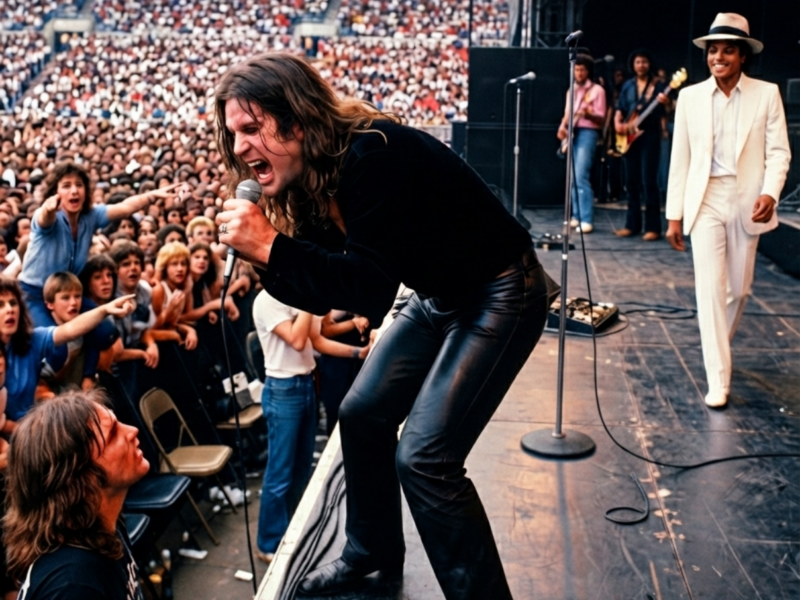
Michael Jackson SHOWED UP at Ozzy Osbourne’s Concert — What Happened SHOCKED 70,000 People.
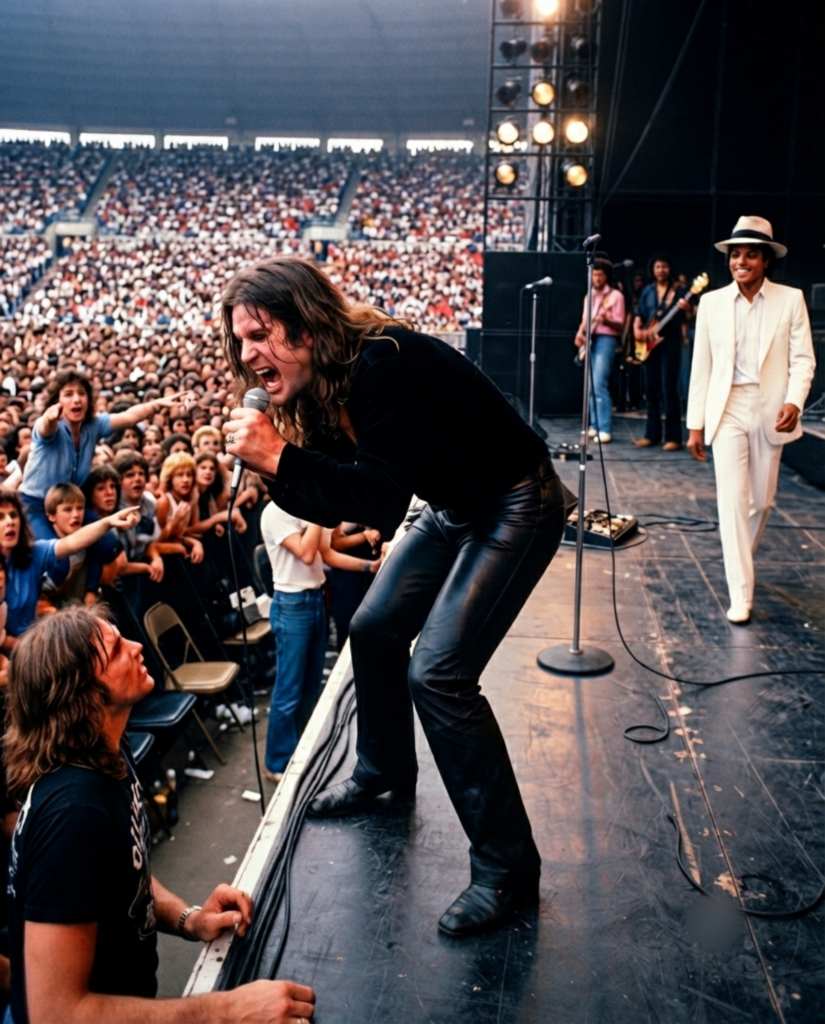
July 1988.
Deep summer.
The kind of heat that hangs over a city and doesn’t leave even after the sun’s long gone down.
JFK Stadium, Philadelphia, packed wall-to-wall with 70,000 people who’d come out for one of the biggest rock shows of the year.
Ozzy Osbourne was 39 that summer, riding a run most performers could only dream about.
He’d already survived the Black Sabbath years.
Already survived the tabloid headlines.
Already built himself into a solo career that had somehow outgrown even the band that made him famous in the first place.
That night’s show was part of a short stretch of stadium dates.
Big open-air gigs that Ozzy actually loved, unlike some of the arena tours where the walls felt too close and the crowd too contained.
Give him a wide-open field and 70,000 people screaming under a summer sky, and something in him lit up that never quite lit up the same way indoors.
“I like a crowd I can’t see the edges of,” Ozzy told his band before the tour kicked off.
“Feels like the whole world showed up instead of just one town.”
Nobody in that stadium, least of all Ozzy himself, had any idea that before the night was over, he’d be sharing that stage with one of the biggest pop stars on the entire planet.
If you already love Ozzy Osbourne, hit that subscribe button because this story is a wild one.
Michael Jackson was 29 that summer, deep in the middle of the Bad Tour.
The record that had somehow followed Thriller without falling apart under the weight of expectation.
He was by any measure the single biggest entertainer in the world at that exact moment.
And everybody knew it.
Stadiums sold out in minutes.
Kids in every country on Earth knew the moonwalk.
Michael had built his whole career on precision, on control, on giving audiences exactly the polished, perfect show they’d paid to see.
What most people didn’t know was that Michael had grown up with a strange, private love for hard rock and heavy guitar music.
Tucked away behind all the sequins and choreography that defined his public image.
He’d spent long nights back at Hayvenhurst, listening to records that surprised his own family.
Guitar-driven stuff.
Loud stuff.
Stuff that had nothing to do with Motown or the smooth soul he’d grown up performing since he was a little kid in Gary, Indiana.
“There’s something about that kind of music,” Michael told a close friend once, “that just doesn’t care what anybody thinks of it. I’ve never been allowed to not care what people think. Maybe that’s why I love it so much.”
That July, Michael was in Philadelphia for a stretch of his own tour dates.
A few days off, wedged between shows.
His assistant mentioned, almost in passing, that Ozzy Osbourne was playing JFK Stadium that Saturday night.
Michael sat with that a moment, something flickering behind his eyes his assistant couldn’t quite read.
“Get me tickets,” he said.
“Not backstage. Just tickets. I want to actually watch the show.”
His assistant looked at him carefully.
“You want anybody to know you’re there?”
“No,” Michael said.
“For once, I just want to watch somebody else be the show.”
This next part is where the whole night takes a turn.
Nobody in that stadium expected it, so stick with me.
He arrived quiet, dressed down about as much as Michael Jackson ever dressed down.
A plain baseball cap pulled low.
Sunglasses.
A simple black jacket instead of anything with a single sequin on it.
He had a seat about 15 rows back, close enough to see everything clearly, far enough that in a crowd that size, most people were too busy watching the stage to notice one more face in the dark.
He sat alone.
No entourage.
Nobody flanking him the way they usually did wherever he went.
It felt strange, he’d admit later, sitting in a crowd without anybody managing the space around him.
Without a single person checking to see if he was comfortable or recognized or safe.
Just a man in a plain jacket waiting for a show to start, same as everybody else around him.
Ozzy opened the show the way he always did.
Loud and chaotic and completely without pretense.
Pulling 70,000 strangers into something that felt more like one huge sweaty party than a carefully staged production.
He told stories between songs about growing up dirt poor in Birmingham.
About working in a slaughterhouse before any of this.
A story the crowd ate up the same way crowds always did, no matter how many times he told it.
“Now, I know some of you lot have heard this one before,” Ozzy said, grinning out at the sea of faces stretching back into the dark.
“But I promise you, every word’s true, and I’ll keep telling it till the day I die, because it reminds me exactly where I came from.”
Michael, sitting 15 rows back, found himself smiling without quite meaning to.
There was something about Ozzy’s voice, about the roughness of him, that cut straight through all the noise of a stadium show and landed somewhere real.
He hadn’t expected that.
He’d expected chaos.
Expected the kind of wild theatrics his own team’s careful choreography could never quite touch.
What he got instead felt more like standing in somebody’s garage while they told you their whole life story.
Except that garage happened to hold 70,000 people.
Ozzy tore through his biggest songs, the crowd roaring along on every riff, and by the middle of the set, the whole stadium was on its feet, fists pumping, screaming every word.
Michael found himself moving to the music too.
Quiet.
Half surprised at how much he actually knew of it from those late nights alone at Hayvenhurst.
Then, about an hour in, Ozzy slowed things down.
The band eased into something heavier but more deliberate, and Ozzy stepped up to the mic, his voice dropping into that softer, more thoughtful register he used for the songs that mattered to him most.
“I want to do something a little different right now,” Ozzy said.
“I want to sing a song about pain. About carrying something heavy your whole life and finding a way to keep going anyway.”
The crowd murmured, curious.
“And you know, there’s a bloke out there in the world right now who’s carried more weight than about anybody I’ve ever seen and made something beautiful out of it. Don’t know if he’s here tonight, but I sure do respect him.”
Ozzy launched into a slower version of one of his own songs about grief and survival.
About a man who’d been told his whole life what he couldn’t handle and carried it anyway.
Keep watching because what happens next, nobody in that stadium could have predicted.
Somewhere around the second verse, a ripple started working through the crowd near where Michael was sitting.
It began small.
A few heads turning.
Somebody nudging the person next to them.
Then it spread the way these things always do in a big crowd, faster than anybody could really track.
A teenage boy rose up, turned around, squinted, turned back to his friend, and whispered something urgent.
That friend turned too.
By the time the song reached its bridge, half the section around Michael had turned to stare.
Whispering.
Pointing.
The sunglasses and the plain jacket doing absolutely nothing to hide who he actually was once enough people had gotten a good look.
Ozzy up on that stage felt the shift the way he always felt shifts in a crowd.
That particular sense a performer develops over decades of reading a room, even from 50 yards away under bright lights.
He kept singing, but his eyes tracked toward the disturbance, trying to make sense of what was pulling attention away from the song.
He finished the verse, and in the pause before the next one, he shielded his eyes against the stage lights and squinted out into the stands.
“Now, what in the bloody hell is going on out there?” he said.
“Somebody want to tell me what’s more interesting than my singing?”
A voice called out from somewhere in the crowd, loud enough to carry.
“It’s Michael Jackson! Ozzy, Michael Jackson’s here!”
The whole stadium seemed to catch its breath at once.
Ozzy’s eyebrows shot up under the stage lights, surprise plain across his face, quickly followed by something like delighted disbelief.
“Now hold on. Somebody’s pulling my leg.”
“I swear it’s true!” the voice called back.
“He’s right there, 15 rows back!”
70,000 people turned at once, craning to see.
And Michael, caught dead center in that wave of attention, slowly pulled off his sunglasses and gave a small, almost bashful wave.
The stadium exploded.
This next part is the reason people still talk about that July night.
“Well, I’ll be damned,” Ozzy said into the mic, laughing now, shaking his head.
“Michael Jackson’s been sitting out there 15 rows back this whole time like he’s just any old bloke come to watch the show.”
The crowd roared with laughter, the tension breaking into pure delight.
“Mr. Jackson,” Ozzy called out, still shielding his eyes.
“You going to sit way back there all night, or are you going to come on up here and say hello proper?”
Michael, sunglasses now dangling from one hand, shook his head and mouthed something that looked like, “I’m just watching. Keep going.”
“Oh no, mate,” Ozzy said, planting a hand on his hip.
“I don’t perform for guests who won’t come up and say hello. My mom raised me better than that. You get on up here right now, or I swear I’ll send security down there to carry you up.”
The crowd erupted into chanting, 70,000 voices calling his name.
And Michael, seeing there wasn’t any graceful way out of it, finally stood, laughing despite himself, and started making his way toward the aisle.
If you’re hooked on this exchange, this is a real good time to hit subscribe.
Security cleared a path as he moved down toward the stage.
People reaching out along the way, calling his name.
A few reaching for autographs he promised to get to later.
A young girl held out a concert program and a pen, and he signed it without breaking stride, grinning at her.
He kept moving, clearly a little embarrassed at the sudden spotlight, clearly amused by the whole situation too.
When he reached the stage, Ozzy reached down and helped pull him up, and the two of them stood there a second, sizing each other up in front of 70,000 witnesses.
“Now, what in the world are you doing sneaking into my show?” Ozzy asked, grinning, still holding on to his hand.
“Wasn’t trying to sneak,” Michael said into the mic, his voice soft but carrying easy through the massive stadium.
“Just wanted to watch somebody else be the star for one night. Guess that plan didn’t work out too well.”
“Well, you sure picked a funny way to stay hidden,” Ozzy said, and the crowd laughed again.
“In a stadium this size, you’re about as easy to hide as a lighthouse.”
Michael laughed too, shaking his head.
“I should have known better,” he admitted.
“I used to listen to your records late at night at home when I was a kid. Grew up on that voice, honestly. Guess some part of me forgot I couldn’t just blend into a crowd listening to it.”
The stadium went quiet with surprise at that admission.
70,000 people not expecting Michael Jackson of all people to talk about growing up on heavy metal records.
“You used to listen to my music?” Ozzy asked, genuinely touched.
“All the time,” Michael said.
“Late at night when everybody else in the house was asleep. Something about it felt honest in a way I wasn’t always allowed to be on stage. Some of my earliest real memories of music at all, actually. Before any of this.”
He gestured vaguely at the stadium, at the lights, at everything his career had become.
“Well, I’ll be,” Ozzy said softly.
“Now that’s about the nicest thing anybody’s told me all year.”
This next part is what nobody expected, even after everything that had already happened that night.
“Can I ask you something?” Ozzy said, turning to Michael.
“Go on.”
“You know how to sing harmony over a heavy riff?”
Michael raised an eyebrow, something sparking behind his eyes.
“I can hold my own.”
“Good,” Ozzy said, turning to his band.
“Lads, let’s do ‘Changes.’ I bet Michael here knows the shape of that one, even if he don’t know every word.”
Michael’s expression shifted.
Something more serious passing over his face.
“I know that one,” he said quiet.
“It always made me think about my brother Randy. About losing people. About everything changing whether you’re ready or not.”
“What it remind you of exactly?” Ozzy asked, curious now.
“That growing up the way I did, everything changed so fast,” Michael said.
“One year I’m a kid singing in Gary, next year I’m on television, next year I’m somebody the whole world thinks they know. That song, it’s about not being able to stop the changes, even when you want to. That always got me.”
Ozzy’s eyes softened.
“Then we’re definitely doing it for that.”
“Let’s sing it,” Michael said quiet.
Something passed between them, unspoken but understood.
The kind of moment that happens between two people who’ve both spent their lives being misunderstood by folks who only ever saw the surface of what they were.
One of them wrapped in sequins and a single glove.
The other wrapped in chaos and headlines.
Both of them carrying something far more tender underneath than the world usually bothered to notice.
Ozzy nodded to his band and the two of them began to sing.
Keep watching because this is where the whole night turns into something nobody in that stadium will ever forget.
Their voices found their way together slow at first.
Ozzy’s rough, weathered voice carrying the melody, while Michael, tentative but genuinely trying, found a harmony line underneath it.
Something rawer around the edges than his usual polished pop delivery.
Something that sounded for just a moment like a man who’d actually grown up on this music instead of just performing an approximation of it.
By the second verse, the stadium had gone almost completely silent.
70,000 people leaning in, watching two performers from two entirely different worlds find something true together in the middle of an old song about loss and change and the strange grief of growing up faster than you’re ready to.
When they hit the chorus together, their voices blending in a way nobody had planned or rehearsed, more than a few people in the crowd were openly crying.
Moved by something in that combination neither one of them could have predicted walking into that stadium that night.
An older man near the front, weathered hands folded in his lap, had tears running freely down his face.
And when Ozzy caught sight of him from the stage, something in his own voice caught too.
Just for a second.
Before he pushed through it.
The song ended, and for a long moment, nobody made a sound.
Then the applause started and it didn’t stop, building into something enormous.
70,000 people on their feet.
“Well,” Ozzy said, a little breathless, “I don’t believe I’ve ever heard that song harmonized quite like that before.”
“Neither have I,” Michael admitted, wiping quickly at the corner of one eye.
Stay with me because what happens next is the reason this night became legend.
Ozzy turned to the crowd, still holding Michael’s hand.
“Now, I don’t know about the rest of you lot, but I don’t think I’m letting Michael walk off this stage after just one song. What do you say?”
The roar that answered him nearly shook the stadium walls.
Michael laughed, shaking his head.
“Ozzy, this is your show. I didn’t come here to take it over.”
“You ain’t taking nothing over,” Ozzy said.
“You’re just going to stay right up here with me a while and we’re going to have ourselves a good time. That all right with you?”
Michael looked out at that sea of faces.
70,000 people waiting.
Hopeful.
And something in him, some old instinct toward control and image and careful calculation, seemed to let go all at once.
“All right,” he said.
“All right, let’s do it.”
For the next 20 minutes, the two of them traded songs and stories.
Ozzy teaching Michael a verse here and there.
Michael surprising the crowd with how much of the old records he actually remembered from those late nights at home, humming along even when he didn’t know every word outright.
“You really love this music, don’t you?” Ozzy said at one point, watching Michael’s face soften every time a familiar riff started up.
“I do,” Michael said.
“I think some part of me has been afraid to admit that my whole career. Trying to be everything smooth and controlled and perfect. Maybe part of that was hiding how much I actually loved something so raw.”
Ozzy considered that.
“Ain’t nothing wrong with loving something raw, mate. Raw and reckless ain’t the same thing. Took me years to understand that myself.”
“How’d you figure it out?” Michael asked.
“Same way most folks figure anything out,” Ozzy said.
“The hard way. Spent years in this business feeling like I had to be one thing or another. Wild enough for the headlines, but not so wild I actually fell apart for real. Took me a long while to understand I could just be all of it at once. Loud and thoughtful. Chaotic and careful. And none of that made me less than what I was.”
Michael nodded slow, something settling in his expression.
“I think I’ve spent my whole career trying to prove I wasn’t chaotic. Maybe I overcorrected.”
“Maybe you did,” Ozzy said, not unkind.
“But you built something real doing it your way. Don’t ever apologize for that. Even if it means admitting some old record still means something to you.”
If this story is teaching you something already, that’s your cue to hit that like button.
Ozzy asked the crowd if they wanted to hear one more together, and the answer came back so loud it practically registered as a physical force moving through the stadium.
“All right,” Ozzy said, grinning.
“Let’s do something a little different this time. Michael, you got anything of yours you want to try together? Something we can find our way into?”
Michael thought a moment, then named one of his own songs.
Something slower.
Something with more room in it than his usual dance-floor material.
A ballad most of his fans knew but that rarely got the spotlight it deserved on stage.
“Never sang anything of mine with a rock band before,” Michael admitted.
“Well, there’s a first time for everything,” Ozzy said.
“Let’s find out what it sounds like.”
The band worked out the chords quick, following Ozzy’s lead, and the two of them tried it together, stumbling through the first attempt, laughing at each other when the harmonies didn’t quite land.
Ozzy’s guitarist, scratching his head, trying to find the right key against Michael’s more layered pop structure.
“Try it a step lower,” Michael suggested, and the band adjusted.
And this time, it clicked.
The electric guitar weaving in underneath Michael’s melody in a way nobody in that stadium had ever heard before.
Something unexpected and genuinely beautiful emerging out of a pop ballad reimagined with a hard rock edge underneath it.
The crowd, sensing they were watching something being invented right there in front of them, cheered through every fumble and every fix, completely given over to the spontaneity of it.
When they finished, Michael stood there a moment, something like genuine wonder on his face.
“I’ve never done anything like that before,” he admitted.
“Never just made something up on the spot in front of this many people.”
“Best way to make something,” Ozzy said.
“Can’t plan out everything, mate. Sometimes you just got to jump and see what catches you.”
“I usually plan everything,” Michael said.
“Every show, every step, every word between songs. Feels strange doing something this unplanned in front of this many people and not being terrified.”
“Why ain’t you terrified?” Ozzy asked, curious.
Michael thought about it.
“Because you made it feel safe somehow. Like there wasn’t any wrong answer up here. Just two people trying something together.”
“That’s about the whole secret to it,” Ozzy said.
“Ain’t no wrong answer in a duet, mate. Just two voices finding each other.”
This next part is what nobody expected, even after everything that had already happened.
Near the end of their time together, Ozzy turned serious for a moment, looking out at the crowd, then back at Michael standing beside him.
“You know,” he said, “I’ve watched you for years from a distance. Doing things your own way, no matter what anybody said about it. Took some real nerve to be who you are in this business. I know something about that myself, though I reckon we went about it real different.”
“Different how?” Michael asked.
“You did it quiet,” Ozzy said.
“Controlled. Smiled your way through it. Let people think they knew exactly who you were, then blew everybody’s mind on stage when nobody expected it. I did it loud. Right out front, daring folks to have an opinion about me. Two different roads to the same place, I reckon.”
Michael sat with that a moment.
“I think I respect the loud way more than people give it credit for,” he said.
“Took me a long time to learn that being controlled isn’t the only way to be strong.”
“And I think there’s something to be said for your way, too,” Ozzy said.
“Sometimes loud ain’t brave. It’s just noise. Took nerve to do what you did. Being perfect in front of the whole world night after night, never letting anybody see you crack even when you probably wanted to.”
“There were nights it didn’t feel brave,” Michael admitted.
“Felt more like drowning some days. All that pressure, all those expectations. There were nights I wondered if I’d overcorrected so hard I lost track of who I actually was underneath all the choreography.”
Ozzy’s expression softened.
“I think we all wonder that, mate. Every single one of us who’s built something big out of what folks expected us to be small about. Question is whether you still recognize yourself when the noise dies down.”
“You still do?” Michael asked.
Ozzy thought about it a long moment, genuinely considering the question instead of just offering a rehearsed answer.
“Tonight, sitting 15 rows back, listening to you sing something that reminded me of my brother,” Michael said slowly, “that’s the first time in a long while I felt like myself instead of like the idea of myself everybody argues about.”
“Well then,” Ozzy said, squeezing his hand, “I reckon tonight did exactly what it was supposed to do.”
The crowd, sensing the genuine weight passing between the two of them, had gone quiet and reverent.
70,000 people leaning into a moment that felt far more intimate than a stadium show had any right to feel.
“Thank you,” Michael said finally, “for pulling me up here tonight. I came to watch, ended up remembering something about myself I think I’d forgotten.”
“Well, I’m awful glad you did,” Ozzy said.
“This is about the most fun I’ve had on a stage in a long while.”
Stay with me because what happens after the show closes out this whole story.
They finished out the set together, one last song, voices blending one final time before Michael finally stepped back to let Ozzy close out his own show the way he’d planned it all along.
The applause when Michael finally exited the stage went on and on.
The crowd not quite ready to let the moment end.
If you already love Ozzy Osbourne, this is a great time to hit that subscribe button.
Backstage after, in Ozzy’s dressing room, the two of them sat together, the adrenaline of the night slowly settling into something quieter.
A crew member brought them both cold drinks and they sat there sipping like two old friends instead of two of the biggest names in music sitting in a trailer behind JFK Stadium.
“I mean it,” Michael said, “about growing up on your music. I don’t talk about that much. Feels strange admitting something that raw in front of that many people.”
“Nothing wrong with raw,” Ozzy said.
“Took me a long time to understand that myself. World tries to convince you raw is weak. It ain’t. Raw is just honest.”
“I think I needed to hear that,” Michael admitted.
“You got brothers still around? People who remember what it was like before all this?” Ozzy asked, gentle.
“I do,” Michael said.
“Doesn’t say much about my career? Honestly, I think some of what I do makes people back home uncomfortable. But music like yours, the music my brothers and I used to sneak and listen to when we weren’t supposed to, that we always agreed on.”
“You ought to tell them about tonight,” Ozzy said.
“Bet it would mean more to them than every headline you’ve ever made combined.”
Michael considered that, something thoughtful crossing his face.
“I think I will.”
They talked a while longer about fame, about the strange loneliness of being watched all the time, about how rare it was to find another person in the business who actually understood the particular weight of it.
“Everybody thinks they know exactly who I am,” Michael said.
“Based on one image, one headline, one story. Nobody bothers asking what’s actually underneath it.”
“I know that feeling better than you might think,” Ozzy said.
“Bit the head off a bat one time and it took the whole world 20 years to figure out there was an actual songwriter underneath all that instead of just a punchline. Still fighting that fight some days if I’m honest.”
“How do you stay so warm through all of it?” Michael asked.
“I feel like I’ve gotten more guarded every year this business has thrown things at me.”
Ozzy thought about that seriously.
“I reckon I decided a long time ago that letting the world make me hard would mean the world won. I’d rather stay a little soft and prove them all wrong than get hard and prove them right. Don’t mean it’s easy. Just means it’s the choice I made.”
“You know,” Ozzy said, “for what it’s worth, I think what you’ve built, doing it your way, controlled and precise and unapologetic about wanting it perfect, that’s brave. Real brave. I don’t think I ever could have done it that way myself.”
“And I think what you’ve built,” Michael said, smiling, “surviving decades of people underestimating you, laughing at the headlines, coming out the other side, still standing on this stage tonight, that’s its own kind of brave too. Maybe braver than mine.”
They sat with that a moment.
Two men who’d built empires out of two completely different approaches to the same impossible business, finding something like real respect for each other in a quiet room after a stadium full of people had gone home, still talking about what they’d witnessed.
Before Michael left that night, he asked Ozzy for one thing.
“Can we do that again sometime? Not for a show, not for cameras. Just to sing.”
“Anytime you want, mate,” Ozzy said.
“My door’s always open.”
Michael smiled, something lighter in his face than when he’d walked in that dressing room.
“I might actually take you up on that.”
“You better,” Ozzy said.
“I don’t offer that to just anybody.”
That night at JFK Stadium became one of the most talked-about unplanned moments of the entire summer.
Entertainment columns picked it apart for weeks, trying to make sense of how two performers from such different worlds had ended up creating something so genuinely moving together with absolutely no planning behind it.
Most of the coverage focused on the spectacle of it.
Two massive stars sharing one stage.
But the people who’d actually been there, all 70,000 of them, remembered something quieter underneath the headlines.
Something about two men finding a piece of themselves they hadn’t expected to find that night.
If this story about two legends, two totally different worlds, and one unforgettable night moved you even a little, go ahead and hit that subscribe button because there’s a lot more where this came from.
Years later, when reporters occasionally brought it up, Ozzy told it the same simple way he told most things that mattered to him.
“I looked out into that crowd and there he was,” Ozzy said once.
“Just sitting there 15 rows back trying to watch somebody else’s show for once. I couldn’t let that go. Turned out to be one of the finest surprises of my whole career, finding out how much that bloke actually understood about the kind of music I grew up making.”
And Michael, asked about it in a rare interview years down the road, kept his answer short, the way he often did with things that had actually mattered to him.
“I went to that show trying to disappear into a crowd for one night,” Michael said.
“Instead, I ended up remembering who I was before any of the fame started. Standing on a stage with one of the loudest, most honest voices this business has ever produced. Sometimes the best things happen exactly when you’re not looking for them at all.”
If you already love Michael Jackson, this is a good time to hit that subscribe button before we finish this one up.
Crew members who worked that show later spoke about the atmosphere backstage in the weeks that followed, describing a kind of quiet disbelief that had settled over everybody involved.
The sense that they’d witnessed something that couldn’t have been planned even if somebody had tried.
“You don’t get moments like that by scripting them,” one former stage manager said in an interview years later.
“You get them by accident. By two people who actually mean what they’re doing, colliding with each other in front of 70,000 people who happen to be watching. We tried for years afterward to recreate something even close to that energy at other shows, and it never worked because the second you try to plan spontaneity, it stops being spontaneous.”
Members of the crowd who’d been present that night occasionally wrote in over the years, describing what it had felt like to be in that stadium while the whole thing unfolded.
One letter, printed in a music magazine’s retrospective feature years later, captured the feeling shared by many.
“I went to that show expecting a normal Ozzy concert,” the letter read.
“Loud, chaotic, a great time. What I got instead was watching two men I genuinely admired stop performing for us entirely and start actually connecting with each other like real people with real history and real doubt sitting right there on the surface where everybody could see it. I’ve never forgotten it. I don’t think anybody in that stadium ever will.”
If this story is teaching you something real about connection across two totally different worlds, hit that like button right now.
Ozzy’s bandmates, when asked about the incident in later interviews, generally expressed a mixture of amusement and genuine pride in how their frontman had handled the unexpected moment.
“That’s Ozzy through and through,” one of them said.
“He never held back on stage in his whole life and he wasn’t about to start just because Michael Jackson turned out to be sitting in the crowd. Most people would have turned the whole thing into some huge production. Ozzy just kept being himself because that’s the only way he ever knew how to operate on stage or off it.”
Michael’s own dancers and band, watching from wherever they happened to be that night, had similarly vivid memories of hearing about the moment secondhand.
“We heard about it the next day and none of us believed it at first,” one longtime member of Michael’s touring crew recalled years later.
“Michael sneaking into a rock concert alone. No security, no plan. What we found out later was that it wasn’t the first time he’d done something like that. Just the first time he got caught. That took real courage, sneaking off like that, more than people gave him credit for at the time.”
The song that eventually emerged from Michael and Ozzy’s studio conversations the following year never became one of either man’s biggest commercial hits.
But those close to both artists always considered it one of the more personally meaningful projects either of them worked on during that period.
Session musicians who worked on the track later described an atmosphere in the studio unlike anything they’d experienced with either performer before.
“They kept pushing each other,” one session guitarist recalled.
“Every time one of them settled into something comfortable, the other one would ask if that was really the take or if there was something more honest underneath it. I’d never seen two artists hold each other accountable like that in a studio before. It was exhausting and it was brilliant, both at once.”
If this story left an impact on you, please hit that like button before we finish.
There’s something particular about a moment like that one.
Something that happens when two people who’ve spent their entire careers being watched, being judged, being turned into symbols bigger than themselves, suddenly find themselves in a situation neither of them planned for.
And instead of retreating to the safety of the rehearsed and the expected, they choose to let something real happen in front of thousands.
In front of tens of thousands of complete strangers.
Michael showed up at Ozzy’s concert that night not to make a statement, and not really expecting anybody to notice him at all.
He just wanted, for one evening, to be part of a crowd instead of the reason for it.
And when he got pulled up onto that stage, unguarded in a way the public rarely got to see, he gave everyone watching something far more valuable than a polished, rehearsed appearance.
He gave them proof that even the most controlled, most carefully managed performer in the world is still, underneath it all, just a person who grew up loving music the same way everybody else did.
That’s the story that got told and retold in the years that followed.
Not because it involved two of the biggest names in music history, though certainly that helped it spread.
But because it reminded everybody who heard it of something simple and true.
That the walls we build around ourselves, the images, the personas, the careful management of every single detail, they can come down in an instant when something honest is waiting on the other side.
If this story taught you something about connection, about two completely different worlds finding common ground, and about the courage it takes to just show up and be yourself, make sure you’re subscribed, hit that like button, and share this with somebody who needs to hear that the best things really do happen when you’re not looking for them at all.
That’s what happened on a July night in 1988 at JFK Stadium in Philadelphia.
Not a publicity stunt.
Not a planned crossover, no matter how the story got told and retold in the years that followed.
Just one man trying to disappear into a crowd, one honest invitation up onto a stage, and a handful of songs that proved nobody, not even the biggest star in the world, is ever quite as far from an ordinary music fan as the image would have you believe.
The night Michael Jackson showed up at Ozzy Osbourne’s concert.
And minutes later, 70,000 people watched two legends quietly rewrite the whole story of who they actually were, right there in front of everyone.









