Michael Jackson SAW His Own Face On A Homeless Boy’s T-Shirt — He Stopped The Car Immediately.
There is a specific experience that belongs only to the very famous.
The experience of seeing your own face in an unexpected place.
Not on a poster or an album cover or a television screen.
Those are expected, managed, part of the deliberate infrastructure of a public life.
The other places, the places where your face appears because someone decided to carry it there for their own reasons without your knowledge.
A tattoo on a stranger’s arm.
Your name written in the margin of someone’s notebook on a subway.
Your face on the back of a jacket moving through a crowd.
Michael Jackson had encountered this experience thousands of times across his career.
The specific disorienting quality of being present in places you didn’t put yourself had long since become part of the texture of his ordinary life.
On a Tuesday afternoon in November 1999, on a street in London, he encountered it differently.
He encountered it on the back of a 10-year-old boy who was living without a home.
He asked his driver to stop the car.
The meeting had been in Mayfair, the specific formal environment of music industry business, the kind of conversation conducted in rooms with good furniture and careful language about numbers and rights and the specific commercial questions that occupied the infrastructure of a career like Michael’s.
He had been present for it in the specific professional way that such meetings required.
Attentive.
Engaged.
The business Michael, rather than the other one.
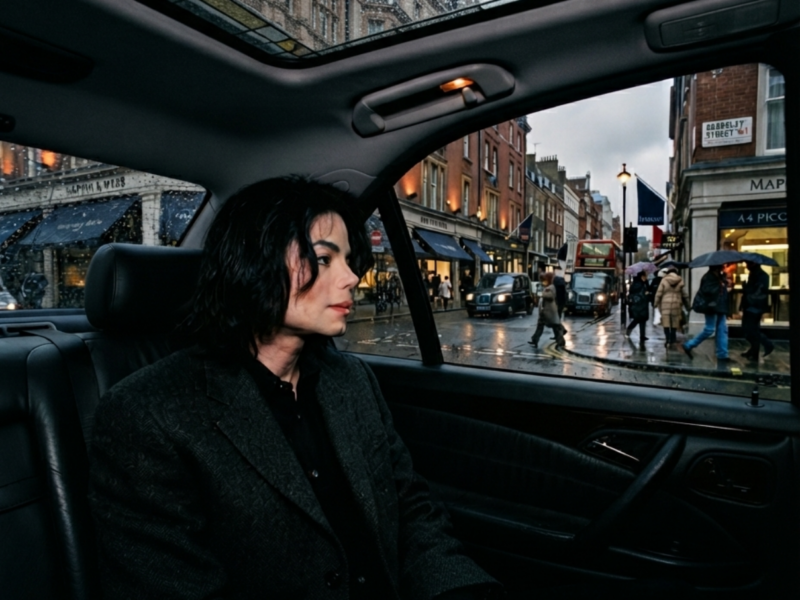
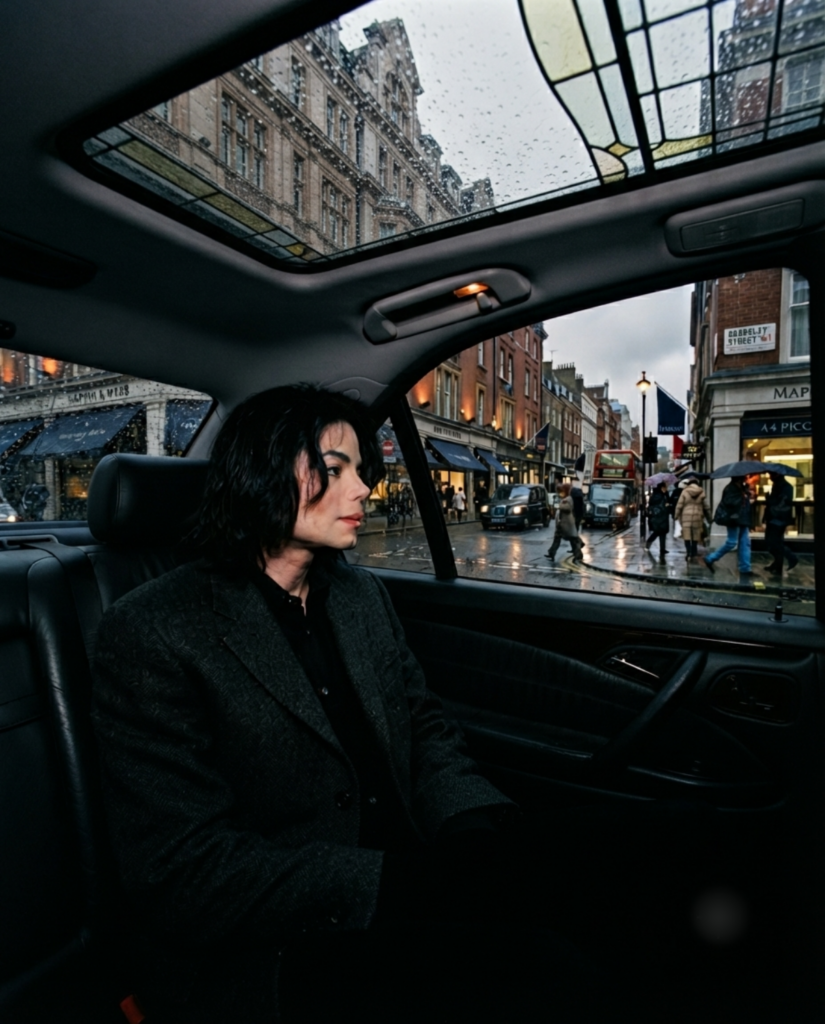
He was in the car afterward.
The driver was navigating the specific dense geography of central London in the middle of a Tuesday afternoon, the particular traffic of a city that has more vehicles than its road network was designed to accommodate.
The route from Mayfair took them through the edge of the West End, through streets that transitioned within blocks, from the expensive to the ordinary to the precarious.
Michael was looking out the window.
Not with active attention.
With the passive, slightly unfocused gaze of someone who is present in a moving vehicle and is allowing the city to pass across their visual field without quite receiving it.
Then something made his eyes refocus.
He saw the boy.
James was 10 years old and had been living without a fixed address for eight months.
This was not in the vocabulary available to a 10-year-old, a situation he described to himself as homelessness.
It was a sequence of circumstances.
The flat that was gone.
The relative’s sofa that became unavailable.
The shelter that had space sometimes and didn’t other times.
The movement from one temporary place to another that had become, over eight months, the ordinary texture of his life.
James went to school.
He came home to wherever home was that week.
He was 10 years old and adaptable in the way that 10-year-olds are adaptable when they have no alternative.
The T-shirt had come from a bag of donated clothes at one of the shelters.
It was old, the fabric faded to a pale shadow of its original color, the seam at the right shoulder partly separated, the hem fraying at the front.
But it was warm and it fit and it was clean, which were the operational criteria that governed clothing decisions.
The face on the front was faded but legible.
Sandra had not particularly noted it when she packed it into James’s bag.
It was a T-shirt.
It was suitable.
She had other things to think about.
James wore it because it was there.
He was wearing it on the pavement outside a newsagent on a Tuesday afternoon in November when a black car slowed beside him and then stopped.
The window.
Michael saw the T-shirt first.
The specific sequence of visual processing that the sight produced.
The face.
The recognition of the face.
The recognition that the face was his own.
The registration of the state of the garment carrying it.
The registration of the size and age and situation of the person inside the garment.
It happened in the compressed, rapid way that such sequences happen when the mind is presented with something that doesn’t fit its expectations.
He had seen his face in many places.
He had seen it on T-shirts, thousands of them, on thousands of people, in thousands of configurations.
It was part of the specific experience of being who he was.
He had not seen it like this.
Faded.
Fraying.
On the back of a child standing on a pavement in November in London, with the specific, slightly hollow quality of someone for whom the street is a familiar environment in a way that it should not be.
He said something to the driver.
The driver, navigating the traffic, oriented toward the next turn, continued forward.
Michael said it again.
The driver looked in the mirror.
“Stop the car,” Michael said.
The car stopped.
The pavement.
His security coordinator in the front passenger seat was already assessing the situation.
The specific rapid professional assessment of someone whose job is to anticipate what happens next.
What happened next was that Michael opened his own door.
In the ordinary management of his public appearances, Michael did not open his own doors.
This was not a matter of preference, but of protocol.
The specific practical protocol that manages the movement of a person whose unannounced presence in a public space produces a response that requires careful management.
He opened his own door.
He got out.
The security coordinator was on the pavement a second later, repositioning, recalibrating, doing the job with the tools available, which were now suddenly different from the tools that had been available 60 seconds ago.
Michael walked toward the boy.
James saw him coming.
The specific cognitive event occurred.
The face approaching on the pavement being the same face that was on his own chest.
The recognition.
The dissonance of the recognition.
James did not move.
Michael stopped in front of him.
He looked at the T-shirt.
He looked at the boy.
He crouched down.
“That’s a good T-shirt,” he said.
James looked at him.
He was 10 years old and he had been in the city long enough to have developed a certain weariness of unexpected adult attention.
The specific learned caution of a child who has spent months in circumstances that require vigilance.
But there was something about the man in front of him that bypassed the weariness.
Maybe it was the crouching.
The specific deliberate act of getting down to his level.
Maybe it was the voice.
Maybe it was simply the quality of the attention, which was the quality of someone who was fully present rather than partially present, who was looking at him rather than in his direction.
“Where did you get it?” Michael said.
James told him.
The shelter.
The bag of donated clothes.
His mother had found it.
Michael listened.
Then he said, “What’s your name?”
James told him.
“Are you here by yourself?”
“No. His mom was at the newsagent.”
Michael nodded.
He did not stand up immediately.
He stayed crouched at James’s level and looked at him with the specific attention of someone who was completing a thought that began when he saw a face on a faded T-shirt and understood something about the specific distance between that image and the place it had traveled to.
Then he said, “Is your mom coming out soon?”
Sandra.
Sandra came out of the newsagent with a small paper bag and the specific focused orientation of someone who has a clear list of things to accomplish and is working through it efficiently.
She saw the small crowd first.
Not a large crowd.
The security coordinator and the driver, both now on the pavement, and a few pedestrians who had slowed to register what was happening.
But enough to register as anomalous.
Then she saw her son talking to a man crouched on the pavement.
Then she saw who the man was.
She stopped.
The man stood up when he saw her.
He said, “You must be James’s mom.”
Sandra looked at him.
She looked at James.
She looked back at him.
“Yes,” she said.
The single word delivered with the specific economy of someone who has very briefly lost the ability to produce more than one word at a time.
Michael said he had seen James from the car.
He said he had wanted to stop.
He said he wondered if they might have a few minutes.
Sandra stood on the pavement outside the newsagent with her paper bag and looked at the man who had just asked if she had a few minutes.
“Yes,” she said again.
What happened over the following hours exists in its complete form in the accounts of three people.
Michael, who never spoke about it publicly.
The security coordinator, who gave a partial account in 2011 when he was asked directly about it and chose to answer briefly and carefully.
And James, who was 30 years old in 2019 when he gave a longer account to a journalist who had heard about the day from a secondary source and had spent six months finding him.
The outlines of what the three accounts have in common.
Michael invited Sandra and James into the car.
The car went to two places that afternoon.
The first was a shop where James was given what James described as an amount of clothing that seemed to a 10-year-old impractical in its abundance.
The second was a hotel where Michael’s team arranged a room for Sandra and James to stay that night.
The security coordinator’s account added one detail that James did not include.
At some point during the afternoon, Michael made a phone call.
The coordinator did not know who he called or what was said.
He knew that it lasted approximately 15 minutes and that Michael’s expression during it was the specific focused expression of someone solving a logistical problem rather than having a social conversation.
What the phone call produced, if anything, the coordinator did not know.
James, in his 2019 account, described the afternoon in the specific, slightly impressionistic way of someone reconstructing a day that happened when they were 10 years old and that they have thought about many times since without fully being able to organize it into a clear sequence.
He remembered the car.
He remembered the clothes.
He remembered his mother being very quiet in a way that he understood, even at 10, to mean that she was managing something large by being very still.
He remembered at the end of the afternoon Michael saying something to Sandra.
He couldn’t remember what it was.
He remembered that his mother nodded.
The driver gave his account in 2011 in a brief interview with a music publication that was running a retrospective piece on Michael’s humanitarian activities.
He was asked what he remembered about the day.
“I remember the T-shirt,” he said.
“When he saw it, when he saw his own face on that child, I could see it in his face. Something happened.”
He was quiet for a moment.
“He’d seen his face everywhere his whole life. On everything. Everywhere. He was used to it.”
Another pause.
“But seeing it there. Faded. Worn out. On a kid on the street. That was different. He saw himself somewhere he hadn’t put himself. And what it meant. Where it had ended up. What it was doing there. He saw all of that at once.”
He looked at the interviewer.
“That’s why he stopped. Not because of the boy at first. Because of the T-shirt. Because of what the T-shirt told him about where his face had traveled. And then he looked at the boy, and the T-shirt stopped being the point.”
James, 2019.
He was 30 years old.
He had a job, not in music, not in anything adjacent to the world that had, on one Tuesday afternoon, briefly and unexpectedly intersected with his own.
Something ordinary.
Something that required him to be in one place at a predictable time, which was not, he said, something he had taken for granted for the first 10 years of his life.
His mother was well.
The journalist asked him what he wanted to say about that day.
James thought about it for a long time.
“People always want it to be a transformation story,” he said.
“Like one afternoon changed everything and then everything was different.”
He shook his head.
“Life doesn’t work like that. Things got better and then worse and then better again. It took years. It took a lot of things.”
He paused.
“But I’ll tell you what that day was.”
He looked at the journalist.
“That day, someone looked at me and saw me. Not the situation. Me. And then he looked at the situation and decided the situation was something he could do something about right then, with what he had.”
He was quiet for a moment.
“He didn’t fix everything. He couldn’t fix everything. But he stopped. And he got out of the car. And he crouched down on the pavement and talked to a 10-year-old like the 10-year-old was the most important person on the street.”
Another pause.
“Which, for those few minutes, I was.”
Michael Jackson’s face has been on more T-shirts than can be counted.
It has traveled to every country on Earth.
It has been worn by people who loved his music and people who wore it as fashion and people for whom it was simply a piece of clothing that was available.
It traveled in the autumn of 1999 to a 10-year-old boy on a London pavement, faded, worn, fraying at the hem.
Michael saw it from a car window.
He stopped.
He got out.
He crouched down on a pavement and asked a child where he got the T-shirt.
He listened to the answer.
And then he did what he could do right then, with what he had.
Which was not nothing.
Which was, for a 10-year-old boy and his mother on a Tuesday afternoon in November, quite a lot.
The T-shirt, James said, was worn out long ago.
But he remembered the face on it.
He remembered who stopped.









