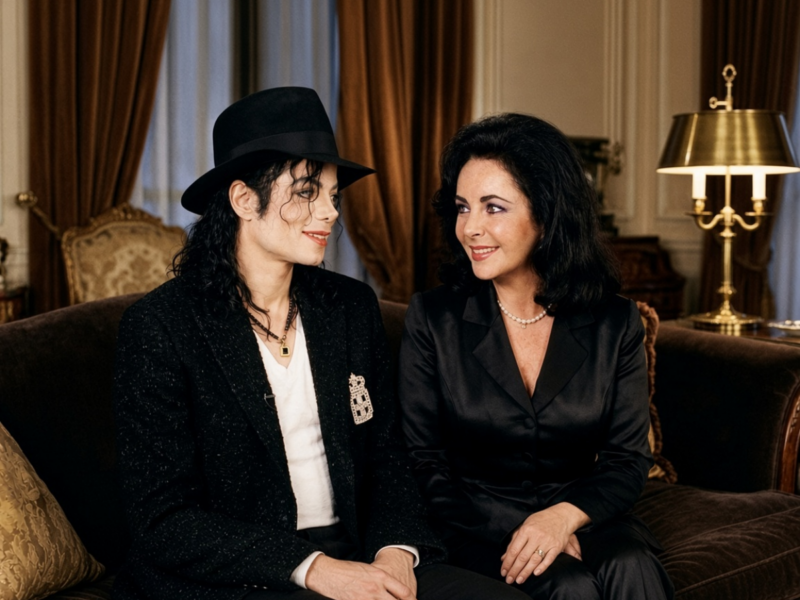
Michael Jackson Sang ‘Jolene’ — Did Elizabeth Taylor Actually Cry?
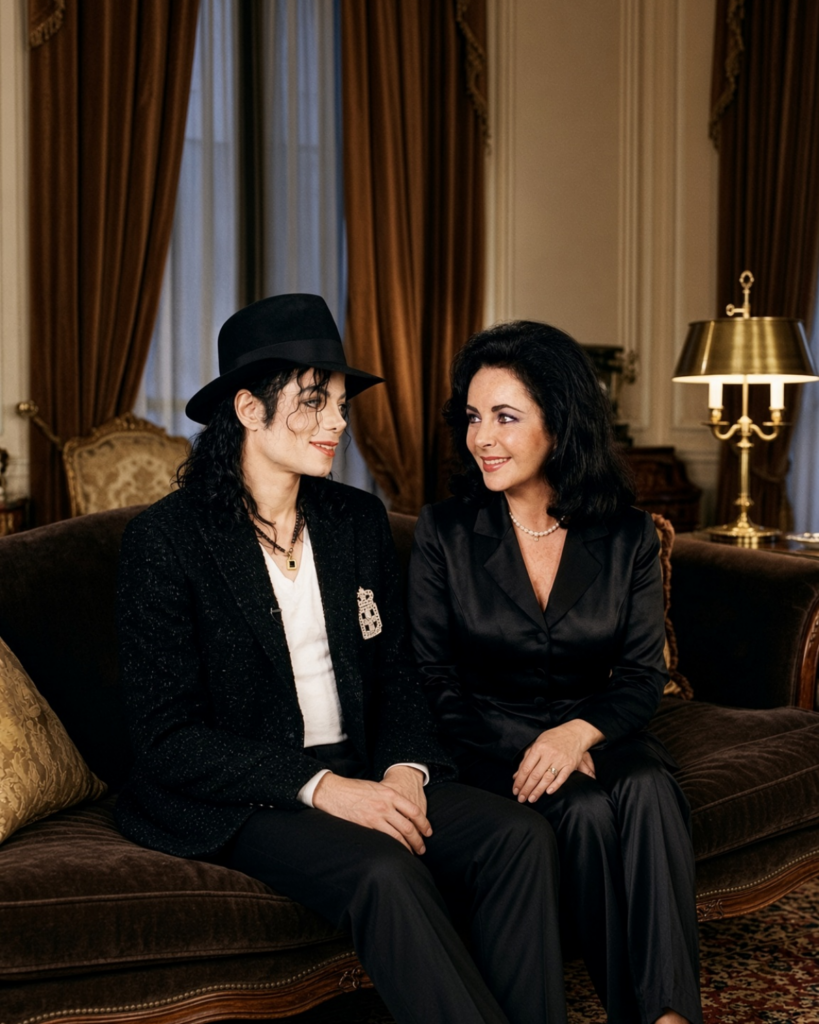
They say Michael Jackson once sang Dolly Parton’s “Jolene” in a recording studio.
And after the final note, Elizabeth Taylor was reportedly in tears.
But here’s the strange part.
There is no confirmed recording.
No verified session log.
And yet the story refuses to disappear.
So, what if the most fascinating part isn’t whether the story is true, but why so many people believe Michael Jackson could have done exactly this?
The room was supposedly quiet before Michael even began.
No conversation, no laughter, no one reaching for a phone, just the faint sound of equipment humming somewhere behind the walls.
Michael Jackson stood in front of the microphone.
Across the glass, someone was watching him.
Elizabeth Taylor, one of Hollywood’s most recognizable faces, one of Michael’s closest friends.
And between them was a song almost nobody would have expected Michael Jackson to sing.
“Jolene,” a country song, a desperate plea, a song written by Dolly Parton about the fear of losing the person you love.
According to the story that has circulated among fans, Michael didn’t approach it like a pop superstar.
He didn’t try to make it bigger.
He didn’t try to overpower it.
He supposedly stripped it down until all that remained was the emotion.
And then he sang.
One take.
That’s the claim.
And when he finished, the room supposedly stayed silent.
Then Elizabeth Taylor cried.
It sounds like one of those stories that could have been written specifically for a Michael Jackson documentary.
Except there’s a problem.
The details of this particular recording session cannot be reliably verified.
There is no solid primary source confirming the famous one-take performance or Taylor’s supposed reaction.
So tonight, we’re going to do something different.
We’re going to follow the story, but we’re also going to separate what is documented from what has become legend.
Because Michael Jackson’s real life was already extraordinary enough.
And sometimes the truth becomes even more interesting when you remove the parts that can’t be proven.
Before Michael Jackson ever became the King of Pop, he learned something that would define almost everything he did afterward.
Listen.
Really listen.
He learned it as a child.
While other children were worrying about school, friends, and weekends, Michael was standing under stage lights.
He learned timing.
He learned harmony.
He learned how audiences reacted to a voice.
He learned that a tiny pause could sometimes create more emotion than a huge note.
And as he grew older, that understanding became part of his identity.
Michael didn’t simply sing melodies.
He treated the human voice like an instrument.
A breath could become percussion.
A whisper could become part of the rhythm.
A sharp sound could emphasize a beat.
A change in pronunciation could alter the emotional meaning of an entire line.
That attention to detail became one of the defining characteristics of his recordings.
So when you hear the claim that Michael once approached “Jolene,” there’s an interesting question hiding underneath it.
What would Michael Jackson actually hear in that song?
Because if he heard only a country record, there probably wouldn’t be much reason for him to record it.
But if he heard the emotion underneath it, everything changes.
“Jolene” was written by Dolly Parton and released in 1973.
At first glance, the song seems incredibly simple.
A woman is pleading with another woman.
Please don’t take the man I love.
But the simplicity is deceptive.
There’s jealousy.
There’s insecurity.
There’s desperation.
And perhaps most importantly, there’s vulnerability.
The narrator isn’t threatening Jolene.
She’s begging her.
That’s what makes the song unusual.
The woman she’s afraid of is beautiful, confident, and apparently capable of taking everything away from her.
The singer knows she may not be able to compete.
So instead of pretending she’s stronger than she is, she admits that she’s afraid.
That emotional honesty is the heart of “Jolene.”
And Dolly Parton has spoken about the real-life inspirations behind the song.
One came from a young fan named Jolene who asked Dolly for an autograph.
The other came from Dolly’s own life involving a woman she believed was paying too much attention to her husband.
Two different moments became one character, one name, one song, and eventually one of the most recognizable titles in popular music.
That is important because “Jolene” isn’t really about country music.
Country music is simply the language Dolly used to tell the story.
The emotion itself is universal.
Anyone who has ever been afraid of losing someone understands it.
And Michael Jackson understood universal emotion better than almost anyone.
This is where the legend becomes interesting.
Imagine Michael hearing the song for the first time.
Maybe he isn’t thinking about guitars.
Maybe he’s not thinking about Nashville.
Maybe he’s not thinking about country radio.
Maybe he’s hearing something else.
A person standing in front of another person asking them not to destroy their life.
That is a completely different way of hearing the song.
And Michael had a particular gift for making emotional situations sound personal.
Listen to “She’s Out of My Life.”
There isn’t a complicated story.
It’s heartbreak.
Listen to “Human Nature.”
It’s curiosity and loneliness.
Listen to “Billie Jean.”
It’s suspicion, fear, and accusation.
Michael could take relatively simple emotional ideas and make them feel enormous.
That’s why the possibility of him singing “Jolene” is so fascinating.
Not because it would prove that he could sing country music, but because it would give him another emotional landscape to explore.
Now comes the part of the story that has captured people’s imagination.
According to the circulating account, Michael supposedly entered a studio and prepared to record the song.
No huge production, no wall of instruments, just enough music to support the vocal.
He supposedly stood at the microphone for a moment without speaking.
That was something people who worked with Michael often described about him.
Long periods of silence.
Then suddenly a decision.
Once Michael knew what he wanted, he could become incredibly focused.
The story says the room became quiet.
The kind of quiet that happens when everyone realizes something is about to begin.
And then came the opening.
“Jolene.”
Not shouted, not theatrical, just a name.
Again, “Jolene.”
And again, the emotional weight supposedly increased with every repetition.
If the story is accurate, Michael wasn’t trying to imitate Dolly Parton.
He was doing something much more dangerous.
He was interpreting the song through his own emotional vocabulary.
And that’s a critical difference.
When an artist covers another artist’s song, there are two easy mistakes.
The first is imitation.
You copy the original performance.
The second is overcorrection.
You change everything just to prove that you’re different.
The great covers usually do something else.
They find the part of the original song that is timeless and then reveal it from another angle.
That’s what makes the idea of Michael recording “Jolene” so compelling.
Imagine taking a song associated with country music and stripping away almost everything people associate with that genre.
Imagine a sparse arrangement, a dark piano, a subtle rhythm, maybe a guitar sitting almost invisibly underneath, and then Michael’s voice.
Soft, close, almost whispered.
The song suddenly becomes less about a country woman confronting a rival and more about one frightened human being asking another human being for mercy.
That’s where Michael could have made it his own.
And then there’s Elizabeth Taylor.
This is where the story takes an even more emotional turn because Taylor wasn’t simply another celebrity in Michael’s world.
She was one of the people who understood him on a personal level.
Their friendship had begun in an unusual environment, the world of fame.
But what connected them was something deeper.
They both knew what it meant to become famous when you were still young.
They both knew what it meant for strangers to feel entitled to opinions about your private life.
And they both understood something most people never could.
What it feels like to be famous and still feel lonely.
Taylor had been famous since childhood.
Michael had been famous since childhood.
That shared experience created a bond between them.
Taylor openly supported Michael during some of the most difficult periods of his life.
And Michael regarded Taylor with extraordinary affection.
She was not simply Elizabeth Taylor to him.
She was his friend.
That’s why the image of Taylor sitting in a recording studio is so powerful.
If the story were true, she wouldn’t have been listening to Michael Jackson the way a fan listens to Michael Jackson.
She would have been listening to Michael, her friend, and that’s a completely different experience.
Imagine hearing someone you know personally sing a song about fear and vulnerability.
Maybe you wouldn’t hear the superstar.
Maybe you’d hear the person underneath.
That’s why the claim that Taylor cried has such emotional power.
But again, we need to stop at the line between evidence and imagination.
There is no reliable documentation confirming that Elizabeth Taylor was present for a Michael Jackson recording of “Jolene” and cried afterward.
That detail belongs to the story, not established history.
And that’s important because the internet has a strange way of turning repeated stories into facts.
A sentence appears on one website, someone copies it, another person turns it into a video, a third person adds a dramatic detail.
Years later, thousands of people have seen the same claim, and suddenly it feels documented.
But repetition isn’t evidence.
The same problem applies to the legendary one take.
Was Michael capable of extraordinary vocal performances?
Absolutely.
Was he capable of performing difficult material under pressure?
Without question.
But that doesn’t mean every incredible performance happened in a single take.
Michael’s studio process could be extremely detailed.
He worked with producers, engineers, musicians, and arrangers.
Songs could evolve through experimentation.
Parts could be recorded repeatedly.
Different performances could be compared, and tiny details could be changed until Michael was satisfied.
That’s how many great recordings are made.
So when somebody says he sang the entire song perfectly in one take, we need evidence before accepting it: a studio document, a recording, a credible firsthand account, something.
Without that, it’s a fascinating claim, not a fact.
But there’s a reason one-take stories are so popular.
People love moments that feel impossible.
They love the idea that genius doesn’t need preparation, that someone walks into a room and magic simply happens.
And Michael Jackson’s reputation makes that fantasy particularly powerful because he often seemed almost supernatural on stage.
The precision, the movement, the voice, the timing, the ability to control thousands of people with a single gesture.
But behind that apparent effortlessness was years of work.
That’s something we sometimes forget.
The magic looked spontaneous.
The preparation wasn’t.
And that’s why the most interesting version of this story isn’t necessarily “Michael Jackson sang Jolene perfectly in one take.”
Maybe the more interesting question is what would happen if Michael Jackson actually decided to make “Jolene” his own.
Because we already know he wasn’t afraid of unexpected musical ideas.
He worked with rock musicians.
He incorporated gospel influences.
He worked with artists from completely different backgrounds.
He crossed musical boundaries constantly.
And he understood something very important.
A genre is a framework.
Emotion is the foundation.
Think about Michael’s voice for a moment.
There were many versions of it.
The soft Michael, the explosive Michael, the breathy Michael, the angry Michael, the playful Michael, the vulnerable Michael.
He could change the emotional character of a line without changing the words.
That ability is especially important in “Jolene” because the song isn’t about vocal fireworks.
It’s about pleading.
Too much power could actually weaken the emotion.
The singer has to sound like someone who genuinely believes they might lose everything.
And Michael knew how to create that feeling.
Now imagine the final moments.
If the story is true, Michael reaches the final line.
The music continues underneath him.
His voice becomes quieter.
Then the last note disappears and nobody speaks.
One second, two seconds, three.
The kind of silence that feels longer than it actually is.
Someone in the room looks at someone else.
The engineer doesn’t immediately touch the controls.
Michael is still standing at the microphone and Elizabeth Taylor is watching through the glass.
Maybe she is emotional, maybe she isn’t.
We simply don’t know.
But the image has survived because it captures something people have always wanted to believe about Michael.
That behind all the fame, all the records, all the spectacle, there was still a deeply sensitive artist who could walk into a room and make people feel something.
And perhaps that’s the real connection between Michael Jackson and Dolly Parton.
They came from very different musical worlds, but both understood storytelling.
Dolly could create a complete character in a few minutes.
Michael could create an entire emotional world in a few minutes.
Different tools, different voices, different backgrounds.
Same fundamental idea.
Make people feel something.
That’s why “Jolene” has survived for so long.
It’s not because everyone listening is a country music fan.
It’s because almost everyone understands fear.
Fear that someone else is better.
Fear that someone else is more beautiful.
Fear that the person you love could leave.
Fear that you might not be enough.
That’s the emotion.
And emotions don’t have genres.
There’s another fascinating possibility.
Maybe the reason this story has survived is because fans know Michael recorded countless things that were never released.
His creative process produced far more material than what eventually appeared on his albums.
Ideas came and went.
Demos were made.
Songs were experimented with.
Some survived.
Others disappeared into archives.
That reality makes people wonder about the unknown.
What else did Michael record?
What songs did he sing privately?
What collaborations never became public?
What performances exist that the world has never heard?
That’s where imagination begins.
And sometimes imagination creates a story around a possibility.
But if someday an authentic recording of Michael Jackson singing “Jolene” were discovered, the world would have an entirely different conversation.
People wouldn’t need to imagine what it sounded like.
They could hear it.
They could analyze the arrangement, study the vocal, listen to the phrasing, compare it with Dolly’s original, and perhaps the biggest question would finally be answered.
Did Michael really sing it?
Until then, the story remains exactly that: a story.
An intriguing one.
An emotional one.
But unconfirmed.
And there’s something almost fitting about that.
Michael Jackson’s career was filled with things the public saw and things it never saw.
There was the superstar everyone knew.
And then there was the private artist.
The person who could spend hours working on tiny musical details.
The person who could become completely absorbed in a melody.
The person who could hear something in a song that other people didn’t hear.
That private Michael is the one people remain fascinated by.
Not the costumes, not the headlines, not the tabloid stories.
The artist.
So perhaps the most important thing about the “Jolene” story isn’t whether Elizabeth Taylor actually cried.
It isn’t whether the recording took one take.
And it isn’t even whether the recording exists.
It’s what the story reveals about the way people remember Michael Jackson.
They remember him as someone capable of surprising a room.
Someone who could take an unexpected idea and turn it into something extraordinary.
Someone whose voice could make a familiar song feel unfamiliar.
And someone whose closest friendships were often built on experiences that the outside world could never fully understand.
That’s why this story feels so believable.
It combines things that are real with details that remain unproven.
And when those two things get mixed together, a legend is born.
So let’s leave the mystery where it belongs.
Did Michael Jackson record “Jolene”?
Unconfirmed.
Did he perform it in one perfect take?
Unconfirmed.
Was Elizabeth Taylor there?
Unconfirmed.
Did she cry?
Unconfirmed.
But what we do know is far more solid.
Dolly Parton’s “Jolene” is one of the most enduring songs of its era.
Michael Jackson was an artist who constantly crossed musical boundaries.
And Elizabeth Taylor was genuinely one of Michael’s closest and most loyal friends.
Those facts are enough to make the possibility fascinating.
Because if the recording ever turns up, we may finally discover whether the legend was built around something real.
And if it never does, the mystery will remain.
A song, a superstar, a Hollywood legend, and a studio moment that may have happened or may have existed only in the imagination of the people who wanted it to be true.
Maybe somewhere in an archive, there really is a tape.
Maybe there’s nothing.
But until someone presses play, one question remains hanging in the silence.
What would Michael Jackson have sounded like if he had truly made “Jolene” his own?
And honestly, that’s a recording many fans would still love to hear.









