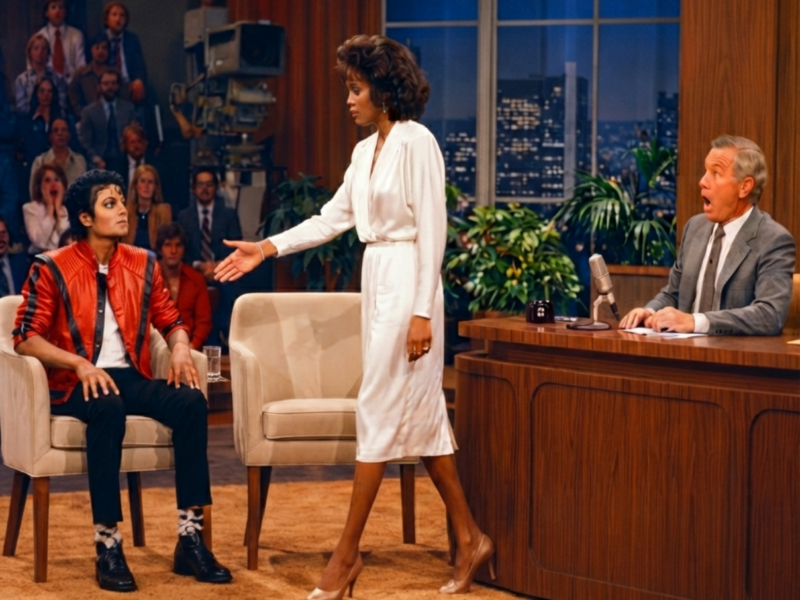
Michael Jackson Refused to Shake Whitney Houston’s Hand — What Whitney Said Left the Studio Frozen.
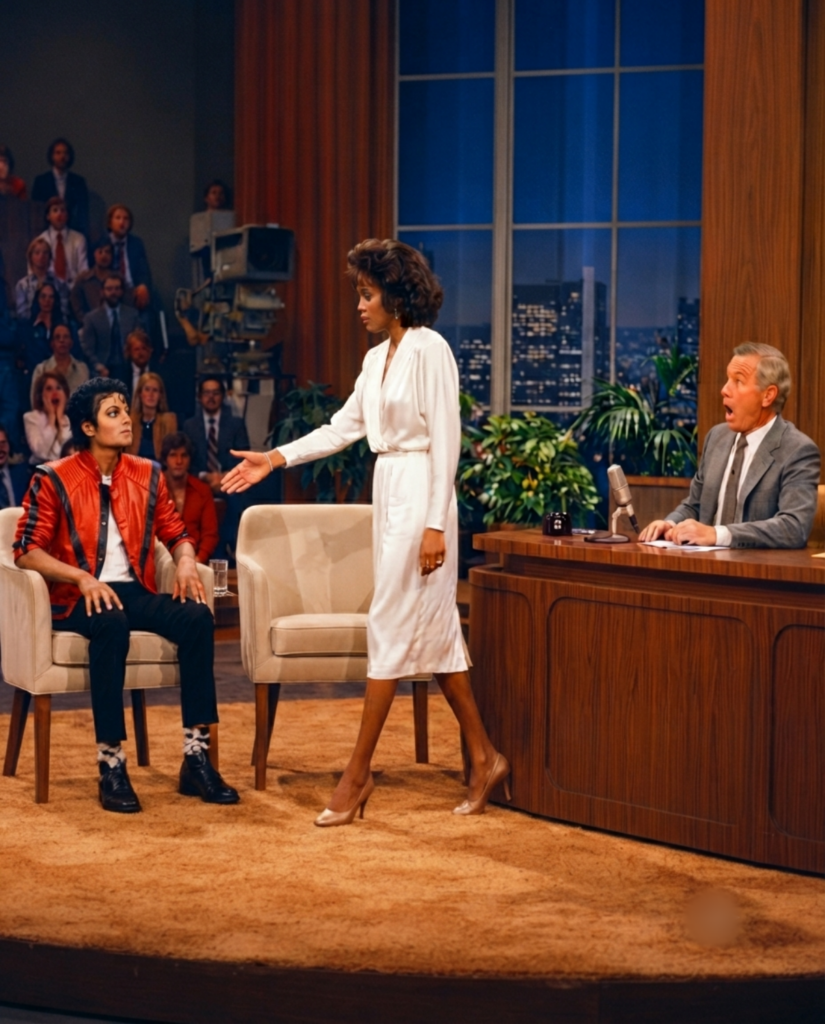
The call sheet at NBC Studios in Burbank said one guest that night, not two.
May of 1986, Studio 1, *The Tonight Show* with Johnny Carson. And for weeks, the booking had simply read: Michael Jackson, solo interview, twelve minutes, no music segment.
That was the deal his people had signed off on. That was the only reason he’d agreed to come at all.
Michael almost never did television anymore. *Thriller* was three years old by then and had somehow still sold like it dropped that morning. And the constant, grinding attention that came with owning a record like that had worn a kind of permanent caution into him.
He’d spent most of the last year out at his family’s place in Encino, deep into early work on the follow-up album, coming out mostly for family business and the occasional favor to a friend.
The invitation from Carson’s people had taken three months of careful back-and-forth just to lock down. And even then, it came with a list of conditions as long as a grocery receipt.
No surprise guests. No surprise questions about his personal life. No physical contact beyond a handshake with Johnny himself at the top of the segment.
Nobody at NBC broke that last condition on purpose.
What happened instead was simpler and dumber than any conspiracy. The kind of mix-up that happens in live television more often than anyone wants to admit.
A booking assistant two floors up, working off an old draft of the night’s rundown, penciled in a second guest for the same segment without checking the updated sheet.
By the time anybody upstairs noticed the error, it was already too late to fix it quietly. The second guest was already in a car headed to the studio. And pulling her segment now would have meant explaining to her label, on record, why NBC had unbooked one of the fastest-rising stars in the country with six hours’ notice.
That guest was Whitney Houston. Twenty-two years old.
And by that spring, she’d already done something almost nobody does on a first album: string together one massive single after another until the record itself became less a record and more a weather system.
Her mother, Cissy Houston, had spent years singing behind Aretha Franklin and Elvis Presley without ever quite becoming a household name herself. And everyone around Whitney had grown up understanding that this business could swallow a voice like that whole and never give anything back.
Her cousin was Dionne Warwick. Her godmother, by all accounts, was Aretha Franklin herself.
Whitney had grown up singing in the choir loft at New Hope Baptist Church in Newark before she’d ever stood in front of a microphone anywhere else. And every person in her family who’d come before her in this business had told her some version of the same warning.
Watch who’s got their hand on the wheel. Because it usually isn’t you.
If you already love either one of these two, go ahead and hit subscribe now, because tonight’s the night nobody in that building expected to remember for the next forty years.
The two of them had actually been in the same room once before, though neither one would call it meeting.
A little over a year earlier, in January of 1985, close to fifty of the biggest names in music had crowded into A&M Studios late one night to record a charity single for famine relief.
Forty-some voices packed shoulder-to-shoulder in a room built for a fraction of that number.
Whitney had stood near the back that night—nineteen years old, barely a name yet outside of gospel circles and a handful of industry insiders—watching legends she’d grown up idolizing pass a single microphone hand to hand.
Michael had been at the center of it, one of the few people in that crowded room who’d actually written part of what everybody else was there to sing.
They’d been introduced briefly by a mutual acquaintance somewhere around four in the morning, exchanged a polite word or two over the noise, and that had been the whole of it.
Neither one remembered much about the exchange afterward beyond the noise and the exhaustion of the night.
It would take another sixteen months, a magazine cover neither one of them had asked for, and a mixed-up call sheet to bring them face to face again in any way that actually counted.
She’d signed with Arista a few years earlier, after Clive Davis caught her singing at a club in New York and reportedly sat frozen through the entire set—the way people describe hearing something and immediately knowing they’re not going to be able to talk themselves out of chasing it.
Her debut record had come out the year before. And by the spring of 1986, it had already thrown off three number-one singles in a row—an almost unheard-of run for somebody who’d never had an album out before that one.
She was, by any measure anybody wanted to use, the biggest new thing in the entire music industry. And she was carrying that weight the way most twenty-two-year-olds carry a suitcase two sizes too heavy—gripping it with both hands and trying hard not to let anybody see her arms shake.
What almost nobody talked about that spring, though plenty of people in the business were already whispering it, was the other side of that success.
Black radio programmers had started grumbling that her records sounded too polished. Too pop. Too built for a white audience that had never once had to sit through what her family had sat through to get her that voice in the first place.
A few columnists had already started using the word *crossover* like it was an accusation instead of a description. Like reaching that many people at once was something to apologize for, rather than something to be proud of.
Whitney read every single one of those pieces, no matter how many times her team told her not to. And she kept a private running account in her head of exactly which writers had used the word *manufactured* to describe a voice she’d built for free, for years, standing on a small wooden riser at New Hope Baptist Church, long before anybody in New York had ever heard her name.
Michael arrived at the studio a little after six that evening. Quiet in the particular way he’d been quiet for most of the last three years. Moving down the hallway with two assistants and a security man staying a careful half step behind him.
He knew almost everybody on that crew by name and asked after their families the way he always did—soft-voiced, genuinely curious, the kind of warmth that made people forget, at least for a minute, how strange his life actually was compared to theirs.
He thanked the same makeup artist twice for the same touch-up, the way he always did, and settled into his dressing room to run through Johnny’s expected questions with an assistant one more time before air.
He was by then already living with a habit that had crept up on him slowly over the previous couple of years and had nothing to do with rudeness or vanity, whatever the tabloids liked to print about it.
Crowds had started grabbing at him in ways they never used to. Tearing buttons off his jackets. Yanking strands of his hair as souvenirs. And somewhere in the middle of all that, his body had simply started flinching from unexpected touch before his mind caught up and told it to relax.
He wore a single glove some nights—not for the look people assumed, but because a burn scar from an accident years earlier during a commercial shoot had left a patch of skin on that hand that reacted badly to certain fabrics and to prolonged contact.
He’d started keeping a small bottle of hand sanitizer in his jacket pocket after a bout of the flu that had knocked him flat for two full weeks the previous winter. A stretch of illness that scared him more than he ever let on to the people around him, since sickness meant missed studio time—and missed studio time was the one thing in his life he genuinely could not stand to lose.
None of that made the evening news. None of it explained itself to a live audience of four hundred people who only saw what was directly in front of them.
And that gap between what a man is actually carrying and what a room decides it’s watching is exactly where this whole story lives.
About twenty minutes before taping, a producer found Michael in his dressing room and told him, almost as an afterthought, that a second guest had been added to his segment.
Michael went very still.
“Nobody mentioned that to me,” he said. Quiet. Careful. The way he got when something had rattled him and he didn’t want it showing on his face.
The producer—already halfway out the door, the way producers always seem to be the second they’ve dropped bad news on somebody—told him it was a great pairing. That the audience was going to love it. That Whitney Houston herself was already down the hall getting her hair finished.
Michael sat with that name for a second.
Whitney Houston.
He knew the records. Everybody knew the records that spring. They were impossible not to know. And he knew—because somebody had shown him the magazine two weeks earlier without thinking much of it—exactly what had been printed under his name in a national music magazine that had hit newsstands the week before.
A cover line, bold across the top corner, reading in his own supposed words that she was the one artist alive who could take his crown someday.
He had never said that. Not in those words. Not in that shape. Not to anybody.
He’d been asked weeks earlier, in a rushed hallway interview after a charity event, some broad question about who he thought had a bright future in music. And he’d rattled off three or four names the way anybody would, answering a lazy question fast so he could get to his car.
Somebody had taken that answer, cut it down to a single name, and dressed it up as a personal anointing—timed, as far as he could tell, right alongside a new single of hers climbing the charts.
He’d been burned by exactly that kind of thing his whole life. Words trimmed and reshaped until they said something he’d never actually meant, printed under his name to sell somebody else’s product.
And now here he was, twenty minutes from live television, being told the very artist whose new single that quote seemed built to promote was about to sit down next to him—in front of four hundred people and a national audience—with no warning, no consent, and no chance to say a single word about it beforehand.
This next part is where the whole night turns. So stay with me.
Whitney, three doors down, was dealing with a nervousness of her own that had nothing to do with the surprise pairing and everything to do with what came before it.
Her mother had flown out with her that week, sitting quietly in the corner of the dressing room the way she always did before a big appearance—watching her daughter’s reflection in the mirror instead of her daughter directly. An old habit from her own years, standing just off camera behind bigger names.
Cissy had seen the same magazine everybody else had seen. She hadn’t said much about it at the time, beyond a single, flat sentence.
“Somebody’s using that man’s name to sell your record, baby. And one day, somebody’s going to use yours the exact same way to sell somebody else’s.”
Whitney hadn’t thought much of the warning at the time. She was twenty-two, three number ones deep into her very first album, and the whole business felt most days like it was moving too fast for her to do anything but hang on.
When the producer told her about the joint segment, she’d actually smiled—genuinely pleased, thinking it might be a nice thing. Meeting the biggest star in the world. Maybe even getting to thank him for something kind a magazine had quoted him saying about her.
She had no idea he’d never said it. She had no idea the quote had cost him anything at all.
And she walked out toward that stage that night, believing in good faith that she was about to shake the hand of a man who’d already gone on record admiring her.
If you’re already hooked, this is a good moment to hit that subscribe button, because what’s about to happen on that stage caught everybody in that studio completely off guard.
Johnny opened the segment the way he opened most nights—loose, unhurried, in that specific broadcasting way that had nothing to do with him actually being slow and everything to do with decades of practice making it look easy.
He and Michael ran through the expected territory first. The success of *Thriller*. Whether the pressure of following it up kept him up nights. A few questions about the reclusive rumors that had started swirling in the press that year.
“People think I hide because I’m strange,” Michael said at one point, that soft half-smile in place. “I hide because it’s the only way I get any peace to actually make the next thing worth hearing.”
The audience laughed—warm, comfortable. The segment rolling exactly the way Michael had rehearsed it in his head on the drive over.
Then Johnny glanced down at his cards, and something in his face shifted. The particular look he got right before dropping a surprise on a guest who had no idea it was coming.
“Michael, we’ve got a little something extra for you tonight,” Johnny said. “I think you’re going to like this.”
Michael’s expression didn’t move much. But something behind his eyes tightened.
He already knew what was coming. He’d had twenty minutes to brace for it.
And twenty minutes was not nearly enough.
“Ladies and gentlemen—Whitney Houston.”
The roar that came up out of that audience was a different animal entirely from the warm applause a minute earlier. Sharper. Louder. The sound of a room that genuinely could not believe its own luck.
Whitney walked out in a simple dark dress, waved to the crowd with an easy, open smile, shook Johnny’s hand, and turned toward the couch where Michael sat.
She put her hand out first. Genuinely warm. Genuinely excited. A young woman meeting someone she believed—based on what she’d read in print two weeks earlier—already thought well of her.
Michael looked at that hand for a beat too long.
Long enough that the front rows noticed. Long enough that Johnny’s easy grin flickered for half a second before he smoothed it back into place.
Then Michael simply nodded toward her—polite but closed—and gestured for her to sit. His own hand staying right where it was.
Whitney’s smile held for a second out of pure professional instinct. The kind of composure you learn fast in this business, whether you want to or not.
But something in her eyes had already gone somewhere else. Quick and sharp. The private math of a person recalculating a whole situation in under two seconds.
She sat down anyway. Smoothing her dress. Saying nothing about it, because that’s what you do on live television when four hundred people are watching and the cameras are still rolling.
Most of that audience missed the moment completely.
But Johnny caught it. The front rows caught it.
And somewhere in the room, without being able to name exactly what had happened, four hundred people felt the temperature of the segment drop by a couple of degrees.
If this story is already pulling you in, go ahead and hit that like button, because it’s about to get a whole lot more uncomfortable before it gets better.
Johnny, doing what good hosts have always done, tried to paper over it fast.
“Well, folks—two of the biggest voices in the country sitting right here together. How about that?”
The crowd clapped, relieved to have somewhere to put their hands. Still not entirely sure what they’d just watched.
Johnny turned the conversation toward safer ground. Asking Whitney about the run of hit singles, about growing up in a house full of that much musical talent, about what it felt like watching her records climb the charts one after another.
“It still doesn’t feel real some mornings,” Whitney said—her voice warm and easy on the surface, though something underneath it had gone a little more careful than it had been thirty seconds earlier. “I grew up singing in church. I never once pictured any of this.”
Johnny turned toward Michael. “You know a little something about that yourself. Having a career blow up faster than anybody can really prepare for.”
Michael nodded, measured. “I know it can be a lot to carry all at once. Especially when everybody around you starts deciding what it means before you’ve had a chance to figure that out yourself.”
Whitney glanced over at him, something in the comment landing a little differently than she expected.
“Is that a general observation?” she asked, keeping her tone light. “Or is there something particular behind it?”
The room went a shade quieter.
Johnny, sensing the ice underneath the conversation, leaned forward slightly—letting it play out instead of rushing past it the way a less experienced host might have.
Michael was quiet a second, weighing something.
“There’s a magazine on newsstands right now with my name attached to a quote about you,” he said finally. Even and careful. “I never said those words. Not the way they printed them.”
The studio went very still.
Whitney’s easy expression faltered. Genuine confusion crossing her face now instead of performance.
“What quote?” she asked.
“The one calling you the one artist who could take my crown someday,” Michael said. “Somebody built a whole magazine cover out of four words I said in a hallway, answering a completely different question. And then timed the whole thing to land right when your new single hit the radio. I don’t know who arranged that. I don’t know if anybody on your side had a hand in it. But I walked in here tonight not knowing whether I was about to be used again to sell something I never agreed to sell.”
A low murmur rolled through the crowd. The particular sound of an audience realizing the friendly banter they’d settled into had just cracked open into something real.
Keep watching, because what Whitney says next is the reason people are still talking about this broadcast.
Whitney sat with that for a moment. Something working behind her eyes.
“You think I had something to do with that?” she said—and there was an edge in it now. Quiet, but unmistakable.
“I didn’t say that,” Michael answered.
“You didn’t have to,” Whitney said. “You wouldn’t shake my hand a minute ago. I’ve been sitting here trying to figure out what I did wrong before I even opened my mouth. I wasn’t trying to embarrass you.”
“I’ve had my words twisted and sold under my own name more times than I can count,” Michael said. “And I’ve learned the hard way to be careful before I hand anybody a photograph or a moment they can use to make it look like I said something I never actually said.”
Whitney’s jaw tightened.
“You know what?” she said—her voice steady now, gaining strength instead of losing it. “I never saw that magazine before it printed. Nobody at my label showed it to me first. I found out about that quote from a girl on my own road crew who bought a copy at the airport newsstand and showed it to me on the plane. And I sat there just as confused as you probably were. Because I never asked anybody to put your name next to mine like that.”
“Then why didn’t you say something?” Michael asked—genuinely, not accusing.
“Say what? To who?” Whitney said. “You think anybody at my label is going to pull a cover story once it’s already printed and selling copies? You think a twenty-two-year-old, six months into her first album, gets to make a phone call like that and have it actually mean something?”
The studio had gone dead quiet now. Four hundred people leaning forward without quite realizing they were doing it.
“I do know what it’s like, being sold before you get a say in it,” Whitney said—quieter now. Something raw creeping into her voice. “My whole family’s been in this business longer than I’ve been alive. My mother sang backup for people whose names are bigger than mine will ever be. And she never once got her name on the record cover for most of it. I watched that happen to her my whole childhood. I told myself it would be different for me because I’d have my own name on my own album. And here I am, six months in, already finding out my own name gets handed around same as anybody else’s. Printed next to yours to sell copies neither one of us agreed to sell.”
If this is hitting you already, that’s your sign to subscribe, because it only gets more honest from here.
Michael was quiet a moment. Something shifting behind his expression.
“I didn’t think about it that way,” he admitted. “I’ve spent so long guarding my own name that I walked in here assuming somebody on your side had a hand in using it. I didn’t stop to think somebody might be doing the exact same thing to you at the same time, from the other direction.”
“You didn’t,” Whitney said. And it wasn’t a question.
“No,” Michael said. “I’m sorry for that.”
Whitney studied him a long moment. Some of the sharpness in her expression softening—though not all of it.
“You’ve spent your whole life being careful about people using your name to sell something,” she said. Slow now. Deliberate. Each word landing like she’d been carrying it around for longer than just the last three minutes. “You didn’t even stop to think somebody could be using mine the exact same way. I’m not your rival, Michael. I’m just another kid these people are figuring out how to sell. Same as you were once. And nobody in this business has ever once asked either one of us what we actually wanted before they started weighing us up side by side and selling tickets to the fight.”
The studio went completely silent.
Not the awkward silence from the handshake a few minutes earlier. Something heavier. More total. The sound of four hundred people realizing they were watching something that had stopped being television and started being real.
Johnny didn’t say a word for a full three seconds—an eternity in live broadcast terms. Just looked between the two of them, letting it sit.
If that line just hit you the way it hit that whole studio, go ahead and hit that like button right now, because we’re not done yet.
Michael sat with it a long moment. Something working across his face that the cameras caught clearly. A man genuinely reckoning with something, instead of performing a reaction for an audience.
“You’re right,” he said finally. Quiet. No defensiveness in it at all. “I’ve spent so many years watching people try to use my name that I forgot it happens to other people, too. Sometimes people I never once thought to check on. Because from where I was sitting, it looked like the whole world was already handing you everything.”
“It doesn’t feel like that from here,” Whitney said—some of the edge draining out of her voice now, replaced with something closer to tired honesty. “It feels like everybody’s got an opinion about what I am before they’ve even heard me sing a full song. Too polished for the church people who raised me. Not polished enough for folks who think a girl who sang gospel shouldn’t be allowed on pop radio. I can’t win either argument. So I’ve just been trying to sing the songs and let people say whatever they’re going to say anyway.”
Michael nodded slow.
“I know something about not being able to win an argument, no matter which way you turn,” he said. “People spent years telling me I wasn’t allowed to just be a solo artist because I came up in a group with my brothers first. Like whatever I built on my own somehow belonged to all of us collectively, instead of being mine. Then once *Thriller* happened, it flipped completely. And suddenly people were saying my brothers held me back all those years—like the group meant nothing at all. I couldn’t win that one either. I just made the music and let people argue about what it meant without me.”
Whitney let out a short, surprised laugh. Some real warmth in it for the first time since the confrontation started.
“I didn’t expect you to actually understand that,” she admitted.
“Most people don’t ask,” Michael said. “They just assume because I smile a lot and keep my voice soft that none of it actually touches me. It touches me plenty.”
This next part is where the whole night turns warm, so don’t go anywhere.
Johnny, sensing the temperature in the room shifting into something worth following, leaned in.
“Whitney, has anything about this conversation changed how you’re seeing what happened a minute ago, when Michael didn’t shake your hand?”
Whitney considered it seriously.
“Yeah,” she said. “I think I understand now. He wasn’t refusing my hand because of anything about me. He was protecting himself from getting used one more time by people who’ve never once asked him what he actually wants. I can respect that. Even if it stung, sitting here not knowing why.”
“Is that different from what you said a few minutes ago?” Johnny asked.
“Not entirely different,” Whitney said. “But maybe more honest. Because if I’m being real, part of what stung wasn’t really about the handshake at all. It was feeling like even after everything I’ve built these last few months—three number-one records, all of it—I still walked out here tonight and the very first thing that happened was me getting measured against somebody else’s comfort, instead of just getting to be myself for a minute.”
Michael was quiet a beat. Something genuine crossing his face.
“That’s a fair thing to feel,” he said. “And I think I owe you more than just an apology for the handshake. I think I owe you an apology for assuming the worst about you before you’d said a single word to me.”
Whitney studied him.
“Would you shake my hand now?” she asked. “If I put it out again?”
The whole studio seemed to hold its breath along with her.
She extended her hand a second time. The same gesture from the start of the segment—though something in the way she held it now felt different. Less performance. More plain honesty.
Michael looked at it a moment. Then reached out and took it. Firm. Steady. Every trace of the earlier tension gone from his face.
The crowd rose up out of their seats. The particular roar that happens when a room senses something true just got settled in front of them. Not through some rehearsed apology—but through two people actually working through it in real time.
Johnny looked into the camera, visibly moved.
“Ladies and gentlemen, I’ve been sitting behind this desk a long time. And I don’t believe I’ve ever seen anything quite like what just happened on this couch.”
If this story has moved you even a little so far, make sure you’re subscribed before we keep going, because the rest of this segment is even better.
The conversation ran on for several more minutes. The tension from the opening completely melted into something warmer than anybody in the building had expected walking in that night.
Johnny asked Whitney about growing up around her mother’s career. About what it had been like, sitting in church pews watching Cissy lead a choir long before either one of them had a record deal to their name.
“I used to sit right up front,” Whitney said. “And I’d watch my mother close her eyes when she really meant a note. Not just when she was hitting it right—when she meant it all the way down. I spent years trying to figure out the difference between the two. Because everybody can learn to hit a note eventually. But meaning it? That’s the part nobody can teach you.”
“That’s not so different from a lot of things,” Michael said. “I spent years working on a single move for a performance. Practicing it alone at night after everyone else had gone home, because I wanted people to see something that looked effortless—even though it took months to actually get there. Meaning it and making it look easy. Those aren’t the same job. But they both take everything you’ve got.”
“Never thought about it that way,” Whitney said. “But you’re probably right.”
Michael asked her—genuinely curious now, instead of just filling airtime—how she decided when a take on a record was actually finished, versus just good enough to move past.
“You feel it,” Whitney said. “Same as knowing when you’ve really meant a note in church, versus just hitting it clean. There’s a difference between technically right and actually true. And it took me a long time to trust my own ear enough to hear which one I was listening to.”
“That’s not so different from choreography,” Michael said. “Knowing when a movement is actually saying something, instead of just being technically correct.”
“Maybe we’re not as different as I figured, walking in here tonight,” Whitney admitted—something almost like a smile pulling at the corner of her mouth.
Johnny, who’d mostly stepped back and let the two of them carry the last several minutes themselves, leaned in one more time before wrapping the segment.
“You two ever think about singing something together someday?”
Both of them exchanged a glance. Something unreadable passing between them.
“We only really met tonight,” Whitney said carefully. “Under strange circumstances, at that.”
“Would you ever want to?” Johnny pressed.
Michael considered it seriously.
“I think maybe someday. If it felt honest, instead of something people expected from us just because we sat on the same couch on Johnny Carson one night under a misunderstanding. I’d be open to that.”
“I would, too,” Whitney said. “As long as it’s real. I don’t do anything that isn’t anymore. Not after tonight.”
“Neither do I,” Michael said. “Not anymore.”
As the segment wound down, it was Whitney who spoke up first. Something unguarded coming through now that real trust had settled between them.
“I want to say something about the magazine thing,” she said.
“Go ahead,” Michael said.
“I was ready to just let the whole handshake sit there unaddressed,” she said. “Figured it’d be easier to just smile through the rest of the segment and let it go. Wasn’t planning on bringing any of it up myself.”
“Figured it needed addressing,” Michael said. “Felt dishonest to sit here making pleasant conversation when something real had clearly just happened between us in front of everybody.”
“Why’d you risk it, though?” Whitney asked. “Could have easily made the whole thing worse instead of better.”
“Because I figured you’d respect the truth more than you’d respect me pretending everything was fine when it plainly wasn’t,” Michael said. “Seemed like a fair bet, given everything you just told me about people deciding things about your record before you ever got a say.”
If this story has left an impact on you, that’s a good sign to hit that like button right now.
Whitney nodded slowly. Something thoughtful crossing her face.
“You know, most people in this business, when something like that happens, either ignore it completely or get defensive and make it worse. You didn’t do either one. You just asked plain. And then you actually listened, instead of arguing with what I said back.”
“Didn’t see much point arguing,” Michael said. “You know your own experience better than I ever could from the outside looking in.”
“That’s a rare kind of humility,” Whitney said. “Especially from somebody who sold as many records as you have.”
“Sales don’t automatically make a person right about everything,” Michael said—a small smile crossing his face now. “Learned that a long time ago. Usually the hard way.”
The audience laughed, warm at that. The whole studio fully settled now into whatever real thing had built itself between the two of them over the last twenty minutes.
Johnny looked into the camera, clearly moved by what had unfolded on his own stage.
“For the record,” he said, “I’ve hosted this show a long time. And I don’t have a clean box to put what just happened here tonight into. What I can tell you is that it was real. And in this business, real is the one thing nobody can fake, no matter how hard they try.”
The show cut to commercial. The audience stayed in their seats a beat longer than usual. That particular reluctance of a crowd that’s just witnessed something and isn’t quite ready to stand up and let go of it yet.
Backstage after the taping wrapped, Whitney found Michael near the exit before either of them headed out for the night. Cissy trailing a few steps behind her daughter, watching the two of them with a careful, unreadable expression.
“I meant it,” Whitney said. “What you did out there. Actually asking, instead of just staying cold and letting it hang there all night. That’s rare in this business.”
“Figured the truth was worth more than a comfortable silence,” Michael said.
“You know,” Whitney said, “I think I owe you something, too. Separate from all that camera talk. I got defensive fast back there. And some of that wasn’t really fair to you either, given you didn’t have anything to do with that magazine in the first place.”
“Don’t need an apology,” Michael said. “What you said mattered. Whether or not I was the one who put that quote out there, it made me think about some things I hadn’t considered much before either.”
“Still,” Whitney said. “I appreciate you not turning the whole thing into your own hurt feelings out there. Would have been easy for you to walk away thinking I’d done something to you personally.”
“Wasn’t about you specifically,” Michael said. “Understood that pretty quick, once you laid it out plain in front of everybody.”
Cissy stepped forward then, extending her own hand toward Michael. Something warm and direct in her expression.
“I’ve watched my daughter get handed a lot of things in this business these last few months,” she said. “Some of it good. Plenty of it not. I don’t think I’ve seen anybody hand her the truth quite that plainly before. And I don’t think I’ve seen her take it that well, either. That’s rare, on both ends.”
Michael shook her hand, genuinely moved. “Thank you, ma’am,” he said. “That means more than you probably know.”
They stood together a moment in the quiet hallway, the buzz of the last hour slowly settling around them, a few crew members passing by with expressions that suggested they were still processing exactly what they’d watched unfold out on the studio floor.
“We ought to actually talk again sometime,” Whitney said. “Not on camera. Not with an audience hanging on every word. Just talk.”
“I’d like that,” Michael said.
“I mean it,” Whitney said. “I think there’s more to say here than what fit into one segment.”
“Whenever you’re ready,” Michael said.
They shook hands once more before parting for the night. The gesture carrying a completely different weight than the tense, unfinished moment from the start of the evening.
Michael’s assistant caught up with him in the parking lot, still visibly stunned by everything that had just happened.
“I’ve never seen anything like that,” the assistant said. “You handled that so well.”
Michael was quiet a moment, looking back toward the building.
“I didn’t handle anything,” he said. “I just told the truth. And so did she. Sometimes that’s all it takes. And sometimes it’s the hardest thing in the world to actually do.”
That broadcast became one of the most talked-about moments on television that whole year. Entertainment columns picked it apart for weeks, trying to figure out exactly what had happened and why it landed the way it did with anybody who watched it.
Most of the early headlines only caught the surface of it. *Jackson Snubs Houston on Live Television.* Missing the deeper conversation that had actually played out once that first uncomfortable moment passed.
A few weeks later, a reporter for a national magazine asked Michael about it directly.
“Some people are saying you and Whitney planned that whole exchange ahead of time. To generate buzz for both your records.”
“Nobody could plan something like that,” Michael answered—careful with his words the way he always was. “You can plan what words to say. Maybe you can’t plan what it feels like to actually mean them in front of that many people watching. I think anybody who was in that room—or anybody who’s watched the tape closely since—can tell the difference.”
Whitney, asked about it separately for a different publication, kept her answer shorter. Characteristically direct.
“Sometimes the respectful thing isn’t pretending everything’s fine,” she said. “Sometimes it’s asking a straight question and actually being willing to hear whatever comes back. Even when it’s uncomfortable to sit with in front of the whole country.”
If this story about honesty, pressure, and two young stars finding real understanding is moving you, go ahead and hit that subscribe button, because there’s more of this story still to come.
Over the years that followed, the manufactured rivalry the press loved building between big stars never fully left either one of them alone. Writers kept measuring Whitney against Michael, against Prince, against whoever the industry’s next big crossover name happened to be that season—the same way they’d measured Michael against a dozen other names throughout his own career.
But something had shifted between the two of them privately after that night. Something the public rarely got to see directly.
They stayed in touch here and there over the years that followed. A phone call now and then. A brief, quiet conversation at an industry event where neither one brought up the cameras or the magazine covers. Just two people who’d had one honest conversation in front of the whole country and never quite forgot it.
Clive Davis, who’d signed Whitney to Arista and watched her career from as close as anybody in the business, was asked about the broadcast years afterward during a long interview covering his decades in the industry.
“I remember getting a phone call about it before I’d even seen the tape myself,” he said. “Somebody on my team was panicking, telling me our biggest new artist had just gotten publicly snubbed by Michael Jackson on national television. And for about twenty minutes, I thought we might be looking at a real mess to clean up in the morning papers. Then I actually watched the segment, start to finish. And I understood we hadn’t lost anything at all. We’d watched Whitney hold her own with real grace against the single biggest star on the planet. And come out of it more respected than she went in. I never did find out for certain who at that magazine put those words in Michael’s mouth. I made sure nobody on my side of things had touched it. Because I never wanted anybody—including her—wondering if I’d played a part in something like that.”
A producer who worked with both of them at different points in their careers spoke about it years later in an interview.
“People assume, because the press loved pitting the two of them against each other in print for years, that there was some real feud underneath it,” the producer said. “That’s not what I saw. What I saw was two people who understood something about each other almost nobody else in this business could understand. The weight of being that famous, that young, with your own name getting handed around by people who never once asked you first. That night on Carson’s stage—whatever tension started it—it cracked something open between them that never fully closed back up.”
Years later, when reporters asked Michael about that appearance, he never told it like gossip. Never dressed it up bigger than it already was.
“That’s one of the nights people still bring up to me,” he said once, decades after. “Not because of the mix-up at the start—though that mattered plenty in the moment. But because for a few minutes on that couch, we weren’t two names getting weighed against each other in a magazine. We were just two people who’d both been sold before we ever got a say in it. Finally getting to say that out loud to somebody who actually understood exactly what it cost.”
Whitney, in one of her own later interviews, was asked about that night specifically.
“People think that whole thing was staged,” she said. “It wasn’t. I really didn’t know about that magazine quote before I walked out on that stage. And he really didn’t know I had nothing to do with it either. What happened after that wasn’t a script. That was two people deciding to actually talk, instead of letting the moment turn into something ugly and cold. I think about it more than people would probably guess.”
The interviewer asked whether the exchange had changed how she handled the pressure that kept building around her in the years that followed—as her career grew even bigger, and the criticism about being too polished, too pop, too far from her gospel roots kept following her into every new interview.
“A little,” Whitney admitted. “Made me think more carefully about whether people were actually against me, or just as trapped by this business as I was, coming at it from a different angle. That’s a question worth asking. No matter how many records you sell or how big people tell you your name has gotten.”
If this story about honesty, pressure, and unexpected respect moved you, please subscribe before we continue, because what came later makes this whole night mean even more.
When Michael passed away in 2009, Whitney gave a brief statement to a reporter who asked what he’d meant to her personally. More restrained and personal than most of what she said publicly that year.
“People keep asking me what he meant to the business. To music,” she said. “I can tell you what he meant to me. A long time ago, on a talk show, something got messed up that neither one of us asked for. And instead of either one of us just staying cold about it, we talked it out in front of the whole country. I don’t think people know how rare that actually is in this business. We spent years after that getting compared to each other in print, like we were supposed to be enemies. We never were. Rest well, Michael. This business is a whole lot colder without you standing somewhere in it.”
When Whitney passed away in 2012, tributes came in from every corner of the industry. And a handful of them referenced—directly or indirectly—that long-ago night on Carson’s stage.
A former *Tonight Show* staffer, reflecting on her career after the news broke, brought up the broadcast specifically in an interview.
“I was in the control room the night that happened,” the staffer said. “I remember the panic when we realized the wrong guest sheet had gone out, and Michael didn’t know she was coming. I remember thinking we might have a real disaster on our hands, live in front of the whole country. What actually happened instead was one of the most human things I ever saw happen on that stage in all my years working there. Two of the biggest young stars in the world stripping away every bit of performance and just talking to each other like real people for a few minutes. I think about that night more than almost anything else from my whole career in television.”
There’s something particular about a moment like that one. Something that happens when two artists who’ve each spent years getting measured, packaged, and sold by people who never once stopped to ask them what they actually wanted suddenly find themselves in a room together with nowhere to hide and nothing left to gain from pretending.
Michael didn’t shake Whitney’s hand that night—not because he wanted to embarrass a young woman six months into the biggest year of her life, but because years of having his own words twisted and sold out from under him had worn down his patience for gestures that, however innocent they looked from the outside, felt like one more reminder that his name was never fully his own to protect.
And when Whitney pushed past her own confusion and hurt to ask him straight why—when she chose an honest, difficult conversation over smiling through an uncomfortable silence for the cameras—she handed everyone watching something far more valuable than a smooth, forgettable television moment.
She handed them proof that even the two biggest new names in music, the two people magazines loved measuring against each other that year, were carrying remarkably similar weight underneath all that success. And that a little honesty could turn a public misunderstanding into something that actually mattered. Something that outlasted the headline the next morning by decades.
That’s what makes this story worth telling all these years later. Not the drama of the opening moment itself, but what came after it. The choice both of them made—in front of a live studio audience and millions of people watching at home—to be honest instead of comfortable. To risk looking foolish, or hurt, or defensive, in exchange for something real.
Most people never get a moment like that in their own lives, let alone in front of the whole country. Most misunderstandings just simmer, unresolved, buried under politeness and the fear of making things worse.
What happened on that couch in May of 1986 was different. Because both of them decided, independently, in real time, that the truth mattered more than saving face.
If this story taught you something real about honesty, pressure, and unexpected understanding, make sure you’re subscribed. Hit that like button. And share this with somebody who needs to hear it today.
That’s what happened on a spring night in 1986 on *The Tonight Show*. Not a feud. Not a scandal. No matter what the next morning’s headlines tried to make of it.
Just one confused handshake, one honest question, and two of the biggest young stars in the world discovering—in front of millions of people—that they’d been carrying the same weight all along. Just from opposite directions.
And maybe that’s the real lesson sitting underneath this whole story. That the people we spend our lives getting compared to, measured against, weighed up beside in every magazine and every headline, are usually carrying something remarkably similar underneath all of it.
Fear of being sold before they ever got a say. Fear of being reduced to a single quote, a single cover line, a single easy story that has nothing to do with who they actually are. Fear that no matter how much they build with their own two hands, somebody will always be standing there ready to hand their name to somebody else for the right price.
Michael and Whitney never became especially close in the years that followed. Their lives took different paths. Their careers moved in different directions. And the manufactured rivalry the press had built around them never fully disappeared from public memory.
But something passed between them that night that neither one ever forgot. Something that outlasted the headlines. Outlasted the comparisons. Outlasted even both of their lives.
A single moment of honesty—offered and received—in front of the whole watching world.









