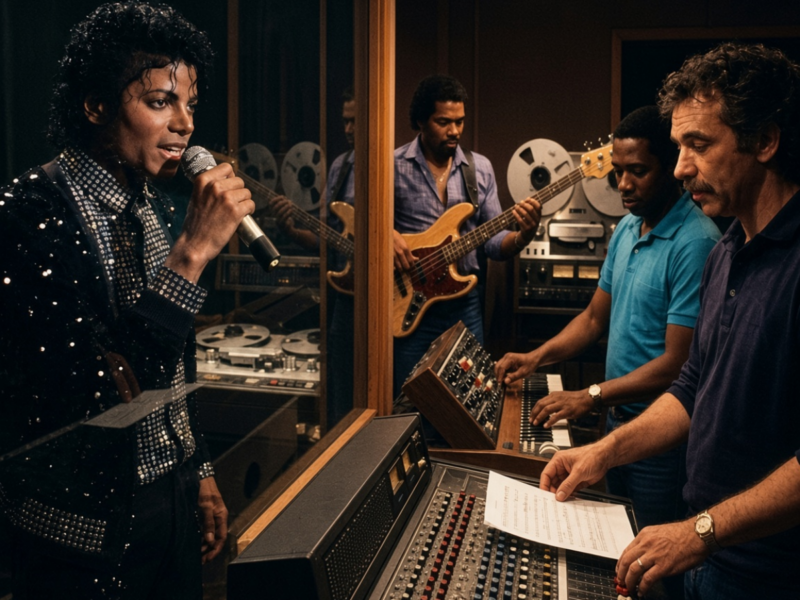
Michael Jackson Played ‘Billie Jean’ — Quincy Jones Had to Stop Him.
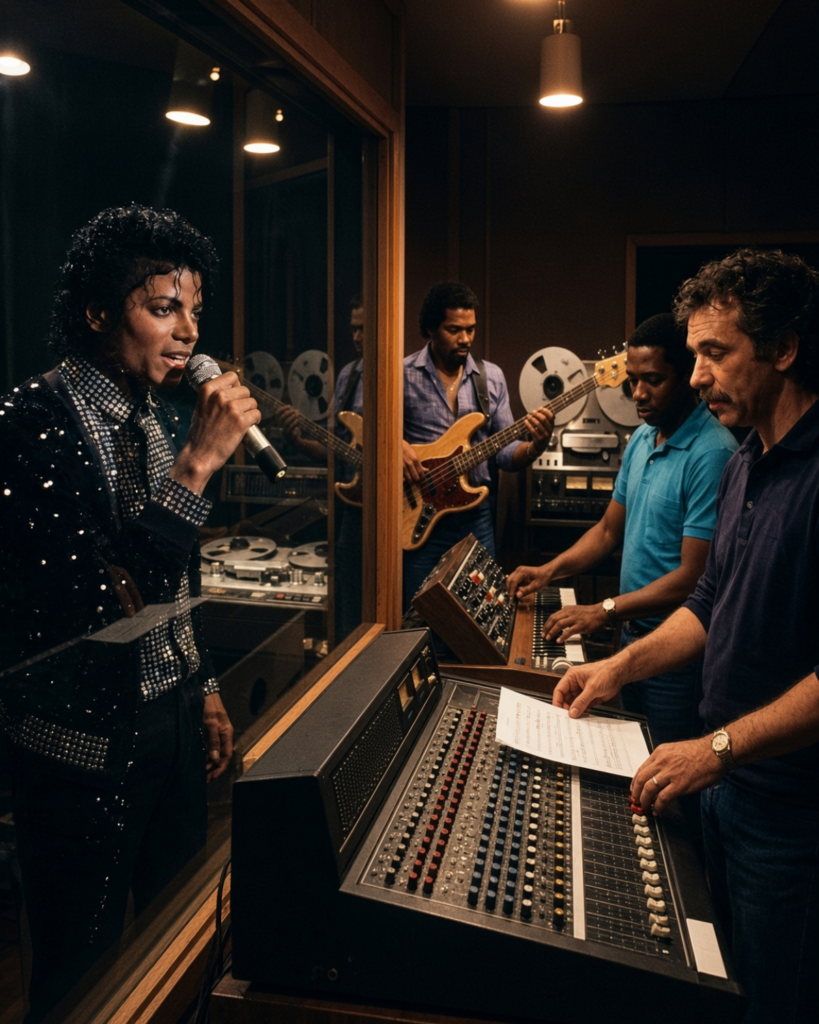
The biggest pop star on earth is locked in a dark Los Angeles studio, standing in front of a live microphone.
He hits the downbeat, singing a baseline that will change pop culture forever.
And suddenly Quincy Jones slams his hand on the console and cuts the tape dead.
If you’ve ever wondered what happens when absolute pop royalty walks into a room with the most demanding jazz-trained producer on the planet, you’re about to find out.
Today, we aren’t just looking at the making of a single song.
We are stepping inside Westlake Recording Studios in late 1982 to witness a high-stakes psychological and musical showdown that would define modern music history.
The album was Thriller.
The song was “Billie Jean.”
To understand why that tape was stopped, you have to understand the sheer suffocating pressure inside Studio N at Westlake Recording Studios in the autumn of 1982.
Michael Jackson was only 24 years old.
He was coming off the colossal success of his 1979 solo album, Off the Wall, which had sold millions of copies and established him as a force outside of the Jacksons.
But for Michael, Off the Wall was just a warm-up.
He felt snubbed by the Grammy Awards when it only won a single award.
And that rejection ignited a fire inside him that bordered on obsession.
Michael didn’t just want a hit record.
He wanted Thriller to be a cultural phenomenon, an album where every single track could stand on its own as an undeniable, bulletproof single.
He wanted to shatter every record, cross every musical boundary, and appeal to every demographic on the planet.
Enter Quincy Jones.
Known in the industry simply as Q, Quincy was musical royalty.
He wasn’t a pop star.
He was a titan of jazz, big band arrangement, and film scoring.
He had arranged for Frank Sinatra, conducted for Count Basie, scored scores of major Hollywood films, and accumulated a level of musical authority that few in the industry could rival.
Quincy didn’t care about fleeting pop trends, flashy image, or studio hype.
He cared about three things: emotional truth, rhythmic discipline, and sonic space.
When these two forces met at Westlake, it was a collision of two distinct generations and philosophies.
Michael represented raw, instinctive, body-first pop genius.
Quincy represented decades of classical and jazz rigor.
And when work began on a track titled “Billie Jean,” those two philosophies were put to the ultimate test.
The origins of “Billie Jean” trace back to Michael’s home studio at the Hayvenhurst Estate in Encino, California.
Michael spent weeks in isolation working on a home four-track cassette recorder.
The inspiration for the song came from a composite of real-life experiences: groupies who had harassed Michael and his brothers during their touring years, making claims of paternity that haunted Michael deeply.
Michael spent days walking around his estate with the melody looping endlessly in his mind.
He was so consumed by the song’s hypnotic groove that he famously didn’t even notice his car caught fire on the Ventura Freeway while driving home from a studio session.
He was humming the baseline aloud to himself.
When Michael brought the home demo to Quincy, he knew he had something extraordinary.
The demo already contained the foundational elements: the iconic walking baseline played on a synthesizer, the subtle rhythm guitar chops, and Michael’s raw vocal arrangements.
However, Quincy had immediate reservations.
First, Quincy hated the title.
He felt people would associate “Billie Jean” with tennis star Billie Jean King and initially wanted to rename the track “Not My Lover.”
Second, Quincy felt the intro was far too long and sparse.
But Michael stood firm on the title, and more importantly, he refused to let anyone shorten the track’s driving hypnotic rhythm.
To bring “Billie Jean” from a cassette demo to a radio masterpiece, Quincy brought in his secret weapon: legendary recording engineer Bruce Swedien.
Swedien was an audio wizard who believed in recording music with maximum dynamic range and spatial separation.
Swedien approached “Billie Jean” not as a standard pop session, but as an architectural project.
To get the drum sound right, Swedien constructed a custom wooden platform for session drummer Ndugu Chancler’s drum kit.
He designed a special isolation box for the bass drum and placed a piece of flat plywood between the hi-hat and the snare drum to prevent the sound of the hi-hat from leaking into the snare microphone.
They recorded the track using a state-of-the-art Harrison Series 4000 mixing console.
Swedien would end up mixing “Billie Jean” a total of 91 times over several weeks, tweaking microscopic volume differences, EQ balances, and room reverbs, only for Quincy and Michael to ultimately choose Mix 2 as the final master.
Every single element was being built with surgical precision.
Session bassist Louis Johnson was brought in to play live bass over the synthesizer baseline, creating a dual-layered, punchy low-end that felt both mechanical and deeply human.
Synthesizer wizard Greg Phillinganes and arranger Jerry Hey worked on layering synth pads and horn stabs that added layers of dark, paranoid atmosphere to the track.
Let’s look closely at the structure of “Billie Jean.”
If you listen to the finished track today, the intro is a masterclass in psychological buildup.
It starts with drums alone, a steady, unyielding four-on-the-floor beat played by Ndugu Chancler, accompanied by a subtle shaker.
Just drums and percussion building tension for four full bars before that famous baseline enters.
Most pop producers in 1982 would have rushed that intro.
Radio programmers demanded tracks that hit the main hook within five to ten seconds to prevent listeners from changing the dial.
Standard industry wisdom dictated that you throw synths, guitar chops, or vocal hooks right at the start.
Michael and Quincy disagreed with industry standard wisdom, but they also disagreed with each other on how to handle that tension.
Michael wanted the rhythm section to stretch out for as long as possible.
He wanted the listener’s body to adjust to the tempo, to feel an irresistible compulsion to move before any melodic element was even introduced.
During playback sessions in the control room, Michael wouldn’t sit in a chair.
He would stand near the monitors, snapping his fingers, stomping his feet, and dancing in place.
If a section of the song didn’t make him want to dance right there on the studio carpet, he considered it a failure.
He was choreographing the track in real time, engineering a physical neurological response.
Which brings us to that fateful afternoon in Westlake Studio N.
Michael had just spent over an hour inside the vocal booth delivering pass after pass of lead and background vocals.
He emerged from the booth into the dimly lit control room, sweating, his hair tied back, driven by adrenaline.
He walked up to the console and asked Bruce Swedien to rewind the master tape.
He wanted to demonstrate a specific vocal phrasing idea and a subtle shift in micro-rhythm for the pre-chorus section.
Michael stood right beside the console, humming along with the playback, using his hands to demonstrate the push-and-pull rhythm he felt the track needed.
And right in the middle of his demonstration, click.
Quincy Jones reached over, slammed his palm down on the mixing console, and hit the stop button, bringing the tape drive to a dead halt.
The heavy studio monitors went completely silent.
The atmospheric tension in the room instantly spiked.
Bruce Swedien froze mid-motion.
The assistant engineers lowered their heads.
The only sound left in the room was the low electric hum of the power amplifiers and the air conditioning vents.
Michael stopped mid-vocal phrase.
His body went still, his shoulders tensed, and he turned slowly to face Quincy.
Quincy slowly removed his reading glasses, placed them on the console, leaned back in his leather swivel chair, and looked directly at Michael with that calm, unshakable glare that had governed studio sessions for four decades.
“Micro-timing, Michael,” Quincy said, his tone quiet, measured, yet authoritative.
“You’re rushing the intro. You want people dancing before the beat even establishes itself. But if the baseline doesn’t breathe for those first four bars, you destroy the hypnotic effect. You’re letting the energy out of the balloon too fast.”
For any 24-year-old artist, even one who had sold millions of records, being stopped mid-sentence and corrected in front of an elite team of audio engineers could have easily triggered a massive ego defense.
Lesser artists would have argued, thrown a tantrum, or retreated into defensive silence.
Instead, Michael took a step closer to the console.
Michael didn’t react with anger because he understood who Quincy was: a mentor who cared deeply about musical integrity.
But Michael also knew something that Quincy’s traditional jazz training made him overlook.
Michael’s urge to push the timing forward wasn’t an accident or a lack of discipline.
It was an instinctive manipulation of energy.
“If we hold it back too long, Q, the listener gets passive,” Michael explained quietly.
His voice gentle but firm.
“They need to feel the pull. They need to feel like they’re chasing the beat, like the song is running ahead of them and pulling them onto the floor.”
Quincy leaned back and shook his head, offering a dry smile.
“No, Michael. Music is like a rubber band. If you pull it too tight, it snaps and loses its elasticity. If you let it go too fast, there’s no snap at all. You have to stretch it until it hurts. Hold it right at the breaking point and then let go.”
The control room became a battleground between two distinct eras of American music: the jazz arranger who understood tension through structural harmony and the pop genius who understood tension through physical sensation and street-level dance dynamics.
What Quincy didn’t fully realize at that precise moment was that Michael wasn’t operating solely on pop intuition or dance floor instincts.
Beneath the glittering stage presence, the white socks and the fedora was a musician with a deeply disciplined secret classical education.
While the world knew Michael as the child prodigy from Gary, Indiana, who grew up under the Motown label, few people understood the level of formal rigor Barry Gordy had instilled in his young artists.
Back in the late 1960s, Gordy insisted that all Motown acts study musical structure, arrangement, and theory.
While his brothers were relaxing or playing sports during breaks on tour, young Michael was frequently found in hotel lounges or private practice rooms with classically trained piano instructors.
He spent years dissecting classical compositions, analyzing the counterpoint of Johann Sebastian Bach, the dramatic dynamic shifts of Ludwig van Beethoven, and the emotive melodic phrasing of Frédéric Chopin.
Throughout the late 1970s and early 1980s, Michael maintained a private piano practice routine.
He understood voice leading, vocal stacking, dynamic tension, and thematic development on an analytical level.
So when Quincy spoke about the rubber band theory of rhythm, Michael didn’t just hear producer advice.
He mapped it directly onto classical compositional techniques.
He knew that what Quincy called stretching the rubber band was functionally identical to the rubato and dynamic control used by classical masters to build unbearable dramatic suspense before a musical payoff.
Michael looked at Quincy, smiled, and nodded.
“Let’s roll the tape back.”
What followed over the next several hours was a master class in record production and sonic engineering.
Instead of arguing about theory, Michael and Quincy worked together to deconstruct and rebuild the track’s micro-rhythms step by step.
They systematically evaluated every instrument in the mix.
One, the kick and snare balance.
Bruce Swedien adjusted the decay settings on the noise gates so the snare drum cut cleanly without washing over the synth bass.
Two, the synth bass decay.
Quincy and Michael tweaked the envelope controls on the synthesizer, shortening the release time on the notes so that the space between the bass notes felt as loud and impactful as the notes themselves.
Three, vocal percussion layering.
Michael stepped back into the vocal booth and recorded multiple tracks of vocal percussion: his signature gasps, heh-heh clicks, and rhythmic exhalations.
These were not random vocal ad libs.
Michael arranged them to act as explicit percussion instruments, filling the microscopic gaps in the rhythm section to keep the energy driving forward while the baseline maintained its steady hypnotic hold.
Michael also added a string arrangement written by Jerry Hey, which entered during the second verse.
The strings provided a dark, staccato counter-melody that elevated the song’s feeling of paranoia and isolation.
By late evening, the new mix was complete.
The control room lights were dimmed.
Bruce Swedien pushed the master faders up, bringing the giant Westlake Studio monitors to concert volume, and hit play on Mix 2.
The room was filled with the opening drum pattern.
Four bars went by, sparse, punchy, and deliberate.
Then the walking baseline dropped.
The adjustment was immediate and profound.
By allowing the intro to breathe without rushing the timing, the baseline hit with double the emotional weight.
The space created in the first few bars established an inescapable sense of suspense.
When Michael’s lead vocal entered, delivering the paranoid opening lines—”She was more like a beauty queen from a movie scene”—it floated effortlessly over a rock-solid hypnotic foundation.
Quincy sat silently in his chair, his eyes closed, nodding along to the beat.
Michael stood near the rear of the control room, his feet moving quietly, executing a series of precise dance moves in the shadows.
When the song faded out after four minutes and fifty-four seconds, the room remained silent for a second as the last reverberations faded.
Quincy turned around in his chair, looked at Michael, and broke into a broad smile.
“All right, Smelly,” Quincy said, using his affectionate nickname for Michael.
“You were right about the energy, but the space makes it live.”
Michael smiled back.
The tension had evaporated, replaced by the collective realization that they had just created something that transcended standard pop music.
When Thriller was released on November 30, 1982, Epic Records executives were initially hesitant to release “Billie Jean” as a single, favoring “The Girl Is Mine,” a duet with Paul McCartney, to secure mainstream pop radio play first.
But when “Billie Jean” was officially released as the album’s second single in January 1983, it shattered every industry expectation.
The song exploded onto the global charts, spending seven consecutive weeks at number one on the Billboard Hot 100.
It topped charts across Europe, Australia, and South America, becoming one of the best-selling singles in history.
Beyond radio success, “Billie Jean” rewrote visual culture.
The iconic music video directed by Steve Barron, featuring Michael walking down a city street lighting up stepping stones beneath his feet, became one of the first videos by a Black artist to be placed in heavy rotation on MTV, effectively breaking down the network’s longstanding racial barriers and paving the way for generations of Black artists to come.
Then came March 25, 1983, the taping of the Motown 25: Yesterday, Today, Forever television special.
Performing “Billie Jean” solo on stage, wearing a black sequin jacket, a rhinestone glove, and a black fedora, Michael debuted the moonwalk to an audience of 47 million viewers.
That single live performance cemented his status not just as a pop star, but as a global icon.
Looking back at that afternoon in Westlake Studios, that moment when Quincy Jones stopped the tape wasn’t a story of conflict or artistic defeat.
It was a testament to the power of creative collaboration at the absolute highest level.
It proved that true genius does not exist in a vacuum.
It requires the courage to challenge and be challenged.
Without Quincy’s relentless insistence on space, restraint, and dynamic control, “Billie Jean” might have been just another fast, energetic pop song of the early 1980s.
And without Michael’s unyielding vision, rhythm-first instincts, and classical understanding of dramatic tension, the track might have been stripped of the raw, dangerous energy that made it unforgettable.
The lesson of “Billie Jean” lives in those microscopic details.
In the space between the bass notes, in the four bars of silence before the groove drops, and in the relentless pursuit of perfection by two masters who refused to settle for anything less than immortality.









