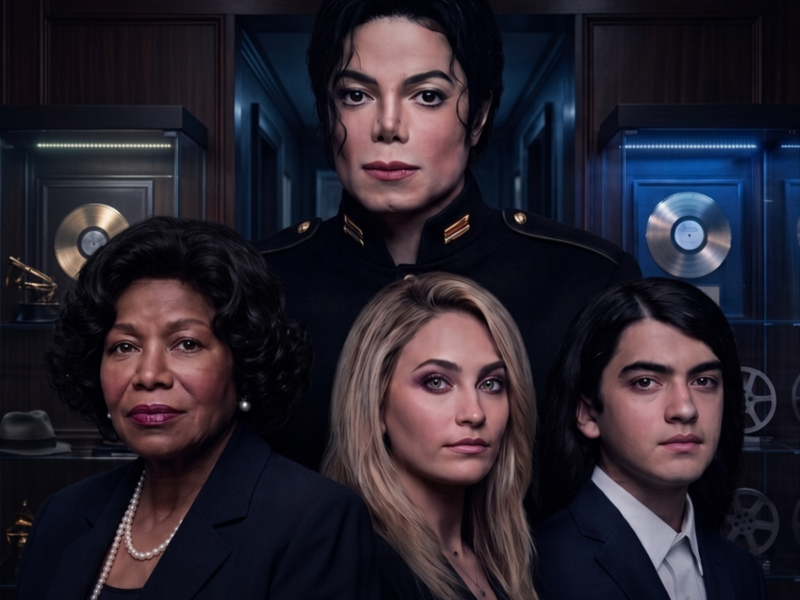
Michael Jackson Left Behind a Fortune — and a Family War.
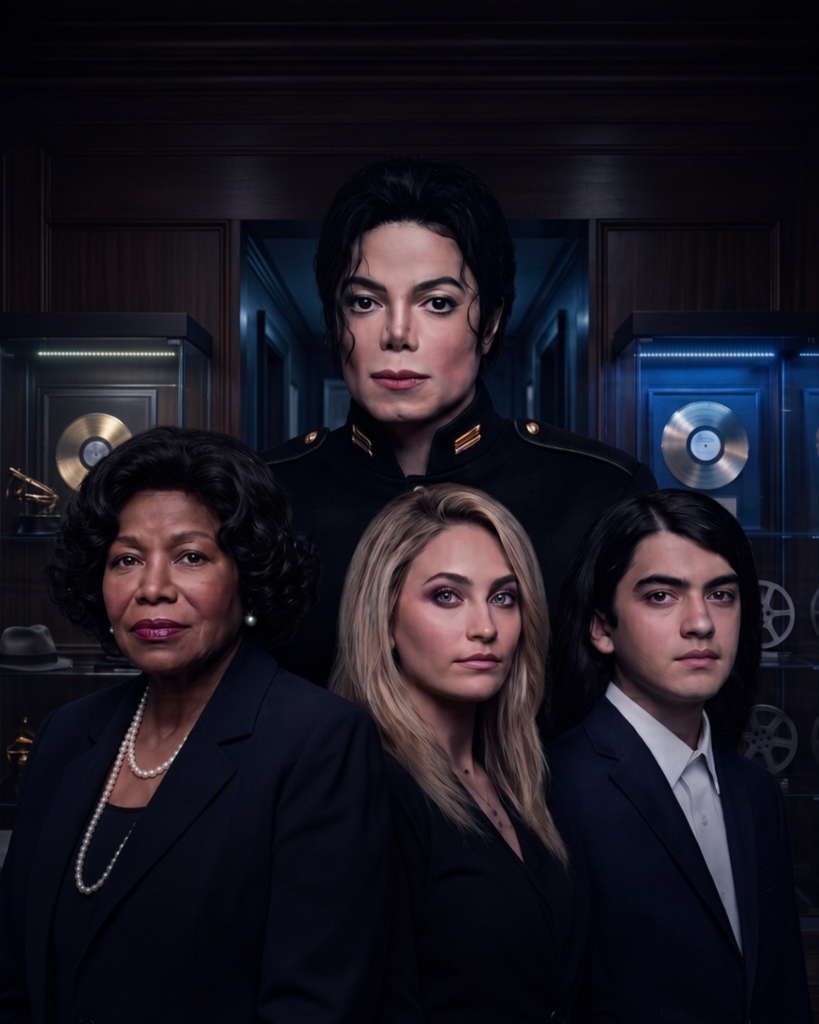
The fight over what Michael Jackson left behind has now lasted longer than any of his children ever had him.
It began four days after he died.
Since then, it has pulled in his mother, his father, five of his brothers and sisters, and all three of his kids.
It has turned a grandmother and her grandson into opponents.
It has put his daughter across a courtroom from the man her father chose to guard everything he owned.
And at the center of it sits a fortune the estate now puts at roughly $2 billion—built, by the estate’s own account, out of a man who died more than $500 million in debt.
But the strangest thing about this war isn’t the money.
It’s that nobody stays on the same side.
Relatives who attacked the executors one year would be split against each other a few years later.
A grandson who stood beside his grandmother would end up fighting to stop her.
And the two men the family accused of fraud—accusations never proven—were at that very moment turning a debt-ridden estate into hundreds of millions of dollars.
So who was actually protecting Michael Jackson?
The family who wanted control, or the men who had it?
The answer begins with a document Michael signed seven years before he died—a document some of the people closest to him would come to call a fake.
June 25th, 2009.
Michael Jackson dies in Los Angeles.
He is fifty years old.
He leaves three children.
Prince is twelve.
Paris is eleven.
The youngest, known to the world back then as Blanket and today as Bigi, is seven.
He leaves a catalog of songs, his own recordings, a half share of one of the biggest music publishing companies on Earth, his name, his face, and a mountain of debt.
Four days later, his parents go to court.
Katherine and Joe Jackson file a petition saying their son died without a will.
They ask that Katherine be put in charge of his estate.
The court agrees temporarily and with limited powers.
For a few days, Michael Jackson’s mother holds the keys to everything her son built.
Then two men step into the case carrying a piece of paper.
It’s a will dated July 7th, 2002.
It names Michael’s lawyer, John Branca, and a music executive, John McClain, as his executors.
It sends everything into a family trust.
His three children are the main beneficiaries.
A share is set aside to care for his mother for the rest of her life.
Charities are named, too.
And the will does something else.
It gives the executors sweeping power—to sell, to lease, to mortgage, to keep Michael’s businesses running.
In the summer of 2009, almost nobody is looking at that clause.
Years later, it will decide a case against his mother.
On July 6th, Judge Mitchell Beckloff makes his call.
Katherine is out.
Branca and McClain are in.
In a single ruling, the shape of everything that follows is locked into place.
Michael’s family would benefit from his fortune, but the power over it—to run it, to spend it, to sell it—belonged to two men outside the family.
Every battle that comes next will be fought in the space between those two things.
The first question is simple.
Does the family accept it?
Katherine at first pushes back.
Then she stops.
In August, she withdraws her bid to run the estate, and the court admits the will.
By November, she drops her objection to the executors altogether.
At that hearing, her position is put in plain words.
It’s high time that the fighting end.
Her husband doesn’t see it that way.
Joe Jackson files his own objection.
He claims the will was fabricated.
He claims the executors have conflicts of interest.
He wants them gone.
He never gets the fight he wants.
The court rules that Joe isn’t a beneficiary under the will, so he doesn’t have the legal standing to challenge who runs it.
An appeals court agrees.
And quietly, while all of this plays out, the legal window to attack the will itself closes.
One hundred twenty days pass.
No one with the right to challenge it files.
On paper, it’s over.
The will stands.
The executors stay.
But in this family, a legal ending and a real ending are two very different things.
The accusation that the will was a fake doesn’t die when the courthouse door closes.
It goes underground and waits.
Meanwhile, the men in charge are not sitting still.
In 2010, the probate court authorizes Branca and McClain to keep operating Michael’s businesses.
That matters.
They aren’t caretakers locking a vault.
They’re running a company—licensing, investing, making deals, all under a judge’s supervision.
And it works.
By the summer of 2012, according to the Los Angeles Times, the estate has brought in roughly $475 million in gross earnings in just three years.
And it has cut deeply into the debt Michael left behind.
That same summer, the accusation comes back.
And this time, it isn’t Joe making it.
In July 2012, a letter reaches Branca and McClain bearing the names of five of Michael’s brothers and sisters: Janet, Jermaine, Randy, Rebbie, and Tito.
The siblings who grew up beside him.
Not one of them inherits under his will.
The letter demands that the executors resign.
It accuses the estate of wrongdoing.
It says, once again, that the will is a fraud.
And then it makes the fight personal.
It says the whole situation is damaging their mother’s health.
Three years after the court shut the door, Michael’s own brothers and sisters are trying to kick it open, and they’re doing it in Katherine’s name.
Which leaves one question hanging: where does Katherine herself stand?
Within days, nobody can ask her.
That July, Katherine travels to Arizona with members of the family.
Back in California are the three children she’s legally raising—Prince, Paris, and Bigi.
And suddenly, they can’t reach her.
They call.
Nothing.
A day passes, then another.
The woman who has raised them since their father died has gone silent.
Paris is fourteen.
She doesn’t wait for the adults to sort it out.
She goes public.
Her grandmother is missing, and she hasn’t heard from her in days.
Now the whole world is watching a family that can’t find its own matriarch.
Authorities locate Katherine and confirm she is physically safe, but safe is not the same as reachable.
Family members and lawyers start saying she’s being isolated, kept away from the very grandchildren in her care.
For the court, the question is narrower and more urgent.
Katherine is the legal guardian of Michael’s three children, and right now she isn’t there to be one.
On July 25th, Judge Beckloff suspends her guardianship and hands it temporarily to Michael’s nephew, the children’s cousin, TJ Jackson.
The judge is careful about how he frames it.
He isn’t punishing Katherine, he says.
He points instead to the intentional acts of third parties—actions by other people that were keeping her from doing her job.
Stop and look at what just happened.
A fight that started over who controls Michael’s money has now reached into who gets to raise his children.
In August, Katherine comes home to California, and she tells her side of those days.
Her phone was taken.
Her iPad was taken.
And nobody told her that her grandchildren were searching for her.
She denies she was ever kidnapped.
In her telling, she wasn’t held—she just wasn’t told.
She gets her guardianship back, but not alone.
At the family’s own request, TJ stays on as co-guardian.
And the offensive against the executors starts to come apart from the inside.
Tito repudiates his part in the letter.
Later, Jermaine pulls his support, too.
Two of the five names are gone.
The executors stay exactly where they are.
But something has broken that won’t be fixed with a court order.
Until now, the line in this fight ran between the Jacksons and the men running the estate.
Now it runs straight through the family, with Michael’s children on one side trying to reach their grandmother and some of their aunts and uncles on the other.
The executors survived the storm.
The family didn’t come out the same way.
And the fortune at the center of it is about to get much, much bigger.
Branca and McClain keep building.
In 2016, Sony buys the estate’s 50% stake in Sony/ATV, the music publishing giant.
The price: $750 million.
The estate keeps Michael’s own master recordings and keeps Mijac, the company that holds the songs he wrote himself.
The executors present the sale as a way to maximize the estate’s value for Michael’s children.
In 2018, another sale.
Sony pays $287.5 million for the estate’s stake in a company that held part of EMI Music Publishing.
That’s more than a billion dollars across two deals in two years, from an estate that began buried in debt.
And in that same year, 2018, something much smaller happens—so small, nobody fights about it.
Branca and McClain approve $625,000 in extra payments to three law firms.
Bonuses on top of their fees.
Nobody says a word.
Not yet.
There’s one more reason the estate stays open year after year: a long fight with the IRS over what Michael was actually worth the day he died.
In 2021, the U.S. Tax Court puts a number on the most famous face on the planet.
His image and likeness at the moment of his death: a little over $4 million.
Disputes like that keep the estate tied up.
As late as 2024, fifteen years after Michael died, his fortune still hasn’t been handed over to the family trust.
The executors still hold it, and that means they’re still the ones who decide what to sell.
In November 2022, they decide to sell again.
The executors ask the court to approve a massive transaction—moving a significant share of the estate’s assets into a joint venture with an outside buyer in exchange for a huge cash payment and a stake in the new venture.
One person files a written objection.
Not Michael’s three children.
Not the brothers and sisters who once demanded the executors resign.
One person.
Katherine Jackson, now in her nineties.
The same woman who thirteen years earlier wanted the fighting to end.
Her argument is not complicated.
The assets are growing in value.
The estate doesn’t need the cash.
Nobody has proven the price is fair.
And then the argument that cuts deepest.
According to Katherine, Michael had told members of his family that these assets should never be sold.
It’s the family’s version of Michael against the paper version of Michael.
What he said, according to his mother, against what he signed.
If Michael’s family was ever going to stand together against the executors, this is the moment.
The grandmother who raised his children is fighting to keep their father’s assets from being sold.
All three of them have a voice in the case.
They don’t stand together.
Prince, the oldest, is the clearest.
He doesn’t object at the start of the hearing.
He doesn’t object at the end.
He doesn’t join his grandmother.
Paris is the hardest to read.
At first, her lawyer tells the court she has no objection.
Then later, she appears briefly to say she’s joining her grandmother.
She doesn’t spell out on what grounds or how far.
The confusion ends up in the record almost word for word: the court was not really even sure what Paris Jackson’s position is.
Remember that line.
It won’t describe Paris for long.
And Bigi, the youngest, the boy who was seven when his father died, takes the strangest path of all.
At first, he holds back his position.
Then he joins his grandmother’s objection.
He stands with her.
And in the same case, he acknowledges that he considers the sale a good business deal.
He’s against it.
And he thinks it’s good business.
Why stand against a deal you believe is good?
The record doesn’t give his reasons, but for now, grandmother and grandson are on the same side.
After a hearing that stretches over several days, Judge Beckloff rules in 2023: the will allows the executors to sell.
They did their homework.
The deal is in the estate’s best interest.
Katherine’s objection is rejected.
In February 2024, the financial press names the buyer.
Sony again—this time acquiring roughly half of Michael’s music interests for at least $600 million, a deal that values that slice of his legacy at around $1.2 billion.
Now Katherine has to decide whether to keep going.
She does.
She appeals.
And the side she thought she had splits apart.
Prince never objected.
Paris doesn’t appeal.
And Bigi, the grandson who had stood beside her, decides he’s done.
His reasoning is cold and clear.
He calls the appeal an extreme long shot.
He says it doesn’t benefit the estate.
But walking away isn’t the end of it, because the fight turns to money of a different kind.
Who pays for the fight itself?
Katherine asks the estate to cover her legal fees—more than $561,000 tied to her objection and her appeal, according to the executors.
And Bigi goes to court to oppose part of it.
He draws a precise line.
He’s willing to accept reasonable fees for her original objection, the one that at least forced a judge to take a hard look at the deal.
But the appeal is another matter.
In his view, estate money paying for it would mean he and his siblings funding a fight they had chosen not to continue.
And there’s a detail that makes the line sharper.
Under Michael’s plan, whatever remains of the share set aside for Katherine passes to his children after her death.
When Bigi asks who should pay for his grandmother’s appeal, he’s really asking whose inheritance should fund it.
Katherine hits back.
She argues the estate can easily afford her fees without hurting anyone.
And she goes further.
She claims the executors keep assets inside the estate in order to hold on to control, and that if everything moved into the family trust, the beneficiaries could receive distributions far more freely.
It’s her accusation, and it’s never proven.
But listen to what it means inside this family.
The grandson’s position is: stop spending the family’s money on this fight.
The grandmother’s is: this fight is about the family’s money.
In 2012, Michael’s children couldn’t reach their grandmother, and one of them told the world she was missing.
Twelve years later, one of them is opposing her in court.
On August 21st, 2024, the California Court of Appeal rules.
Katherine loses.
The court finds she hadn’t properly raised part of her argument in the first place, and even on the merits, the answer is the same.
The will Michael signed in 2002 gives his executors the power to sell estate assets for as long as the estate remains open.
Selling now and handing what remains to the trust later aren’t in conflict.
The clause nobody noticed in 2009 has decided the case.
Not one of Michael’s three children joined her appeal.
The woman who once asked for the fighting to end is, fifteen years later, the last person still fighting alone.
And just as her war ends, another one opens—from the grandchild whose position no one could read.
On June 24th, 2025, Paris Jackson files an objection.
Her target isn’t a billion-dollar sale.
It’s that small payment from 2018—the one nobody said a word about.
$625,000 in bonuses the executors paid to three law firms.
It sounds like a smaller fight.
It isn’t.
Katherine had fought over what the executors were allowed to sell, and the courts had answered her: the will gave them that power.
Paris doesn’t touch that question.
She goes after something else entirely—not what the executors can do, how they do it, and who is checking.
Her questions are specific.
Why were lawyers paid extra money for time that, as she frames it, was never recorded?
Why did some of those payments go out in full before any final approval?
Why did it take years to bring those fees before the court?
And underneath all of it: who is watching the people in charge?
The estate fires back.
It says those lawyers were central to deals that made the estate extraordinarily profitable, and that payments like these are normal in the industry.
And that summer, as Paris widens her challenge to the estate’s financial practices and its disclosures, the executors deliver the argument they’ve been building for sixteen years.
They took an estate drowning in debt and turned it into an enormously valuable business.
And the beneficiaries have benefited enormously.
It’s a collision between two ideas of what protecting Michael means.
The executors point to the results.
Paris points to the receipts.
On November 10th, 2025, Paris gets hit.
Beckloff throws out a major part of her petition.
Key pieces of her case were built on statements made in court filings—territory California law protects.
It isn’t a ruling that her questions about the money are wrong.
But from the outside, it looks like a story this family has lived before.
Joe Jackson challenged the executors and was told he had no standing.
Five of Michael’s siblings demanded they resign, and the executors stayed.
Katherine fought the sale and lost twice.
For sixteen years, every Jackson who has come after these two men has walked away without what they came for.
Now it looks like Paris is next.
She could stop there.
She doesn’t.
She announces she’s going to keep fighting, and she reshapes her case.
Five months later, the pattern breaks.
On April 29th, 2026, Mitchell Beckloff—the same man who has overseen this estate since the summer Michael died, now handling the dispute as a private referee—signs a 23-page ruling.
He sides with Paris on the bonuses.
In his words, “The bonus amounts paid appear arbitrary.”
The $625,000 has to go back into the estate.
The executors can no longer pay lawyers bonuses like that without written consent from every beneficiary or an order from the court.
Thirty percent of the lawyers’ fees must now be held back until they’re approved.
Fee requests stretching back years have to be brought forward.
And Paris, for what she recovered, is entitled to reasonable fees of her own.
Think about what that means.
The money nobody said a word about in 2018 is going back.
And the men who have held power over Michael’s fortune since 2009—the power the will gave them, the power the courts kept confirming—now have limits on how they pay their own lawyers.
Not because of a letter.
Not because of a public accusation.
Not because of a claim about what Michael would have wanted.
Because a beneficiary asked where the money went, and a judge found the answer didn’t hold up.
After nearly seventeen years, someone from Michael’s own family has finally made the executors give money back.
Three years earlier, a court wasn’t even sure what Paris Jackson’s position was.
Nobody is unsure now.
But the ruling cuts both ways, and that’s what makes it real.
It also recognizes the estate’s extraordinary financial turnaround.
Paris wins her battle.
Branca’s larger defense—that the executors built something enormous—survives.
And then, less than a month later, the war loses one of its original players.
On May 26th, 2026, John McClain dies in Los Angeles at seventy-one, from complications after a fall.
For seventeen years, he and John Branca had run Michael Jackson’s estate together.
Since the week the will appeared, it had always been the two of them.
Now, in the filings that follow, one name stands across from Paris: John Branca.
And her victory doesn’t end the fight.
It moves it.
In July, the battle turns to secrecy.
Paris opposes efforts to seal information about the fees.
Branca argues that exposing certain documents could damage future deals or hand an advantage to the estate’s adversaries.
Paris presses the question at the heart of her whole campaign: how much is a beneficiary actually allowed to know?
Then comes September 2026.
Having won back $625,000, Paris asks the estate to pay her legal bill.
The amount: $1,165,481.90.
Branca doesn’t dispute that she deserves reasonable fees for what she recovered, but he objects to the number.
He says it includes work on fights she didn’t win.
One day later, the estate files a request of its own.
It asks the court to approve more than $9 million in legal fees—about six years of work on taxes, trademarks, business deals, and litigation.
The estate’s justification is the same story it has told since 2009.
An estate that once carried more than $500 million in debt is now, by its own valuation, a conglomerate worth around $2 billion.
As of today, no public ruling has settled either request.
So, after seventeen years, the family is fighting over how much it cost to fight.
And that’s the answer to what Michael Jackson really left behind.
He left his family a fortune, and he gave the power over it to two men outside the family.
He made his children the beneficiaries, and he made his mother a beneficiary for life, but he gave the decisions to Branca and McClain.
Every war since 2009 has been an argument over that single choice.
His parents tried to take control, and the will took it away.
His brothers and sisters tried to remove the executors, and the family split instead.
His mother tried to stop a sale, and her own grandson refused to pay for it.
His daughter went after how the executors paid their lawyers, and made them give the money back.
The war didn’t end because anyone won it.
It changed shape every time the fortune grew.
First, it was about who controls Michael’s legacy.
Then whether to sell it.
Then who watches the people selling it.
And now, who pays for all of it.
The fortune survived.
It kept growing.
But the family it was meant to protect has spent seventeen years fighting over what protecting him actually means.
Michael Jackson was a father to his children for twelve years, eleven years, and seven years.
The war over what he left them is seventeen years old, and no one has set a date for it to end.









