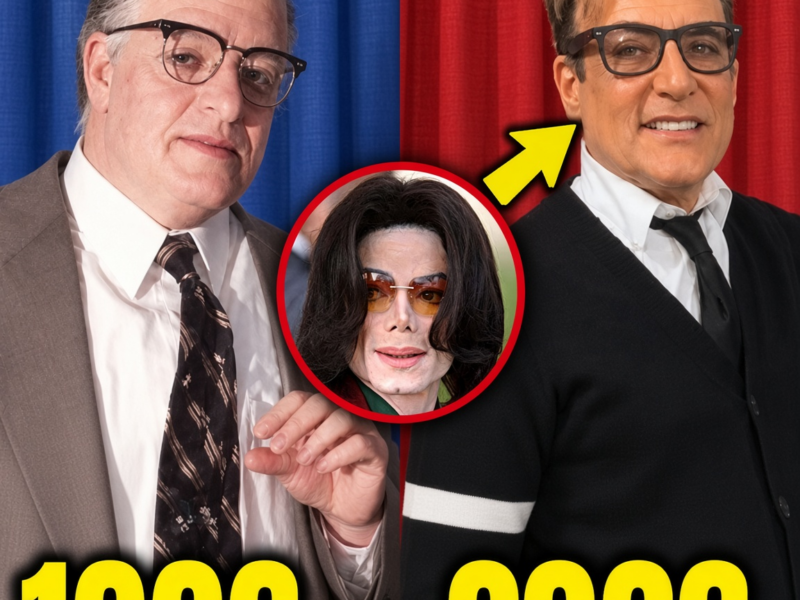
Michael Jackson Is Fooling Everyone With This Secret Disguise.
The extent of recognition Jackson had gained by the 1980s made him unique in celebrity history.
His face was so recognizable that walking down the street would incite a stampede.
“Thriller” alone sold more than 30 million copies in America, making Jackson undoubtedly the world’s most recognizable person.
Fame came at a huge cost for him.
Visiting grocery stores, cinemas, record stores, even going on a walk through the park became an impossible task without the presence of security guards, crowds, and photographers.
According to many people who worked with him, Jackson was craving those simple pleasures of life which were stolen away from him because of his fame.
Buying records, going to watch movies, letting his kids go out on Halloween.
And thus he became an artist of disappearance, through connections with some of the best Hollywood special effects artists, including Rick Baker, winner of several Oscars for makeup artistry.
Michael Jackson approached disguise just like he did choreography and directing, as an art that one could master fully rather than a simple sleight of hand trick to fool a passerby for five minutes.
False beards, afros, fake aging prosthetics, masks, and even full bodysuits were real means for reclaiming, if only for a few moments, a semblance of normality he lost around age eleven when the Jackson 5 rocketed to fame.
Here begins a journey through his disguises, confirmed by interviews, biographies, and the actual experiences of the individuals who aided in his disappearance.
From a Manhattan concert hall in 1984 to the movie theaters, malls, and ski slopes where he would assume another identity completely.
It leads onto the sets where makeup turned him into werewolves, robots, and laughing ghouls for the cameras, and ultimately to the cinematic tactics of deception, decoys, body doubles, and even rocket-assisted escapes that enabled him to disappear from stadiums packed with hundreds of thousands of devoted fans.
Few stars in the annals of modern celebrity have approached the art of playing hard to find with such a dedication to creativity and delight in the role.
And appropriately enough, it was a date that made him do it.
The date took place in 1984 when Jackson went to see a concert by the band Kool and the Gang at Madison Square Garden with actress Tatum O’Neal.
But knowing full well that such an event was certain to attract too much attention, Jackson asked for help from Rick Baker, the makeup artist who would go on to create the werewolf look for “Thriller.”
Baker created the wig and the beard with which Jackson was able to age himself considerably.
And according to O’Neal, the disguise proved to be so successful that the couple managed to slip through the crowd unnoticed.
Although O’Neal jokingly noted that he could have attracted quite a few curious glances of a totally different sort, as an older couple going to a concert with a much younger date.
This first victory seemed to have created an opening.
Jackson would start visiting regular record shops dressed in tattered clothes, worn-out shoes, false buck teeth, and intentionally messy wigs.
Acting like a homeless person looking around the store instead of the most famous pop star on Earth.
Quietly browsing records next to people who had no clue who was standing right next to them, and who sometimes even felt sorry for him and gave him money thinking he really needed it.
For someone who could always expect screaming crowds whenever he showed up somewhere, this sort of shopping was almost a miracle in itself.
Just being in a room for ten or fifteen minutes without being noticed while browsing records was the same as everyone else.
Chris Tucker himself has described how he used to take Jackson to regular movie theaters with his heavily made-up face, thick coats, and big hats on several television shows, and stated how strange it felt to be in a movie along with one of the most recognizable performers ever while a regular audience was sitting just a few rows away from him and had no idea that they were sitting along with the King of Pop in the theater.
Tucker described how Jackson used to enjoy those moments immensely and considered visiting the movie theaters something like a great luxury for which many people do not care.
This is exactly what happened when singer Akon recounted his experience at a mall with Michael Jackson.
He said how the pop star arrived looking very believable in his old age, with wrinkles, gray hair, and a wooden walking stick, walking past shops as a stranger whose age was so real no one ever bothered to give him a second glance.
Akon says the transformation was so great that he would sometimes have to remind himself who was under all that makeup, because he found himself walking side by side with Michael Jackson.
The disguise that made him most famous, however, did not rely on any high-tech disguise whatsoever.
His signature black surgical mask, large sunglasses, and hat, which he wore relentlessly through airports and urban streets throughout the 1990s and 2000s.
The look became so strongly connected to Jackson that it began to work less as a disguise and more like a second signature look, one immediately identifiable in tabloids around the world.
A bizarre situation in which the disguise actually became as famous as the face it sought to conceal.
During his stay in Bahrain after 2005, having moved to the Gulf state in the wake of his legal woes in California, Michael Jackson apparently used a woman’s traditional abaya and niqab outfit to take his kids shopping without attracting the attention of the paparazzi, which is a classic example of the length to which he went for one simple day in his life in another country.
It is the outfit that made it possible for Michael to be virtually anonymous in the area where such clothes are very common, giving him the opportunity to move around without being surrounded by all the commotion that would have surrounded him everywhere else in the world, and reportedly to shop without any disturbance for the first time in years.
The use of a wheelchair, a bulky blanket that completely covered his body, and a large black umbrella that provided enough shielding of his face was the method employed during hospital and hotel exits, which turned what could have been a simple process of leaving through the hotel’s lobby into a small-scale security detail, where aides stood in place to block all camera angles from taking shots at photographers that were waiting for him outside the hotel’s main entrance.
It is worth noting that not all disguises worked.
In 2003, when visiting a gift shop in Las Vegas, Michael Jackson wore a mustache, wig, and false teeth.
But the store owner recognized him from the distinct walk caught on the store’s security video system.
The case revealed the limits of using a simple disguise that is based solely on facial features and makeup and ignores the particular body language of a dancer who spent decades of his life performing on stage.
Traveling to Aspen in winter would involve wearing a full-faced mask for skiing along with goggles, large-brimmed hats, and coats to hide the face.
So much so that other skiers would think that he is just another tourist taking advantage of the snow slopes instead of the world’s most photographed man quietly skiing past them in the holiday season.
As music director Chucky Booker recounted, Jackson once approached him while wearing only his regular clothing and wearing a simple hat, engaging him in conversation until the end without revealing his identity at all, showing that sometimes even the most simple disguise combined with confidence and a slight change in one’s speech could be enough to fool the world.
He recounted how surreal it seemed for him to see Michael Jackson standing right before him, with his voice slowly transforming into a recognizable one as he saw his face.
And for his own children, Halloween provided one precious gift each year.
Rubber monster masks, witches, and ghouls that allowed him to become invisible amongst the other costume trick-or-treaters, blending in just once a year as a nameless parent rather than the most scrutinized performer of his time.
These occasions were seen by many and described as times where Jackson appeared to be far less stressed, more relaxed than he ever appeared elsewhere, and had the privilege to enjoy the moments which are a given to all of the world’s parents.
These eleven examples in total prove not to be just a celebrity’s quirks.
They are instead examples of how this individual took control of a few moments within his life and made efforts to create a sense of normality in a life which was otherwise dictated by nothing but spectacle, grandeur, and public observation.
No matter how elaborate the costume was, the basic idea remained unchanged.
Whereas the public disguises were all about concealing Michael Jackson, the screen disguises were about doing the opposite.
Using prosthetics and costume to transform himself into someone totally different in front of hundreds of millions of viewers across the globe.
In “Ghosts,” Michael Jackson underwent several hours of work with prosthetics such as foam latex to transform himself into the Mayor of Normal Valley, a chubby old conservative white bureaucrat who intends to chase Michael Jackson from the town.
The disguise involved not only putting on the costume but also a totally different way of walking, a different stance, and also a totally different comedic timing.
Michael Jackson loved to completely disappear into the character, such that at the end of the video one would look at the credits to know who was the real performer of the dance steps.
This particular film went even farther, featuring Jackson as several ghoulish individuals, including the monstrous Super Monster, all done under heavy makeup that used both motion capture techniques and CGI effects, which were considered state-of-the-art for mid-1990s music videos and never equaled since then.
Industrial Light and Magic also worked on the video with digital effects, combining practical prosthetics with computer animation, an uncommon technique used in short-form music videos, thus squeezing a limited budget of a minor horror film into a one-of-a-kind music video of thirty-eight minutes in length.
However, none of these transformations stands out in pop culture history more than “Thriller,” where Jackson worked once again with Rick Baker, who also created the disguise of Kool and the Gang years before in his concert, into a snarling cat-like werewolf wearing glowing yellow contact lenses and moving facial prosthetics, only to come back as a decaying dancer among zombies.
The fourteen-minute short film directed by John Landis became one of the most influential and technologically advanced music videos ever made and was partially responsible for the rise of music videos as a full-fledged cinematic art rather than just promotional material.
Five years later, “Moonwalker” took Jackson’s movie persona sci-fi altogether, transforming him into a giant cyborg robot, running away from a claymation car chase done through stop-motion animation techniques that had been developed by Will Vinton Studios, the animation studio that made the commercials and short films during the period.
In the same “Speed Demon” portion of the film, Jackson also had a dance showdown with Spike, an oversized claymation rabbit that was done in a satiric and cartoonish style as a takeoff on Jackson himself, yet with impressive stop-motion animation to match his own dance moves.
Jackson appeared in the song “Black or White,” which was released in 1991.
This song presented a quieter yet equally impressive Jackson appearing out of an unprecedented computer-generated morphing effect, one of the earliest such effects to be displayed to the public, changing into himself from a sleek black panther before performing a highly charged solo dance routine that remains one of the most frequently played and talked about music videos ever made.
In order for Jackson to change into the black panther in the music video, elaborate frame-by-frame digital composition was needed and took many months to do.
And in the “Remember the Time” video directed by John Singleton and starring Eddie Murphy, Magic Johnson, and a who’s who of Black Hollywood royalty, Jackson was shown entering the stylized ancient Egyptian court, completely enveloped in a black hooded robe along with a retinue of guards of the pharaoh, keeping his true identity hidden from the royalty watching on screen before making an elaborate magical entrance surrounded in a shower of gold dust, a theatrical mask-lifting ritual that served as both plot point and pure spectacle.
The unmasking moment became one of the defining moments of a decade full of mystery and revelation.
In combination, these seven transformations demonstrate an artist who used disguise not just for escape, but as a language unto itself, one that he cultivated over the course of a decade through increasingly ambitious short films.
Whereas his disguises in the public sphere were intended to make him undetectable, seamlessly passing by strangers without their knowledge, the characters he played in film were constructed in order to be indelible.
Each requiring special effects artists, pain, and relinquishing all control to a self very different from his own.
Few performers before or after him have invested so much time into disappearing both from the world and from himself, while doing it so entertainingly at the same time.
One of the most iconic examples of Jackson’s costumes did not involve any of these secret vacations, but rather was an act hidden within the confines of popular entertainment in a costume which could be attributed to someone else or obscured by so much makeup that it would be impossible for a casual viewer to identify him.
One such example is Jackson’s appearance in “Men in Black 2,” a film from 2002 where Jackson appears as a secret agent called Agent M.
This agent applies for a job as a member of the fictitious police force responsible for maintaining order in the entire galaxy and works alongside such actors as Will Smith and Tommy Lee Jones.
More than nine years prior to that, Jackson portrayed Leon Kompowsky, a psychiatric patient who believed himself to be Michael Jackson in “Stark Raving Dad,” an episode of “The Simpsons” from 1991, among the earliest of the show’s favorite guest-starring spots.
Due to a legal obligation to the label at the time, he took the name of John Jay Smith for credit on the project, the best known of animation history’s inside jokes, which the show’s writers have made fun of since then, years later, when fans long knew the unmistakably speaking voice of the character as their idol’s.
Far earlier than all of that, a young adult Michael Jackson hid his identity under burlap and straw, covering his entire body from head to toe, along with thick face paint to play the role of Scarecrow in the 1978 film musical version of “The Wiz,” starring Diana Ross, directed by Sidney Lumet.
He had to convey the Scarecrow’s gentle and clumsy nature through his actions and his voice, and not his recognizable face, and the role proved pivotal in meeting producer Quincy Jones, who was to help create the sound of “Off the Wall,” “Thriller,” and “Bad.”
In his 1990s Dangerous World Tour, Jackson utilized chrome masks with mirrors to cover his face during intermission segments and videos to hide his identity from both the crowd and the backstage crew while performing intricate costume changes between acts, turning what would have been a simple wardrobe requirement into a further source of mystique for his performances.
The visual imagery was consistent with the overall tour motif of transformation and illusion and helped develop the underlying concept of Jackson’s career up until that point, which was the fact that the identity behind the mask did not matter nearly as much as the story that the mask told.
At its most grandiose level, Jackson’s disguise process transformed from being purely self-disguise to theatrical illusionism with teams of collaborators involved rather than just a wig or mask.
However, the irony of the story has one truly touching element behind it.
No matter how he may try to cover up with costumes and ridiculousness, they brought Jackson some brief moments of everyday experience, such as going through records without people collecting around him, going to see a movie next to an oblivious stranger, or trick-or-treating with his kids on some peaceful residential street.
This is not the behavior of a man who wants to be famous.
This is the behavior of a man attempting to return to normal life.
It is clear, however, that his legacy goes much further than simply chart success, choreography, and album sales.
In terms of mastery of disguise, Michael Jackson may be considered an unparalleled artist who saw deception as a creative medium worthy of perfection, regardless of whether it involved fooling a camera in Las Vegas or shocking an entire generation with a fourteen-minute werewolf metamorphosis.
It would be hard to think of another celebrity who ever needed a disguise more, and one who made this need such a constant, surprising entertainment to watch many years after the man himself did so.









