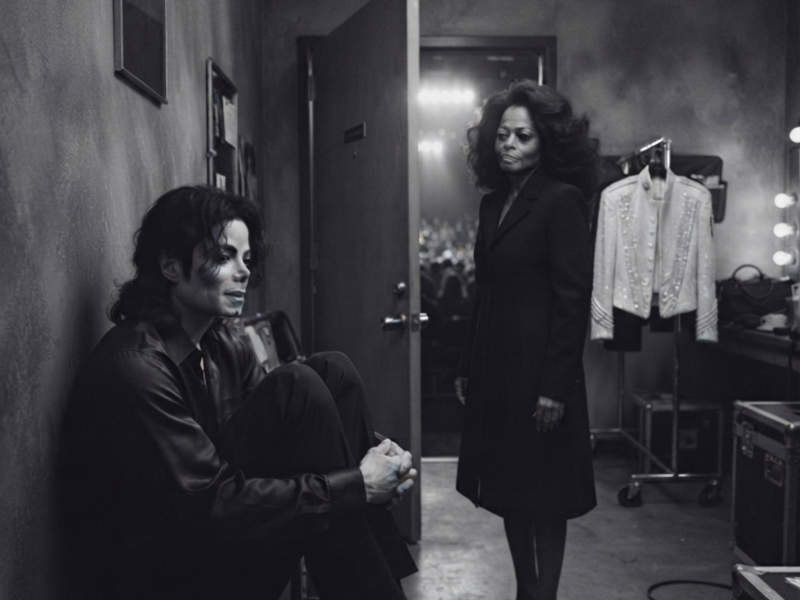
Michael Jackson FROZE Backstage and Refused to Move — Only One Person Could Reach Him.
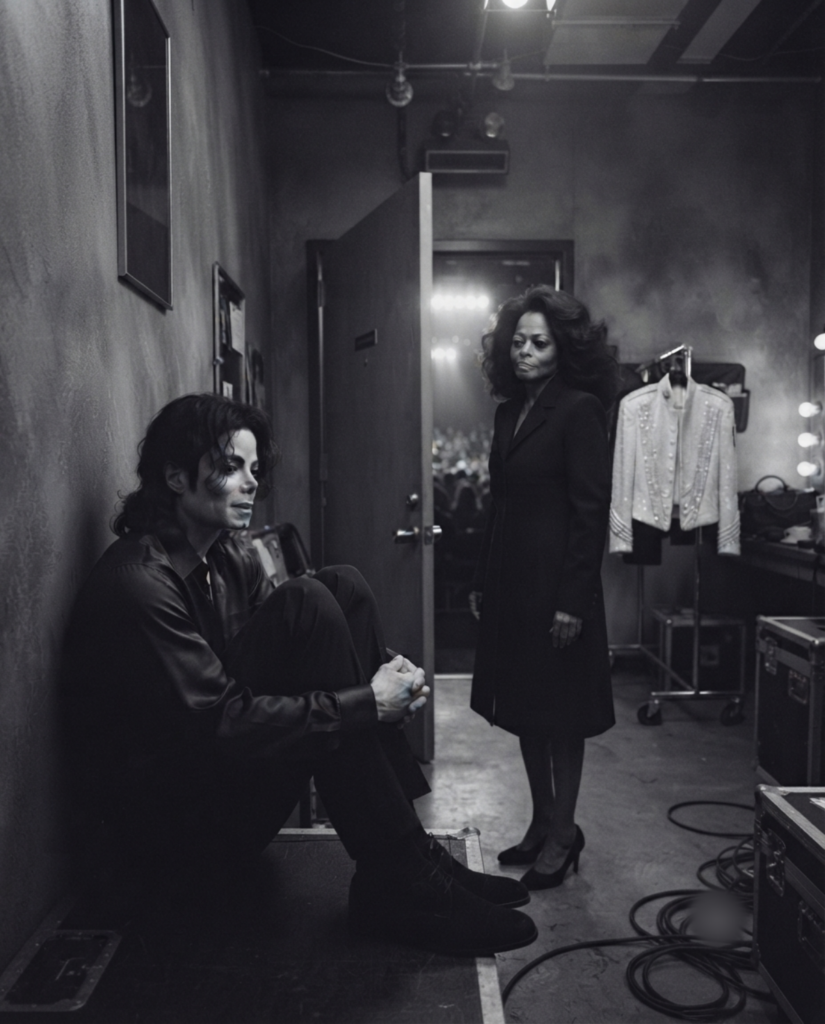
The stage manager’s radio crackled at 7:43 p.m., and the message made his blood run cold.
“Michael Jackson is not moving. He’s in the corner of his dressing room, and he won’t respond. Someone get down here now.”
Madison Square Garden.
The 10th of September, 2001.
One of the most important concerts ever staged in the history of popular music.
Thirty years of Michael Jackson’s solo career.
Twenty thousand people already inside the arena, screaming, chanting his name, shaking the floor above his head.
And the King of Pop was sitting on the floor of his dressing room, back against the wall, arms wrapped around his knees, staring at nothing.
He hadn’t spoken in fourteen minutes.
He hadn’t moved in eleven.
And nobody in that building—not the producers, not the security team, not the six backup dancers warming up in the corridor—had any idea what to do next.
But there was something else happening that night that nobody in the mainstream press ever reported.
Something that explains not just why Michael froze, but why what happened in the next twenty minutes became one of the most quietly devastating and quietly triumphant stories in music history.
Because what Michael Jackson was carrying into that building on the 10th of September, 2001, wasn’t just the weight of a comeback concert.
He was carrying the weight of everything he’d already survived.
Let’s go back.
Thirty years is a long time to be famous.
For Michael Jackson, it was a physical reality that lived in his body every single day.
He had been performing professionally since he was six years old.
While other children were learning to read, Michael was learning how to feel a crowd.
By twenty-five, he had already changed music, dance, and the entire concept of what it meant to be a global entertainer.
But here’s what the world didn’t see behind the sequined gloves and the moonwalk and the smile that lit up entire arenas.
Michael Jackson had never once chosen this life.
It had been chosen for him.
And for three decades, he had carried that truth like a stone in his chest.
Heavy.
Silent.
The 30th Anniversary Celebration concerts at Madison Square Garden were supposed to be a triumph.
Two shows.
September 7th and September 10th.
Whitney Houston.
Usher.
Destiny’s Child.
The industry saying, in the only language it knows, “You are irreplaceable.”
September 7th had gone beautifully.
Michael transformed the moment a spotlight found him.
Electricity.
Pure and concentrated.
But September 10th was different from the moment the SUV pulled up.
His personal assistant, Gary, noticed it first.
Michael stepped out, looked up at the marquee—his name in lights, “Michael Jackson: 30 Years of Solo Career”—and just stopped.
The security team waited.
Nobody said anything.
Then Michael put on his sunglasses, even though it was already evening, and walked inside without a word.
In the dressing room, the rituals that always grounded him slipped away one by one.
His costume—the white military jacket, the black pants, the single glove—lay untouched on the rack.
His makeup artist, Maria, asked three times if he was ready.
He nodded all three times.
Didn’t move.
At 7:43, Maria stepped into the corridor and said four words that sent controlled panic through the entire production team.
“He won’t come to the mirror.”
That doesn’t sound like a crisis.
But everyone who knew Michael understood exactly what it meant.
The makeup mirror was the transition point.
The moment where he became the performer.
If he wouldn’t come to the mirror, he was stuck.
The stage manager found him exactly as described.
Floor.
Corner.
Back against the wall.
Knees to his chest.
The crowd, one floor above, pulsing through the ceiling.
Like a second heartbeat.
The stage manager spoke gently.
Michael didn’t respond.
Not a nod.
Not a word.
His eyes were open, but somewhere else entirely.
Somewhere nobody in that corridor could follow.
This is the part nobody talks about.
The tour director made one decision.
He didn’t call the label executives in the VIP section.
He didn’t call the choreographer or the publicist.
He called one number and said four words.
“We need you here.”
Diana Ross arrived backstage at Madison Square Garden twenty-two minutes later.
She came through the side entrance.
No entourage.
No fanfare.
Just Diana Ross in a simple black coat, moving through the corridors with the quiet certainty of someone who knew exactly where she was going and exactly what she needed to do when she got there.
She’d known Michael since he was nine years old.
His first real mentor.
His first example of what Black excellence at the highest level actually looked like.
She had watched the stolen childhood.
The twenties consumed by impossible pressure.
The way the media chewed on him.
And she had said very little publicly, because Diana Ross understood something rare.
Michael didn’t need commentary.
He needed someone who remembered who he was before any of it started.
She opened the dressing room door.
The stage manager moved to follow.
She stopped him with one look.
The door closed.
What happened in that room over the next twenty minutes was witnessed by no one.
No cameras.
No recording devices.
No assistants hovering.
Just Diana Ross and Michael Jackson in a quiet room beneath twenty thousand people who had no idea the show was hanging by the thinnest possible thread.
A crew member standing closest to the door described what he heard.
Not words at first.
Just Diana’s voice, low and steady, the way you’d talk to someone in the dark.
Then silence.
Then more of her voice.
Then, around the fifteen-minute mark, something nobody expected.
He heard Michael laugh.
Small.
Surprised.
Like he’d forgotten he could.
But real.
At 8:04 p.m., the dressing room door opened.
Diana stepped out first, her expression calm and unreadable.
She looked at the stage manager and said simply, “Give him five minutes.”
Then Michael appeared in the doorway.
Costume on.
Standing straight.
Eyes clear.
He looked at the stage manager and said quietly, but without hesitation, “I’m ready.”
What Diana said inside that room has never been fully confirmed.
But people who knew them both have pieced it together, because Diana understood something nobody else backstage did.
This wasn’t stage fright.
Michael Jackson had performed in front of a billion people on the Dangerous World Tour.
He did not get stage fright.
What he had was something far more human.
He was caught in the gap between who he had been and who the world needed him to be.
And for fourteen minutes, he simply could not make himself cross it.
Thirty-two years into a career that started before he could choose it.
Performing a celebration of his own legacy at a time when parts of his life were being publicly dismantled in ways that made him feel invisible and profoundly alone.
Diana didn’t try to talk him out of any of that.
She didn’t minimize or reframe or deliver a speech.
She reminded him of something simpler.
Why he had fallen in love with music in the first place.
Not the industry.
Not the fame.
The music itself.
The twenty thousand people above their heads weren’t there for the spectacle.
They were there because his music had found them in their darkest moments.
She reminded him that underneath everything, he was still the little boy who heard a song and felt, for the first time, that he wasn’t alone.
And that twenty thousand people upstairs needed to feel exactly that tonight.
Michael Jackson walked out of that dressing room, crossed the corridor, climbed the steps to the stage level, and stood in the wings.
The lights went down.
The crowd roared.
The opening notes built through the sound system, low and thunderous, rising like something unstoppable.
And Michael Jackson walked into the light.
What followed was one of the most electrifying performances of his career.
A lighting director who had worked hundreds of major concerts described it this way.
“It was like he was performing for someone specific in that crowd. Like every song was addressed to one person. And it made every single person in that arena feel like they were that person.”
That is the gift Diana Ross unlocked that night.
By bringing him back to why it mattered, she had freed him to give the audience the only thing Michael Jackson could give that no one else on earth could replicate.
Himself.
Not the spectacle.
Not the brand.
The actual human being who had grown up inside the impossible story of Michael Jackson and somehow remained capable of genuine feeling.
The show ran two hours and forty minutes.
He didn’t miss a step.
He didn’t miss a note.
When the finale came and the lights blazed and twenty thousand people rose to their feet, Michael stood at the center of that stage and did something the crew noticed but the audience might have missed.
He looked up.
Not at the lights.
Not at the cameras.
Up.
Like someone saying thank you to a room that’s now empty.
The story of the freeze never made the papers.
The tabloids had other angles they preferred.
The crew signed NDAs.
Diana never discussed it publicly.
But here is what that night actually was, stripped of the celebrity machinery and the industry mythology.
It was a man in a moment of profound human vulnerability being met by another human being with profound, genuine love.
Not professional crisis management love.
The kind that says, “I see you. Not the version the world made of you. You.”
Diana Ross walked into a dressing room and gave Michael Jackson the only thing that could move him.
She gave him back himself.
He walked onto that stage and gave twenty thousand people the same gift.
That is what real artistry is.
Not technical mastery, though Michael had that beyond measure.
It’s the willingness to stay human inside the inhuman pressure of being a symbol.
To keep feeling in an industry designed to commodify feeling.
To stay soft enough to be reached, even when the safest thing would be to go numb.
Michael Jackson froze on the 10th of September, 2001, because he was human.
He walked out onto that stage because someone loved him enough to remind him why the human parts mattered most.
Think about the person in your life who has ever walked into your darkest room without a script, without an agenda, without anything except the willingness to sit with you until you remembered who you were.
That person is the reason you got back up.
Who has done that for you?
And more importantly, have you ever done it for someone else?
Because twenty thousand people got a miracle that night.
And it started with one phone call, one side entrance, and one person who refused to let someone she loved stay on the floor.









