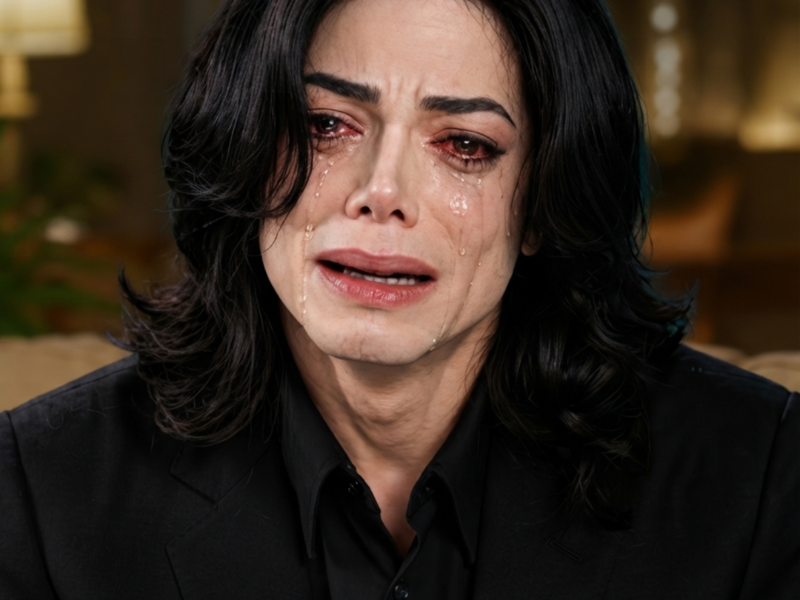
Michael Jackson Final Interview Before His Death — He Finally Revealed the Dark Truth.
“These will be my final show performances in London. This is it. And see you in July.”
The last time Michael Jackson stood on a stage, he sang “Thriller” and “Earth Song” under blinding lights at the Staples Center in Los Angeles.
“If you want to make the world a better place—”
It was a bizarre set of circumstances. He just made a very bad decision.
“—take a look at yourself.”
He didn’t know who he was. He was a house of cards.
“I didn’t make a change.”
That was the beginning of the end for him.
He was wrapped in a blanket between takes. He looked cold. He looked tired. But when the music started, something electric happened. He became Michael Jackson again.
That was June 24th, 2009. Twenty-four hours later, he was dead.
Famous or infamous? One of the best-known people on the planet ever.
Without a doubt, Michael Jackson’s worth more dead than alive. People wanted him dead.
He was afraid. Something’s not right. Michael told me that they were going to murder him.
And in the weeks, days, and final hours that led up to that moment, Michael Jackson had been saying things in interviews, in private letters, in phone calls to his closest friends that now read like a man desperately trying to get the world to understand what was happening to him. A man who could see something coming and couldn’t stop it.
So today we are going to do something that has rarely been done with the care it deserves. We are going to walk through Michael Jackson’s final months through his last recorded interviews.
Michael Jackson, the King of Pop, has died.
Who killed him? Was it an overdose?
Many people thought that Michael was murdered. Maybe he committed suicide.
It couldn’t have been deliberate, could it?
His private confessions, his handwritten letters, and the chilling testimonies of the people who were with him at the very end. And we are going to let the timeline tell the truth.
Because one question keeps surfacing no matter how many years pass. Did Michael Jackson try to warn us?
Stay with me, because by the end of this video, you are going to have a very hard time answering no.
To understand what Michael Jackson was saying in his final months, you have to understand what had been done to him in the years before.
This is not ancient history. This is context that changes everything.
By 2001, Michael Jackson was sitting on one of the most valuable assets in the music industry—a share of the Sony ATV music publishing catalog, which included hundreds of Beatles songs.
He had acquired it in 1985 for $47.5 million. By the early 2000s, that catalog was worth hundreds of millions of dollars, and Sony wanted it back.
According to multiple sources close to Jackson, Sony Music’s then-CEO, Tommy Mottola, began applying enormous pressure on the singer—not just as a business rival, but as something that felt deeply personal.
A source close to Jackson told Fox News at the time that Mottola had allegedly told Michael directly, “I’ll ruin you if you don’t agree to Sony’s terms.”
Michael didn’t stay quiet about it.
In 2002, he stood in front of a crowd of his supporters outside Sony’s New York offices with a megaphone and called Mottola to his face a racist and devilish.
He said that Sony had deliberately undermined his 2001 album, *Invincible*, refused to promote it properly in order to weaken him financially and force him to surrender the catalog.
Think about that for a second.
The King of Pop—the man who had sold over 400 million records worldwide—standing on a street corner with a megaphone, claiming the most powerful music company on Earth was trying to destroy him.
At the time, most people laughed it off. They called it a breakdown. They called it eccentric behavior from an eccentric man.
But here is what nobody asked. What if he was right?
Because Michael Jackson was, by his own admission, thinking at a level that the people around him didn’t expect.
He said at the time—and these are his words—that they thought he was just an artist who only paid attention to his art. They didn’t count on him being able to think.
He knew what he had. He knew what they wanted. And he refused to give it up.
That refusal, many who were close to him now believe, is where his real troubles began.
“Why would I want a white child to play me? I’m a Black American. I’m proud to be a Black American. I am proud of my race. I am proud of who I am. I have a lot of pride in who I am and dignity.”
Ask yourself this. Can you think of a single interview in the history of television that destroyed someone’s life more completely than the Martin Bashir documentary destroyed Michael Jackson’s?
In early 2002, journalist Martin Bashir approached Jackson through mutual friend Uri Geller, persuading MJ to let him do an intimate fly-on-the-wall documentary.
The pitch was simple. This will rehabilitate your image.
Bashir had famously interviewed Princess Diana in 1995, helping shift public sympathy toward her. Jackson wanted the same thing.
He trusted Bashir. He let cameras follow him for over a year.
When the documentary *Living with Michael Jackson* aired in February 2003, it was a gut punch.
Carefully edited to cast Jackson in the most suspicious light possible, it focused heavily on his relationships with children at Neverland, stripping away context, rearranging sequences, removing moments where Bashir himself had praised Jackson warmly off camera.
Jackson’s nephew Taj later revealed that Bashir had used a forged or manipulated letter connected to Princess Diana to gain access to Michael in the first place—mirroring the same deceptive tactics the BBC later confirmed Bashir used to get Princess Diana herself to sit down with him.
Jackson was furious. He immediately produced a rebuttal documentary, *The Footage You Were Never Meant to See*, showing the unedited raw material—Bashir encouraging Jackson to open up, praising his fatherhood, creating false intimacy, then discarding it all in the edit.
But almost nobody watched the rebuttal. The damage was done.
Within weeks of Bashir’s documentary airing, an investigation was opened. By November 2003, Michael Jackson was arrested.
By 2005, he was standing trial for child molestation charges—charges he was ultimately acquitted of on all fourteen counts.
But here is what the acquittal couldn’t undo. The years it took. The money it cost. The reputation it shredded.
The toll it took on a man who, by every account from those who knew him, was already a deeply fragile, deeply sensitive human being who needed very little to be pushed past his limit.
He was never the same after 2003, and everyone around him knew it.
“So I’ll take that and use that as the main foundation for the track and build all the sounds around that.”
Fast forward to 2009. Michael Jackson is fifty years old. He is broke—or very close to it—because decades of extraordinary spending, Neverland’s upkeep, legal fees, and bad financial management have all but swallowed his fortune.
His Neverland Ranch is gone. He is living as a tenant, moving from rented mansion to rented mansion with his three children: Prince, Paris, and Blanket.
Then comes AEG Live and *This Is It*.
On March 3rd, 2009, Michael Jackson walks out onto a stage at the O2 Arena announcement in London in front of screaming thousands of fans who have no idea what is about to happen.
He takes the microphone and says, “This is it. This is the final curtain call.”
Fifty dates at the O2. The largest concert residency ever announced at that point. AEG estimated it would gross over $100 million.
But behind the scenes, AEG’s CEO, Randy Phillips, was already seeing the cracks.
In a March 2009 email to his superiors—an email that would later be revealed in court—Phillips described Jackson as “an emotionally paralyzed mess, riddled with self-loathing and doubt now that it’s show time. He’s scared to death.”
Scared to death. That email was written in March. The shows were supposed to start in July.
And yet, rather than slow down, get Jackson additional professional help, or reduce the pressure, AEG Live expanded the tour.
Fifty shows became fifty shows with intense rehearsal schedules, an increasingly distressed star, and a personal physician whose qualifications to handle what he was walking into were, by any measure, completely inadequate.
That physician was Dr. Conrad Murray.
“I’m just never satisfied with what I do creatively. I just regret the limitation of my own imagination. I just feel there’s so much more. I don’t think I’ve ever done a project where I was totally happy with it.”
Here is something about Michael Jackson that very few people truly understood until it was too late. He could not sleep.
Not comfortably. Not naturally. Not for years.
By the time 2009 arrived, Michael Jackson was relying on a drug called propofol—a powerful surgical anesthetic normally used in hospital operating theaters with a full anesthesia team present—to fall asleep at night.
He called it his “milk” because of its milky white appearance in the vial.
He had tried everything else. A nurse practitioner named Cherilyn Lee, who began treating him in early 2009, testified that Jackson pleaded with her repeatedly to administer propofol to help him sleep. She refused. She told him it was dangerous.
He told her that doctors had already told him it was safe and that he just needed to be monitored.
Other doctors had said no. He kept looking for someone who would say yes.
Conrad Murray said yes.
Over the final two months of Michael Jackson’s life, Murray was giving Jackson nightly infusions of propofol in the bedroom of the rented Holmby Hills mansion—six nights a week.
A Las Vegas pharmacist later testified that he had shipped Murray a staggering 255 vials of propofol in the nearly three months before Jackson died.
255 vials.
Think about that number. Let it sit with you.
Now ask yourself, how does a man who is supposedly being prepared for the greatest comeback in pop history find himself in a bedroom being put under general anesthetic every single night just to sleep?
Murray himself, in a taped interview with police two days after Jackson’s death, described spending an entire night in the final weeks of June trying desperately to get Jackson to fall asleep—administering one drug after another. Lorazepam. Midazolam. Valium. Watching them fail one by one before finally giving in to what Jackson was asking for.
And according to court testimony, there was something else going on.
In those same weeks before his death, Michael Jackson would sometimes tell his tour director, Stacy Sanki, that “God keeps talking to me.”
He said it more than once.
A man receiving lethal doses of anesthetic every night. A man who couldn’t sleep. A man hearing voices.
What was Michael Jackson actually experiencing in his final weeks?
“A biopic about the singer’s early life came out this year called *Michael*. It’s made more than $368 million at the US box office. There’s been some criticism, though, that the movie didn’t address some of the controversial issues in his life.”
Now here is where things get deeply unsettling, because it turns out that Michael Jackson was not just suffering quietly. He was telling people what he feared—directly, urgently.
German businessman Michael Jacobshagen had been a close friend of Jackson’s for nearly two decades.
In an interview that surfaced years later, Jacobshagen revealed that in the weeks leading up to June 25th, 2009, Michael had called him from a Las Vegas hideaway in tears.
He wasn’t just upset. He was terrified.
Jackson pleaded with Jacobshagen to fly from Germany to the United States to be with him.
When Jacobshagen arrived, Michael handed him something extraordinary: thirteen handwritten letters in which he stated, in plain language, that they were trying to murder him.
“He was in emotional meltdown,” Jacobshagen recalled. “He kept saying, ‘They are going to murder me.'”
Michael Jackson’s own sister, La Toya, would later publicly echo that exact belief—that her brother had not simply died, but had been killed. That the circumstances of his death were not a tragic accident, but something far more deliberate.
Now, let’s be very careful here. We are not here to make wild accusations. We are here to ask the questions that the facts demand.
Because look at what we know.
A man who had publicly accused his record label of trying to ruin him. A man who had accused the most powerful music executive in the industry of threatening him.
A man who sat on one of the most valuable music catalogs on Earth. A man whose business affairs were being managed by people whose interests and his own were not always aligned.
A man whose doctor was being paid by the concert promoter. And a man who, in his final weeks, was writing letters to a trusted friend saying they want me dead.
Michael Jackson wasn’t a fool. He was, by every account, extraordinarily intelligent when it came to the music business. He had outmaneuvered major labels before. He had built a legacy that spanned fifty years.
So when he said “they,” who did he mean?
“When did the color of your skin start to change?”
“Oh boy. I don’t—sometime after *Thriller*.”
“Around *Off the Wall*, *Thriller*, sometime.”
“What did you think? I mean, you—”
“It’s in my family. My father said it’s on his side. I can’t control it. I don’t understand. I mean, it makes me very sad.”
The final formal media interview Michael Jackson gave while recording music was captured during sessions with will.i.am of the Black Eyed Peas.
The two had been collaborating on new material—three songs reportedly titled “Dreaming,” “Still the King,” and a tribute to James Brown called “I Will Miss You.”
In that interview, Michael spoke about music the way he always had—not as a career, but as a calling.
He said writing music was “something I never stopped doing. That’s how it is.”
He was still creating. Still reaching. Still pouring himself into the work.
But will.i.am also described a phone call he received from Jackson in the weeks before his death that chilled him.
Michael called, deeply upset, saying that someone had leaked one of their songs. “Why would they do that? Who does that?” he asked.
In a world where Michael Jackson could trust no one around him—where his doctor was being paid by his promoter, where his record label had allegedly worked against him, where a journalist had used his own openness to destroy him—even a leaked demo felt like another betrayal. Another piece of evidence that his circle had been compromised.
When Jackson died, will.i.am made a decision that spoke louder than anything he could have said in an interview. He refused to release those songs.
He said releasing music without Michael’s approval would dishonor a friend who was one of the most precise, meticulous perfectionists in the history of the art form. He honored the silence Michael would have wanted.
And when a posthumous Jackson album was later released by Sony—exactly the label Michael had accused of trying to ruin him—will.i.am publicly called it disrespectful.
Think about that irony. Michael Jackson spent his final years fighting to keep control of his music and his narrative. The moment he was gone, the machine took over.
“Now with that ABC News special, taking an inside look at the life of Michael Jackson with never-before-seen footage of the King of Pop at the height of his fame.”
One year before he died, on the eve of his fiftieth birthday in August 2008, Michael Jackson gave what became his final television interview—a phone call to ABC News journalist Chris Connelly.
From the rented California home he was sharing with his three children, where the night’s plan was cake and cartoons, he said something that now feels heartbreaking in hindsight.
He said his greatest achievements still lay ahead of him.
He said he still had his signature moves—and some new ones. He said this tour, this comeback, was going to be unlike anything the world had ever seen.
He believed it. You can hear it in every word.
A man sitting at home with his kids eating birthday cake, telling a journalist that the best was yet to come.
A man who would be dead in ten months.
“*Last Days of Michael Jackson* goes behind the scenes with the music legend, sharing exclusive conversations with Diane Sawyer, revealing insights into that perfectionism that drove him to the very top of the music industry.”
June 24th, 2009. The Staples Center, Los Angeles.
Security cameras captured Michael Jackson arriving at the arena for his last rehearsal—wrapped in a blanket, walking slowly past his tour director, Stacy Sanki.
She asked if he was cold. He said yes.
But then the music started, and in what would be the last known footage of Michael Jackson performing, he gave everything he had left.
A full run-through of “Thriller.” An emotional, soaring performance of “Earth Song.”
Not in full performance mode, Sanki later testified. But he got through it. He did it.
And when the rehearsal ended—when the last note faded and the stage lights dimmed around him—Michael Jackson did something that was captured on that security camera footage.
He closed his eyes. He tilted his face upward. And he smiled.
That is the last image we have of him alive and performing. Eyes closed, face turned to the sky, smiling.
Fourteen hours later, Dr. Conrad Murray called 911 from the bedroom of the Holmby Hills mansion. He told the dispatcher that Michael wasn’t breathing.
He did not tell them about the propofol. He did not tell them about the nightly infusions.
By the time paramedics arrived, Michael Jackson was already gone. He was fifty years old.
The coroner ruled his death a homicide—acute propofol intoxication combined with benzodiazepine sedatives.
Murray was later convicted of involuntary manslaughter and sentenced to four years in prison—serving just under two for the death of the King of Pop. Two years.
“The legendary singer Michael Jackson died in 2009. The singer was known as the King of Pop. He was 50 years old when he passed due to an overdose from an anesthesia and then other prescription drugs. His doctor was later convicted in his death.”
So now that you have sat with this full timeline—the Mottola threats, the Bashir betrayal, the AEG pressure, the propofol, the handwritten letters saying “they are going to murder me”—what conclusion do you reach?
Let me ask you directly, because you deserve to be part of this conversation.
Do you believe Conrad Murray acted alone?
Because here is what the evidence shows.
AEG Live was paying Conrad Murray’s salary—$150,000 a month.
AEG Live’s own internal emails showed they knew Jackson was in trouble months before he died.
And yet the tour went on. The rehearsals went on. The pressure went on.
Murray’s own lawyers argued that Jackson had administered the fatal dose himself while Murray stepped out of the room to make phone calls. But the prosecution’s experts—propofol specialists—said there was no credible evidence of that.
What there was evidence of was a doctor who left a patient alone while he was under anesthetic, who didn’t call 911 immediately, who rode in the ambulance without disclosing the drug he’d administered, and who had 255 vials of a surgical anesthetic shipped to him for use in a private bedroom.
The medical expert who testified for the Jackson family said it plainly. Conrad Murray repeatedly failed to meet the standard of care in his treatment of Michael Jackson.
But here is the deeper question, the one that nobody in that courtroom could fully answer.
Who was watching the watchman?
If the doctor was compromised by who was paying him, if the promoter had financial interests in keeping the shows going regardless of the star’s health, if the record label had a history of alleged hostility toward the artist himself—then where exactly was the system that was supposed to protect Michael Jackson?
He was telling people he was afraid. He was writing letters. He was making phone calls in tears. He was asking friends to fly across the Atlantic to be with him because he felt that unsafe.
And the world—his world—kept turning. The shows were sold. The costumes were fitted. The dancers were rehearsed.
And a man who couldn’t sleep was put to bed every night with a surgical anesthetic in a Los Angeles bedroom.
“I love Michael Jackson. I was his closest friend. Indeed, I was Michael’s doctor, but I spent more time with him as a friend than taking care of him medically.”
There is one final detail in this story that carries its own kind of weight.
Michael Jackson’s will, dated October 6th, 2006—just three years before he died—has, according to his former publicist Raymone Bain, never been fully located or publicly distributed as he intended.
Bain, who held a surprise press conference in Washington, DC years after his death, said, “I have wished and hoped and prayed that Michael Jackson’s will would be found, revealed, discovered, dropped from the sky, because in it, he painstakingly outlined how he wanted his legacy to be preserved and maintained.”
A man who spent the last decade of his life fighting for control of his art, his image, and his children. Who wrote letters about being murdered. Who refused to release music without his personal approval. Who told the world in a quiet phone call on his birthday that his greatest achievements still lay ahead.
Had written a detailed document explaining exactly what should happen when he was gone.
And it cannot be found.
If that doesn’t stay with you, I don’t know what will.
Michael Jackson’s story is not simply the story of a pop star who died too soon.
“We, the jury, in the above-entitled action, find the defendant, Conrad Robert Murray, guilty of the crime of involuntary manslaughter.”
It is the story of an extraordinarily gifted human being who spent his entire adult life fighting—for his art, for his innocence, for his children, for his catalog, for his legacy, for the right to simply sleep at night.
And in his final months, he was fighting in a way that most people around him didn’t recognize as fighting, because it looked like fear and breakdown and fragility.
But looking back now, through the lens of everything we know—the emails, the testimonies, the letters, the court records, the final footage of a man smiling in an empty arena—it looks less like a man falling apart and more like a man who could see exactly what was coming and couldn’t stop it.
You’ve been watching and listening, and I want to know what you think.
Because this story belongs not just to historians or music journalists. It belongs to the millions of people who grew up with Michael Jackson’s music, who were shaped by it, who loved him.
Do you believe Michael Jackson died as the result of negligence alone, or was there something darker at work? Were his warnings taken seriously enough? And does a music legacy like his protect itself, or does it need protecting?









