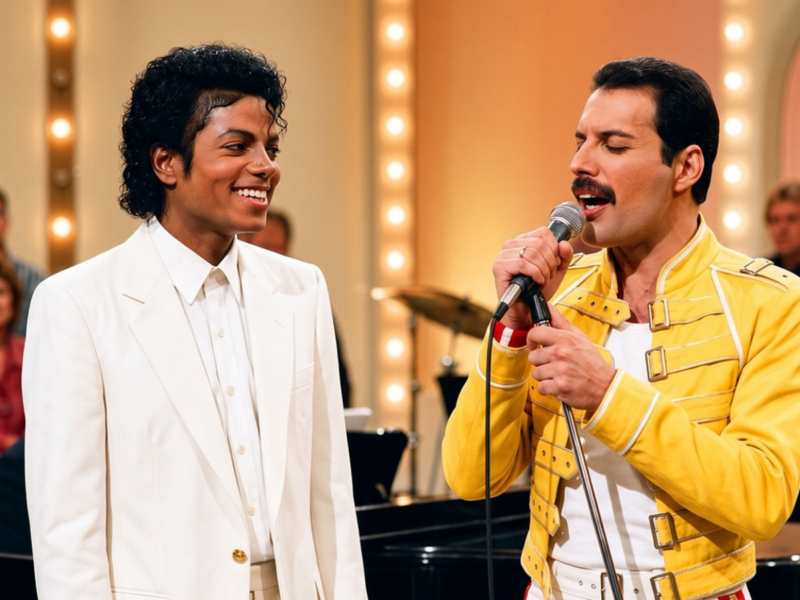
Michael Jackson DARED Freddie Mercury to Sing Billie Jean Live — Nobody Was Ready For THIS…
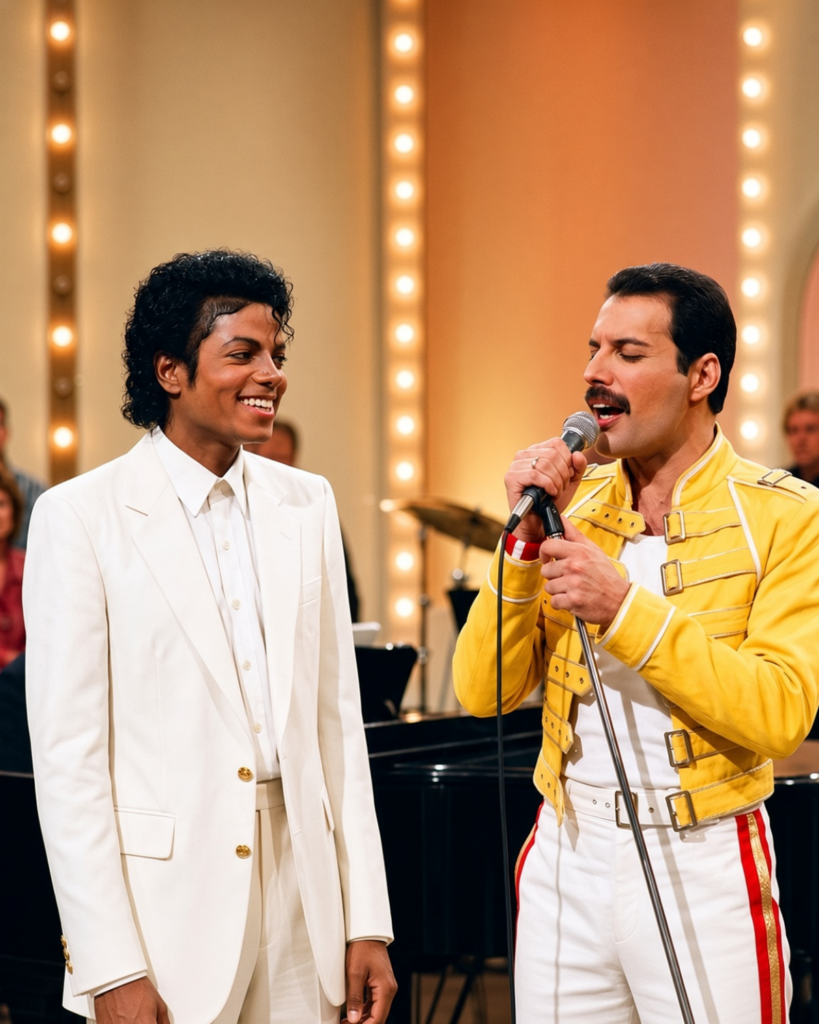
February 23rd, 1985.
Wilshire Boulevard, Los Angeles.
A cold rain had been falling since noon.
The thin, stubborn kind that Southern California only gets a handful of times a year, and the line outside the Crescent Theater stretched all the way down the block and around the corner past a shuttered shoe repair shop.
The people standing in it didn’t seem to care about the rain.
Some of them had umbrellas.
Most of them didn’t.
A few had been standing there since six in the morning, holding coffee cups gone cold, talking to strangers like old friends, because every single one of them knew something the rest of the city didn’t know yet.
The Crescent was a small room.
Eleven hundred seats.
A balcony that curved around like a horseshoe.
Red velvet worn thin on the armrests.
A ceiling painted with faded gold stars that somebody had touched up in the fifties and nobody had touched since.
It was the sort of theater where vaudeville acts once did two shows a night and where, forty years later, local dance schools held their spring recital.
It was not the sort of place where Michael Jackson played.
And yet, that night, that’s exactly what was happening.
The show was a benefit for the burn unit at Brotman Medical Center in Culver City.
A little over a year earlier, in January of 1984, Michael had been filming a soda commercial at the Shrine Auditorium when a pyrotechnic charge went off too close and set his hair on fire.
He’d been rushed to Brotman.
He’d lain in a bed there while nurses cleaned the wound on the back of his head.
And when he got out, he did something that surprised a lot of people who thought they had him figured out.
He took the settlement money, one and a half million dollars, and gave the whole thing to that hospital.
They named the burn center after him.
So when the hospital’s fundraising committee asked, very politely and without much hope, whether Michael might consider doing something small for them, maybe an appearance, maybe a few words at a dinner, he surprised them, too.
He said he’d sing.
Not at a stadium.
Not at an arena.
In a little room for the nurses and the doctors and the families and for whoever else could get a ticket.
Eleven hundred seats, that’s all.
He didn’t want it televised.
He didn’t want it turned into an event.
He just wanted to sing for the people who’d taken care of him.
The tickets sold out in nineteen minutes.
People called it a miracle.
The hospital called it a blessing.
Michael’s management called it a headache.
What almost nobody knew was how close Michael had come to calling the whole thing off.
Two months earlier, on a December night at Dodger Stadium, Michael had stood on stage with his brothers for the last show of the Victory Tour.
And in front of fifty thousand people, he’d said in that soft voice of his that this was the last time they’d see the Jacksons perform together.
The crowd had screamed because crowds always scream.
But backstage afterward, it had been very quiet.
Nobody fought.
Nobody slammed any doors.
It was just over.
Something that had been part of his life since he was five years old, standing on a box in Gary, Indiana, so the audience could see him over the microphone stand, was finished.
He’d gone home to the house on Havenhurst Avenue in Encino, and he’d waited to feel free.
He’d waited to feel the relief everyone told him he’d feel.
It didn’t come.
What came instead was a strange, quiet emptiness that settled over the house like fog off the ocean.
He’d sit at the piano in the upstairs studio at two in the morning with his notebooks open and nothing coming out.
He’d walk the grounds in the dark, past the pens where his animals slept.
He’d put on old records and lie on the floor and listen, trying to remember what it had felt like when music was the easiest thing in the world.
Thriller had sold more copies than any album in history.
People had started calling him the biggest star on the planet, and they meant it literally.
And he’d never been lonelier in his life.
The Crescent Theater show was going to be his first time on a stage without his brothers beside him since he was a small child.
No Jermaine to his left.
No Marlon to his right.
No Jackie.
No Tito.
No Randy.
Just Michael and a band of session players he’d rehearsed with for four days.
He hadn’t told anyone that this scared him.
He wasn’t sure he’d admitted it to himself.
But three times that week, he’d picked up the phone to call the hospital and tell them he was sick.
And three times he’d put it back down again, because he could picture the nurse who used to bring him ice chips at Brotman, a heavyset woman with a laugh like a car horn, and he couldn’t do it to her.
What he didn’t know, what nobody at the Crescent knew as the rain came down and the line inched forward, was that a car had just pulled out of the parking garage of the Beverly Hills Hotel with a very unexpected passenger in the back seat.
Freddie Mercury was in Los Angeles.
Freddie had flown in four days earlier to do press for his first solo record, an album called Mr. Bad Guy that he’d been working on in Munich for the better part of a year.
He’d poured himself into it.
Every song on it was his.
Start to finish.
No committee, no compromise, no three other brilliant, stubborn men in the room voting on the bridge.
He was proud of it.
He was also, though he’d never have said this out loud to a reporter, frightened of it.
Because America had gone cold on him.
It had happened slowly and then all at once.
Five years earlier, Queen had owned this country.
Another One Bites the Dust had been number one on the pop chart and the soul chart at the same time, which almost nobody had ever done.
They’d filled the Forum in Inglewood.
Kids in Ohio and Texas and Georgia knew every word of their records.
Then came 1982 and a funkier, stranger album that the American fans didn’t know what to do with, and a tour where the seats weren’t quite as full.
And then in 1984 came a video for a song called I Want to Break Free, where all four members of Queen dressed up as housewives as a joke.
A British joke.
A parody of an old English soap opera that every person in London understood instantly.
In England, it was a hit.
In America, MTV pulled it.
Radio stations got nervous.
And Queen, the band that had once packed Madison Square Garden, didn’t come back to tour America at all.
Freddie told people he didn’t care.
He told people America could do what it liked.
He’d make a joke, flick his wrist, change the subject.
But the people who knew him well, and there weren’t many, knew better.
He cared terribly.
He’d loved America.
He’d loved the size of it, the loudness, the way American crowds didn’t wait to be told they were allowed to go crazy.
And he’d started to wonder, lying awake in hotel rooms, whether the whole thing was simply over for him here, whether he’d become a man who used to be big in the States.
The press days in LA had not helped.
One radio host had called him Freddie Mercury of Queen, formerly of the charts.
Another had asked him three questions about his mustache, and none about the record.
A young woman from a magazine had asked, quite sweetly, whether Queen had broken up.
Freddie had smiled through all of it.
He was very good at smiling through things.
That evening, he’d been meant to have a quiet dinner with an old friend who worked in the record business, a man who’d known him since the early seventies.
Over the first glass of wine, the friend mentioned in passing that he wouldn’t be able to stay late because he had tickets to a little benefit show on Wilshire.
What sort of show? Freddie asked.
Michael’s doing a set for the burn hospital.
Small room.
Eleven hundred people.
Freddie put his glass down.
Michael Jackson, he said, in a room with eleven hundred people.
That’s the one.
Freddie sat very still for a moment.
Then he laughed.
The big, open laugh.
The one that showed the teeth he’d spent his whole life trying to hide with his top lip.
And he said, Well, darling, I think dinner can wait, don’t you?
This story is about to take a turn nobody expected.
There’s something you need to know about Freddie Mercury and Michael Jackson, because it’s the reason that night went the way it did.
They weren’t strangers.
In the summer of 1980, when Queen played the Forum, a shy young man in a sparkly jacket had come backstage to meet them.
It was Michael.
He was twenty-one, and he was already a star from his years with his brothers and from Off the Wall, but he wasn’t yet the giant he’d become.
He told Freddie, very quietly, that he loved their record and that there was one song on it, a bass-heavy, stripped-down thing John Deacon had written, that they absolutely had to put out as a single.
Freddie had told the band.
The band had argued.
They put it out.
It went to number one.
Freddie never forgot that.
Then in 1983, when Thriller was already sweeping the world, Freddie had come to the house in Encino, and the two of them had spent a strange, happy, chaotic stretch of days in Michael’s home studio working on songs together.
They recorded a few demos.
One was called There Must Be More to Life Than This.
Another was called State of Shock.
Another was called Victory.
They had a wonderful time.
They also, famously, had a llama.
Michael kept animals at the house.
And one afternoon, in the middle of a session, Michael had brought his llama into the recording studio.
Just walked it right in, like it was the most natural thing in the world.
Freddie, who’d come to make a record and not to share a vocal booth with livestock, had called his manager and said, in his most dignified voice, that he’d like to be collected, please, because he was recording with a llama.
They’d laughed about it later.
But the songs were never finished.
Schedules got in the way.
Lawyers got in the way.
Life got in the way.
State of Shock went to Mick Jagger instead.
Victory became the title of a Jacksons album and tour.
And Freddie and Michael drifted the way famous people drift, not through any fight or any bad feeling, but just because the world kept pulling them in different directions, and neither of them picked up the phone.
Freddie had been hurt by it a little.
Not angry.
Just a small sore spot that he pressed on sometimes when he was tired.
He believed in those songs.
He’d believed in the two of them together.
And they’d let it go like it didn’t matter.
Now he was in the back of a car heading down Wilshire in the rain, and he wasn’t entirely sure why.
He told himself it was curiosity.
He told himself it would be fun.
Both of those things were true.
But underneath them was something else he didn’t want to look at too closely.
He wanted to see whether Michael would be glad to see him.
He wanted, just for one night, to walk into a room in America and have someone be happy he’d come.
The Crescent Theater’s stage door was in an alley behind the building, lit by a single bulb in a wire cage.
Two security men in rain jackets stood beside it, checking names against a clipboard.
When Freddie’s car pulled up and he climbed out, the younger of the two guards took one look at him and did not recognize him at all.
Freddie was dressed down that night.
Jeans, a white tank top under a battered leather jacket, the short dark hair, the thick mustache.
To a nineteen-year-old kid from Pomona, he looked like any other guy who’d wandered back here hoping to get an autograph.
Name? the kid said.
Freddie, said Freddie.
The kid ran his finger down the clipboard.
Freddie what?
Mercury.
Darling, like the planet, or the thermometer if you prefer.
The kid looked down the list again.
Looked back up.
You’re not on here, sir.
The older guard, a heavyset man in his fifties with a gray crew cut, had been watching this with a slowly widening face.
He leaned over and said something very quietly into the younger man’s ear.
The kid’s eyes went round.
He looked at Freddie.
He looked at the clipboard.
He looked at Freddie again.
You’re the guy from Queen, the kid said.
I’m the guy from Queen, Freddie agreed pleasantly.
Although I’m told that’s rather an old reference in this country now.
The older guard laughed, a short bark of a laugh, and pulled the door open.
Not in my house it isn’t, Mr. Mercury.
My daughter wore out two copies of your greatest hits.
Go on in.
I’ll let them know you’re here.
Freddie thanked him with a little bow and stepped inside.
And just like that, he was backstage at the Crescent Theater, standing in a narrow cinder block corridor that smelled of wet coats and floor wax and the old, dusty radiator heat that small theaters never quite managed to get rid of.
It was a busy corridor.
Stagehands in black carried cable coils past him.
A woman with a headset and a clipboard hurried by, talking to three people at once.
Somebody in a room further down was tuning a guitar.
And along one wall, on a folding table, somebody had set out coffee urns and trays of little sandwiches wrapped in plastic.
And next to those, a hand-lettered card thanking everyone who’d volunteered.
Freddie stood there for a moment and took it in.
It had been a long time since he’d been in a room like this.
Queen played stadiums now.
Queen played football grounds and bullrings and arenas in South America with a hundred and thirty thousand people.
The backstage areas at those shows were whole villages, with catering tents and trailers and golf carts.
He’d almost forgotten that it could be this small, this close.
You could hear the audience through the wall here, a warm, low, restless murmur.
Eleven hundred people talking at once.
He liked it immediately.
It reminded him of the pubs and the colleges and the little halls where Queen had started, back when they drove themselves to gigs in a van with a broken heater and shared one bag of chips between four of them on the way home.
The woman with the headset came back down the corridor, spotted him, and stopped dead.
Oh my God, she said.
Oh my God, Mr. Mercury, nobody told me.
Does Michael know you’re here?
I rather doubt it, Freddie said.
I didn’t know I was going to be here myself until about an hour ago.
She stared at him.
Can I get you anything?
A chair?
Water?
Do you want to go out front?
I can get you a seat.
I think I can move somebody.
I can.
Darling, breathe, said Freddie, and put a gentle hand on her arm.
I’m perfectly happy right here.
I’ll stand in a corner and be good.
I promise not to bite anyone.
She laughed, surprised, and some of the panic went out of her shoulders.
And then she did something she’d later say she wasn’t sure she should have done.
She went to tell Michael.
Michael was in his dressing room at the end of the hall, a small square room with one mirror ringed in bulbs, a threadbare couch, and a little window up high that looked out on nothing but the brick wall of the building next door.
He’d been sitting there for almost an hour, alone, in a white shirt and dark trousers, not dressed for the stage yet.
His stage jacket hung on a rolling rack by the door.
His single glove lay on the counter next to a paper cup of hot water with honey and lemon that had long since gone lukewarm.
He was doing what he always did before a show, which looked from the outside like nothing at all.
He sat very still.
He breathed.
He hummed small scraps of melody under his breath.
He tapped his fingertips against his knee in patterns that only he could hear.
But tonight, it wasn’t working.
Tonight, his stomach was a clenched fist.
Every few minutes, his eyes went to the space on the couch beside him, the space where Jackie would have been sitting, cracking some dumb joke to loosen everyone up, or where Marlon would have been stretching, or where Randy would have been drumming on the arm with two pencils.
The room felt enormous with just one person in it.
It was the smallest dressing room he’d had in years, and it felt like a cathedral.
There was a knock.
Michael, it was the woman with the headset.
I’m sorry.
I know you said no visitors, but I think you’ll want to know this.
He turned toward the door.
It’s okay.
What is it?
Freddie Mercury’s here.
He’s in the hallway.
He just walked in.
He’s not on any list.
He says he heard about the show at dinner.
For a second, Michael didn’t say anything.
Then he stood up.
He didn’t mean to.
His body just did it on its own.
Freddie’s here, he said.
Right now.
Right now.
By the coffee.
Something happened to Michael’s face that the woman with the headset would describe years later to her grandchildren as the lights coming on in an empty house.
He’d been gray all evening.
Quiet and gray and folded into himself.
And now, in the space of two seconds, color came back into him.
His eyes went wide and bright.
His hand went up to his mouth like a kid who’d just been told he was going to Disneyland.
Oh my gosh, Michael said softly.
Oh my gosh, Freddie.
And then, before she could say anything else, he was past her and out the door.
Freddie was standing by the coffee urns holding a paper cup of tea he had no intention of drinking when he heard quick footsteps coming down the corridor behind him.
He turned around.
Michael Jackson was walking toward him, almost jogging, in his white shirt and his socks, because he’d forgotten to put his shoes on.
They stopped about three feet apart.
For a moment, neither of them said anything.
It had been almost two years.
They’d both been through a great deal in that time, most of it in public, and some of it in the kind of private darkness nobody else ever sees.
They looked at each other the way old friends do when they’re checking to see whether the other person is still the same person.
Freddie, Michael said.
Hello, Michael, said Freddie.
No llama tonight.
And Michael laughed.
It burst out of him, high and helpless, the laugh of a teenager.
And he put both hands over his face and bent forward and laughed so hard that two stagehands carrying a road case stopped to look.
Freddie started laughing, too.
That big barrel laugh of his.
And for a good long moment, the two of them just stood there in that cinder block hallway laughing like idiots while the crew tried to work out what on earth was going on.
I’m sorry, Michael said finally, wiping his eyes.
I’m so sorry about the llama.
You’re not sorry at all, said Freddie.
You thought it was hilarious.
I thought it was a little hilarious.
I’ve been in therapy about it, Freddie said gravely.
Twice a week.
My analyst says I’m making tremendous progress.
That set Michael off again.
And then, still half laughing, he did something Freddie didn’t expect.
He stepped forward and hugged him.
Not a quick showbiz hug with a pat on the back.
A real one.
He held on.
I’m so glad you’re here, Michael said, quietly, into Freddie’s shoulder.
You don’t even know.
Freddie felt something catch in his throat that he hadn’t planned on.
He patted Michael’s back awkwardly.
Two careful little pats, because for all his flamboyance on stage, off it he was often shy, and hugging in hallways was not something he was used to.
Well, Freddie said when Michael let go, I couldn’t let you do a show this small without a proper heckler in the building, could I?
Michael smiled at him.
But Freddie, who had spent a lifetime reading audiences, read something else underneath the smile.
He saw the tiredness.
He saw the tension around Michael’s eyes.
The way he kept pressing his thumb against the side of his index finger over and over.
He saw that the boy who’d bounced into the Forum dressing room in 1980 had become a man carrying something very heavy.
You’re nervous, Freddie said.
It wasn’t a question.
Michael looked away a little.
You nervous in a room with eleven hundred people.
You’ve played to a hundred thousand with my brothers, Michael said quietly.
I’ve never done it without my brothers.
Not really.
Not since I was a little kid.
Freddie was silent for a moment.
Then he nodded slowly, and the teasing went out of his face.
Ah, he said.
Yes, that I understand.
And he did, more than Michael knew, because Freddie had spent the whole of the last year in Munich making a record alone, without Brian and Roger and John.
And every day of it, he’d felt the absence of them like a missing limb.
He’d wanted the freedom.
He’d gotten the freedom.
And the freedom, it turned out, was cold.
Can I tell you something about that? Freddie said.
Please.
Every time I go on without them, I feel like a man who’s walked out onto a frozen lake.
Every step, I think, this is the one where I go through the ice.
He shrugged.
And then I don’t.
And then I get to the other side.
And the fear doesn’t go away, darling.
It never does.
But you learn that it’s lying to you.
That’s all.
Michael looked at him for a long moment.
Then he said, Will you stay for the show?
I wouldn’t miss it.
No, Michael said.
I mean, will you stay back here, close, near the stage?
Freddie tilted his head.
There was something in Michael’s voice now, something that hadn’t been there a second ago.
A spark.
Almost mischievous.
Why? Freddie said slowly.
What are you planning?
Michael just smiled.
It was a different smile from before.
It was the smile of a man who’d had an idea and liked it very much.
You’ll see, he said.
And then the woman with the headset appeared at the end of the corridor and called out that it was ten minutes to places.
And Michael squeezed Freddie’s arm once, turned, and hurried back toward his dressing room, still in his socks.
Freddie stood there holding his cold tea.
You’ll see, he repeated to himself.
Wonderful.
I love it when Americans say that.
It always ends so well.
At 8:15, the house lights at the Crescent went down.
It’s hard to describe what it’s like to be in a small room when the lights go down for someone that famous.
In a stadium, the darkness is huge and far away.
In a room like the Crescent, it’s intimate.
It’s close.
You can hear the person next to you breathing.
You can hear someone in the balcony whisper, Oh my God, before anything has even happened.
You can feel eleven hundred hearts speed up at the same time, and you can feel yours go right along with them.
Freddie had been given a place in the wings, stage left, behind a black curtain, on a wooden stool somebody found for him.
From there, he could see the edge of the stage and a slice of the audience in the front rows.
He could see the nurses, a whole row of them, near the front, still in their hospital scrubs under their coats because they’d come straight from the late afternoon shift.
He could see a boy of about ten, sitting between his parents, the side of his face and his neck marked with the pale, shiny, tight skin of a healing burn.
The boy was holding on to the armrests with both hands.
Freddie looked at that boy for a long time.
And then a single white spotlight hit the center of the stage, and Michael walked into it.
He was dressed now.
A black jacket with a military cut, sequins catching the light in small, sharp flashes.
Black trousers.
White socks.
Loafers.
The single glove.
He stood in the circle of light and didn’t move.
And the room erupted.
The sound in a small theater doesn’t have anywhere to go.
It bounces back.
It builds on itself.
Eleven hundred people screaming in a room built for vaudeville was louder, in its way, than fifty thousand in a stadium, because it had nowhere to escape to.
Freddie felt it through the wooden floor, through the stool, through his own chest.
He found he was grinning.
Michael let it go on.
He stood there very still and let them scream, and Freddie watched the side of his face in the light and saw him take one long, deep breath, the breath of a man stepping onto that frozen lake.
Then the drummer counted off, and the band hit, and Michael moved.
He opened with Wanna Be Startin’ Somethin’.
And within thirty seconds, the fear was gone.
Or if it wasn’t gone, it had gone somewhere Freddie couldn’t see it.
Michael danced like the stage was on fire and he was the only thing in the room that couldn’t burn.
He spun.
He froze.
He slid backward across the boards like the floor had been oiled.
The nurses in the front row were on their feet.
The boy with the burn scars had let go of the armrests and was clapping, his mouth wide open.
He went straight into Rock with You, and then Working Day and Night, and the band was tight and hungry behind him.
By the fourth song, the whole room was sweating.
The old radiator heat and eleven hundred bodies and the lights had turned the Crescent into a greenhouse, and nobody cared.
The balcony was bouncing.
Freddie could actually see it moving, the old gilded rail swaying slightly, and he made a mental note never to sit in a balcony in Los Angeles.
He was enjoying himself enormously.
Watching Michael work was like watching a great athlete or a great surgeon, someone who’d spent so many thousands of hours perfecting something that it had stopped looking like effort at all.
Freddie was a showman.
He knew how hard this was.
And he knew he was watching one of the very few people alive who did it better than he did.
But he also noticed something between songs.
In those few seconds of darkness before the next spotlight hit, Michael’s face went somewhere else.
Freddie saw it clearly from the wings.
The smile dropped.
The shoulders came down.
He’d glance to his left, where a brother used to be.
He’d glance to his right.
And then the light would come back, and the smile would come back with it, snapping into place like a mask.
He’s working so hard, Freddie thought.
He’s working so hard to make it look easy.
Five songs.
Six.
And then, at the end of Don’t Stop ‘Til You Get Enough, with the crowd absolutely roaring and the band riding the final chord out, Michael threw his arm up in the air and the whole band stopped on a dime.
Silence.
Or as close to silence as eleven hundred overheated people could manage.
The screaming broke into scattered cheering, then into applause, then dropped away to murmurs as people realized Michael wasn’t moving on to the next song.
He was just standing there at the front of the stage, breathing hard, sweat on his face, the microphone in his hand.
Thank you, he said softly.
Thank you so much.
They screamed again.
He waited.
I want to say something, Michael said.
His speaking voice was so different from his singing voice, so quiet and light that the room hushed almost immediately, the way a room hushes for a child.
A year ago, some of you in this room took care of me when I got hurt, and I didn’t forget.
I’ll never forget.
There are some nurses sitting right here.
He pointed to the front row, and the nurses screamed and covered their faces and waved.
You were so kind to me.
You didn’t treat me like a star.
You treated me like somebody who was scared and hurting.
And that’s all I was.
So, thank you.
The room applauded, warm and long.
There’s somebody else here tonight, Michael went on, and his voice changed a little.
There was a smile in it.
Somebody who didn’t tell anybody he was coming.
He just showed up.
He’s standing right over there behind that curtain, and he thinks he’s hiding.
In the wings, Freddie went very still on his stool.
Oh no, he thought.
Oh no, no, no, darling.
Don’t you dare.
This man, Michael said, is one of the greatest singers who ever lived.
Not one of the greatest rock singers.
One of the greatest singers.
Period.
Five years ago, I went backstage at one of his shows, and I was so nervous I could barely talk to him, and he was so nice to me.
He turned toward stage left.
Freddie, come out here, please.
The name went through the room like electricity through a wire.
For a second, there was confusion.
A ripple of people turning to each other.
Freddie who?
And then someone in the balcony shrieked, Freddie Mercury! at the top of their lungs, and the whole theater came apart.
Freddie sat on his stool behind the curtain with his heart going like a drum.
He hadn’t prepared for this.
He wasn’t dressed for it.
He was in a tank top and jeans and a leather jacket that had seen better days.
His voice hadn’t been warmed up.
He’d had a glass and a half of wine at dinner.
He’d come here to watch, to be a face in a hallway, to see whether an old friend would be glad to see him.
He had not come here to walk onto somebody else’s stage in front of eleven hundred Americans who, for all he knew, had forgotten who he was.
But the room didn’t sound like it had forgotten.
The room sounded like it was shaking.
He thought briefly of simply staying where he was.
Letting the moment pass.
Waving from the curtain.
Nobody would think less of him.
Then he looked at the side of the stage, where the boy with the burn scars was standing on his seat now, craning his neck to see into the wings, his father’s hand on his back to keep him steady.
Freddie stood up.
He shrugged the leather jacket off his shoulders and left it on the stool.
He ran a hand once over his hair.
And then he walked out into the light the way he always did, like he owned the place and had kindly agreed to let everyone else stay.
The noise when Freddie came out was unlike anything the Crescent Theater had heard in its sixty-year history.
People who were there said the old chandelier over the orchestra seats was actually swinging.
The nurses were holding on to each other.
A man in the fourth row had both fists in the air and was bellowing something that might once have been words.
Freddie strolled to center stage, lifted one hand, and gave the crowd a small royal wave, and they screamed louder.
He turned to Michael with a look of mock fury.
You little monster, he said into Michael’s microphone, and eleven hundred people laughed.
I’m sorry, Michael said, grinning.
He did not look sorry.
I came here for a quiet evening, Freddie told the crowd.
A quiet evening, darlings.
I was promised a seat and a cup of tea, and now look at me.
I’m not even wearing proper trousers.
More laughter.
Someone from the balcony yelled, We love you, Freddie.
And Freddie put his hand over his heart and blew a kiss up toward the dark, and the balcony lost its mind.
Michael watched all this with a look on his face that Freddie would think about later.
Not the look of a man sharing his stage.
The look of a man who was learning something.
Freddie, Michael said when things quieted down a little.
Can I ask you something in front of everybody?
You’re going to anyway, aren’t you?
I am.
Then go on, darling.
I’m already out here.
It can’t get any worse.
Michael laughed, and then he got serious.
He walked a slow circle around Freddie the way a boxer circles the other man in the ring, and the room got very quiet, sensing something coming.
A couple of years ago, Michael said, Freddie came to my house and we made some music together, and it was some of the most fun I’ve ever had in a studio.
He’s so fast.
He’ll hear a melody one time and he’ll sit at the piano and he’ll turn it inside out.
He’ll find things in it that you didn’t even know were there.
I learned so much from him in just a few days.
Freddie shifted his weight, uncomfortable in the way people are uncomfortable when they’re being complimented and can’t make a joke to get out of it.
And we never finished those songs, Michael said quietly.
And that’s my fault.
That’s on me.
I felt bad about it for a long time.
Freddie looked at him, surprised.
He hadn’t expected that.
Not here.
Not out loud in front of all these people.
So I’ve been thinking, Michael went on, about what Freddie does.
About how he takes a song and makes it his.
And I want to see him do it right now, tonight, with one of mine.
A low murmur moved through the room.
Freddie, Michael said, turning to face him fully.
I dare you.
I dare you to sing Billie Jean.
The murmur turned into a gasp, then a roar.
Then, strangely, it collapsed back into near silence as eleven hundred people realized what had just been asked and turned, all at once, to see what Freddie would do.
Because Billie Jean wasn’t just a song.
In February of 1985, Billie Jean was the song.
It was the one that had broken MTV open.
It was the one Michael had sung on the Motown anniversary special two years earlier, when he’d moonwalked for the first time on television and the entire country had stopped breathing.
It was that baseline.
That heartbeat.
That tight, paranoid, shadowy groove that every kid in America could do from memory.
It belonged to Michael the way a fingerprint belongs to a hand.
Singing it in front of him would be like painting over someone’s signature while they stood there watching.
Freddie stood very still in the middle of the stage.
Billie Jean, he repeated.
Billie Jean.
You’re Billie Jean.
That very one.
Freddie turned to the audience with his eyebrows up somewhere near his hairline.
He wants me to sing Billie Jean, he said.
In his own concert.
In front of him.
To a room full of people who paid to hear him sing Billie Jean.
He turned back to Michael.
Darling, that’s not a dare.
That’s an assassination.
The crowd howled, but Michael didn’t laugh this time.
He stepped closer.
He lowered the microphone slightly so that what he said next was quieter, though the room was so silent now that the people in the first ten rows could hear it perfectly.
I don’t want you to sing it like me, Michael said.
I’ve heard it like me a thousand times.
I’m tired of it like me.
I want to hear it like you.
I want to know what you’d find in it.
Freddie looked at him up close under the lights.
He could see what the audience couldn’t.
He could see that Michael wasn’t playing.
He wasn’t doing a bit.
There was something almost pleading in his eyes.
It was the look of a man who’d lost his way back to his own music and was hoping desperately that somebody else might be able to show him the path.
And Freddie understood, in that moment, that this wasn’t really a dare at all.
It was a question.
And it was a question Freddie had been asking himself for a year in a studio in Munich.
What if I ruin it? Freddie said quietly, only to Michael, though the microphone caught it.
Then ruin it, Michael said.
At least it’ll be real.
For five long seconds, nobody in the Crescent Theater made a sound.
Freddie looked out at the room, the nurses in their scrubs, the boy standing on his seat, the balcony packed shoulder to shoulder, eleven hundred faces turned up toward him in the heat and the half-light, waiting.
He thought of the radio host who’d called him formerly of the charts.
He thought of the young woman who’d asked if Queen had broken up.
He thought of every hotel room in every city where he’d lain awake wondering if America was done with him.
And then he thought, quite clearly, Well, darling, you can find out tonight, can’t you?
He turned around and looked at the back of the stage, where the band was sitting, watching him with the particular terrified alertness of session musicians who have no idea what’s about to happen.
And off to one side, half hidden under a dust cover, he saw it.
A grand piano.
An old black Steinway that belonged to the theater, pushed back against the wall, probably used for the dance recital.
Freddie pointed at it.
Does that work?
The keyboard player, a lanky young man with a ponytail, blinked at him.
Uh, yeah.
We tuned it this afternoon, just in case.
Just in case, Freddie repeated, delighted.
Isn’t that marvelous?
Just in case.
Would some lovely people please bring it forward for me?
Two stagehands ran out.
The dust cover came off.
The piano rolled forward on its casters, its wheels squeaking against the old boards until it sat near the front of the stage, angled toward the audience.
Somebody found a microphone stand and set it up beside the bench.
The whole thing took maybe ninety seconds.
And in all that time, the audience never stopped murmuring, a low, excited hum, because they could sense that whatever was coming, it was not going to be what they’d imagined.
Freddie sat down at the piano.
He adjusted the bench.
He ran his hands once over the keys without pressing them, the way a pianist does to say hello to an instrument, and then he played a single, low, quiet note.
He turned to the bass player.
Darling, you know the line.
Of course.
Everybody knows the line.
The bass player said.
Good.
Don’t play it yet.
Wait for me.
When I look at you, bring it in very softly, like somebody walking up behind you in the dark.
The bass player nodded.
Freddie turned to the drummer.
And you?
Nothing for now.
Nothing at all.
Just wait.
Then he turned to Michael, who was standing a few feet away at the edge of the light, his hands clasped in front of him.
You asked for it, Freddie said.
I did, said Michael.
Freddie put his hands on the keys.
He closed his eyes and he began.
He didn’t play the groove.
That was the first thing everybody in the room noticed.
There was no heartbeat, no tick of the hi-hat, no famous baseline sneaking in.
Instead, there was a chord.
Slow.
Heavy.
In a minor key that sounded like rain on a window at night.
He let it ring out and die away.
Then another.
Then a third.
Climbing.
Unresolved.
He was building something that sounded more like the opening of a requiem than a pop song.
And for a long moment, no one in the audience knew what he was doing.
Then he started to sing.
He started low.
Lower than anyone had ever heard Michael sing it.
Down in the dark, rich bottom of his range, where his voice had a grain to it like old wood.
He sang the opening lines not as a story about someone else, but as a memory.
As a man sitting alone in a room, remembering a night that had gone wrong.
He took the words slowly, stretching them, leaning on the ones that hurt, letting the silences between phrases grow longer than anyone expected them to.
The effect on the room was immediate and strange.
It went quiet.
Not the quiet of people politely waiting.
The quiet of people who had been caught off guard.
The song they’d heard on the radio a thousand times.
The song they’d danced to at weddings and in their kitchens and at the roller rink.
The song that had always sounded cool and slick and a little dangerous suddenly sounded like something else entirely.
It sounded lonely.
It sounded frightened.
It sounded like a man who’d been accused of something and was sitting in the dark trying to work out how his life had gotten away from him.
Freddie sang the first verse like that, just voice and piano.
And by the end of it, the woman with the headset, standing in the wings, had put her clipboard down on a road case and forgotten it was there.
Michael had not moved.
He stood at the edge of the light, very still, and he was staring at Freddie with an expression that the people in the front row could see clearly.
It was the face of a man hearing his own song for the first time.
Then Freddie opened his eyes, turned his head, and looked at the bass player.
And the baseline came in.
Not the way it does on the record.
Soft.
Half the tempo.
Almost a whisper under the piano.
That famous figure.
That walking heartbeat.
But slowed down and stretched out until it sounded like footsteps coming down an empty street late at night.
The bass player had understood exactly what Freddie wanted.
It was like somebody walking up behind you in the dark.
A sound went through the audience.
It wasn’t a gasp, and it wasn’t a cheer.
It was a sort of collective shudder.
Eleven hundred people feeling the hair stand up on their arms at the same time.
And Freddie leaned into the microphone and began to climb.
This is the part the people who were there have the hardest time describing, because it didn’t feel like a man singing a song.
It felt like weather.
Freddie took that second verse and started pushing it upward, phrase by phrase, into his upper register, into that huge, ringing tenor that could fill a football stadium without a microphone.
And every line went a little higher, and a little louder, and a little more desperate.
He was pleading now.
Arguing.
He was a man insisting on the truth to a room that wouldn’t believe him.
The drummer, who’d been told to wait, couldn’t wait anymore.
He came in on the snare, sharp and dry.
Not the disco beat, but something slower and heavier.
Like a march.
And the band followed him.
The guitar found a chord and held it.
The keyboard player found the strings setting on his synthesizer and laid down a long, aching swell underneath everything.
And suddenly, Billie Jean wasn’t a dance record.
It was a rock opera.
It was Freddie Mercury at a grand piano in a sixty-year-old theater, turning the most famous pop song in the world into something that sounded like it had been written for a cathedral.
He hit the chorus and he did something with it that nobody in that room had ever imagined possible.
He sang it in harmony with himself.
Not with a tape.
Not with a trick.
He sang the line, and then, in the space of a breath, leapt up a third and sang it again over the top of the echo still ringing in the old hall, and then again, higher, so that for a moment it sounded like there were three of him.
A choir made out of one man, and the Crescent Theater’s cracked plaster ceiling rang with it.
The nurses in the front row were crying.
One of them had both hands pressed flat against her mouth.
The father of the boy with the burn scars had pulled his son down off the seat and into his lap and was holding him tight.
And the boy wasn’t squirming, which boys of ten never fail to do.
He was just staring at the stage with his mouth open.
Up in the balcony, somebody started to clap along and then stopped, embarrassed, because nobody else was.
Nobody wanted to break it.
It was too fragile.
It felt like if you made one wrong sound, the whole thing might shatter.
Michael Jackson had performed Billie Jean more times than he could count.
In rehearsal rooms, in stadiums, on television, in his head while falling asleep.
He knew every breath in it.
Every step.
Every place where the crowd would scream.
It had become, if he was honest, something he did rather than something he felt.
A machine he climbed into every night.
It worked perfectly.
It always worked perfectly.
And somewhere along the way, he’d stopped being able to hear it.
Now, standing at the edge of the light in a little theater on Wilshire Boulevard, he was hearing it.
He was hearing what he’d written when he was twenty-three, sitting in the studio at Havenhurst late at night, working out that baseline on a drum machine over and over for hours.
He’d written it about the feeling of being hunted.
About fame and the strangers who wanted something from you.
And the terrible fear of being accused and not believed.
He’d written it about being afraid.
And somewhere between writing it and performing it a thousand times, he’d sealed the fear up inside the groove.
Polished it.
Made it shine.
Made it cool.
He’d made it so slick that nobody, not even him, could see the frightened young man underneath anymore.
Freddie had just peeled the whole thing open with a piano and a voice.
And Michael was standing there with his hands pressed together in front of his mouth, and tears were running down his face.
He didn’t wipe them.
He didn’t turn away from the audience.
He just stood in the spill of Freddie’s spotlight with his shoulders shaking and let it happen.
Freddie didn’t see it at first.
His eyes were closed.
He was somewhere deep inside the song now, the way he went sometimes in the middle of a big show.
A place where the stage and the crowd and the heat all fell away, and there was only the sound, rising and rising.
He came to the bridge and he let his voice drop suddenly, all the way back down to almost nothing.
The band dropped with him.
The drums stopped.
The strings faded for a few bars.
There was nothing in that whole theater but the piano, the soft baseline walking in the dark, and Freddie’s voice, barely above a murmur, singing to himself.
And into that quiet, from the side of the stage, came another voice.
Michael had stepped forward.
He’d walked into the light without anybody noticing.
Slowly, the way you approach something you don’t want to startle.
And he’d come up to stand beside the piano, and he’d started to sing along.
Not the melody.
A harmony.
High and thin and trembling, floating over the top of Freddie’s line like a wisp of smoke over a candle.
Freddie heard it and opened his eyes.
He looked up at Michael, standing beside the piano with tears on his face, singing his own song as if he were learning it for the first time.
And something passed across Freddie’s face that the people in the front row would describe for the rest of their lives.
It wasn’t surprise.
It wasn’t triumph.
It was tenderness.
It was the look you give someone you love when you realize they’ve finally stopped pretending to be all right.
He didn’t stop playing.
He nodded, very slightly, and moved his voice down to make room.
And the two of them sang the bridge together.
Freddie low and Michael high.
Two completely different instruments.
One full of wood and whiskey and London rain.
The other full of silk and air and something so light it barely seemed to touch the ground.
Their voices found each other and locked together the way two gears lock, and the whole room felt it happen.
And then Freddie looked at the drummer and at the bass player, and he grinned.
That enormous, reckless, joyous Freddie grin, and he mouthed one word.
Now.
The band came crashing back in.
Full tempo.
Full volume.
The real groove.
The famous one.
That heartbeat that every kid in America knew in their bones.
And the whole theater exploded.
Freddie stood up from the piano bench.
He kicked it back with one heel.
He grabbed the microphone off its stand and he strode to the front of the stage and threw his arm up into the air, fist clenched, and eleven hundred people threw their arms up with him without even deciding to.
He was Freddie Mercury again.
Not the tired man in the hotel room.
Not the formerly of the charts.
He was the man who’d stood in front of a hundred and thirty thousand people in São Paulo and made every one of them sing.
And he was doing it here, in a room built for vaudeville, and the room was his.
And Michael, beside him, came alive.
He started to move.
The kick.
The spin.
The jerk of the shoulders.
The sharp snap of the head.
And then, as the crowd screamed so loud that the band could barely hear itself, he glided backward across the old wooden boards in that impossible sliding walk, the one that looked like a man walking forward while the floor pulled him back.
The moonwalk.
In front of eleven hundred people, sixty feet from the back wall.
And Freddie watched him do it and threw his head back and laughed, and then did something that nobody expected.
He tried it.
He was terrible at it.
He knew he’d be terrible at it.
He got about three feet, flailing in his white sneakers, arms windmilling, before he nearly went over backward into the piano and caught himself with one hand on the lid and struck a pose there like he’d meant to do it all along.
The crowd absolutely roared.
Michael laughed so hard he doubled over and missed a line.
And then the two of them were singing the final chorus together, both at full voice now.
Freddie hitting a note at the top that held and held and held until it seemed impossible that a human chest could keep it going, and Michael weaving his own high line around it, and the band pounding underneath, and eleven hundred people singing along at the tops of their lungs, and the old balcony swaying, and the dusty gold stars on the ceiling vibrating so hard that somebody later swore a flake of paint came drifting down through the spotlight like snow.
They ended it together.
Freddie threw his arm up.
Michael threw his arm up.
The band stopped dead, and the room went silent for three or four seconds.
Nobody breathed.
It was as if eleven hundred people had been lifted up very high and sat down very suddenly and hadn’t quite touched the ground yet.
Then it came.
It started in the front row with the nurses.
A sound that was half a cheer and half a sob.
It spread to the orchestra seats, to the back, up into the balcony, and it built and built until it wasn’t applause anymore.
It was something else.
People were on their feet, on their seats, holding on to each other.
A man in a good suit near the aisle had his face in his hands.
A teenage girl in the balcony was screaming Freddie’s name over and over, her voice cracking.
And the boy with the burn scars was back up on his seat, standing on it again, clapping his hands over his head as hard as he could, his face shining with tears and sweat.
Freddie stood at the front of the stage, breathing hard, sweat running down the sides of his face and soaking the collar of his tank top.
He looked out at the room, at the standing, screaming, weeping crowd, and his expression was very strange.
It wasn’t the look of a performer drinking in applause.
He’d had so much applause in his life.
He’d had applause from crowds so big you couldn’t see where they ended.
This was the look of a man who’d been lost and had just been found.
He lifted the microphone, and then lowered it again, and then lifted it again.
For once in his life, Freddie Mercury didn’t seem to know what to say.
Beside him, Michael reached out and took his hand.
Not a handshake.
He just took it and held it.
The way a child takes an adult’s hand crossing a street, and the crowd, seeing it, went quiet again, slowly, section by section, until the old theater was silent enough to hear the radiators ticking.
Michael raised his microphone.
His face was still wet.
When he spoke, his voice came out rough and thick.
I wrote that song, Michael said.
When I was twenty-three years old, and I’ve sung it more times than I can count.
He paused.
He swallowed.
And tonight, for the very first time, I heard what I was really trying to say when I wrote it.
The room stirred, a low, aching murmur.
I’d forgotten, Michael said very softly.
I’d forgotten that it was about being scared.
I made it so shiny that I forgot.
And Freddie just sat down and played it, and he gave it back to me.
He turned to look at Freddie.
Thank you for giving it back to me.
Freddie’s face crumpled.
There’s no other word for it.
For one second, the whole elaborate, glittering, armored thing that Freddie Mercury wore in front of the world fell away.
And there was just a man from Zanzibar who’d grown up at a boarding school in India, who’d come to London with nothing, who’d spent his whole life performing a person bigger and braver and louder than he felt inside.
And that man was standing on a stage in Los Angeles in a sweaty tank top, holding Michael Jackson’s hand, and crying in front of eleven hundred strangers.
He laughed through it.
Of course he did.
He wiped his face with the back of his wrist and he laughed, a wet, choked sound, and he leaned into the microphone.
Well, he said, and his voice broke in the middle of the word.
I did tell you I was going to ruin it.
The room laughed and wept at the same time.
You didn’t ruin it, Michael said.
I tried to moonwalk, darling.
I nearly died.
I nearly went into the piano.
That’s going to be in my obituary.
Michael laughed, helpless again, his head down, his shoulders shaking, still holding Freddie’s hand.
And then Freddie turned to the audience.
The joking went out of his face.
He looked out at them, all the way to the back, all the way up to the top of the balcony, and he said something that nobody who was there has ever forgotten.
You know, he said quietly, I was told this week that America had forgotten about me.
The room went dead silent.
I was told that by a few people, actually, Freddie went on, with the faintest ghost of a smile.
Quite a few.
And I’m afraid I rather started to believe it.
He paused.
He looked at the front row, at the nurses, at the boy on the seat.
So thank you.
Thank you for tonight.
Thank you for reminding me that I was wrong.
What happened next, the people in that room would describe as the loudest sound they ever heard in their lives.
Eleven hundred people who had walked in expecting to see Michael Jackson and who had instead watched a British rock singer take their favorite song apart and put it back together in front of their eyes stood in the heat and the old gold light of the Crescent Theater and screamed their love at Freddie Mercury until the walls shook.
Freddie stood there and let it wash over him.
He didn’t wave.
He didn’t bow.
He didn’t do any of the things he usually did.
He just stood there with Michael’s hand in his and his eyes wet, taking it in the way a man in a desert takes in rain.
Michael finished the show after that.
He did three more songs, and people said they were the best three songs he’d sung all night.
Freer and looser and happier than anything before them.
At one point during Beat It, he pulled Freddie back out from the wings, and Freddie did some screaming rock and roll ad-libs over the guitar solo that made the lead guitarist laugh so hard he almost dropped his pick.
And at the very end, during the encore, Michael walked down the steps at the side of the stage into the audience and went straight to the boy with the burn scars and knelt down in the aisle in front of him and gave him the single sequined glove off his own hand.
The boy put it on.
It came up past his elbow.
He wore it for the rest of the night.
It was nearly midnight when the Crescent finally emptied out.
The rain had stopped.
The crowd had drifted away down Wilshire in small, dazed groups, talking quietly.
Some of them still wiping their eyes.
The crew was packing up in that slow, tired, satisfied way crews pack up after a show that went better than anyone deserved.
Road cases rolling.
Cables being coiled.
Somebody laughing at the far end of the hall.
Freddie was sitting on the loading dock out back.
The big rolling door was up and the cool, damp night air was coming in off the alley, smelling of wet asphalt and car exhaust and faintly of somebody’s cigarette.
He was sitting on the edge of the dock with his legs dangling, his leather jacket back on, a can of ginger ale in his hand that one of the stagehands had fetched for him.
He was looking at nothing in particular.
At the puddles in the alley, catching the light from the single caged bulb over the stage door.
At the brick wall across the way.
He heard footsteps behind him and didn’t turn around.
He knew who it was.
Michael sat down beside him on the edge of the dock.
He’d changed out of the stage clothes into a plain dark sweater and a pair of old corduroy trousers.
His face was washed.
His eyes were still a little red around the rims.
He had a can of orange soda, which he opened with a small hiss, and didn’t drink for a while.
Neither of them said anything.
Somewhere down the alley, a cat was investigating a dumpster.
A car went past on Wilshire with its radio on, and faintly, of all things, it was playing a Queen song.
Another One Bites the Dust.
Both of them heard it at the same moment.
Neither of them said a word.
Freddie just raised his eyebrows very slowly, and Michael put his hand over his mouth, and his shoulders started to shake.
I paid him, Michael said.
I paid him fifty dollars to drive past.
You did not.
No, but I wish I had.
Freddie laughed, and the laugh went up into the night air, and then the silence came back, but it was a better silence now.
Easier.
Can I tell you something? Michael said eventually.
Always.
I almost didn’t do tonight.
Michael turned the soda can in his hands.
I almost called and canceled three times.
I kept thinking about walking out there alone without my brothers.
And I thought, what if I go out there and I don’t know who I am without them?
What if I’m just, I don’t know, half of something.
Freddie didn’t answer right away.
He took a sip of his ginger ale.
He looked at the puddles.
And now, he said.
Now I don’t know, Michael said.
But I’m not as scared.
Freddie nodded slowly.
Shall I tell you a secret? he said.
Go ahead.
I spent the whole of last year in Munich making a record without Brian and Roger and John.
My first one on my own.
And every single morning, I’d wake up and think, Freddie, you silly old queen, who do you think you are?
Those three are the finest musicians you’ll ever work with.
What makes you think you can do anything without them?
He smiled, but it was a thin smile.
And then I’d go to the studio and do it anyway.
And some days it was wonderful, and some days it was dreadful, and I never knew which it was going to be until I got there.
Was it worth it?
I don’t know yet, Freddie said.
Honestly.
It comes out in April.
Nobody in this country will buy it.
I know that already.
The radio people here think I’m a man in a dress who used to have hits.
He shrugged.
But I’ll tell you what I learned.
The band isn’t a wall you stand behind.
And going out alone isn’t standing in front of a firing squad.
It’s just two different ways of being yourself.
That’s all.
You’re not half of anything, darling.
You never were.
You were always the whole thing.
You just had some lovely company.
Michael was very quiet for a long moment.
The whole thing, he repeated softly.
The whole thing.
Michael looked down at the soda can in his hands, and for a moment, Freddie thought he might cry again, but he didn’t.
He just breathed out, long and slow, the way you breathe out when you’ve been holding something for a very long time and finally put it down.
I’m sorry about the songs, Michael said.
The ones we made at my house.
I’m sorry we didn’t finish them.
Freddie waved a hand.
Oh, please.
No, I mean it.
I think about them.
I think about There Must Be More to Life Than This.
You wrote something so beautiful, and I just let it sit on a tape in a drawer.
Freddie looked at him sideways.
He’d been ready to deflect.
He was very good at deflecting.
But something about the night, about the rain and the alley and the old, broken-down theater, made him not want to.
It did sting a little, he admitted.
I won’t lie to you.
I thought we had something, and then, poof.
Nothing.
Not a phone call.
I thought maybe I’d done something wrong.
Maybe the llama had filed a complaint.
Michael laughed despite himself.
The llama loved you.
The llama tried to eat my notebook.
Michael, that’s how he shows love.
Freddie chuckled and shook his head.
Then he said, more seriously, I understand, though.
I really do.
This business is like a river.
It picks you up and takes you somewhere, and you look up and three years have gone by.
It wasn’t anybody’s fault.
We both just got carried off.
Maybe we could finish them, Michael said.
Someday.
Maybe we could, Freddie said, and something in his voice made it sound like he didn’t quite believe it and didn’t quite not believe it either.
They sat for a while longer.
The cat down the alley had given up on the dumpster and was now sitting on the lid, washing one paw, entirely unimpressed by the two most famous singers in the world sitting fifty feet away.
That little boy, Michael said after a while.
With the burns.
Did you see him?
I saw him, said Freddie.
I was watching him the whole time before I went on.
He was holding on to his seat like it was going to fly away.
When I was at Brotman, Michael said slowly, there was a boy like him on the same floor.
Maybe a little younger.
He’d been hurt real bad.
A kitchen fire.
And the nurses told me he’d been scared of everything since.
Scared of lights, scared of noise, scared of people looking at him.
And I went and sat with him one afternoon.
And I didn’t sing or anything.
I just sat.
And after a while, he asked me if I was scared too, and I said yes.
Michael’s voice went very quiet.
And he looked so relieved, just to know that somebody else was.
Freddie turned and looked at him.
That’s what you gave them tonight, you know, he said.
When you cried out there, you didn’t have to.
You could have kept the mask on.
Everybody would have gone home happy.
But you let them see you were frightened too, and that you were still standing up there anyway.
He paused.
That’s the most useful thing a performer can ever do, darling.
Much more useful than hitting the high notes.
Any fool can learn the high notes.
You hit the high notes pretty good.
I’m a very special fool, said Freddie.
Michael smiled.
Then he said, What did you mean out there?
About America forgetting you?
Freddie was quiet for a long time.
It’s silly, he said finally.
It’s not silly.
Freddie sighed.
He set the ginger ale down beside him on the concrete.
You have to understand, when I was a boy in Zanzibar, and then at school in India, and then in London with no money, I used to listen to American records.
Little Richard.
Aretha.
Elvis.
Jimmy, God rest him.
America was where the music came from.
America was the place that told you whether you were any good.
And when Queen finally came here and they loved us, it was the most wonderful feeling in the world.
It was like being let into a club I’d been staring at through the window my whole life.
He picked at a flake of paint on the edge of the dock.
And then they stopped loving us.
Just like that.
Over a silly video.
Over a joke they didn’t understand.
And I told everybody I didn’t care.
And I told the band I didn’t care.
And I told the papers I didn’t care.
And I think I told myself that so many times that I forgot I was lying.
He smiled faintly.
And then tonight, a room full of Americans stood up and shouted my name like I’d never gone away.
And I had to stand there and admit to myself, in front of all of them, how much I’d missed it.
Michael didn’t say anything for a moment.
Then he said, very simply, They didn’t stop loving you.
They just forgot to tell you.
Freddie turned and studied his face.
People are like that, Michael went on.
They love something, and then they get busy, and they forget to say it.
And the person on the other end thinks it’s gone.
But it isn’t gone.
It’s just waiting for somebody to remind them.
He shrugged.
You reminded them tonight, that’s all.
Freddie opened his mouth to make a joke.
Then he closed it again.
You know what my mother used to tell me? Michael said.
Tell me.
She used to say, Michael, you don’t sing so people will love you.
You sing so they’ll know they’re not alone.
And if they love you after, that’s a gift.
But it’s not the reason.
He turned the orange soda around in his hands.
I forgot that.
For a while, I forgot that.
I got so busy trying to make everything perfect for everybody that I forgot the whole point.
Freddie nodded very slowly.
Your mother, he said, is a very wise woman.
She is.
Mine would have liked her.
Mine used to say something similar, actually, in a much more parsed way.
She’d say, Freddie, stop showing off and just sing properly.
Freddie laughed softly.
I never listened.
Of course.
Showing off is the whole of my personality.
But I think I know what she meant now.
What did she mean?
Freddie thought about it.
The alley was very quiet.
The cat had curled up on the dumpster lid and closed its eyes.
I think she meant, Freddie said slowly, that the costumes and the lights and the jumping about are lovely.
They’re great fun.
I’ll never give them up.
I’m far too vain.
But they’re the wrapping paper, darling.
They’re not the present.
And the terrible thing about being famous is that people start getting so excited about the wrapping paper that you forget there was ever anything inside it.
Even you forget.
Especially you.
He tapped his chest lightly.
Tonight, I sat at that piano with no costume and no lights and no band.
And I thought, Well, Freddie, let’s see if there’s still anything in the box.
And there was.
He smiled at Michael.
And then you walked up and started singing with me.
And I realized there was something in yours, too.
Something you’d forgotten about.
Something frightened and lovely and true.
Michael’s eyes filled up again.
He looked away down the alley, blinking.
Wrapping paper, he said with a wet little laugh.
Wrapping paper, Freddie agreed.
They stayed out on that loading dock for almost an hour.
They talked about everything and nothing.
Michael asked Freddie about his cats, and Freddie, delighted, spent a full ten minutes describing each one in detail.
Their names.
Their personalities.
Which ones sulked, and which ones slept on his head.
Freddie asked Michael about the animals at Havenhurst, and Michael told him the llama was doing very well, and Freddie said he was relieved to hear it and hoped it had found a more appreciative duet partner.
They talked about their mothers and their fathers, which was harder.
They talked about growing up feeling like outsiders.
Freddie as a Parsi boy from Zanzibar with teeth he was ashamed of in an English boarding school.
Michael as a child star who’d never gone to a normal school or had a normal birthday party.
They talked about how strange it was that the two of them, of all people, from two completely different corners of the earth, had ended up feeling so much the same.
At one point, Michael asked, Do you ever feel like the person on stage isn’t really you?
And Freddie said, Darling, the person on stage is the most me I ever get to be.
It’s the fellow who has to go to the supermarket afterward that I don’t recognize.
Michael laughed and said he’d never been to a supermarket in his life.
Well, you’re not missing much, said Freddie.
Terrible lighting.
No audience at all.
Around one in the morning, Michael’s driver came out onto the dock and quietly said it was time to go.
There was an early meeting in the morning.
There was always an early meeting in the morning.
Michael stood up.
He brushed the dust off the seat of his corduroys.
Then he looked down at Freddie, still sitting on the edge of the dock.
Thank you, Michael said, for coming tonight.
For not saying no.
You didn’t give me a great deal of choice.
You could have said no.
I could have, Freddie admitted.
But then I’d have spent the rest of my life wondering what I’d have found in that song, and I’m far too nosy for that.
Michael smiled.
Then he held out his hand, and Freddie took it, and Michael pulled him up to his feet, and for the second time that night, Michael hugged him.
And this time, Freddie didn’t do the two awkward little pats.
This time, he hugged him back properly.
Call me, Michael said into his shoulder.
I mean it this time.
Really?
Call me.
I’ll call you, Freddie said.
And if I don’t, you call me.
I don’t care who calls whom.
Just don’t let another three years go by, darling.
We’re neither of us getting any younger.
Deal.
And no llamas.
I can’t promise that.
Freddie laughed and let him go.
And Michael walked down the steps of the loading dock and across the wet alley to the waiting car.
At the car door, he turned around one more time and lifted his hand.
Freddie lifted his back, and then the car pulled away down the alley, its tires hissing on the wet asphalt, and turned onto Wilshire and was gone.
Freddie stood on the dock for a while longer, alone, with his hands in the pockets of his leather jacket, looking at the empty alley.
Then he picked up his ginger ale, finished it in one long swallow, set the empty can neatly on the edge of the dock, and went inside to find his coat and his friend and his ride home.
The woman with the headset saw him on his way out.
She’d later say that he was humming something as he walked down the corridor.
She couldn’t tell what it was at first.
Then she recognized it.
It was the baseline from Billie Jean, but slow, slow like footsteps in the dark, the way he’d played it at the piano.
He stopped when he saw her and gave her a little bow.
Thank you for looking after me tonight, darling, he said.
You were marvelous.
I didn’t do anything, she said.
You told him I was here, Freddie said.
That was everything.
And then he was gone, out the stage door, past the older guard with the gray crew cut, who’d waited his whole shift to tell Freddie that his daughter was going to lose her mind when she heard about tonight.
Freddie stopped and asked the daughter’s name and wrote her a note on the back of the guard’s clipboard, which the guard tore off very carefully and kept folded in his wallet until the day he retired.
There were no television cameras at the Crescent Theater that night.
Michael had insisted on that.
But a local reporter had been in the audience, a young woman who’d gotten a ticket through her aunt, who was a nurse at Brotman.
She wrote a short piece about the evening that ran in the Sunday paper a week later, on an inside page, under a headline that didn’t even mention Freddie’s name.
It was barely three hundred words long, but the last line of it got passed around the music business for years afterward, clipped out and pinned up on corkboards in recording studios from Los Angeles to London.
She wrote that she had walked into the Crescent Theater expecting to see the biggest star in the world and had walked out having watched two frightened men remind each other why they’d started singing in the first place.
A few people had brought little cassette recorders in their pockets, the way people did in those days.
For years afterward, muffled, hissing bootleg tapes of Freddie’s Billie Jean would turn up at record fairs and in the back rooms of collectors’ shops, traded hand to hand, fifth and sixth generation copies, so worn you could barely make out the piano.
People who heard them said it didn’t matter.
You could still hear it.
You could still hear the room go quiet.
Freddie flew home to London three days later.
Mr. Bad Guy came out that April, just as he’d predicted.
In America, it barely made a dent.
But something had changed in Freddie, and the people around him noticed it.
He seemed lighter.
He seemed less worried about what the radio people thought.
When a journalist asked him in May whether he was upset that America hadn’t taken to his solo record, he just smiled and said, America and I have an understanding now, darling.
We had a little chat.
It’s all sorted out.
And then came July 13th, 1985.
Live Aid.
Wembley Stadium.
Seventy-two thousand people in the stands and an estimated one and a half billion more watching around the world.
Queen went on a little before seven in the evening, London time, with barely twenty minutes to play.
Nobody expected much.
They were a band a lot of people thought had peaked.
They’d been off the road for a while.
They didn’t have a new hit.
What happened next has gone down as one of the greatest live performances in the history of rock music.
Freddie strode out onto that stage in a white tank top and jeans, and he sat down at a piano and he played the opening of Bohemian Rhapsody.
And then he stood up, and for the next twenty minutes, he owned the entire world.
He led seventy-two thousand people in a call and response that echoed off the stands like thunder.
He strutted and pranced and punched the air and hit notes that seemed impossible.
And when it was over, the other acts backstage, many of them the biggest names in music, looked at each other and knew that the day belonged to Queen.
The people who knew Freddie best would sometimes wonder afterward where that fire had come from.
How a man who’d seemed so tired and uncertain at the start of the year had walked onto the biggest stage on earth and set it alight like he had nothing left to prove to anybody.
He never said, but a few weeks after Live Aid, somebody at a party in London asked him, half joking, whether he’d been nervous out there in front of the whole world, and Freddie was quiet for a second, and then he said, Not really.
I did my practicing in a little theater in Los Angeles back in February, with a friend.
I learned there’s no such thing as a crowd, darling.
There’s only one person at a time.
And every one of them is frightened, and every one of them wants you to tell them it’s all right to be.
He smiled.
After that, Wembley was easy.
Michael watched Live Aid on television at Havenhurst.
He was alone in the house that afternoon, sitting on the floor in front of the set, the way he’d sat as a boy.
And when Queen came on, he turned up the volume as high as it would go.
A member of his household staff would later say that she heard him from the other end of the house, shouting at the television, cheering, clapping.
When she came in to check on him, he was on his feet and there were tears on his









