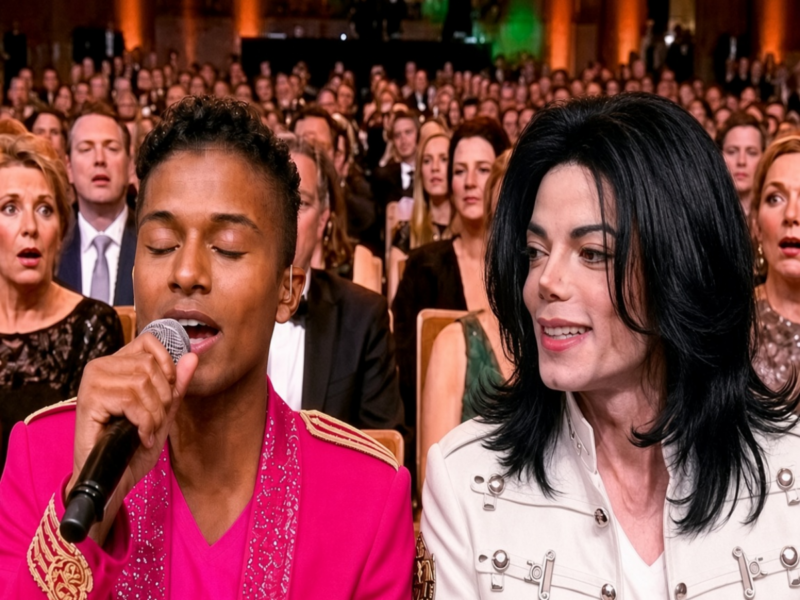
Michael Jackson Couldn’t Believe Jaafar Jackson Sing Like THIS (Next Michael).
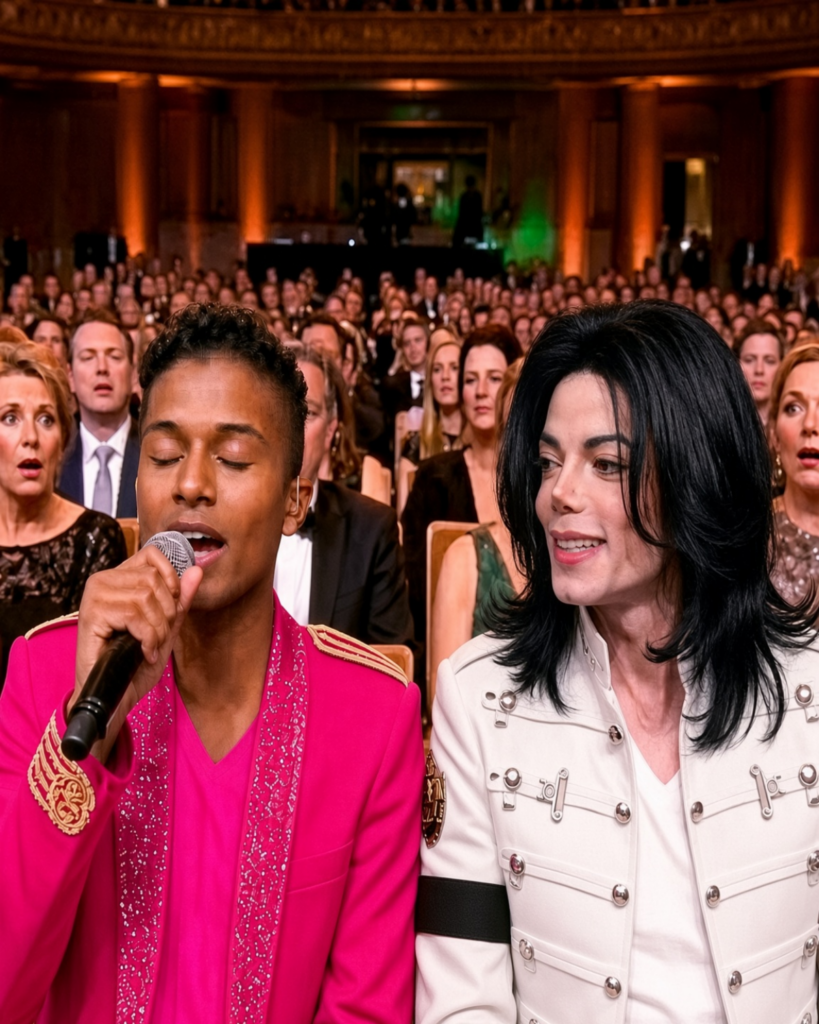
Ever wondered if anyone could truly replicate Michael Jackson’s legendary voice?
Jaafar Jackson just shocked the world by hitting every impossible note with unbelievable perfection.
The similarity is so uncanny that even lifelong King of Pop fans are rubbing their eyes and questioning their own ears.
Get ready as we dive into the breathtaking moments where Jaafar Jackson proved he is the true musical successor to his uncle’s iconic legacy.
Born into fame, a baby was crying in Los Angeles one July day without having any idea that someday he was going to fill stadiums with his uncle’s songs.
His name was Jaafar, the second child of Jermaine Jackson and Alejandra Genevieve Oaziaza.
Childhood in Encino seemed normal for an average kid—swimming pools, pianos, and uncles entering with their unfinished demo tapes.
Golf was the first career choice for young Jaafar.
But things changed when he turned twelve years old.
Marvin Gaye’s tunes led him to the piano instead, and Katherine Jackson could be found sitting silently somewhere near, watching him teach himself about music.
Neverland was where Uncle Mike used to do magic tricks.
He taught him dance steps in socks.
Golf equipment became silent and dusty.
On the other hand, the microphone became more appealing than ever before.
Jaafar slept on the floor in Michael’s childhood bedroom at Hayvenhurst to be closer to the ghost of his dead uncle.
But whenever it was time to dance, he headed straight to the estate’s rehearsal room.
The floorboards at Hayvenhurst were well-used, worn by the same steps that were done countless times before.
Jaafar found his groove, practiced in the same mirrored room that Michael used years ago.
The house was a mixture of polish and must—decades of rehearsal kept behind its walls.
And even though he said that the experience was purely practical, not spiritual in any way, people could tell that something changed in him nonetheless.
He became quieter, more focused, more present on set than ever.
The room taught him economy first and foremost.
Each step he took needed some kind of purpose, or it would be instantly disregarded.
For Jaafar, Hayvenhurst was never some kind of museum or shrine.
Instead, it remained what it always was—a working room that was open for business.
And in its mirrors, two reflections were overlapping for some time in the exact same place.
Nephew and uncle.
After sixteen full rehearsals of the Motown 25 routine, the choreographers Rich and Tone Talauega—both men who had choreographed for Michael himself—stood with crossed arms and looked unimpressed.
They did not want Jaafar to copy anything, but they wanted him to be fully fluent to the extent that he would have to stop thinking entirely.
His feet were sore and blistered as a result of the constant practice.
He bandaged them and continued to dance day in and day out.
One day, in the middle of one of his spins, his calves locked and he fell on the floor.
He got back up and started all over again.
In the third month, muscle memory kicked in to keep up with the ambition, and he could do a whole concert routine without stopping at any point.
The Talauegas gave him something more than meaningless compliments.
They silently approved of his progress—which only a few others had made before him.
Even before Antoine Fuqua had officially committed to the project, Jaafar was alone in a hired studio facing a mirror with a laptop in front of him, practicing a part he hadn’t yet secured.
For two whole years after that, there was nobody watching him except for his own reflection and no feedback besides constant repetition.
He collected his own library of concerts, focusing not so much on moves as on transitions between them, on split-second choices.
An accidental entry about fear in Michael’s diaries provided him with an emotional gateway of sorts.
He observed Michael holding a microphone, adjusting his jacket in the middle of a verse, timing his breaths between lines.
His friends called him all the time during that period, and he answered hardly ever.
For months, the only conversation partner he had was his mirror.
The set demanded eighteen takes, three full days of shooting, sore knees iced at night, and back on set the following morning, pain-free.
Just one of several dance routines that Jaafar did completely on his own during a production process that took place from January to May 2024.
Fuqua made sure that the set remained very small.
Few cuts.
No screen checks.
No digital tricks were tolerated.
John Logan’s screenplay balanced the large-scale dance numbers with small studio scenes, providing Jaafar enough time to rest between them.
Out of the camera’s reach, Jaafar spent many hours in makeup and hair tests, getting his prosthetics and lace wigs adjusted for Michael’s specific facial shape during the various eras.
With the reshoots extending the post-production period, Jaafar found enough time to re-record two important scenes with vocals.
It wasn’t enough for Jaafar to study the biggest successes of Michael’s performances.
Rather, he searched for the hidden errors in them.
It was more interesting for him to see the rehearsal clips when Michael failed to do a spin or missed a beat than the final performance itself, because it was a way for him to understand the person behind the superstar.
He collected clips chronologically, from TV commercials of the Jackson 5 to History, and watched Motown 25 so often that he could predict the cuts.
He was also researching another history of Michael’s performances—the one which showed how Michael took the lightness and precision of Fred Astaire and made it his own.
Seated in a folding chair with a spiral notebook on his knees, Jaafar filled page after page with sketches, time codes, and questions every day.
Gradually, the dance moves of Michael became full sentences, and every performance told its own story.
On the web, Michael’s ghost was debated for weeks in terms of whether some way had been found to digitally bring him back into the film in his most significant numbers.
Jaafar thought this theory very funny, because the reality behind it was much more simple.
Hard graft.
He said it simply on the Today Show: “I’m singing on top of Michael’s vocal. It’s a blend.”
This was true only for concert footage, where Jaafar sang live into a boom mic on set.
The recording of studio segments happened differently.
The mix disappeared completely, leaving only Jaafar singing his parts a cappella.
The music supervisor of the movie, John Warhurst, confirmed that this solo singing of Jaafar was good enough to be performed alone.
The blending at other places was done by artists, not by necessity.
Ordinary viewers could not recognize when Michael’s voice stopped and when Jaafar started singing.
Hardcore fans, recognizing every breath, could notice this difference.
One time, a sound engineer paused during recording to inquire if Michael’s original vocal tracks had somehow got mixed into Jaafar’s.
Jaafar merely smiled without saying anything.
This was the reward for several months of work that involved repeating the same phrase—”I love you, thank you”—for the whole afternoon until it ceased to make any sense and started to make sense again.
He would repeat newspaper stories in Michael’s voice, and later he would read poems and scripts in Michael’s voice as well, forming new sounds that his voice had not made before.
Singing was an additional routine of comparison of original tracks and a cappella tracks, as well as adjustment of the speed and vibrato of his attack.
Sometimes he would lose his vocal cords and had to whisper instead of speaking.
He paused for a short while and continued immediately.
There were affirmations all around his rehearsal studio, said in Michael’s voice every day.
No one gifted Jaafar his voice.
He earned it through false notes on a piano bench.
When high school classmates were playing sports and hanging around, he was learning to form chords, studying R&B and soul arrangements, straining his voice with exercises.
In 2015, when the cameras came for the Living with the Jacksons television show, he locked himself in the practice room in lieu of trying to catch some airtime.
After all, failure doesn’t need an audience.
A brief credit on Tito’s 2021 music video, “Love One Another,” showed him things a camera could never teach: how to read lights, time out retakes, how everything works behind the scenes of a set.
At twenty-two, he had invested countless hours behind his back without any money involved.
He didn’t know that he was developing the exact skill set needed on a movie set.
Just one Instagram post by Antoine Fuqua, and before the day was out, every prominent media platform had reposted it.
Estate co-executive John Branca released a statement of endorsement.
But what truly mattered was buried away in the casting team’s notes, where they noted that Jaafar carried himself with the ease of someone who really had spent his life in those kitchens and rehearsal studios.
There were already plans in place for a star-studded cast, with Colman Domingo as Joe Jackson, Nia Long as Katherine, Miles Teller as John Branca, Kendrick Sampson as Quincy Jones, and young Juliano Krue Valdi as the early Jackson 5 years.
It made headlines across the globe.
It didn’t bring Jaafar any joy, though.
He powered down his phone and spent two whole days locked inside his apartment, gazing up at his ceiling.
Millions were about to see how well he would be able to portray his uncle’s legacy.
Katherine Jackson did not merely condone the casting from afar, but personally contacted her grandson to let him know this.
“You have his eyes. Use them,” she said.
Those few words meant more than anything that the studios could have put out, and Jaafar knew it immediately.
From there on out, the Jackson family went into tactical mode.
Jermaine watched the tapes of Jaafar rehearsing via video calls every day, adjusting his chin angle, pauses, and microphone position.
Jaafar used a second computer screen for his father’s critiques only.
The real proof came when the family previewed their first rough cut.
Katherine sat through twenty silent minutes until she realized that for a moment she was watching her own grandson on screen.
He almost cried right then and there.
Text messages came in from his brothers and even his cousins.
The whole Jackson family had turned into his invisible safety net.
“Jaafar Jackson as a star,” proclaimed one headline in a straightforward and totally unequivocal manner.
Yet another reviewer declared that Jaafar was not imitating Michael, but had actually become him.
An opinion to which Jaafar returned three times, unsure whether he believed himself.
Fuqua sent him an enthusiastic review with a brief two-word caption: “Print this out.”
After that came award nominations by various critics groups—a very rare achievement for any newcomer in the role of lead actor.
But all these achievements didn’t affect Jaafar as much as one simple act did at the premiere.
At the premiere, Katherine Jackson nodded to him only once, but he noticed it at the edge of his vision across the room.
That one simple gesture, rather than enthusiastic reviews, was stored in his memory together with the old notes of rehearsals.
Critics could give him their enthusiastic appraisal today and then easily forget about him tomorrow.
Jaafar knew this all too well already.
Off the Wall vinyls have been completely sold out in London and Los Angeles—a surprising byproduct of a film premiere that no one could have ever anticipated.
Similar phenomena occurred when it came to streaming as well.
Several of Michael’s older songs were played three times more on a daily basis right after the movie was released.
TikTok was flooded by videos of parallel performance—Jaafar’s dance moves on screen set next to the iconic dance moves of Michael himself.
The whole narrative changed its direction, moving away from old scandals and toward the art instead.
Studio work.
Vocals.
Those dance moves that redefined popular music decades ago.
For those who have never seen Michael live before, this film was their first experience.
For the rest of us, it was an emotional revival.
The Lionsgate people witnessed the cultural phenomenon turn into sales spikes and playlist domination.
And Jaafar could feel the force of it coming at once.
Jaafar dropped a song on June 28th, 2019, that had absolutely nothing to do with his uncle’s legacy.
And that was precisely the idea.
“Got Me Singing,” produced in partnership with Hardy Indigo, is a bright and cheerful Latin pop hit filmed in Rio on a set made up of staircases covered in paint.
The song is driven by a catchy chorus infused with Brazilian funk melodies and a beautiful view of the ocean.
Jaafar even contributed to the songwriting, trying to come up with something different from the traditional Jackson family sound.
The song performed averagely.
It didn’t generate high-level numbers on streaming platforms or any radio airplay at all.
The song itself was not what interested Jaafar the most.
He was just testing how he could perform without the weight of his name.
His famous album project never saw the light of day.
Twenty-seven percent.
That is the figure displayed on review aggregation websites during the first Tuesday of release, slowly rising to thirty-five percent over the following weeks.
Reviews about the movie described the screenplay as shallow and sanitized, among other similar adjectives.
Jaafar read some of those headlines one morning, sitting alone in a hotel room, and closed his laptop before reading a complete review of the movie.
However, one aspect remained unchanged in even the most negative reviews: the compliments for his physical and vocal transformation.
One reviewer said it clearly: “An excellent performance in a film scared to try anything.”
Jaafar would not have disagreed.
He gave everything he had.
The screenplay and its cautious approach was someone else’s.
He sent Fuqua a text message with just four words: “Told you I’d try.”
Fuqua’s response did not take long: “You didn’t try. You did.”
He was completely unfazed by the negative reviews.
He knew what to expect.
The views skyrocketed to 116 million in a mere seventy-two hours following the sudden release of the first teaser at the end of November 2025.
The Lionsgate marketers could not take their eyes off the counter that was continuously climbing as they refreshed their browser window.
On the web, the audience stopped frames one by one, comparing Jaafar’s silhouette with the old clips of Michael, putting them side by side on every possible platform.
Jaafar himself found out about these numbers when taking a lunch break in his dance studio.
But what he felt was more like dread than excitement, as the hype had suddenly set the expectation to an unrealistic level.
None of this pressure had anything to do with him.
That very same night, Jaafar returned to work, practicing his spin until it gave him another excruciating cramp in his calf.
Not reading any comments at all, he continued dancing.
The trailer had done its share.
Now everything shown there had to live up to its promises.
A folding chair.
A camera.
Not even a costume nor music.
Nothing safe to rely on.
This is what Jaafar had to record himself while trying out for a part that thousands of actors around the world competed for.
After a casting process that lasted two years on a worldwide scale, and after watching Jaafar’s tape, the director Antoine Fuqua decided to pause the tape halfway and then re-watch it.
But not because of the similarity of his appearance, but because of his hands—how they were positioned, how they moved subconsciously while the character spoke.
Graham King, the producer, wrote in the internal memo something like “organically personifying Michael.”
Since Jaafar subconsciously caught all features of his uncle’s voice and stage presence, at twenty-six and with not even one feature movie in his résumé, Jaafar was cast as a leading role for a $150 million movie.
For six hours after the announcement, his phone wouldn’t stop buzzing.
And then Jermaine’s voice told him only two words: “Prove it.”
A bunch of teenagers poured out of the sold-out Chicago theater one night, screaming “Wanna Be Startin’ Somethin'” at the top of their lungs from the lobby, and phones were immediately firing off messages of pure excitement in group texts.
That same story unfolding over and over across the globe said something the critic ratings never could.
Michael got mediocre reviews overall, but its audience delivered an A-minus CinemaScore and demanded more from the film.
One late night, Jaafar flipped through page after page of mentions.
The heart emojis.
The caps locks.
The mother saying her daughter wanted to listen to Michael’s music for the first time ever.
He bypassed any analysis of his work altogether, reading the heartfelt, messy, sometimes typo-plagued messages instead.
They weren’t criticizing his work.
They were thanking him directly for giving life to someone who was dead to them once again, even just for a moment.
That part of it, he silently understood, lay beyond any critical eye’s reach.
From raw rehearsal room takes to smashing box office records, Jaafar Jackson totally nailed his uncle’s magic.









