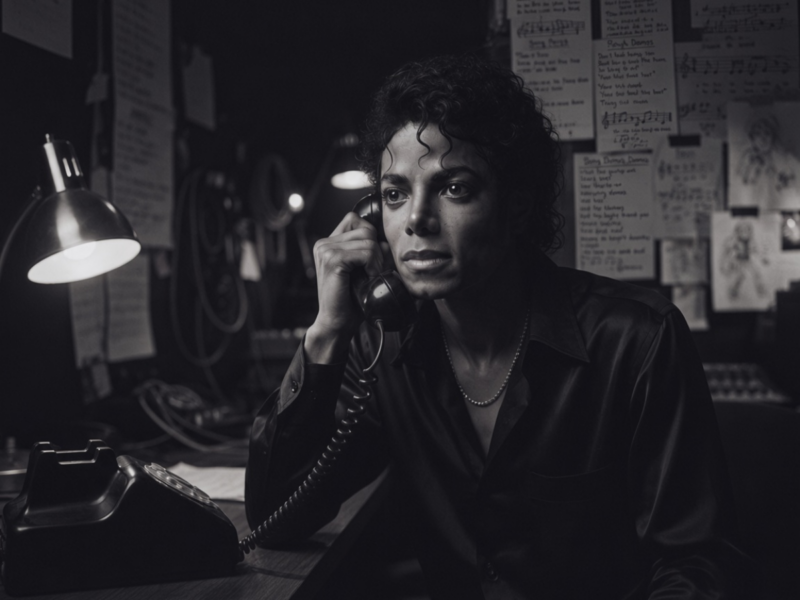
Michael Jackson Called Prince at 2 AM — What Prince Said Changed Pop History Forever.
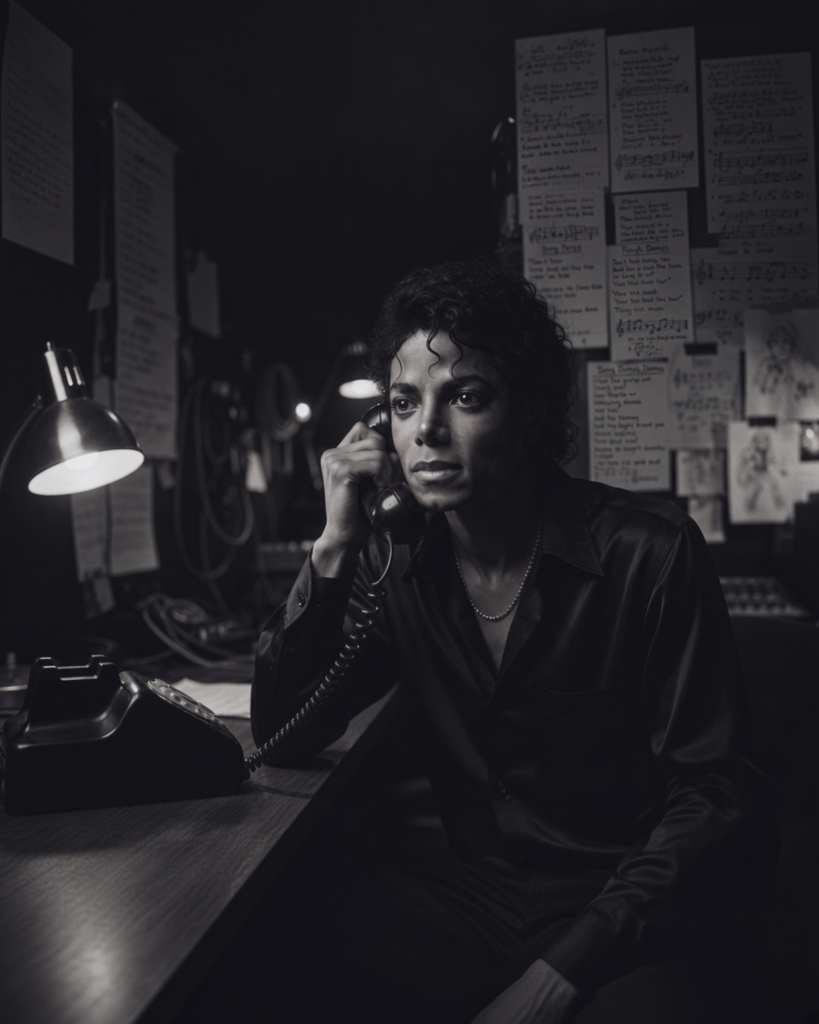
The phone call lasted four minutes and twelve seconds.
When it ended, Michael Jackson sat alone in his Encino home studio at 2:17 in the morning, staring at a wall covered in handwritten lyrics, and made a decision that would reshape the sound of an entire decade.
Nobody believed it would work.
His own manager called it career suicide.
But what happened in the eighteen months that followed didn’t just prove them wrong.
It created something the music world had never seen before and has never fully seen since.
Los Angeles, January 1982.
The music industry was bleeding out.
Record sales had collapsed.
Between 1978 and 1982, the American music industry lost nearly half its revenue.
Disco had imploded.
Punk had fractured.
Radio programmers were terrified, playing the same thirty songs in endless rotation because nobody could agree on what came next.
The executives at major labels were holding emergency meetings, trying to figure out how to stop the bleeding.
Michael Jackson was watching all of it and feeling privately like he was running out of time.
Off the Wall had sold 7 million copies in 1979—a number that should have made any artist feel untouchable.
But Michael felt the ground shifting beneath the industry he’d given his entire childhood to.
He felt something changing in the culture, and he wasn’t sure he was changing with it fast enough.
He was also watching Prince.
That’s the part nobody talks about enough.
Prince Rogers Nelson was twenty-three years old, same age as Michael, and he was doing something nobody in pop music was supposed to do.
Writing everything himself.
Producing everything himself.
Playing every instrument himself.
The music sounded like nothing that existed before it.
And Michael kept returning to one question at two in the morning when the house was quiet.
What would happen if they worked together?
Michael floated the idea to his manager in late 1981.
Bring Prince in to co-write two or three tracks for the new album.
Fuse Michael’s melodic instinct with Prince’s instrumental ferocity.
The result could be something neither could achieve alone.
His manager’s response was immediate and cold.
He slid a trade magazine across the table—a profile of Prince.
The headline called him “the most difficult artist in the business.”
Stories were already circulating about sessions that collapsed because Prince refused to compromise on a single bass note, about executives who left meetings with him feeling like they’d been to war.
Michael read the profile, set the magazine down, said nothing.
But he didn’t drop the idea.
That was the thing about Michael that people consistently underestimated.
He was soft-spoken, almost painfully deferential in social situations.
But underneath all of that was a will made of pure titanium.
When he decided something, he decided it.
He had Prince’s number through a mutual contact.
He called on a Tuesday night in February 1982.
Prince picked up on the third ring.
Michael was direct.
He told Prince he believed they were working toward the same thing from different directions—both trying to break some ceiling that kept Black artists from being taken seriously as complete artists, as composers and innovators and not just entertainers.
He told Prince he wanted to make one song together.
Just one.
To see what happened.
Prince was quiet for a very long time after that.
Then he said, “I don’t share my frequency.”
Four minutes and twelve seconds.
Then the call was over.
Michael sat in the silence of his studio at 2:17 in the morning and stared at the lyrics on the wall.
And here’s the thing nobody saw coming.
He didn’t feel rejected.
He felt something he hadn’t expected at all.
He felt challenged.
Prince hadn’t said no because he thought Michael wasn’t good enough.
Prince had said no because he was protecting something—some sovereignty over his own creative vision that he wasn’t willing to dilute for anyone, not even for Michael Jackson.
And Michael respected that completely, in a way that immediately reoriented everything.
He picked up his notebook, wrote a single line at the top of a blank page.
Not a lyric.
A question.
“If I can’t bring Prince’s intensity into my music, where does my own intensity come from?”
He didn’t sleep that night.
By morning, he had twelve pages of notes.
The Thriller sessions began six weeks later at Westlake Audio with producer Quincy Jones.
From the first day, everyone in the room knew something was different.
Michael arrived with more material than he’d ever brought to a session before.
Not just song ideas—fully formed emotional blueprints for what each track needed to do.
“He came in like he had something to prove,” Quincy Jones said years later.
“Not in an anxious way. In the way a fighter comes into a gym who’s been training alone for months and is finally ready to show someone what they’ve built.”
But then something happened that almost derailed everything before it started.
Three weeks into the sessions, Michael played a rough demo for Quincy.
Four minutes and nine seconds.
The song was called “Billie Jean.”
And Quincy, one of the most experienced producers in music history, said the intro was too long.
“Cut the first thirty seconds,” he said.
“Get to the hook faster. Radio won’t wait.”
Michael listened, nodded, went home, came back the next morning with the same thirty seconds intact.
Quincy raised an eyebrow.
Michael said quietly, “The bassline is doing something in those thirty seconds that nothing else in the song does. It’s building something the listener doesn’t know they’re building yet. If you cut it, the payoff changes. I need those thirty seconds.”
Quincy looked at him for a long moment.
Then said, “Okay. Your way.”
That was the thing Prince’s refusal had unlocked.
Not competition.
Not bitterness.
What it unlocked was a fierce, uncompromising certainty about his own vision.
Michael had spent his entire career—from age five, performing in talent shows while other kids learned to ride bikes—being shaped by other people’s ideas about what he should sound like.
The label’s ideas.
His father’s ideas.
Even Quincy’s ideas.
And Prince, by refusing to share his frequency, had inadvertently shown Michael that the only frequency worth protecting was his own.
Four months into the sessions, with early playbacks already unsettling the label executives—”Too dark,” they said.
“Too cinematic. Nobody will understand this.”—Michael did something nobody expected.
He called Prince again.
Not to relitigate the collaboration.
That door was closed, and Michael understood it.
He called because Prince had said something in a magazine interview that Michael had cut out and taped to his studio wall.
“I don’t make music for the music industry. I make it for the people who need it at two in the morning.”
Michael called to say thank you.
For a refusal.
For nothing.
That’s the only time I ever heard of Prince being quiet because someone surprised him, the mutual contact recalled years later.
He didn’t expect that.
He expected Michael to reopen the collaboration.
Instead, Michael was calling to say the sentence changed how he was finishing the album.
Prince said, “Is it good?”
Michael said, “I think it’s the best thing I’ll ever make.”
Prince said, “Then you didn’t need me.”
The call lasted less than three minutes.
Thriller was released on November 30th, 1982.
What happened over the next eighteen months became the most documented commercial phenomenon in recording history.
Sixty-six weeks on the Billboard 200.
Seven top-ten singles from a single album—a record that still stands.
The first album ever to produce number-one singles in pop, R&B, and rock simultaneously.
Thirty-seven million copies in the first two years.
But the numbers aren’t the point.
They were never the point to Michael.
The point was what happened to the culture.
Black artists began appearing on MTV not because the network had a change of heart, but because the commercial gravity of Thriller made ignoring Michael Jackson impossible.
The walls that had confined Black artists began developing cracks that only grew wider.
An entire generation of musicians—not just pop artists, rock artists, every genre—recalibrated what was possible.
There is one final detail that matters.
In 1983, a journalist asked Michael who he thought the most important artist in music was.
Michael named three people.
Quincy Jones.
Fred Astaire.
And then, almost quietly, as if uncertain he wanted to say it on the record, he named Prince.
“He taught me something,” Michael said, without meaning to.
The journalist asked what Prince had taught him.
Michael smiled—that particular smile, the one that held more than it revealed.
“He taught me that the most important thing you can protect is what’s specifically yours. Nobody else can make what’s specifically yours. If you water it down trying to share it, you lose the only thing that actually matters.”
The quote ran on page fourteen of a trade publication and was largely ignored.
But Michael kept a copy of that magazine in his home studio for the rest of his life.
Taped to the wall.
Next to the twelve pages of notes from the night Prince said no.
Next to everything that came from a four-minute phone call at 2:17 in the morning, when someone refused to share his frequency and changed everything.
Because that’s what the greatest creative decisions look like from the outside.
They look like a door that didn’t open.
A missed opportunity.
A rejection.
What they actually are is the moment you stop waiting for someone else’s permission to find out what you’re capable of.
Prince didn’t share his frequency, so Michael found his own.
And the world is still listening to what he heard.









