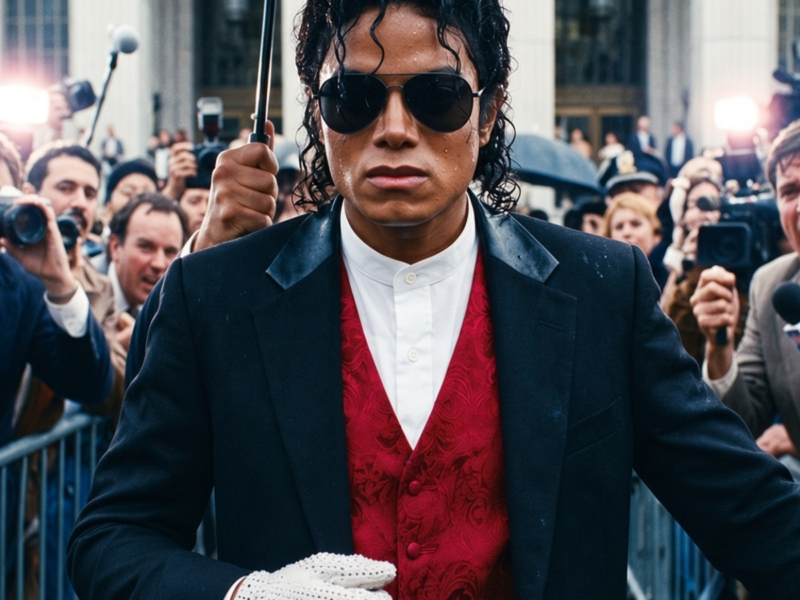
Michael 2 The Biggest Years Are Still Coming.
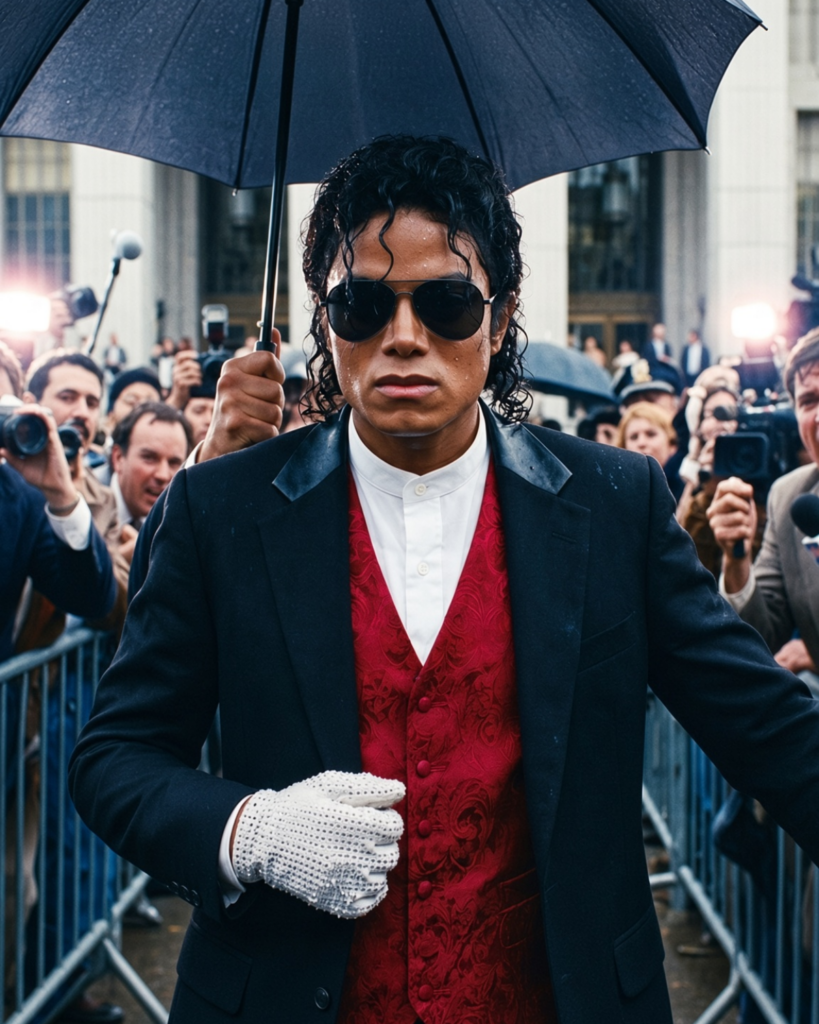
The lot at Raleigh Studios in Hollywood was quieter than it should have been for a Tuesday afternoon.
The security guard at the gate kept waving cars through like he was conducting a funeral procession.
A black SUV with tinted windows rolled past the soundstage where the first Michael movie had shot its concert sequences.
The driver didn’t even glance at the plywood barricades still painted with fading Thriller red.
Somewhere inside, a young man with the same jawline as the King of Pop was sitting in a trailer that smelled like jasmine and old carpet.
His name was Jaafar Jackson, and he had spent the last eighteen months learning how to breathe like his uncle.
Not just dance like him.
Not just sing like him.
Breathe.
The way Michael breathed before the first note of “Wanna Be Startin’ Somethin'” when the crowd noise hit a certain pitch and his chest would rise like he was pulling the whole arena into his lungs.
Jaafar had studied hours of footage in a Burbank editing bay until his eyes burned, and he had finally figured out that the secret wasn’t in the choreography.
It was in the pause.
The half-second before everything exploded.
And now, with a sequel script sitting on the table in front of him, he was starting to understand that the real explosion might not be on stage at all.
“People think they know the story,” Jaafar said, leaning back in a leather chair that had been brought in from a prop warehouse because the trailer’s original furniture was too small for his frame.
“They know the glove. They know the moonwalk. They know the baby dangling over the balcony and the Neverland gates and the mugshot. What they don’t know is what it felt like to be inside that life when it was happening.”
He tapped the script with two fingers, a gesture his uncle had used in interviews when he wanted to make a point without raising his voice.
“That’s what a second movie can do. Not just show the events. Show the man who had to live through them.”
The first Michael biopic had been a phenomenon, pulling in over $400 million worldwide and turning Jaafar from a relatively unknown nephew into a legitimate Hollywood presence.
Critics praised his portrayal of young Michael’s early hunger, the way he captured the desperate energy of a kid from Gary, Indiana who knew he had something the world needed.
But the film stopped before the hardest parts.
It ended on the brink of superstardom, with the Jackson 5’s early triumphs and Michael’s first solo breakthroughs, leaving the 1990s and 2000s untouched.
The allegations.
The trials.
The media circus that turned a man into a monster in the public imagination.
The estate had reportedly been nervous about those years for decades, and the first film’s producers had walked a careful line, avoiding anything that could trigger legal action or alienate the fan base.
But Jaafar wasn’t interested in careful anymore.
“He was the most famous person on the planet,” Jaafar said, his voice dropping into a register that sounded almost like Michael’s speaking voice, soft and deliberate.
“More famous than the president. More famous than the pope. And when you’re that famous, every single thing you do gets put under a microscope. Every mistake. Every odd habit. Every friendship.”
People start building a version of you in their heads, and that version takes on a life of its own.
My uncle spent the last twenty years of his life trying to figure out how to be a human being inside that machine. That’s the story nobody’s told yet.”
The script on the table was titled “Michael: The Later Years” in plain black letters, but everyone in the industry was already calling it Michael 2.
It was a working draft, incomplete, with entire sequences marked in red ink where the legal department had flagged potential issues.
Jaafar had read it three times, and each time he found himself lingering on a scene set in a hotel room in Denver in 1993, where Michael sits alone after a grueling day of depositions, staring at a television that’s playing his own music video on mute.
The scene had no dialogue for the first two pages. Just Michael watching himself perform, a ghost in his own body, while the phone on the nightstand blinked with twenty-nine missed calls.
Jaafar had asked the screenwriter if that detail was real.
The screenwriter said it was based on testimony from a former assistant, but they might have to change it for legal reasons.
Jaafar said they should keep it.
“That’s the whole movie right there,” he said. “Twenty-nine missed calls. Twenty-nine people who wanted a piece of him, and he couldn’t pick up the phone for any of them.”
The first film had made a promise to audiences without realizing it.
By showing Michael as a child, as a teenager, as a young man on the verge of something enormous, it had set up a question that the sequel would have to answer.
What happens when the dream comes true and it turns out to be a nightmare?
The filmmakers had split Michael’s life into two parts for practical reasons, but also for emotional ones.
The first movie was about becoming.
The second movie, if it got made, would be about surviving.
And that meant going places the first film had deliberately avoided.
“There’s a scene in the first movie where Michael is standing in front of a mirror, practicing the moonwalk for the first time,” Jaafar said.
“He falls. He gets up. He falls again. And then he gets it, and he smiles, and the audience smiles with him. That’s the promise. That’s the setup.”
Now imagine the same guy, twenty years later, standing in front of a different mirror, in a different hotel room, and he can’t even look at himself.
That’s the payoff. That’s what we owe the audience.”
The legal problems were real.
The first film had reportedly shot scenes involving the 1993 civil settlement and the 2005 criminal trial, but those scenes were removed after attorneys for the estate and the accusers raised concerns about defamation and privacy.
California law has strict rules about what can be shown in films based on real people, especially when those people have ongoing legal claims or estates that aggressively protect their interests.
The sequel would have to navigate the same minefield, but with even higher stakes because the later years were more legally complicated.
The 2005 trial ended in acquittal on all charges, but the 1993 case was settled out of court, which means there’s no legal finding of fact to anchor the narrative.
The filmmakers would have to decide how much of the story they could tell without crossing lines that would get them sued or shut down.
“You can’t just show something and say it’s true,” said a Los Angeles entertainment attorney who reviewed the first film’s legal strategy but asked not to be named because the sequel was still in development.
“You have to be able to defend every single scene in court. And when you’re dealing with allegations that were never proven, or that were settled without admission of guilt, you’re in a gray area that makes studios very nervous. The first movie avoided that gray area entirely. The second movie can’t.”
Jaafar had his own ideas about how to handle it.
He wanted the sequel to show Michael’s perspective, but not in a way that denied the seriousness of the accusations.
He wanted to show a man who believed he was innocent, who was frustrated by a system that seemed determined to destroy him, but who also understood that the public had questions that deserved answers.
“It’s not about saying he was perfect,” Jaafar said. “It’s about saying he was human. And humans are complicated. Humans make mistakes. Humans trust the wrong people. Humans sometimes do things that look strange from the outside but make perfect sense from the inside. That’s the story I want to tell.”
The first film had been careful to show Michael’s kindness, his generosity, his childlike wonder.
It showed him giving money to strangers, visiting sick children in hospitals, building Neverland as a refuge for kids who had no other place to go.
Those scenes had resonated with audiences because they showed a side of Michael that the tabloids had ignored for decades.
But the sequel would have to show the other side. The side that made people uncomfortable. The side that led to the allegations in the first place. And that meant walking a tightrope between empathy and accountability.
“There’s a version of this movie that’s a hagiography,” said a film critic who had seen an early draft of the sequel script.
“It shows Michael as a martyr, surrounded by people who misunderstood him, and it blames everyone else for his problems. That movie would be a disaster.”
Then there’s the opposite version, the one that leans into the allegations and turns him into a villain.
That movie would also be a disaster. The only version that works is the one that shows both things at once. The genius and the damage. The love and the pain. The man and the myth.”
Jaafar had been thinking about that balance for months.
He had watched interviews with Michael from the 1990s and 2000s, studying the way his uncle’s voice changed when he talked about the allegations.
There was a defensiveness there, but also a sadness.
A weariness.
Like a man who had been asked the same question a thousand times and still didn’t know how to answer it.
“He would say, ‘I would never hurt a child,’ and you could see in his eyes that he meant it,” Jaafar said.
“But you could also see that he knew people didn’t believe him. That’s the tragedy. He spent the last part of his life knowing that a huge chunk of the world thought he was a monster, and there was nothing he could do to change their minds.”
The sequel would also have to deal with the financial reality of Michael’s later years.
Despite his enormous success, he had struggled with debt, spending, and mismanagement.
At the time of his death in 2009, he was reportedly more than $400 million in debt, and his estate had to scramble to stabilize his finances.
The first film had glossed over those details, focusing instead on his artistic triumphs.
The sequel would have to show the other side of the ledger.
The extravagant shopping sprees. The failed business ventures. The loans that kept piling up. The people who took advantage of his generosity.
“He was surrounded by sharks,” Jaafar said.
“Some of them were well-meaning. Some of them weren’t. But they all wanted something from him, and he gave it to them because he didn’t know how to say no. That’s part of the story too.”
The estate’s involvement in the sequel was still being negotiated.
The first film had been made with the cooperation of the Jackson family, which gave it access to music rights, family photos, and personal anecdotes that would have been impossible to get otherwise.
But the estate had also exercised a certain amount of control over the narrative, and some critics had accused the first film of being too sanitized.
The sequel would likely face the same criticism, but Jaafar believed that the family’s involvement was an asset, not a liability.
“We know the truth better than anyone,” he said.
“We were there. We saw what he went through. So if we’re going to tell the story, we should tell it right.”
The film’s director, Antoine Fuqua, had been attached to the project since before the first movie came out, and he had been quietly developing the sequel in between other projects.
Fuqua had a reputation for making films about complicated men, from Training Day to Southpaw, and he was drawn to the challenge of showing Michael’s later years without reducing them to a simple morality tale.
“The thing that interests me is the contradiction,” Fuqua said in an interview from his office in Santa Monica.
“Here’s a guy who made some of the most joyful music in history, and his life was often deeply unhappy. Here’s a guy who loved children and was accused of the worst possible crime against them. Here’s a guy who had more money than anyone could spend and died broke. How do you reconcile those things? You don’t. You just show them. You let the audience sit with the discomfort.”
Fuqua had already begun scouting locations for the sequel, including a return to Neverland Ranch, which had been sold and renamed Sycamore Valley Ranch after Michael’s death.
The property had been stripped of its amusement rides and zoo animals, but the train station and the main house remained, and Fuqua wanted to shoot there because the emptiness of the place reflected the emptiness of Michael’s later life.
“The first movie showed Neverland as a paradise,” Fuqua said.
“The second movie shows it as a prison. Same place. Different perspective. That’s the whole point.”
The sequel would also have to address Michael’s relationship with his children, who were the center of his world in the last decade of his life.
The first film had ended before they were born, so the sequel would introduce them for the first time.
Paris, Prince, and Blanket had been raised in a bubble of secrecy, their faces covered by masks and veils whenever they appeared in public.
The sequel would show Michael as a father, trying to protect his kids from the same media scrutiny that had destroyed him.
“He wanted them to have a normal childhood,” Jaafar said.
“But he also knew that was impossible. So he did the best he could. He homeschooled them. He took them to museums and movies and theme parks at odd hours so they wouldn’t get mobbed. He tried to give them a life that wasn’t defined by his fame. And in some ways, he succeeded. In other ways, he failed. That’s the story.”
The film would also have to deal with Michael’s death, which was still a raw subject for the family.
The 2009 overdose of propofol, administered by his personal physician, Dr. Conrad Murray, had been ruled a homicide, and Murray had been convicted of involuntary manslaughter.
The sequel would show the days leading up to Michael’s death, the exhaustion, the pressure, the desperate attempt to prepare for the This Is It concerts.
Jaafar had read the script pages for those scenes and had found them almost unbearable.
“There’s a moment where he’s rehearsing ‘Billie Jean’ and he stops in the middle of the dance and says, ‘I can’t do this anymore.’ And everyone thinks he’s joking, so they laugh. But he’s not joking. He’s telling them the truth. And nobody hears him. That’s the moment the movie has to earn.”
The first film had ended with Michael on the verge of global domination, the world at his feet, the future wide open.
The sequel would end with his death, the world in mourning, the future stolen.
That contrast was the heart of the story, and Jaafar believed it was the reason the sequel needed to be made.
“People remember the hits,” he said. “They remember the performances. They remember the scandals. But they don’t remember the man. They don’t remember the guy who stayed up all night writing music because he couldn’t sleep. They don’t remember the guy who called his mother every day just to hear her voice. They don’t remember the guy who cried in his trailer after every show because he was so lonely. That’s the guy I want to show. That’s the guy I want people to know.”
The production timeline for the sequel was still uncertain.
Fuqua had other commitments, and Jaafar was considering other roles, including a possible biopic about another member of the Jackson family.
Janet Jackson had reportedly expressed interest in making her own film, and Jaafar had hinted that he might be involved in that project as well.
“Janet has a story that hasn’t been told,” he said. “She was a huge star in her own right, and she dealt with a lot of the same pressures as Michael. But she also had her own path. Her own struggles. Her own triumphs. I think people would be fascinated by that.”
For now, though, Michael 2 was the priority.
The script was still being revised, and the legal issues were still being sorted out, but Jaafar was confident that the film would happen.
“The first movie was a love letter to the early years,” he said.
“The second movie is a reckoning with the later years. It’s harder. It’s darker. It’s more complicated. But it’s also more important. Because if we don’t tell this part of the story, then we’re not telling the truth. And the truth is what my uncle deserved. Even if it hurts. Even if it’s messy. Even if it makes people uncomfortable. That’s the movie I want to make.”
The sun was setting over the Hollywood hills, and the soundstage lights were flickering on in the distance.
Jaafar stood up from the leather chair and walked to the window of the trailer, looking out at the lot where his uncle had once rehearsed for the Victory Tour.
The same lot.
The same city.
The same dream.
But a different story.
A harder story.
A story that was still waiting to be told.
“He used to say that the greatest artists are the ones who show you their scars,” Jaafar said.
“Not the ones who hide them. Not the ones who pretend they don’t exist. The ones who show you the scars and say, ‘This is who I am. This is what I’ve been through. This is what I’ve survived.’ That’s what this movie is. It’s his scars. And I think people are finally ready to see them.”
The first film had been a celebration.
The second film would be a confession.
And in between, there was a man who had changed the world and paid a price that no one could fully understand.
Michael Jackson was the King of Pop, but he was also a son, a brother, a father, a friend.
He was a genius and a mess.
He was loved and hated.
He was everything and nothing.
And if Michael 2 got made, if the filmmakers could find a way to tell the whole story, then maybe, just maybe, audiences would finally see him as he really was.
Not a myth. Not a monster. Just a man.
A man who sang and danced and dreamed and suffered.
A man who left behind a legacy that was as complicated as it was unforgettable.
And that, Jaafar believed, was the greatest story of all.
The phone on the trailer table buzzed with a text from the producer.
The legal team had cleared three more scenes. The script was moving forward. The sequel was one step closer to reality.
Jaafar smiled and picked up the phone, typing a quick reply.
Then he sat back down in the leather chair and opened the script to the scene in the Denver hotel room, the one with the twenty-nine missed calls.
He read it again, slowly, letting the words sink in.
Then he closed the script and looked at the cover. “Michael: The Later Years.”
The title was still temporary.
Everything was still temporary.
But the story was real.
And it was finally time to tell it.









