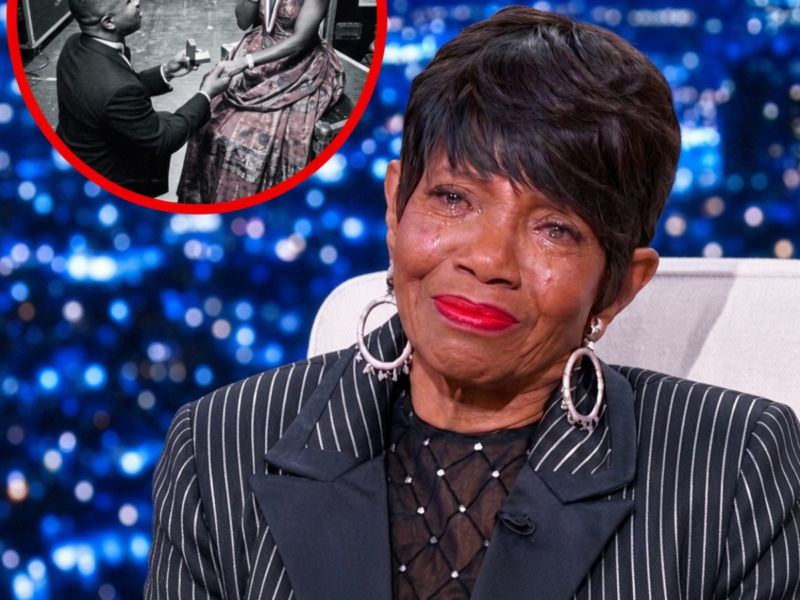
Melba Moore Reveals The Truth About Freddie Jackson Nobody Knew.
A quiet church on a gray morning.
Just before a goodbye, glimpse a church sanctuary.
The organ has gone soft.
Every seat is full.
Someone rises to speak.
Someone who has stood before packed theaters all her life and who now has to find words that no microphone can improve.
What do you say about a friend when the music has stopped?
That question sits behind a headline many people have clicked: what Melba Moore said at Freddie Jackson’s funeral.
It deserves a tender and truthful answer.
Here is the truth.
Following his passing, a homegoing service was held in Harlem at Mount Nebo Baptist Church.
However, the record this story relies on does not include any words spoken during the service.
What does exist is a short written message released through her publicist the day after he died.
It is public.
It is heartfelt.
And it says a remarkable deal in very few lines.
An office worker with a quiet dream, a young boy from Harlem, a devoted son, and a star who gave him his first big chance in life are all examples of the same person.
Throughout the entirety of this, a clear distinction will be maintained between what has been confirmed and what has not been verified.
Let’s start with a scenario that exists in the minds of fans even today.
In a 2023 interview, Melba Moore described a prank.
Freddie Jackson, a man who sold records by the million, came to visit her and waited for the door to open.
When it did, there stood his old friend in the silliest outfit imaginable.
He lost all control, sinking to the hallway floor, laughing too hard to stand.
Perfectly calm, she looked down and said, “Now you can come in.”
To his listeners, he was the smooth sound of slow dances.
To his friend, he was the man giggling on the floor.
Hold on to that contrast, because the rest of this story shows how both could be true.
Frederick Anthony Jackson was born in Harlem, New York, on October 2nd, 1956.
Most coverage lists his age at death as 70, and the Amsterdam News, a Harlem institution, gives that same birth date.
A few outlets printed 69, and one gave the year as 1957, so you may see different numbers.
Money was tight.
He once described his childhood menu as collard greens and fried chicken, a modest detail from a man who never pretended to be royalty.
Sources differ on the size of his family.
Some biographies say he was the third of five children, while he told one interviewer that his mother had six.
The reports behind this story do not name a spouse or children, and that privacy deserves respect.
What the reports do agree on is the foundation.
He grew up in a single-parent household, raised by his mother and grandmother.
In a 2023 interview, he credited his mother with teaching him love, humility, and acceptance.
According to his official biography, he never knew his father, and he called the home a house of love.
In a 2019 interview, he proudly called himself a mama’s boy and explained that she came north from Alabama at 18.
He also told a joke about her.
After weeks on the road, he would rest in her arms and share his adventures.
And then she would hint that it was time to reach into his pocket for the church offering.
A star who had just sold out theaters was still, to her, somebody’s son.
He even liked to say that she was singing at a church concert twelve hours before he was born.
That is family lore in his own words, but it suits a boy whose first stage was a sanctuary.
That sanctuary was Mount Nebo Baptist Church, a congregation famed for its choir.
As a child soloist, he earned a nickname that followed him for years: Ever Ready Freddie.
A Harlem guide to the church says his solo sometimes moved listeners to tears.
Imagine being ten years old and discovering that one phrase can make a room go still.
The neighborhood gave him a second classroom.
He watched James Brown and Aretha Franklin at the Apollo Theater, close enough to see how a great singer lowers her volume to make a crowd lean in.
Later, at White Rock Baptist Church on 127th Street, he sharpened the breath control and smoothness that would define his sound.
At White Rock, he met a young musician named Paul Laurence.
It probably felt like an ordinary friendship between two people who loved the same sound.
It became the partnership of a lifetime, with Laurence writing and producing for him for decades.
After school, they formed a group called LJE, short for the Laurence Jones Ensemble, and worked New York’s nightclubs.
Small stages, uncertain pay, and the hope that somebody important might wander in.
Then came a surprise.
Near the end of the 1970s, he moved west and sang lead for a funk band called Mystic Merlin, which recorded three studio albums between 1980 and 1982.
The man later known for gentle ballads began as a dance-floor funk singer on the California coast.
Back in New York, he took a day job as a word processor, according to his biography.
After work, he went to Hush Productions and sang demo recordings for Laurence.
A demo is a rough practice recording meant to show a song’s promise.
Picture a tired office worker walking to a studio, singing songs that might never be heard.
It looked like ordinary effort.
It was the road to everything.
To understand that road, you have to know who was waiting on it.
Melba Moore was born in New York City in 1945 and spent her earliest years in Harlem.
Her father was a saxophonist, her mother a singer, and her stepfather, a jazz pianist, insisted she learn piano.
After college, she worked as a music teacher before the stage claimed her.
She began her performing career in 1967 in the original cast of the Broadway musical Hair, then replaced Diane Keaton in the featured role of Sheila, becoming the first Black actress to replace a white actress in such a role.
In 1970, she won a Tony Award for her work in Purlie.
And that same year, she earned a Grammy nomination for Best New Artist.
A summer variety show with Clifton Davis followed in 1972.
Her recording hits came in 1976 with “This Is It” and “Lean on Me,” which brought her third Grammy nomination.
By the early 1980s, she was recording for Capitol, partnering with producer Kashif and with Paul Laurence, the same friend who had been guiding Jackson.
That overlap matters.
When she spotted his nightclub act in 1981, according to tributes, she was already working with the man who knew his talent best.
She hired him as a background singer and as part of her touring show.
His graduate school consisted of conducting tours.
His training included learning how to read a crowd, how to pace a show, and how to maintain his composure in front of thousands of people.
It is mentioned in one biography that his brief solo performances piqued the interest of both audiences and those who worked within the industry.
In the same way that many other celebrities would not have, she did not have to share her stage.
She did it anyway.
By 1984, he had his own Capitol contract, and soon the roles reversed.
In 1986, the two recorded “A Little Bit More,” a duet on her album A Lot of Love, and it became a number one R&B hit.
According to AllMusic, it and her next single, “Falling,” were consecutive chart-toppers, and she scored more than a dozen top 20 R&B singles during that decade.
The backup singer she had hired out of a nightclub was now her duet partner on one of her biggest records.
Their lives continued to intersect.
During the 2010s, they shared the stage with other musicians such as Jeffrey Osborne, Peabo Bryson, and Stephanie Mills whenever they participated in the same performances or festivals.
As this was going on, her own career continued to expand.
When she played Fantine in Les Misérables on Broadway in 1995, she made history by becoming the first Black woman to do so.
After that, she went on to perform a one-woman show, released an estimated 25 studio albums, and was honored with a star on the Hollywood Walk of Fame.
Which brings us to her statement.
Released October 6th, 2026, through her publicist Double XXposure Media Relations, it reads: “My heart is broken over the loss of a great singer and even a greater friend, Freddie Jackson. When we worked together on songs such as our hit, ‘A Little Bit More,’ his sense of humor had me laughing during the sessions. We had such a special relationship. I will forever miss my dear friend. Rest peacefully, Freddie.”
Notice what a woman with that résumé chose to leave out.
No Tony, no chart positions, no sales.
She named only a recording studio and the sound of laughter.
Anyone who has tried to sing something delicate while fighting a giggle knows how much trust that takes between two people.
Back to 1985.
His debut album, Rock Me Tonight, arrived, and its title track, written by Laurence, spent six weeks at number one on the R&B chart.
Two more songs, “He’ll Never Love You (Like I Do)” and “Love Is Just a Touch Away,” reached the R&B top 10, and the album went platinum.
The next single raised the stakes.
“You Are My Lady,” written and produced by Barry Eastmond, became another R&B number one and his highest-charting pop single, peaking at number 12 on the Billboard Hot 100.
It is the tune a band plays near the end of a wedding when couples drift toward the dance floor without being asked.
It earned him two Grammy nominations for the 1986 ceremony: Best New Artist and Best Male R&B Vocal Performance.
He did not win, but those ballots placed him among the most closely watched newcomers in the country.
Not only did his album Just Like the First Time, released in 1986, achieve platinum status, but it also produced three consecutive R&B chart-toppers: “Tasty Love,” “Have You Ever Loved Somebody,” and “Jam Tonight.”
The song “I Don’t Want to Lose Your Love,” the fourth single, came very close to reaching the top spot.
After that, in 1988, he released Don’t Let Love Slip Away, which featured the songs “Hey Lover” and “Nice ‘n’ Slow.”
The latter song earned him an American Music Award for Favorite Soul/R&B Single.
The title track of 1990’s Do Me Again and “Love Me Down” repeated the feat.
One summary counts 19 top 10 R&B singles between 1985 and 1992, 10 of them at number one.
On the Quiet Storm airwaves, he shared with Luther Vandross, James Ingram, Jeffrey Osborne, and Peabo Bryson.
The Amsterdam News called him one of the most consistent hitmakers.
He was well aware of his dreams and goals.
He looked up to singers like Marvin Gaye, Sam Cooke, and Al Green because they were able to connect with pop audiences without losing their individuality.
One interviewer asked him about his songs, and he said that they were intended for people who enjoy holding hands in concert.
It is a modest aspiration that will endure for a long time.
Humor followed him everywhere.
In a 1989 interview, as recounted in recent coverage, he laughed about fans rushing the stage during his early tours.
“Some might like his looks and some might not,” he said, but what he was selling was his voice.
Years later, he turned that wit into a podcast.
Conversations with Freddie Jackson was known for laughter, music industry stories, and a recurring comedy segment.
For a man whose records whispered, it was a delightful twist.
He also had a charming habit.
The Philadelphia Tribune described him as friendly and outgoing, someone who often spoke about himself in the third person, explaining why he left New York City.
He scolded his own reflection, declaring that he had stopped living there and merely existed.
Television noticed his charm, too.
In 1989, he appeared on The Golden Girls in an episode called “Two Rode Together.”
Dorothy takes her mother Sophia to Disney World, and the trip goes sideways.
He plays a hotel lounge singer and serenades Sophia, played by Estelle Getty, with “It’s a Small World.”
Imagine the most romantic singer on Black radio crooning a children’s classic to a cranky grandmother.
One recent essay says he clearly had a great time with it.
He also appeared as himself on Family Matters and in the film King of New York.
That same year, he sang “Love Survives,” a duet with Irene Cara for the animated film All Dogs Go to Heaven.
So plenty of children first heard him at the movies.
Years later, the hip-hop duo OutKast gave him a playful shout-out in a rhyme about milkshakes and snowstorms, proof that younger artists saw him as the definition of cool.
Tastes shift, as they always do.
As mainstream R&B moved in new directions during the 1990s, his chart success slowed.
He left Capitol in late 1993 and signed with RCA, which released Here It Is in 1994.
A Christmas album followed that year.
Then Private Party in 1995 and Life After 30 in 1999.
He never stopped.
It’s Your Move arrived in 2004, Transitions in 2006, and For You in 2010, produced by Eastmond.
By one count, he made 15 studio albums, and in 2014, he released the single “Love and Satisfaction” and toured internationally.
One of his most endearing chapters followed shortly after that.
During an interview in 2019, he explained that he had relocated to South Jersey approximately one year earlier.
He stated that New York City had been wearing him down and he desired trees, stillness, and a reduction in the number of sirens.
Because his manager and band were located in the Philadelphia area, the relocation felt like reuniting with family.
His favorite story was about how he had started a new life.
While he was in New York for a visit, he pleaded with his family to take him back to Voorhees.
He stated that his neighbors would occasionally do a double take when they saw him at the grocery store, wondering why the man pushing a cart looked so much like Freddie Jackson.
The response he gave was that he could adjust to it over time.
Additionally, he acknowledged the region as the source of his musical inspiration.
“The city of Philadelphia was the source of three of my number one records,” he stated, and he spoke fondly of McFadden and Whitehead, both of whom he found himself missing terribly.
In Camden, he collaborated with a young vocal group known as Juton, which was coached by Leon Huff, who is now a member of the Rock and Roll Hall of Fame.
In that very same interview, he revealed his most vulnerable side.
His mother had passed away approximately five years earlier, according to his own estimation, and his friends had encouraged him to compose a song in her honor.
As he put it, grief operates according to its own pace.
“When I was finally able to find the words, it was in the tranquility of South Jersey.”
In addition to that, it had jolted his sense of purpose.
It wasn’t until a song called “Find My Way” kept playing on his stereo and wouldn’t stop playing that he began to question whether or not he should maintain his singing career.
It was the seed that eventually grew into his album Love Signals.
Once he reached that point, he stated that he was no longer making records for the industry, but rather for his own heart and for his most devoted fans.
The next year showed it was the right choice.
In 2017, the single “One Night” topped an internet radio indie soul chart, and Love Signals followed in 2018.
A magazine put him on its cover that January.
And in 2019, he headlined the African World Festival at the Charles H. Wright Museum in Detroit.
That same year, he released “A Million Ways,” and the novelist John Edgar Wideman published a story in The New Yorker titled “Arizona,” written as a letter to him.
His final album, My First Love, arrived in 2023 and, according to his official biography, was dedicated to his mother.
After all the hits, he returned to the first person who ever heard him sing.
In 2024, he shared something deeply personal.
In a video message, he revealed a kidney disease diagnosis and announced a partnership with the National Kidney Foundation.
He said he planned to face it with openness and resilience.
Many performers keep their health private.
He chose to speak, hoping his experience could help others.
On the evening of Monday, October 5th, 2026, he died, three days after his 70th birthday.
His family announced it the next morning on his official Instagram page, saying he had gone home to rest.
They called him more than a legendary voice, remembered him as kind and generous, and thanked everyone who had ever sung along, telling them they had been family to him.
Here, guessing tends to rush in, so let’s be careful.
The reports behind this story gave no cause of death.
He spoke openly about kidney disease in 2024, but no official source linked that diagnosis to his passing, and it would be wrong to suggest otherwise.
Only his family can say more.
Let’s sort this out clearly.
What is confirmed?
He died on October 5th, 2026.
His family announced it on October 6th.
Moore released a written statement, and a service was planned for October 19th at Mount Nebo Baptist Church.
What is not confirmed: the cause of death, the number of his siblings, and the birth year in a few outlets.
The lighter stories, like the prank and the podcast, come from interviews and fan accounts we have not independently verified.
What this story cannot know: what was said at the service, who spoke, and whether Moore added words of her own.
Those moments belong to the people in that room.
Some viewers may object that a written statement is not a eulogy, and they are right.
A press message cannot capture a voice that cracks or a pause before a name.
But short messages often say more than long speeches.
She needed only five sentences, and she spent them on laughter, friendship, and a wish for peace.
So what do we take away?
Perhaps greatness and warmth are different gifts, and the rare person has both.
The records prove the first.
The hallway, the shopping cart, and the studio laughter suggest the second.
A church soloist in Harlem.
A word processor with a dream.
A backup singer who became a headliner.
Ten number one R&B hits built on patience and a sound that never shouted.
Somewhere a couple is swaying to one of those songs right now, and a friend’s few honest lines remain the kindest tribute anyone has written.
Rest peacefully, Freddie.









