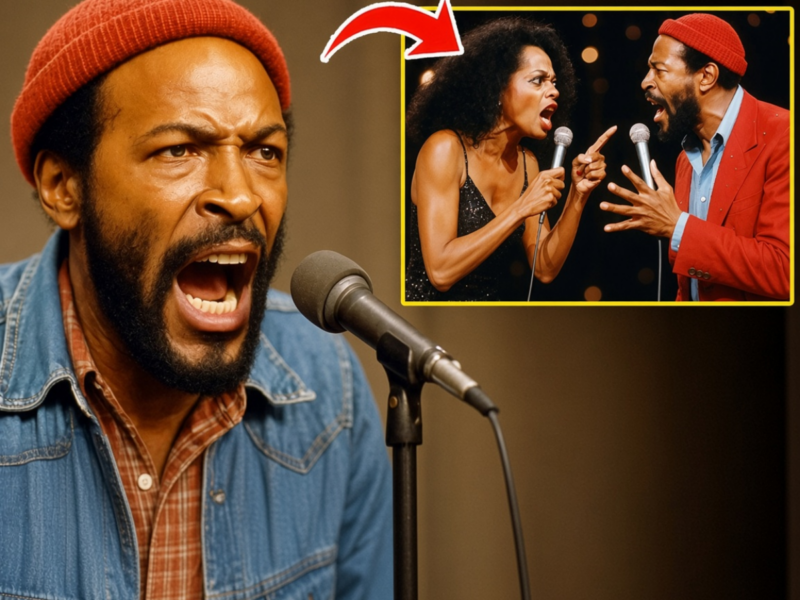
Marvin Gaye Revealed The 5 Artists He Couldn’t Stand Working With.
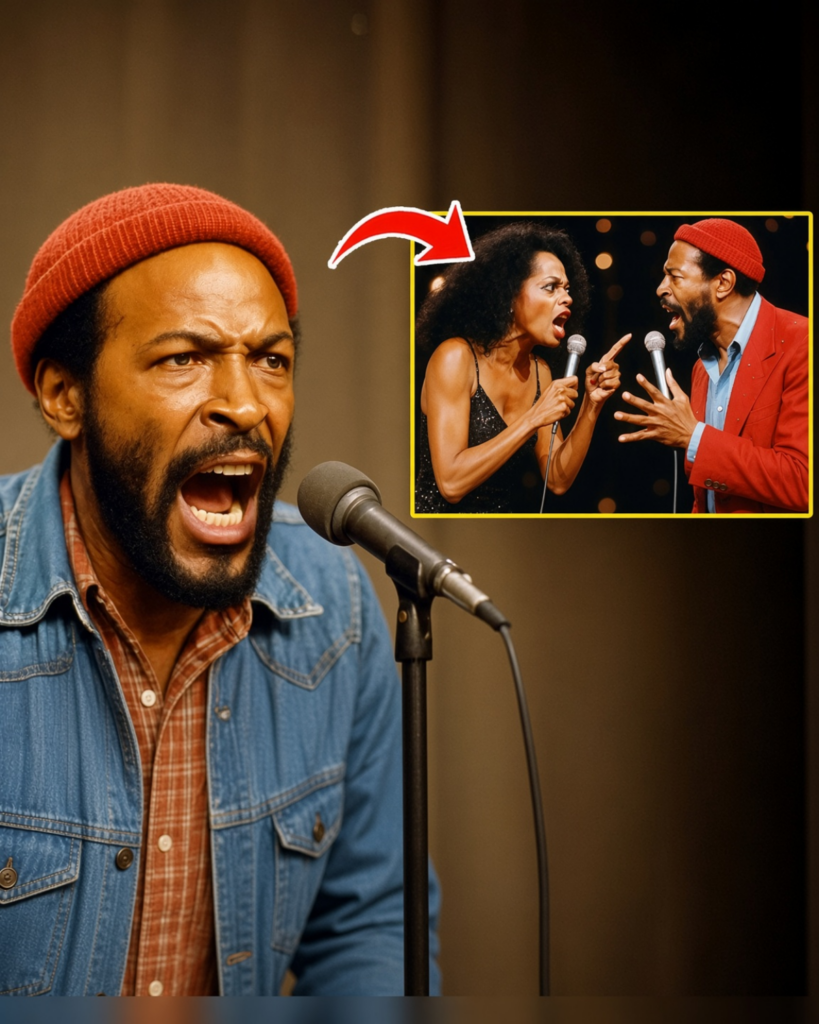
For Marvin Gaye, music wasn’t just art.
It was soul.
It was flesh and blood.
A realm with no room for pretense, calculation, or ego-driven theatrics.
And he spoke out very clearly, very authentically.
There were five individuals, five names.
No matter how famous, no matter how acclaimed, Marvin simply couldn’t tolerate.
Diana Ross was one of them.
The powerful, beautiful, and icy woman who once suffocated Marvin, stifling his creativity in his own recording studio.
But the other four each represented a profound rift.
One who only knew control, one who never yielded the stage, a shadow thought to be a genius, but was actually a musical shackle, and another icon he never collaborated with simply because Marvin knew if he did, he would lose himself.
This isn’t about envy.
This is a hard truth to swallow in a world where ego can kill an entire harmony.
A list never before revealed.
Silent yet fierce fractures.
And now we will open the backstage door where Marvin once said no.
Not out of disrespect, but because he refused to lose his soul.
Barry Gordy once told Marvin Gaye not to overthink, just let the girls scream.
That phrase seemed gentle, but to Marvin it was like a cold lock tightening around his throat every time he tried to utter his true voice.
It seemed like advice, but gradually Marvin realized it was an order, and it was also the boundary Gordy had drawn early on: the line between a money-making Black singer and a human being with a soul.
Years later, Marvin recounted that during the time he wrote “What’s Going On,” he felt like he was living in a glittering prison.
There was gold.
There was fame, but there was no freedom.
No one forbade him from speaking, but no one wanted to listen.
The kind of music he wanted to make about war, about drugs, about injustice, about the disorientation of Black men returning from the battlefield was all deemed too heavy.
And when he brought the recording to Gordy, the man bluntly stated, “This isn’t hit material. No one wants protest songs.”
Detroit, winter of 1970.
Marvin wore a long beige coat.
Sitting alone in his car outside Motown headquarters.
The street lights were dim, snow falling lightly.
Beside him was a notebook filled with unfinished draft lyrics.
“Father, father, we don’t need to escalate.”
He had written these lines not to sell records.
He wrote them because they were a cry for help for his brother who had just returned from Vietnam with bewildered eyes, no longer knowing who he was.
He wrote for the children being beaten in the streets.
He wrote for himself, the man who had once smiled, once shone, once been loved, but always felt empty.
He no longer wanted to be Motown’s Marvin Gaye.
Not the romantic crooner with dreamy eyes and sweet love songs, but Marvin the Black artist who saw blood, anger, love, and despair in the same drum beat.
And that, to Barry Gordy, was a threat.
Barry Gordy was a strategic genius, but he was also the one who built an empire based on absolute control.
Marvin once said, “Working with Gordy was like living in a dream someone else wrote for you.”
At Motown, everything was formulaic, from notes to stage presence.
What Marvin wore, how he sang, even how he answered interviews, all meticulously calculated.
He was part of an industrial chain, a branded commodity.
But Marvin couldn’t pretend anymore.
The passing of his close friend Tammi Terrell after a series of health crises, his brother returning from the battlefield like a hollow shell, the increasing brutality of the police toward Black people, all suffocated him from within.
Music was the only way to breathe.
And he knew if he continued to listen to Gordy, he would drown in the silence imposed by this industry.
Marvin went into the studio alone without Gordy’s supervision.
He called veteran jazz musicians, recording “What’s Going On” in a few days with entirely new material: soul mixed with jazz, funk, gospel, and even pain.
He no longer sang for the radio.
He sang for his soul.
Gordy heard the recording and was furious.
Called it unmarketable music.
No release, no promotion.
But Marvin didn’t back down.
He declared he would not record any more music if “What’s Going On” wasn’t released.
A Black artist daring to challenge the most powerful Black music mogul of the time, that had never happened.
But Marvin had crossed the line.
Finally, Motown conceded.
The record was released and within weeks, it became Marvin Gaye’s best-selling single in history, and then the album of the same name.
Like a bomb exploding the old definition of entertainment soul music.
Marvin had won, but the price was an irreparable rift.
Gordy never truly forgave Marvin for breaking free from the mold.
Their relationship from then on was a silent war.
Still smiling in front of each other, still shaking hands at press conferences, but inside was a distance greater than money or fame.
Marvin once confided, “He no longer saw me as a Motown singer. I think he felt betrayed, but I was just trying to survive.”
It wasn’t a battle between two men.
It was a battle between two eras, between Black music softened to please the market, and Black music that spoke of true pain, true roots, true soul, between safe love songs and songs that dared to question America itself.
Marvin Gaye didn’t resent Barry Gordy for his power.
He resented the silence he forced him to keep.
Resented the way Gordy, who shared his skin color, his background, who grew up stifled by the system, turned his back, choosing comfort over truth.
To many, it was just a conflict between boss and artist.
But to Marvin, it was a cut, silent, yet profound, from someone who once thought he had found a home, only to realize that place didn’t accept the most authentic part of him.
For music, he was willing to lose family.
For his voice, he chose solitude.
And perhaps that is the price every Black artist must pay if they want to sing their heart out without being trimmed to fit others’ ears.
They didn’t look each other in the eye, not once.
They only sang together through a soundproof glass.
The recording studio in Los Angeles that day, the sound engineer recalled, was as cold as a hospital room.
Not because of the air conditioning, but because of the atmosphere between the two biggest Motown figures at the time, Diana Ross and Marvin Gaye.
He sat in the corner, feet propped on a chair, holding a lit cigarette.
On the other side, she stood straight as a statue, headphones tight on her head, eyes fixed on the empty space in front of her.
Between them was a thick glass wall and a silence no one dared to touch.
The album “Diana & Marvin” was orchestrated by Barry Gordy as a Motown dream.
Two of the label’s brightest stars singing duets, igniting a new era of soul pop.
But behind the mics, everything quickly turned into a discordant dream.
Diana Ross was a person of discipline.
Every recording had to be precise.
Every line had to be perfect, every breath.
She had been trained, or rather programmed, to maintain a flawless public image.
As a Black woman in an industry controlled by white and Black men, she had no choice but perfection.
Marvin, on the other hand, after “What’s Going On,” rejected all frameworks.
He recorded by inspiration.
Some days he was late.
Some days he didn’t show up.
Some days he walked into the studio wearing nothing but a lit herb in his hand.
He sang with raw, authentic, unedited emotion.
And that very freedom drove Diana mad.
They didn’t discuss, didn’t coordinate.
In fact, most of the time they didn’t record simultaneously.
One arrived, the other left.
Two voices spliced together by technique, not by emotion.
They were two flames, but they never burned in the same direction.
Rumors spread quickly in the studio.
“They don’t like each other,” an assistant said.
“Not because of personalities, but because of energy. They don’t breathe the same air.”
Diana was accustomed to control.
But when faced with Marvin, who rejected all frameworks, compromised with no one, pleased no one, she didn’t know where to place herself.
Marvin felt suffocated.
He once said, “I couldn’t be myself in that room.”
Every time Diana asked to re-record a section, he would simply leave the room in silence.
No argument, but no yielding either.
The tension didn’t erupt into arguments, but seeped out in every sigh, every fragmented recording.
And the terrifying thing was no one intervened, no engineer, no producer, no Barry Gordy.
Because for Motown, as long as the album was completed, nothing else mattered.
The album “Diana & Marvin” was released in late 1973, and strangely, it was still a success.
Songs like “You’re a Special Part of Me” and “My Mistake Was to Love You” were still loved, constantly played.
But for those who were in the studio, they knew behind the harmonies was a chilling distance.
Neither of them truly sang with each other.
An engineer once shared, “Every time Diana left the studio, Marvin would come in and vice versa. No one said it, but everyone knew they avoided each other.”
And so instead of being a vibrant love song, “Diana & Marvin” became a fabrication, a beautiful poster of a Motown dream that never truly materialized.
Marvin later shared, “I always felt in that room I had no place. Not because of Diana, but because of all the expectations placed on me, on her, on what that album was supposed to become.”
He didn’t blame her, but he also didn’t forgive the way everything was forced into an image of a perfect couple, even though they never were one.
As for Diana, as always, she never spoke about it.
She moved on.
She maintained her image.
But those who truly listened to her sing on that album would find her voice not exactly loving, not exactly happy.
It was dry, controlled, and a little, just a little, weary.
Motown once dreamed they could replicate the success of Marvin and Tammi or Diana and the Supremes.
But there was one thing they forgot.
Marvin and Diana were not versions of anyone.
They were two separate worlds, two artistic battlefronts.
And forcing them into the same mold only created suffocation, not harmony.
Not everyone is suited for a duet.
Not every dream should be forced into reality.
Sometimes the two brightest stars cannot shine in the same sky because the light of one is the shadow of the other.
And so they moved on, each in their own direction.
No animosity, no regrets.
It’s just that some recordings are made not to be sung together, but to remind us that artistic space, like love, doesn’t always have enough room for two.
There was only one microphone on stage and no one would step back.
That’s how it began.
Not with a loud argument, not with a backstage punch or a shocking scandal.
Simply a moment, two men, two rising stars approaching the mic, and neither yielding.
Marvin never forgot that time.
He sang as if every show was his last.
“I understood that. But please share the mic.”
He once told a friend after the performance.
His voice wasn’t angry, just a hint of weariness, a gentle but very real kind of hurt.
Motortown Review, 1966.
Marvin already had several big hits.
David Ruffin was then propelled to the forefront with “My Girl” alongside The Temptations.
Both were Motown icons, the most prominent Black record label in America at the time, but they were completely different.
Marvin was a perfectionist.
He controlled his breath, every vocal flourish, every stage movement.
David was like a storm, singing with all his lungs, all his blood, and all the wildness in his heart.
He never stood still.
He danced, knelt, screamed, and he captured every eye.
“David always overdid it, not to please the audience, but to make everyone see he was superior to me,” Marvin said.
No camera captured that emotion, but it was evident on the faces of every artist on the tour.
They knew those two egos could not share a headline.
At Motown, who was the number one vocalist was always an unspoken question.
Smokey had romance.
Levi Stubbs was fierce.
But David and Marvin, they were the two most formidable opposites.
And the irony was they were often placed together in performances, shows, projects.
Initially, they tried to be friendly, exchanged polite smiles, patted each other’s shoulders, but backstage didn’t lie.
A technician recounted, “Every time they were about to step on stage, the air was freezing. No one argued, but you could feel the dislike. It was as clear as the bass in ‘Ain’t No Mountain High Enough.'”
Once in Detroit, Marvin opened with “Ain’t That Peculiar,” and the audience almost entirely stood up.
He felt he owned the stage.
But just as he finished his performance, David walked out.
No greeting, no transition.
He sang “Ain’t Too Proud to Beg” as if to drown out every trace of the previous act.
Marvin was stunned.
Not out of envy, but because he felt he had just been dismissed, overlooked.
Both Marvin and David came from places no one remembers.
The poverty, the coldness of prejudice, and the suffocating atmosphere of white America in the ’60s weighed on them from childhood.
They sang not just to be famous.
They sang to survive.
They needed to be the best because if not, there would be no place for them on the radio, on TV, or in the heart of America.
Marvin once said, “I’m not fighting David. I’m fighting this world. The world that once told me someone like me would never make it on the radio.”
But David also said, “They don’t remember my name. They just say the guy who sang ‘My Girl.’ I have to do everything not to be forgotten.”
And that was the problem.
They were more alike than they thought.
Both wounded, both yearning, both lonely at the top.
But because of that, they couldn’t cherish each other.
In 1970, during a joint rehearsal for a television show, David was nearly two hours late.
Marvin had been ready long before.
He hated disrespect, especially from those he didn’t consider truly considerate artists.
When David walked in, before he could say anything, Marvin spoke: “What, want to do a solo act now?”
His voice half joking, half sarcastic.
David smirked.
“If I did a solo, at least people wouldn’t fall asleep.”
No one laughed.
No one said anything more.
But that coldness, it was worse than a punch.
From that day on, they never shared a table, never shared a backstage room, never spoke outside of mandatory interactions.
Their professional camaraderie, or any goodwill, died in prolonged silence.
1991, David Ruffin passed away.
Marvin didn’t cry, but he remained silent for a very long time.
A close friend recounted, “The only time he mentioned David was when he said, ‘He sang with everything he had. Sometimes that’s what makes people leave too soon.'”
Marvin knew they couldn’t be friends, but they also couldn’t be enemies because deep down he understood David in a way only those who have been similarly wounded can understand.
They were both brilliant, but the light of one always dimmed the other.
That wasn’t their fault, but the fault of a world that only allowed one Black voice to resonate at a time, an industry built on comparison, elimination, and fierce competition.
If born in a different context, where Black artists didn’t have to scream so loudly to be heard, perhaps they could have been allies.
But at Motown, when the spotlight only shone enough for one, the other always had to step into the shadows.
Marvin understood that clearly, and so he never forgave, nor ever blamed.
It’s just that he wished, just once, David could have given him the mic, and they could have sung together like people sharing the same pain.
Marvin Gaye detested being lectured, especially by someone like Norman Whitfield, who would constantly expound on hit song structure, studio harmony, and the Motown formula for success.
Marvin didn’t need formulas.
He needed freedom.
And that’s why those two men, one a production genius, one a performance genius, ultimately couldn’t work together.
Not because they didn’t respect each other, but because neither would yield.
Whitfield thought Marvin was dreaming.
Marvin thought Whitfield was stifling emotion.
They looked at each other like two oppositely charged wires.
The closer they got, the more sparks flew.
“Marvin, listen to me.”
That familiar phrase made Marvin want to simply get up and leave the studio.
Norman Whitfield was no ordinary individual.
He was the mind behind the resurgence of the Temptations.
The one who transformed the romantic vocal group into psychedelic warriors with “Papa Was a Rollin’ Stone,” “Ball of Confusion,” “Cloud Nine.”
He made soul music deeper, darker, and more multifaceted than ever before.
But he didn’t grasp one thing.
Marvin wasn’t a speaker for him to plug in and control the sound.
In a meeting in early 1970, Whitfield placed a demo tape on the machine and said, “This is going to be your next big thing. Rock-influenced, layered bass, a hypnotic hook. Trust me, this is a hit.”
Marvin sat still, arms crossed.
He listened, said nothing.
Then he quietly said, “I don’t see anything in it. No soul.”
Norman was furious.
“Don’t you see I’m paving the way for you to move forward? Do you want to destroy everything we’ve built?”
Marvin smiled, a smile that could drive people mad.
Cold, soft, yet harder than stone.
“I don’t need anyone to pave the way. I’m paving my own.”
From then on, they no longer sat at the same table.
They communicated through intermediaries, unfinished recordings, discarded ideas.
Neither would concede.
One side demanded to modernize Motown with sound.
The other demanded to humanize emotion with lyrics.
“He treated me like a child,” Marvin said to his close friend after a tense argument in Studio 3 at Hitsville, Detroit.
“He thought he was the only one who knew how to make music. I said I wanted ambient sounds. Wanted to record voices from the street. Wanted to sing like I was talking. He scoffed. Told me I was losing touch with reality.”
“Whose reality?” Marvin blurted out.
“I live my reality in a world where a Black man doesn’t know when he’ll die because of the police. I sing about that, and he thinks as if he’s drawing a sales chart.”
Whitfield wasn’t insensitive.
He was just too obsessed with achievement.
He himself had to fight for Barry Gordy’s trust.
Had to prove that he wasn’t just a producer with good ears.
He wanted every song released to be a shot straight to the charts.
As for Marvin, he no longer cared about the charts.
Not after his cousin died in Vietnam.
Not after witnessing violence, discrimination, the corruption from the government.
He couldn’t sing about love when there were gunshots outside.
Then came “What’s Going On?”
Marvin self-produced, self-arranged, set all of Motown’s formulas aside.
Whitfield heard the demo, and he couldn’t believe his ears.
Not because it was bad, but because it shattered everything he had ever believed in.
“You’re singing as if you’re praying,” he said, half compliment, half sarcasm.
“Because I am praying,” Marvin replied.
“And this song isn’t for the radio. It’s for those who are suffering.”
Whitfield turned away, said nothing more.
Motown almost didn’t release “What’s Going On.”
Barry Gordy called it the most ridiculous song I’ve ever heard.
Whitfield didn’t argue with that statement.
Perhaps deep down, he felt a pang, knowing Marvin had done what he himself had always wanted to do: break Motown from within.
But Marvin acted on instinct.
As for Whitfield, he still needed a plan.
When the album was released and became a monumental success, the whole world looked at Motown differently, and Whitfield, for the first time in his life, felt he had been outdone, not by another label, but by his own former collaborator.
On one occasion at a small party in Hollywood, Marvin and Whitfield accidentally sat near each other.
Neither spoke first.
Then after a few drinks, Marvin turned and said, “You know, I don’t dislike you, but I wish you had listened to me just once instead of only listening to yourself.”
Whitfield chuckled a dry laugh.
“You know, Marvin, I just didn’t want to see you burn yourself out in that thing called freedom. This world doesn’t forgive artists.”
Marvin nodded.
His eyes were weary.
“But it also doesn’t forgive those who deny their own soul.”
Whitfield continued to produce technically sophisticated works.
He elevated soul music to new sonic heights, but he never created a “What’s Going On.”
Marvin continued further with “Let’s Get It On,” then “Here, My Dear,” then “Midnight Love.”
Sometimes he stumbled, sometimes he shone brilliantly, but he was always himself.
Whitfield once said in a rare interview, “Marvin was not an easy person to work with, but if he were easy, he wouldn’t have left such a legacy.”
Marvin and Whitfield each chose a path.
They clashed.
They argued, but neither was wrong.
It’s just that sometimes music needs two different minds to exist.
And sometimes those two minds cannot be in the same room.
Marvin Gaye didn’t need Norman Whitfield.
Norman Whitfield also didn’t need Marvin Gaye.
But the world’s music needed both.
Marvin Gaye once walked out of a meeting room in LA in the early ’80s, leaving behind him a peculiar silence and astonished gazes from one of the world’s biggest producers.
The room still echoed with the polite laughter of Quincy Jones, who had just offered one of the most enticing opportunities in Marvin’s career: recording an album with him, the man who had just helped shape “Off the Wall” and was about to redefine pop music with “Thriller.”
Marvin didn’t say a word of refusal.
He simply stood up, shook hands lightly, and left slowly, as if he was walking out of a life not meant for him.
No one understood, but he did.
They were two men, both in the music business, but they viewed life through two completely different lenses.
Quincy was an architect.
He built songs like a building, layer by layer, floor by floor, every beat, every tap, measured and calculated to every breath.
He believed in structure, in teams, in a polished American dream.
Marvin was not.
He was someone who closed his eyes, put on headphones, and sang as if it were the last time in his life.
No blueprint, no clear recording schedule, sometimes no producer at all.
To him, music was blood, pulse, something that should not be produced.
So what really happened in the meeting between the two?
Quincy approached with good intentions.
He admired Marvin from his early days at Motown, through “What’s Going On” to “Let’s Get It On,” and even the instinctive love songs that followed.
Quincy believed that if the two of them collaborated, something extraordinary would happen.
He envisioned an album with deep, sharp harmonies, sweet strings, jazz-infused soul drums, Marvin singing almost whispered yet haunting lines.
A marriage of classical discipline and raw instinct.
He believed he could tame Marvin without losing his soul.
But Marvin didn’t want to be tamed.
He didn’t even want anyone to think they were taming him.
He once told a close friend after the meeting, “Quincy is a genius, but too many layers, too perfect. I don’t believe in perfection. I believe in chaos, in things that have to be sung before they can even be written down.”
Marvin didn’t need a producer anymore at that point.
He was already someone who wrote, arranged, mixed, and adjusted every bass note himself in the dead of night.
Quincy might be the king of the studio.
But Marvin didn’t need a throne.
He only needed ambiguity, space, room for his soul to permeate every note.
Some said Marvin feared Quincy, feared the constraints, feared having to put himself on a nine-to-five studio schedule.
But that wasn’t the truth.
He didn’t fear Quincy.
He respected him.
But between them was an unbridgeable chasm.
One believed art needed organization.
The other believed art was about letting go.
Quincy later said in a 1989 interview, “I wanted Marvin, but Marvin didn’t want producers. He was the producer. I couldn’t keep up with his chaos.”
It wasn’t that Quincy wasn’t talented enough to keep up.
It was that he didn’t want to step into a world without a map.
No one wants to confine themselves in a storm without knowing when it will subside.
And so that potential collaboration between two of the greatest Black men in American music vanished into thin air after just one conversation.
No animosity, no arguments, no definitive conclusion.
No “I’ll call you later.”
Just a gentle shake of the head and a very softly closing door.
Fans were disappointed.
They imagined a Marvin introduced by Quincy into the world of “Thriller,” of spotlights, of deep dance tracks, a more splendid Marvin of the ’80s, perhaps less solitary.
But Marvin didn’t want to live in that imagined world.
He didn’t belong on Las Vegas stages or at awards nights.
He belonged in dimly lit rooms with quiet background music and a rusty microphone capturing the sigh of a restless soul.
Quincy, meanwhile, continued to rise.
He made “Thriller.”
He made history.
He didn’t need Marvin.
But he never forgot him.
Once Quincy mentioned Marvin at a small party.
“He was the most beautiful ghost music ever had. A ghost that could not be caught, could not be held, could not be produced, only listened to when it spoke on a rainy night.”
When Marvin passed away in 1984, Quincy sent a wreath of white flowers to the funeral.
Nameless, only a small note with a few brief lines.
“There was nothing wrong with the way you heard the world.”
And that was it.
No Quincy-Mavin album, no leaked demos, no behind-the-scenes studio footage, no shared dreams materialized.
Only a “nearly” enough to keep people imagining forever.
Marvin Gaye was never the easygoing type of artist.
He didn’t stay within Motown’s framework.
Didn’t bow to a system no matter how glamorous.
For Marvin, music wasn’t a product that needed good management, but a voice that needed to live authentically.
Perhaps that’s why he clashed with almost every major figure of his era, from Diana Ross, the diva who always demanded control, to David Ruffin, who wouldn’t share the microphone, to Norman Whitfield, the producer too fond of formulas, and even Quincy Jones, whom Marvin never believed truly understood his heart.
These conflicts at first glance seemed like artistic ego, but deeper down they were a persistent battle between a Black soul yearning for freedom and an industry constantly trying to control and categorize.
Marvin wasn’t someone who sought trouble; he simply refused to live a lie.
Marvin’s greatest success wasn’t in who he collaborated with, but in this: he dared to say no even to the most powerful, most famous individuals.
And sometimes that no created music that made the whole world fall silent to listen.









