Marvin Gaye Refused to Shake Michael Jackson’s Hand — What MJ Said Left the Studio Frozen.
By the time Marvin Gaye reached his dressing room at NBC Studios in Burbank that October evening in 1982, he had already decided he was probably going to disappoint somebody before the night was over.
He usually did.
It wasn’t something he planned. It was just the shape his life had taken over the last few years. And by forty-three, he’d stopped pretending otherwise, even to himself.
He’d flown in from Europe three days earlier—thinner than people remembered him, quieter too—carrying the specific tiredness of a man who’d spent two years living out of a borrowed apartment in Belgium because the Internal Revenue Service and half of Motown’s old business partners had made it difficult to live comfortably anywhere in his own country.
He’d gone over there half-broke and half-broken.
And somewhere in a small room overlooking the North Sea, he’d found a song that pulled him back from wherever he’d been circling—a song called “Sexual Healing” that was already climbing the charts faster than anything he’d put out in years.
Columbia Records wanted him back in front of American audiences to ride that wave.
And that was the whole reason he was standing in a dressing room in Burbank instead of staying in Belgium, where nobody expected anything from him.
If you already know how this story ends, go ahead and hit that subscribe button right now, because what happens on that stage is one of the strangest nights in the history of that show.
Ten years earlier, Marvin had fought Barry Gordy for the right to release an album called *What’s Going On?*
A record about poverty and war and brothers coming home broken from Vietnam. The kind of record Gordy had flatly told him nobody wanted to hear from a Motown artist.
Motown made hits. Motown made love songs. Motown did not make records asking hard questions about what America was doing to its own people—especially not its own Black people.
And Gordy had said so to Marvin’s face more than once.
Marvin had released it anyway, quietly, almost daring the label to stop him—and it had become one of the most important records anybody in that building had ever put out.
He’d won that fight. He’d never quite gotten over having to fight it in the first place.
And in the years since, he’d developed a specific kind of watchfulness around anybody the industry held up as its shining, easy success story. The ones who never seemed to have to fight for anything at all.
He hadn’t met Michael Jackson properly in years. Not since Michael had been a kid, running around the same Motown hallways Marvin used to walk—wide-eyed and polite, and already working harder than grown men twice his size.
Marvin had liked him then, the way you like a kid who reminds you a little of yourself at that age. Hungry. And unsure whether the hunger would ever actually get fed.
What he felt about the man Michael had become by 1982 was more complicated than liking. And he hadn’t fully sorted it out, even sitting in that dressing room an hour before taping.
A producer knocked and told him, almost as an afterthought, that they’d added a surprise element to the broadcast. Michael Jackson would be joining his segment.
Marvin sat with that for a moment. “Does he know?”
“Not yet,” the producer said. “We’re telling him closer to air. Keeps it fresh for the audience.”
“That’s a strange way to treat two grown men,” Marvin said—not unkindly, just observing it the way he observed most things.
“Good television usually is,” the producer said, and left before Marvin could say anything else.
Keep that exchange in mind, because it matters for what happens later that night.
Across the lot in a different dressing room, Michael Jackson was going through his own private ritual before a public appearance—the same one he’d been running since he was a small boy standing in the wings of the Apollo Theater, waiting for his cue.
He hummed scales quietly to warm his voice. Ran through the choreography for the number he’d be performing that night one more time in the mirror. Adjusted his jacket twice, though it had fit perfectly the first time.
He was twenty-four that fall—three years removed from *Off the Wall*, which had turned him from a former child star into one of the biggest solo artists in the world, and deep into work on a new album back in Los Angeles that he hadn’t told almost anybody the full shape of yet.
An album he was privately determined would be bigger than anything he or anyone else had ever made.
He didn’t talk much about the years before *Off the Wall*—the Jackson 5 years, the years his father Joe had drilled him and his brothers for hours every single day until their steps and their harmonies were flawless enough to satisfy a man who was never quite satisfied.
Motown had packaged the five of them as something bright and safe and easy to sell. And Michael had understood, even as a child, that the money moving around him rarely moved in his direction. That decisions about his own voice and his own image were being made in rooms he wasn’t allowed into.
He’d built a whole adult career in part out of quietly reclaiming pieces of control the label and his father had once held completely.
He respected almost nobody in the music business the way he respected Marvin Gaye.
He’d worn out his own copy of *What’s Going On* as a teenager. Had studied the way Marvin had turned his voice into something that could hold both tenderness and real anger in the same breath. Had privately hoped for years that someday he’d get to make Marvin proud of something he’d done with his own career—instead of just being a kid Marvin had once been polite to in a hallway.
If this story is already pulling you in, this is a good spot to hit that like button, because it’s about to get a lot more interesting.
A production assistant knocked on Michael’s door about twenty minutes before the taping began.
“Mr. Jackson, we wanted to let you know we’ve added a surprise for your segment tonight.”
Michael looked up from the mirror. “What kind of surprise?”
“Marvin Gaye is going to be joining you on the couch,” she said. “Should make for great television.”
Michael was quiet for a second—and something moved across his face that the assistant would later describe as pure, uncomplicated delight. The specific look of a much younger man than twenty-four.
“Marvin Gaye,” he repeated, like he wanted to make sure he’d heard it right.
“That’s right.”
“Nobody told me that was happening tonight,” Michael said—though there wasn’t any real complaint in it, just surprise.
“It’s a good surprise,” the assistant said, already halfway out the door.
Michael sat with it a long moment after she’d gone, running through everything he might say to a man whose records he’d studied harder than almost anybody else’s. Everything he might ask him. Whether there’d be enough time in one television segment to say even a fraction of what he actually wanted to say.
He had no idea, sitting there rehearsing warm and eager questions in his head, that the man on the other side of that surprise had spent the last hour rehearsing something considerably more guarded.
The taping started at seven that evening.
The *Tonight Show* studio in Burbank was packed tight—four hundred people dressed up for a night they’d been told would feature one of the biggest young stars in the country. And the room had the specific electric hum of an audience that already knew, before anything happened, that they were about to see something worth telling people about later.
Johnny opened with his usual monologue—sharp and easy, working the crowd through a few jokes about the fall television lineup before turning the show over to the night’s business.
Michael came out to a wall of sound that nearly drowned out the band. Four hundred people on their feet before he’d crossed half the stage. The specific roar reserved for a performer whose talent had stopped needing any kind of introduction years earlier.
He performed a song from *Off the Wall*, and the studio came completely undone watching him move—a level of precision and control that made grown stagehands who’d seen every kind of performer stop what they were doing just to watch.
He sat down across from Johnny afterward—polished and warm and soft-spoken, in the specific way that made people underestimate exactly how sharp he actually was underneath the shyness.
They talked about the success of *Off the Wall*, about the pressure of following a record that big, about how he spent his time when he wasn’t recording.
“I hear you spend a lot of time at the piano, even when you’re not working on anything specific,” Johnny said.
“I don’t really think of it as not working,” Michael said. “Music’s just always sort of running in the background for me. Even when I’m doing something else, there’s usually a rhythm or a melody sitting in the back of my mind somewhere.”
“Does that ever get exhausting?”
“Sometimes,” Michael admitted. “But I think I’d feel more exhausted if it stopped. I’ve been doing this since I was real little. It’s less like a job to me and more like just how my mind naturally runs.”
If you’re enjoying this so far, go ahead and hit that like button, because it’s about to get a lot more interesting.
Johnny let that segment run a few more comfortable minutes, then glanced down at his cards with the specific small smile that told the audience something was coming.
“Michael, we’ve got a surprise for you tonight. I think you’re going to like this one quite a bit.”
Michael’s whole face lit up—no performance in it at all, just genuine anticipation.
“I already might know what it is,” he said, grinning.
“Then let’s not keep you waiting. Ladies and gentlemen—Marvin Gaye.”
The curtain opened, and the sound the crowd made was a different animal entirely from the roar they’d given Michael. Deeper. Rougher around the edges. The specific noise a room makes for somebody whose music has actually lived inside people’s private lives for a decade, rather than just their radios.
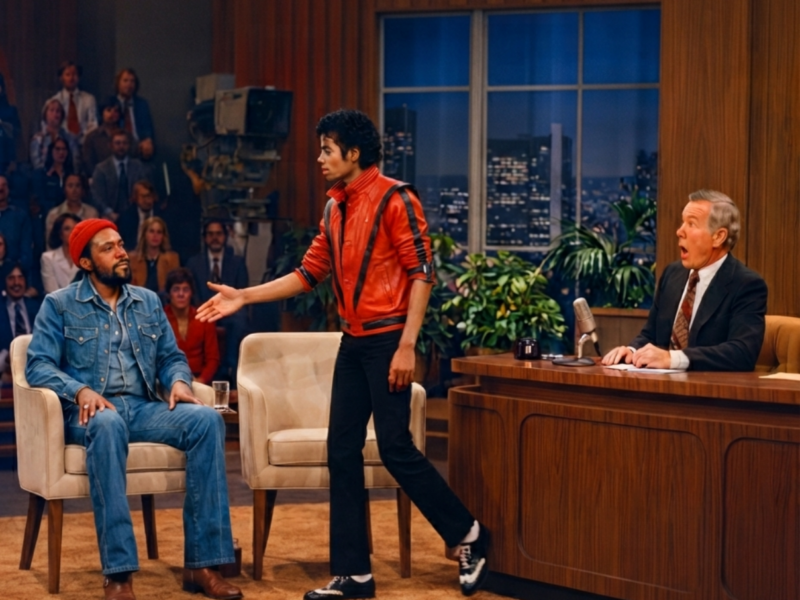
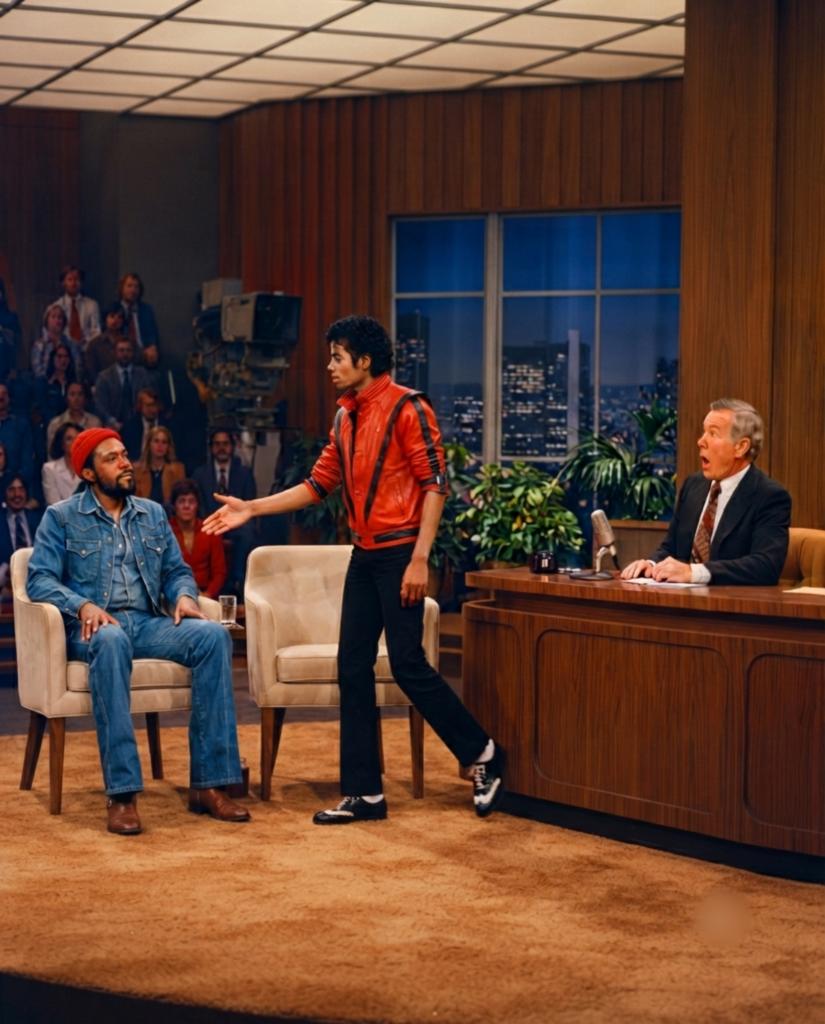
Marvin walked out slow, in a dark suit that hung a little looser on him than it might have a few years earlier, and lifted a hand toward the crowd before turning toward the couch—where Michael sat already halfway out of his seat, with his hand extended.
“Marvin,” Michael said, genuine warmth all over his voice. “It’s such an honor.”
Marvin looked at the offered hand.
He looked at it for a beat longer than a handshake usually takes to arrive or not arrive—long enough that if you were watching closely, you’d know something was happening behind his eyes that had nothing to do with rudeness and everything to do with a decision he’d made before he ever walked out from behind that curtain.
Then he sat down in the open chair, hands folded in his lap, and said nothing at all.
Michael’s hand hung there a moment, then slowly came back down.
He didn’t make a scene of it. He just sat back down himself, the bright warmth on his face flickering into something more careful, more uncertain—though he tried to keep it from showing too plainly for the cameras.
Most of the audience missed the moment entirely, caught up in simply being in the same room as two of the biggest names in American music.
But the front rows saw it. Johnny saw it—his easy grin catching for just a half second before he smoothed it back into place.
And somewhere in that studio, four hundred people who hadn’t consciously registered what had just happened still felt something shift in the air. The specific tension a room absorbs, even when it can’t yet name the source of it.
This is exactly the moment to hit that subscribe button, because what happens over the next few minutes is the whole reason this story gets told at all.
Johnny recovered fast, the way good hosts do.
“Well, folks, I don’t think this stage has ever held two more important voices in American music at the same time. Marvin, it’s a real pleasure having you here.”
“Pleasure’s mine,” Marvin said, his voice low and even, giving nothing away.
“Michael,” Johnny said, “I know you’ve spoken before about how much Marvin’s music meant to you growing up.”
“More than I could probably explain in the time we’ve got,” Michael said, still trying to find his footing after the moment that had just passed between them. “*What’s Going On* was one of the first records that made me understand music could actually say something—not just make people dance. I must have listened to that whole album a thousand times.”
“That’s kind of you to say,” Marvin said—and something in the flatness of it landed harder than the words themselves.
Johnny, sensing the temperature in the room shifting in a way he hadn’t planned for, tried to steer things back toward safer ground.
“Marvin, you’ve been living overseas the last couple years. What brought you back for this new record?”
“Needed some distance from a few things,” Marvin said. “Sometimes you have to leave a place to see it clearly.”
“And what did the distance show you?”
Marvin was quiet a moment—and when he answered, he wasn’t really looking at Johnny anymore.
“Showed me some things about this business I already suspected but hadn’t let myself say out loud.”
If this story is teaching you something already, don’t forget to hit that like button before we keep going.
“Care to say some of it out loud now?” Johnny asked—half joking, sensing there was more sitting under the surface than a talk show segment usually invited.
Marvin turned, finally, and looked directly at Michael for the first time since he’d sat down.
“I’ll say this much. I watched Motown take five little boys from Gary, Indiana, and turn them into the safest, shiniest thing that label ever sold. Watched the money move everywhere except toward the boys actually doing the singing. Watched grown men decide what a child’s voice should sound like, what he should wear, what he should say to reporters—all while that child’s own father stood over him, making sure he never stepped an inch out of the line the label had drawn.”
He paused.
“I don’t say that to be cruel. I say it because I fought that same machine myself for years, just from a different angle. And I get tired sometimes of watching folks act like a man’s success erases what it cost to get there—or what it cost the people who got used up building the road he walked in on.”
The studio had gone very quiet.
Michael’s face had gone very still—the easy warmth from a few minutes earlier replaced with something more guarded, more alert.
“Is that why you didn’t shake my hand?” Michael said.
It wasn’t quite an accusation. It came out more like he was trying to understand something plainly, rather than defend himself.
“Partly,” Marvin said. “And partly because I’ve spent years watching the industry hold up young men like you as proof that everything’s fine. That the machine treats its artists well, as long as they’re talented and obedient enough. I get tired of being the cautionary example while somebody else gets held up as the success story—when both of us came up through the exact same grinder.”
Keep watching, because what Michael says next is the part everybody’s still talking about.
Michael sat with that a long moment—and when he finally spoke, his voice had lost the careful, practiced warmth of a talk show guest and had gone somewhere quieter and more honest instead.
“I understand why you’d think that,” he said. “From the outside, I probably do look like the success story. *Off the Wall* did better than almost anybody expected. People see the numbers and figure the man behind them must have had it easy.”
“Didn’t you?” Marvin asked—not unkindly, genuinely asking.
“No,” Michael said simply. “I didn’t have a childhood most people would recognize as one. I was on stage by the time I was five years old. My father drilled my brothers and me for hours every single day. And if a step was wrong or a note was flat, there were consequences I don’t really like talking about in public. Motown owned nearly everything about how we looked and sounded—right down to what we were allowed to say in an interview. I used to watch other kids playing outside from the window of a tour bus and wonder what that was even like.”
He paused.
“I don’t say that so anybody feels sorry for me. I say it because you’re right that the machine chewed a lot of people up—and I don’t think being one of the ones who came out the other side successful means I came out of it untouched.”
The audience had gone completely silent. The specific silence of four hundred people who realized they weren’t watching a scripted exchange anymore.
If you think you already know where this story is headed, trust me—you don’t.
Marvin studied him a long moment, something in his own face shifting—the guardedness loosening just slightly at the edges.
“I didn’t know all that specifically,” he admitted. “Knew the general shape of it. Everybody in that building back then knew Joe Jackson was hard on you boys. Didn’t know you carried it the way you’re describing it right now.”
“Most people don’t ask,” Michael said. “They just see the records and the dance moves and figure that must mean everything worked out fine underneath it.”
“That’s a real double standard,” Johnny said carefully—sensing the conversation had turned into something that deserved space, rather than a quick pivot to the next topic.
“It is,” Marvin said. “And I think part of what I walked out here carrying wasn’t really about you specifically, Michael. It was about ten years of watching this industry hold successful Black artists up as evidence that everything’s fair—while men like me, who fought it and got bruised up doing so, get quietly written off as difficult, or troubled, or ungrateful. I think I put some of that weight on you before you’d said a single word tonight. And that wasn’t entirely fair of me.”
“I understand it, though,” Michael said. “Even if it wasn’t fair, I understand where it came from.”
If you’re loving this exchange, make sure that subscribe button’s already hit, because you’re not going to want to miss what happens next.
“Can I ask you something?” Michael said.
“Go ahead.”
“Do you think a man can come up through something like that and still make something real? Something that actually says what he means, instead of just what sells?”
Marvin considered the question seriously—the way he considered most things that actually mattered to him.
“I think it’s harder,” he said. “I think the machine wants you comfortable and easy to predict. And making something real usually means making somebody uncomfortable somewhere along the way. Including yourself. I had to fight Barry Gordy personally to put out a record that actually said something about what was happening to people in this country. He told me nobody wanted to hear it. Told me it would end my career.”
He paused.
“I put it out anyway. Best thing I ever did—and the hardest fight I ever picked in this business.”
He got quiet for a moment, and when he spoke again, his voice had gone somewhere else entirely—back to a Detroit conference room more than ten years earlier that he clearly hadn’t fully left, even after all this time.
“I sat across a desk from Barry Gordy in the winter of 1970 with a tape in my hand,” Marvin said. “And he told me, plain as anything, that it was the worst record he’d ever heard come out of that building. Said it sounded like something you’d play at a funeral, not something a record store could sell. Told me I’d spent years building an image as a smooth, romantic singer, and I was about to throw all of it away on a record full of grief and anger that wasn’t going to move a single unit.”
He shook his head slowly.
“I remember looking at him and asking whether he’d actually listened to the words or just the sound of it. He said the words were the problem. Nobody wanted a Motown artist asking why police were beating boys in the street, or why mothers were crying over sons coming home from a war nobody could explain to them. He wanted love songs. Motown had built an entire empire on love songs, and here I was handing him something that sounded like a funeral.”
“What did you say back to him?” Michael asked, leaning forward slightly, caught up in it now.
“Told him I wasn’t putting out another record until that one came out first,” Marvin said. “Told him he could shove every other tape I ever made, if he wanted to. But that one was going out into the world exactly how I’d made it—or it wasn’t going out with my name on it at all. We went back and forth on it for months. I dug my heels in. He dug his in harder. There were people in that building who thought I’d lost my mind—walking away from hits to fight over a record about pain nobody wanted to buy on a Tuesday afternoon.”
He allowed himself something close to a smile. Faint, and tired.
“Record came out anyway, in the end. Sold better than anything I’d put out before it. Man who told me nobody wanted to hear it ended up putting his own name on the credits as executive producer once the checks started coming in.”
“That must have felt like something,” Michael said.
“Felt like a lot of things,” Marvin said. “Felt like winning. Felt like being right. Mostly it felt lonely, if I’m being honest with you. You fight a battle like that inside a building full of people who are supposed to be on your side, and you win it. And afterward, you look around and realize how few of them were actually standing with you while it was happening. Most of them were waiting to see which way it broke before they decided who they’d been rooting for all along.”
Michael sat with that a long moment.
“I think I understand that more than you’d expect,” he said quietly. “Not the exact same fight—but the loneliness of it. Being surrounded by people whose whole job is managing you, and realizing most of them are managing the asset, not the person underneath it.”
Marvin looked at him with something sharpening into real attention now—the weariness from earlier almost entirely gone.
“Tell me about that,” he said. “Not the polished version you give a magazine. The real shape of it.”
Michael glanced toward Johnny, who gave the smallest nod—the specific permission of a host who understood he was sitting on something far more valuable than his usual run of show.
“There was a rehearsal room in Gary,” Michael said. “Before any of the world knew who we were. My father would have us running the same eight bars of a song for three hours straight if one of us came in a half beat off. If I made a mistake, there were consequences I’ve talked about before—and consequences I still don’t talk about. And I was five years old the first time I understood that being good enough—actually good enough—wasn’t a choice I got to make for myself. It was survival.”
He paused.
“By the time Motown got hold of us, that whole structure just got bigger. More people deciding what I sounded like, what I wore, what I was allowed to say when a reporter asked me a question. I learned to smile in a very specific way before I learned most of my multiplication tables.”
The studio and everyone in it had gone entirely still.
“Did anybody ever ask you if you wanted any of it?” Marvin asked—quiet now, all the earlier edge gone out of his voice.
“No,” Michael said simply. “Not really. Not in a way that would have mattered if I’d said no. I loved singing. I loved being on that stage more than almost anything in the world—still do. But loving the thing you do, and being asked whether you wanted to do it under those particular terms, are two very different questions. And only one of them ever got asked of me.”
Marvin nodded slowly—and for the first time all evening, something like real recognition passed between the two men. The specific recognition of two people who’d been shaped in very different rooms by the same basic machinery.
“I used to watch you boys from across the building,” Marvin said. “Used to think, there but for a different set of circumstances. My own father was hard on me, too—in ways that had nothing to do with music. Different kind of hard. I understood something about what it costs a child to grow up trying to satisfy a man who’s never quite satisfied. Even if the specific shape of it looked different for you than it did for me.”
“I didn’t know that about you,” Michael said.
“Not something I talk about on television, generally,” Marvin said, with the faintest, driest trace of humor. “Suppose tonight’s already gone further than either of us planned on—so I don’t imagine one more honest thing is going to hurt much.”
If this exchange is teaching you something already, this is a good time to hit that subscribe button, because the two of them are only getting started.
Johnny—watching the whole thing unfold with the specific stillness of a man who understood interrupting would be a genuine mistake—finally spoke. Gentle. Careful not to break whatever had settled between them.
“Michael, do you think your father ever understood what all of that cost you?”
Michael considered the question a long moment.
“I think he understood it in his own way,” he said. “I think he believed the discipline was the only thing that was going to get five boys out of Gary, Indiana, and into a life bigger than the one he’d had. I don’t think he ever fully understood that a person can build something remarkable and still be quietly missing pieces of himself underneath it. Those two things aren’t opposites. They can both be true about the same childhood.”
“That’s a generous way of putting it,” Marvin said.
“I’ve had a lot of years to work on being generous about it,” Michael said. “Doesn’t mean the missing pieces aren’t still missing. Just means I’ve stopped being angry at him for it. Most days. Most days.”
Marvin looked at him for a long moment—and something in his own posture shifted. Softened. The last of the guardedness he’d carried out from behind that curtain finally settling somewhere quieter.
“I owe you a real apology,” he said. “Not the kind you give for the cameras. I looked at you tonight and saw a symbol before I saw a person. Saw everything I resent about how this business treats men who look like us when they’re young and talented and easy to sell. And I let that resentment decide who you were before you ever got the chance to tell me yourself. That’s not fair to any man—and it certainly wasn’t fair to you.”
“I think I understand why you did it, though,” Michael said. “That doesn’t happen to people for no reason. Somebody built that weariness in you a long time before tonight. The same way somebody built the missing pieces into me.”
“Maybe so,” Marvin said. “Doesn’t make it fair to hand you the bill for it, though.”
“You didn’t hand me the whole bill,” Michael said. “You asked me straight, once Johnny pushed you to—and then you actually listened, instead of arguing with what I told you. That’s further than most men in this business ever get.”
If you’re loving this exchange, make sure that subscribe button’s already hit, because there’s still more worth staying for.
“I think about my own boy sometimes,” Marvin said after a moment. “Watching him grow up around all this—wondering what pieces of himself this business is going to quietly take before he’s old enough to notice they’re gone. A man in my position, you start seeing every young talent that comes through as a version of that fear. Whether it’s fair to the young man standing in front of you or not.”
“Is that why you didn’t shake my hand?” Michael asked again—gently this time, not accusing, genuinely curious now that the air between them had changed so completely.
“Partly that,” Marvin admitted. “And partly plain exhaustion, if I’m honest. Fighting this business for as long as I have wears a particular kind of tiredness into a man that doesn’t always show up as anger. Sometimes it shows up as refusing a simple, decent gesture from somebody who never did a single thing to deserve having it withheld.”
“I’d rather know that than wonder about it for the rest of my career,” Michael said.
“Then you’ll know it,” Marvin said. “And you’ll know the rest of it, too—if you ever need to hear it from somebody who’s already limped through most of the fights you’ve still got ahead of you.”
Johnny let a long moment of silence sit in the studio before speaking again—sensing that the silence itself was doing more work than any question he could ask into it.
“I think,” he said finally, “we’ve gotten considerably further into an actual conversation than any of us expected walking into tonight’s taping.”
The audience laughed—warm, and a little disbelieving. The specific laugh of a room that understood it had just watched something far more valuable than the segment it had been promised.
If this story is teaching you something already, don’t forget to hit that like button before we keep going.
“I think about that record all the time,” Michael said. “I’m working on something new right now, back home. I haven’t told many people the full shape of it yet—but I want it to be bigger than anything I’ve made. And I don’t just mean bigger in sales. I want some of it to actually mean something. The way your record meant something to me.”
Marvin looked at him for a long moment—something unreadable passing behind his eyes.
“Then don’t let anybody talk you out of the parts of it that scare them,” he said. “The parts a label executive wants softened are usually the parts actually worth keeping.”
This is exactly where you want to make sure that subscribe button’s already lit up, because what happens next is the whole reason this story still gets told.
“Can I ask you something else?” Michael said.
“Go on.”
“You said you watched Motown take five boys from Gary and turn us into something safe to sell. Do you still see me that way—as part of that machine, I mean—rather than somebody who got out from under it?”
Marvin was quiet a long moment, and the studio held its breath right along with him.
“No,” he said finally. “Not after what you just said to me. I think I walked out here tonight carrying an old grudge and looking for somewhere convenient to set it down. And you didn’t deserve to be the place I set it. That’s on me. Not you.”
“I don’t need an apology,” Michael said. “I think what you said needed saying—whether or not I was the perfect example of it.”
“Still,” Marvin said. “I’ve got a boy of my own, close to your age when I first really started paying attention to what this business does to young men. Wouldn’t want somebody unloading years of their own bitterness onto him without asking first whether he’d earned it. Don’t imagine you’ve earned much of what I was carrying out here tonight.”
If this story about honesty cutting through old wounds is landing with you, please hit that subscribe button, because there’s more to this story worth staying for.
Johnny—watching the exchange with the specific stillness of a host who understood he was witnessing something rare—finally spoke.
“Marvin, has anything Michael said changed how you’re feeling about how the segment started?”
Marvin nodded slowly. “A good deal. Yeah. I came in here tonight ready to make a point—and I made it, I suppose. But I made it at the expense of a young man who turned out to have earned a lot more understanding than I was willing to extend him walking in. That’s a mistake I’ll own.”
“Would you shake his hand now?” Johnny asked gently—sensing the moment the whole studio had been waiting for without quite realizing it.
Marvin looked at Michael a long moment. Then he extended his own hand first this time, without waiting to be asked.
“I would,” he said. “Not because the cameras are on us. Because you earned it in the last ten minutes—more than most grown men in this business ever bother to.”
Michael reached out and shook it—firm. Something in his whole posture loosening with real relief.
The audience came up out of their seats—the specific roar of a room that understood it had just watched something honest settle itself between two people, instead of getting smoothed over for the sake of good television.
If this is giving you chills right now, that’s your cue to hit that like button, because the whole studio just erupted.
Johnny let the moment breathe before speaking again.
“I’ve hosted a lot of guests on this stage over the years. I don’t think I’ve ever watched anything quite like what just happened here tonight.”
The segment ran on for several more minutes—the earlier tension fully given way to something warmer than anybody in that building had expected when the taping began.
Marvin asked Michael about the new record he was working on. Real curiosity in his voice now, instead of wary distance.
“What made you decide you wanted it to be bigger than *Off the Wall*?” Marvin asked.
“I don’t just mean bigger as in more copies sold,” Michael said. “I mean, I wanted to hold more inside it. *Off the Wall* was mostly about joy—about wanting to move people’s bodies. I think the next one needs to carry some of the things I don’t usually let myself say out loud, too.”
“That’s the hardest kind of record to make,” Marvin said. “Takes real nerve to let people see past the shine.”
“I learned that from listening to your records,” Michael said. “You never hid behind the shine. Even on the love songs—there was always something underneath them that felt true.”
Marvin looked at him for a moment, something almost like pride crossing his face. The specific pride of an older man recognizing something worth encouraging in somebody younger.
“Then you’re already halfway to making something that matters,” he said. “Rest of it just takes nerve and time.”
If this story is teaching you something already, don’t forget to hit that like button before we keep going.
Johnny leaned in, sensing there was more worth drawing out while the two men were still this open with each other.
“Marvin, you fought Motown for years to make the record you wanted to make. Michael’s talking about wanting to do something similar with this new album. Any advice for a young man about to have that same fight?”
Marvin thought about it seriously before answering.
“Don’t let them convince you the fight isn’t worth having,” he said. “They’ll tell you the safe version sells better—and sometimes it does, in the short run. But the records that actually last, the ones people are still listening to twenty years later, those are usually the ones some executive somewhere didn’t want released in the first place.”
“I don’t think I could let this next one go out soft, even if somebody asked me to,” Michael said. “I’ve been sitting on some of these songs for months now. They mean too much to me to water down.”
“Then you’ve already learned the lesson it took me most of a career to learn,” Marvin said. “Some men never learn it at all. Spend their whole lives making exactly what they’re told to make—and wonder later why none of it feels like it was really theirs.”
Michael sat with that a long moment.
“Can I ask you something else?”
“Go ahead.”
“Does it get easier? Fighting for what you actually mean to say, instead of just what’s expected of you?”
Marvin considered the question with real weight behind it.
“No,” he said honestly. “If anything, it gets harder—because the stakes get bigger every time you succeed. But it gets more necessary, too. A man who stops fighting for what he actually means starts disappearing a little more with every record. Until one day he looks up and can’t quite remember which parts were ever really his.”
If this story about two artists finding real common ground moved you, go ahead and hit that subscribe button, because the ending is worth every minute you’ve spent on this so far.
As the segment moved toward its close, it was Marvin who spoke up first—something coming loose in him now that the earlier guard had fully dropped.
“I want to say one more thing,” he said. “About the hand.”
“Go ahead,” Michael said.
“I was ready to let it sit there unaddressed,” Marvin admitted. “Figured I’d made my point plain enough without needing to explain myself further. Wasn’t planning on bringing it back up at all, until Johnny asked me straight.”
“I’m glad he did,” Michael said.
“Why is that?”
“Because otherwise I might have spent the rest of tonight wondering what I’d done,” Michael said. “Might have carried that home with me and turned it over for weeks, trying to figure out what I said or did wrong before I ever opened my mouth. I’d rather know.”
Marvin nodded slowly, something thoughtful moving across his face.
“That’s a heavier thing to carry than I meant to hand you,” he said. “I’m sorry for that part of it, at least. The point I was making needed making—but the way I made it, letting you sit there confused and hurt in front of four hundred strangers? That part I could have handled with more care.”
“I appreciate you saying so,” Michael said. “Most people, once they’ve made their point, don’t bother circling back to check what it costs the other person to hear it.”
“Learned the hard way that circling back matters,” Marvin said. “Spent a long time in this business watching men make their point and walk off satisfied. Never once checking what they left behind them. Didn’t want to be one more example of that. Not with you.”
If this story left an impact on you, that’s a good sign to hit that like button.
Johnny looked into the camera—clearly moved by what had unfolded on his own stage.
“Folks, I’ve done this show a long time. And I don’t have a clean way to describe what we just witnessed. I can tell you it was real. And in this business, real is about the hardest thing in the world to fake convincingly for very long.”
The show cut to commercial. The audience stayed in their seats longer than usual—the specific reluctance of a crowd that had just watched something happen and wasn’t quite ready to let go of the feeling by standing up and walking toward the exits.
Backstage after the taping wrapped, Michael found Marvin near the dressing rooms before either man headed home for the night.
“I meant what I said out there,” Michael said. “About your record. It changed how I thought about what music could actually do.”
“I believe you,” Marvin said. “Didn’t believe it as easily an hour ago. But I believe it now.”
“Can I ask you something off camera this time?”
“Go ahead.”
“Are you doing all right?” Michael asked. “Really? I mean—you look tired in a way that goes past jet lag.”
Marvin was quiet a moment—surprised by the directness of it, coming from someone he’d spent the whole evening treating like he needed protecting from.
“Not always,” he admitted. “This business takes more out of a man than people watching from the outside usually understand. I imagine you know a little something about that yourself, given everything you told me tonight.”
“More than I usually let on,” Michael said.
“Then let me leave you with something, since you were generous enough to let me take back what I said wrong out there,” Marvin said. “This business will ask you for everything you’ve got. And it won’t tell you in advance how much of yourself you’ll have left over once it’s done asking. Hold something back for yourself. Doesn’t have to be much—just enough that there’s still a person left underneath the artist when the crowds go home.”
Michael was quiet a long moment, taking that in the way he took in most things that actually mattered—turning it over carefully.
“I’ll try to remember that,” he said.
“See that you do,” Marvin said—and something almost like warmth, real warmth this time, crossed his tired face. “World’s going to ask a lot of you in the next few years. I can feel it coming the same way I felt it coming for myself once, a long time ago. Don’t let it take more than you’re willing to give.”
They shook hands one more time before parting for the night—the gesture carrying an entirely different weight than the tense, unfinished moment from the start of the evening.
If you’re loving this story so far, make sure that subscribe button’s already lit up, because the ending is coming—and it’s not the one you’re expecting.
That broadcast became one of the most talked-about moments on television that whole season.
Entertainment columns spent weeks trying to pick apart exactly what had happened and why it had landed the way it did with audiences. Most of the early headlines only caught the surface—framing it as Marvin Gaye snubbing the young superstar, missing the deeper conversation that had unfolded once that first moment passed.
The fuller story—the one that actually mattered—came out slowly over the following weeks, in interviews where both men separately were finally asked to explain what viewers had actually watched.
“People think I was rude to that young man,” Marvin told a reporter a few weeks later. “Maybe I was, in that first moment. But he didn’t let it just sit there and rot between us—and he didn’t get defensive about it, either. He listened. And then he told me something true about his own life that I hadn’t bothered to ask about before I decided what kind of man he must be. That’s rarer than people think. In this business, or any other.”
Michael, asked about it separately for a magazine feature, kept his own answer characteristically gentle.
“I think sometimes people carry things that don’t have anything to do with you specifically,” he said. “The kindest thing you can do is let them say it—and then tell them the truth about yourself, instead of getting hurt or defensive. I learned a lot that night. Not just about him. About myself, too.”
Two months later, on November 30th, 1982, Michael Jackson released the album he’d been quietly working on that whole time.
A record called *Thriller*.
It would go on to become the best-selling album in the history of recorded music.
And years later, when interviewers asked him what had shaped its more ambitious moments—the songs that carried more weight than anything on *Off the Wall* had dared to carry—Michael occasionally mentioned a conversation he’d had backstage at a talk show taping in the fall of 1982.
Without ever going into the full details of how that conversation had actually started.
Marvin’s own comeback that same season carried him further than even he had expected. “Sexual Healing” became the biggest hit of his career. And the following February, he won his first competitive Grammy Award—more than two decades into a career that had already changed American music more than once.
For a little while, watching him accept that award, it looked like the hardest years might finally be behind him.
They weren’t.
On April 1st, 1984, Marvin Gaye was shot and killed at his parents’ home in Los Angeles by his own father, after an argument that had been building for most of both men’s lives.
He was forty-four years old.
The news moved through the music industry the way terrible news always moves—fast, and disbelieving.
And among the people who found themselves unable to speak about it for days afterward was Michael Jackson—who had spent eighteen months since that *Tonight Show* taping quietly carrying around the advice a tired, guarded man had given him backstage about holding something back for himself.
If this story about two artists—one lost too soon—finding honesty together on a single strange night moved you even a little, go ahead and hit that subscribe button, because there’s a lot more where this came from.
A member of the *Tonight Show* production staff who was on the floor that October night, interviewed years later for a retrospective on the show’s most memorable broadcasts, said he’d never forgotten the specific quality of the silence that followed Marvin’s refused handshake.
“You have to understand—nobody in that building expected a confrontation,” he said. “We booked it because two huge names in the same segment makes good television, plain and simple. What we got instead was something nobody could have written on purpose. I’ve worked on that show a long time, and I don’t think I ever saw a room go that quiet and then come back around to something that warm in the same twenty minutes.”
He paused.
“When we heard about Marvin a couple years later, a bunch of us on the crew went back and watched that tape again. Different kind of watching it, once you know how the story actually ends.”
Johnny Carson, asked in a later interview to name a broadcast that had genuinely surprised him over the decades, brought that night up without hesitation.
“I’ve had a lot of unpredictable things happen on that stage,” Johnny said. “But I don’t think I ever sat behind that desk more uncertain of where things were headed than I did the moment Marvin Gaye didn’t take that young man’s hand. And I don’t think I ever felt better about how something turned out. Two men who could have let that go badly. Instead, let it go somewhere honest. And I’ve thought about that particular night more than almost any other broadcast I ever hosted.”
That’s the real story behind one of the strangest and most quietly moving nights in that studio’s history.
Not a scripted moment dreamed up by a writer—but a real evening when an older artist’s exhaustion ran headlong into a younger one’s willingness to actually answer for himself.
And somewhere in the middle of that collision, something true got said that neither man ever quite forgot.









