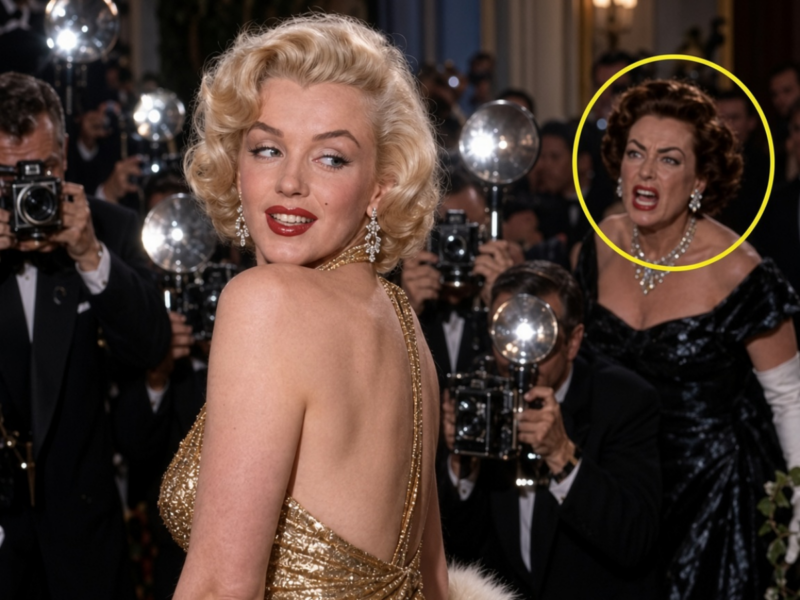
Marilyn Monroe wore a gold dress to an awards show — Joan Crawford called it vulgar and it backfired.
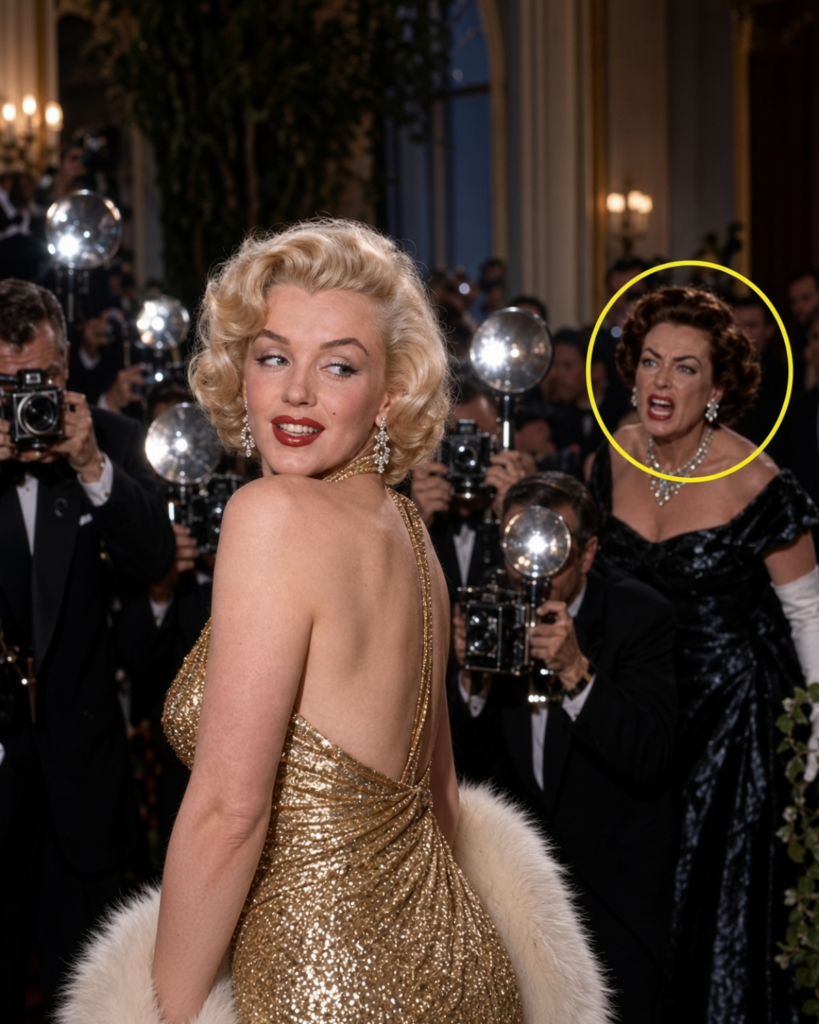
Joan Crawford criticized Marilyn Monroe for wearing a gold dress to an awards dinner.
The criticism reached newspapers across America.
Within weeks, Crawford was explaining why she had said it.
Monroe still had two of the biggest films of her career waiting to open.
The published remarks survive.
So does Crawford’s admission that she had made them.
The argument began in a room full of people who were watching Monroe accept an award.
Contemporary coverage places the Photoplay dinner in the Crystal Room of the Beverly Hills Hotel on February 9th, 1953.
The magazine was recognizing the previous year’s achievements.
Monroe received the award commonly identified as Fastest Rising Star.
Photographs show her in the pleated gold lamé gown associated with designer William Travilla.
Reports described an entrance about 90 minutes late.
That delay belongs to the newspaper account.
A photograph cannot establish when somebody arrived.
The Marilyn Reports later account says Travilla and columnist Sidney Skolsky, Monroe’s escort, had advised her against wearing the gown.
Their advice has become part of the story surrounding the dress.
The surviving photographs establish the dress itself.
A fitted waist, a deeply cut neckline, and fine pleats spreading across the skirt.
Monroe wore it to collect recognition from a publication whose business depended on movie stars attracting attention.
The reported reaction was loud.
People shouted and whistled.
The familiar claim that Jerry Lewis climbed onto a table appears in the comments attributed to Crawford by Associated Press reporter Bob Thomas.
It should remain attributed to that account.
The reported commotion was sufficient material for the column that followed.
Thomas’s story circulated in early March.
The surviving reproduction is dated March 2nd.
Other accounts give March 3rd, a difference consistent with a syndicated article appearing on different days.
Crawford compared Monroe’s appearance to burlesque.
She argued that provocative actresses still needed to communicate respectability.
She also questioned the effectiveness of Monroe’s publicity and suggested that the younger performer needed to change direction.
Those were professional criticisms as well as objections to address.
One part of the chronology is often lost.
Crawford had recently received an Academy Award nomination for Sudden Fear.
The Academy’s own record confirms it.
She was competing for the same acting prize she had already won for Mildred Pierce.
She was not attending this season’s events as a forgotten performer without a current success.
Monroe was being honored as a newcomer while Crawford remained under consideration for the industry’s most conspicuous acting award.
The two women had reached that room by different routes.
Crawford had begun in the silent era and survived the arrival of recorded dialogue.
Monroe had worked through brief contracts, small parts, photographs, and supporting performances.
Niagara had opened only weeks before the dinner.
Later publicity would compress those years into the sudden appearance of a blonde star.
The film credits show a longer apprenticeship, and Crawford’s own credits begin almost three decades earlier.
The New York Public Library’s biographical record identifies Crawford’s original name as Lucille LeSueur.
Her early employment included dancing before MGM signed her in 1925.
Her precise birth year is disputed across reference works, so a confident declaration that she was exactly 47 at the Photoplay dinner would add certainty the record does not warrant.
She was an established star from an earlier generation.
Monroe, born in 1926, was 26 that February.
The studio renamed LeSueur through a publicity competition.
Film historian Pamela Hutchinson describes the episode in her account for the British Film Institute.
The advertised search for a new name made the transformation itself into publicity.
A performer entering the film business could have her clothes, photographs, billing, and even the name above her face revised.
Crawford’s subsequent career would involve further revisions, but the name selected in the silent years remained.
Hutchinson also describes Crawford’s work in shaping her appearance and maintaining contact with admirers.
The public image required repeated effort.
Studio portraits presented a well-controlled face.
Correspondence offered fans a more personal connection.
Those practices are reported features of her professional life rather than evidence that every public gesture was insincere.
The work was being done for an audience that encountered her between films through photographs, magazines, and letters.
The film record places her opposite Lon Chaney in The Unknown.
In 1927, Tod Browning directed the circus melodrama.
Crawford’s role came before the picture generally recognized as her breakthrough, and it gave her experience in a production built around an already formidable performer.
David Parkinson’s BFI career survey identifies Chaney as an important early example for her.
The following year, a different kind of picture moved her toward the center of MGM’s publicity.
Our Dancing Daughters opened in 1928.
The released film presents a young woman whose appetite for parties and dancing can be mistaken for a lack of principle.
Its costumes and physical movement are available to inspect.
Crawford’s energy is part of the performance along with the contrast between what other characters assume about the heroine and what she actually does.
The story gives its apparently reckless young woman more integrity than the respectable surface of her rival suggests.
In his TCM account, Roger Fristoe reports that Crawford obtained the screenplay and pressed producer Hunt Stromberg to cast her.
He also recounts her later claim that the part was adjusted to suit her personality.
Those are reported production recollections.
The film’s existence, her leading role, and its importance to her rise are firmer ground.
By the time audiences saw her dancing on screen, MGM had a performer it could promote as an embodiment of fashionable youth.
The publicity around Crawford reached beyond an individual picture.
F. Scott Fitzgerald discussed her as an example of the flapper, a young woman associated with sophistication, nightlife, and restless energy.
His assessment survives in accounts of the film’s reception.
It was praised for precisely the kind of contemporary appeal that depended on being recognizably new.
Crawford was being identified with a generation through her movement, clothes, and manner.
The next pictures kept her in that territory.
Our Modern Maidens followed in 1929.
TCM’s production history identifies it as Crawford’s final silent film and a successor to Our Dancing Daughters.
Douglas Fairbanks Jr. appeared alongside her.
The later film continued the connection between her screen persona and young people whose romantic decisions disturbed conventional arrangements.
These are the stories she was being hired to perform before she became the mature figure remembered from her 1940s dramas.
Her transition to sound can be followed through the films.
The Hollywood Revue of 1929 included her among MGM’s performers.
Montana Moon, released the following year, used her experience as a singer and dancer in an early talking picture.
TCM historian Frank Miller describes the studio capitalizing on the popularity of her flapper image while adding musical material.
Her voice became another component of a career that had first advanced through silent performance.
In Possessed, released in 1931, Crawford played a working woman who becomes involved with a wealthy man played by Clark Gable.
The film’s romantic arrangement creates difficulties when his public ambitions make their private life inconvenient.
The screen story links luxury to dependence and respectability to concealment.
Its heroine wants more than the conditions she has been born into.
Her clothes change as her circumstances change, and the production gives those changes considerable visual attention.
Glenn Erickson’s published review of the restored film describes Possessed as a central example of Crawford’s working-girl ascent into high society.
That is a critical reading of the film supported by its plot and design.
It does not tell us what she privately believed about every woman who followed her.
It does establish the kinds of ambition and sexual complication her own screen career had made attractive to audiences well before 1953.
Grand Hotel placed her in an ensemble with Greta Garbo and John and Lionel Barrymore in 1932.
The Academy’s historical record lists the film as that year’s Best Picture winner.
Crawford’s presence in this company makes her standing visible without requiring a league table of who was most glamorous.
MGM could put several valuable names in one production.
Crawford was one of them and her subsequent films continued to pair her with major leading men.
Norma Shearer also occupied an important position at MGM, and comparisons between the women have generated their own stories of resentment.
The more useful evidence here is their work together in The Women in 1939.
Crawford played Crystal Allen, the perfume counter employee involved with the husband of Shearer’s character.
George Cukor directed the adaptation of Clare Boothe Luce’s play.
Its competition among women belonged to a written comedy and the actresses were employed to perform it.
Before The Women, however, Crawford had suffered a highly public professional rebuke.
In May 1938, the Independent Theater Owners Association attacked the expense of stars it believed were failing to justify their salaries.
Its president, Harry Brandt, was associated with the advertisement.
The label remembered from the dispute is “box office poison.”
Crawford was among its targets alongside performers whose names would remain prominent in film history for decades.
The contemporary reporting is specific about the source of the attack.
Theater owners were complaining to producers about business.
They were not issuing an Academy judgment on acting ability.
The Times’ May 16th report described the uproar and the famous names caught in it.
The advertisement’s later reputation can make it sound like an official industry verdict, but the surviving record identifies an interested organization trying to influence the people who supplied its films.
Film scholar Catherine Jurca’s study Hollywood 1938 places the controversy within a wider commercial crisis.
The publisher’s account of her research describes falling attendance, unfavorable publicity, and an industry campaign intended to bring customers back.
Her work draws on exhibitors, studio personnel, and audiences.
That interpretation widens the explanation beyond a collection of individual performers suddenly becoming worthless.
Producers and theater owners had a larger business problem to address.
For Crawford, the label did not immediately end employment.
The Women followed in 1939.
Strange Cargo followed in 1940 with Clark Gable again opposite her.
The released film gives her a rougher setting and a less protected kind of glamour than an elegant society romance.
She plays Julie in a story involving escaped convicts.
Its existence is a practical correction to the notion that the trade advertisement erased her from the screen.
A Woman’s Face arrived in 1941.
Crawford played a disfigured blackmailer whose appearance changes after surgery.
Christina Newland’s BFI essay describes the role as an important move toward darker psychological material.
According to Newland, Crawford pressed for the part despite resistance to casting her against the image MGM had established.
That account concerns a reported production disagreement.
The performance itself shows her taking on a character whose vulnerability and aggression could not be reduced to evening clothes.
Her MGM contract ended in 1943.
Institutional career accounts described the separation as a negotiated end to a long association, not the instantaneous dismissal sometimes supplied by a dramatic retelling.
She then moved to Warner Brothers.
The change of studio came years after the Poison advertisement and years after she had proved she could work in sound.
Mildred Pierce was still ahead.
She had to obtain the role before it could become the familiar comeback story.
The production accounts collected by the BFI describe resistance from director Michael Curtiz and Crawford’s determination to be considered for Mildred.
Those recollections should remain reported, including stories about her screen test and disputes over how glamorous the character ought to look.
The documented result is straightforward.
Curtiz directed the picture for Warner Brothers.
Crawford played its central character and the film was released in 1945.
The story began as a James M. Cain novel.
The screen adaptation follows a woman who separates from her husband, takes work waiting tables, and builds a restaurant business.
Her effort to satisfy her daughter becomes increasingly destructive.
These are events in the fiction, not episodes from Crawford’s private household.
Ann Blyth plays the daughter Veda.
Eve Arden plays a colleague whose practical perspective gives the film a different voice from the demands made upon Mildred at home.
Critic Imogen Sara Smith’s Criterion essay emphasizes the labor running through the picture.
Smith points to its attention to women working, including figures beyond the star.
Her reading treats the film as an examination of class, money, and the damage inside an apparently successful ascent.
Crawford’s performance sits within that argument, but Smith’s assessment is criticism rather than a production document.
The visible work includes serving customers, handling food, and running a business.
The Academy’s record confirms Crawford’s Best Actress win at the ceremony in 1946 for the previous year’s film.
That distinction between film year and ceremony year is simple but useful.
Mildred Pierce was a 1945 release.
The Oscar followed.
A performer publicly questioned in 1938 had now received the industry’s leading acting award.
Other people could argue about her temperament, but the award in the film did not depend on their agreement.
The comeback also gave Crawford new material to play.
Newland argues that she developed a productive career in crime films and melodramas about mature women.
The point is supported by titles including Flamingo Road and The Damned Don’t Cry.
The latter, released in 1950, puts her at the center of another ascent through wealth and criminal association.
This part of her career contained work with its own audience and ambitions.
It was not merely waiting time between an Oscar and old age.
Humoresque, released in 1946, paired her with John Garfield.
Possessed followed in 1947, a different film from the earlier Gable romance with the same title.
The later Possessed brought another Academy Award nomination.
These documented credits are useful when assessing what the Photoplay controversy could threaten.
Crawford had already changed her image more than once.
She could still secure central roles, and the gold dress appeared during another period of recognition for her work.
Sudden Fear opened in 1952.
Its screenplay makes Crawford a successful playwright who marries an actor played by Jack Palance and discovers that he is planning to kill her.
The released film gives her both terror and practical decisions to perform.
Film Forum’s program describes the central reversal.
The man she had rejected professionally becomes the husband from whom she must protect herself.
The suspense depends upon the audience staying with her discovery and response.
The Academy nominated Crawford for Sudden Fear and Palance for his supporting performance.
Those nominations place the film in the immediate background of the Bob Thomas interview.
Crawford was not merely a veteran invited to offer a general opinion about younger women.
Thomas was talking with an actress whose current work was part of that year’s awards coverage.
Shirley Booth eventually won Best Actress for Come Back, Little Sheba.
The official ceremony record lists Crawford among the other nominees.
Monroe’s earlier credits describe a less secure professional position.
The British Film Institute identifies Ladies of the Chorus, released in 1948, as her first major role.
She played a young performer in a burlesque troupe with Adele Jergens as her mother.
That makes Niagara an important breakthrough rather than her first substantial appearance of any kind.
The distinction avoids erasing a film in which audiences could already watch her carry scenes and perform musical material.
The plot of Ladies of the Chorus concerns the difficulties created when a young chorus performer becomes involved with a man from a wealthier family.
His relatives’ response to her background becomes part of the romance.
That is the released film’s story.
Years before Crawford’s remarks, Monroe had acted in material about the distance between a woman’s public occupation and other people’s judgment of her fitness for respectable company.
The picture was modest, and it did not immediately make her a major star.
The Asphalt Jungle gave her a smaller but memorable part.
In 1950, John Huston directed the crime film, and Monroe played the young woman attached to Louis Calhern’s corrupt lawyer.
The cast and release are documented in the film and archival catalogs.
She did not lead the robbery plot.
Her appearances belong to the lawyer’s separate domestic arrangement, which becomes relevant as the crime falls apart and people try to account for where they have been.
All About Eve also appeared in 1950.
Monroe played Miss Caswell, a young aspiring actress brought into a circle organized around an established theatrical star.
Bette Davis played that star, Margo Channing.
The film’s credits confirm Monroe’s place in the ensemble.
Its central struggle concerns ambition and succession in the theater.
Crawford did not appear in it, and its fictional hostility should not be transferred to her disagreement with Monroe three years later.
By 1952, her work included Clash by Night, directed by Fritz Lang.
The film paired established performers Barbara Stanwyck, Paul Douglas, and Robert Ryan with Monroe in a supporting role as a cannery worker.
TCM’s production account reports Stanwyck’s patience with the younger actress.
It also discusses Monroe’s difficulties on set.
These are retrospective accounts of working behavior, not permission to supply the contents of a private argument between them.
The released picture presents Monroe in a working environment and a relationship with conflict in it.
Her costume and performance belong to that character.
She is not playing the showgirl she would later perform in Gentlemen Prefer Blondes.
The difference can be seen without accepting an extravagant claim that one supporting performance proved every skill she possessed.
It established another credit with a major director and put her on screen beside an actress with a long professional history.
Don’t Bother to Knock, also released in 1952, offered more sustained dramatic responsibility.
Monroe played Nell Forbes, a troubled babysitter in a hotel.
Richard Widmark and Anne Bancroft appeared in the cast.
The character’s behavior becomes dangerous, and the film requires changes of mood that are far removed from a publicity photograph.
The BFI’s later programming and TCM’s discussion both identify it as an important early opportunity to assess her dramatic work.
Monroe’s publicity was advancing at the same time.
Philippe Halsman’s portrait appeared on the cover of Life in 1952.
The photograph and its publication are documented.
Auction catalogs also preserve prints associated with the cover session.
National magazine exposure could make a face familiar to people who had not followed every supporting credit.
The cover gave her a separate kind of visibility before Niagara opened and before Photoplay presented its award.
The nude calendar photographs that became a public story in 1952 supplied another test.
Biographical accounts report that Monroe acknowledged posing before she became famous and explained it in terms of needing work.
That account should be presented as her public explanation, not an invitation to invent the circumstances of a particular unpaid bill.
The controversy did not end her employment.
She continued appearing in films and the next year brought three releases with her among their principal attractions.
Niagara opened in January 1953.
Henry Hathaway directed and Monroe appeared with Joseph Cotten and Jean Peters.
The film record establishes a thriller about a troubled marriage, infidelity, and a murder scheme against the background of the falls.
Monroe played Rose Loomis.
Her character was designed to attract attention and conceal dangerous intentions.
The advertising sold both the location and Monroe, and the film gave her a prominence her earlier small parts had not.
The contemporary New York Times review published on January 22nd considered the falls and Monroe together as attractions.
It did not simply announce an unquestioned new dramatic genius.
The review is evidence of how she was being discussed while the release was new.
Niagara’s publicity, her appearance, and the visible scenery were being evaluated in the same conversation.
A few weeks later, that conversation continued around what she wore outside the film.
The opening business of Niagara also entered the dispute.
Thomas’s contemporary column reported disappointment with its performance in a particular market and questioned whether publicity was translating into customers.
That should not be repeated as a final worldwide financial verdict.
An early local report, a completed theatrical run, and a studio’s eventual accounts describe different things.
Crawford’s published comments used the immediate concern about drawing audiences before Monroe’s later 1953 releases were available to judge.
The timing prevented anyone in the Crystal Room from knowing the year’s completed results.
Gentlemen Prefer Blondes had not yet opened.
How to Marry a Millionaire was also ahead.
Monroe’s future success is available to us as a record of releases and reception.
It was not a fact the dinner guests had already watched unfold.
The award marked a rise in progress.
Crawford’s remarks assessed a performer whose next major test was still coming.
The surrounding industry was changing too.
The federal antitrust proceedings against the major film companies are documented in the Paramount case and the resulting decrees.
The Justice Department’s account explains the restrictions on practices connecting distribution and exhibition.
Among the consequences was separation between major studios and their theater holdings.
This was a business and legal change, not an order that particular actors should stop working.
Its implementation extended beyond the date of the Supreme Court decision in 1948.
The practical distinction is important.
A studio’s power to manufacture and distribute a picture did not guarantee the same control over where that picture would play.
Television also offered audiences entertainment at home.
TCM’s production history of How to Marry a Millionaire places Fox’s investment in widescreen within its effort to draw customers back to cinemas.
A new face was one attraction among several being sold.
Color, screen size, and sound were receiving their own publicity.
Fox introduced CinemaScope to paying audiences with The Robe in 1953.
How to Marry a Millionaire had been photographed earlier but reached cinemas later.
The production chronology documented by TCM prevents a simple confusion between the first film made and the first released in the process.
Monroe would help sell the second release.
Her stardom was developing while the company was asking exhibitors and audiences to invest in a changed theatrical experience.
The Academy records also show that the next generation did not arrive in one form.
Audrey Hepburn won Best Actress for Roman Holiday at the 1954 ceremony.
Ava Gardner was nominated for Mogambo and Deborah Kerr for From Here to Eternity.
These were different screen personalities in different kinds of production.
Their presence alongside continuing veterans makes the period more varied than a single replacement of reserved actresses by women who wore more revealing clothes.
Betty Grable provides the closer comparison to Monroe.
Both worked for Fox and both were being marketed through blonde glamour.
TCM’s history of Gentlemen Prefer Blondes reports that the studio had originally acquired the musical property with Grable in mind.
Monroe eventually played Lorelei Lee.
The casting change is a concrete professional succession, though it does not establish that every subsequent conversation between the two women was hostile.
The Monroe-Crawford dispute developed in a press already discussing how the younger actress presented herself.
The clippings collected by Crawford researcher Brian Johnson include Erskine Johnson on Monroe’s genes, two February columns by Sheilah Graham, and a March Associated Press item quoting Marie Windsor.
Their dates and subjects make Crawford’s comments part of an existing exchange.
They also keep three other contributors visible in a story usually reduced to two actresses.









