Marilyn Monroe Sang ‘Happy Birthday’ to JFK — Ten Weeks Later, She Was Dead.
15,000 people were sitting inside Madison Square Garden on the night of May 19th, 1962, waiting for a woman who wasn’t there.
Peter Lawford, the president’s brother-in-law, kept walking back to the microphone to introduce her.
Each time the spotlight swung to the wings, and each time nobody walked out.
It became the running joke of the evening.
Lawford presenting her again and again to an empty stage, the crowd laughing a little harder each time, the orchestra vamping through another few bars with nowhere to go.
When she finally appeared, roughly midway through a program considerably longer and more crowded than most retellings bother to mention, Lawford had reworked the introduction into something closer to a punchline than a formality.
“Mr. President,” he said, “the late Marilyn Monroe.”
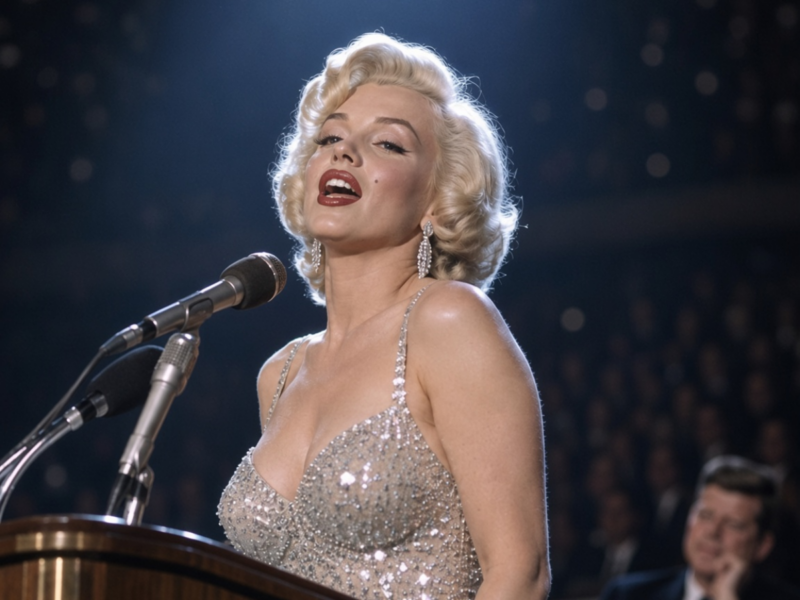
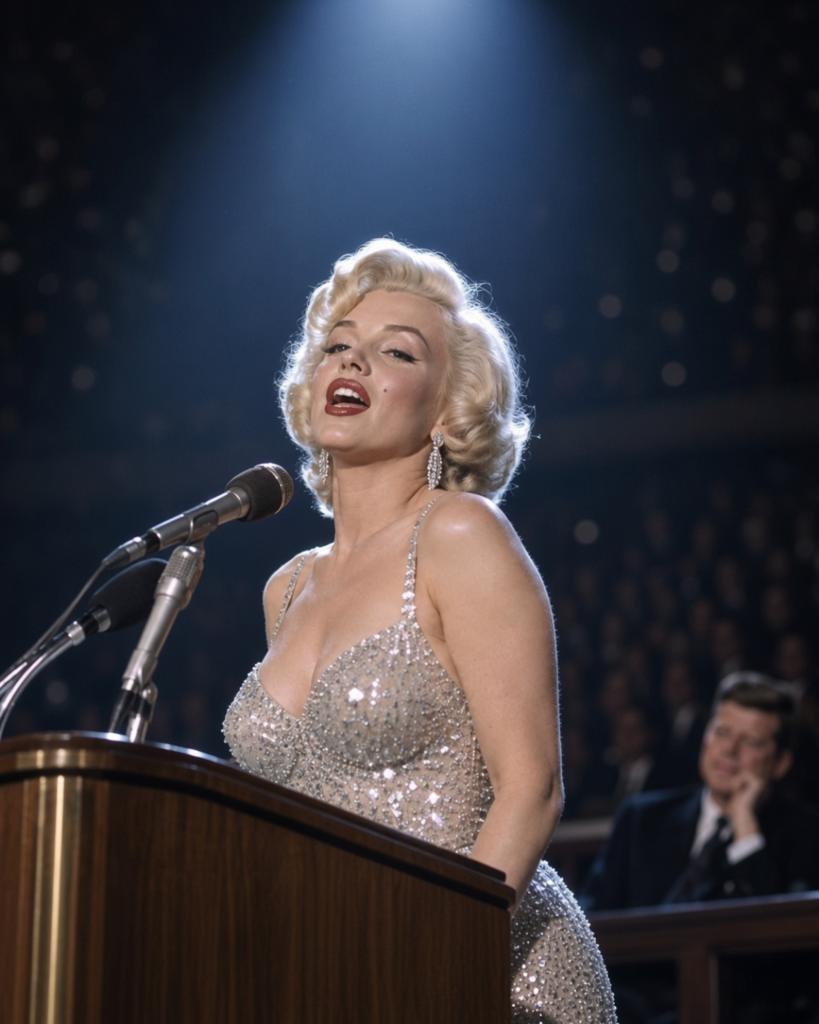
She walked out in a dress that had been sewn directly onto her body that afternoon because it was too tight to put on any other way.
Flesh-colored, sheer, covered in 2,500 hand-set rhinestones.
Under the arena lights, it looked less like fabric than like something she’d been poured into.
She flicked the microphone once and began to sing.
Happy birthday to you.
Happy birthday to you.
Happy birthday, Mr. President.
It lasted well under two minutes.
It’s one of the most replayed 60 seconds in American television history, and it happened less than 11 weeks before she was found dead in her own bedroom.
To understand how she ended up on that stage at all, you have to go back considerably further than 1962, all the way to a munitions factory in 1944, where a photographer named David Conover shooting a wartime propaganda assignment for Yank magazine happened to photograph a 19-year-old assembly line worker named Norma Jeane Dougherty.
She had already been married once at 16, largely to avoid being sent back into foster care after her mother’s ongoing mental illness made raising her impossible.
Conover’s photographs led to modeling work with the Blue Book Agency, and within two years, she’d built enough of a magazine cover career to get a screen test at 20th Century Fox.
Studio chief Darryl Zanuck signed her to a short contract in August of 1946, $75 a week.
The studio picked a new name for her.
Marilyn, after a Broadway star, and Monroe, her own mother’s maiden name.
The rise from there wasn’t fast.
And it wasn’t smooth.
Fox dropped her within a year.
She moved to Columbia, then back to Fox, picking up small parts in forgettable pictures while studying dance, singing, and acting on the side.
Her break, when it came, came in pieces.
A small but attention-getting role in the 1950 noir The Asphalt Jungle, another in that same year’s All About Eve, enough to convince the studio she might be worth building into something bigger.
Her agent, Johnny Hyde, one of the few people in that period by most accounts genuinely looking out for her rather than simply profiting from her, negotiated a new seven-year Fox contract in 1951 and then dropped dead of a heart attack months later, leaving her to navigate the machinery he’d built for her mostly alone.
She did it anyway.
By 1953, with Niagara, Gentlemen Prefer Blondes, and How to Marry a Millionaire all released within months of each other, Marilyn Monroe wasn’t a promising contract player anymore.
She was one of the biggest stars in the world.
She spent the back half of that decade trying with mixed success to be taken seriously as something more than the image the studio had built.
She married Joe DiMaggio in January of 1954.
Nine months, a very public honeymoon, and a very public divorce later, the marriage collapsed under the exact tension that would define most of her adult relationships.
A husband uncomfortable with a wife whose fame depended on being looked at.
Married to a woman who’d spent a decade fighting to be looked at in exactly that way.
She left Hollywood for New York not long after, studied under Lee Strasberg at the Actors Studio, and started her own production company, a genuinely unusual move for any actress in 1955, let alone one the industry still mostly treated as decorative.
In 1956, she married the playwright Arthur Miller.
By the end of that marriage, five years later, she’d made only four films, a steep falloff for a woman who’d once released three hits in a single year.
And the ground beneath the version of Marilyn Monroe the public thought it knew had already started to shift.
That marriage ended in divorce on the 11th of November 1960.
A few months later on the 10th of February 1961, her own psychoanalyst, Dr. Marianne Kris, had her committed to the Payne Whitney Psychiatric Clinic in Manhattan for what her press agent described publicly as rest and recuperation.
Marilyn experienced it as something closer to imprisonment.
In a six-page letter she later wrote describing the stay, she recounted a locked ward, bars concealed behind the windows, and a moment of real desperation in which she threatened to harm herself simply to pressure the staff into releasing her, insisting afterward to the doctor she wrote it to that she’d never actually intended to go through with it.
She was released after four days, but only after her ex-husband, Joe DiMaggio, showed up and reportedly threatened to tear the hospital down brick by brick if they didn’t let her go.
The marriage was over.
The devotion evidently wasn’t.
She’d also had gallbladder surgery that same stretch, and her most recent film carried a weight well beyond ordinary box office disappointment.
The Misfits, released in February of 1961, had been written specifically for her by her own husband, Arthur Miller.
A role built around a fictionalized version of Marilyn herself, and shooting it in the Nevada desert through the summer of 1960 had coincided almost exactly with the collapse of their marriage in real time.
Miller rewrote pages through the night, while the two of them stopped speaking to each other during the day.
He began a relationship on set with the film’s photographer, Inge Morath, who would become his next wife.
Marilyn’s co-star, Clark Gable, insisted on performing his own stunts at 59 years old, including being dragged behind a truck and wrestling a wild horse in desert heat that regularly topped 100 degrees.
Two days after filming wrapped, he suffered a heart attack.
He was dead 10 days later.
Some in the production blamed the stress of Marilyn’s chronic lateness and repeated production shutdowns for contributing to it.
Even though Gable had already failed a physical examination before filming began for reasons that had nothing to do with her, she reportedly carried the guilt anyway.
The film underperformed at the box office on release following a string of disappointments that had quietly started to erode the idea that Marilyn Monroe automatically meant a hit.
And it left her going into 1962 having just watched her marriage and her last major co-star both end within the same shoot.
By the spring though, there were real signs of a turnaround.
She bought her first house, a modest place on Fifth Helena Drive in the Brentwood section of Los Angeles, the first home she’d ever owned outright in her own name.
She’d landed the lead in a new comedy for 20th Century Fox called Something’s Got to Give, a remake of a 1940 screwball picture opposite Dean Martin.
The production did not go smoothly.
Filming began in late April without her on set at all.
She told the studio she was too ill to work.
When she finally did show up, her appearances stayed sporadic enough that the director ran out of scenes he could shoot without her and shut the production down entirely for several days.
By the second week of May, she’d missed 11 of the shoot’s first days outright.
In the middle of that mess, on the 17th of May, word reached the set that Marilyn had been personally asked to perform at a fundraising gala in New York two days later.
A birthday tribute to President Kennedy timed 10 days ahead of his actual birthday so it could double as the kickoff for the next election cycle’s fundraising.
Fox had technically preapproved the appearance before production fell this far behind schedule.
Nobody stopped her from going.
The man responsible for actually getting her onto that Madison Square Garden stage had spent nearly a decade building exactly the kind of bridge that made an evening like it possible.
Peter Lawford was an English-born actor, a fixture of MGM musicals through the 1940s, and a member of Frank Sinatra’s Rat Pack by the time Kennedy ran for president.
But his more consequential credential, socially and politically, was his wife.
Lawford married Patricia Kennedy, the president’s own sister, in April of 1954, and Sinatra took to calling him brother-in-law from that point on, half affectionate, half needling, because the marriage had turned a moderately talented actor into the single easiest route between Hollywood and the Kennedy family.
Lawford and his wife hosted parties at their Santa Monica home through the 1950s, attended by exactly the kind of overlapping Hollywood and political crowd that made an evening like the Garden gala possible at all.
Marilyn, among the recurring guests over the years, it was Lawford, by most accounts, who had first introduced her socially into Kennedy circles well before 1962.
The specific extent of what happened afterward in private is exactly the kind of claim this story keeps circling back to without ever fully settling.
The event itself was built to be enormous, and decades of retelling have compressed the entire evening down to a single spotlight and a single song, as though Marilyn simply walked out alone into an otherwise empty night.
She didn’t.
15,000 people filled the old Madison Square Garden for what was officially a Democratic Party fundraiser meant to pay down debt left over from the 1960 campaign and start building a war chest for 1964, with tickets running anywhere from $100 to $1,000 and the whole evening eventually clearing roughly a million dollars for the party.
The program opened with the baritone Robert Merrill singing the national anthem and ran for hours after that through one of the most stacked entertainment lineups of the entire decade.
Comedy from the host Jack Benny, jazz from Ella Fitzgerald.
A specially choreographed Jerome Robbins ballet piece and an aria from the opera singer Maria Callas.
Performances from Harry Belafonte, Peggy Lee, Danny Kaye, Bobby Darin, Jimmy Durante, and Diahann Carroll.
A reading from the actor Henry Fonda.
Marilyn’s turn came roughly in the middle of all of it.
Not as the evening’s climax and not as an isolated event, but as one internationally famous name inserted into a program already overflowing with them, which makes it even more remarkable in hindsight that hers is the only 60 seconds from that entire star-studded night that anyone outside a small circle of historians can actually recall.
The whole evening had been organized by an entertainment lawyer named Arthur Krim, head of the party’s financing committee, working alongside a co-chair named Anna Rosenberg, both of whom sat beside the president through the program.
Jacqueline Kennedy wasn’t among the 15,000.
The first lady rarely attended Democratic Party functions to begin with, and that night she was at a horse show in Virginia with her two children instead.
According to the biographer J. Randy Taraborrelli, the decision wasn’t incidental.
Jackie reportedly chose a family barbecue with her own mother and stepfather over the gala specifically because she didn’t want her presence read as an endorsement of the evening.
Whatever she actually knew or suspected about her husband’s private life by that point, Taraborrelli’s own conclusion after years spent on the subject was that there simply isn’t enough hard evidence to support the idea of a sustained affair.
Only enough smoke gathered from enough directions that Jackie herself apparently assumed something was there without ever confirming it.
What’s better documented is how she reacted two and a half months later when Marilyn died.
By every account from people close to her at the time, she was genuinely devastated, grieving a woman she may or may not have had reason to resent in a way that read as real rather than performed.
Marilyn’s performance, when it finally happened, ran the traditional “Happy Birthday” lyrics through her own arrangement, slower, huskier, with “Mr. President” slipped into the line where a name usually goes, accompanied only by a jazz pianist named Hank Jones.
It read, to the 15,000 people in the room, and to the millions who’d eventually see the footage, as something considerably more intimate than a standard birthday tribute from a hired performer.
When the president finally took the microphone himself later in the program, his remarks ran through the usual mix of thanks to the night’s performers and organizers along with a nod to the political work still ahead.
The debt now paid, he told the room, and the responsibility of doing right by it fell to everyone who’d shown up to help clear it.
In the days afterward, a formal thank-you letter went out to Marilyn from Kenny O’Donnell, one of the president’s closest aides.
The kind of routine administrative courtesy extended to every performer who donated an evening to the cause.
A small, dry, entirely bureaucratic footnote to a moment that would go on to mean considerably more to the public than it apparently did in the moment to the White House staff processing the paperwork around it.
Here’s the honest accounting of what’s actually established after that night versus what’s been assumed onto it in the decades since.
Documented on film beyond any dispute: Marilyn Monroe sang to John Kennedy in front of 15,000 witnesses in a dress that made headlines on its own, and the recording has been replayed and parodied for over 60 years.
Beyond the performance itself, the most careful reconstruction of the actual relationship comes from the biographer Donald Spoto, who concluded after years of research that Marilyn and John Kennedy met in person on only four occasions across an eight-month span.
A dinner party at the Lawfords’ home in October of 1961, a second dinner in New York the following February hosted by a socialite named Fifi Fell, a weekend in late March at Bing Crosby’s Palm Springs estate, and finally the Madison Square Garden gala itself in May.
That’s a considerably more modest count than decades of tabloid retelling would suggest, and it comes from one of the more rigorous biographers to work the material, not from someone with a scandal to sell.
The March weekend at Crosby’s house produced the closest thing to direct testimony anyone has offered.
Marilyn’s longtime masseur Ralph Roberts later described a phone call she made to him during that weekend seeking advice on how to give a proper massage, advice she said she then relayed to Kennedy himself on the phone.
Roberts’ own conclusion based on what she told him afterward was that the March weekend had been the entirety of whatever physical relationship existed between them.
A single occasion, not an ongoing affair, treated by both parties afterward as considerably less significant than the rumor mill would eventually make it.
That’s reported secondhand, resting on one friend’s account of what Marilyn told him.
Not confirmed, but about as close to a primary source as this particular question has ever gotten.
The claims involving Robert Kennedy sit on shakier ground still, though they’re not nothing either.
A letter surfaced decades later written to Marilyn by Jean Kennedy Smith, Robert’s own younger sister, congratulating her in writing on being the new item with Bobby and half joking that she ought to come east with him on his next visit.
It’s a real physical auctioned artifact, not a secondhand recollection, which makes it more concrete than almost anything connecting her to either brother.
What it actually proves is a different question.
A sister’s teasing letter is consistent with a real relationship, but it’s also consistent with a joke about a friendship written by someone who wasn’t in the room for whatever was or wasn’t happening.
Reported by people who were present or close to the family, but resting on secondhand testimony rather than hard documentation that Kennedy invited her to that Palm Springs weekend specifically, and that whatever happened between them continued in some form afterward.
Rumored, circulating in gossip columns at the time and amplified by decades of biographies since, with no consistent primary source confirmation.
The broader claim that either Kennedy brother maintained an ongoing physical relationship with her extending through the summer she died, or that John Kennedy, tiring of the arrangement, passed her off to Robert.
A line that shows up constantly in secondary accounts and almost never traces back to anyone who actually witnessed it and flatly unproven despite entire book franchises built on the premise.
Any claim that her death months later was directly connected to either relationship rather than being what the official investigation actually concluded it was.
That’s the gap this single performance sits inside.
Everyone agrees on the 60 seconds captured on film.
Almost nothing else about what those 60 seconds meant has ever been nailed down to everyone’s satisfaction, and the story has been reshaped by each successive decade’s appetite for scandal ever since.
What isn’t in dispute is what happened to her afterward, because it’s on studio paperwork, not in anyone’s memoir.
She went back to Los Angeles and returned to Something’s Got to Give, playing a woman presumed dead after years stranded on a desert island who returns home to find her husband already remarried.
A plot with an irony nobody involved seems to have commented on publicly at the time, given how much of Marilyn’s own life by 1962 revolved around whether the public had already started writing her off.
Among the scenes she filmed in that final stretch was a nude swimming pool sequence.
She’d suggested it herself and deliberately let photographers onto the closed set to capture it, generating exactly the kind of headline a struggling, over-budget production needed.
It worked.
Images from that pool sequence ran in magazines around the world within days.
Arguably the single most effective piece of publicity Something’s Got to Give ever generated for a film that would end up never actually released in her lifetime.
Her last full day of filming was the 1st of June, which happened to be her 36th birthday.
Three days later, she was unavailable again, citing illness.
On the 8th of June, 20th Century Fox fired her outright, citing costs from the delays that had by then run past $2 million and filed suit against her and her production company for damages reported as high as $750,000.
The studio moved to replace her with the actress Lee Remick.
Dean Martin refused to keep filming without his original co-star and the production shut down again, this time indefinitely.
For nearly two months, Something’s Got to Give sat unfinished, and Marilyn Monroe sat publicly fired from her own comeback picture.
Behind the scenes, though, the numbers eventually won out.
Studio leadership changed hands and on the 1st of August, with the production still dead in the water and no viable version of the film existing without her, Fox rehired her on a renegotiated two-picture deal worth a reported $1 million, an extraordinary sum for any actress at that studio at that time.
She had four days left to live.
From the 27th to the 29th of July, well documented, unlike much of what followed, the Lawfords invited her to Frank Sinatra’s Cal Neva Lodge at Lake Tahoe, hoping the trip would lift her mood.
It didn’t seem to work.
A security employee there would later describe Sinatra himself as visibly shaken by how depressed she’d become over that weekend, as though she were sinking further rather than recovering.
A second, considerably less certain claim surfaced decades later, long after most of the principal witnesses were dead, that she made another trip back to the same lodge on the 3rd of August, the night before she died, and that the mob figure Sam Giancana was there pressuring her to stay quiet about her relationships with both Kennedy brothers.
That version rests on a single account recorded on tape by Marilyn’s former hair stylist shortly before his own death in 1998.
And it has never been corroborated by anyone else who was supposedly present.
A Nevada state archivist who investigated the broader Cal Neva rumors found something else worth weighing against the whole story.
No record exists at the John F. Kennedy Presidential Library of the president ever visiting Lake Tahoe or Northern Nevada at any point during his time in office at all.
The August 3rd trip belongs firmly in the unproven category, a claim that’s been repeated often enough in documentaries and books that it can start to feel established without ever actually being proven.
On the 4th of August, what’s agreed on is considerably plainer.
She spent part of the afternoon with her psychiatrist, Dr. Ralph Greenson, the same doctor she’d written that letter to describing Payne Whitney the year before, a session that was, by his own later account, unremarkable in tone.
That evening, the last confirmed phone call anyone has been able to document came from Peter Lawford, the same man who’d stood at that Madison Square Garden podium 11 weeks earlier, introducing her to an empty stage.
What was actually said in that call has been reconstructed, argued over, and mythologized in nearly as many versions as the relationship with the Kennedys itself.
What’s certain is that it was the last conversation anyone could later confirm she had.
She was found dead the following morning, the 5th of August, 1962, in the bedroom of the Brentwood house she’d bought for herself only months before, the first home, and as it turned out, the last one she would ever own outright.
Her housekeeper, growing concerned that her bedroom door had been locked for hours with no answer, called Dr. Greenson, who broke through the bedroom window to get inside and found her already gone.
The official investigation by the Los Angeles County authorities ruled the death a probable suicide caused by acute barbiturate poisoning.
That ruling has been argued with, picked apart, and relitigated by amateur investigators and professional biographers for well over 60 years since.
The most extreme version of the alternate theories showed up in a 2014 book, claiming Robert Kennedy personally ordered her killed with a lethal injection to stop her from going public about her relationships with both brothers at a press conference.
A claim built almost entirely on anonymous secondhand sourcing, unsupported by the autopsy findings, and rejected by virtually every mainstream biographer who has examined the case in depth.
It’s the kind of theory that gets a fresh news cycle every few years, regardless of how little new evidence actually accompanies it.
No competing account, extreme or measured, has ever produced the kind of hard primary source evidence that would overturn the coroner’s original finding.
The official record says what it says.
The decades of alternate theories say considerably more with considerably less to stand on.
15 months later, on the 22nd of November 1963, President Kennedy was assassinated in Dallas.
Robert Kennedy, the brother rumor had spent decades attaching to Marilyn just as insistently as it attached his older brother, was himself assassinated less than five years after that.
In June of 1968, campaigning for the presidency his brother never got to finish shaping.
Three lives at the center of the same overlapping rumor, all three cut short within a single decade.
None of the three deaths fully resolved to every skeptic’s satisfaction even now.
A coincidence of timing that has done more to keep the conspiracy industry around all three of them alive than any single piece of actual evidence ever has.
The overlap between their stories has been doing permanent work on the public imagination.
The dress outlived both of them by decades in the most literal sense possible.
It surfaced at auction in 1999 and sold for $1.26 million, a record at the time for a piece of clothing.
It went to auction again in 2016 and sold for $4.8 million to Ripley’s Believe It or Not, which displays it at one of its Hollywood locations under controlled lighting and temperature.
The 2,500 rhinestones Marilyn was sewn into for less than two minutes in 1962, still catching the light more than 60 years later.
In 2022, the dress was briefly worn again for a matter of minutes by a celebrity at the Met Gala.
A decision that immediately drew criticism from textile conservators concerned about what even a short reappearance on a living body might do to a garment that fragile, that old, and that expensive.
The designer, Jean Louis, had built the piece from a 21-year-old assistant’s sketch specifically so it would look under stage lighting like almost nothing was there at all.
Six decades later, the exact same illusion still draws a debate about how much of the original fabric can survive being worn again simply by being looked at behind glass.
What’s actually endured longer than any single piece of evidence on either side of the JFK question is the shape of the story itself.
A beautiful, famous, increasingly fragile woman, a president at the height of his own mythology.
A single, loaded, perfectly filmed 60 seconds.
And a death two and a half months later that arrived early enough and strangely enough to make almost any theory feel plausible to someone determined enough to believe it.
Documentaries revisit it every few years.
New books claim new evidence roughly on schedule.
None of the genuinely new evidence has moved the needle on the official record in over 60 years.
And the 60 seconds of footage everyone actually agrees on has, if anything, only grown more famous the longer the argument about everything around it has continued.
60 seconds of song, a dress worth millions, 11 weeks.
Those are the numbers that are actually settled.
Everything else about that night has been up for argument since roughly the morning after it happened.









