Mahalia Jackson Called Dolly to Sing in Her Church—What He Sang Made Her Say, He’s Got the Anointing.
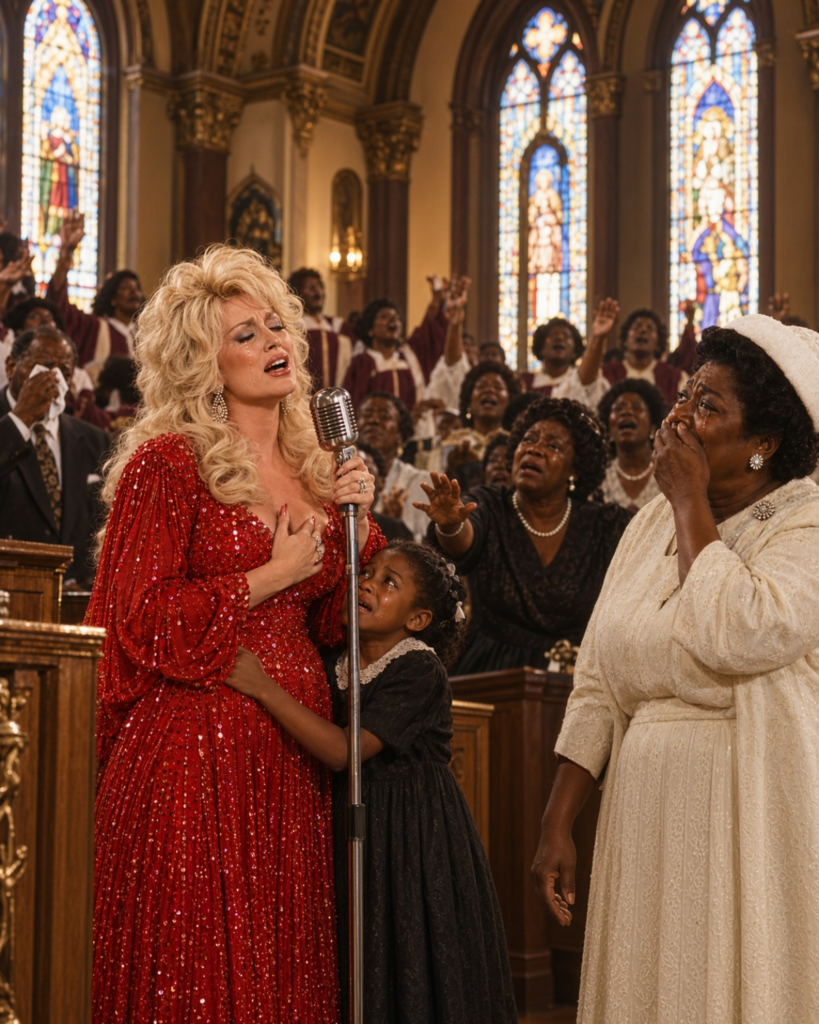
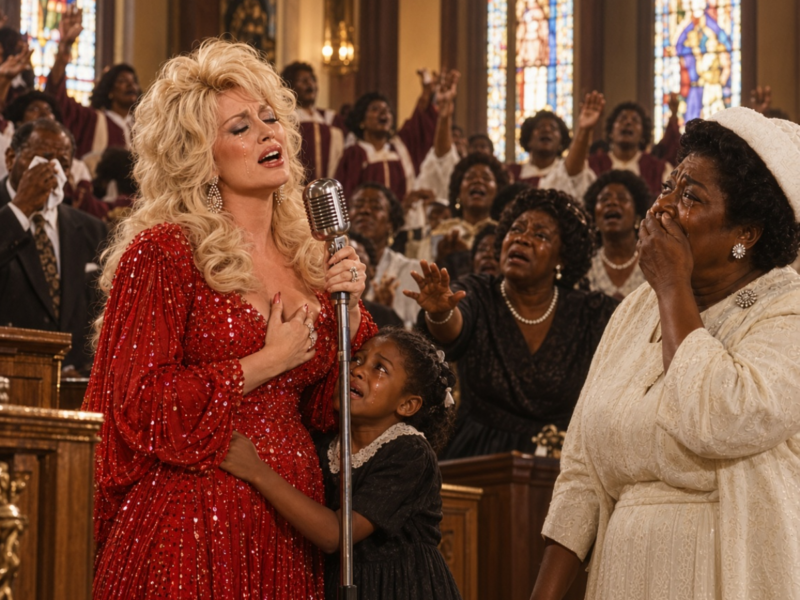
The moment Dolly Parton walked into Mahalia Jackson’s church wearing a glittering red dress, the singing stopped.
Not gradually.
Every voice vanished at once.
The final organ chord trembled beneath the stained-glass windows while dozens of faces turned toward the center aisle.
Dolly froze.
Her jeweled dress caught the morning light, scattering red sparks across the wooden pews.
Her famous blonde hair had been arranged carefully, and the television smile she used whenever fear entered a room rested upon her lips, but it could not protect her here.
Some people whispered.
Others stared openly.
This was not a concert hall or a Nashville television studio.
It was a sacred place filled with people whose voices had been shaped by suffering, faith, and generations of struggle.
Gospel music was not entertainment inside these walls.
It was survival.
And now a young white country singer stood in the aisle, looking as though she had arrived for a performance.
Dolly suddenly felt every rhinestone upon her body.
She considered turning around.
Then Mahalia Jackson rose from the front pew.
The whispers stopped.
Mahalia walked toward Dolly with the quiet authority of a woman who never needed to demand attention.
Her dark dress carried no glitter.
Her expression was warm, but her eyes studied Dolly carefully.
An usher stepped into the aisle.
Mahalia raised one hand.
“I invited her. Let the girl through.”
The path opened.
Dolly followed Mahalia toward the pulpit while her heels sounded painfully loud against the floor.
She had expected a private conversation and perhaps a meal afterward.
She had not known the entire congregation would be waiting.
When they reached the front, Dolly leaned closer.
“You didn’t tell me there would be this many people.”
“If I had, would you have come?”
Dolly looked toward the pews.
“No, ma’am.”
“That is why I didn’t tell you.”
A faint smile appeared on Mahalia’s face.
Then she pointed toward the microphone.
“I want you to sing.”
Dolly’s smile disappeared.
“These people came to hear you.”
“They hear me often. I don’t think I’m ready.”
Mahalia looked directly into her frightened eyes.
“If you wait until fear leaves, child, you’ll never open your mouth.”
The congregation applauded politely as Dolly approached the microphone.
The sound was respectful, but uncertainty remained beneath it.
She could feel the questions.
Had Dolly come for publicity?
Would cameras appear once everyone accepted her?
Did she believe country glamour was enough to enter a tradition built from pain she had never lived?
A man near the rear stood.
“This is Nashville.”
The applause stopped.
His name was Reverend Isaiah Cole, an elderly deacon whose voice had carried the church through funerals, protests, and nights when frightened families needed somewhere safe to gather.
He pointed toward Dolly’s dress.
“Gospel isn’t a costume.”
Dolly’s face reddened.
A few people looked toward Mahalia, expecting her to defend the guest she had invited.
Mahalia remained silent.
This answer belonged to Dolly.
She could have walked away.
No one would have blamed a famous singer for refusing to be humiliated before strangers.
Her manager stood near the entrance, already motioning for her to leave.
Dolly looked down at herself.
Then she removed her sparkling earrings.
She placed them beside the pulpit.
Next came the necklace.
Finally, Dolly stepped out of her jeweled shoes and left them beneath the microphone.
She stood barefoot before the congregation.
“You’re right,” she told Reverend Cole.
“Faith shouldn’t be worn like a costume.”
The room grew still.
“But these clothes aren’t my story. They’re only what happened after it.”
Dolly explained that she had grown up in a tiny cabin in the Tennessee mountains.
Her family had little money and too many children for the space they shared.
Some winters, cold entered through the walls.
Some evenings, the cupboards offered almost nothing.
Her mother still sang.
She sang while dividing food into portions small enough to hide her own hunger.
She sang when storms shook the roof and frightened children crowded into one bed.
She sang because hope sometimes had to be created before it could be believed.
Dolly’s father worked until his hands split, yet often returned home unable to provide everything his family needed.
He was not a man of polished speeches.
His faith appeared in the way he rose before sunrise and tried again.
“Music wasn’t decoration in our home,” Dolly said.
“It was how we survived feeling forgotten.”
Reverend Cole lowered his hand.
The suspicion did not disappear from every face, but something had changed.
They were no longer staring only at the dress.
Dolly took several handwritten pages from her purse.
She had brought a gospel song no one had heard before.
The pianist opened the sheet music.
Dolly stopped him.
“No piano.”
He looked toward Mahalia.
Dolly’s voice trembled.
“I need to sing it the way Mama taught me.”
She stepped away from the microphone stand.
Dolly closed her eyes.
Her first note emerged quietly.
There was no country band behind her, no studio arrangement, no applause sign to tell the congregation how to respond.
Only one unaccompanied voice beneath the stained glass.
She sang about a mother who drank water at dinner so her children could believe she was not hungry.
She sang about a father returning with empty hands and still promising that tomorrow would be better.
She sang about children wearing patched clothing while carrying dreams poverty could not touch.
The words were simple, but they were true.
Mahalia’s expression changed.
She had heard technically perfect singers from the greatest stages in the world.
Dolly was not trying to impress anyone.
Every line seemed pulled from an old wound she had carried out of the mountains.
The congregation listened more closely.
Dolly’s voice grew.
Its country edges remained, but beneath them lived the same desperation that had shaped every honest gospel song.
A refusal to let suffering have the final word.
Reverend Cole slowly sat down.
An elderly woman in the front row leaned forward, tears gathering in her eyes.
Dolly reached the verse about a mother singing beside her children during a storm.
A memory struck her.
She saw rain entering through the cabin roof.
She felt her mother’s fingers moving through her hair.
She heard that exhausted voice promising the frightened children that morning would come.
Dolly’s own voice broke.
She stopped.
Her eyes opened.
No sound came from the church.
For one terrible moment, she believed she had confirmed every doubt.
The famous country singer had entered their sacred room and failed before reaching the heart of her own song.
Then someone whispered from the third row.
“Take your time, child.”
Dolly looked toward the voice.
Compassion had replaced suspicion in the faces before her.
An elderly woman began humming the unfinished melody.
Another person joined.
Then the microphone exploded with a sharp electrical crack.
Dolly stepped backward.
Every speaker went silent.
The church technician ran toward the equipment while Reverend Cole rose again.
Without the microphone, Dolly’s trembling voice could never overpower the large room.
Her manager opened the rear door and motioned for her to leave.
Mahalia walked toward Dolly.
The congregation waited for her decision.
She looked at the dead microphone.
Then at Dolly’s bare feet.
Finally, she raised one hand and gave an order that silenced the technician.
“Leave it.”
Mahalia stepped away from the pulpit.
No microphone.
No piano.
No protection.
Dolly stared at her.
“What if they can’t hear me?”
Mahalia’s answer came quietly.
“Then give them something worth leaning closer to hear.”
Dolly drew one shaking breath.
But before she could continue, a little girl appeared at the end of the center aisle.
Her dress was black.
Her face was wet with tears.
And according to the woman chasing after her, the child had not spoken a single word since watching her mother die.
The little girl stood at the end of the center aisle.
Her black dress hung loosely around her knees.
One hand clutched a faded handkerchief while the other remained locked inside the fingers of the woman trying to stop her.
“Grace,” the woman whispered.
“Come back.”
The child pulled free.
Every face turned.
Dolly remained barefoot beside the dead microphone, unable to look away from the grief inside Grace’s eyes.
The woman following her was Grace’s aunt, Ruth.
She explained in a broken whisper that the girl had been sitting beside her mother when illness took her life.
Grace had spoken one word that night.
“Mama.”
Then nothing.
Doctors found no physical damage.
Counselors tried gently.
Relatives read stories, sang lullabies, and waited beside her bed.
Grace heard them all, but she had locked her voice somewhere no one could reach—until now.
The girl walked toward Dolly.
Each step echoed through the church.
Her aunt covered her mouth, afraid that calling her back might close whatever door had opened inside her.
Dolly lowered herself to one knee.
Grace stopped several feet away.
She stared at Dolly’s red dress, the discarded shoes, and the tears upon her face.
Then her eyes moved toward the handwritten pages lying beside the silent microphone.
Dolly did not ask her to speak.
She did not reach for her.
She simply waited.
Grace lifted the faded handkerchief.
A small embroidered flower appeared in one corner.
“My mother had one like that,” Dolly said softly.
The child’s expression changed.
Dolly touched one of the handwritten pages.
“This song is about her.”
Grace looked toward the congregation.
Hundreds of people watched, but nobody moved.
Mahalia Jackson slowly turned and lowered one hand, asking everyone to give the child silence instead of expectation.
Dolly whispered, “Would you like to stand with me?”
Grace hesitated.
Then she stepped forward.
Dolly offered her hand.
The little girl did not take it.
She wrapped both arms around Dolly’s waist.
The sudden embrace nearly broke her.
Dolly closed her eyes and held Grace against the red fabric.
She remembered being a frightened mountain child clinging to her own mother while storms shook their cabin.
For several seconds, the church heard only Dolly’s uneven breathing.
Then the elderly woman in the third row resumed humming.
One low note, nothing more.
Another woman joined her.
A man near the rear added a deeper harmony.
The sound moved slowly through the pews—not as a performance, but as a hand being extended.
Grace felt the vibration against Dolly’s body.
Dolly began singing again.
Without the microphone, her voice was smaller, but it carried farther because everyone had chosen to listen.
The congregation leaned toward her.
No one coughed.
No one whispered.
Her song continued through memories of hunger, patched clothes, and parents who protected their children from hopelessness even when they could not protect them from poverty.
Grace held tighter.
Dolly reached the passage about a mother leaving courage inside her child.
Her voice cracked again.
This time, the congregation did not wait for her to recover alone.
Their humming grew beneath her.
Dolly tried once more.
The melody returned.
Mahalia stepped from beside the pulpit.
She did not take the center.
She stood several feet behind Dolly and answered one phrase with a powerful gospel response.
The sound rose through the church like thunder contained inside a human voice.
Dolly turned.
Mahalia nodded.
“Continue.”
Dolly sang another line.
Mahalia answered.
Country and gospel met beneath the stained glass—not competing, not pretending to be the same, but discovering that grief recognized both voices.
The choir rose, one person at a time.
The pianist placed his sheet music aside.
He found the melody by listening and touched the keys so softly that Dolly’s natural voice remained above them.
A tambourine sounded from the third row.
The dead microphone no longer mattered.
The church awakened.
Dolly stood with Grace still holding her waist.
Her voice grew stronger as Mahalia carried the places where emotion weakened it.
The choir surrounded them, turning one woman’s memory into something the entire room could hold.
Reverend Cole watched from the rear.
He had accused Dolly of wearing gospel like a costume.
Now he saw her barefoot before the congregation, not demanding acceptance and not pretending to understand suffering that was not hers.
She had brought the truth she knew.
Then she had allowed their voices to meet it.
Grace slowly released Dolly’s waist.
The child looked toward Mahalia.
Mahalia lowered her voice until only the congregation remained.
Dolly knelt again.
Grace touched the handwritten song.
Her lips moved.
No sound emerged.
Ruth took one step forward.
Mahalia stopped her gently.
“Let the child find her own way.”
Grace tried again.
A whisper escaped.
Dolly leaned closer but did not ask her to repeat it.
The girl placed one hand against Dolly’s cheek.
“Mama,” she sang.
Ruth collapsed into the nearest pew.
The church inhaled as one.
Grace had spoken.
Dolly’s tears fell freely now.
“What did she sing?” she asked.
Grace looked toward the stained-glass light.
Then she attempted the melody Dolly had been singing.
Her first note trembled and disappeared.
The congregation lowered its harmony so she could hear the little sound she had made.
Grace tried again.
This time, the note survived.
Dolly joined quietly beneath it.
Mahalia added a gentle response.
The girl sang only a few words, but every person inside the church understood that they were witnessing something more powerful than technical perfection.
Grace had not recovered because a famous singer commanded her to speak.
She had heard a story that made room for her grief.
When Dolly reached the final passage, she lifted Grace into her arms.
The child continued singing against her shoulder while the choir rose with them.
Men who had entered with hardened expressions wiped their eyes.
Women reached toward the pulpit.
Reverend Cole lowered his head and openly wept.
The church seemed to shake beneath the voices.
Then Grace suddenly stopped.
Her body became rigid in Dolly’s arms.
She looked toward the rear entrance.
A man stood there holding a brown envelope.
Ruth saw him and went pale.
“That’s the landlord.”
The choir faded.
The man walked down the center aisle without removing his hat.
He ignored the worshippers and handed Mahalia the envelope.
“This building has been sold,” he announced.
“You have until the end of the month to leave.”
A wave of shock moved through the congregation.
Mahalia opened the notice.
The church’s children’s program owed months of rent.
Donations had fallen.
Repairs were overdue.
And the building’s owner had accepted an offer from a private developer.
The rooms where Grace received food and counseling would be closed.
The small classroom where children learned music would be destroyed.
Grace stared at the man.
“Where will we go?”
They were the first full words she had spoken since her mother died.
No one had an answer.
Dolly held the child tighter.
The landlord looked at her glittering red dress.
“If the famous singer cares so much, perhaps she can buy you another church.”
Several people turned toward Dolly.
Her manager shook his head from the doorway.
Purchasing the building would create headlines, contracts, and financial risks no one had discussed.
Mahalia folded the notice.
“We did not invite her here to rescue us.”
The landlord smiled.
“Then start packing.”
He turned and walked away.
Dolly looked at Grace.
The little girl had finally found her voice inside these walls, only to learn that the place itself was being taken away.
Dolly approached Mahalia.
“How much do they owe?”
Mahalia refused to answer.
“I came here to hear your heart, not your bank account.”
Dolly lowered her voice.
“And what if my heart refuses to walk away?”
Before Mahalia could respond, Reverend Cole took the envelope and examined the final page.
His expression changed.
“This sale isn’t legal.”
Everyone turned.
The buyer’s signature belonged to a company the congregation recognized.
It had purchased several homes in the neighborhood, evicted the families, and left the buildings empty.
But beneath that signature was something worse.
The church’s treasurer had approved the sale.
Mahalia looked toward the organ.
The treasurer’s chair was empty.
Then a loud crash came from the office behind the pulpit.
Someone was inside, destroying the financial records.
And smoke had begun creeping beneath the door.
Smoke curled beneath the office door like a black warning.
For one terrible second, everyone remained frozen.
Then Mahalia’s voice struck the sanctuary with the force of thunder.
“Get the children outside.”
The congregation moved at once.
Parents lifted frightened toddlers from the pews.
Volunteers formed a line toward the side exit while Reverend Cole rushed to the office and pulled desperately at the locked handle.
Dolly wrapped both arms around Grace.
“We are leaving together.”
But Grace pointed toward the smoke.
“My mama’s picture is in there.”
Dolly’s heart dropped.
The children’s program kept photographs of every family it served inside that office.
Grace’s mother had volunteered there before her death.
Her picture, letters, and final recorded song were among the memories now being consumed by flames.
Dolly carried Grace toward the exit and placed her safely into the arms of an elderly woman.
“Stay with her,” Dolly said.
Then she turned back.
Mahalia caught her wrist.
“That room may be burning.”
“And a child’s mother is inside it.”
Before Mahalia could answer, the office window shattered.
Flames climbed through the broken glass, illuminating a shadow moving behind the smoke.
Someone was still in there.
Reverend Cole struck the door with his shoulder.
It refused to open.
Several men joined him, but the old frame held.
Then Dolly grabbed a wooden offering stand.
“Move.”
She drove its heavy base into the lock.
On the third strike, the door burst inward.
A wave of smoke rolled across the hallway.
People covered their faces and stumbled backward.
Through the darkness, Dolly saw a man crouched beside a metal wastebasket filled with burning documents.
It was Leonard Price, the church treasurer.
He held a leather ledger beneath one arm and a half-empty can of lamp oil in the other hand.
Mahalia stared at him.
“Leonard.”
His face collapsed.
“I didn’t mean for it to spread.”
Reverend Cole moved toward him, but part of the ceiling crashed between them in a shower of sparks.
Leonard rushed toward the rear window, trying to escape with the ledger.
Dolly saw what he carried.
Those pages could prove who had stolen the church’s money.
She stepped into his path.
“Give me the book.”
Leonard looked at the flames behind him, then at the famous woman standing barefoot before him.
“You don’t understand. If they find out what I did, my life is over.”
Dolly’s voice became painfully quiet.
“You were willing to destroy the lives of children to protect your own.”
Leonard pushed past her.
Mahalia blocked the doorway.
The frightened treasurer stopped.
Mahalia did not shout or threaten him.
She simply looked at the man who had prayed beside her, counted the congregation’s donations, and eaten at their tables.
“How much did they pay you?”
Leonard’s eyes filled with tears.
“Enough to make me believe I could escape being poor.”
Mahalia’s expression hardened.
“You escaped nothing. You only handed your poverty to people smaller than you.”
A burning beam cracked above them.
Dolly lunged forward, seized the ledger, and pulled Leonard toward the doorway seconds before the timber collapsed where he had been standing.
Outside, sirens screamed through the street.
Firefighters charged into the building as the congregation formed a bucket line to protect the sanctuary.
Men and women who had arrived wearing their finest church clothes now stood covered in soot, passing water from hand to hand.
Nobody asked whether the person beside them belonged.
Nobody cared who had doubted Dolly when she entered.
They fought for the church together.
Dolly emerged, coughing, clutching the scorched ledger against her chest.
Grace ran into her arms.
“My mama’s picture.”
Dolly had no answer.
Then Mahalia stepped through the smoke holding a small metal box.
Its edges were blackened, but it remained closed.
Inside were the photographs, letters, and recordings belonging to the children.
Grace pressed the box against her heart.
“You saved her.”
Mahalia knelt before her.
“No, child. Love saved what the fire tried to erase.”
Across the courtyard, police officers opened Leonard’s ledger.
Page after page revealed missing donations, false payments, and secret transfers to the development company purchasing the church.
Leonard had forged Reverend Cole’s signature.
He had also hidden the final notice from the bank.
The church had not simply been sold.
Its debts had been deliberately manufactured.
Leonard finally confessed.
The developer had promised him money and a position in the new building planned for the property.
His instructions had been simple.
Weaken the children’s program.
Redirect donations.
Frighten the congregation.
And destroy every record before investigators could see the truth.
Mahalia listened without interrupting.
When Leonard finished, he fell to his knees.
“I’m sorry.”
Behind Mahalia stood families who had skipped meals while believing the church had no money.
Children had worn torn shoes while their donations disappeared into Leonard’s secret account.
Mahalia’s voice trembled.
“Sorry is where repentance begins. It is not where consequences end.”
The police led him away, but the surviving ledger brought devastating news.
The forged sale could eventually be overturned.
Yet the bank required an emergency payment before midnight to suspend the eviction.
Without it, the property would legally transfer to the developer before any judge could review the fraud.
Reverend Cole asked the officer how much they needed.
The answer left everyone silent.
It was more money than the congregation could raise in a year.
Dolly stepped forward.
“I’ll pay it.”
Relief spread through the crowd, but Mahalia shook her head.
“No.”
Dolly stared at her.
“These children could lose everything tonight.”
“And if you write one check, the world will call this Dolly Parton’s rescue. Tomorrow, some other church will face the same darkness with nobody famous standing outside.”
“So what do you want me to do?”
Mahalia looked toward the soot-covered congregation.
“Help them discover how powerful they are when they stand together.”
The fire chief emerged from the building and delivered another blow.
The sanctuary was unsafe.
No one could re-enter until the damaged roof and wiring were repaired.
Their instruments were trapped inside.
Their microphones were destroyed.
Their piano had been damaged by water.
And there were only hours remaining.
Dolly looked at the church steps, the gathering neighbors, and Grace holding her mother’s rescued photograph.
Then she understood.
“We don’t need the building.”
Before sunset, word spread across the city.
Dolly Parton and Mahalia Jackson would hold an emergency concert on the church steps.
There would be no tickets, no reserved seats, and no polished stage.
Anyone could come.
Anyone could sing.
Every contribution, however small, would help save the children’s program.
Local radio stations carried the announcement.
Musicians arrived with borrowed instruments.
Restaurants brought food.
Taxi drivers transported elderly residents without charge.
Children emptied coins from jars they had been saving for toys.
As darkness fell, thousands filled the street.
Dolly stood barefoot beneath a single hanging light.
Mahalia took her hand.
Grace waited between them, wearing Dolly’s sparkling shoes, even though they were far too large.
For several hours, the neighborhood sang.
Yet when the courthouse clock approached midnight, Reverend Cole counted the donations and turned pale.
They were still desperately short.
Then headlights appeared beyond the crowd.
A black car pushed slowly toward the church, followed by two trucks carrying demolition equipment.
The developer stepped out, holding the signed property order.
“You have until midnight,” he announced.
“After that, everyone leaves.”
The crowd looked toward Dolly.
Dolly looked toward Mahalia.
Mahalia placed the dead microphone aside and stepped to the edge of the stairs.
“Then we have time for one final song.”
Grace reached for Dolly’s hand.
But before the first note could rise, the courthouse clock began striking midnight.
The first stroke of midnight rolled across the city.
The developer smiled.
“You’re out of time.”
But before the second bell could sound, Grace stepped out of Dolly’s oversized shoes and walked barefoot to the edge of the church steps.
She was still holding her mother’s photograph.
The little girl who had remained silent for months looked at thousands of frightened faces, drew one trembling breath, and began to sing.
Her voice was almost too soft to hear.
There was no microphone, no piano, no choir supporting her—only a grieving child singing the melody her mother had once used to carry her through sleepless nights.
The developer turned toward his lawyers.
“Remove them.”
Two officers moved forward, but Mahalia raised her hand.
“Let the child finish.”
The third bell struck.
Dolly knelt beside Grace and joined her quietly.
She did not overpower the girl or transform the moment into her own performance.
She followed Grace’s uncertain rhythm, allowing the child’s fragile voice to lead.
Then Mahalia began singing.
Her voice rose from the steps like thunder emerging from the earth.
The fourth bell sounded.
Every conversation stopped.
People listening through radios across the city heard the three voices blending beneath the night sky.
The mountain girl who had arrived in rhinestones.
The Queen of Gospel whose church was being stolen.
And a child who had finally discovered the courage to speak after losing her mother.
Inside the radio station, an engineer leaned toward his microphone.
“If you can hear this,” he told the city, “they are still short of the amount needed to save the church.”
The fifth bell struck.
A taxi driver pulled to the curb and emptied the money from his meter box into a donation bucket.
A restaurant owner arrived with the earnings from his entire evening.
A nurse who had just finished her shift removed several folded bills from her purse.
Then an elderly man approached the steps carrying a glass jar filled with coins.
“My wife received meals from this church before she died,” he said.
“Nobody ever asked whether we could repay them.”
He poured the coins into the bucket.
The sound joined the music like rain.
The sixth bell struck.
More people came running from the surrounding streets.
Some carried money.
Others brought whatever they could sell: watches, rings, musical instruments, family treasures.
A young boy offered the bicycle he had spent two summers repairing.
Mahalia gently pushed it back toward him.
“Keep your bicycle.”
“But I want to help.”
“Then stand beside Grace and sing.”
The boy climbed the steps.
Another child joined him.
Then another.
Soon, every child from the community program surrounded Dolly, Mahalia, and Grace.
Some sang beautifully.
Others missed notes.
One frightened child could only hum.
But together they created something no professional choir could have rehearsed.
They created proof that the building mattered.
The seventh bell struck.
The developer checked his watch.
“This performance changes nothing.”
Dolly stood and faced him.
“You’re right. A song can’t frighten a man who values money more than people.”
His smile returned.
Then Dolly continued, “But it can remind everyone else what they’re fighting for.”
Beyond the crowd, car doors slammed.
Former members of the church began arriving from across the city.
A teacher brought money collected from her students.
A mechanic carried a metal box filled with years of saved tips.
Several musicians who had heard the broadcast stepped forward and offered the profits from their next concerts.
The eighth bell struck.
Reverend Cole and volunteers counted the donations on a table beneath the hanging light.
They counted once, then again.
His expression fell.
They were still short.
Dolly quietly reached for her purse, but Mahalia touched her arm.
“Wait.”
Dolly stared at the clock.
“We don’t have time.”
Mahalia looked toward Grace.
“Sometimes faith is not knowing how the story ends. Sometimes it is continuing to sing while the last page is still empty.”
The ninth bell struck.
Grace’s voice trembled.
She looked down at her mother’s photograph and nearly stopped.
Dolly placed one hand over the child’s heart.
“Your mama’s song is in there. Nobody can evict it.”
Grace closed her eyes and sang louder.
The choir answered her.
The tenth bell struck.
A battered city bus stopped at the end of the street.
The doors opened.
Dozens of elderly men and women slowly stepped onto the pavement.
They were people the church had fed, sheltered, and visited when their own families could not.
Some walked with canes.
Others leaned on one another.
At the center of the group was Grace’s grandmother.
She approached carrying a small wooden music box that had belonged to Grace’s mother.
Grace ran into her arms.
Her grandmother opened the box and removed a sealed envelope.
“Your mother left this for the church,” she told Grace.
“She said I should use it only when hope appeared to be gone.”
Inside was the insurance payment from Grace’s mother’s final policy.
It was not a fortune, but it closed nearly half the remaining distance.
The eleventh bell struck.
Reverend Cole counted again.
The crowd waited.
He shook his head.
They were still short by several thousand.
The developer stepped toward the entrance.
“Prepare the property.”
The engines of the demolition trucks came alive.
Their headlights flooded the church.
Grace covered her ears as the machines growled like approaching animals.
Dolly looked at Mahalia.
Mahalia looked back.
Neither woman knew what else to do.
Then a police officer pushed through the crowd carrying Leonard’s scorched ledger.
“We found another account.”
Everyone turned.
The officer explained that Leonard had hidden stolen donations in a private account controlled by the developer company.
Because the money could now be traced directly to the congregation, authorities had obtained an emergency order freezing the sale.
The developer’s face went white.
“That is impossible.”
The officer held out the document.
“No. What you did was illegal.”
The final bell began to strike.
The developer’s lawyers read the order, then slowly stepped away from him.
Police moved toward the trucks and commanded the drivers to switch off their engines.
One by one, the machines fell silent.
Reverend Cole stared at the frozen sale order.
“The church is safe for tonight?”
The officer answered, “The recovered funds and tonight’s donations are enough to stop the transfer. A judge will decide the rest, but nobody is taking this building.”
The final stroke of midnight faded over the city.
For one breathless moment, nobody reacted.
Then Grace shouted, “We saved Mama’s church!”
The street exploded.
People cried, embraced strangers, and raised their hands toward the sky.
Musicians struck their instruments.
The children’s choir began again, louder than before.
Dolly collapsed onto the steps, overcome with tears.
Mahalia sat beside her.
“You could have written the check,” Mahalia said.
Dolly looked at the thousands of people celebrating together.
“But then they would never have seen what they could do.”
Mahalia smiled.
“Now you understand gospel.”
Months later, the court canceled the fraudulent sale.
The developer was convicted.
The stolen donations were returned, and Leonard accepted responsibility for his betrayal.
Dolly anonymously paid for the church’s repairs, but she kept her promise.
Her name appeared nowhere on the building.
The children’s center reopened beneath a new sign bearing the name of Grace’s mother.
On opening morning, Grace stood beneath it in a simple red dress.
She sang the same song that had begun inside the church, this time without fear.
Years passed.
Grace became a gospel singer whose voice filled theaters around the world.
Before every performance, she placed her mother’s photograph beside the microphone and told audiences about the night a church nearly burned, a city nearly surrendered, and two women taught her that grief did not have to remain silent.
People remembered Dolly’s glittering dress.
They remembered Mahalia’s earth-shaking voice.
They remembered the broken microphone, the fire, and the midnight bells.
But Grace remembered something quieter.
When her voice was small, Dolly lowered hers.
When fear made her tremble, Mahalia stood beside her.
And when the world threatened to erase everything her mother had loved, an entire city answered one frightened child with a song.
Dolly Parton had entered the church wondering whether she belonged.
She left understanding that belonging was never granted by applause, clothing, or fame.
It happened when one wounded heart recognized another and refused to let it sing alone.
And when Mahalia heard what Dolly sang, she said quietly to the congregation, “She’s got the anointing.”
That was the moment everyone understood the truth.
The anointing is not in a voice.
It is in a heart that arrives broken and sings anyway.









