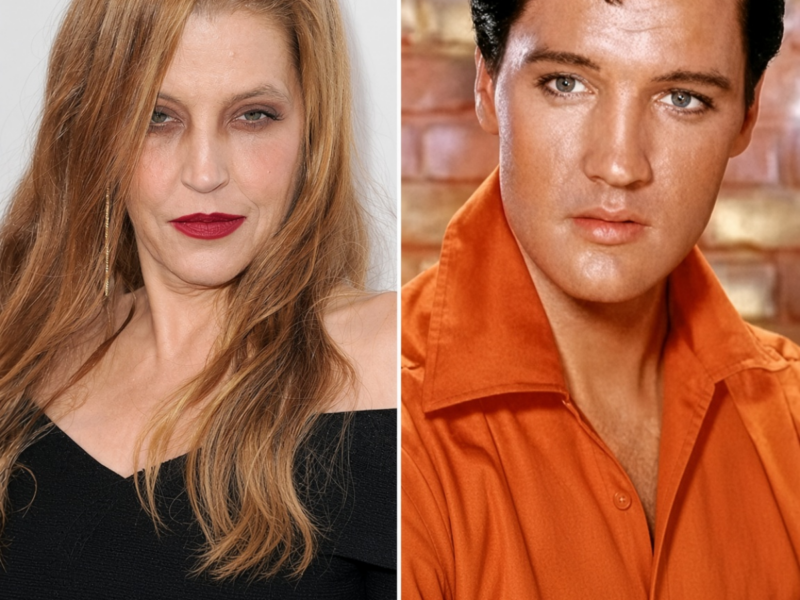
Lisa Marie Presley Looked Just Like Elvis.
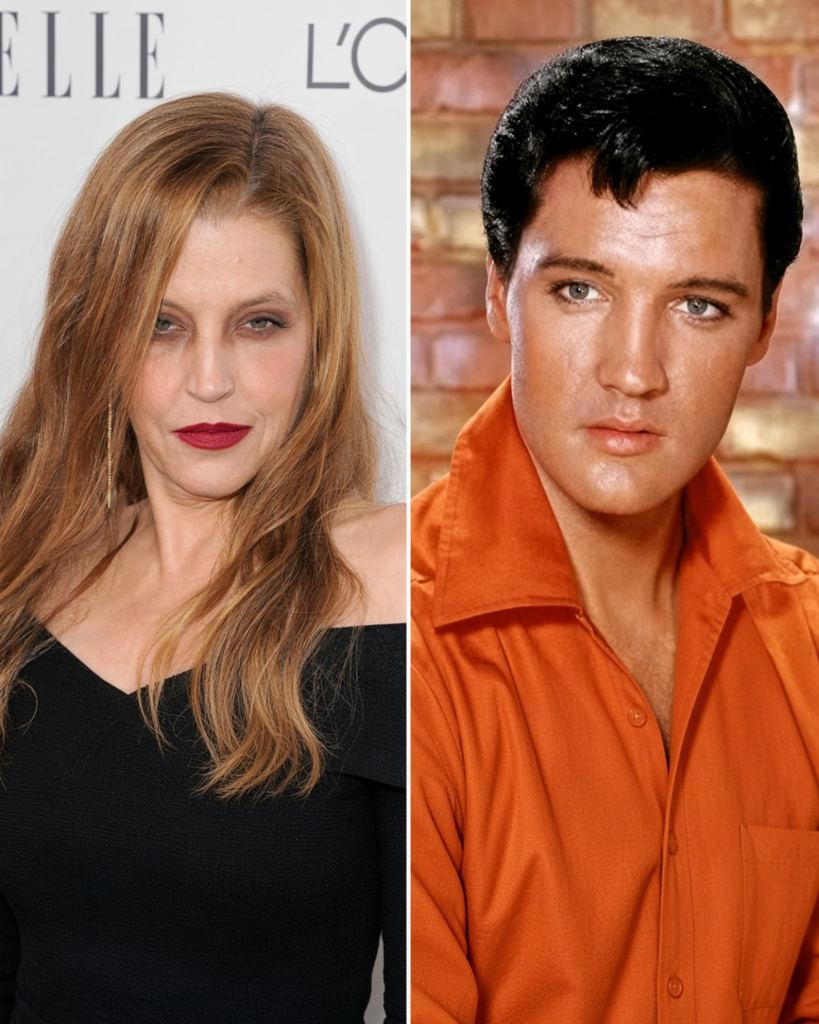
The perfect blend of your mom and dad. I mean, visually, yeah. It’s unbelievable.
But on the inside—
Being told she had her father’s face—what nobody ever asked was what it cost her to wear it.
Think about that for a second. Not the fame, not the money—the face.
The thing you can’t take off, can’t hide, can’t trade in for a different one when the world gets too loud.
Lisa Marie Presley walked into rooms and watched people stop mid-sentence. Not because of something she said. Not because of something she did.
Because of how her eyes sat under her brow. Because of the curve of her jaw. Because when she turned her head a certain way under a certain light, a stranger saw a man who had been dead for decades.
And they didn’t just notice it. They reacted to it.
Some people smiled. Some people went quiet. Some people reached out to touch her arm as if touching her might bring something back.
Imagine living like that.
Every introduction, every handshake, every dinner, every airport—somebody looking at you and seeing somebody else.
Someone they loved. Someone they lost. Someone who belonged to them in a way you never fully could.
That was Lisa Marie’s life, and today we’re going to talk about what that face really meant.
Because the resemblance wasn’t a coincidence, and it wasn’t a footnote. It was the story.
It shaped how fans treated her, how the press wrote about her, how her own family looked at her—and in the end, how she looked at herself.
So let’s start where she started. With a little girl, and a house, and a father the whole world wanted.
Lisa Marie was born on February 1st, 1968—nine months after her parents’ wedding.
Elvis Presley was already the most famous man on the planet, and he had just become a father.
Those who knew him in that period have said again and again that he was besotted with her. He called her his little girl. He showed her off.
For a man who lived most of his life surrounded by crowds, she was one of the few people who made him seem simply like a dad.
But her childhood was never going to be ordinary.
Her parents’ marriage fell apart, and they divorced in 1973 when she was five.
After that, her life split in two. There was the life in California with her mother, Priscilla—and there was the other life, the one that happened in Memphis behind the gates of Graceland.
Think about how a child experiences that.
To most people, Graceland is a landmark. A bucket-list stop. A place with a gift shop and a guided tour.
To her, it was just where her father lived. It was where she went to be with him.
The hallways that tourists whisper in were the hallways she ran down.
And she was a kid. She wanted what kids want—attention, time, a parent who wasn’t distracted.
And her father, for all his love, lived a life that was anything but quiet. There were tour schedules, long nights, a whole world of people orbiting around him.
But in those visits, there were moments that belonged only to the two of them.
And those moments are what she carried with her for the rest of her life.
Then came August 16th, 1977. Lisa Marie was nine years old. She was at Graceland that day.
Elvis Presley, at forty-two, was found unresponsive in his home—and the news that would shake the entire world landed first in the house where his little girl was.
Nine years old. Let that sink in.
A child in the middle of a summer losing her father. Not privately the way most children lose a parent—publicly. Instantly. The kind of loss that becomes a headline before you’ve even understood it.
By that evening, the whole world was grieving. Fans gathered at the gates. Flowers piled up. Reporters stood outside speaking quietly into cameras.
And somewhere inside, a little girl was trying to understand why her dad wasn’t coming back.
Here’s what’s hard to grasp about her grief.
Most of us mourn a parent in a small circle. We cry with our family. We bury them. And then, slowly over years, we try to live around the hole they left.
Lisa Marie never got that—because the whole world was in mourning with her, and the world never stopped.
Every August, fans return to Graceland for the candlelight vigil. Every year, there are tributes, documentaries, anniversaries.
His memory isn’t allowed to fade—and neither is the fact that she is the living piece of him.
She wasn’t just a daughter who lost a father. She was the walking, breathing reminder of what the world had lost.
Now think about what happens to a child’s memory in that situation.
Normally, you remember a parent privately—their voice, their smell, the way they laughed. Those memories are yours. Nobody can argue with them. Nobody can edit them.
When your father is Elvis Presley, your memories don’t stay private. They get compared. They get measured against the legend.
Everyone has their own version of him, and many of them think theirs is the real one—the performer, the icon, the movie star, the voice on the radio.
And she had a different version. She had the man who was her dad.
That’s a strange kind of loneliness—to be one of the only people alive who knew him that way, and to have the entire world insisting they knew him better.
And then there’s the face.
As she grew, the resemblance became impossible to ignore.
The dark, heavy brows. The full mouth. The way her expression shifted when she was serious. The eyes, which people described again and again as strikingly like his.
Of course, she was also her mother’s daughter. Priscilla’s features were in there, too. But the world didn’t care about that part.
The world saw Elvis.
And when you’re young, and you’re still figuring out who you are, that’s a heavy thing to have projected onto you.
Every teenager wants to be seen as an individual. She was being seen as an echo.
Picture it. A girl is trying to find herself—and everywhere she goes, someone is trying to find him in her. In her smile. In her walk. In the way she laughs.
She’s being studied. She’s being measured—not for who she is, but for how much of someone else she carries.
So here’s the question that sits at the center of everything.
What do you do with that?
You can lean into it. You can wear the resemblance like armor and let it open doors. Or you can resist it. Fight it. Try to prove you’re something separate.
Lisa Marie spent much of her life doing both—sometimes in the same year.
When she became a singer, the comparison followed her into every interview. When she spoke about her father, the press leaned in as if she were holding a sacred relic.
And when she tried to talk about anything else—her own life, her own feelings, her own dreams—the conversation always drifted back to him.
Now let’s talk about the moment many fans remember—when she sat down on CBS’s The Talk on September 13th, 2013, and spoke about growing up at Graceland.
By then, she was a grown woman. A mother. She had lived through marriages, tabloids, loss, and years of public scrutiny.
And what stood out in how she spoke about her childhood home was how human she made it sound.
Not a museum. Not a monument. A place where a little girl had a father.
When she talked about those memories, you could sense something fans rarely got to see—a woman who loved her father, who was proud of him, but who had also carried his name like a weight.
She could laugh about it. She could joke. But under that warmth, there was something else.
A tenderness. A guardedness. The sense of someone protecting the parts of the story that were still hers.
Because that’s what a lot of people missed about Lisa Marie.
She was funny. She was sharp. She was warm in a way that made interviewers relax.
But she had learned early that the public wanted a certain version of her—the sweet daughter, the keeper of the flame.
And she knew how to give them enough of that to be gracious while keeping the real thing close.
It’s a skill you develop when you’re never allowed to be just yourself.
And here’s the part that makes it even more poignant.
The more you watch her talk about Graceland, the more you realize she wasn’t just remembering a house. She was remembering the last place where she had her father.
Every room had a memory. Every corner had a ghost.
And the world kept visiting that house—tour group after tour group—to see the things she could never really leave behind.
So when we say she looked just like Elvis, we’re not just talking about cheekbones and eyebrows.
We’re talking about a life lived under a magnifying glass. A life where the most intimate thing about you—your face—belonged to millions of strangers.
Think about what that does to your sense of self.
You look in the mirror in the morning. Who’s looking back? You, or him?
Where does one end and the other begin?
For most of us, that question never comes up. We look like our parents, sure. People say, “You have your dad’s smile.” We laugh. It’s sweet. It’s harmless.
But when your dad is a global icon, that sentence carries a different weight.
It isn’t a compliment you can just accept. It’s a reminder. A comparison. A claim that the world has on you.
And the older she got, the more she seemed to look like him.
That’s the thing about resemblance. It doesn’t fade. Sometimes it sharpens.
The older we get, the more we grow into our inheritance.
So imagine being middle-aged and watching the same face in the mirror that the world saw in grainy photographs.
A face frozen at forty-two while you keep getting older.
She was literally outliving her father’s age in his own features.
She was becoming a woman who looked like a man who never got to grow old.
There’s something haunting about that. Something no one talks about.
The world saw a resemblance. She lived inside it.
And all the while, there was something else coming. Something bigger than a face, bigger than a legacy, bigger than a famous last name.
Because there was a birthday on the horizon. A very specific one.
February 1st, 1993. The day she turned twenty-five.
The day everything her father left behind would legally become hers.
Graceland. The music. The name. The empire.
Every piece of the legend would move out of the hands of the people who had been managing it and into the hands of a young woman who had spent her whole life being compared to it.
She was about to inherit more than money. She was about to inherit the responsibility of being Elvis’s daughter in the most literal, legal, undeniable way possible.
And she had no idea what that inheritance would cost her.
The day she turned twenty-five, Lisa Marie Presley inherited her father’s empire.
She also inherited his shadow—and only one of those came with a bank account.
February 1st, 1993. Most people mark a twenty-fifth birthday with a party and maybe a quiet panic about getting older.
For her, it was a legal deadline.
It was the date when the music, the name, the image, and Graceland itself passed into her hands.
Let that land.
At an age when most of us are still figuring out how to cover rent, she was handed the keys to one of the most recognizable brands on Earth.
And here’s something that gets lost in the legend.
When Elvis died in 1977, the estate was not the golden machine it is today.
Much of its value was built afterward, through years of relentless work by the people running it—including her mother, Priscilla.
Graceland opened to the public in 1982 and turned into a pilgrimage site.
By the time Lisa Marie came of age, the estate had grown into something enormous, with reports putting its worth around $100 million.
So what did she actually inherit?
Not just assets. A living, breathing enterprise with a global fan base attached.
Millions of people who felt Elvis belonged to them—and who now looked at his daughter and expected her to guard him.
Think about that job description.
Keep the flame lit. Don’t embarrass him. Don’t change him. Don’t let him fade.
And do it all while you’re still carrying the grief of a father you lost when you were nine years old.
Nobody hands you a manual for that. There is no training for becoming the custodian of a legend.
But here’s the thing about Lisa Marie. She didn’t just want to be the keeper of someone else’s story.
She wanted one of her own.
So she did something that was either incredibly brave or incredibly reckless, depending on who you ask.
She became a singer.
Picture the pressure.
You step up to a microphone, and you aren’t just another artist with a debut album. You’re Elvis Presley’s daughter.
Before anyone hears a single note, they’ve already decided what you should sound like—or what you shouldn’t.
Her first album, To Whom It May Concern, arrived in 2003 and debuted in the top five on the Billboard 200.
That’s a real achievement. But look at how the world talked about it.
Reviews and headlines kept circling back to the same question: How much of him is in her?
The voice. The look. The name.
It was almost impossible to find a piece of coverage that let her simply be a musician.
She followed it with Now What in 2005, and then, years later, Storm & Grace in 2012, produced by T-Bone Burnett.
Many critics praised that record for its rootsy, personal feel. It sounded like a woman finally writing from her own life, instead of performing the role she’d been handed.
And still, the comparisons never stopped.
Every interview. Every review. Every profile.
As if the world couldn’t hear her until it had first measured her against him.
That’s the trap of a famous resemblance. You can work for years to prove you’re your own person, and the first thing anyone says is, “You look just like your father.”
Now let’s talk about love—because if the public struggled to see Lisa Marie as separate from Elvis, how could the people who got close to her be any different?
She married young, in 1988, to a musician named Danny Keough.
They had two children together, Riley and Benjamin. By all accounts, that was the quiet chapter of her life—the one that existed far away from headlines.
But the marriage ended in 1994.
And then came the one nobody saw coming.
May 1994. A secret ceremony in the Dominican Republic.
Lisa Marie Presley had married Michael Jackson.
The world lost its mind.
Think about the headline. The daughter of the king of rock and roll and the king of pop.
Two of the most famous families in music history joined together. It sounded like something no screenwriter would dare to invent.
But the reaction wasn’t pure wonder. It was suspicion.
People wondered whether it was love, or image, or something stranger.
Jackson’s devotion to Elvis’s legacy was well known, and the whispers started almost immediately. Was he marrying her, or was he marrying the name?
Lisa Marie has said she loved him, and that’s the part we can take at face value.
What we can say is that the public could never see this marriage as a simple love story.
It was always a symbol first, a spectacle second, and a relationship third.
It lasted less than two years. They divorced in 1996.
And that’s the pattern worth noticing. When your last name is Presley, even your private choices become public property.
Every relationship comes with an audience—and every audience has a theory.
Then, in 2002, another headline that stopped people in their tracks.
Lisa Marie married actor Nicolas Cage.
Now, Cage has never hidden how much Elvis means to him. He’s spoken about it for years.
And that raises the question that must have hung over her at the time.
When someone is that drawn to your father, how do you know where the admiration ends and the attraction begins?
That marriage was over almost before it started. They separated within weeks, and the divorce was finalized in 2004.
It remains one of the shortest high-profile marriages of its era.
We don’t need to guess at what went wrong in a private relationship. But look at the shape of it.
Two famous people—one of whom had spent a lifetime in love with a legend—marrying the legend’s daughter.
Whatever else it was, it was never going to be an ordinary marriage.
She would marry once more, in 2006, to musician Michael Lockwood, and they would have twin daughters.
But that is a story for another chapter.
What matters here is the thread running through all of it.
Over and over, Lisa Marie had to wonder the same thing.
Do they see me, or do they see him?
For most of us, that question is a fleeting insecurity.
For her, it was a permanent condition of life.
And then there was the money.
On paper, this should have been the part of her life that was secure.
Generational wealth. A catalog that earns money every single year. A name that practically prints currency.
But the reality, according to reporting, was far more complicated.
In 2005, she sold a majority stake in Elvis Presley Enterprises to an entertainment company in a deal reported to be worth around $100 million.
She kept ownership of Graceland and a minority share.
For a lot of fans, that was a shock. The daughter of Elvis letting go of control of the very thing she’d inherited.
Why would she do it?
Reports at the time pointed to the financial pressures of maintaining the estate and her own lifestyle.
And in the years that followed, stories kept surfacing about money troubles.
Then, in 2018, came the part that really got people’s attention.
Lisa Marie filed a lawsuit against her longtime business manager, alleging mismanagement of her finances.
In her court filings, she claimed her money had been badly handled. The allegations were disputed, and the case was reportedly settled.
Let’s be careful here. These were claims made in litigation, not proven facts, and the other side pushed back.
But the headline alone told a story.
The woman who inherited one of the most valuable names in entertainment was, by her own account, fighting over her finances in court.
And years later, after her death, reporting emerged that she had left behind significant debt.
The scale of it was reported at many millions of dollars.
Think about how strange that is.
The estate of Elvis Presley—the brand that fills arenas decades after his death—and his only child struggling to keep her own financial footing.
It’s a reminder that inheriting a fortune and holding on to one are two completely different skills.
And she was handed the first without ever being taught the second.
So where does that leave us?
A woman with her father’s face and her father’s name. A career where every note was compared to his. Marriages that came with their own set of questions about who she was to the people who loved her. And a fortune that was supposed to protect her but that, according to the reporting, kept slipping through her fingers.
You could look at that life and see a cautionary tale.
Or you could see something simpler.
A person trying, again and again, to build something that was hers inside a house that was never really hers to leave.
Through all of it, she had a reason to keep going. Not the estate. Not the fame.
Her children.
Because in the middle of every marriage, every album, every court filing, there was a boy—born in 1992, before she ever touched the inheritance.
A quiet child who would grow up with a famous name and a familiar face. His grandfather’s eyes. His grandfather’s smile. And the same impossible weight.
Benjamin.
She would pour everything she had into protecting him.
But there are some things no inheritance can buy and no legacy can prevent.
And one day, in the summer of 2020, Lisa Marie Presley would face a loss that made every other battle in her life look small.
When her son grew up, Lisa Marie Presley looked at him and saw her father.
It gave her joy and terror at the very same time.
Imagine it.
You spend your whole life being told you have a dead man’s face. You learn to live with it. To smile through it. To wear it.
And then one day, you look across the kitchen table and see those same eyes looking back at you—not in your reflection. In your child.
His name was Benjamin Storm Keough.
He was born on October 21st, 1992—the second child of Lisa Marie and her first husband, Danny Keough.
And almost from the beginning, people noticed.
They noticed the dark, heavy brow. They noticed the intensity in his expression. They noticed how, in certain photographs, in certain light, the years seemed to fold in on themselves—and Elvis Presley was somehow standing there again. Young and quiet and watching.
For fans, that resemblance was a wonder.
For Lisa Marie, it had to be so much more complicated.
Because she knew exactly what a face like that could mean.
She knew what it was to be looked at and measured against a legend. She knew the pressure, the expectation, the strangers who think they have a claim on you because of how you look.
And now she was watching her son grow into it.
Think about what that does to a mother.
Part of you is proud. It’s your boy. He is beautiful. He carries your family’s history in his face.
But another part of you braces—because you know what’s coming. You know the comparisons. The whispers. The weight of a name that was never his to choose.
So she did what a protective mother does. She tried to give him a childhood where he could simply be a kid.
By most accounts, Benjamin grew up close to his family—and especially close to his older sister, Riley.
The two of them had each other through a childhood that was anything but ordinary.
They shared the same famous grandfather. The same impossible name. The same quiet understanding of what it was like to be looked at before you’ve even said a word.
And Benjamin found his own way to express himself.
He loved music. He played. He wrote. He spent his time the way a lot of young musicians do—chasing something he couldn’t quite put into words.
Those who knew him described someone gentle, thoughtful, and deeply loved.
A young man with a famous face and a private heart.
Lisa Marie adored him. She said so often and openly. She spoke about her children as the center of her life—the thing that kept her anchored through everything else.
The marriages. The money. The headlines.
Through all of it, there were her kids.
And then came July of 2020.
This is the part of the story where we slow down, because it deserves care.
On July 12th, 2020, Benjamin Keough died.
He was twenty-seven years old.
Twenty-seven.
A young man gone before his life had really begun to take shape.
The world reacted the way it always does when a famous family is struck by tragedy. Headlines. Tributes. Statements.
But behind the headlines was a family that had just been shattered.
A mother had lost her son. A sister had lost her brother. And a grandmother, Priscilla, had lost her grandson.
Benjamin was laid to rest at Graceland, in the Meditation Garden—the quiet place on the grounds where Elvis himself is buried.
Think about the weight of that.
A young man coming home to the same ground as his grandfather—the man whose face he carried.
For Lisa Marie, it was a loss that cut deeper than anything she had endured before.
And she had already endured a great deal.
She had lost her father at nine. She had lived through divorces, public scrutiny, and years of grief that never quite let go.
But losing a child is a different kind of loss. It breaks the natural order.
A parent is never supposed to bury their son.
Later, she wrote about it herself.
In 2022, she shared a deeply personal essay about losing Benjamin—and what stood out was how raw and unguarded it was.
This wasn’t the polished voice of a celebrity managing her image. This was a mother describing a grief so heavy it had reshaped everything.
She spoke about the pain of losing her son. About how it changed her. About how hard it was to keep going.
And here’s what struck so many readers.
She didn’t dress it up. She didn’t offer a neat lesson or a comforting conclusion.
She simply told the truth about how hard it was.
That’s what makes her words so powerful—because for most of her life, Lisa Marie had been a symbol. A face. A resemblance.
But in that essay, she was just a mother.
There is a cruel detail in all of this that’s hard to ignore.
Lisa Marie—the woman who had spent her whole life with her father’s features following her around—had lost the one person who carried them forward.
Her son, with his grandfather’s eyes, was gone.
Some of the people who loved her have said that Benjamin’s death changed her forever. And it’s not hard to understand why.
How do you move on from a loss like that?
How do you wake up each morning and make breakfast and answer emails and live in a world that no longer has your child in it?
You don’t move on. You carry it.
And she carried it every day.
But there was another person carrying that grief right beside her.
Riley Keough.
Riley had lost her brother—her closest ally, the person who understood what it meant to grow up in the Presley shadow.
And she had to find a way to keep standing.
And she did.
In the years after Benjamin’s death, Riley continued building a career that was entirely her own.
She had already made a name for herself as an actress with roles in films like Mad Max: Fury Road and American Honey.
She was proving—quietly and steadily—that you could carry a famous name without being defined by it.
In 2022, she stepped further into her own voice, co-directing the film War Pony, which went on to win an award at the Cannes Film Festival.
For a young woman who had spent her life being introduced as someone’s granddaughter, it was a defining moment.
She wasn’t just a Presley. She was an artist.
Think about what that meant for Lisa Marie.
Watching her daughter step out from the family shadow and do it on her own terms must have brought a mixture of pride and ache—because she knew what it took.
She had spent a lifetime trying to do the same thing.
And that same year, the Presley name returned to the spotlight in a big way.
In 2022, Baz Luhrmann’s film Elvis arrived in theaters with Austin Butler in the title role.
It was a major cultural moment. Suddenly, a whole new generation was talking about Elvis—studying his life, rediscovering his music.
For the family, it must have been surreal.
Their father, grandfather, great-grandfather was being brought back to life on the big screen in front of millions.
Lisa Marie attended the film’s Cannes premiere alongside her mother, Priscilla, and reports at the time said she was moved by what she saw.
Imagine sitting in that audience.
You are watching your own father—rendered by an actor—moving and singing and living on screen.
The man you lost when you were nine, brought back for two and a half hours.
And you are watching it while carrying the grief of having lost your own son just two years earlier.
It’s almost too much to hold.
Joy and sorrow in the same breath. Pride and loss side by side.
That was the emotional world Lisa Marie was living in during those final months.
A year of public celebration of her family’s name, set against a private life shaped by grief.
Now we need to be careful here, because people love to speculate about families in pain.
Some will tell you that grief tore this family apart. Others will tell you it brought them closer.
The truth is that we don’t know—and we shouldn’t pretend to.
What we do know is that grief changes every relationship it touches.
It makes some conversations harder and some silences longer.
It asks people to carry something heavy—and not everyone carries it the same way.
What we can say is that Lisa Marie loved her children.
She said it publicly. She wrote it publicly. And she lived it.
Her family was her anchor.
And in that last year, she seemed to be searching for a way back to herself.
She started speaking more openly about her grief. She returned to music, working on new material. She showed up in public again, more visibly than she had in some time.
There was a sense, to those watching, that she was trying to rebuild.
There is also something that sends a chill down the spine when you look at the calendar.
Benjamin died on July 12th, 2020.
And Lisa Marie, two and a half years later, would die on January 12th, 2023.
The twelfth. The same day of the month.
It’s a coincidence. Nothing more.
But it’s the kind of coincidence that stops you in your tracks, because it feels like the story closing a circle that no one asked it to close.
Because the truth is, the timeline was shorter than anyone realized.
By the winter of 2022, Lisa Marie had spoken publicly about her pain. She had watched her father brought back to life on screen. She had seen her daughter win acclaim.
And she was, by every outward sign, still standing.
But in a matter of weeks, the world would see her face one more time—in a ballroom full of cameras and flashing lights—wearing a smile that many people would later look back on and wonder about.
And what happened in the days after that would change the story forever.









