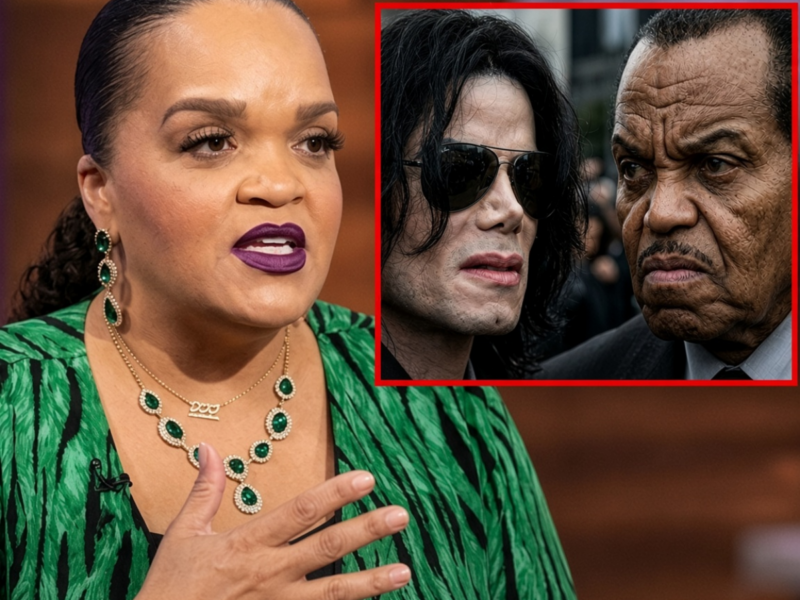
Joh’Vonnie Jackson On Her Relationship With Joe Jackson & Michael Biopic.
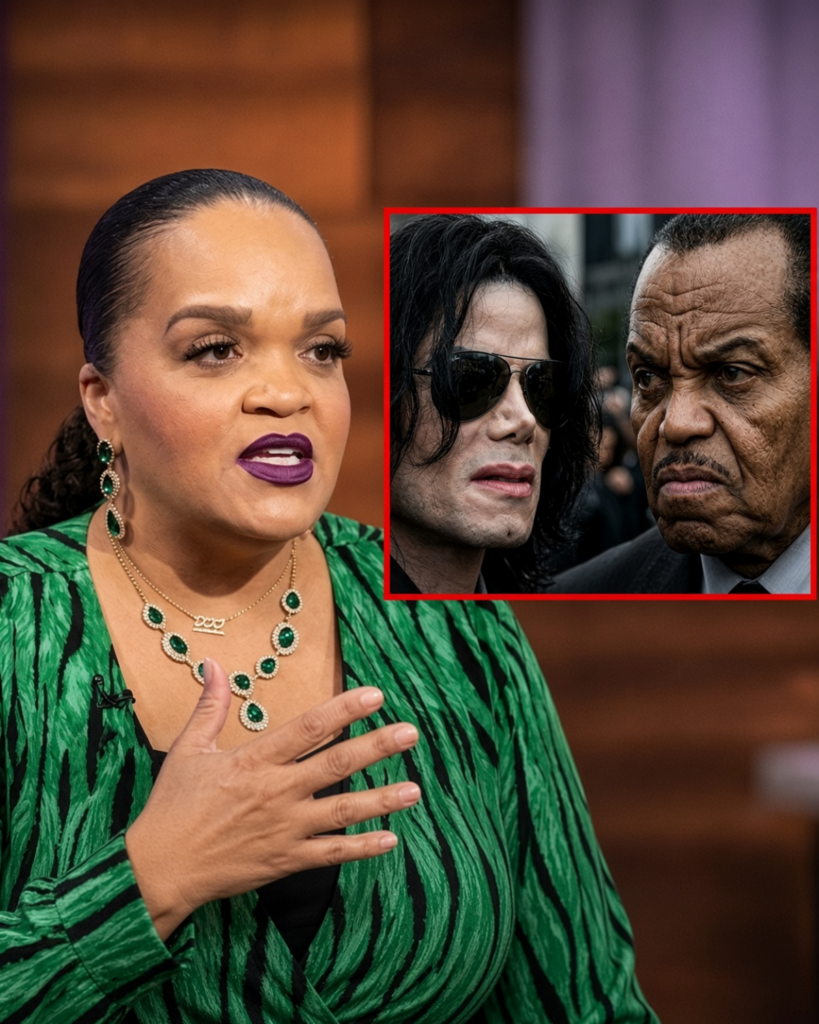
We had to grocery shop at a different grocery store.
He was just trying to make sure his secret didn’t get published.
If you think the glittering Hollywood magic of the recent Michael biopic told you everything about the legendary Joe Jackson, Joh’Vonnie Jackson is here to prove you completely wrong.
Growing up bearing the cruel label of a bastard child while being utterly ignored by the most powerful family in global entertainment, this secret daughter is finally stepping out of the shadows to strike a devastating blow to her family’s carefully curated history.
The harsh, unfiltered reality of the patriarch Joe Jackson stands in stark, unsettling contrast to the sanitized version currently shining on the silver screen.
While the world is busy applauding the theatrical portrayal of the Jackson dynasty, Joh’Vonnie is dismantling the illusions.
What really happened behind the closed doors of that empire, away from the flashing paparazzi cameras?
This isn’t just another celebrity scandal.
It is the agonizing, deeply personal journey of a girl who endured decades of profound rejection.
Get ready for a raw, unprecedented look at the real Joe Jackson, a man far more complex, ruthless, and historically grounded than any Hollywood scriptwriter could ever dare to capture.
The Bastard Child memoir and the scream from the shadows.
The year was 1989.
When Joh’Vonnie Jackson turned fifteen, she was standing at the precipice of womanhood, an age where most teenage girls are completely consumed by the chaotic beauty of high school, first crushes, and the fleeting drama of adolescence.
But for Joh’Vonnie, there was no normal teenage dream.
While her peers were plastering posters of global pop icons on their bedroom walls, icons who, in a cruel twist of fate, shared her very bloodline, she sat in suffocating silence within the four walls of a shadowy room.
She wasn’t living.
She was hiding.
And in that heavy, oppressive isolation, she began to pour a terrifying amount of deeply rooted resentment, sorrow, and unspeakable trauma into the pages of a secret diary.
For decades, those pages were buried in the dark, acting as a silent vault for a ghost.
They remained completely concealed until the woman, having finally reached middle age and exhausted by a lifetime of erasure, made the radical decision to drag her truth into the blistering light of the public eye.
But you have to ask yourself, when it was finally time to publish her life story, why would she deliberately brand her literary debut with such a horrific title?
Why would she willingly plaster the words bastard child across the cover of her own memoir?
Make no mistake, this was not merely a catchy title chosen by a publishing house for shock value.
This was the exact venomous phrasing, the most cruel, degrading slur imaginable, that the world and, devastatingly, her own flesh and blood had used to relentlessly humiliate her behind closed doors.
For years, it was a weapon forged to keep her small, to keep her quiet, and to ensure she understood her place at the absolute bottom of the Jackson family hierarchy.
By taking that word and stamping it on her book, Joh’Vonnie was executing a masterclass in psychological reclamation.
The publication of this memoir was never just a therapeutic exercise to heal a wounded inner child.
It was a calculated, heavily armored clapback aimed directly at an empire.
It was a defiant, agonizing scream from a woman who had been gagged for a lifetime.
Imagine the sheer audacity it takes to stand up against the most fiercely protected legacy in the history of soul, R&B, and pop music.
She knew exactly what she was doing.
She didn’t care if the famous, universally adored Jackson siblings, the idols of millions, were left paralyzed by shock or consumed by blinding rage.
She was completely indifferent to the PR crisis she might trigger.
After spending her entire life walking on eggshells to protect the reputations of people who wouldn’t even acknowledge her existence in a crowded room, Joh’Vonnie was done playing the compliant victim.
Through Bastard Child, she grabbed the world by the shoulders and forced it to look her dead in the eye.
She demanded to be recognized not as a dirty little secret, not as a stain on a flawless Hollywood pedigree, but as a living, breathing human being.
To truly comprehend the deepest layer of Joh’Vonnie Jackson’s trauma, we must pause and confront the most heartbreaking paradox of her entire existence and the core beating heart of her memoir.
The public is often quick to dismiss the illegitimate children of the rich and famous as the unfortunate aftermath of a meaningless overnight fling or a fleeting moment of indiscretion on a chaotic concert tour.
But Joh’Vonnie’s origin story violently shatters that shallow cliché.
She was absolutely not the result of a passing shadow or a careless mistake.
She was the living, breathing product of a deeply entrenched, profoundly secretive twenty-five-year-long romantic relationship between her mother, Cheryl Terrell, and Joe Jackson.
Stop and deeply consider the gravity of that timeline.
A quarter of a century.
You do not maintain a hidden second life for twenty-five years without a profound, enduring emotional tether.
While Joe Jackson was ruthlessly building a legendary musical empire and ruling his primary household with an iron fist, he was simultaneously seeking refuge, comfort, and undeniable affection in the arms of Cheryl.
Therefore, by all biological and emotional definitions, Joh’Vonnie was a child born out of a profound and enduring love.
She was brought into this world through a bond that outlasted countless highly publicized Hollywood marriages.
Yet this beautiful truth was entirely eclipsed by a brutal reality, because that love existed outside the sanctified boundaries of the official Jackson family marriage.
Joh’Vonnie was ruthlessly and systemically punished for a crime she did not commit.
A newborn baby does not choose its parents.
An infant does not comprehend the complexities of infidelity, PR crisis management, or royal family honor.
She arrived into the world as an innocent blank slate, only to be instantly branded as the ultimate threat to the carefully curated Jackson dynasty.
She was the physical, breathing manifestation of her father’s greatest transgression.
And for that, she was unceremoniously discarded into the darkest, coldest corners of abandonment.
Imagine the sheer psychological torture of her daily reality as she grew up.
While the globe worshiped at the altar of her family’s genius, Joh’Vonnie was condemned to watch the glittering, stratospheric success of her siblings from the cheap seats of a life she was never allowed to join.
She shared their exact DNA.
She shared their striking features, their bloodline, and their name.
Yet she was entirely locked out of the castle.
She had to sit in a quiet living room and watch her father stand proudly on global television, holding up the arms of his famous sons and daughters, bathed in the blinding flash of paparazzi cameras, while completely ignoring the daughter crying in the shadows just a few miles away.
She wasn’t just neglected.
She was actively erased.
To be born of an enduring love only to be treated as a dirty, unspeakable secret creates a unique, paralyzing kind of agony.
It is a profound injustice that dictated her entire youth, forcing an innocent child to pay the ultimate price for the sins, the secrets, and the towering ambitions of the adults who were supposed to protect her.
Her memoir is the ultimate subversion of the celebrity documentary narrative.
It strips away the platinum records, the sold-out stadiums, and the flawless moonwalks to reveal the collateral damage left in the wake of immense fame.
In writing Bastard Child, Joh’Vonnie Jackson didn’t just tell her story.
She successfully dismantled the myth of the perfect royal family of pop, proving that sometimes the most profound acts of rebellion come from simply refusing to be a secret anymore.
The truth behind the Hollywood halo and the unseen Joe Jackson.
Right now, the world is sitting in darkened movie theaters, captivated by the silver screen.
Millions are applauding Hollywood’s latest masterpiece, the Michael biopic, eagerly consuming this beautifully crafted, meticulously sanitized portrayal of the Jackson dynasty’s patriarch, Joe Jackson.
But as the credits roll and the global audience cheers for this cinematic redemption arc, Joh’Vonnie Jackson sits in front of the screen, paralyzed by a suffocating, unbearable wave of emotional dissonance.
Her reaction is a violent collision of two entirely different realities.
On one hand, there is blood.
There is family.
Half of her heart swells with an undeniable, tearful pride as she watches her own flesh and blood, her nephew Jaafar Jackson, resurrect the King of Pop.
She sees the undeniable genius of her family lineage exploding on screen.
Jaafar’s performance is an absolute triumph, a chillingly perfect reincarnation of Michael that no other actor on earth could have achieved.
It is a moment of pure cinematic magic, and Joh’Vonnie respects the immense dedication it took to bring her brother’s artistry back to life.
But as the movie attempts to humanize and soften the man who built the empire, the other half of Joh’Vonnie, the scarred, abandoned little girl who lived in the shadows, violently rejects the Hollywood illusion.
With a single chilling declaration that cuts through the industry’s multi-million-dollar PR spin, she states, That is absolutely not the father Joe Jackson that I knew.
The man being celebrated by the masses is a character written for mass consumption.
The man Joh’Vonnie knew was a force of terrifying, unchecked reality.
To truly grasp the magnitude of Joh’Vonnie’s trauma, we must completely dismantle the Hollywood version of Joe Jackson and look squarely at the brutal historical context that forged him.
This was not merely a strict stage parent, a misunderstood visionary, or a tough-love manager.
This was a Black man born into the suffocating grip of the Deep South during the absolute darkest years of the Great Depression.
He was brought up in a Jim Crow America that offered no mercy, no warmth, and absolutely no margin for error.
Joe Jackson was a product of a society that demanded ruthless, unapologetic survival.
And that ruthless survival is exactly what he brought into his home, and exactly what he inflicted upon Joh’Vonnie.
She pulls back the curtain on a father who was terrifyingly cold, a man who ruled his hidden second family with an iron fist and a leather belt.
She doesn’t shy away from the horrific reality of the physical abuse, detailing the stinging, breathless agony of the beatings she endured at his hands.
For a child desperate for a father’s embrace, receiving a switch instead of a hug was a soul-crushing betrayal that left scars far deeper than the physical marks on her skin.
Yet the true brilliance of Joh’Vonnie’s perspective, and what makes her narrative so deeply compelling, is that she refuses to simply paint him as a one-dimensional monster.
Through the lens of her deep, agonizing reflection, she offers a startling, almost heartbreaking level of grace.
She forces the audience to confront a deeply uncomfortable truth.
Beneath the violence, the emotional starvation, and the unforgiving discipline, there was a twisted generational survival mechanism at play.
Joe Jackson’s brutality was, in his own broken, traumatized mind, a warped form of armor.
He was raising children in a world he believed was fundamentally designed to destroy them.
And his method of protection was to break them first so the world couldn’t.
It is a horrifyingly complex reality.
A rough, jagged corner of generational trauma that outsiders sitting comfortably in their velvet theater seats with their popcorn will never truly understand unless they have lived beneath the crushing weight of that specific history.
Joh’Vonnie’s truth shatters the cinematic fantasy, reminding us that real history is never as clean, as linear, or as easily forgivable as a Hollywood script.
She demands that we look at the ugly, unvarnished truth of a man who built a musical dynasty on top of a mountain of silent collateral damage.
The anatomy of a secret.
When you spend your entire formative existence locked inside a suffocating emotional vacuum, the silence eventually becomes deafening.
For Joh’Vonnie Jackson, the tragedy of her childhood wasn’t just the physical absence of a traditional father figure or even the sting of the physical discipline.
The true devastation lay in the profound, aching emptiness of her daily reality.
She grew up in a house where the most basic, fundamental questions of human connection were never, ever asked.
Not once did her parents sit at the edge of her bed, look her in the eyes, and ask, What are you thinking?
How do you feel today?
What are you afraid of?
She was a child starved of emotional oxygen, forced to swallow her tears and her voice to accommodate the complex, secretive lives of the adults around her.
When you are raised as an inconvenient secret, you are conditioned to believe that your feelings are a burden.
You are taught that you do not matter.
As Joh’Vonnie crossed the threshold into adulthood, she found herself standing at the most critical crossroads of her entire life.
She was carrying the crushing, radioactive weight of severe generational trauma.
History and statistics dictate that children who are subjected to that level of emotional deprivation and rejection often go on to repeat the cycle.
They bleed on people who didn’t cut them.
They pass the bitterness, the coldness, and the dysfunction down to the next generation like a cursed family heirloom.
Joh’Vonnie could have easily allowed the darkness that consumed her childhood to swallow her future.
She could have become exactly what her trauma programmed her to be.
Instead, she made a radical, fiercely defiant decision.
The buck stops here.
She chose to violently shatter the karmic cycle of the Jackson family.
Her journey into motherhood was not a coincidence, nor was it a casual progression of life.
Getting pregnant and bringing a child into the world was a fiercely intentional, calculated act of rebellion against the emotional famine of her past.
When she gave birth to her daughter Yasmin, she didn’t just see a baby.
She saw an opportunity for total, absolute redemption.
Joh’Vonnie made a silent vow to the universe that this child would become the absolute epicenter of a fierce, unrelenting, and unconditional love, the exact kind of love that had been so brutally withheld from her.
This is where the story shifts from a tragedy of abandonment to a masterclass in self-salvation.
Joh’Vonnie weaponized tenderness.
Every single time she wrapped her arms around her daughter.
Every time she wiped away a tear.
Every time she sat down to listen to her child’s smallest, most insignificant worries, something miraculous happened.
She wasn’t just raising Yasmin.
With every I love you, every forehead kiss, and every moment of unwavering support, Joh’Vonnie was retroactively reaching back through time, wrapping her arms around the lonely fifteen-year-old girl crying in the dark and healing her own shattered inner child.
She poured the entirety of her fractured soul into her daughter, actively transmuting her lifelong pain into profound, nurturing power.
And the result of this grueling, beautiful emotional labor, it is nothing short of breathtaking.
From the wreckage of a bastard child, a girl who was told by society and her own bloodline that she was a mistake, a stain, a shadow, rose a masterpiece.
She did not raise a child broken by the world.
Joh’Vonnie raised a phenomenal, highly educated, fiercely independent woman.
Today, her daughter stands proudly as a dedicated registered nurse.
While the Jackson family built their legacy on entertaining the masses, Joh’Vonnie’s legacy is literally out in the world saving lives.
Her daughter’s very existence, her compassion, and her success are the ultimate, irrefutable proof that Joh’Vonnie won.
She didn’t need the flashing lights of Hollywood, the millions of dollars, or a star on the Walk of Fame to validate her existence.
By raising a brilliant, empathetic human being who knows exactly what she is worth, Joh’Vonnie Jackson orchestrated the greatest triumph of them all.
She proved that you are not defined by the cruel labels the world slaps on you, nor are you defined by the family that abandons you.
You are defined by the love you choose to give and the future you are brave enough to build from the ashes.
The journey of Joh’Vonnie Jackson is nothing short of a quiet yet earth-shattering epic.
She was born into the suffocating shadow of the most powerful musical dynasty on the planet.
A phantom child deliberately erased from the family portrait to protect a meticulously crafted public image.
Yet from that profound abyss of rejection, she found the monumental courage to step into the light.
She weaponized her truth through the pages of her memoir, daring to challenge the multi-million-dollar Hollywood machine and its polished cinematic narratives.
While the world is so easily hypnotized by the glittering legacy of the Jacksons on the silver screen, Joh’Vonnie’s voice serves as a piercing, entirely necessary counternarrative.
She refused to let her history be written by the people who abandoned her.
In the end, her story leaves us with an unforgettable universal revelation.
The scars of your past might brand you with a painful, agonizing label, but those labels do not hold the pen to your future.
Through sheer, unbreakable resilience and the transformative, redemptive power of motherhood, Joh’Vonnie completely rewrote her own destiny.
She stands today as living proof that a human being’s true value is never determined by the cruel titles society forces upon them, nor by the family that turns its back.
Your worth is forged in the fire of your own survival and in the love you bravely choose to create from the ashes.









