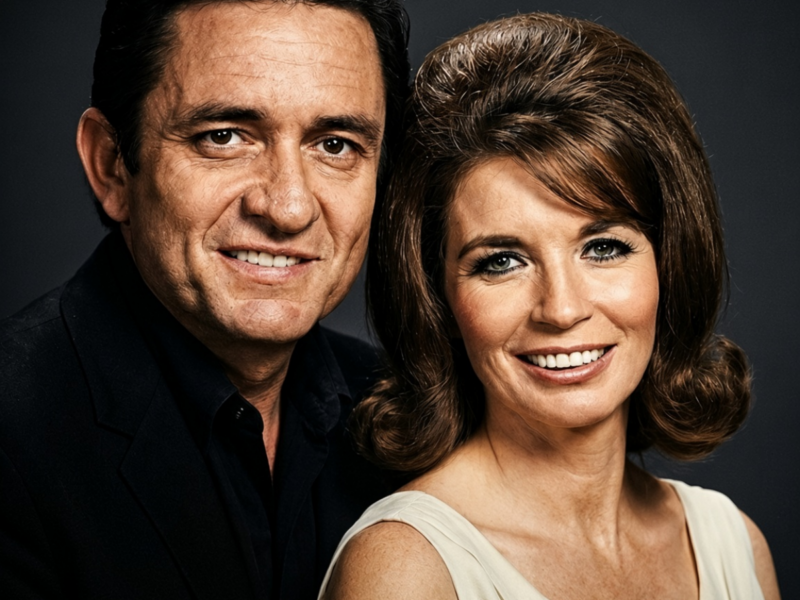
Johnny Cash’s Marriage With June Carter Was Much Nastier Than You Thought.
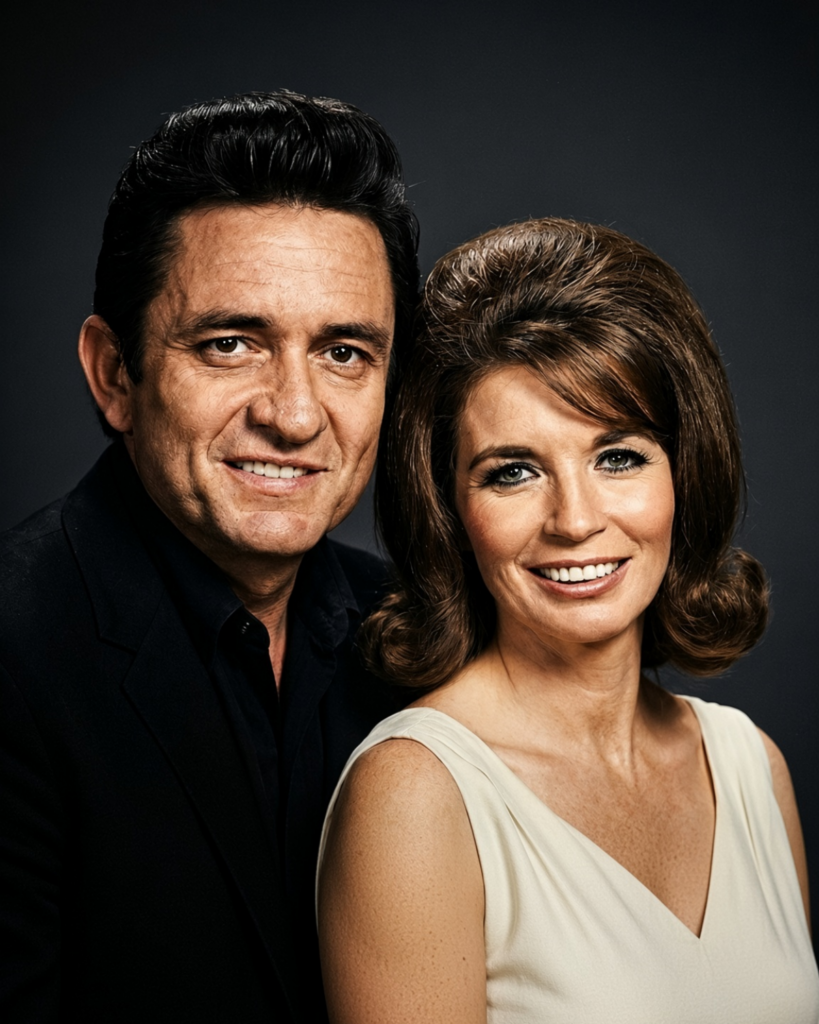
Odense, Denmark, the 23rd of June, 1994.
Johnny Cash is on tour in Europe.
His wife is turning 65, and he sits down to write her a birthday note.
Twenty-one years later, a British poll would name it the greatest love letter of all time, ahead of Keats and Winston Churchill.
People love to quote the tender parts.
Hardly anybody quotes this line: “Sometimes we irritate each other a little bit.”
A little bit.
Now, hold that phrase up against what’s on the record.
A first wife’s divorce suit.
A biographer who says there was a second Carter sister.
A doctor who told June her biggest problem was her husband.
And a son’s book with a chapter his mother would have denied.
It started backstage at the Grand Ole Opry on a summer night in 1956.
But first, the version everybody loves, because a lot of us watched it happen.
The 22nd of February, 1968.
The London Gardens Arena in London, Ontario.
Seven thousand people in the seats.
Johnny Cash stops the show and asks June Carter to marry him, right there on the microphone.
She tries to laugh it off and get him to sing another song.
He tells her he won’t sing another note until she answers.
She says yes, and the building comes apart.
Eight days later, on the 1st of March, they’re married at a church in Franklin, Kentucky.
The night before the wedding, their duet, “Jackson,” had won them a Grammy.
After that came everything you remember.
The Johnny Cash Show on ABC from 1969 to 1971, with June at his elbow trading jokes.
The gospel records, the Christmas specials with the whole family packed around the tree.
A son, John Carter Cash, born in March of 1970.
Thirty-five years of marriage.
And then an ending no screenwriter would dare to pitch.
June died in May of 2003, and Johnny followed her four months later, as if he simply couldn’t stay without her.
Then Hollywood made it official.
Walk the Line opened on the 18th of November, 2005, with Joaquin Phoenix as Johnny and Reese Witherspoon as June.
On the 5th of March, 2006, Witherspoon walked up and collected the Oscar for Best Actress.
The film told us June was the woman who pulled the Man in Black back from the edge, and that once she said yes, the hard part was behind them.
It’s a lovely story.
Parts of it are even true.
Robert Hilburn was the Los Angeles Times critic who covered the Folsom Prison concert in January 1968—the only reporter there—and he sat down with both Johnny and June just months before they died.
He liked the movie fine.
He also told NPR it had a fairy-tale quality and that the real thing came straight out of the rougher world of country music.
The files agree with him.
So go back to the night of the 7th of July, 1956, at the Ryman Auditorium in Nashville.
Johnny Cash is 24 and making his Opry debut.
He has a hit on the radio called “I Walk the Line,” which he’d later describe as a pledge of devotion to his young wife.
Her name is Vivian Liberto.
She married him in San Antonio on the 7th of August, 1954.
And she’s home with their baby daughter, Rosanne, and a second child on the way.
Backstage, Cash meets June Carter.
She’s 27, the daughter of Mother Maybelle, on stage with the Carter Family since she was ten.
Even this first meeting comes in two versions.
In liner notes she wrote in 2000, June remembered him taking her hand and saying he’d always wanted to meet her.
And she wrote that she couldn’t remember anything else they talked about except his eyes.
In an interview in 2002, Cash told it bolder.
He said he shook her hand and told her he was going to marry her someday.
Here’s the detail the movie left out.
According to the Ryman’s own history, the man who introduced Johnny Cash to the Opry crowd that night was Carl Smith—June’s husband.
Everybody in this story was married to somebody else.
June had wed Carl Smith on the 9th of July, 1952, and they had a daughter, Carlene.
That marriage ended in 1956.
By November of 1957, she’d married again, to a policeman and former football player named Edwin “Rip” Nix.
And in July of 1958, she had a second daughter, Rosie.
Meanwhile, Vivian was raising what became four girls—Rosanne, Kathy, Cindy, and Tara—largely on her own in California while her husband lived on the road.
In her memoir, she wrote that the loneliness of those years was more than she could bear, and that when Johnny did come home, she barely recognized the man she’d married.
Her verdict on him in that same book is two short sentences: “I married a good man. He just couldn’t stay good.”
In 1961, June and the Carter Sisters joined the Johnny Cash touring show.
On paper, it was good business.
The Carters brought a famous name, and Johnny brought the crowds.
In practice, it put June Carter on the same stages and the same long highways as a married man who had once told her he’d marry her.
Within two years, the two women in his life would be telling completely different stories about the same song.
Before we get to that song, one more document.
In 1960, Cash’s close friend, the singer Johnny Horton, died.
According to Hilburn’s biography, Cash soon proposed to Horton’s widow, Billie Jean.
She turned him down.
He was still married to Vivian at the time.
Keep that in mind the next time somebody tells you June Carter was the only woman Johnny Cash ever chased.
Now, the song.
The official history says June Carter wrote “Ring of Fire” with Merle Kilgore about a love she knew she shouldn’t feel.
Her younger sister, Anita, recorded it first in 1962.
Johnny’s version, with those Mexican trumpets, went to number one in 1963 and helped steady a career his record label had grown nervous about.
That’s the version on the songwriting credits.
Vivian told it differently.
In her memoir, published in 2007, she wrote that one day in early 1963, while she was out working in the garden, Johnny told her about a song he’d just written with Kilgore and another friend on a fishing trip at Lake Casitas.
He said he was giving June half the credit.
Vivian asked him why.
“She needs the money,” he said.
Vivian wrote that June had no more written that song than she had, and that for years it baffled her to hear June describe writing it.
So, which one is true?
Here’s the trouble.
June’s son, John Carter Cash, was asked that exact question live on NPR in 2007.
He answered at first that his mother wrote it, then corrected himself on the air.
“She co-wrote it,” he said, “with Merle Kilgore, and his father’s contribution was the arrangement and those horns.”
Two families, one song, and no recording of what was said in that garden.
What nobody disputes is that by the mid-’60s, the marriage at the center of all this was falling apart in public.
On the 4th of October, 1965, Johnny Cash was arrested at the El Paso airport on a federal drug charge after a trip across the border into Mexico.
He spent a night in jail, pleaded guilty to a misdemeanor, and walked away with a $1,000 fine and a suspended 30-day sentence.
When he went back to El Paso for court that December, the wife standing beside him on the courthouse steps wasn’t June.
It was Vivian.
An Associated Press photographer took their picture.
Because of how Vivian looked in that grainy newsprint, segregationist groups in the South decided she was Black, and they went after Cash, his concerts, and his family with boycotts and threats.
Vivian took that, too.
Then, in 1966, she filed.
Hilburn reports the grounds were extreme mental cruelty, and the divorce became final in 1967.
June’s marriage to Rip Nix ended in 1966 as well.
Decades later, Rosanne Cash told People magazine how it looked from inside the house: “It seemed inevitable, though it was so painful for my mom.”
Walk the Line gives you that stretch as a man spiraling and a good woman refusing to give up on him.
Hilburn’s book adds texture the movie wouldn’t touch.
He describes the time June threatened to quit the tour and go home, and Johnny gathered up her suitcase and her clothes and carried them off to his own room so she couldn’t leave.
In 2000, Cash himself told Rolling Stone that he and June had held off saying they loved each other because they both knew the divorces and the misery that would follow.
That’s not a man being rescued.
That’s a man terrified of being left.
Cash would later give June her share of the credit for what came next.
Talking to the Christian Broadcasting Network years afterward, he said that the first time he got in trouble with his medication in 1967, it was the love of God and the love of people like June, his mother, and close friends that pulled him through.
Notice the list.
June is on it.
She isn’t alone on it.
And then, in early 1968, it all seemed to come right at once.
In January, he played Folsom Prison—the concert that made him bigger than he’d ever been.
In February came that proposal in London, Ontario.
And here’s where the files start arguing with the film.
Hilburn writes that June acted flustered on that stage, but that the two of them had already been talking about marriage for weeks, down to specific dates.
The great surprise of country music may not have been much of a surprise to the bride.
Hilburn also told NPR something that never made it into the movie.
When Johnny finally asked June to marry him, three other women were shocked, because each of them thought the proposal was coming to her.
On the 29th of February, they won the Grammy for “Jackson.”
On the 1st of March, they married in Franklin, Kentucky, chosen because they could get the license and say their vows the same day.
Merle Kilgore, the co-writer of “Ring of Fire,” stood up as best man.
June wore light blue.
The reception, alcohol-free, was at Johnny’s house in Hendersonville, Tennessee.
Vivian had remarried that year, too, to a Ventura police officer named Dick Distin.
She’d stay with him for the rest of her life.
This is roughly where the movie lets you go home.
John Carter Cash, who would later serve as an executive producer on Walk the Line, said in 2007 that the film leaves you feeling his parents lived happily ever after.
Then he added that the reality wasn’t so.
He wasn’t kidding.
The first test came before he was even born.
In 1969, June was pregnant with the couple’s only child together.
And according to Robert Hilburn, sometime around her fifth month, she discovered that her husband had been involved with her own sister, Anita.
This is the most explosive claim in the whole file, so let’s be careful with it.
Hilburn told NPR he first heard it while researching his book, and that it stunned him.
He couldn’t get anybody to say it on the record.
Several people told him off the record, so in his book, he presents it as speculation.
And then, on the radio, he said this: “I’m certain it happened.”
There are hints elsewhere in his reporting.
He describes a recording session years earlier where bassist Marshall Grant heard Johnny remark on how beautiful Anita was, and Grant asked whether Vivian was going to have to start worrying about two Carter sisters.
Nobody in the Carter or Cash families has ever confirmed the affair publicly.
That’s the honest state of it: a respected biographer’s conviction, unnamed sources, and silence from the people who would know.
John Carter Cash was born on the 3rd of March, 1970.
The family photographs from those years are some of the warmest in country music.
The television show was a hit.
By the ’70s, Johnny was standing on Billy Graham Crusade stages and making a film about the life of Jesus.
Publicly, he’d never looked more settled.
Privately, Hilburn told NPR, “John and June were constantly breaking up. He’d have an affair with somebody else,” Hilburn said, “and she might, too.”
June never wrote a word about any of it, and neither of her memoirs goes near it.
You’d think the first years of a marriage would be the hardest ones.
In this marriage, the ’80s were worse.
Now jump to the early 1980s.
In 2007, John Carter Cash put it in one plain sentence on NPR: “My father came back into addiction in the 1980s.”
He was a teenager by then, close enough to see all of it, and he said as much in interviews since.
The family finally staged an intervention, and Johnny checked into the Betty Ford Center in Rancho Mirage, California.
He talked about it openly to the Associated Press in 1986.
“I ended up in the Betty Ford Center for 43 days,” he said.
By the 26th of June, 1984, he was out, and he and June stood side by side cutting the ribbon at a new alcoholism treatment institute at Vanderbilt in Nashville.
A smiling couple, a pair of scissors, a photograph for the newspapers.
So who was holding this family together while the photographs were being taken?
Hilburn’s answer is blunt.
Throughout the marriage, he writes, “June neglected her own needs to tend to Johnny’s.”
At one point, a doctor told her flatly, “Your biggest problem is being the wife of Johnny Cash.”
The doctor said they couldn’t treat her until she did something about that.
She didn’t leave.
She toured, she sang, she hosted, she kept the house running in Hendersonville, and kept her husband’s world turning.
She also, according to her son, became a compulsive shopper.
In 1994, on her 65th birthday, she got that letter from Denmark.
And this is the part of the story the legend never told you.
Because for years, almost nobody knew it.
In 2007, four years after both of his parents were gone, John Carter Cash published a book about his mother called Anchored in Love.
The first half is a loving portrait of the funny, fearless girl from Maces Spring, Virginia.
Then, near the end, he writes something no magazine profile, no Christmas special, and no Oscar-winning movie had ever said out loud.
June Carter Cash—the woman famous for saving her husband from addiction—had been fighting an addiction of her own.
In the epilogue, he wrote, “My mom’s addiction late in life was known to very few people.”
He said he’d hesitated to put it in print because if she were still alive, she would probably deny it.
Material released with the book said her struggle began around 1993 and lasted until the end of her life.
If that timeline is right, the greatest love letter of all time was written to a woman a year or so into a battle that her husband, her son, and a handful of others were quietly watching.
Read the letter again with that in your head.
“Sometimes we irritate each other a little bit.”
It doesn’t sound like a greeting card anymore.
It sounds like two people who’d spent decades taking turns being the one who held on.
By the early 2000s, Johnny was failing, too.
Hilburn describes diabetes, a nerve disorder, near blindness, and hands that could barely work a guitar.
In February of 2003, the director Mark Romanek filmed him in Hendersonville for a music video of the song “Hurt,” partly inside the shuttered House of Cash Museum.
June appears in it for a few seconds, keeping watch over her husband’s shoulder.
According to Hilburn, she didn’t want the video released.
It showed him too frail.
He put it out anyway, and Hilburn says the album it came from sold about 2 million copies, where his previous records with producer Rick Rubin had sold around 300,000.
The video picked up six MTV nominations.
The wife who held the family’s image together for 35 years lost that argument, and the public loved him for it.
When Hilburn sat down with Johnny for the last time, he could barely get through a conversation.
He kept stopping, apologizing, resting.
Then he picked up his guitar and sang Hilburn the black gospel songs he planned to record next.
Every word intact.
Here’s the question I keep coming back to.
If you were her son, holding a secret your mother would have denied to her last day, would you have written that chapter?
On the 7th of May, 2003, June had surgery to replace a heart valve.
There were complications.
She died at Baptist Hospital in Nashville on the 15th of May.
She was 73.
At her funeral, Emmylou Harris sang the old hymn “Angel Band.”
On the 5th of July, Johnny made one last public appearance at the Carter Family Fold in Hiltons, Virginia—the music hall her family built.
He was too weak to walk to the microphone on his own.
Before “Ring of Fire,” he told the crowd, “The spirit of June Carter overshadows me tonight.”
Then he said he’d sing a song she wrote and was extremely proud of.
One of the last songs he sang that night was “Understand Your Man,” the 1964 record Hilburn calls a thinly veiled message to Vivian.
On the 12th of September, 2003, Johnny Cash died at that same hospital of complications from diabetes.
He was 71.
Two weeks earlier, at the MTV Video Music Awards, Justin Timberlake had accepted a trophy in a category where Cash was also nominated and told the room his grandfather raised him on Johnny Cash and that Cash deserved it more than anyone there.
The ending kept unfolding.
On the 24th of October, Rosie Nix Adams, June’s daughter, died in an accident at 45.
On the 24th of May, 2005, Vivian died in Ventura—six months before Walk the Line reached theaters.
She never saw herself played on screen.
Her memoir came out two years later, with Johnny’s letters to her inside it.
Her daughter Kathy walked out of a family screening of the film five times and told reporters, “My mom was basically a nonentity in the entire film.”
Her half-brother, John Carter Cash, said her criticisms had merit.
“The point of the film,” he said, “is my parents’ love affair.”
The house, the hits, and the legend went to the love story.
The first wife got a footnote, and a book that only came out after she was gone.
And the truth ended up with the one person who’d helped produce the fairy tale.
John Carter Cash put his name on the movie, then wrote the book that quietly corrected it.
Both were about the same woman.
Only one of them told you what loving Johnny Cash actually cost her.
The son’s own summary, as Hilburn tells it, was that his father’s life was a struggle between darkness and light, and in the end, the light won.
Maybe so.
But somebody had to keep the lamp lit all those years, and for most of them, it was June.









