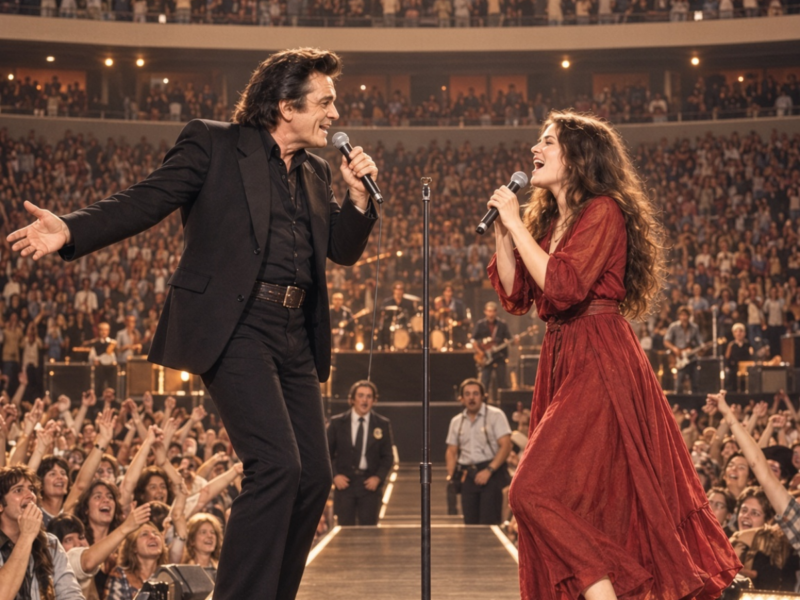
Johnny Cash STOPPED a Concert to Find a Mystery Singer – Their Duet Became Legendary.
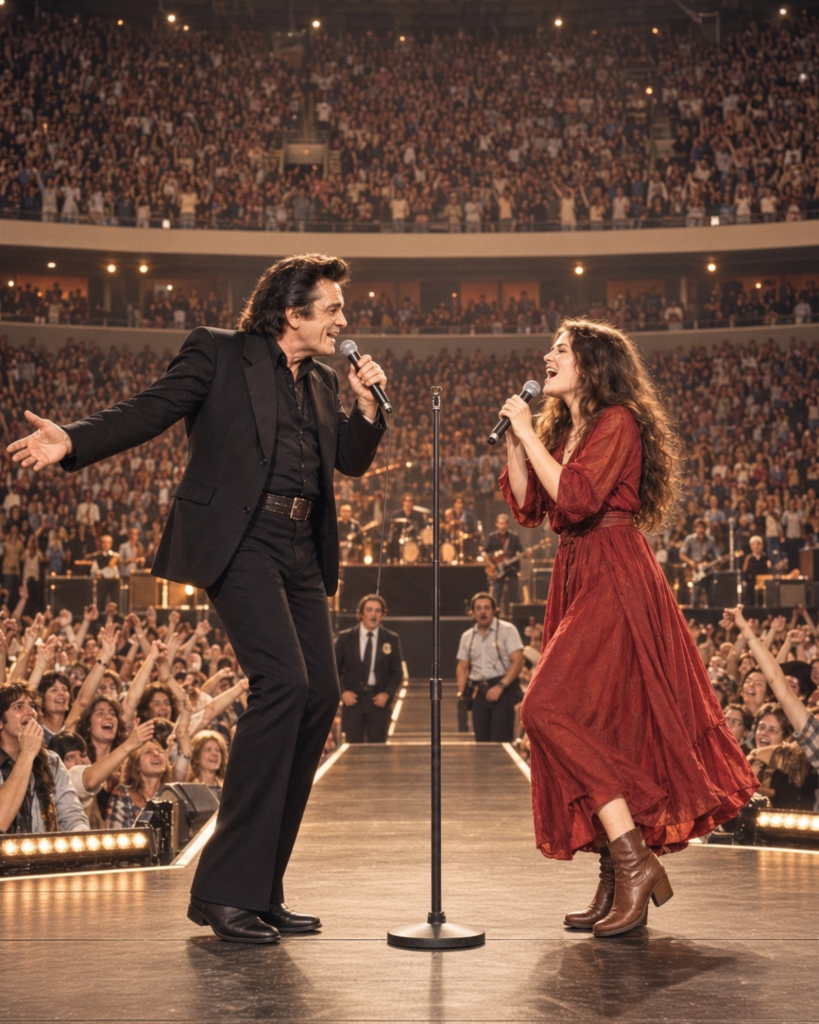
August 3rd, 1974, Des Moines, Iowa.
The grandstand at the Iowa State Fair was holding somewhere around 12,000 people that night, and every last one of them was drenched in sweat.
It had been 102° that afternoon, and even with the sun gone down behind the livestock pavilions, the air still felt like breathing through a wet towel.
Johnny Cash was four songs into his set, standing at the edge of the stage in that black coat.
He refused to take off no matter what the temperature was.
And he had just hit the opening bars of Ring of Fire when he stopped singing.
He didn’t walk off.
He didn’t signal the band.
He just lowered his microphone and tilted his head.
The way a man does when he hears something he can’t quite place, like a distant train whistle that doesn’t match any schedule he knows.
12,000 people watched Johnny Cash stand perfectly still on that stage listening to something none of them could hear yet.
To understand what happened that night at the Iowa State Fair, you have to understand where Johnny Cash was in 1974.
And where he was, by most accounts, was somewhere between grateful and afraid.
6 years earlier, he had nearly killed himself.
Pills booze, a body that weighed 150 pounds on a frame built for 220 pounds.
He’d been arrested seven times.
He’d set fire to 500 acres of national forest in California and nearly burned himself with it.
But by 74, he was clean, married to June, father to John Carter Cash, who had just turned four.
He had a television show, a best-selling album, and two invitations to the White House.
By every measure the world uses to keep score, Johnny Cash had come back from the dead and won.
Except Johnny Cash didn’t feel like he’d won anything.
He talked about it with June on the bus that afternoon, parked behind the fairgrounds while the opening act played.
The bus was a silver eagle customized with a bedroom in the back and a kitchen that June kept stocked with cornbread and cold chicken.
You know what a man at the gas station in Omaha said to me this morning?
Johnny asked.
He was sitting at the fold down table tuning a guitar he didn’t need to tune.
June looked up from her book.
What did he say?
He said, “Hey, aren’t you the guy who burned down that forest?” Not, “I I Walk the Line.
Not Falsome prison.
The guy who burned down that forest.” June closed her book gently, which told you she was about to say something that would sting in a useful way.
One man at a gas station in Omaha.
John, it’s not just him.
Every interview, every profile, Johnny Cash, who battled addiction, Johnny Cash, who nearly lost everything.
Like the music is just the backdrop for the mess.
Is that what you think the music is?
I think some nights I get up on that stage and I don’t know if people are there to hear me sing or to see if I’ll fall apart again.
June reached across the table and put her hand over his.
John Robert Cash, you get up on that stage tonight and you sing like the man I married.
If somebody in the audience is waiting for a wreck, that’s their business.
Your business is the music.
Johnny looked at her for a long moment, then nodded and stood up to get dressed for the show.
He didn’t know it yet, but June was about to be proven right in a way neither of them could have predicted.
While Johnny Cash was tuning a guitar he didn’t need to tune on a silver eagle bus, Margaret Anne Cooper, Maggie, to anyone who knew her was peeling potatoes in a temporary kitchen tent 200 yards away.
The kitchen tent served the fair workers.
The people who ran the rides cleaned the livestock barns and kept the whole operation moving for 11 days every August.
Maggie had been working the tent for three years.
Ever since her husband Danny didn’t come home from Quang Tri Province.
Danny Cooper had been 20.
Two when he shipped out and 20.
Two when he died because he didn’t make it to 23.
The letter from his commanding officer said he had died bravely, which was the kind of thing they always said whether it was true or not.
Maggie kept the letter in a shoe box under her bed, along with Danny’s dog tags and a photograph of the two of them at the Jasper County Fair the summer before he left, grinning like two people who had no idea what was coming.
Maggie was 24 now.
She lived in Newton, Iowa, 40 miles east of Des Moines in a rented duplex with thin walls.
She waitressed at a diner called Pat’s 6 days a week.
And during the fair, she picked up kitchen shifts because the money was better and her mother could watch Lily.
Lily was four.
She had Danny’s dark hair and Maggie’s pale blue eyes, and she talked to herself constantly in a narration style that suggested she believed her entire life was a television show.
Tonight, Lily was sitting on an overturned milk crate in the corner of the kitchen tent, drawing with broken crayons while Maggie peeled potatoes and tried not to listen to the concert.
Trying not to listen to Johnny Cash performing 200 yards away was like trying not to notice a thunderstorm.
The sound came through the canvas walls.
That deep baritone that sounded like it was coming from somewhere underneath the ground.
Maggie had grown up on Johnny Cash.
Her father, Earl, had played Cash Records on a Magnavox console stereo every Sunday morning while he cooked breakfast.
Earl believed there were two kinds of music.
Music that told the truth and music that didn’t.
And Johnny Cash told the truth.
Earl also believed there were two kinds of careers.
Careers that put food on the table and careers that didn’t.
When Maggie was 14 and asked if she could audition for the school musical, Earl had said, “You can sing all you want on your own time, but you’re not going to make a fool of yourself on a stage.” She had sung in the First Baptist Church choir every Sunday from age 9 to 18.
The choir director, Eunice Peton, had once told Maggie’s mother that Maggie had one of those voices that comes along maybe once in a generation in a town this size.
Maggie’s mother relayed the compliment to Earl who said, “That’s nice.
She still needs to learn to type.” So Maggie learned to type and to waitress and to peel potatoes at the Iowa State Fair while Johnny Cash sang 200 yards away.
Mama, who’s singing?
Lily asked, looking up from her crayons.
Johnny Cash, baby, is he good?
Maggie smiled.
Yeah, Lily, he’s real good.
Can we go watch?
We don’t have tickets, sweetheart.
I’m working.
Lily considered this.
Can we get ice cream after?
One scoop, one and a half.
Lily Marie, one scoop.
Lily agreed and went back to her crayons.
The band was playing Folsom Prison Blues.
Now Maggie didn’t realize she was singing along.
She never did.
It happened the way breathing happened.
Without decision, without effort, her hands kept peeling, the potato skins curling off in long spirals, and her voice found the melody the way water finds the lowest ground.
The two other kitchen workers, Gus, who ran the fryer, and Dee, a teenager washing dishes, didn’t say anything.
They’d heard Maggie sing before.
But tonight was different.
The sound from the grandstand was so close.
So present that Maggie’s voice responded to it the way a tuning fork responds to a struck note.
She wasn’t just singing along anymore.
She was singing with, finding lines that wo around the melody, answering phrases Johnny Cash couldn’t hear, turning a solo performance into a conversation that only she was having.
When Folsom Prison Blues ended, Maggie stopped singing and became aware of what she’d been doing.
Her face flushed.
“Sorry, got carried away.
Don’t apologize,” Gus said.
“That was better than most of what’s on the radio.” Gus, I’m peeling potatoes.
Dolly Parton was picking tobacco before she was on the radio.
You’re just saying and I’m just peeling.
We’ve got four more bushels before the late shift.
The band started the next song.
Maggie recognized it immediately.
The mariachi style horns, the rolling guitar line, the rhythm that sounded like a heartbeat speeding up.
Ring of Fire, her favorite.
Danny used to sing it in the shower badly but with total commitment.
And it was one of those memories that could still hit her sideways on ordinary Tuesday afternoons.
Maggie picked up another potato.
The horns swelled through the canvas walls and she began to sing.
She didn’t sing the melody this time.
She sang underneath it, around it, through the spaces between the words where a second voice could live without crowding the first.
Her soprano wrapped around Cash’s baritone, following the same line, but finding its own path, its own direction.
She was so deep inside the music that she didn’t notice Gus and Dee had stopped working.
She didn’t notice Lily had put down her crayons.
She didn’t notice the kitchen tense service flap was letting her voice carry out into the warm Iowa night.
But someone on that stage did.
Cash was halfway through the second verse of Ring of Fire when it happened.
He was standing center stage, the spotlight making his coat look like polished obsidian.
And the band was locked into that rolling groove.
He was singing the chorus.
I fell into a burning ring of fire when he heard it.
A voice, female, high and clear, carrying a harmony line that had no business being that good.
It wasn’t coming from the audience.
Crowd singing is enthusiasm without precision, volume without nuance.
This was precise controlled, finding intervals that required real training or real instinct or both.
Cash kept singing, but his eyes moved, scanning the wings, the sound crew area, his backup singers.
The Carter family, including June, were not singing on this song.
He looked at June.
She was watching him with a curious expression.
She’d heard it, too.
The voice was coming from somewhere behind the stage, off to the right, where the backstage paths connected to the service areas.
Cash finished the chorus and moved into the third verse, distracted now.
The voice was still there, fainter when his own was louder, clearer in the instrumental breaks.
Always finding the right note.
Whoever was singing knew this song the way you know the furniture arrangement in a dark room.
The verse ended.
The instrumental break came up.
Cash lowered his microphone and tilted his head.
For 3 seconds, Johnny Cash stood silent on a stage in front of 12,000 people listening.
The band kept playing.
The crowd, sensing something, began to quiet.
Cash turned to Bob Wooden, his guitarist, and made a cutting gesture across his throat.
The music stumbled, then stopped.
12,000 people fell into uncertain silence.
Cash walked to the front of the stage and spoke into his microphone.
Folks, I need to ask y’all to bear with me for a minute.
I just heard something back there that I need to go find.
He looked off stage to his road manager, Lou Robin.
Lou, who’s singing back there?
Lou Robin stepped to the edge of the stage, hands spread.
He had no idea.
Cash turned back to the audience.
Ladies and gentlemen, I’m going to step away for a few minutes.
June’s going to come out and keep you company.
I need to go find a voice.
June walked on stage with the calm of a woman who had been performing since she was 10.
You heard something?
She asked, leaning close.
Tell me you heard it, too.
I heard it.
Where?
Backstage over by the service tents.
Cash handed June his microphone.
Keep them warm.
I’ll be back.
John, you’re in the middle of a concert.
June, that voice is in the middle of something, too.
And I think it’s been there a lot longer than tonight.
June watched him walk off stage, then turned to the audience.
Well, she said, “Looks like my husband has gone off to do something interesting.
While we wait, how about I tell you all about the time Johnny accidentally bought a buffalo.
The crowd laughed.
June launched into the story.
And behind the grandstand, Johnny Cash.
The man in black, the voice of American country music, was walking through the backstage corridors of the Iowa State Fair, following a sound he couldn’t explain and couldn’t ignore.
I kept coming back to the potato peeling while writing Maggie’s introduction.
The rhythm of that work, the mindlessness of it, the way your hands can be doing one thing while everything else about you is doing another.
That gap between what a person’s hands are doing and what their voice is doing felt like the whole story in miniature.
The backstage area of the Iowa State Fair grandstand was a maze of temporary corridors, equipment storage, and service paths where livestock smells mixed with popcorn grease and diesel exhaust.
Johnny Cash moved through it with focused intensity.
Not running because Cash didn’t run as a matter of personal policy, but walking with purpose.
Boot heels clicking on the concrete.
The voice had stopped.
Whoever had been singing during Ring of Fire had gone silent, probably because the music had stopped and there was nothing left to sing with.
Cash paused at an intersection, closed his eyes, and listened.
Nothing but crowd noise, generators, and June’s voice faintly telling the buffalo story.
She was at the part where the buffalo got into the neighbor’s garden, which meant she had about 4 minutes of material left.
He turned toward the service tents, pushed through a canvas flap, and found a hand-lettered sign.
Staff.
Cash pushed open the kitchen tent service flap, and stepped inside.
Three people looked up at him.
A large man in a stained apron over a deep fryer. a teenage girl elbow deep in soapy water and a woman with dark brown hair pulled back in a bandana holding a potato in one hand and a peeler in the other.
There was also a small child on a milk crate in the corner drawing with crayons who looked up at Cash with the polite disinterest of someone who had no idea who he was.
The large man recovered first.
Can I help you, sir?
Cash wasn’t looking at him.
He was looking at the woman with the potato.
She was looking back with an expression that combined confusion, recognition, and the specific alarm that comes from realizing you’ve been caught doing something you didn’t know you were doing.
That was you, Cash said.
I’m sorry, Maggie said, singing during Ring of Fire.
That was you.
Maggie’s face went red from her collar to her hairline.
She looked at Gus, who was nodding with the satisfied expression of a man proven right.
She looked at Dee, standing with her mouth open.
She looked back at Johnny Cash.
I’m sorry, sir.
I didn’t mean to disturb the show.
I didn’t even realize I was.
Sometimes I sing when I’m working and I don’t know I’m doing it.
It won’t happen again.
Ma’am, Cash said.
I stopped a concert to come find you.
The last thing I want is for it to not happen again.
Maggie stared at him.
She was still holding the potato.
You stopped the concert.
I did.
Because of me.
Because of your voice.
I’ve been performing for 20 years and I have never heard someone do what you just did with that harmony line.
Where did you learn to sing like that?
I didn’t learn.
I sang in church choir growing up.
Mrs.
Peton at First Baptist in Newton, but I never had training.
I just hear music and something in me answers it.
I can’t explain it better than that.
Cash stepped further into the tent, pulled a folding chair from the wall, turned it backward, and sat down with his arms on the back rest.
What’s your name?
Maggie.
Maggie Cooper.
Maggie, I’m Johnny.
I know who you are, Mr.
Cash.
My father played your records every Sunday.
Call me Johnny.
Mr.
Cash is what the IRS calls me, and I don’t like them much.
Maggie, would you sing something for me?
The shift was immediate.
The flush on her cheeks went from embarrassed to ashen.
She put the potato down and stepped backward.
I can’t do that.
Why not? because you’re Johnny Cash and I peel potatoes for a living.
I’m not a performer.
I’m a kitchen worker.
I work at a diner in Newton and I come here for the fair because the money’s good and my mother can watch my daughter.
She gestured toward Lily.
I can’t just sing for Johnny Cash.
Cash looked at Lily.
Lily looked back with a candid appraisal that only fouryear-olds can manage.
What’s your name?
Cash asked her.
Lily Mary Cooper.
I’m four.
Mama says we’re getting ice cream after her shift.
One scoop.
One scoop is respectable.
What flavor?
Strawberry.
What’s your name?
Johnny.
Are you the one who was singing?
Mama said you were good.
Your mama’s being generous.
I was doing my best, but your mama was the one making it sound good.
Maggie was watching this exchange with a mother’s woriness.
But there was something about the way Cash talked to Lily directly, seriously, without condescension that loosened something in her.
Johnny, I appreciate you coming to find me.
But I think you probably heard the song coming through the tent walls, and it mixed with crowd noise and sounded better than it was.
If I actually sang for you, you’d be disappointed.
Cash leaned back.
He studied her and then said something she didn’t expect.
In 1967, I was playing a show in Dallas.
I was so loaded on pills that I couldn’t remember the words to my own songs.
I stood on that stage and opened my mouth and nothing came out.
The band kept playing and I just stood there and the audience booed.
June was backstage crying and I stood there thinking, “This is what I deserve.” The kitchen tent was silent.
You know what got me off that stage? a stage hand, a kid, maybe 20, who grabbed my arm and walked me to the wings and said, “Mister Cash, you don’t belong out there tonight, but you’ll belong out there tomorrow.” Some kid whose name I never learned told me I’d belong out there tomorrow, and that was enough to make me believe it.
Cash stood up and looked Maggie in the eyes.
I’m not here because of acoustics.
I’m here because I heard a voice that belongs on a stage.
And I think the owner of that voice has been telling herself she doesn’t belong there for a long time.
I’ve been wrong about a lot of things in my life.
Pills, whiskey, how many forests a man can drive through while lighting matches.
But I’m not wrong about music.
Maggie’s knuckles were white on the plywood counter.
My father always said singing wasn’t a real career.
He said I needed to learn something practical.
Your father know I grew up picking cotton in dis Arkansas.
My daddy picked cotton and my mama picked cotton and I picked cotton until my fingers blood every day.
My daddy told me the same thing yours told you.
Music was foolishness.
A man works with his hands.
You know what I said to him?
What?
Nothing.
I was too scared.
I just waited until I was old enough to leave and then I left and then I sang.
The music was louder than my fear.
That’s all it takes, Maggie.
Even if it’s louder by one note, that’s enough.
Gus by the frier had tears running down his face.
He wiped them on his apron.
Lily had gotten off her milk crate and walked over to take Maggie’s hand.
“Mama,” Lily said.
“The man wants you to sing.” Maggie looked at her daughter.
“At Johnny Cash at the pile of unpeeled potatoes on the plywood counter.
I don’t have anything to wear,” she said.
“The kind of objection people make when they’ve already decided to say yes.
You’re wearing exactly the right thing, Cash said.
I want them to see you the way I found you.
Come on.
Cash radioed Lou Robin and told him to set up an extra vocal mic.
Lou asked who the guest was.
Cash said, “Her name’s Maggie.
She peels potatoes and she sings better than half the people in Nashville.” Lou had the microphone set up.
Gus told Maggie he’d watch Lily.
You go on.
Lily and I are going to discuss the ice cream situation.
I think we can negotiate up to two scoops.
Lily’s face lit up.
Cash and Maggie walked through the backstage corridors.
At the stage entrance, Maggie stopped.
The wings were dark, but beyond them, the lights blazed white and hot.
June was at the microphone telling a story about Johnny trying to cook Thanksgiving dinner.
Maggie stood at the threshold between darkness and light, and she did not move.
I can’t.
Cash didn’t push.
He stood beside her and said, “Tell me about your daughter.” “What, Lily?
Tell me about her.
She’s four.
She likes strawberry ice cream and drawing.
She asked me this morning why clouds don’t fall down and I didn’t have a good answer.
She ever seen you sing on a stage?
I mean, she hears me sing.
I sing her to sleep every night.
Danny used to sing to her when she was a baby, even though he was terrible at it.
After he was gone, I kept singing because I wanted her to know there was always music in our house, even when everything else was quiet.
Your daughter is sitting in a kitchen tent at a state fair because that’s where her mama works.
She has never seen her mama do anything except work and take care of her.
Tonight you have a chance to let her see her mama walk out on a stage and sing in front of 12,000 people because Lily will remember it for the rest of her life.
Every time someone tells her she can’t do something, she’ll think about the night her mama walked out of a kitchen and onto a stage.
Could Maggie Cooper, a waitress from Newton, Iowa, who hadn’t sung for anyone outside a church choir in six years, actually walk onto that stage and sing with Johnny Cash?
If you believe that sometimes the biggest moments in life come from the smallest acts of courage, go ahead and hit that like button.
Now, let’s see what Maggie did.
Maggie Cooper walked onto the stage of the Iowa State Fair Grandstand.
She walked out in her kitchen apron and her work boots and her bandana and the stage lights hit her and the crowd noise hit her and she stopped for a moment.
Just one moment and then she kept going.
June saw her coming.
June had walked to the extra microphone, tested it with a tap, adjusted the height down 6 inches.
Maggie was shorter than the crew had assumed and stepped back.
Cash walked out behind Maggie.
The crowd went quiet when they saw this unknown woman in a kitchen apron.
Confusion rippled through 12,000 people.
Ladies and gentlemen, Cash said, “I owe you an apology for the interruption.
A few minutes ago, I was singing Ring of Fire, and I heard a voice from backstage that stopped me cold.
I found it in the kitchen tent where this woman was peeling potatoes and singing harmony that most professionals couldn’t match.
Her name is Maggie Cooper.
She’s from Newton, Iowa.
She’s a waitress and a mother and she’s never been on a stage.
I’d like to sing Ring of Fire with her if you’ll allow it.
The crowd applauded.
Warm, encouraging Midwestern applause.
The sound of 12,000 people saying, “Go ahead, honey.” Cash nodded to the band.
Bob wouldn’t hit the opening guitar line.
The horns came in.
Cash began singing.
Maggie was gripping the mic stand with both hands.
She was not singing.
Her mouth was closed.
The lights were hot and the crowd was a dark mass and the music was rolling forward without her.
Cash moved through the first verse watching her.
The chorus was coming.
He had about four bars of instrumental.
In those four bars, Cash lowered his microphone, took three steps toward Maggie, and spoke into her ear.
Close enough that no mic could pick it up.
Don’t sing for them.
Sing for Lily.
He stepped back.
The chorus hit.
I fell into a burning ring of fire.
Maggie opened her mouth.
The first notes were thin and shaky.
Her voice cracked on, burning.
She gripped the stand harder and it cracked again on.
Went down, down, down.
In the kitchen tent, Gus had carried Lily out to the service corridor where the PA system reached.
Lily was on Gus’s shoulders.
That’s my mama, she told him.
She’s singing for the people.
On stage, between the second line of the chorus and the third, there was a breath, less than a second.
And in that breath, Maggie stopped being terrified and started being a singer.
Her voice opened up.
It found its center and its support and its color.
Going from thin and frightened to a full-bodied soprano that wrapped around Cash’s baritone the way she’d been doing in the kitchen.
Cash turned his head toward her and grinned.
A real grin, the kind performers give each other when the music finds its groove.
They finished the chorus together.
Cash’s bass and Maggie’s soprano.
Two voices that had no business sounding that good together, blending into something that made 12,000 Iwans forget the heat and the humidity and everything except the music.
Then Cash did the thing that would become the most talked about moment of the evening.
On the second verse, he stopped singing.
He lowered his microphone, stepped back, and let Maggie sing alone.
She didn’t notice at first.
She was deep in the song, eyes closed, voice running through the melody with the ease of a river finding its course.
She sang the second verse of Ring of Fire to 12,000 strangers alone in a kitchen apron.
She opened her eyes and realized Cash wasn’t beside her anymore.
She found him standing five feet back, arms folded, watching her with an expression that combined pride and recognition and something that might have been relief. the relief of a man tired of being the center of everything who had found someone worth handing the spotlight to.
They sang the final chorus together and hit the last ring of fire in unison and the Iowa State Fair grandstand produced a sound that the venue staff would later say was the loudest single moment they had ever recorded.
12,000 people stood.
The applause lasted a full 90 seconds.
Maggie was standing at the microphone, eyes wet, hands trembling.
Cash walked over, took her hand, and raised it above her head the way boxing referees raised the winner’s hand.
“Ladies and gentlemen,” he said.
“Maggie Cooper, Newton, Iowa.” The moment I found in this draft was the pause between burning and went down.
The breath where fear turns into singing.
I’ve been thinking about how many people have that exact breath inside them and never get past it.
And how few are lucky enough to have somebody standing next to them saying, “Sing for Lily.” when it happens.
After the concert, Johnny and June brought Maggie and Lily to their bus.
The Silver Eagle’s narrow kitchen table had four adults and one fouryear-old packed around it, and June had made a plate of cold chicken and cornbread that Lily was eating with focused intensity.
Cash had changed out of his stage coat and was wearing a plain black shirt with the sleeves rolled up.
He was drinking coffee.
June was drinking tea.
Maggie was drinking water because she didn’t want to ask for anything and June had handed her a glass without asking.
And Lily’s father June asked with the gentle directness of a woman who had learned that some questions are kinder asked straight then danced around.
Maggie looked at Lily who was absorbed in a chicken leg.
Vietnam January 71 101st Airborne.
June reached across the table and put her hand on Maggie’s arm.
She didn’t say, “I’m sorry,” or any of the things people say when they don’t know what else to say.
She just held Maggie’s arm for a moment and let go, and that was enough.
Cash put down his coffee cup.
“Maggie, I want to make you an offer, and I want you to hear the whole thing before you answer.” Maggie straightened.
I have a friend in Nashville named Jack Clement.
He produced some of my early records at Sun, runs a studio now.
I want to call Jack and set up a demo session for you.
I’ll cover the studio time, the travel, all of it.
You come to Nashville, record three or four songs, and Jack will tell you honestly whether you have something the business can use.
Maggie opened her mouth, but Cash held up his hand.
Hear the whole thing.
I’m not promising a record deal.
I’m not promising fame or money.
What I’m promising is an honest answer.
If Jack says you’ve got something special, he’ll help you figure out what to do with it.
If the truth is you’re a wonderful singer who should keep singing at church and for her daughter, he’ll tell you that too.
And there’s no shame in it.
I can’t go to Nashville.
I have Lily.
I have my job.
I don’t have money for bus fair.
My mother can’t take Lily for more than a few days.
And my father would say I was being foolish.
June leaned forward.
My mother was practical, too.
Mother Maybel raised three daughters on the road, singing for crowds that sometimes threw things at us.
She used to say that being practical means doing what keeps your family alive.
And sometimes what keeps a family alive is letting somebody in it do the thing they were born to do.
June, I wasn’t born to do this.
I was born in Newton, Iowa.
I peel potatoes and wait tables and take care of my daughter.
That’s what you’ve done.
That’s not the same thing as what you do.
Cash cut in before the conversation could make Maggie feel pressured.
I’m offering you a bus ticket, three days in a studio, and an honest opinion.
Try it once.
If you hate it, if Jack says you’re not ready, you go back to Newton and nobody thinks less of you.
There’s no wrong answer.
Lily had found Cash’s guitar case and was trying to open it.
“Can I?” she asked.
“Go ahead.” Lily opened the case and looked at the guitar with reverence.
She didn’t touch it.
She just looked.
The way people look at things they understand are important, even when they don’t know why.
Maggie watched her daughter looking at that guitar.
Three days.
Three days.
And if it doesn’t work out, I come home.
You come home.
Okay, I’ll try it once.
Maggie took a Greyhound from Des Moines to Nashville on September 14th, 1974.
Lily stayed with Maggie’s mother in Newton.
Jack Clement studio was on Belmont Boulevard in a building that had been a church before.
It was a recording studio which gave it acoustics that engineers spent fortunes trying to replicate elsewhere.
Clement was a stocky man with a beard and a tendency to say exactly what he thought.
Cash says you can sing.
Clement said when Maggie arrived.
Cash says a lot of things.
Let’s hear it.
Maggie stood in the vocal booth wearing headphones that were too big for her head and sang Ring of Fire.
I I Walk the Line.
Amazing Grace and a Patsy Cline song called Crazy that she’d been singing since she was 12.
Clement listened without expression.
When Maggie finished, he walked into the booth and stood in front of her.
“You’ve got a problem,” he said.
Maggie’s stomach dropped.
“Your voice is extraordinary, but it’s an ensemble voice.
You hear music in layers.
You’re always listening for where your voice fits with other voices.
That’s rare and valuable, but it means you’re never going to be a Loretta Lynn or a Tammy Wynette standing out there alone.
That’s not what your voice does.
So, I should go home.
I said you’re not a solo act.
What you are is one of the best harmony singers I’ve heard in 20 years.
Do you know what a session vocalist does?
Sings backup.
Sings everything.
Backing vocals, harmony parts, choir sections, jingles, demo tracks for songwriters.
A great session vocalist works six days a week, makes a very good living, and sings on records that win Grammys.
The audience never knows your name.
Your face is never on a cover.
But every time they hear a song and think that harmony is beautiful, that’s you.
Nobody would know it was me.
Nobody would know it was you.
I’d be invisible.
You’d be essential.
There’s a difference.
Maggie Cooper moved to Nashville in January of 75.
It was the hardest thing she had ever done.
Harder in some ways than losing Danny.
It meant taking Lily out of the only home she’d known, away from her grandmother and the familiar streets of Newton.
It meant telling her father.
Earl listened to his daughter explain that she was moving to Nashville to sing.
When she finished, he said, “I’ve worked 31 years building washing machines so this family could have a stable life.
You’re going to throw that away to sing songs for people who won’t even know your name?
Yes, sir.
And you’re taking my granddaughter to Tennessee?
Yes, sir.
Earl didn’t say anything for a long time.
Then he said, “Your mother and I won’t be driving down to visit, and he turned back to his Magnavox where a Johnny Cash record was sitting on the turntable.
The first year was brutal. demo sessions that paid $50, jingles for local car dealerships, waitressing three nights a week at Tootsie’s Orchid Lounge on Broadway.
Famous for being the bar where songwriters drank, and infamous for being the bar where they didn’t tip.
Cash helped where he could.
June brought groceries to Maggie’s one bedroom above a dry cleaner on 18th Avenue and pretended she’d bought too much.
When Maggie protested, June said, “I have been accidentally buying too much food for 30 years, and Jon has never once noticed.” The break came in 76 when producer Billy Cheryl hired Maggie for a Tammy Wynette album.
Cheryl had a reputation for firing session vocalists midtake.
Maggie walked into Columbia Studio a terrified.
She sang on six tracks in two days.
Cheryl called her into the control room and said, “You’re on my list now.” Others called.
By 78, Margaret Cooper was one of Nashville’s most in- demand session vocalists.
She sang on records by George Jones, Merle Haggard, Reba McEntire, Emmylou Harris, three CMA album of the year winners, six Billboard number ones.
Nobody outside Nashville studio community knew her name.
Cash played the Iowa State Fair every year from 74 until 97.
Every year, halfway through his set, he’d stop and invite Maggie out to sing Ring of Fire together.
She never did develop an interest in stage costumes.
She walked out in whatever she happened to be wearing.
The grandstand erupted every time.
It became a tradition.
Fair regulars brought first timers and said, “Wait until the Maggie part.” Maggie’s mother came every year third row.
Earl never came.
When Lily was 12, she asked if it bothered Maggie that she was never famous.
Your father wanted to come home from Vietnam.
He didn’t get what he wanted.
I got to come home from Nashville every night and tuck you in.
It wasn’t entirely true.
There were nights when Lily was asleep and Maggie sat alone listening to the radio, hearing her own voice buried in someone else’s hit, wondering what it would feel like to be the name people remembered.
She never walked to the front of that microphone.
That was the price of the life she’d chosen or the one that had chosen her.
In ‘ 91, Earl Cooper died.
Maggie came home for the funeral.
While packing up his things, she found something in the closet beside the Magnavox, a cardboard box.
Inside every newspaper clipping that mentioned her name, album liner notes where she was credited as backing vocalist, a small feature in the Jasper County Tribune, a photograph from the Des Moines’s register of Maggie and Cash on stage at the fair, cut out carefully, placed in a manila envelope with her name written on it in Earl’s handwriting.
He had never called, never said he was proud.
He had just quietly collected evidence of his daughter’s career and stored it in a box next to the stereo where he played Johnny Cash records every Sunday morning.
Maggie sat on the floor of her father’s bedroom with that box in her lap for a long time.
In 98, she moved back to Newton.
Lily was 28 by then, married to a Nashville sound engineer pre her first child.
Maggie bought a small house on the street where she’d grown up.
She rented a room at the community center on 1st Avenue and put up a flyer.
Free singing lessons for anyone aged 81 18.
No experience needed.
No audition required.
She called it the second voice music program.
Second voice as in harmony and second voice as in the voice inside you that hasn’t found permission to come out yet.
The first semester she had seven students.
By the second year, 34 kids from Newton, Grinnell, Colfax, Mitchellville, farm kids and town kids who sang in church or in the shower or didn’t think they could sing at all until Maggie stood next to them and proved otherwise.
She didn’t start with scales or technique.
She started by singing with them, standing beside each student, singing harmony while they sang melody, singing until they forgot they were scared.
You can’t teach someone to sing by telling them how.
She told the Newton Daily News.
You teach them by singing with them until they forget they’re scared.
On September 12th, 2004, Johnny Cash died at Baptist Hospital in Nashville.
He was 71.
June had died 4 months earlier.
Maggie was in Newton in the middle of a lesson with a 14year-old girl named Trisha Ramirez when Lily called.
Maggie finished the lesson, drove home, sat in her living room, looking at a framed photograph on the wall, herself and cash on stage at the fair in 86, both laughing about something the camera couldn’t explain.
She renamed the program The Man in Black Music Scholarship and funded it with her savings from 20.
Three years of session work, money she’d been putting away in a Nashville bank account she’d never touched.
In a 2009 interview with Iowa Public Radio, Maggie was asked what Johnny Cash had taught her.
He didn’t teach me to sing.
I already knew how.
And he didn’t teach me to perform.
I was never much of a performer.
What Johnny taught me was that talent without courage is just a nice sound that nobody hears.
He walked into a kitchen tent and told a woman peeling potatoes that she had a voice worth sharing.
He didn’t have to do that.
He could have finished his show and gone home.
But he stopped.
He listened.
He came looking.
She paused.
And he taught me that one scoop of ice cream can be negotiated to two if you know the right people.
The Iowa State Fair grandstand has been renovated twice since 74.
The kitchen tent is long gone, replaced by a permanent facility with stainless steel counters.
But there is a plaque on the wall of the performers entrance installed in 2005.
In memory of the night the music stopped and started again.
August 3rd, 1974.
Johnny Cash and Maggie Cooper.
The man in black music scholarship has sent 47 young musicians to college.
Nine work in music professionally.
Two are session vocalists in Nashville.
One is a high school choir teacher in Newton, Iowa, which Maggie always said was the most important job in music.
Maggie Cooper still lives in Newton.
She still teaches, though she’s 70 for now and her lessons run shorter.
She still sings harmony to the radio while she cooks and she still doesn’t always realize she’s doing it.
Every August 3rd, Maggie drives to Des Moines and buys a ticket to whatever show is playing at the grandstand.
She sits in the regular seats and she listens.
And every year when the music starts, she sings along.
Nobody stops the show for her anymore.
She doesn’t expect them to.
She had her night and it was enough.
This story is a dramatized interpretation based on Johnny Cash’s life and legacy, not a documented historical event.
Johnny Cash once said, “You build on failure.
You use it as a stepping stone.” Maggie Cooper built on something harder than failure.
She built on silence, on years of being told her voice didn’t matter enough to share.
And when someone finally told her otherwise, she didn’t become a star.
She became something rarer.
The person who helps other people find their voices.
If this story moved you, here’s a question worth sitting with.
If you were Maggie, standing at the edge of that stage with 12,000 strangers waiting, would you have walked out or would you have gone back to the potatoes?
Both choices take courage.
Only one of them changes the story.









