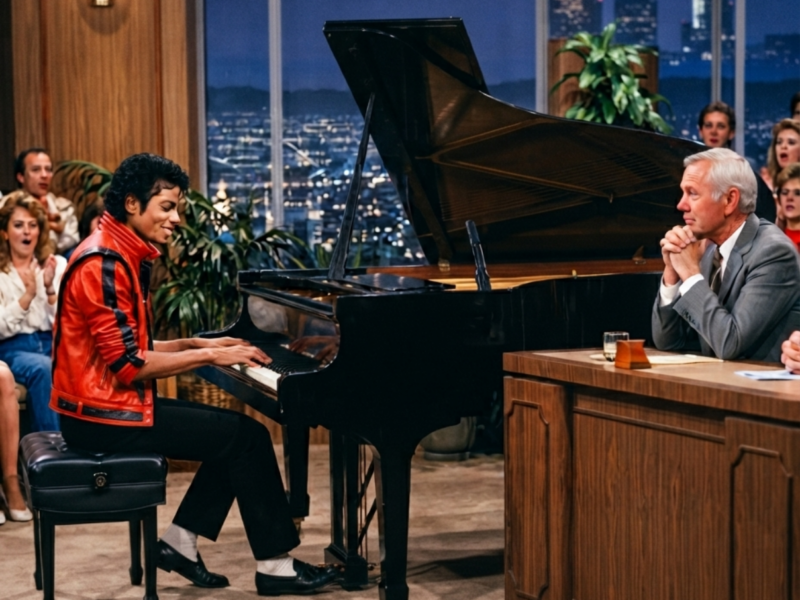
Johnny Carson Jokingly Asked Michael Jackson to Sit at the Piano — The Entire Studio Went Silent.
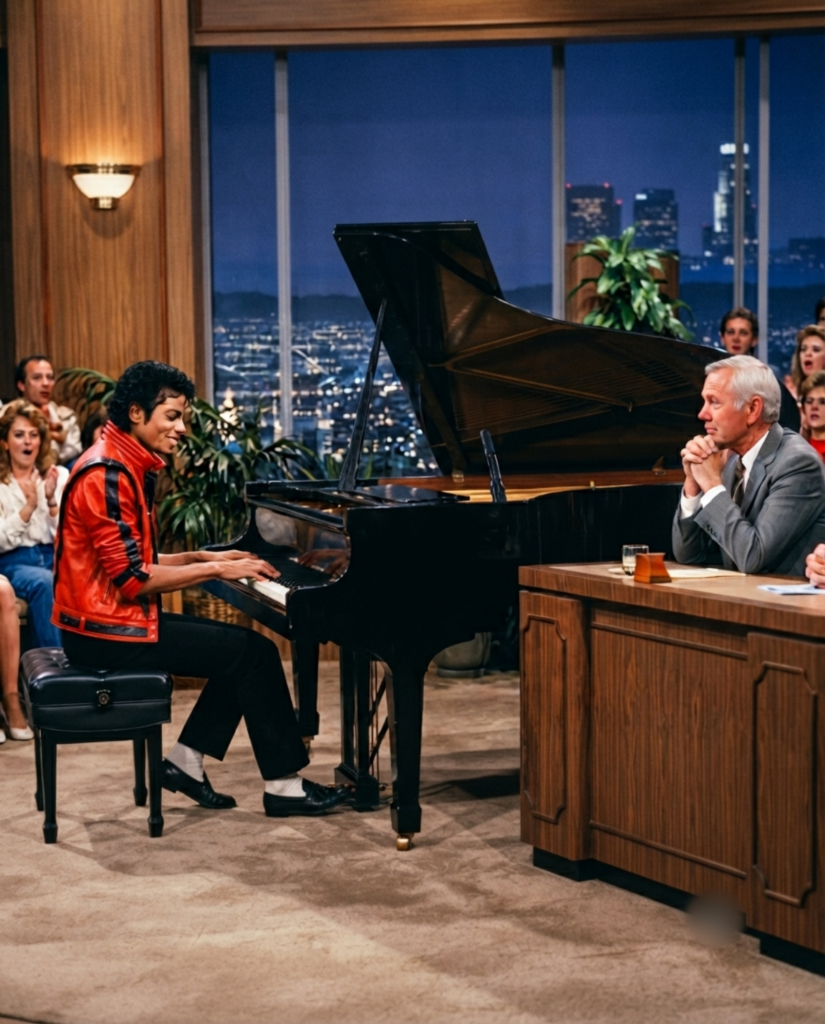
Johnny Carson gave exactly one interview near the end of his life where somebody asked him about a night in March of 1980, and he didn’t say much.
He just said that if people wanted to understand what he meant when he talked about the difference between a performer and an artist, they should go dig up the tape if they could still find a copy of it anywhere.
Most people who asked him about it never got more than that one sentence. He kept the rest of it for himself.
To understand what he meant, you have to go back to that actual night—back before anybody in that building had any idea what was coming.
Michael Jackson was twenty-one years old that spring, and on paper, he had every reason in the world to walk into NBC Studios in Burbank feeling like the luckiest young man in America.
*Off the Wall* had been out for seven months by then, and it had done something almost nobody in the industry believed a former child star could do. It had made him a solo phenomenon—not a novelty act riding on the name Jackson, not a former Motown kid trying to stay relevant, but a genuine, grown, standalone force.
“Don’t Stop ‘Til You Get Enough” had gone to number one. “Rock with You” had gone to number one right behind it. The album had already sold millions of copies—more than anybody at his own label had projected when it came out.
And two weeks before that *Tonight Show* taping, the Grammys had happened, and *Off the Wall* had walked away with almost nothing.
It won an award for a category the industry itself still quietly treated as a separate, lesser room from the main stage. Album of the Year wasn’t even a conversation. Record of the Year wasn’t even a conversation.
The show that celebrated the best music made that year had looked at an album that had reshaped an entire genre and decided—in the way these things get decided by rooms full of older men who’d already made up their minds about who counted as a serious artist—that it simply didn’t belong in the same breath as the winners.
Michael had smiled through the broadcast. He always smiled through things in public.
But something about that particular snub had lodged itself somewhere deep and hadn’t come loose since.
He’d spent that whole year hearing two very different versions of himself talked about in public.
One version was the story the label loved telling—the former child star who’d finally broken free of the group and proven he could carry an entire album on his own name.
The other version showed up in smaller print, in interviews with older critics who still referred to him even now as “one of the Jackson boys,” as though nine years of solo work and a chart-topping record somehow hadn’t fully happened yet in their eyes.
He read both versions more closely than he ever let on. And some nights, he honestly couldn’t decide which one bothered him more—the people who doubted him, or the people who only seemed to love him for what he used to be.
His assistant that year—a soft-spoken young man named Nelson, who’d been hired mostly to keep Michael’s schedule from swallowing him whole—remembered the ride to the studio that evening as one of the quietest they’d ever shared.
Michael usually filled silence with something: a hum, a question about the driver’s family, some stray thought about a song idea.
That night, he just looked out the window the whole way to Burbank.
“You all right?” Nelson finally asked.
Michael nodded—though the nod didn’t carry much conviction behind it. “Just tired,” he said. “People think because the record’s doing well, everything’s fine. Everything’s not always fine just because the numbers are good.”
If you already love Michael Jackson, hit that subscribe button now, because what happens on that couch tonight is going to surprise even the people who think they already know his whole story.
His father had called him twice that week, both times about the same thing—reminding him that the family name still needed representing, that a Jackson didn’t go on national television and let anybody see him rattled, that a Grammy snub was nothing compared to what real trouble looked like.
Michael had heard some version of that speech his whole life, delivered in a hundred different rooms, always with the same underlying message: Whatever you’re feeling doesn’t matter as much as how well you perform through it.
He’d learned to nod along to that speech a long time ago—mostly because arguing with it had never once worked in his favor.
Joseph Jackson had built his entire sense of the family’s worth around performance from the time Michael was small enough to stand on a kitchen chair and still not reach the microphone stand without help.
Rehearsals in Gary had run for hours after school, sometimes late into the night, Joseph pacing in front of his sons with a belt looped through his hand—more as a warning than anything else most nights, though not always just a warning.
Michael rarely talked about those years directly—not with reporters, not even with people close to him. But the shape of them showed up everywhere in how carefully he moved through the world now. How quickly he apologized for things that weren’t his fault. How hard he worked to make everyone around him comfortable, even when he himself clearly wasn’t.
He arrived at the studio a little after six—polite as always, thanking the same crew members twice for things that hadn’t needed doing twice, asking the makeup artist about her son’s baseball season the way he always remembered to ask about the small things in other people’s lives, even when his own felt like it was fraying at the edges.
Everybody on that crew loved having him around. He made the whole building feel a little warmer just by walking through it.
“Did the season start yet?” Michael asked the makeup artist—a woman named Rosa, who’d worked on him twice before that year.
“Opening day’s this Saturday,” she said, dabbing a light powder along his jaw. “He’s nervous. Keeps asking me if he’s good enough to start.”
“Tell him everybody feels that way before opening day,” Michael said. “Even the good ones. Especially the good ones, probably.”
Rosa smiled at that, and Michael smiled back—and for a moment, the tiredness that had followed him in from the car seemed to lift a little. The way it always did around people who didn’t want anything from him except a kind word about their kids’ baseball season.
What almost none of them knew was that Michael had spent an hour alone in his dressing room before the show, sitting at an old upright piano some prop department had wheeled in years earlier and never bothered removing, running his fingers slowly over a melody that didn’t have a name yet.
He did that sometimes—more than people realized. Not writing a song exactly. Just feeling something out. Letting his hands find whatever his voice couldn’t quite explain that day.
He’d been working on this particular melody on and off for almost two years. Never finishing it. Never quite sure what it was supposed to become.
He’d never played it for anybody. Not Quincy. Not his brothers. Not even his mother, who he told almost everything.
Keep that detail in your back pocket, because it’s going to matter a whole lot more before this story is over.
The *Tonight Show* studio that evening had its usual electric hum—the kind of energy that builds in a room full of people who know they’re about to watch something being made, rather than just recorded.
Johnny Carson was sharp that night, dressed impeccably as always, working through his monologue with the easy rhythm of a man who’d been doing this so long it had become as natural as breathing.
The audience was the usual Burbank mix. Tourists who’d waited hours for tickets. Regulars who came back every week. Industry folks scattered here and there, trying to look like they weren’t taking notes.
Backstage, the production team had spent most of the afternoon debating how to handle the booking.
Michael Jackson wasn’t a frequent guest on shows like this one, and nobody on staff was entirely sure what kind of interview he’d give.
His publicist had sent over a short list of subjects considered fair game—the album, the upcoming tour plans, a few safe questions about growing up in the business—and a slightly longer list of subjects to steer clear of. His family. His personal life. Anything that might come across as prying.
Carson had glanced at both lists that afternoon, the way he glanced at most lists handed to him by publicists—with polite indifference. He’d been doing the job long enough to know that the best segments almost never came from the questions somebody wrote down for him in advance.
The stage crew had left the grand piano out from an earlier segment involving a jazz trio, and nobody had gotten around to wheeling it off before Michael’s segment. It sat there gleaming under the lights the whole time—an afterthought nobody planned on using again that night.
Michael came out to warm applause. Not the screaming pandemonium of a Jackson 5 concert from a decade earlier, but a genuinely warm welcome—the kind that said America already respected what he’d built, even if the Grammys hadn’t gotten around to admitting it yet.
He shook Johnny’s hand, sat down in the guest chair, crossed his legs, and folded his hands neatly in his lap—the way he always did on camera. A posture that looked relaxed to anybody who wasn’t paying close attention, and looked like careful self-control to anybody who was.
Carson started easy. He asked about the album, about the reaction overseas, about whether Michael missed performing with his brothers now that he was carving out his own lane.
Michael answered every question politely, softly—giving Carson exactly enough to keep the segment moving without ever quite opening a door wide enough for anybody to step all the way through it.
“I read the album’s done incredibly well,” Carson said. “Must feel good, all things considered.”
“It feels good,” Michael said, his voice soft and even. “I’m grateful people are listening.”
Carson studied him a beat, sensing something underneath the polite answer that the words themselves weren’t quite carrying.
“Grateful,” he repeated. “That’s an interesting word to use for a year like the one you’ve had.”
Michael’s smile didn’t move, but something behind his eyes flickered. “It’s the right word,” he said. “I don’t know a better one.”
“You’ve been performing since you were what—five years old?” Carson asked. “What’s that like, looking back on it now that you’re a grown man with your own career outside the group?”
Michael considered the question carefully—the way he considered most questions on camera, like each one was a door he had to check before deciding how far to open it.
“It’s strange,” he said. “Most people get to grow up a little before anybody’s watching. I did most of my growing up with an audience already in the room. I’m not complaining. I got to do something most people never get the chance to do. I just sometimes wonder what I would have turned into if nobody had been watching yet.”
“That’s an honest answer,” Carson said, genuinely a little surprised by it.
“It’s the only kind I know how to give when somebody actually asks a real question,” Michael said.
And something in his tone suggested he didn’t get asked real questions nearly as often as people might assume.
“You still close with your brothers,” Carson asked, “now that you’re out here doing your own thing?”
“Close as we’ve ever been,” Michael said. “Different now, though. We don’t share a bedroom and a rehearsal schedule anymore. Sometimes I miss the noise of that more than I expected to. It’s quieter now, having my own place, my own schedule. Quiet’s a strange thing to get used to when you’ve spent your whole life surrounded by people.”
Carson nodded slowly. “Loneliness is a funny thing to hear from a man who just sold this many records,” he said.
Michael offered a small, careful smile. “Everybody thinks the two things cancel each other out,” he said. “Records selling, loneliness. In my experience, they usually just happen at the exact same time.”
About seven minutes into the interview, Carson could feel the room’s energy starting to dip.
Michael wasn’t being difficult. He was being careful—and careful on live television is a way of draining a segment of its life, even when the guest is one of the biggest stars in the country.
Carson had interviewed thousands of people by then. He knew exactly what a guest sounded like when they were giving him a performance of an interview instead of an actual conversation. And Michael, however sweetly, was giving him a performance.
Carson glanced toward the far side of the stage, where a grand piano sat gleaming under the lights, left over from an earlier musical segment. Nobody had bothered rolling it away yet.
Something in his expression shifted—the particular look his producers had learned to recognize as the moment Johnny was about to abandon the cards entirely.
“Michael,” he said, leaning forward. “We’ve got a beautiful piano sitting right over there doing absolutely nothing. Why don’t you go sit down and play us something?”
The audience laughed—warm and easy. It was clearly meant as a joke, a playful jab at a guest everybody assumed was strictly a singer and a dancer. Somebody who moved like lightning on a stage but had never once been photographed at an instrument.
Michael laughed too, soft, shaking his head. “Oh, I don’t think anybody wants to hear that, Johnny,” he said.
“Come on,” Carson pressed, that famous mischievous glint sliding into his eyes. “You’ve written some of the biggest songs in the country this year. You’re telling me you can’t sit down and pick out a tune for us?”
The audience started clapping along, encouraging—the way a crowd does when it senses a host is about to talk a reluctant guest into something memorable.
If this is already pulling you in, that’s a good sign to hit subscribe, because the next four minutes are the whole reason people still talk about this broadcast.
Michael looked toward the piano.
For a moment, nobody in that studio noticed anything change in his face. Then something did change. Small. Quiet. The kind of shift you’d miss if you weren’t watching closely.
The polite, camera-ready smile faded just slightly—replaced by something more private. Something that looked almost like a door creaking open somewhere he hadn’t planned on opening that night.
He was quiet a second longer than the joke really called for.
“All right,” he finally said, his voice barely above the microphone’s reach. “But don’t say I didn’t warn you.”
The audience cheered, thinking they were about to get a quick, fun run through “Rock with You,” or maybe a few bars of one of the old Jackson 5 hits. Something familiar and safe to close out an interview that hadn’t quite caught fire.
They had no idea what they were actually about to get.
Michael stood—and something about the way he crossed that stage was different from the way he’d walked out twenty minutes earlier. His shoulders dropped slightly. His chin lifted. The careful, guarded posture of the interview chair fell away with every step, like a coat being set down on the way through a doorway.
He reached the piano bench and sat.
And for a moment, he simply looked down at the keys without touching them. The way you look at something you’ve been circling around for a long time before you finally let yourself get close to it.
He didn’t glance at the audience. He didn’t glance at Carson.
He closed his eyes for a second—and then his hands came down onto the keys.
Stay with me here, because what happened over the next several minutes is the part of this story nobody who was in that room ever forgot.
It wasn’t “Rock with You.” It wasn’t “Don’t Stop ‘Til You Get Enough.” It wasn’t any Jackson 5 song anybody in that audience had ever heard before.
And it certainly wasn’t the kind of technical showpiece a trained pianist might have chosen to prove a point.
It was something simple. Almost painfully simple. Five or six notes repeating and slowly building on themselves—the kind of melody that sounds like it’s been hummed alone in a room a thousand times before anybody ever thought to put it on an instrument.
The studio went quiet in a way it hadn’t been quiet all night. Not the polite quiet of an audience waiting for a punchline—the particular quiet of a room realizing, in real time, that it was watching something it hadn’t been prepared for.
Carson’s easy smile faded. He leaned back slightly, unfolded his hands from where they’d been resting on the desk, and simply watched—the way you watch something when you sense that any noise you make, even a small one, might break whatever is happening.
Michael’s hands weren’t fast. They weren’t flashy. There was no technical fireworks to gasp at, no dazzling run up and down the keyboard the way Carson’s joke had half-implied there might be.
What there was, instead, was a kind of aching patience.
Each note held a half second longer than expected. The melody circling back on itself again and again, like somebody trying to say the same sentence a dozen different ways until it finally came out right.
He played with his eyes closed most of the way through it. His shoulders moved slightly with the phrasing—not the theatrical sway of a stage performance, but something smaller and more private. The unconscious motion of somebody who had genuinely forgotten, for just a few minutes, that four hundred people and a national audience were watching him do it.
The house band, seated off to the side for the whole broadcast, had gone completely still.
One of the horn players—a session veteran who’d backed nearly every major act to come through that studio in a decade—later said he’d never seen a room of professional musicians go that quiet for an amateur before. And he meant “amateur” with real respect behind it.
Because what he was watching wasn’t technical mastery. It was something else.
It was a man telling the truth with the only ten fingers he had.
Partway through, his left hand introduced a second, lower phrase underneath the first one. Nothing complicated—just a few notes repeating in a slightly different rhythm. But the way the two lines wove together made something in the room’s chest tighten without anybody quite understanding why.
It was the sound of somebody thinking out loud. Working through a feeling they hadn’t fully named yet. One hand asking a question, and the other hand answering it—just a little differently every time.
The melody built for almost three minutes. Small variations layering over each other. Never getting loud. Never turning into the kind of grand finale a Vegas lounge pianist might have reached for to earn a bigger ovation.
If anything, it got quieter as it went. More careful. Like Michael was protecting something fragile, rather than performing something impressive.
Then his hands slowed, and the last few notes fell one at a time—spaced out, deliberate—until his fingers finally came to rest on the keys without pressing them down at all.
He sat there a moment. Not moving. Not looking up.
If this moment is landing on you even half as hard as it landed on that studio, hit that like button right now, because Johnny’s about to ask the question that changes everything.
The silence lasted five full seconds—which, on live television, might as well be an entire lifetime.
Then the audience came apart.
Not just applause. People rising out of their seats. A woman near the front visibly wiping at her eyes. One of the horn players shaking his head slow, like he was trying to talk himself into believing what he’d just watched.
Johnny Carson sat behind his desk with his hands folded together. And for the first time all night, he didn’t say anything at all for a long moment.
When he finally spoke, his voice had lost its usual polish.
“Michael,” he said, quiet. “Why doesn’t anybody know you can do that?”
Michael turned slowly on the bench to face him. His expression wasn’t proud. It wasn’t embarrassed either. It was something harder to name. Something closer to a held breath finally being let go.
He was quiet a moment, looking down at his own hands resting in his lap.
“Because that’s not what people want from me, Johnny,” he finally said.
The words settled over the studio like a held note that hadn’t quite resolved.
Carson leaned forward slightly. “Go on,” he said—gentle now, all the showmanship gone out of his voice.
Michael looked toward the piano, rather than at the camera, rather than at the audience—the way people look at something when they’re talking mostly to themselves and just happened to have an audience nearby.
“I’ve been playing since I was little,” he said. “Nobody taught me properly. I just used to sit at whatever piano was around and figure things out by ear. Late at night, mostly. After rehearsal. After everybody else had gone to bed. That was never part of the act. That was just mine.”
Carson didn’t interrupt. He’d learned, across nearly two decades behind that desk, exactly when to stay quiet and let a guest keep walking toward whatever they’d started walking toward.
“When I was real small,” Michael continued, “my whole life got built around being ready. Ready to rehearse. Ready to perform. Ready to be exactly what my father needed the group to be that week. There wasn’t a lot of room left over for anything that didn’t have an audience attached to it. But late at night, when everybody else was asleep, I’d find a piano somewhere in the house. And for an hour, nobody was grading it. Nobody was deciding whether it was good enough to put on a record. It was just me figuring out what a feeling sounded like when nobody was keeping score.”
“That’s a different kind of music than what the world knows you for,” Carson said.
“Completely different,” Michael agreed. “What you hear on the radio—that’s built with a whole team. A whole vision. Quincy and the musicians and the arrangements. And I love every bit of that work. I really do. But this—” He glanced back at the piano. “This is the part nobody built with me. This is just mine.”
“Did your brothers ever hear you play like that growing up?” Carson asked.
Michael shook his head slightly. “Not really,” he said. “We were always working on what the group needed. There wasn’t a lot of room for anybody to just sit and play something nobody had asked for. I used to wait until the house was quiet. Sometimes that meant two in the morning. I didn’t mind. The quiet was kind of the whole point.”
“That sounds lonely,” Carson said. Gentle.
“It was,” Michael admitted. “Still is, some nights. But I think I needed somewhere to put certain feelings that didn’t have anywhere else to go. And the piano was patient with me in a way people don’t always have time to be. It never got tired of waiting for me to figure out what I was trying to say.”
If this conversation is already getting to you, that’s exactly the moment to hit subscribe, because what Michael says next is the reason this broadcast is still talked about all these years later.
“Can I ask you something?” Carson said. “That piece you just played—does it have a name?”
Michael shook his head slightly. “Not yet,” he said. “I’ve been working on it a couple years now. Never finished it. Never played it for anybody before tonight, actually. Not even my producer.”
“Why tonight?” Carson asked. “Why here, on a talk show, in front of eleven million people, when you wouldn’t even play it for the man who produces your records?”
Michael considered the question seriously—the way he considered most questions, like he wanted to make sure the answer was true before he let himself say it out loud.
“I think,” he said slowly, “because you asked it like a joke. If you’d asked me seriously—like you wanted a show—I probably would have played something safe. But you asked it easy. Like it didn’t matter either way. And something about that made it feel like maybe it was allowed to just be small. Maybe it didn’t have to prove anything to be worth playing.”
The studio had gone almost reverent. The earlier laughter completely gone from the room, replaced by the particular hush of a room that senses it’s being led into something private.
“Two weeks ago,” Michael went on, unprompted now—something loosening in him that hadn’t been there twenty minutes earlier—”the Grammys didn’t think the album deserved much. I understand why, some of it. It’s a different sound than what people expected from me. But it stung more than I let on. I smiled through the whole broadcast, because that’s what you do. You smile. You clap for the other winners. You tell reporters you’re just happy to be nominated. But some part of me kept thinking—if that record isn’t enough, if seven months of the whole country singing along to it isn’t enough, then maybe I’m not building the thing I think I’m building. Maybe I’m just really good at making people dance, and that’s the whole of it.”
“That’s a heavy thing to carry around at twenty-one,” Carson said.
“Heavier than people realize,” Michael admitted. “Because when you’re that age, and that many strangers are clapping for you every single night, everybody assumes you must feel like the luckiest person alive every waking minute. Some days I do. Some days I sit in a room by myself after a show that just sold out in eleven minutes, and I feel about as lonely as anybody’s ever felt in the history of being alive.”
The audience had gone completely silent now. Four hundred people leaning forward together. Nobody clapping to fill the gap. Nobody laughing to ease the weight of it.
Keep watching, because this is the part of the story that turns everything you thought you understood about that night on its head.
“Is that what the piano’s for?” Carson asked, quiet. “The part nobody built with you?”
Michael nodded slowly. “I think so,” he said. “When I sit down and play something like what you just heard, nobody’s deciding if it charts. Nobody’s comparing it to the last thing I made. It’s just a feeling finding its way out through my hands. And for those few minutes, I’m not the finished product everybody sees on the album cover. I’m just a person still figuring something out. I don’t get many minutes like that. I don’t think most famous people do, honestly.”
“Even with your brothers around growing up,” Carson asked, “was there still that kind of loneliness?”
Michael nodded slowly—like the question had reached somewhere he hadn’t expected to visit that night.
“In some ways, more,” he said. “When you’re the one everybody starts pointing to—the one people say is going to be the star of the group—it does something to how your own brothers look at you. Even when they love you. Even when nobody means anything cruel by it. I was surrounded by my own family every single day, and there were still nights I felt like the loneliest person in the state of Indiana. The piano didn’t care whose voice was supposed to carry the group that year. It just waited for whoever sat down in front of it.”
“That’s a hard thing to say out loud about your own family,” Carson said. Gentle.
“It’s not an accusation,” Michael said quickly. “Nobody did anything wrong. Exactly. It’s just what happens when a family builds itself around one thing—getting bigger and bigger. Somebody ends up standing a little apart from everybody else, even while they’re all still standing in the same room.”
“Do you think you’ll ever finish it?” Carson asked, nodding toward the piano. “That piece?”
Michael thought about it a long moment. “Maybe,” he said. “Or maybe some things aren’t supposed to get finished. Maybe some things are just supposed to keep being worked on quietly for the rest of your life, and that’s the whole point of them. I don’t know yet. I’ll know when I know.”
Carson sat with that a moment. Something moved behind his own composed expression.
“Michael,” he said finally. “I asked you to play as a joke a few minutes ago. I want you to know I understand now that I was asking for a whole lot more than I realized I was asking for.”
Michael offered a small, tired smile—the first fully unguarded expression he’d shown all night.
“You didn’t know,” he said. “Nobody could have known. I didn’t know myself until I sat down.”
If this exchange has moved you even a little, go ahead and hit that like button right now, because the studio’s reaction is about to say everything words can’t.
“Can I ask you one more thing?” Carson said.
“Go ahead,” Michael said.
“Does your father know you play like that?”
Something crossed Michael’s face. Quick. Complicated. Gone almost as fast as it appeared.
“No,” he said, quiet. “He knows I can play a little. He’s never heard anything like what I played tonight. I don’t think I ever wanted him watching the one thing that didn’t belong to the act.”
Carson nodded slowly, understanding more than he probably let on.
“That’s yours to keep private if you want,” he said. “But for whatever it’s worth, from an old man who’s interviewed just about everybody worth interviewing over the last twenty years—what you just did up there was the realest thing I’ve had happen on this stage in longer than I can remember.”
Michael’s eyes shone slightly under the studio lights. “Thank you, Johnny,” he said.
And it wasn’t clear whether he was thanking him for the compliment or for asking the question that had let all of it out in the first place.
Carson stood up from behind his desk—something he almost never did mid-segment—and crossed the small distance between his chair and the piano bench. He extended a hand.
Michael stood and took it, and Carson pulled him into a brief, genuine hug. The kind two people share when words have already said everything they can, and a gesture is the only thing left to finish the sentence.
The audience rose to their feet again—louder this time. The applause carrying real weight in it now. The sound of a room that understood it had just watched something true happen in front of it, rather than something staged for their entertainment.
When they separated, Carson held Michael by the shoulder a moment.
“Promise me something,” he said.
Michael waited.
“Don’t let that piano stay a secret forever,” Carson said. “Whatever that piece turns into, whenever you finish it—the world ought to hear it someday. Not the show. Not the choreography. That.”
Michael considered it. Something bittersweet crossing his expression.
“Maybe someday,” he said. “When it’s ready. When I’m ready. Right now, I think it’s still mine.”
“Fair enough,” Carson said. And let it go at that.
Before Michael walked off toward the wings, Carson caught his arm gently one more time.
“For what it’s worth,” he said, quiet enough that the boom mic barely caught it, “whatever those Grammy people decided—that record’s going to outlast every single name on that ballot. I’d bet my whole desk on it.”
Michael smiled, small and grateful. “Hope you’re right, Johnny,” he said.
“I usually am, about these things,” Carson said, a little of his old showman’s grin creeping back in. “Ask anybody who’s worked here long enough.”
If you’re still with me, you already know what’s coming—and it’s a perfect time to subscribe before we get to what happened after the cameras stopped rolling.
Backstage after the taping, Michael’s assistant Nelson found him sitting quietly in his dressing room, the same old upright piano from earlier untouched now, Michael simply staring at his own hands like he was trying to figure out what they’d just done without fully consulting him first.
“You all right?” Nelson asked again—echoing the question from the car ride over.
Michael nodded slowly. “Better than all right,” he said. “Scared, a little. Didn’t plan on any of that happening.”
“Didn’t look planned,” Nelson said. “Looked real.”
“It was real,” Michael said. Quiet. “That’s probably why it scared me.”
His brother Marlon called the dressing room phone about twenty minutes later, having caught the broadcast live from his own living room across town.
“Man,” Marlon said—half laughing, half something else entirely. “When did you learn to do that?”
“Long time ago,” Michael said. “Just never had a reason to show anybody before tonight.”
Tito was in the background somewhere on Marlon’s end. Michael could hear him asking who was on the phone—and then his voice got closer, louder, clearly wanting in on the conversation.
“Tell him he sounded like a whole orchestra up there,” Tito called out.
And Michael laughed for the first time since the segment had ended. A real laugh. Tired, but genuine.
“Tell him thank you,” Michael said.
“He says thank you,” Marlon relayed.
And Tito said something back that made Marlon laugh, too. And for a minute, it felt like being back in that crowded house in Gary again—all of them talking over each other about something that mattered. Nobody worried yet about charts or reviews or Grammy ballots. Just brothers being loud with each other the way brothers are supposed to be.
“You’ve been sitting on that this whole time,” Marlon said. “All those years in the house together, and I never once heard you play like that.”
“You weren’t supposed to,” Michael said—not unkindly. “Wasn’t for anybody to hear yet. Guess it just found its way out tonight.”
Marlon was quiet a second on the other end of the line. “Well,” he finally said, “I’m glad it did. That was something else, Mike. Really was.”
He called his mother that night before he went to sleep—the only person he’d told earlier that year that he was even working on a piece he hadn’t finished.
She’d seen the broadcast. She told him it was the most like himself she’d seen him look on television in years. Maybe ever.
He didn’t call his father.
His father called him instead the next morning. And the conversation lasted less than two minutes—mostly about scheduling for an upcoming appearance. No mention of the piano at all.
Michael never brought it up either. Some doors, once you’ve closed them again, you leave closed a while longer before you try opening them a second time.
A reporter for a national entertainment column happened to catch the broadcast live that night and tried for weeks afterward to get either Michael’s camp or NBC to comment further on it, hoping for a follow-up piece about the mysterious unfinished song.
Michael’s publicist gave a short, careful statement, thanking Mr. Carson for a lovely evening and noting only that Michael enjoyed sharing a personal moment with the audience.
NBC’s press office said even less—treating the whole thing as a routine musical interlude rather than the unplanned confession it had actually been.
The reporter’s editor eventually killed the follow-up piece for lack of new material, and the story quietly faded out of the entertainment pages within a couple of weeks—exactly the way both Michael’s team and NBC seemed to prefer it.
The clip aired once, live, the way every *Tonight Show* segment did in those days. And then it went into NBC’s archive, along with thousands of hours of other footage from that era—most of it never touched again.
It wasn’t officially rerun. Not on any anniversary special. Not on any highlight reel of great talk show moments. Though bootleg copies circulated for years among collectors who traded tapes the way other people traded baseball cards.
Some longtime fans have said Michael’s own camp quietly asked that it not be packaged into any retrospective specials over the years. Others say it was simply an oversight—one segment among thousands that nobody at the network ever thought to preserve properly.
Either way, people who saw it—whether live or on a worn-out bootleg years later—never forgot it.
Michael himself was asked about that broadcast only once, in a later interview years afterward, by a journalist who tracked down a bootleg copy and wanted to know if the piece he played had ever gotten a proper title.
Michael was quiet a moment before answering—the way he always got quiet before saying something he’d actually thought about, rather than something rehearsed.
“Some things you finish and put out into the world,” he said. “And some things you just carry with you, because the carrying is the point of them. I think that one was always going to be the second kind. I don’t need everybody to hear it. I just needed somebody to, once. And Johnny happened to be standing there that night.”
Quincy Jones, asked about it decades later in an interview reflecting on the *Off the Wall* sessions, said he hadn’t known about that piano moment until years after it happened, when somebody finally showed him a copy of the tape.
“I worked with that man in the studio for months,” Quincy said. “I thought I knew every side of his musicianship there was to know. Watching that tape, I realized there was a whole room in him I never got invited into. Made me wonder how many other rooms like that one he was carrying around and never showing anybody.”
If this story about hidden talent, loneliness, and the courage to be honest on live television meant something to you, make sure you’re subscribed, because there’s plenty more where this came from.
A studio musician who’d been in the house band that night, interviewed years later for a piece about memorable unscripted *Tonight Show* moments, described the scene from his own vantage point just offstage.
“We backed everybody in those years,” he said. “Every singer. Every comedian who wanted a little music under their bit. I’d stopped being surprised by anything a guest could do at a piano a long time before that night. Then Michael Jackson sat down and played six notes, and the whole band just quietly put our instruments in our laps and watched. I still tell people about it. Most of them don’t believe me until I describe exactly how quiet that room got. You don’t forget a silence like that.”
Nelson, Michael’s assistant that year, stayed close to him for another two years after that broadcast before moving on to a different job. And he was asked about the piano moment decades later by a documentary crew putting together a retrospective on Michael’s solo years.
“Everybody wants to talk to me about the tours, the choreography, the big moments people already know about,” Nelson said. “I always bring up that Carson appearance instead. Because that’s the one where I actually saw him. Not the performer, not the brand. Just him. Twenty-one years old, scared half to death about a Grammy snub. And for four minutes, he let a room full of strangers see exactly how much that scared him mattered to him. I don’t think people give him enough credit for how much courage that actually took.”
A former engineer who worked on parts of the *Off the Wall* sessions, asked years later whether he remembered Michael ever mentioning an unfinished piano piece, said the question brought back something he’d nearly forgotten entirely.
“There were tapes,” he said. “Cassette after cassette of Michael humming melodies alone into a hand recorder. Most of them never meant for anybody else’s ears. I always figured a few of those never made it onto any record because he wasn’t ready to let them go yet. After I saw what he did on that Carson show years later, on a bootleg somebody passed around the studio, I understood exactly which kind of tape that piece probably came from. Some things a person needs to keep just for themselves a while longer before they’re ready to hand it over to the world.”
A woman who’d been sitting in the third row that night—a schoolteacher from Pasadena who’d waited in line since early afternoon for tickets with her daughter—was tracked down decades later by a local paper doing a retrospective on famous unscripted television moments. She still remembered it clearly, she said. Better than most things from that whole decade of her life.
“You go to a taping like that expecting to laugh a little, clap a little, tell your friends you saw somebody famous,” she said. “Nobody tells you to expect something that quiet. Something that honest. My daughter was twelve at the time, and she still brings it up sometimes. All these years later, neither of us have ever seen anything else quite like it since. On television or anywhere.”
The piano tuner who serviced that particular instrument for NBC—an older man who’d worked on nearly every piano that passed through the Burbank lot for two decades—said he happened to be standing in the wings that night, finishing up an unrelated repair on a different piece of equipment. He wasn’t scheduled to watch the broadcast at all. Something made him stop and look up when the room went quiet.
“I’ve tuned pianos for a lot of famous hands over the years,” he said. “You get a feel sometimes for which ones actually mean what they’re playing, and which ones are just good at making it look that way. That young man meant every single note. I’d stake what’s left of my hearing on it.”
Michael Jackson died on June 25th, 2009, at the age of fifty.
In the years since, his catalog and his legacy have both grown into something almost too large to hold in one clear picture—celebrated and picked apart in equal measure. Remembered by some as the greatest performer of his generation. And by others through the lens of everything that came after those early, dazzling years.
But for the small number of people who were in that studio on a Tuesday night in March of 1980, there’s another Michael Jackson tucked inside all of that noise.
Not the moonwalk. Not the glove. Not the guarded, careful young man who answered Johnny Carson’s early questions with polite, practiced softness.
There’s a twenty-one-year-old sitting alone at an upright piano an hour before showtime, working out a melody that never got a name.
Because for a little while, in a room with nobody watching, he got to just be a person still figuring something out—instead of the finished, dazzling product the whole world was already so sure it understood.
Johnny Carson kept a small cassette tape in the bottom drawer of his desk for the rest of his career. Unlabeled. Played for almost nobody—though a handful of longtime staffers knew exactly what was on it.
When he finally retired from the show in 1992, he took the tape home with him, rather than leaving it in the network archive with everything else.
A friend who visited him years later said Carson played it for him once without much explanation. And afterward said only one thing.
“That’s what the whole job was supposed to be about,” Carson said. “Every single interview I ever did, I was hoping for five minutes like that. Mostly I never got them. That night, I did.”
Years later, when people asked Michael about the *Off the Wall* era, they usually wanted to hear about the tour, the record sales, the moment he realized he could stand entirely on his own outside the group that raised him.
He’d answer those questions the way he answered most things by then. Warm. Careful. A little rehearsed.
But every so often, in a quieter interview with a writer he trusted enough to let his guard down a little, he’d mention that night in Burbank—almost in passing. Never dwelling on it. Never explaining the full weight of it. Just a brief, wistful line about a piano and a joke that turned into something else.
People who knew what to listen for could always hear exactly how much that one small memory still meant to him—tucked away among all the bigger, louder ones the world already knew by heart.
There’s something worth sitting with in a story like this one. Something bigger than the piano itself. Bigger even than the melody nobody ever got to hear finished.
It’s the reminder that the people we decide we already understand—the ones whose whole shape we think we’ve memorized just from watching them on a stage or a screen—are almost always carrying some private room we’ve never been led into.
Michael Jackson walked into that studio that night as the boy who danced better than anybody alive. And he walked out having shown a few hundred strangers something closer to the truth.
That underneath every dazzling, rehearsed, publicly built version of a person, there’s usually a quieter one still working something out. One note at a time. Hoping somebody someday asks the right question, in the right way, to let it out.
That’s what happened on a March night in 1980 in a studio in Burbank, in front of a few hundred people who came expecting an easy interview and left having witnessed something nobody had scripted, planned, or asked for in any real sense at all.
Not a performance. Not a publicity stunt dressed up as spontaneity.
Just one joke that turned out not to be a joke.
One melody with no name.
And a twenty-one-year-old finally letting a room full of strangers hear the one thing in his whole extraordinary life that had never once been built for anybody but himself.









