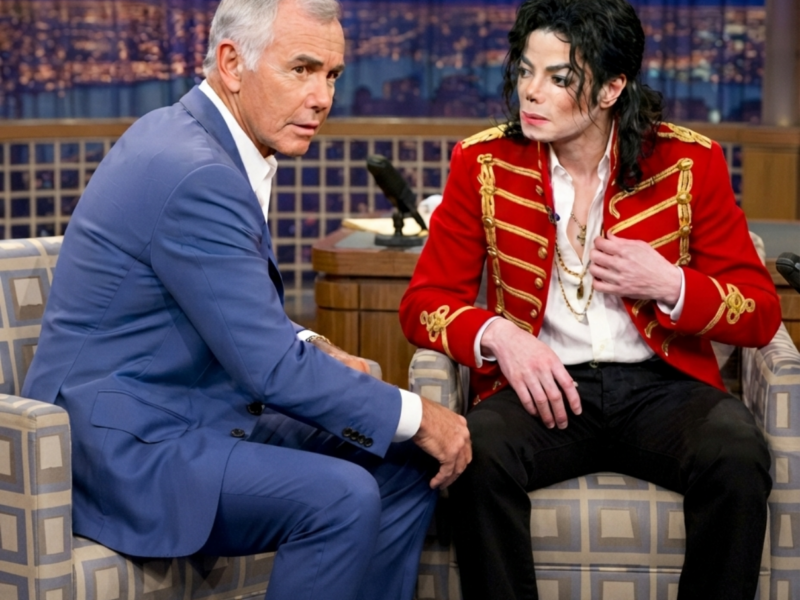
Johnny Carson Asked Michael Jackson One Question… His Answer Left the Studio in Complete Silence.
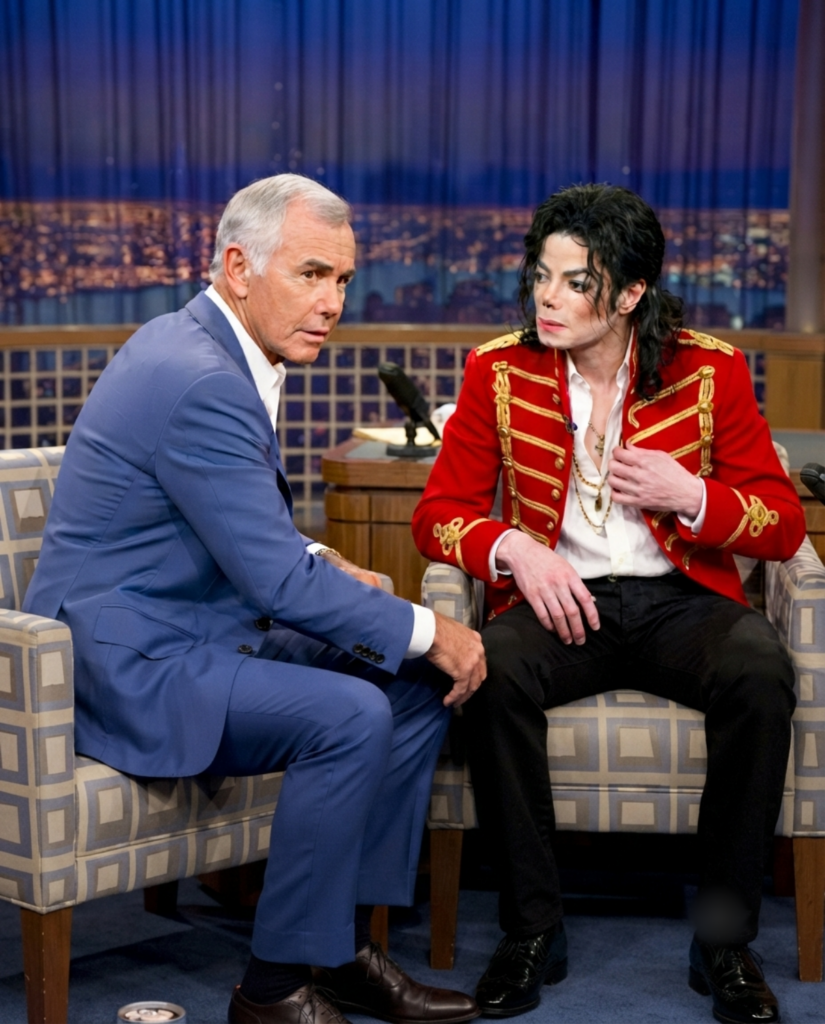
There’s a theory that refuses to die on late-night internet forums and clip compilations.
It claims Johnny Carson and Michael Jackson once got into a heated behind-the-scenes argument before a planned interview.
And that the falling out was so bad neither man ever agreed to sit across from the other again.
It shows up in comment sections under old Tonight Show clips.
It shows up in untold Hollywood secrets compilations.
It shows up in forum threads with titles promising the real reason Michael Jackson never appeared on Johnny Carson’s couch.
Here’s the problem, and it’s worth saying plainly before going any further.
There’s no verified evidence that this argument ever happened.
No contemporaneous news report.
No confirmed quote from Carson.
No confirmed quote from Jackson.
No biographer, staffer, or producer from either camp has ever gone on record describing a blowup between the two of them.
What actually exists is something almost stranger than a feud.
A genuine, well-documented gap in the historical record, one big enough that fans have spent years inventing explanations to fill it.
Because here’s the real mystery, and it’s a legitimate one.
Michael Jackson, arguably the single biggest entertainer on the planet for the better part of two decades, never once appeared as a solo guest on The Tonight Show Starring Johnny Carson.
Not during the Off the Wall era.
Not during Thriller, when he was selling tens of millions of albums and reshaping the entire music industry around himself.
Not during Bad.
Not during Dangerous.
Not at any point across Carson’s thirty-year run behind that desk.
For a show that hosted practically every major star of the twentieth century at some point, from Frank Sinatra to Bette Davis to a rotating cast of presidents, astronauts, and cultural phenomena, the total absence of a one-on-one Carson-Jackson sit-down stands out.
It’s exactly the kind of vacuum that internet mythology loves to fill with a dramatic, unverifiable story.
Because a private feud is simply a more satisfying explanation than it just never happened to line up.
The rumor tends to circulate in slightly different versions depending on where you encounter it.
Some versions claim the argument happened backstage minutes before a scheduled taping, with Jackson supposedly walking out before cameras rolled.
Other versions place it years earlier during some unspecified encounter tied to the Jackson 5’s rise, with Carson allegedly making a dismissive comment about the group’s youth or Motown’s commercial approach that Jackson never forgave.
None of these versions cite an actual source.
No interview.
No memoir.
No contemporaneous news clipping.
And the details tend to shift depending on who’s retelling it, which is usually one of the clearest signs that a story has drifted from rumor into full folklore.
It’s the same pattern that shows up around countless other unverified celebrity legends.
A specific dramatic claim with no attributable source, repeated confidently enough, often enough, that repetition itself starts to feel like evidence.
We want to take a moment to feature this comment from our last video.
Thanks for sharing your thoughts with us.
After watching today’s video, do you think Michael simply never had the right opportunity to appear on Johnny Carson’s show?
Share your thoughts in the comments, and one comment could be featured in our next video.
Now, let’s get back to the story.
What did actually happen, and what’s fully documented, tells a more interesting story anyway.
The Jackson family’s relationship with Johnny Carson’s show goes back to April of 1974.
That’s when the Jackson 5, Michael among them, still a child, already the group’s undeniable focal point, made their first appearance on The Tonight Show.
They performed Never Can Say Goodbye and Dancing Machine for a national audience at a moment when the group was transitioning from bubblegum teen idols into a more mature, disco-inflected act.
It was a big booking for a family group that had already conquered the pop charts but was still working to prove they had staying power beyond a handful of massive early hits.
The group had signed with Motown in 1968 and rocketed to stardom almost immediately, scoring a string of number-one singles right out of the gate, an unprecedented run for a new act at the time.
By 1974, though, the bubblegum sound that made them famous was starting to feel dated against a changing musical landscape.
And the Jackson 5 were actively working to reposition themselves as a more sophisticated act capable of surviving past their teenage years.
Landing a spot on Carson’s show at a moment when the group’s commercial momentum had cooled slightly from its earlier peak mattered enormously to that repositioning effort.
Appearing on Carson’s show in the mid-1970s meant something specific in American entertainment.
It was less a talk-show stop than a stamp of mainstream legitimacy, the kind of appearance that told the country an act had crossed over from a passing sensation into something more durable.
That 1974 appearance is the closest thing that exists to a genuine, on-record Carson-Jackson interaction.
And even that involved the group as a whole, rather than Michael individually.
There’s no publicly available account of any tension backstage that night.
No reporting from the era suggesting friction between Carson and any of the Jackson brothers.
And no evidence that this appearance set off some kind of lasting cold war.
If anything, surviving footage and contemporary write-ups from the period describe a warm, high-energy performance well received by both the studio audience and Carson himself, consistent with how the show typically treated successful young musical acts booked to perform rather than sit for an extended sit-down conversation.
It’s worth noting, too, that most musical guests on Carson’s show in that era were booked primarily to perform a song or two, rather than engage in a lengthy interview segment.
Which is itself part of why so few detailed records exist of what, if anything, was actually said between Carson and any of the Jackson brothers that night beyond standard introductions.
If anything, it reads like a fairly standard successful late-night booking for a rising act, notable mostly in hindsight because of how enormous one of those five brothers would eventually become.
The Jackson family connection to Carson’s show didn’t end there, either, though the follow-up came from an unexpected direction.
In 1991, toward the tail end of Carson’s tenure, Joe Jackson, Michael’s father and the family’s famously demanding patriarch, appeared as a solo guest on the same program, sharing the bill with actor Michael Landon and boxer George Foreman.
It’s a strange footnote in Tonight Show history for a few reasons.
Michael Landon, who spent that same episode good-naturedly pushing back against tabloid headlines speculating about his health, would be dead within two months from cancer, making the episode a small, sad time capsule in retrospect.
Joe Jackson’s presence on the show, meanwhile, meant that a member of the Jackson family did sit down with Carson for a real conversation in the twilight of Carson’s career.
Just not the member fans most wanted to see.
There’s no widely available detailed account of what specifically Joe Jackson discussed in that appearance, but the booking itself confirms something worth noting.
Carson’s producers clearly had no blanket aversion to Jackson family guests, at least as of 1991, undercutting the idea of some standing grudge specifically targeting Michael.
By 1991, Joe Jackson had spent years serving as the public face of the Jackson family’s business affairs, even as his own relationship with several of his children, including Michael, had grown famously strained and was itself the subject of extensive, well-documented reporting over the years regarding his demanding, at times harsh, management style during their childhoods.
His appearance on Carson’s couch that year came during a period when he was largely operating independently of his children’s individual careers, managing various other artists and ventures under the Jackson name.
So, if there was no confirmed feud, what actually explains Michael Jackson’s total absence from Carson’s couch during the years he was the single most famous entertainer alive?
A few real, mundane, well-documented factors line up far more plausibly than a secret argument ever could.
First, Michael Jackson’s relationship with media appearances in general became increasingly rare and tightly controlled as his fame grew through the 1980s.
He gave a handful of high-profile, carefully managed sit-downs, most famously his 1993 interview with Oprah Winfrey, conducted specifically to address rumors and controversies head-on.
But he largely avoided the standard late-night circuit that most major stars used to promote albums and tours.
Talk show appearances generally require a certain unscripted looseness, a willingness to sit and banter, take unexpected questions, and just exist in a conversational format for several minutes at a stretch.
By most accounts from people who worked with him, Jackson grew more guarded about that kind of unstructured public exposure as his career progressed, preferring performance-based appearances, tightly controlled documentary access, or written statements over live, off-the-cuff interviews.
That pattern extended across essentially his entire adult solo career.
Even at the absolute commercial peak of Thriller in 1983 and 1984, when Jackson’s face was arguably the most recognized in the world, his major media moments came through tightly produced formats.
Elaborate music videos treated as short films.
A small handful of choreographed television specials.
Carefully staged award show appearances.
Rather than loose conversational interview slots.
The contrast with how most major recording artists of that era promoted their work, a steady rotation through Carson and later hosts like Arsenio Hall and David Letterman, makes Jackson’s approach look even more deliberate in hindsight.
A conscious choice rather than an accident of scheduling.
Second, timing simply didn’t cooperate.
Carson’s Tonight Show ran until May of 1992, and Jackson’s career as a global solo phenomenon really exploded starting with Off the Wall in 1979 and then Thriller in 1982.
That leaves roughly a decade of overlap during which Jackson was at his commercial peak and Carson was still hosting.
A real window, but a narrower one than people often assume, especially once you factor in how selective Jackson had become about any format resembling a traditional interview by that point in his career.
Carson himself, meanwhile, was known for being fairly hands-off about actively pursuing reluctant guests.
His show thrived on a steady, reliable rotation of performers who wanted to be there, rather than aggressively chasing down every reclusive superstar in Hollywood.
Biographers and former staffers who’ve written about the show’s booking process over the years have generally described a system built around relationships with publicists and managers who pitched guests actively seeking exposure, rather than a producing team built to relentlessly court famously camera-shy stars.
Given how tightly Jackson’s own team controlled his public appearances by the 1980s, it’s entirely plausible that a Tonight Show booking was simply never seriously pursued from either direction, with neither side treating its absence as any kind of statement.
It’s a mundane conclusion compared to a whispered feud, but mundane conclusions are usually where the truth actually lives.
There’s also a simpler cultural note worth making.
Carson’s interview style leaned heavily on quick-witted verbal sparring, comedic timing, and a certain kind of easy small talk that worked brilliantly with actors, comedians, and musicians who thrived on banter.
Jackson, by nearly every account from people who interacted with him professionally, communicated in a notably soft-spoken, deliberate, often shy register that didn’t naturally lend itself to that fast-paced late-night rhythm.
None of that means an appearance couldn’t have worked.
Plenty of soft-spoken guests had memorable Carson interviews.
But it’s one more small, ordinary reason a booking might never have come together, distinct from any dramatic falling out.
None of this is to say Michael Jackson’s life and career were free of real, well-documented controversy elsewhere.
Quite the opposite.
And separating the manufactured Carson rumor from the genuine controversies is worth doing carefully.
Jackson’s later years were shadowed by serious, widely reported legal allegations of child abuse, first in 1993 and again in a criminal trial in 2005 that ended in his acquittal on all charges.
Those cases dominated tabloid and mainstream coverage for years, reshaped public perception of him permanently for a significant portion of the public, and remain, even now, one of the most debated and scrutinized chapters of any modern celebrity’s biography.
Separately, his rapidly and dramatically changing physical appearance across the 1980s and 1990s became a constant subject of media speculation and, at times, outright mockery, with tabloids running increasingly sensationalized stories about plastic surgery, skin condition, and his private life at Neverland Ranch.
His 2002 decision to briefly dangle his infant son over a hotel balcony railing in Berlin in front of a crowd of fans and photographers generated immediate global backlash and widespread criticism of his judgment as a parent, a moment captured on camera and replayed endlessly in the years since.
His death in June of 2009 from acute propofol intoxication administered by his personal physician led to a manslaughter conviction for that doctor and reopened years of scrutiny into the medical arrangement surrounding his final tour rehearsals.
These are the genuine, sourced, extensively reported controversies of Michael Jackson’s life.
Nothing about them involve Johnny Carson at all.
And treating them as somehow connected to a late-night booking gap does a disservice to how complicated and well-documented his actual history already is.
His financial situation in his final years also drew significant, well-documented scrutiny, with reporting describing mounting debts tied to Neverland Ranch and other properties ultimately factoring into his decision to commit to the ambitious This Is It concert residency in London that he did not live to perform.
The rehearsal footage from that final period, later released as a documentary film following his death, became its own subject of extensive commentary regarding his physical condition and stamina in the weeks before he died.
None of that late-career financial or physical strain has any documented connection to Carson either, whose own show had been off the air for roughly seventeen years by the time Jackson died in 2009.
Carson, for his part, had his own well-documented off-camera complexities that occasionally surprised fans who only knew his warm, easygoing on-air persona.
He was famously private, married four times, and known among colleagues for a certain emotional reserve that stood in sharp contrast to his effortless charm behind the desk.
He’d struggled publicly with alcohol at points earlier in his career, something he discussed candidly in a well-known interview with Mike Wallace, describing his competitive drive and his need for control alongside that history.
None of that biography intersects meaningfully with the Jackson family beyond the two documented bookings already covered.
The 1974 Jackson 5 appearance.
And the 1991 Joe Jackson visit.
And no serious account of Carson’s career, personal life, or show history includes any reference to friction with Michael Jackson specifically.
Carson’s own retirement in May of 1992 was itself a major television event in its own right, drawing an estimated fifty million viewers for his final broadcast.
And cementing a thirty-year run during which he conducted somewhere in the neighborhood of twenty-two thousand interviews across his career.
A scale that makes any single unexplained absence, including Jackson’s, statistically almost inevitable, rather than suspicious on its own.
What’s genuinely interesting, once you set the rumor aside, is just how much of an outlier Jackson’s absence really was.
Carson’s producers were remarkably successful at landing nearly every major cultural figure of the era at some point in the show’s three-decade run.
Reclusive types included.
Frank Sinatra, no stranger to guarding his own image carefully, appeared multiple times.
Even famously private figures found their way onto that couch eventually, which makes the total absence of a solo Michael Jackson appearance stand out as unusual rather than typical.
It’s a real, notable gap in a nearly comprehensive record of American celebrity culture passing through one studio in Burbank for thirty straight years.
And it’s exactly the kind of gap that tends to generate speculation precisely because it’s so uncharacteristic.
Other reclusive-by-reputation stars of the era, from Barbra Streisand to Marlon Brando, made at least occasional Carson appearances despite carefully guarded public images.
Which only sharpens the contrast when set against Jackson’s complete absence from the format across an entire adult solo career.
It’s a genuinely unusual data point in the history of American television, even once you strip away every dramatic embellishment the rumor mill has attached to it over the years.
That’s likely the honest answer to why the rumor took hold and spread as far as it has.
Humans are pattern-seeking, story-craving creatures, and an unexplained absence involving two of the most famous entertainers of the twentieth century practically begs for a dramatic narrative to fill it.
A quiet, undramatic explanation, shifting media habits, incompatible interview styles, a narrowing personal comfort with unscripted appearances, ordinary scheduling realities across a busy touring and recording career, doesn’t spread nearly as well online as a whispered story about a blowup nobody can quite source.
The rumor mill around Jackson in particular has always operated on that same principle, throughout his life and long after his death, filling every unexplained gap or absence with the most dramatic available story rather than the most probable one.
A pattern that started well before his death and has, if anything, intensified in the years since.
Documentaries, tell-all books, and social media threads have spent the years since his 2009 death revisiting nearly every unexplained gap or ambiguous detail in his biography, often filling those gaps with speculation that outpaces whatever verified reporting actually exists.
A pattern common to nearly every major celebrity’s posthumous legacy, but one that seems to have attached itself to Jackson’s story with unusual intensity, given how much of his adult life was already spent behind a wall of managed publicity and limited direct access.
Sometimes two extraordinarily famous people simply move through the world on different schedules, different comfort levels, and different definitions of what fame is supposed to look like in public.
And the record, imperfect and incomplete as it is, is still more interesting than the rumor built to replace it.









