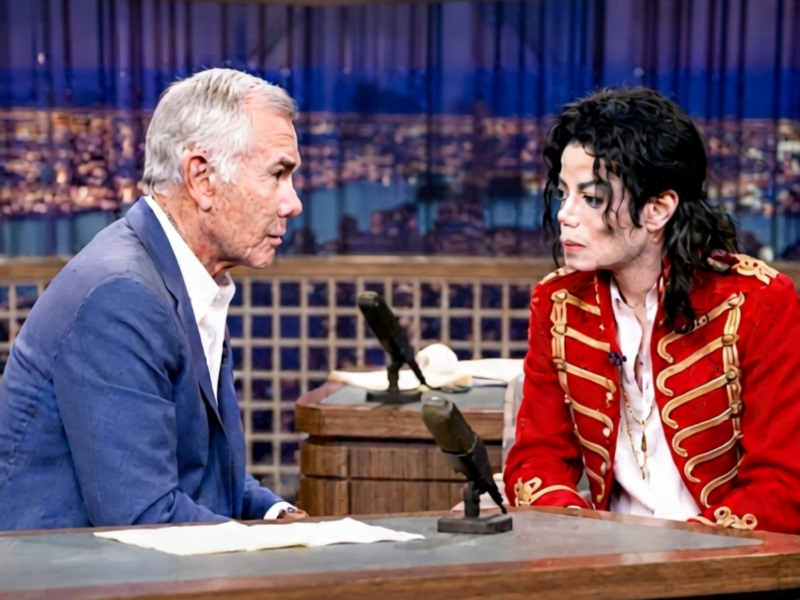
Johnny Carson Asked Michael Jackson One Question… His Answer Left Everyone Speechles.
There is a rumor that just won’t die on internet discussion boards and compilations: that Johnny Carson and Michael Jackson once got into a major disagreement behind the scenes prior to an upcoming interview, and that the fallout was so intense the two men never again agreed to appear opposite one another.
You can find it in the comments section of old Tonight Show videos, in compilations of the untold secrets of Hollywood, and in forum threads that promise the real reason Michael Jackson never appeared on Johnny Carson’s couch.
The problem is that there is no credible documentation of such a confrontation taking place.
And frankly, it’s important to be clear about that before we move on to anything else.
There is no news story, no quoted statement from Carson, no quoted statement from Jackson, no biography, no personal account from anyone associated with either man that confirms a feud between them.
What exists is something even more bizarre than a conflict: an actual, well-documented hole in the historical record.
Because the real enigma here is a genuine one.
Michael Jackson, perhaps the biggest entertainer on earth for nearly two decades, never made a single solo guest appearance on The Tonight Show Starring Johnny Carson.
Not in the Off the Wall period.
Not during Thriller, when he was selling tens of millions of records and reshaping the whole music industry around himself.
Not during Bad.
Not during Dangerous.
Not at any moment throughout Carson’s thirty years behind that desk, for a program that welcomed virtually every major star of the twentieth century at one time or another.
From Frank Sinatra to Bette Davis to a revolving lineup of presidents, astronauts, and cultural phenomena.
The complete absence of a one-on-one Carson-Jackson conversation is striking.
It’s precisely the sort of gap that internet folklore loves to fill with a dramatic, unverifiable tale.
Since a private feud is just a more gratifying explanation than “it simply never happened to work out.”
The rumor tends to circulate in somewhat different forms depending on where you come across it.
Some versions say the argument took place backstage minutes before a scheduled taping, with Jackson supposedly walking out before the cameras started rolling.
Other versions put it years earlier, during some vague encounter connected to the Jackson 5’s rise, with Carson allegedly making a dismissive remark about the group’s youth or Motown’s commercial strategy that Jackson never forgave.
None of these versions point to an actual source.
No interview.
No memoir.
No contemporary news clipping.
And the details tend to change depending on who’s telling it, which is typically one of the surest signs that a story has slipped from rumor into full-blown folklore.
It’s the same pattern that appears around countless other unverified celebrity legends.
A specific dramatic claim with no attributable source, repeated confidently enough, often enough, that the repetition itself begins to feel like evidence.
Before continuing, we want to appreciate everyone who keeps watching and sharing their thoughts with us.
We’ve also picked this comment from our previous video to highlight.
After watching today’s video, do you think the rumor about Johnny Carson and Michael Jackson was believable?
Tell us what you think, and one comment could be featured next time.
Now, let’s continue.
What actually took place, and what is thoroughly documented, makes for a more compelling story regardless.
The Jackson family’s ties to Johnny Carson’s show stretch back to April 1974, when the Jackson 5, with Michael among them, still a boy yet already the group’s clear center of attention, appeared on The Tonight Show for the first time.
For a national audience, they sang “Never Can Say Goodbye” and “Dancing Machine” at a time when the group was shifting away from bubblegum teen idol status toward a more grown-up discoed style.
For a family act that had already topped the pop charts but was still trying to show it could last beyond a few huge early hits, this was a significant booking.
The group had signed with Motown in 1968 and shot to fame almost at once, landing a run of number one singles right from the start.
An unprecedented feat for a new act in that era.
Yet by 1974, the bubblegum sound that had made them famous was beginning to seem dated amid a shifting musical landscape, and the Jackson 5 were actively trying to recast themselves as a more polished act that could outlast their teen years.
Securing a spot on Carson’s show at a time when the group’s commercial momentum had dipped somewhat from its earlier high point was hugely important to that rebranding push.
In the mid-1970s, American entertainment appearing on Carson’s show carried a specific weight.
It was less a talk show appearance than a mark of mainstream acceptance.
The kind of booking that signaled an act had moved from fleeting phenomenon to something more lasting.
That 1974 appearance is the nearest thing to a real, documented Carson-Jackson interaction.
And even it featured the group as a whole rather than Michael on his own.
There is no publicly available account of any backstage friction that night.
No reporting from the time hinting at tension between Carson and any of the Jackson brothers.
And nothing to suggest the appearance sparked any kind of enduring cold war.
If anything, surviving footage and period write-ups portray a warm, energetic performance that went over well with both the studio audience and Carson himself, in keeping with how the show usually handled successful young musical acts booked to perform rather than sit for a long interview.
It’s also worth remembering that most musical guests on Carson’s show during that era were booked mainly to perform a song or two rather than take part in an extended interview, which is part of why so few detailed records survive of what, if anything, was actually exchanged between Carson and any of the Jackson brothers that night beyond the usual introductions.
If anything, it comes across as a fairly ordinary, successful late-night booking for an up-and-coming act, notable chiefly in hindsight because of how huge one of those five brothers would one day become.
The Jackson family’s ties to Carson’s show did not stop there, though.
The next instance arrived from a surprising quarter.
In 1991, near the close of Carson’s run, Joe Jackson, Michael’s father and the family’s notoriously exacting patriarch, showed up as a solo guest on the very same program, appearing alongside actor Michael Landon and boxer George Foreman.
For several reasons, it stands as an odd footnote in the history of The Tonight Show.
Michael Landon, who throughout that episode amiably pushed back at tabloid stories speculating about his health, would die of cancer within two months, turning the episode into a small, sorrowful time capsule when viewed in hindsight.
Joe Jackson’s appearance on the program, meanwhile, meant that a Jackson family member did indeed sit down with Carson for a genuine conversation near the end of Carson’s career.
Just not the one fans most hoped to see.
No widely available detailed record exists of exactly what Joe Jackson talked about during that appearance.
Yet the booking alone confirms something notable.
Carson’s producers plainly held no blanket objection to Jackson family guests, at least by 1991, which weakens the notion of a standing grudge aimed specifically at Michael.
By 1991, Joe Jackson had long acted as the public face of the Jackson family’s business dealings, even though his own relationship with several of his children, Michael among them, had become famously strained and had itself been the focus of extensive, well-documented reporting over the years concerning his demanding, sometimes harsh management style during their childhoods.
His turn on Carson’s couch that year occurred at a time when he was mostly working apart from his children’s individual careers, overseeing various other artists and ventures under the Jackson name.
If there was no confirmed clash, what truly explains Michael Jackson’s complete absence from Johnny Carson’s iconic couch during the era when he was the world’s most renowned entertainer?
Several genuine, commonplace, and well-documented reasons accumulate far more persuasively than any imagined secret dispute ever could.
To begin with, Michael Jackson’s relationship with media appearances became increasingly infrequent and meticulously curated as his stardom skyrocketed throughout the 1980s.
He participated in only a handful of high-profile, carefully orchestrated interviews, most notably his 1993 sit-down with Oprah Winfrey, designed specifically to confront rumors and controversies head-on.
But he mostly shunned the traditional late-night talk show circuit that nearly every major artist of the time used to promote albums and tours.
Such talk show appearances generally demand a certain spontaneous flexibility, a readiness to engage in casual banter, handle unexpected questions, and simply exist in a conversational setting for stretches of several minutes.
According to most accounts from those who collaborated with him, Jackson grew increasingly protective about that kind of unscripted public visibility as his career matured, favoring performance-centric showcases, tightly controlled documentary access, or written declarations rather than live, impromptu interviews.
This cautious approach spanned virtually his entire adult solo career.
Even at the monumental commercial apex of Thriller in 1983 and 1984, when his visage was arguably the most globally recognized, his major media engagements came through intricately produced formats, elaborate music videos presented as short films, a select few choreographed television specials, and meticulously staged award show appearances rather than casual conversational interview segments.
Viewed against how most leading recording artists of that era promoted their work, a consistent rotation through Carson and later hosts like Arsenio Hall and David Letterman, Jackson’s strategy appears even more deliberate in retrospect.
A purposeful choice rather than a simple scheduling accident.
Secondly, timing simply refused to align.
Johnny Carson’s Tonight Show ran until May 1992, while Jackson’s career as a global solo superstar truly exploded beginning with Off the Wall in 1979 and soaring with Thriller in 1982.
This grants roughly a ten-year overlap during which Jackson was at the peak of his commercial power and Carson was still at the helm.
A genuine window, but narrower than most imagine, especially when factoring in Jackson’s increasing selectiveness about any format resembling traditional interviews by that stage of his career.
Carson himself had a reputation for being fairly hands-off when it came to coaxing unwilling guests.
His show thrived on a steady, reliable circulation of performers eager to appear, rather than fervently pursuing every reclusive Hollywood megastar.
Biographers and former staffers who have chronicled the booking process over the years generally describe a system centered on maintaining relationships with publicists and managers who pitched guests actively seeking publicity, rather than a production team aggressively courting famously camera-shy celebrities.
With how tightly Jackson’s own team regulated his public appearances by the 1980s, it is entirely plausible that a booking on The Tonight Show was simply never seriously pursued from either side, with neither party regarding its absence as a statement of any kind.
This commonplace conclusion may be less tantalizing than whispers of a secret feud, but typical conclusions are often where the genuine truth resides.
There is also a more straightforward cultural observation worth noting.
Carson’s interview technique heavily relied on sharp-witted verbal sparring, impeccable comedic timing, and a smooth small-talk style that harmonized exceptionally well with actors, comedians, and musicians who flourished in spirited banter.
In stark contrast, Jackson, according to nearly every testimony from those who worked with him professionally, expressed himself in a notably gentle, measured, and often shy manner that did not naturally align with the brisk pace of late-night talk show dynamics.
This does not imply, however, that an appearance was impossible.
Many soft-spoken guests had unforgettable Carson interviews.
But it stands as one modest, mundane explanation for why a booking might never have materialized, separate from any headline-grabbing disputes.
This in no way suggests that Michael Jackson’s life and career were devoid of genuine, well-documented controversies elsewhere.
Far from it.
It is essential to carefully distinguish the fabricated Carson rumors from the authentic controversies.
Jackson’s later years were overshadowed by grave, widely publicized legal accusations of child abuse, initially in 1993 and again during a criminal trial in 2005, which concluded with his acquittal on all charges.
These legal battles dominated both tabloid and mainstream media for years, permanently altering public perception of him for a significant segment of the audience, and remain among the most rigorously debated and scrutinized episodes in any modern celebrity’s life story.
Separately, his rapidly and dramatically evolving physical appearance throughout the 1980s and 1990s consistently fueled media speculation and at times outright ridicule, with tabloids publishing increasingly sensationalized tales about plastic surgeries, skin disorders, and his private existence at Neverland Ranch.
His controversial 2002 act of briefly dangling his infant son over a Berlin hotel balcony railing, witnessed by crowds of fans and paparazzi, sparked immediate global outrage and widespread disapproval of his parenting judgment.
A moment immortalized on camera and endlessly replayed in subsequent years.
His sudden death in June 2009 due to acute propofol intoxication administered by his personal physician resulted in the doctor’s manslaughter conviction and reopened years of scrutiny regarding the medical arrangements in place during Jackson’s final tour rehearsals.
These are the authentic, sourced, and extensively documented controversies surrounding Michael Jackson’s life.
None involve Johnny Carson in any way, and conflating them with a late-night booking omission diminishes the nuanced and well-recorded complexity of his true history.
Further, his financial status in his final years attracted significant, well-documented attention, with reports highlighting escalating debts linked to Neverland Ranch and other properties.
These financial challenges ultimately influenced his decision to commit to the ambitious This Is It concert residency in London, an engagement he unfortunately did not live to perform.
The rehearsal footage from this final phase, later released as a documentary film posthumously, became a focal point of extensive discussion regarding his physical condition and endurance in the weeks before his death.
None of this late-career financial or physical strain bears any documented relation to Carson, whose show had been off the air for approximately seventeen years by the time Jackson passed away in 2009.
Carson, for his part, harbored his own well-documented off-screen intricacies that occasionally astonished fans who were familiar solely with his genial, laid-back, on-air demeanor.
Renowned for his discretion, he entered into matrimony four times and was recognized among his peers for a certain emotional reticence that sharply contrasted with his effortless charisma in front of the camera.
Earlier in his career, he publicly grappled with alcohol issues, openly discussing these struggles in a notable interview with Mike Wallace, where he explored his intense competitive nature and his craving for control alongside that complex past.
None of this biographical detail intersects significantly with the Jackson family beyond the two recorded encounters already mentioned: the 1974 Jackson 5 guest spot and the 1991 visit from Joe Jackson.
And no credible narrative of Carson’s professional journey, personal life, or television legacy references any tension with Michael Jackson specifically.
Carson’s own retirement in May 1992 was a monumental television event in its own right, captivating an estimated fifty million viewers for his farewell broadcast and solidifying a distinguished thirty-year tenure during which he conducted approximately twenty-two thousand interviews.
This immense scope makes any single unexplained omission, including Jackson’s, statistically nearly inevitable rather than suspicious on its own.
What truly captivates once you discard the gossip is just how extraordinary Jackson’s absence really was.
Carson’s production team had an extraordinary knack for securing nearly every major cultural icon of the era on the show at least once, even the reclusive kinds.
Frank Sinatra, known for meticulously controlling his public image, appeared multiple times.
Even famously private celebrities eventually found themselves on that iconic couch, which renders the complete lack of a solo Michael Jackson appearance notably uncommon rather than typical.
It represents a genuine, striking void in an almost exhaustive chronicle of American celebrity culture passing through a single Burbank studio for three continuous decades.
And it is precisely the kind of anomaly that fuels speculation, because it is so uncharacteristic.
Other famously reclusive stars of the era, from Barbra Streisand to Marlon Brando, made sporadic appearances on Carson’s show despite their guarded public personas, which only heightens the contrast when contrasted with Jackson’s total absence from the format throughout his entire adult solo career.
It remains a truly singular datum in the annals of American television history.
Even after stripping away all the sensationalized rumors that have surrounded it over the years, the likely truthful explanation for why this rumor gained traction and spread so widely is that humans are inherently pattern-hunting, narrative-hungry beings.
When two of the twentieth century’s most iconic entertainers vanish from the spotlight without explanation, it almost demands a riveting story to fill that void.
A mundane, uneventful rationale, changing media landscapes, divergent interview approaches, a shrinking tolerance for unscripted moments, or the routine scheduling pressures of a bustling recording and touring life, does not captivate online audiences nearly as effectively as a tantalizing whispered tale of a dispute no one can quite verify.
Particularly with Jackson, the rumor factory has always functioned on this exact principle throughout his lifetime and well beyond his passing, populating every unexplained absence or mystery with the most sensational narrative available rather than the most plausible one.
This pattern took root long before his death, and if anything, has grown more intense since then.
Documentaries, exposé books, and social media discussions have spent the years following his 2009 death revisiting nearly every unanswered question or ambiguous moment in his life story, frequently filling those voids with conjecture that outstrips the bounds of verified reporting.
An inclination common to the legacies of many major public figures, yet one that has clung to Jackson’s tale with unusual tenacity, given how much of his adult existence was shrouded behind layers of controlled publicity and restricted direct access.
Reflecting on why it is important to resist this tendency is worthwhile.
Michael Jackson’s authentic life is rich with countless documented, impactful, and extensively chronicled episodes that could fill comprehensive retrospectives multiple times over.
A truly revolutionary musical journey.
Groundbreaking music videos that redefined the entire industry’s approach to the medium.
A level of global fame so immense it became its own kind of isolation.
And a legacy that continues to be debated, celebrated, and dissected decades after his death.
The Carson rumor, by contrast, offers none of that substance.
It offers only the comfort of a neat story, a reason why two giants never shared a couch, when the simpler truth is that sometimes giants simply move through the world on different orbits.
No feud required.
No secret argument.
Just two men, two careers, two decades of overlapping fame, and one quiet gap in the record that the internet could never quite leave alone.









