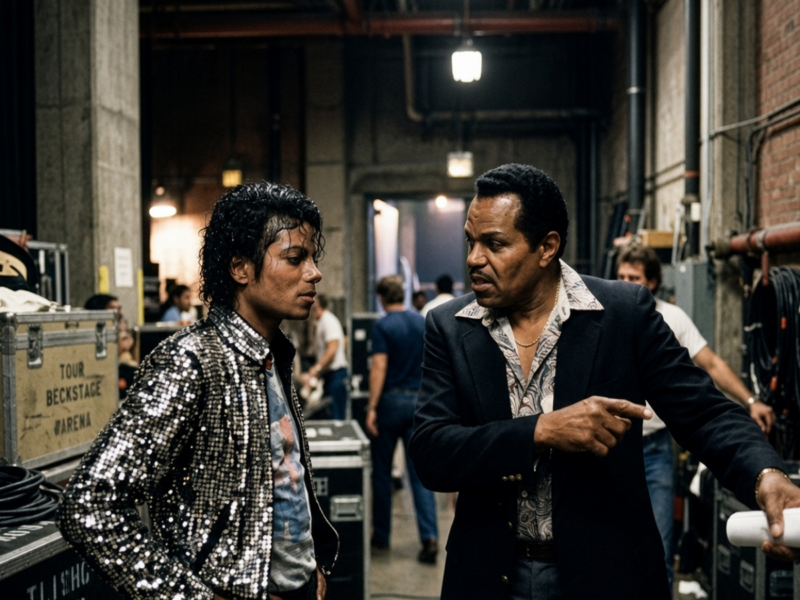
Joe Jackson Confronted Michael Jackson During Thriller — John Landis Stepped In.
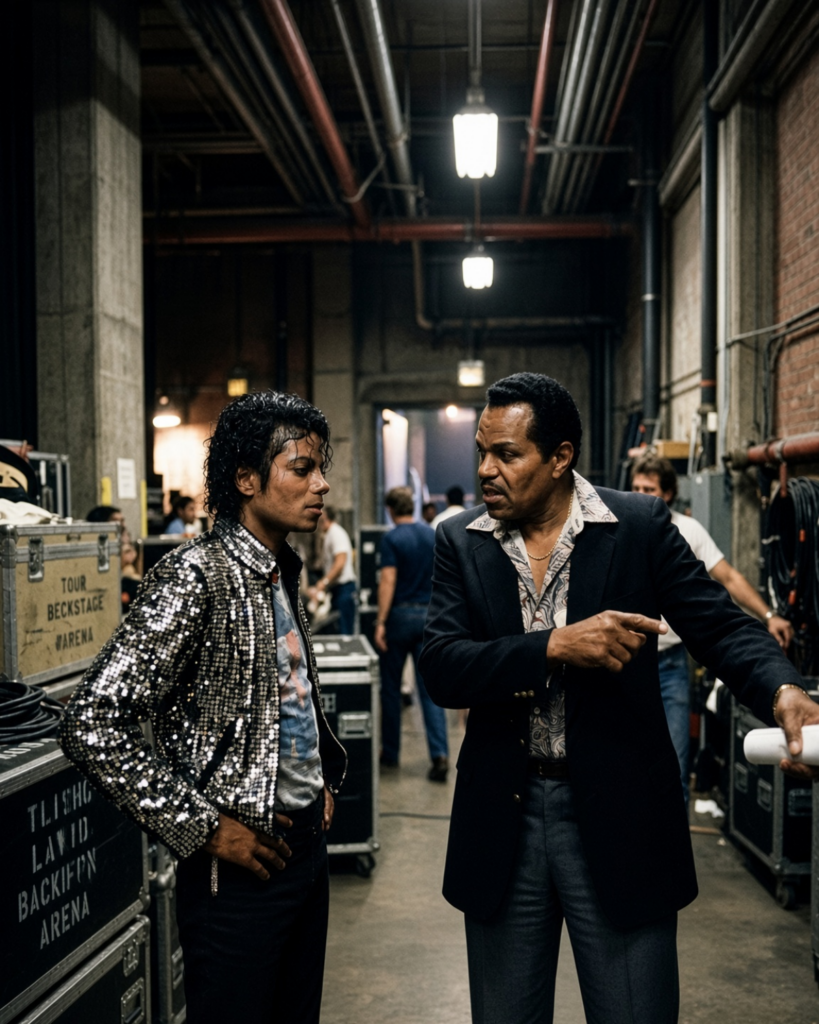
In October 1983, Joe Jackson walked onto the set of “Thriller” to take back control of his son.
But director John Landis stood in front of him and said, “You have no power here today.”
“Thriller” is widely regarded as a watershed moment in pop culture history.
It was more than a music video.
It was a short film that completely transformed the music business, turned MTV into a global powerhouse, and forever elevated Michael Jackson from a hugely successful pop star into an unmatched global phenomenon.
But while millions of fans were captivated by the iconic red leather jacket, the groundbreaking choreography, the eerie Vincent Price voiceover, and the movie-quality zombie makeup, the reality on set was far more intense, stressful, and chaotic than anyone watching at home could have ever imagined.
Behind the lens, Michael Jackson was fighting two battles at once.
He wasn’t just attempting to pull off an extraordinarily ambitious five-hundred-thousand-dollar short film, a budget utterly unheard of for a music video in 1983.
He was also fighting a deeply personal war for his own autonomy, independence, and adulthood.
For his entire life up to that point, Michael had lived under the iron fist and relentless authority of his father and manager, Joseph Jackson.
Joe was the patriarch who had forged the Jackson 5 through ruthless discipline, late-night rehearsals, and uncompromising control.
But Michael was no longer a child singing lead in a Motown group.
He was twenty-five years old.
He had just released the best-selling album in human history, and he was desperately trying to step out from under his father’s suffocating shadow.
When Joe Jackson showed up on the set of “Thriller” unexpectedly, intent on asserting his authority and taking control of the massive production, a high-stakes standoff unfolded in front of the entire cast and crew.
And in that crucial, high-tension moment, it wasn’t a family member or a record executive who stepped up to defend Michael.
It was the film’s director, John Landis.
Landis did something almost nobody in Hollywood or the music industry had dared to do before.
He stood toe-to-toe with Joe Jackson, shut him down, and kicked him off the set.
To truly understand why that confrontation was so explosive, we have to look at the pressure-cooker environment that Michael was navigating in the autumn of 1983.
By late 1983, the “Thriller” album had already been out for nearly a year.
It was released in November 1982, and while it was a colossal smash hit right out of the gate, by the fall of ’83, sales figures were beginning to plateau slightly.
Epic Records felt that the album had reached its absolute peak.
They had already released huge hit singles like “The Girl Is Mine,” “Billie Jean,” and “Beat It.”
Executives at the label saw no reason to invest any more money into promoting an album that had already broken records.
When Michael went to Epic Records executives and told them he wanted to make a mini-movie for the title track “Thriller,” they thought he had completely lost his mind.
The proposed budget was upwards of half a million dollars.
At the time, typical music video budgets ranged anywhere from twenty thousand to fifty thousand dollars.
Spending half a million on a video for a track that wasn’t even currently at the top of the charts seemed like absolute commercial madness to corporate executives.
Epic Records flatly refused to fund the project.
CBS Records boss Walter Yetnikoff famously questioned why they would throw away money on a video when the album was already selling millions of copies.
But Michael was a visionary who refused to take no for an answer.
He didn’t just see a music video.
He saw an event.
He saw a cinematic mini-movie that would captivate the entire world.
Michael had been blown away by the 1981 horror-comedy film “An American Werewolf in London.”
He loved how the director, John Landis, managed to seamlessly blend genuine terror, dark humor, and groundbreaking practical transformation effects created by special makeup artist Rick Baker.
Michael personally called John Landis and asked him if he would be interested in directing a long-form music video for “Thriller.”
Landis was intrigued by the concept, but he warned Michael that making a fourteen-minute theatrical short film was going to be very expensive.
Since the record label refused to finance the project, Michael and John Landis had to get creative.
They came up with an ingenious financing model that revolutionized the home video industry.
They decided to shoot a making-of-“Thriller” documentary alongside the main video production.
Landis and producer George Folsey Jr. arranged a deal where Showtime paid two hundred fifty thousand dollars for the pay-TV rights to the documentary, and MTV paid another two hundred fifty thousand dollars for the exclusive music television broadcast rights.
Between those two deals, the five-hundred-thousand-dollar budget was fully funded without a single dollar coming from Epic Records.
Michael had put his own reputation and creative vision on the line to make it happen.
However, as production prepared to launch in Los Angeles, Michael was carrying immense personal baggage.
His relationship with his father, Joe Jackson, was at an all-time low.
Joe Jackson’s dominance over his children’s lives and careers is legendary.
Growing up in Gary, Indiana, Joe had worked long hours as a crane operator while managing his sons’ musical group with an iron fist.
He demanded absolute perfection.
There were severe consequences for missed dance steps or poor vocal performances.
While Joe’s intense work ethic undeniably propelled the Jackson 5 to international stardom, it also left deep, lasting psychological scars on Michael.
Michael frequently spoke about how terrified he was of his father, recalling how Joe would sit in a chair with a belt in his hand while the boys rehearsed, ready to punish any mistake.
As Michael transitioned into a solo superstar with his 1979 album “Off the Wall” and subsequently “Thriller,” he began taking steps toward personal and professional independence.
He was managed during this transition period by Frank DiLeo and John Branca, legal and management professionals who encouraged Michael to make his own creative and financial decisions.
But Joe Jackson was not a man who surrendered control easily.
He still viewed himself as the patriarch, the manager, and the ultimate decision-maker for the Jackson family empire.
Joe had been pushing hard for a massive Jackson family reunion tour, what would eventually become the 1984 Victory Tour.
Joe wanted Michael to focus entirely on family business, tour contracts, and corporate sponsorships that would benefit the entire Jackson family enterprise.
Joe viewed Michael’s solo side projects, including this bizarrely expensive zombie video with Hollywood film crews, as a distraction from the family’s broader financial interests.
More than that, Joe resented the fact that Michael was surrounding himself with Hollywood executives, film directors, and legal advisers who didn’t report to Joe.
When shooting for “Thriller” commenced in October 1983 across various locations in Los Angeles, including the Palace Theater in downtown LA and the streets of East Los Angeles, the atmosphere on set was electric.
Creative but incredibly tense.
John Landis was a high-energy, fast-talking, direct Hollywood director.
He was not accustomed to dealing with music industry politics, entourage dynamics, or overbearing family members.
Landis treated Michael with respect, but he also treated him like an actor on a film set.
He pushed Michael out of his comfort zone, encouraged him to be funny, teased him, and created a warm, collaborative environment.
For Michael, who was often surrounded by yes-men or intimidated by authority figures, working with Landis was a liberating and fun experience.
Landis treated him like a normal human being, which Michael deeply appreciated.
Then came the day of the confrontation.
It was during the filming of the exterior sequences.
The crew had set up extensive lighting setups, movie cameras, generator trucks, and an army of dancers dressed in elaborate zombie prosthetics created by Rick Baker.
The production was operating like a major feature film set, with strict schedules, union rules, and high costs running by the minute.
Unannounced and uninvited, Joe Jackson arrived on the set.
Joe didn’t come alone.
He arrived with his usual imposing presence, flanked by members of his personal inner circle.
Joe walked onto the set like he owned the place.
He was used to walking onto Jackson 5 video sets, rehearsal studios, and record label offices and immediately taking charge, barking orders, and making demands.
Joe approached Michael and began confronting him right there in front of the cast, crew, and extras.
Joe was upset about how things were being handled.
He began questioning the production, criticizing the management, and trying to assert his authority over Michael’s schedule and decisions.
He wanted to discuss business matters, family arrangements, and financial control.
Michael, who had spent his entire childhood being terrified of his father’s wrath, immediately froze up.
Witnesses on set noted that Michael’s body language completely shifted the moment Joe appeared.
The charismatic, energetic superstar who was leading a massive film production suddenly retreated inward, becoming quiet, anxious, and deeply uncomfortable.
The power dynamic that Joe had established during Michael’s childhood in Gary, Indiana, instantly took hold.
John Landis watched this play out from behind the camera monitors.
Landis was a director who took total control of his film sets.
In the film world, the director is the captain of the ship, and Landis was not about to let anyone, no matter who they were, disrupt his production, intimidate his lead actor, or derail the shoot.
Landis walked directly over to where Joe Jackson was confronting Michael.
Without flinching, Landis stepped right between Joe Jackson and Michael, putting himself physically in the middle of the dynamic.
Landis looked Joe Jackson directly in the eyes and made it crystal clear that his authority ended at the edge of the set.
Landis told Joe Jackson in no uncertain terms that he had no business being on that set, that he was not in charge here, and that he was disrupting a professional movie production.
Landis explicitly informed Joe that on this film set, John Landis was the boss, Michael was the star, and Joe had zero authority or power.
Joe Jackson was stunned.
For decades, very few people had ever dared to speak to Joe Jackson in that tone, let alone challenge his authority over his own son.
Joe was a formidable, intimidating man, and he was accustomed to people backing down when he raised his voice or asserted his presence.
But John Landis didn’t work for Joe Jackson.
He wasn’t part of the music industry machine.
He wasn’t dependent on Joe for access, and he didn’t fear him.
Landis did not back down an inch.
He instructed security and crew members to escort Joe Jackson off the set immediately so that filming could resume.
Joe was furious at being publicly humiliated and ejected from his son’s set.
But given the presence of union film crews, security personnel, and Landis’s uncompromising stance, Joe had no choice but to leave.
For Michael Jackson, that moment was a revelation.
For one of the first times in his life, someone in authority had stepped in, drawn a hard boundary against Joe Jackson, and shielded Michael from his father’s intimidation.
It was a profound moment of validation and protection for Michael.
Landis wasn’t just directing a video.
He was actively creating a safe space where Michael could flourish as an independent artist without the looming shadow of paternal control.
With Joe removed from the set, the tension evaporated and the production resumed with renewed energy.
Michael was able to throw himself fully into the performance of a lifetime.
When you look back at the finished “Thriller” video, knowing what happened behind the scenes adds an entirely new layer of appreciation for what was accomplished.
Michael wasn’t just performing.
He was breaking free.
The “Thriller” short film premiered on MTV on December 2, 1983.
The impact on global culture was immediate and unprecedented.
MTV began broadcasting the fourteen-minute mini-movie up to five times a day to satisfy overwhelming viewer demand.
Ratings soared.
Album sales for “Thriller” exploded back to the top of the charts, eventually pushing total sales past seventy million copies worldwide, a record that still stands today.
The making-of-“Thriller” VHS tape became the best-selling home video cassette in history at the time, proving that fans were just as fascinated by what went on behind the scenes as they were by the final product.
Michael had proven every single record executive, skeptic, and overbearing critic wrong.
He had taken a massive financial and creative risk, funded it through innovative business partnerships, defended his set, and created the definitive masterpiece of the music video era.
The dynamic between Michael, Joe, and John Landis during the making of “Thriller” encapsulates a pivotal turning point in Michael Jackson’s life.
It marked the definitive moment where Michael stopped being a child star managed by his family and fully stepped into his identity as a self-determined, independent global icon.
While Michael’s relationship with his father remained complex and turbulent throughout the rest of his life, the boundary line drawn on the set of “Thriller” in October 1983 was never truly erased.
Michael had tasted creative independence, and he realized that he had the power, the talent, and the standing to make his own decisions.
John Landis’s refusal to let Joe Jackson intimidate his star wasn’t just about preserving a film shoot.
It was an act of protection that allowed Michael Jackson to unleash his full creative genius without fear.
“Thriller” didn’t just change the music industry.
It changed Michael Jackson forever.









