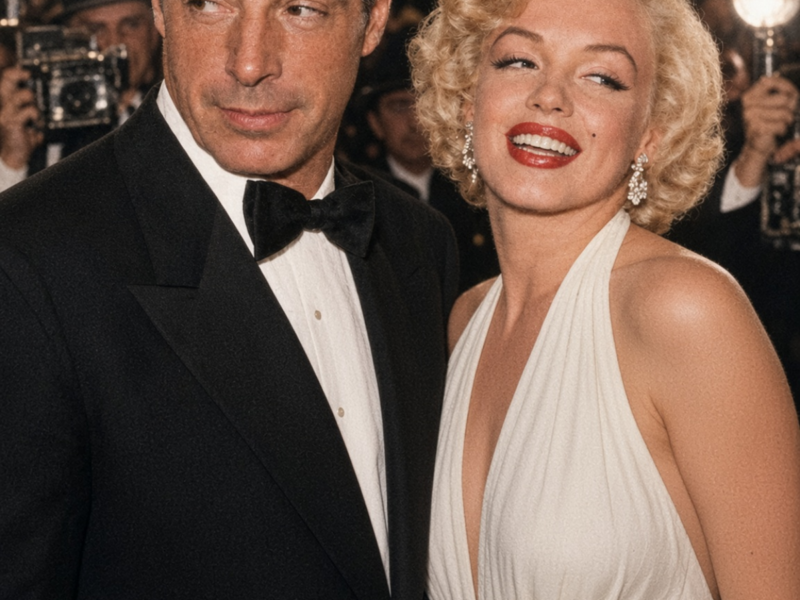
Joe DiMaggio Sent Flowers to Marilyn Monroe’s Grave for 20 Years — He Never Said Why.
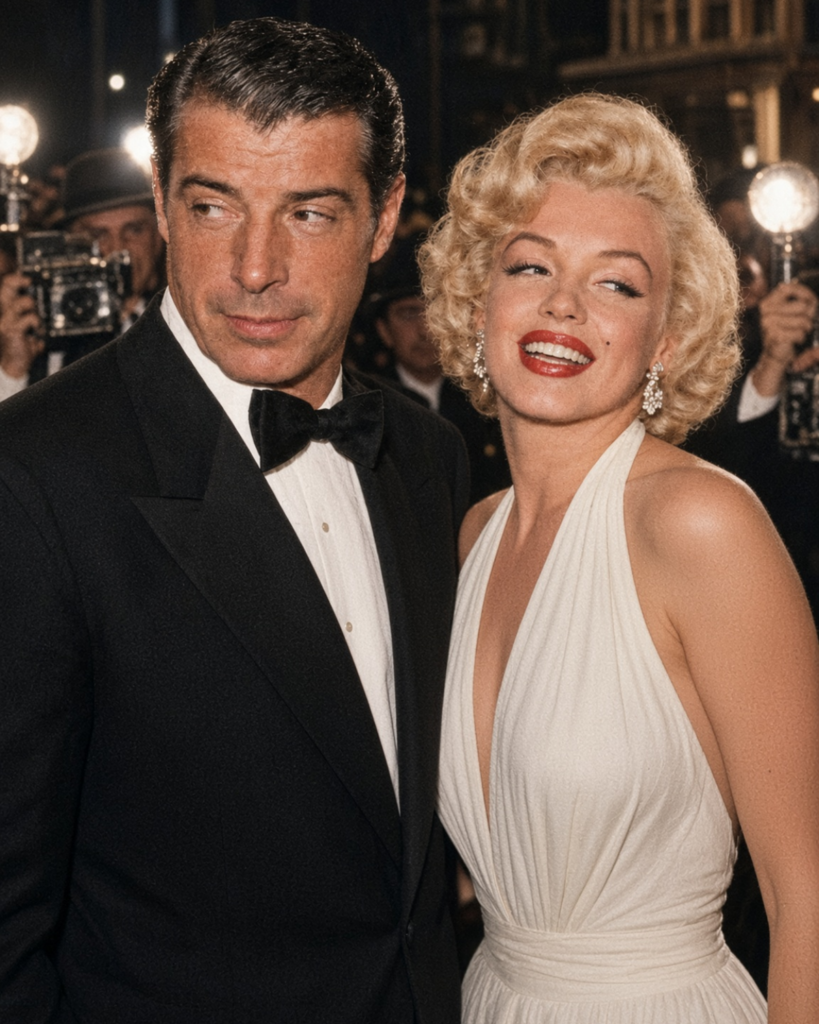
Twice a week for twenty years, fresh roses arrived at a crypt in a small Los Angeles cemetery.
Nobody signed the card.
Nobody from the cemetery staff was ever told who to expect or when.
The deliveries simply kept coming on schedule for two full decades—until the man arranging them died himself in 1999, at which point they stopped and everyone who’d ever wondered about them finally had their answer.
The man was Joe DiMaggio.
The crypt belonged to Marilyn Monroe, his ex-wife of nine months.
Divorced since 1954. Dead since 1962.
He never remarried. He rarely spoke about her publicly for the rest of his life.
And whatever the flowers were actually meant to say, he said it in exactly that way—twice a week, for longer than most marriages last.
By the time he met her, DiMaggio was already one of the most famous men in America, on a completely different axis of fame than hers.
Thirteen seasons with the New York Yankees. Nine World Series championships. Three Most Valuable Player awards.
And a 1941 hitting streak—safely reaching base in fifty-six consecutive games—that remains unbroken more than eighty years later and is still routinely called one of the hardest records in professional sports to ever approach.
Sports writers called him the Yankee Clipper.
A popular song had been written about the streak while it was still happening, turning a baseball statistic into a piece of national culture in real time.
He retired in December of 1951. Inducted into the Hall of Fame in 1955.
Already a legend before Marilyn Monroe ever entered the picture.
Their eventual marriage wasn’t a famous man meeting an unknown woman.
It was two of the most photographed people in the country colliding, each already carrying more fame individually than most public figures manage in an entire lifetime.
To understand what that gesture was actually answering, you have to go back to a marriage that lasted less time than the flowers did afterward.
And that was, by the accounts of people who were there, nowhere near as simple as the ending makes it look.
He came from considerably humbler beginnings than the legend suggests, too.
Born in 1914 in Martinez, California—the eighth of nine children born to Sicilian immigrant parents—DiMaggio grew up the son of a fisherman who considered baseball a frivolous game for bums rather than a path anywhere, and who wanted his sons educated and working rather than chasing a ball around a field.
Three of those sons became major league center fielders anyway.
By the time DiMaggio met Marilyn Monroe, he’d spent two decades converting that same quiet, stubborn discipline into the most decorated career in the sport.
DiMaggio and Monroe met in 1952, set up by a mutual acquaintance for a dinner date neither of them had much reason to expect would go anywhere.
Marilyn’s friend, the Hollywood columnist Sidney Skolsky, had briefed her beforehand on exactly who she’d be meeting.
A genuinely enormous name, Skolsky told her—a man with the kind of public dignity and respect she could use more of herself at that stage of her career.
She arrived at the date two hours late, true to a pattern that would define the rest of her working life.
He was retired from the Yankees by then, one of the most famous athletes in America.
She was rising fast, fresh off supporting roles that had started to make her a name.
By her own account, she’d expected the kind of loud showing-off date most men attempted with her.
DiMaggio was almost entirely silent all evening instead, and the novelty of that apparently worked in his favor.
They married on the 14th of January, 1954, in a quiet ceremony at San Francisco City Hall—a courthouse wedding rather than a church one, since both of them had been divorced before and a Catholic ceremony wasn’t available to either.
The press immediately picked up on the marriage and began covering it obsessively, though the two of them tried where they could to keep their actual daily life quieter than the headlines suggested.
Spending evenings at home together, or tucked into a back corner table at DiMaggio’s own restaurant on Fisherman’s Wharf—a business that carried his name and gave him a rare place in the city where he was simply the owner rather than a spectacle.
It didn’t last.
The trouble started almost immediately, and it started exactly where you’d expect a marriage between a private retired athlete and the most photographed woman in the world to start.
On their honeymoon in Japan, Monroe was asked to break away and travel to Korea to perform for American troops stationed there.
She went.
DiMaggio stayed behind in Japan alone—for a honeymoon that was supposed to belong to both of them.
According to her own hair stylist, Gladys Whitten, Monroe later said DiMaggio threatened to end the marriage right there before it had even properly started over exactly that choice: her career and her audience coming before him.
It didn’t get easier once they were home.
DiMaggio wanted, by every account from the people around them, something close to a traditional private domestic wife—someone who stayed out of the papers rather than in them.
Monroe wanted a husband who took an interest in the career she’d fought hard to build.
She would later describe him, in her own words, as someone consumed by jealousy and possessiveness—uninterested in her work, actively trying to cut her off from her friends and the world of filmmaking she’d spent years working her way into.
This wasn’t a minor personality clash dressed up after the fact.
It was, by her own description at the time, something closer to a slow attempt to make her smaller.
The breaking point came in September of 1954 on a New York City street corner during the filming of Billy Wilder’s The Seven Year Itch.
The scene being shot that night is now one of the most famous images in film history—Monroe standing over a subway grate as a blast of air sends her white dress billowing up around her.
Wilder had deliberately arranged for press and onlookers to be there, understanding exactly what kind of publicity the shot would generate.
By some accounts, as many as 2,000 spectators gathered by the time filming wrapped, cheering every time the dress lifted and the crew reset for another take.
DiMaggio was there, too, watching from the crowd—and by every account of the people around him that night, he was furious.
Not performing anger for effect. Genuinely, visibly disgusted at watching thousands of strangers ogle his wife in public.
What happened immediately afterward is where the record gets harder to look away from.
The couple argued that night, and according to the PBS documentary series American Experience, when they returned to California, the argument escalated again—this time, by that account, into physical violence.
Whatever precisely happened between them in private, Monroe filed for divorce shortly afterward, citing mental cruelty, ending the marriage after nine months.
DiMaggio, for his part, always denied that the subway scene itself was the specific trigger, insisting years later that the real disagreement had been about whether to have children.
Both things can be true at once—a single incendiary night, and a longer argument underneath it that the night simply brought to the surface.
He didn’t let go easily.
In the days after the divorce was announced, DiMaggio wrote her a letter that survives in biographical accounts of the marriage, telling her plainly that he loved her, wanted to be with her, and would do whatever it took to earn back her confidence in him.
It didn’t work. Not right away.
And what he did next made things considerably worse before they got any better.
On the night of the 5th of November, 1954, DiMaggio and Frank Sinatra were having dinner at the Villa Capri restaurant in Hollywood when DiMaggio’s private investigator—a former New York police detective named Barney Ruditsky—arrived with a tip.
Monroe had apparently been spotted with another man, the vocal coach Hal Schaefer, at an apartment building on Waring Avenue in West Hollywood.
DiMaggio and Sinatra left the restaurant immediately and drove there with Ruditsky and another investigator named Phil Irwin.
What happened next has been reconstructed from court testimony, newspaper accounts, and the recollections of the people involved, and the details line up closely enough across all three to trust the shape of it.
At roughly eleven that night, the men broke down the door of an apartment they believed was Monroe’s—using an axe or simply kicking it in, depending on which account you read—sending glass and splinters across the floor.
The apartment belonged to a thirty-year-old secretary named Florence Kotz, asleep alone in bed.
She would later describe waking to a room full of men, lights flashing, uncertain at first whether the object one of them held up toward her was a camera or a weapon.
It was a camera—Irwin’s—brought specifically to photograph whatever they expected to find.
What they found instead was a terrified stranger who had nothing to do with any of it.
Someone shouted that they had the wrong apartment.
The men fled, breaking glasses in the kitchen on their way out.
Monroe, as it turned out, actually had been next door the entire time visiting a friend—though Schaefer himself would later claim she’d in fact been with him, one of several details about that night that different participants have never fully agreed on.
The story stayed out of the papers for almost a year, surfacing publicly in September of 1955 when the gossip magazine Confidential ran an account of it under a headline promising to reveal the real reason behind the Monroe-DiMaggio divorce.
Florence Kotz sued DiMaggio, Sinatra, Ruditsky, and several others involved for $200,000, and the case dragged on for years—eventually settling out of court in 1958 for $7,500, a fraction of what she’d sought, but enough to make the incident permanently, embarrassingly part of the public record for all three men involved.
It became known ever since as the wrong-door raid, and it did lasting damage to DiMaggio’s friendship with Sinatra—a rift the two men would spend years only partially repairing.
And yet somehow, the connection between DiMaggio and Monroe herself never actually ended.
He escorted her to the premiere of The Seven Year Itch in June of 1955—the film built around the exact scene that had blown their marriage apart—standing beside her in public as though the divorce had simply reshuffled the terms of the relationship rather than ending it.
Over the years that followed, he remained one of the steadiest presences in her life, showing up specifically when things got hardest.
In February of 1961, when she was committed to the Payne Whitney Psychiatric Clinic in Manhattan after her divorce from Arthur Miller, it was DiMaggio who intervened to get her released.
He was there again later that same year when she woke up from emergency gallbladder surgery.
By the last year of her life, friends were describing the two of them as closer than they’d been in years.
DiMaggio told people privately that they were planning to remarry.
A former Yankees teammate, Jerry Coleman, later described running into the two of them on Park Avenue not long before her death—DiMaggio’s arm around her, both of them lost in their own conversation, not even noticing him pass by.
One account, resting on a single reported source rather than confirmed documentation, goes further still: that DiMaggio actually proposed again on the 1st of August, 1962, that she accepted, and that a small private remarriage ceremony was being planned at her Brentwood house for the 8th of August.
If that account is accurate, the date they’d chosen for a wedding became instead the date of her funeral.
She died on the 5th of August, 1962.
DiMaggio’s own belief, expressed privately to people close to him afterward, was blunt: that the Kennedys and the Hollywood crowd she’d fallen in with had driven her to it.
Whatever the precise truth of that belief, it shaped everything he did in the days that followed.
DiMaggio took charge of the funeral arrangements personally, and he built the service deliberately into the opposite of the kind of spectacle her life had become.
It was held on the 8th of August at Westwood Village Memorial Park—a small, unglamorous cemetery chosen specifically because it was already the resting place of Grace Goddard and Ana Lower, two women who’d cared for Monroe during her genuinely difficult childhood, long before anyone knew her name.
Marilyn’s own mother, institutionalized at a sanatorium at the time, wasn’t even informed of her daughter’s death, and so wasn’t there either.
DiMaggio kept the guest list deliberately small, and he used it to settle old scores in plain sight.
He barred John and Robert Kennedy outright.
He barred most of the producers, directors, and industry figures he blamed for the version of her life he thought had killed her.
When studio executives pushed him to loosen the list, his answer by multiple accounts was direct: “Tell them if it wasn’t for them, she’d still be here.”
Frank Sinatra’s presence at the funeral is one of the few details in this entire story that different accounts genuinely can’t agree on.
Several retrospective pieces list him among the guests barred at DiMaggio’s insistence, grouped with the Kennedys as men whose closeness to Monroe DiMaggio blamed for her decline.
At least one detailed account of the funeral itself places Sinatra there in person among the small group who actually attended.
Both versions get repeated confidently in different corners of the historical record, and there’s no single definitive primary source settling which one is accurate.
It’s the kind of detail worth holding loosely rather than picking a side on just because one version makes for a cleaner story.
What isn’t in dispute is what DiMaggio did at the casket itself.
Lee Strasberg, her acting coach, delivered the eulogy.
As the service closed, DiMaggio bent down over his ex-wife’s body, kissed her, and said twice, according to contemporary newspaper accounts, “I love you. I love you.”
He was the last person to leave the chapel.
The flowers started not long after that and kept coming for the next twenty years, arriving at her crypt either two or three times a week, depending on which account you trust.
The exact frequency is one of the only details anyone’s ever disagreed about, since the basic fact of the standing order itself is confirmed by multiple biographers and by people who knew DiMaggio personally.
The actor Brad Dexter, a friend of DiMaggio’s, was among those who spoke about it afterward, describing a devotion that never seemed to fade with time the way most grief eventually does.
DiMaggio never gave an interview explaining the arrangement.
He never remarried.
For the rest of his own life, he kept almost everything about his relationship with Monroe out of the public record he’d once been so willing to fight over.
The same instinct, in its way, that had made him furious about a subway grate in 1954 now turned toward protecting the only part of the story he still felt was his to protect.
Time softened some of the harder edges eventually, in ways that complicate the tidy version of this story, too.
A boxing match program from November of 1965 survives with the signatures of DiMaggio, Frank Sinatra, and Dean Martin all on the same page from the same night—suggesting that whatever froze between DiMaggio and Sinatra after the wrong-door raid hadn’t stayed frozen solid for the rest of their lives.
Old friendships and old grudges, it turns out, don’t always resolve as cleanly as a funeral guest list might suggest.
DiMaggio’s own fame, meanwhile, kept finding him in stranger forms as the years went on.
In 1968, Simon and Garfunkel released “Mrs. Robinson,” a song built around one now-famous line asking where Joe DiMaggio had gone—suggesting the country was quietly nostalgic for whatever dignity and quiet excellence he’d once represented.
DiMaggio’s own reaction by most accounts was genuine confusion rather than flattery.
He hadn’t gone anywhere, he pointed out to anyone who’d listen. He was still doing television commercials for a coffee maker and endorsing a savings bank.
And he reportedly considered suing over the lyric before Paul Simon eventually explained in person that the line was never meant literally.
It’s a strange footnote to attach to a man who’d spent years guarding his own privacy as fiercely as he’d once guarded a marriage—famous once again for an absence that wasn’t actually an absence at all.
Joe DiMaggio died in March of 1999 at eighty-four.
According to his own longtime lawyer and close friend Morris Engelberg, who was with him at the end, DiMaggio’s last words were a plain, direct sentence about exactly where his mind still was after thirty-seven years: that he would finally get to see Marilyn.
It’s a claim resting on one man’s account of a private deathbed moment—impossible to independently verify the way a court record or a newspaper photograph can be.
But it’s reported by the person who was actually in the room, not invented by a biographer working from a distance, and it lines up with everything else about how he spent those thirty-seven years.
The flowers stopped arriving at Westwood Village that same year, on schedule, with nothing else.
No announcement. No final delivery marking the end.
Just an absence where a twenty-year pattern had been.
He’d spent the back half of his life protecting the memory of a nine-month marriage that had, by his own wife’s own account at the time, come close to breaking her.
And somehow alongside that, he’d also been the man who showed up at the hospital, who paid for the funeral nobody else was allowed to turn into a circus, who kept a promise nobody made him keep—twice a week for twenty years—without ever once explaining why.









