JFK’s Affair With Marilyn Monroe Was Much Nastier Than You Thought.
The late Marilyn Monroe.
That is how she was introduced at Madison Square Garden in 1962, before fifteen thousand people.
It was a joke about her never being on time.
It played as the sexiest night in American politics.
Now look at what happened around it.
Eleven weeks later, she was dead.
Her studio had fired her. The president’s wife had stayed away.
The only photograph of her with him was taken by the White House photographer and stayed almost unseen for forty-six years.
After she died, men sold stories about her—some of them forged.
It is in coroner’s reports, FBI files, and court records, New York 1962.
So we are going to follow this affair the way the records tell it, in order.
The title says nastier than you thought, and I mean it.
By the end, you will see that the affair was the smallest part of what was done to her.
But before the garden, hold on to that joke about being late.
It comes back, and it stops being funny.
There are two stories people tell about Marilyn Monroe and John F. Kennedy, and you have probably heard both.
The first is a love story. The most famous woman in the world and the most powerful man in it meeting in secret—too famous to ever be together.
The second is a murder story. The Kennedys used her, dropped her, and when she threatened to talk, somebody made sure she never did.
Both stories skip the same thing.
When you go looking for the paper, the affair almost disappears—and what is left is worse, just not in the way you were told.
Start with her, because by 1962 she was already carrying more than anyone in that audience knew.
She was born Norma Jeane Mortenson in Los Angeles in June 1926.
Her mother was committed to a psychiatric hospital. She grew up in foster homes and an orphanage, and she married for the first time at sixteen—partly to avoid being sent back.
By 1962, she had been married three times: to a factory worker named James Dougherty, to the baseball player Joe DiMaggio for nine months in 1954, and to the playwright Arthur Miller, whom she divorced in January 1961.
Weeks after that divorce, she was admitted to a psychiatric clinic in New York and put in a locked ward.
She called Joe DiMaggio, and he got her out.
Keep that name in mind. He is the one man in this story who shows up for her at the end.
Her career looked like a triumph from the outside.
Gentlemen Prefer Blondes. The Seven Year Itch, and the white dress over the subway grate. Some Like It Hot, and a Golden Globe.
But the studio that owned her contract, 20th Century Fox, still paid her like a starlet.
For the film she was making in 1962, she was being paid $100,000.
At the same studio, Elizabeth Taylor had been paid a million to make Cleopatra.
She was the most famous face in the world—and on paper, she was cheap.
And the man she was about to meet had a reputation of his own.
John F. Kennedy married Jacqueline Bouvier in 1953.
By the time he reached the White House in January 1961, the women around him were an open secret among the people who covered him.
The press knew. The Secret Service knew. And as we will see, so did the FBI.
He was also in more pain than the public knew. He had a bad back and a serious illness called Addison’s disease, which the family kept quiet.
Keep his back in mind. It turns up in the strangest place in this story.
The door between his world and hers had a name: Peter Lawford.
Now the brother-in-law, because nothing in this story happens without him.
Peter Lawford was a British-born actor, a member of Frank Sinatra’s Rat Pack, and the husband of the president’s sister, Patricia Kennedy.
Their house on the beach in Santa Monica was the Kennedy family’s base on the West Coast.
When the president came to Los Angeles, he came to the Lawfords. And Marilyn Monroe was a friend of the Lawfords.
Here is the part most versions get wrong.
Books will tell you the two of them met in the ’50s, or at the Democratic Convention in Los Angeles in 1960.
The 1960 story fails the simplest test. She was in New York at the time.
The earlier meetings rest on people repeating other people.
The earliest meeting a biographer dates is a dinner at the Lawford beach house in the autumn of 1961—and even that date is disputed.
That matters, because most of what you have heard about this affair fails in exactly the same way.
Someone said it who heard it from someone who was not in the room.
By the account of her biographer, Donald Spoto, the two of them met perhaps four times in total.
Once at that dinner. Once at a dinner party in New York. Once on a weekend in the desert. And once on a stage in front of fifteen thousand people.
That is not a love affair. That is a schedule.
And there was a third Kennedy in the picture.
On February 1st, 1962, at a Lawford dinner in his honor, she sat with the president’s brother, Robert—the attorney general.
The next day, she wrote about him in a letter to Arthur Miller’s family.
She praised his mind, his sense of humor, and how seriously he took civil rights.
Hold on to that letter. It is one of the only things in her own words about any Kennedy that anyone has ever produced.
And Peter Lawford—the host of all of it—comes back on the last night of her life.
Which brings us to March 1962, and to a weekend in the desert.
The president was flying to California. He was supposed to stay at Frank Sinatra’s house near Palm Springs.
Sinatra had prepared for the visit, by most accounts building a helicopter pad and extra rooms for the president’s party.
Then the plan changed.
The president would stay instead with Bing Crosby—a Republican.
The reason was Robert Kennedy. The attorney general was worried about Sinatra’s friends, some of whom were in the mafia.
By the story later told, when Sinatra heard, he took a sledgehammer to the helicopter pad himself.
Here is the part the love story leaves out.
The day before he flew west—on March 22nd, 1962—J. Edgar Hoover, the director of the FBI, had lunch with the president at the White House.
Hoover knew about another woman.
Her name was Judith Campbell. Sinatra had introduced her to Kennedy in Las Vegas in 1960. She was also involved with Sam Giancana, a boss of the Chicago mafia.
And White House logs would later show seventy calls between her and the president’s office.
Understand what that means.
Two days before the night with Marilyn, the head of the FBI had let the president know that he knew.
The public would not hear the name Judith Campbell until 1975, when a Senate report on the CIA mentioned an unnamed close friend of the president who was also close to the mafia—and the press named her.
And Hoover had a file on Marilyn Monroe, too.
It was not about a president. It was about communism.
In February 1962, she had gone to Mexico. FBI informants reported her friendship there with an American leftist living in exile.
One report to Hoover described her views as “very positively and concisely leftist.”
When the FBI finally released her file—with fewer blacked-out lines—at the turn of 2013, after a request from the Associated Press, it contained nothing about an affair with the president.
It was full of informants and politics. Not one page of romance.
So by the time she drove into the desert, the most powerful policeman in the country was reading about both of them.
On Saturday, March 24th, 1962, Marilyn Monroe was at the Crosby house.
What we know about that night comes, in the end, from one man: her masseur and close friend, Ralph Roberts.
Roberts said she telephoned him from a bedroom to ask him about a muscle, because the man she was with had a bad back.
And then, he said, “The president came on the line himself.”
Sit with that for a second.
The most famous night of the most famous affair in American history, and our best evidence is a phone call about back pain.
Roberts also said this: Marilyn told him that the night was the only time. It was not, in his words, “a major event for either of them.”
And even that is now disputed.
Her publicist, Pat Newcomb, has said she only heard about that night years later. And a poet friend spent the next day with her in Los Angeles—so any visit to the desert was a short one.
So we have one weekend, one witness, and a phone call about a sore back.
That is what the great affair of the century rests on.
Now the question everyone asks: did it go on after that weekend?
Nobody has ever produced a letter between them, a note, a hotel bill, or a single photograph of the two of them alone.
Not one.
But there was one very public night still to come. We will get there.
Now the garden, because this is the night everybody knows.
In the spring of 1962, she was making that film for Fox called Something’s Got to Give.
The studio was in serious trouble. It was losing a fortune on Cleopatra, and it needed this picture finished cheaply and quickly.
She had missed days of shooting—some of them through illness—and now she wanted time off to fly to New York to sing at a Democratic Party fundraiser for the president’s forty-fifth birthday.
The studio sent her a formal notice that she was in breach of her contract.
She went anyway.
That is not a party invitation. That is a career on the line.
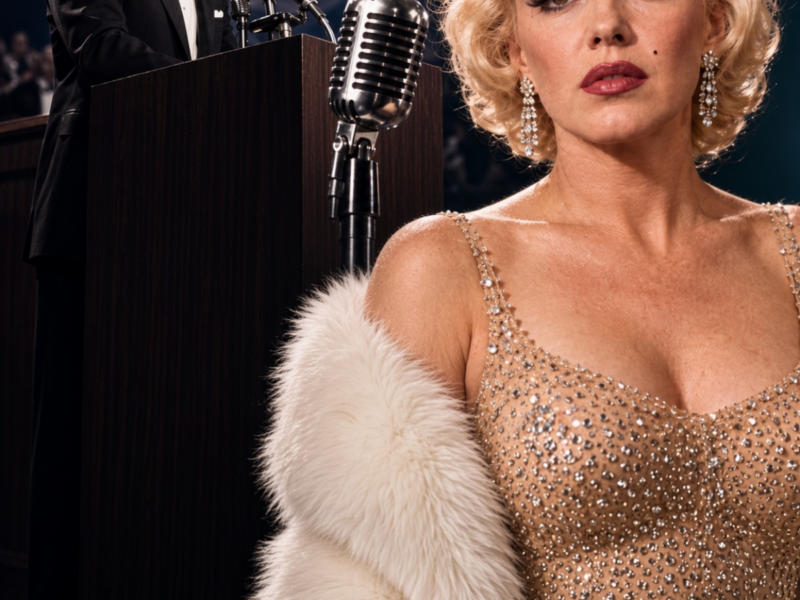
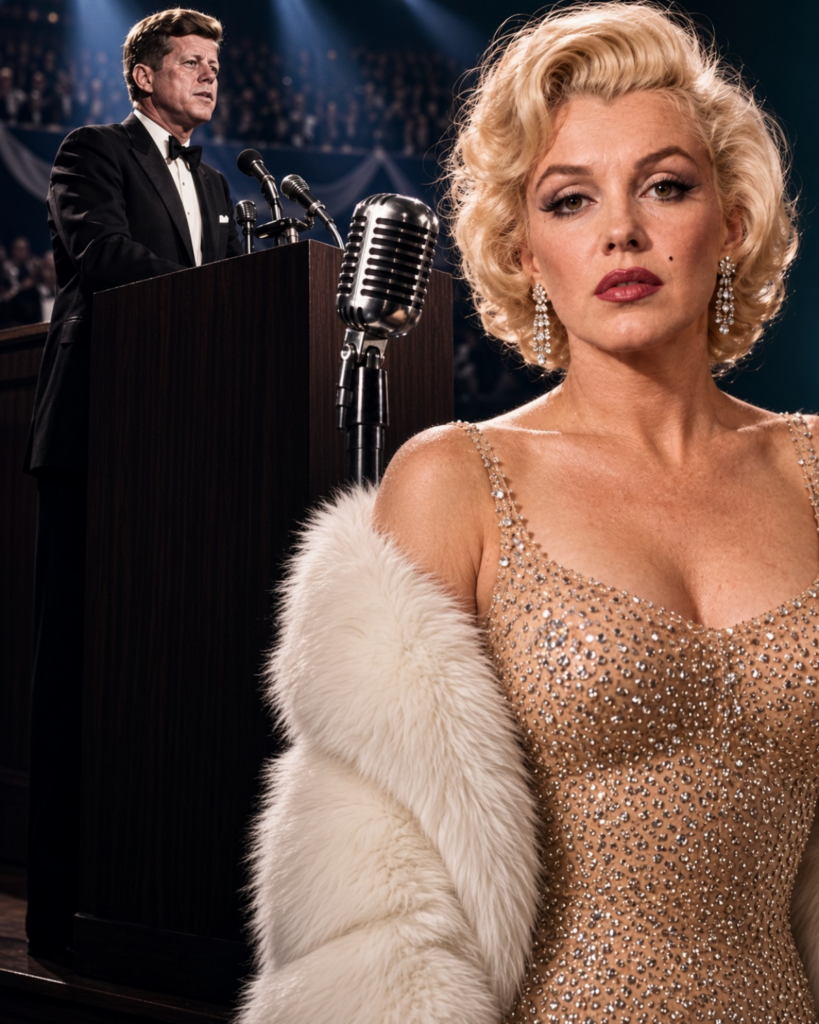
The dress was made by the designer Jean Louis. Flesh-colored, almost transparent, covered in rhinestones.
It fitted so tightly that she had to be sewn into it, and she wore nothing underneath. It cost $1,440.
The sketch for it was drawn by a young designer who would later dress half of Hollywood: Bob Mackie.
On Saturday, May 19th, 1962, at Madison Square Garden, the evening was hosted in part by Peter Lawford.
He had spent the night making a running joke about her lateness.
And when she finally came out, he introduced her as “the late Marilyn Monroe.”
The white fur came off her shoulders, and the audience could see the dress.
Now watch the stage.
She sang “Happy Birthday,” slowly and breathlessly, to the President of the United States. Fifteen thousand people watched.
Then she sang a few new lines to an old tune, “Thanks for the Memory,” thanking the president for his work.
The whole thing lasted a few minutes.
She was not the only star on the bill. The opera singer Maria Callas sang that night, too.
Six years later, Jackie Kennedy would marry the man Callas loved, Aristotle Onassis. Nobody in the garden could have known it.
Then the president came to the microphone.
He said Miss Monroe had left a picture to come all the way east, and he said he could now retire from politics after having had “Happy Birthday” sung to him in such a sweet, wholesome way.
The crowd laughed.
The joke was about her—and she was standing right there.
And here is the part that made it infamous.
Jacqueline Kennedy was not there.
That day, she was at a horse show in Loudoun County, Virginia, with her children.
The first lady stayed in the country. The other woman stood in a spotlight and sang to her husband in front of the national press.
A biography published in 2025, drawing on the memories of friends decades later, has Jackie warning her husband that this woman was different and could be trouble.
Whether she said it or not, she was not in the room.
After the show, there was a private party at the Manhattan townhouse of Arthur Krim, the head of United Artists.
And there the White House photographer, Cecil Stoughton, took a picture.
It shows Marilyn Monroe standing between the president and his brother Robert.
It is the only known photograph of her with John F. Kennedy.
Her guest that night was an old man named Isidore Miller—Arthur Miller’s father. She had brought her former father-in-law to the president’s party.
That photograph was barely seen for forty-six years. It only became widely known after Stoughton died in 2008.
Hold on to that picture. Everything that came after was built on how little of it there really was.
Now the bill, because it arrived almost immediately.
She flew back to Los Angeles and went back to work.
A few days after the garden, she filmed a scene swimming in a pool at night and took off her swimsuit on camera. The photographs went around the world.
It looked like a star trying to prove to her own studio that she could still sell a picture.
On June 1st, 1962—her thirty-sixth birthday—she worked on the film for what turned out to be the last time.
On June 8th, 20th Century Fox fired her.
The studio sued her for half a million dollars. It tried to replace her with the actress Lee Remick.
Her co-star Dean Martin refused to go on without her, and the picture collapsed.
The next year, Fox remade the story with Doris Day under a new title: Move Over, Darling.
A few days later, on June 13th, she sent a telegram to Robert and Ethel Kennedy turning down an invitation to a party.
“Unfortunately,” she wrote, she was “involved in a freedom ride protesting the loss of the minority rights belonging to the few remaining earthbound stars.”
Read that again.
She had just been fired, sued, and replaced—and she turned it into a joke about civil rights for movie stars.
Then there are the phone calls.
Her telephone records survived.
Between June 25th and July 17th, 1962, they show six calls to the switchboard of the Justice Department in Washington. Every one of them lasted between one and five minutes.
That is not a secret line to a lover. That is a switchboard.
On the first of those calls, she spoke to Robert Kennedy’s secretary about a dinner.
And there is a note.
It was written by the president’s sister, Jean Kennedy Smith, and it was sold at auction in 2016.
“Understand that you and Bobby are the new item,” it says. “We all think you should come with him when he comes back east.”
Decades later, Jean Kennedy Smith said the note had been written in jest.
So that is what the Bobby story rests on.
A letter, a telegram, six short calls, and a sister’s joke.
We are coming back to Bobby, because of where he really was on the night that mattered.
And here is the part the family photographs leave out.
That same June, a nineteen-year-old college student named Mimi Beardsley started work as a summer intern in the White House press office.
Fifty years later—as Mimi Alford—she published a memoir. In it, she wrote that she had an affair with the president that began within days of her arrival.
Understand the order of things.
While Marilyn Monroe was being fired—weeks after flying east to sing to him—the president was beginning something with a teenager in his own building.
By the end of July, there were signs that Fox wanted her back. The studio was talking about restarting the picture.
For a moment, it looked as if she had won.
She had days left.
Now the night, because it is where every theory begins.
Early in 1962, she had bought the only house she ever owned—a small Spanish-style house at the end of a cul-de-sac on Fifth Helena Drive in Brentwood.
The tiles at the front door carried a Latin phrase: “Cursum perficio.” My journey ends here.
That is not an omen. That is a coincidence people have been selling ever since.
On Saturday, August 4th, 1962, she spent part of the day with her psychiatrist, Dr. Ralph Greenson.
In the evening, she spoke on the phone with Joe DiMaggio’s son, who said she sounded fine.
Later that evening, Peter Lawford called to invite her to dinner. He said her speech was slurred.
In an interview with the Los Angeles police in 1974, he recalled her last words to him: “Say goodbye to Pat. Say goodbye to Jack. And say goodbye to yourself, because you’re a nice guy.”
Lawford did not go to the house.
His manager, Milt Ebbins, called her lawyer, Mickey Rudin—and Rudin was told by the housekeeper that she was fine.
In the early hours of Sunday, her housekeeper, Eunice Murray, saw a light under her bedroom door and could not get an answer.
Dr. Greenson came, broke in through the window, and found her dead—lying across the bed, by the first accounts, with the telephone still in her hand.
The police were called at about twenty-five past four in the morning.
Now notice the timing.
Investigators later estimated that she had died hours earlier—somewhere between half past eight and half past ten the night before.
That gap between the death and the phone call to the police is where almost every theory about this night lives.
The autopsy found barbiturates and chloral hydrate in her blood, several times the lethal level.
On August 17th, 1962, the Los Angeles coroner ruled it a probable suicide.
She was thirty-six years old.
And where was Robert Kennedy?
He was about three hundred miles away at a ranch near Gilroy, south of San Francisco, with his wife and four of his children.
The family who owned the ranch said he spent the day with them. On Sunday morning, he went to mass in Gilroy.
The FBI’s own records place him there.
The funeral was held on August 8th in Westwood. Joe DiMaggio organized it.
By the reports of the time, he kept the guest list small—and the Kennedys and the Lawfords were not on it.
Think of the name I asked you to keep.
DiMaggio was the one who showed up. And for twenty years afterwards, by the story told, he had roses delivered to her crypt three times a week.
That should have been the end of it.
It was the beginning.
Fifteen months after her death, the president was shot dead in Dallas.
Almost six years after her death, Robert Kennedy was shot in Los Angeles—the city where she died.
And once the men were gone, there were fewer and fewer people left to deny anything.
Which brings us to the part nobody ever put on a poster.
What happened to her name after she could no longer answer for it?
Look at the first story that was sold.
In 1964, a right-wing writer named Frank Capell published a pamphlet called The Strange Death of Marilyn Monroe. It suggested that Robert Kennedy was involved.
The FBI knew about it before it came out.
In a memo dated July 2nd, 1964, the bureau wrote that the allegation had been branded as “utterly false”—and it warned the attorney general personally about the book.
Capell was later indicted in another case for conspiracy to libel a United States senator.
That was the start.
Then came the professionals.
In 1973, the novelist Norman Mailer published a best-selling book about her that floated the idea she might have been murdered.
Later, on national television, he admitted he had needed the money—and put the odds at ten to one that her death was an accidental suicide.
A man named Robert Slatzer claimed he had secretly married her in Mexico in 1952, and that she kept a red diary full of government secrets.
A check she signed in Beverly Hills that very day contradicts the marriage. The diary has never been produced.
A former ambulance driver sold a story about that night to a tabloid for $40,000. A colleague who worked the same ambulance company said it never happened.
In 1985, the British writer Anthony Summers published a book called Goddess, built on hundreds of interviews.
It became a best-seller and the foundation of almost every documentary since.
Even Summers has never claimed he can prove a murder.
Here is the part that sounds invented and is not.
That same year, the housekeeper Eunice Murray told a BBC documentary that Robert Kennedy had visited the house that afternoon.
It contradicted what she had said in 1973 and what she had written in her own book.
When the crew was packing up, with the microphone still running, she was recorded saying this: “Why, at my age, do I still have to cover this thing?”
The line went around the world. And then she told a magazine that once in a while everything becomes confused.
“I am confused,” she said.
And Peter Lawford?
While he was alive, he told the police in 1974 that the books about Marilyn were pure fantasy.
In 1981, he told a biographer the rumors were “pure crap.”
He died on Christmas Eve 1984.
After that, the confessions started.
His widow, an ex-wife, and a writer named C. David Heymann began reporting what Peter had supposedly told them in private.
Peter was no longer there to deny it.
By then, his own life had come apart. After Dallas, the Kennedy family closed its doors to him. Patricia divorced him in 1966. He died at sixty-one, largely forgotten by the family he had once connected to Hollywood.
One of those books has Marilyn telephoning Jackie Kennedy at the White House, and Jackie telling her to go ahead and marry Jack.
There is no record that the call ever took place. The source was a dead man, quoted by a writer.
Compare that with what the officials actually found.
In 1982, the District Attorney of Los Angeles, John Van de Kamp, had the case reviewed.
The report found no credible evidence supporting a murder theory—and he added a line of his own.
He expressed the “faint hope that Marilyn Monroe be permitted to rest in peace.”
Three years later, the Los Angeles police released their own file.
The Chief of Police, Daryl Gates, put it plainly: “She committed suicide by barbiturates. That is the reality.”
But she was not left in peace.
Now the money, because that is where the story went next.
In 1997, one of the most famous investigative reporters in America, Seymour Hersh, was writing a book about John F. Kennedy.
He had been shown a collection of documents—hundreds of pages—including a contract in which Kennedy supposedly paid Marilyn Monroe to stay quiet.
They were forgeries.
Some were typed in fonts that did not exist at the time, and carried zip codes before the post office had introduced them.
ABC News exposed them on September 25th, 1997, and Hersh dropped them from his book.
The man who had sold them, Lawrence Cusack, was convicted of fraud, sentenced to more than nine years in prison, and ordered to pay back $7 million.
Sit with those numbers. Seven million dollars for fake paperwork about a love affair that, by the only witness, happened once.
Look at the dress next.
In October 1999 at Christie’s in New York, the dress she had been sewn into sold for $1,267,000.
In November 2016, it sold again—for $4.8 million—to Ripley’s Believe It or Not. It has been billed as the most expensive dress ever sold at auction.
In May 2022, Kim Kardashian wore it to the Met Gala. She said she lost sixteen pounds in three weeks to fit into it, and she wore it only for the walk up the steps.
The dress cost $1,440 to make. The night it was made for helped cost her the job.
Almost everyone else who touched it afterwards made money.
Even the house.
In 2023, its new owners got a permit to knock it down. The city of Los Angeles stepped in and declared it a historic monument—and in September 2025, a judge upheld the decision.
It is still standing, though the owners are still fighting in court.
And the stories are still being sold.
A hit Netflix documentary in 2022 promised unheard tapes. A novel turned film invented a scene with the president that never appears in any record.
In 2024, a book claimed that a private detective had once recorded the president and Marilyn together. Its authors conceded that the tapes are missing.
Every few years, someone announces a tape that nobody is ever allowed to hear.
Now the fair part, because the Kennedys deserve one here.
There is no evidence that anyone in the Kennedy family killed Marilyn Monroe.
Robert Kennedy was three hundred miles away. The coroner, the district attorney, and the Los Angeles police all concluded she died of an overdose.
The murder stories come from forgers, paid witnesses, and people who changed their accounts.
And there is no proof of a long love affair, either.
By her own friends’ account, it happened once—and it was not a major event for either of them.
If you came here for a murder, the record does not give you one. And I am not going to invent it.
That is the raw material. A beach house. A weekend in the desert, with the FBI already watching. A phone call about a sore back. A song. One photograph. A dismissal. Six short calls. A sister’s joke. An overdose. And sixty years of men selling what happened.
And this is where the whole thing turns.
Go back to that introduction: the late Marilyn Monroe.
On the night, it was a joke about her being late.
Eleven weeks later, it was simply true.
And for sixty years after that, the name kept working for everyone but her.
Now look at who got what each time.
The president got a birthday song and a laugh. His wife got a horse show.
The studio got to sue her for half a million dollars—and then remade her film with someone else.
The brother-in-law got a story he denied for twenty years, until other people told it for him.
The writers got best-sellers. The forger got millions. The auction houses got records.
She got fired.
The nastiest part is not the affair. By the only witness, it was one night.
The nastiest part is that a woman who had been looked at her whole life became, after her death, something men could sell.
And the less there was to the story, the more they invented.
Look at the pattern.
Almost every man in this story either denied her while he was alive, or used her after she was gone.
Except one.
Joe DiMaggio kept her funeral small, kept the Kennedys out, and kept sending roses.
He never remarried, and he never sold a word about her.
When he died in 1999, his lawyer said his last words were: “I’ll finally get to see Marilyn.”
Now go back to the garden.
A woman sewn into a dress. A spotlight. Fifteen thousand people. And the president saying he could now retire from politics.
It is still one of the most famous pieces of film in America.
That is what makes it so easy to misread.
But put it next to the paper.
One photograph, barely seen for forty-six years. A breach notice from her studio. A dismissal. A lawsuit for half a million dollars. A telegram about earthbound stars. Six phone calls, none longer than five minutes. A coroner’s ruling. An FBI memo noting the Bobby story had been branded “utterly false.” And a forger’s prison sentence.
So what was it in the end?
It was not a love story, and it was not a murder.
It was a birthday song that everyone else got paid for—and the late Marilyn Monroe was the only one who paid.









