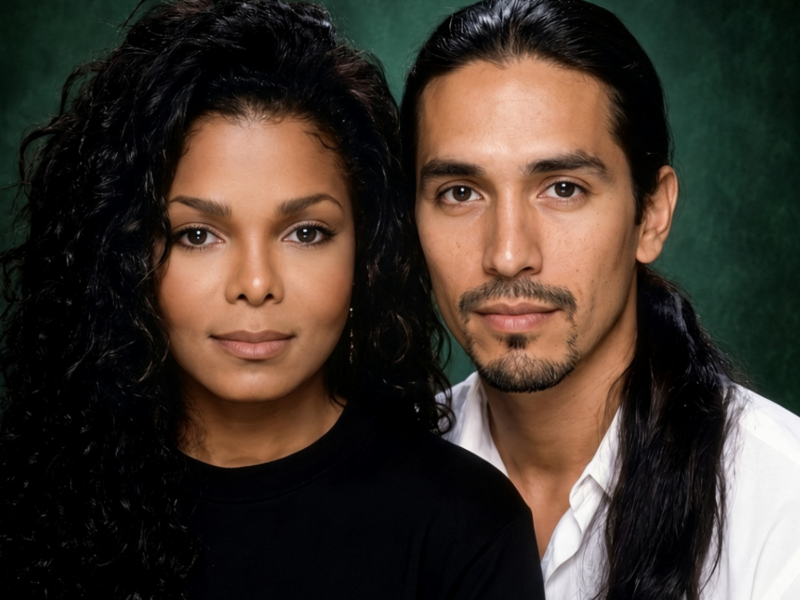
Janet Jackson’s Secret Marriage Was Much Darker Than You Thought.
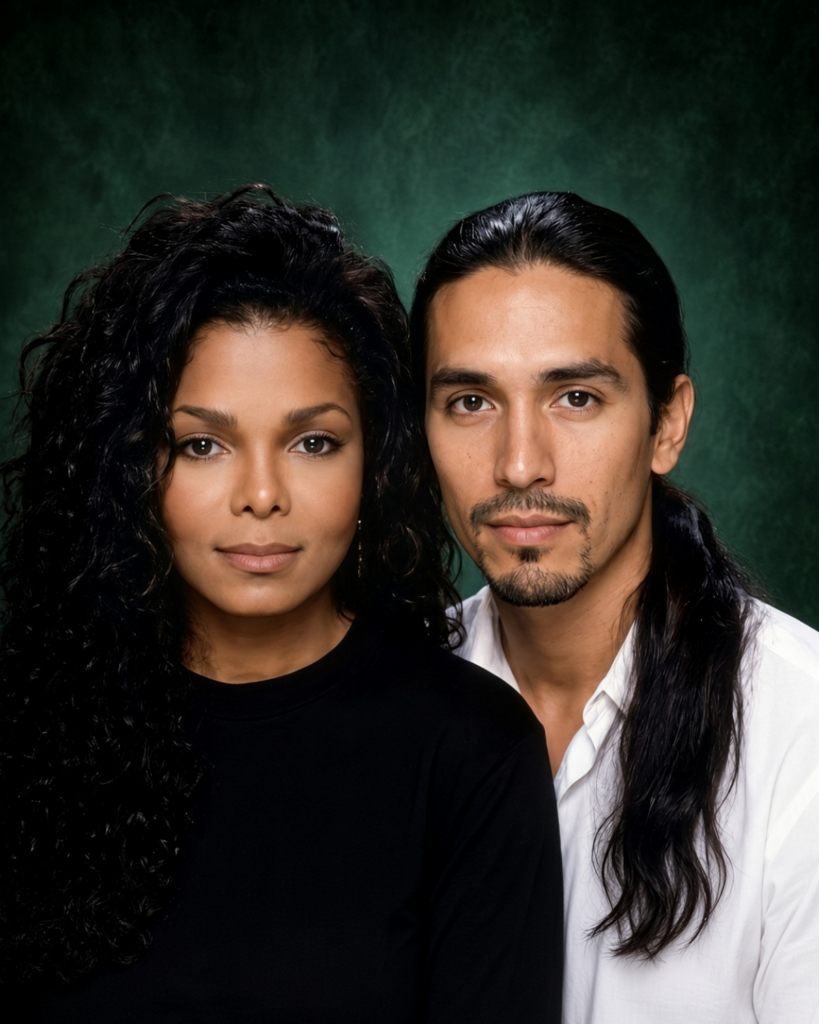
In September of 1993, Rolling Stone put Janet Jackson on its cover.
Jeans unbuttoned, shirt gone, a pair of men’s hands covering her chest.
That fall, half of America wanted to know whose hands they were.
She never said.
Here’s what nobody holding that magazine knew.
Those hands belonged to her husband, and she had been married to him for two and a half years.
It would take a divorce petition in Los Angeles to tell the world, then a $10 million lawsuit, then a court file in which he claimed the secrecy had run both ways and that he was the one who’d been hidden.
It started on the 7th of September 1984 while every other Jackson was out on the road.
You remember the version we were sold.
Janet was the baby.
Born the 16th of May 1966 in Gary, Indiana.
The youngest of nine, raised behind the gates of the family compound in Encino.
She was the little girl doing impressions on the Jackson’s variety show.
She was Penny on Good Times, then Fame, then in February of 1986, the record that made her a star in her own name.
Control, number one on the Billboard album chart with “What Have You Done for Me Lately?” and “Nasty” pouring out of every car radio that summer.
A 20-year-old woman recording in Minneapolis with Jimmy Jam and Terry Lewis telling her family and the whole country that she would be running her own life from now on.
Rhythm Nation in 1989, the album Janet in ’93, The Velvet Rope in ’97.
And through all of it, the magazines told one steady story about her private life, which was that she barely had one.
She was shy.
She was careful.
She worked.
There was a man around, a dancer and video director named René Elizondo, who stood beside her at award shows and directed the video for “That’s the Way Love Goes.”
The press called him her boyfriend, her collaborator.
Maybe more, maybe not.
As far as most of us knew, she was the one Jackson who’d slipped out of the circus.
No feuds on talk shows, no tell-all book, no courtroom.
The girl who took control.
Hold that picture in your mind.
Every piece of it was real.
It just wasn’t the whole thing.
Go back to the late summer of 1984.
Her brothers were out on the Victory Tour and Janet was 18, home in Encino and still living under Joe Jackson’s rules.
Joe managed her career the way he’d managed the boys.
Her first two albums had come out of the family machine, aimed at teenagers, and both sold modestly.
When a record executive named John McClain later told People magazine about taking her career in a new direction, he remembered Joe giving his permission with a warning attached.
“If it didn’t work,” McClain said, Joe would backhand him.
That’s the house she was trying to get out of.
Enjoying the story so far?
Subscribe for more hidden secrets and untold stories.
The way out had a name.
James DeBarge was 21, a singer in DeBarge, the Motown family group that was about to have its biggest hit with “Rhythm of the Night.”
In an interview in 2025, James said the connection ran through his brother Bobby, who’d been dating La Toya, and that he and Janet had talked by phone for years before they really met.
He also said Joe Jackson didn’t like him and didn’t like the relationship, though he was clear that Joe never threatened him.
On the 7th of September, 1984, they eloped.
According to People’s reporting at the time, her brothers were stunned, and so were Katherine and Joe.
Nobody had been asked.
Nobody had been told.
Decades later, in her 2022 documentary on Lifetime and A&E, Janet explained why.
At that age, she said, she couldn’t see any other way to get a life of her own unless she got married.
Think about that for a second.
A girl who’d been on network television since she was 10, with money and fame of her own.
And the only door she could find out of her father’s house was a wedding ring.
And the trouble started that same night.
Back at the hotel after the ceremony, Janet recalled in the documentary, James told her he’d be right back.
She said he didn’t come back for hours.
That was the honeymoon.
The marriage was harder.
The newlyweds didn’t run off to a place of their own.
By most accounts, they lived at the family estate on Havenhurst under the same roof as the father she’d been trying to escape.
And the husband she’d chosen, she said years later, had a drug problem she hadn’t understood when she married him.
Janet’s own words in the documentary are the most painful part of this story.
She described going out at 3:00 and 4:00 in the morning, searching the streets for him.
She described finding his pills and trying to flush them down the toilet and the two of them ending up on the floor fighting over them.
Then she said the line that tells you who she was at 18.
She knew he needed help, she said, but she wasn’t the help that he needed.
The marriage was annulled in 1985.
Now, here’s where the official story splits into three.
In 1986, People magazine gave the credit or the blame to John McClain.
McClain told the magazine he’d spent about eight months working on her to end it because she was a teen idol and the public wouldn’t accept a married one.
Asked to defend that, he said, “I’m trying to make her a star.”
A year later, Janet sat down with Interview magazine and was asked about that exact story.
She said no.
She said she’d known McClain her whole life and that he used to change her diapers.
She said a lot of people thought she’d been selfish for annulling the marriage.
And in 2025, James gave his own version.
He called it the right love at the wrong time.
Two kids on the road, too little time together, and too much interference, he said, from her record company and her father.
The label says it ended the marriage.
The bride says she did.
The groom says everyone else did.
That’s three people describing one year, and not one of them describes the same year.
There’s a fourth version and it never went away.
For decades, rumors claimed Janet had secretly given birth during the marriage and James has said publicly that he believed there was a child.
Janet has always denied it.
In the documentary, she said she could never keep a child away from James and that it wouldn’t be right.
Her Fame co-star Debbie Allen said flatly that nobody on that set ever saw a baby.
Janet’s explanation for the whispers was simple.
She’d started birth control pills and gained weight and the tabloids did the rest.
Here’s what she seems to have taken from all of it.
A marriage you announce stops belonging to you.
It belongs to your father, your label, your brothers, and the checkout line papers.
She’d been 18 when she learned that.
She would not make that mistake twice.
In February of 1986, Control came out, made far from Encino in Minneapolis under McClain’s watch instead of her father’s.
It went to number one, and the girl who’d fought over pills on a bedroom floor became the most talked about woman in pop music.
Somewhere in that same stretch of years, a young dancer from Durango, Mexico, came into her life.
According to the lawsuit he would file much later, their relationship began in 1987.
His name was René Elizondo Jr.
He would be around for the next twelve years in the studio, on the video sets, behind the camera, and at her side.
The public would know him the whole time.
It just wouldn’t know what he was.
On the 31st of March, 1991, Janet Jackson married him.
We know that date from exactly one place, the divorce petition he filed nine years later.
There was no announcement.
There were no photographs released to People or Jet.
Her own sister Rebbie said in the documentary that she was blindsided.
So here’s your dramatic irony.
From this point forward, every time you remember Janet in the ’90s, you’re watching a married woman being described as single.
When she signed with Virgin Records, when the album Janet came out in May of 1993, when she starred opposite Tupac Shakur in Poetic Justice that summer, and her co-star Regina King noticed the chemistry, and later said there was no mistaking that Janet was with René.
When the Rolling Stone cover hit the stands on the 16th of September, shot by Patrick Demarchelier with a man’s hands across her chest that magazines refused to name.
Married.
Married.
Married.
He wasn’t just in the house, he was in the work.
According to Rolling Stone, he co-wrote 37 of her songs over the years with his biggest mark on The Velvet Rope.
He directed “That’s the Way Love Goes,” “Again,” and “Together Again.”
Janet once told an interviewer about shooting the video for “Again” when the male model asked how her boyfriend felt about all the kissing and touching.
She told him her boyfriend was the one directing it, and he kept a camera running off the sets, too.
Much of their private life was recorded on his own cameras, and decades later, that footage became the backbone of her documentary.
Hold on to that detail.
The man who filmed everything is the man who would one day tell the world what the cameras never showed.
Before the wedding though, there had been a piece of paper, a prenuptial agreement.
On her side of the table sat a young woman who, according to court records, was already worth about $10 million.
On his side sat a dancer.
What exactly happened at that table would become years later the most important question in the case.
By the late ’90s, the cracks were showing to the people closest to her.
The Velvet Rope came out in October of 1997, and it was the darkest record she’d ever made, an album she promoted by talking openly about depression and self-worth.
The tour behind it launched in 1998.
Behind the scenes, things between Janet and René were changing.
Her choreographer from those years, Tina Landon, said in the documentary that she watched someone she’d known for a long time start acting differently.
She said it took Janet a long while to confide in her and that what Janet eventually told her was that René had struggled with painkillers before rehearsals began for the Velvet Rope tour.
That is Landon’s account.
René Elizondo has not addressed it in the sources we found and no court ever ruled on it.
Her longtime hair stylist, Wayne Scot Lukas, saw something else in the documentary.
He wondered how a woman who’d built a career on an album called Control could end up in a marriage like that one.
Then Janet said it herself.
“He was always constantly on me about the way I looked,” she said.
She described being told she had to look like her videos whenever she went out, that she couldn’t even go to the movies if she didn’t look like Janet Jackson.
And she said she believed it.
Think about who that was.
The biggest female star in the world on the cover of every magazine being told by her husband that she wasn’t allowed to look like a regular person at a movie theater.
In January of 1999, they separated.
According to Rolling Stone, they had shared a home in San Diego, and she reportedly bought a new place in West Los Angeles.
The two of them had pulled their income for years.
When it ended, by his account, he had no savings of his own.
None of this reached the public.
Not the wedding, not the separation, not the arguments about how she looked.
For more than a year after they split, the world went on calling him her boyfriend.
That was about to stop.
At the end of May 2000, René Elizondo walked into Los Angeles Superior Court and filed for divorce.
The petition was short and devastating in its plainness.
Irreconcilable differences.
Married since the 31st of March 1991.
Separated since January of 1999.
No children.
Janet was 34 with Nutty Professor II about to open that summer.
Overnight, every profile ever written about her single life became a historical document of a different kind.
She answered with a written statement.
She said she had kept the marriage secret to have a normal family life and that her personal life had been lived in public since she was a child.
She hoped her fans would understand.
Her lawyers in Beverly Hills declined to discuss anything at all.
That’s the talk show version of the secret marriage, and it’s the one most of us remember.
A private woman from the most public family in America protecting the one thing she could still keep for herself.
It’s sympathetic.
It may even be true.
But René’s lawyer, Manley Freid, announced something else that same week.
His client was going to challenge the prenuptial agreement, both whether it was valid and what it said.
Freid insisted René wasn’t trying to squeeze her for pennies.
He just wanted what the law allowed.
And in California, the law allows a lot.
Seven months later, he asked for a great deal more than that.
On the last Friday of the year 2000, René Elizondo filed a second case in Los Angeles Superior Court, a lawsuit against his estranged wife seeking $10 million in damages, according to the Associated Press.
Look closely at what he claimed because it’s clever.
The prenup covered the marriage.
So, the suit reached back to before the marriage.
He alleged that Janet had promised to share the profits from Rhythm Nation 1814, the 1989 album that turned her from a star into a phenomenon.
He alleged she’d promised to split everything they’d built together since 1987, the year the relationship began.
Rhythm Nation came out two years before the wedding.
If his story held, the paper they’d signed in 1991 didn’t touch it.
Reports on the full size of his demands varied over the next few years.
Some later accounts put the total as high as $25 million.
The figure the AP reported for that lawsuit was 10.
So now the young woman who had spent her whole adult life keeping her marriage out of the papers was fighting a husband the public had never known existed over money earned from songs the public believed she’d written with somebody else in the room only as a friend.
And still the worst of it hadn’t been put on paper.
In late December of 2001, a superior court judge did what Hollywood lawyers dread and set a trial date.
The divorce of Janet Jackson and René Elizondo was headed for an open courtroom in May.
And in January of 2002, the court file started talking.
According to the records, René claimed that Janet had manipulated him into giving up songwriting credit.
And then came the sentence that flips this entire story on its head.
As quoted from the filing, he said, “Janet told me that my involvement had to be kept secret in order to protect her image.”
Sit with that for a moment.
For nine years, the secret in this marriage was supposed to be the marriage itself.
A star guarding her private life.
But in his court filing, the secrecy went deeper than a wedding ring.
It reached into the music, into the question of whose ideas were on those records, into who got to be seen as the creative force behind the woman who’d sold the world an album called Control.
There was more.
In the same file, he claimed that before the wedding, he had signed the prenup without reading it.
He said Janet and her lawyer had pressured him and that he signed under duress.
And to support that claim, he filed a report from a forensic psychologist arguing that he was the kind of man who could be easily manipulated and unduly influenced.
Read that file cold and you’d think you were reading about a different woman.
Not the shy girl, not the private star.
A powerful, calculating partner who kept her husband out of the credits and out of the light.
Now read Janet’s side again.
The husband who wouldn’t let her go to the movies unless she looked like her videos.
The choreographer’s account of painkillers.
The hair stylist who couldn’t square the singer of Control with the wife he watched.
The man who stood behind the camera and as she told it told her what to do in front of it.
Two people, each one telling the world the other had held the leash.
Nobody outside that marriage knows what was set at the table where the prenup was signed.
Nobody knows who wrote which bar of which song at 3:00 in the morning in the studio.
Here’s what we do know.
Each of them has said on the record that the other was in control.
So, here’s the question I’d put to you.
If you signed a paper you never read for someone you loved, is that their doing or yours?
Hold that thought because the judge never had to answer it.
The trial date came and went without a trial.
The case settled out of public view.
On the 15th of October 2003, papers filed in Los Angeles Superior Court made the divorce final.
More than three years after he’d filed it.
The terms weren’t in those papers.
In the years since, it’s been widely reported that Janet paid him around $10 million plus legal fees, though that number has never appeared in any public court record we could find.
Janet kept her private life private as best she could.
In 2017, at 50, she had her first child, a son named Eissa.
Joe Jackson died the following year.
James DeBarge, as of 2025, was still talking about a film of his own that he promised would settle the old rumors once and for all.
And René Elizondo, much of the footage that let her tell her story in 2022 came from his cameras.
She spent her whole life deciding who got to see her.
The man who saw the most was the one who told the world she was married.









